Coresignal vs Tomba: Which B2B Data Tool Wins in 2026?
Coresignal sells raw company and employee datasets by the million. Tomba finds and verifies the specific email you need. Here is the honest breakdown of pricing, accuracy, and which one actually belongs in your stack.
Coresignal vs Tomba is not a fair fight, because the two tools sell different things. Coresignal sells raw B2B datasets by the million. Tomba finds and verifies the one email address you need. This guide shows which one fits your job, and what each really costs.
TL;DR
- Different categories. Coresignal is a B2B data-as-a-service vendor. It sells bulk company, employee, and job-posting datasets. Tomba is an email finder and verifier. It returns one verified address on demand.
- Coresignal wins when you need millions of records to train a model or power a product.
- Tomba wins when you need working emails for people you can already name.
- The price gap is huge. Tomba starts free (25 searches/mo), then $49/mo. Coresignal is a data contract, often hundreds to thousands per month.
- Most sales teams need Tomba. Buying a raw dataset to send 200 cold emails a week is like buying a quarry to hang one picture frame.
What is Coresignal, exactly?#
Coresignal is a public-web data provider. It scrapes, cleans, and structures professional data at scale: company profiles, employee records, job postings, funding events, technographics. It sells that data through APIs, search filters, and bulk datafeeds. The buyers are data teams, VC/PE analytics platforms, HR-tech vendors, and AI companies.
The pitch is coverage and volume. Hundreds of millions of records, refreshed on a cadence, delivered as JSON or flat files. You are buying a dataset, not an answer. Say you want to know which US SaaS companies with 50–200 employees hired a VP of Sales in the last 90 days. Coresignal is built for that shape of question. Check their official site for current dataset scope — it changes.
Here is what Coresignal is not built for. It will not hand your SDR the email address of Sarah Chen, Head of RevOps at a company they just found on LinkedIn. Contact-level email data is not the core promise, and email verification is not the product.
What is Tomba, and where does it fit?#
Tomba solves the last mile. You have a name and a company. You need a deliverable email address. Tomba's email finder resolves the pattern and finds the address. Then it runs SMTP-level verification and returns the result with a confidence score and sources.
Around that core sit the tools that make the address usable. An email verifier for lists you already own. Domain search for every published address at a company. Catch-all handling, phone finder, and data enrichment to fill in title, seniority, and company fields. It all runs through the UI, a Chrome extension, Sheets/Excel add-ons, and the Tomba API.
The mental model is simple. Coresignal sells you the map of the whole territory. Tomba gives you the front door key for the one house you are visiting today.

Coresignal vs Tomba: how do they compare head-to-head?#
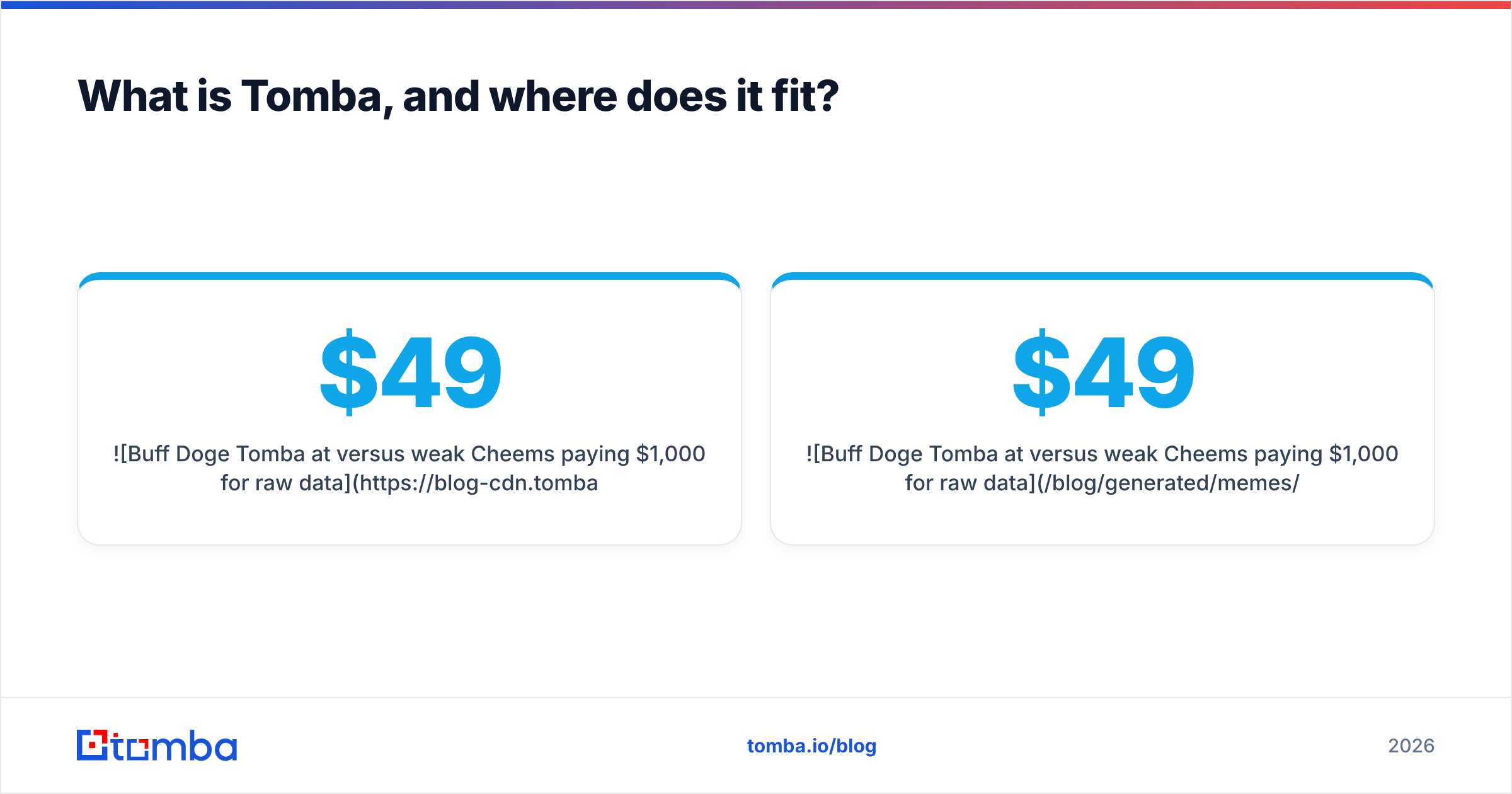
| Dimension | Coresignal | Tomba |
|---|---|---|
| Primary product | Bulk B2B datasets (company, employee, jobs) | Email finder + verifier + enrichment |
| Core unit sold | Records / datafeeds / API credits | Searches and verifications |
| Entry price | Enterprise-leaning contracts; self-service API plans typically start in the low-to-mid hundreds per month | Free tier (25 searches/mo), then $49/mo Starter |
| Mid tier | Scales with record volume and dataset count | $99/mo Growth, $249/mo Pro |
| Free option | Sample data / trial access on request | Yes — 25 searches/mo, no card |
| Email addresses | Not the core deliverable; contact-level email coverage is limited | Core deliverable, SMTP-verified with confidence score |
| Email verification | Not a product | Yes — real-time + bulk, catch-all detection |
| Phone numbers | Limited / not the focus | Yes — phone finder + validator |
| Setup effort | Data engineer required (ingest, dedupe, schema, storage) | Minutes — UI, Chrome extension, Sheets, or API |
| Ideal buyer | Data/ML teams, analytics platforms, HR-tech, VC/PE | SDRs, founders, agencies, recruiters, RevOps |
| Refresh model | Scheduled dataset refreshes | Real-time lookup at query time |
| Best at | Coverage, breadth, historical depth | Precision on a named person, deliverability |
Two honest reads of that table:
- If you checked "data/ML team" and you need raw breadth, Tomba is not your tool. No pricing advantage changes that.
- If you checked "SDR / founder / agency," Coresignal is far over-specified for the job. You will pay for power you never touch.
Is Coresignal accurate enough to email people directly?#
This is where the comparison gets decided.
Coresignal's data is structured, and structured is not the same as deliverable. A record can be perfectly correct about someone's employer and title. It can still give you nothing to put in the "To:" field.
Some datasets do carry email fields. But they share the flaw of all bulk data. They were true when the crawl ran, not when you hit send.
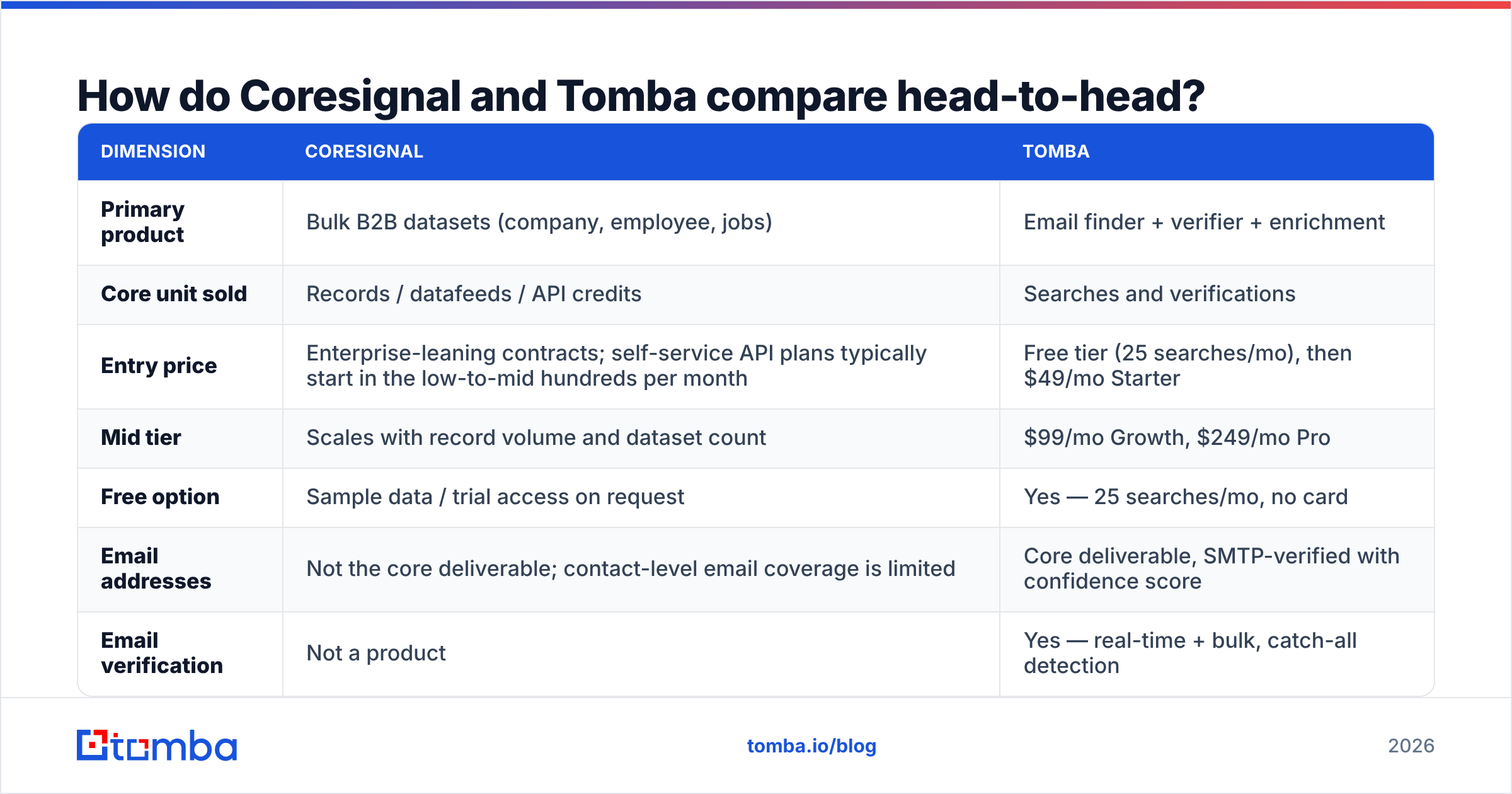
B2B contact data decays fast. Industry estimates put annual decay at 22–30%. People change jobs. Companies rebrand. Mailboxes get retired. So a dataset refreshed each quarter always ships some stale addresses. That is not a knock on Coresignal. It is the physics of bulk data.
Email finders work from the other end. They resolve the address at query time. Then they check it against the mail server right now. That is why verified-at-query-time tools post lower bounce rates than dataset extracts.

The practical rule: never send to an unverified address, whatever your data source. If you do buy or build a dataset, run it through a bulk verifier before it touches your sequencer. A 3% bounce rate is survivable. A 12% bounce rate torches your sender reputation and takes months to rebuild.
Coresignal vs Tomba: what does each one actually cost?#
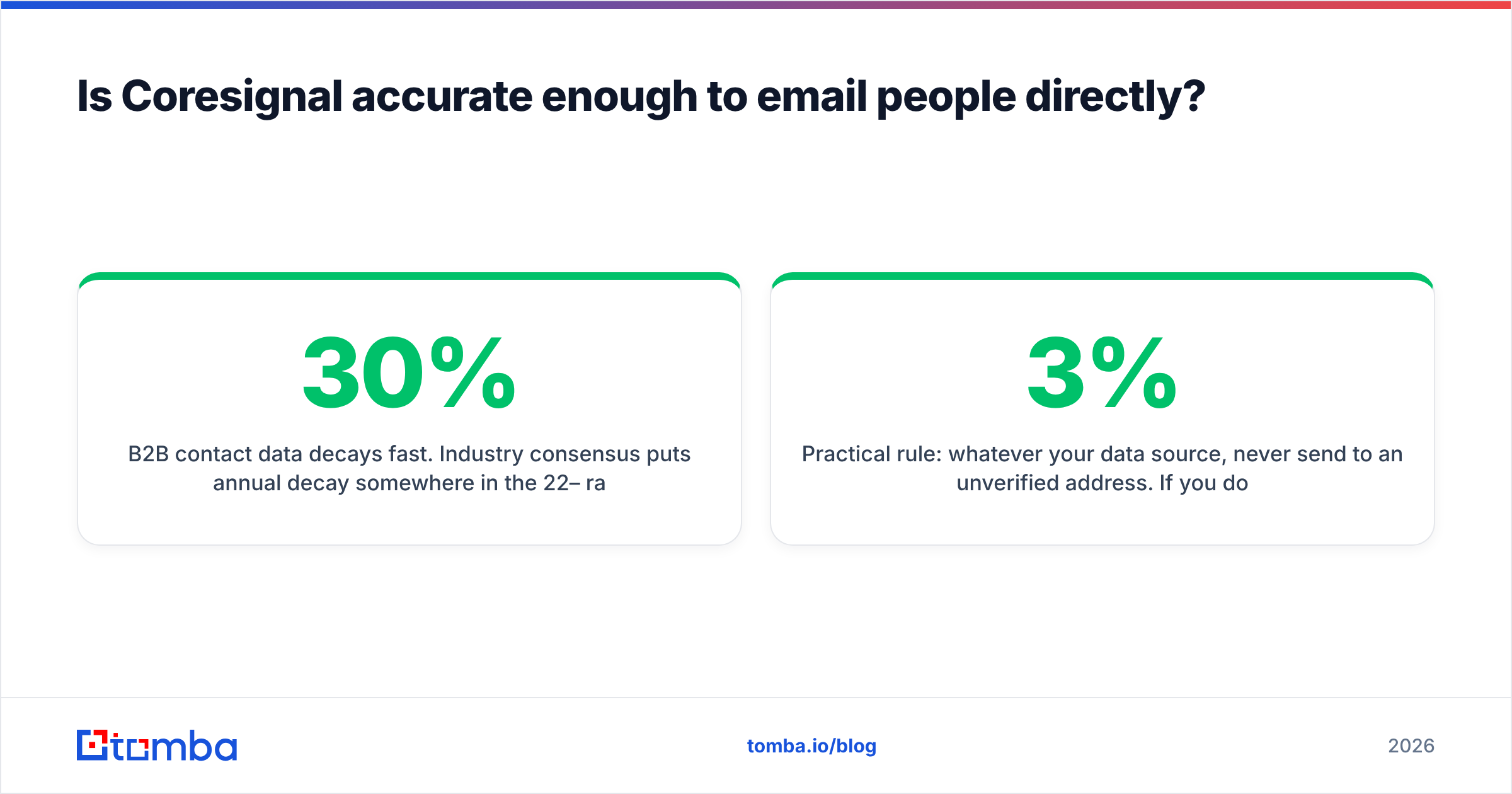
Tomba's pricing is public and flat:
- Free — 25 searches/mo, no credit card
- Starter — $49/mo
- Growth — $99/mo
- Pro — $249/mo
- Enterprise — custom
Full breakdown on the Tomba pricing page.
Coresignal prices like a data vendor, because it is one. Self-service API access exists at the lower end. But the model is built around record volume, dataset choice, and refresh frequency. Serious usage lands you in an annual contract conversation. Buyers often report four- and five-figure annual spend once several datasets and refresh cadences stack up. Confirm current numbers directly. Data vendors reprice more often than SaaS tools do.
The distortion this creates is predictable. A five-person sales team shops for a dataset vendor because "we need better data." They sign a contract sized for a data platform. Then they use maybe 0.3% of the records they paid for. And they still have no verified email addresses for the 400 people they wanted to reach.

Which one should you choose? A 5-question decision list#
Run through these honestly. The answer usually falls out after question two.
- Do you need records, or one person's email? Building a searchable universe of companies is a dataset problem (Coresignal). Building a list of 300 named prospects is a lookup problem (Tomba).
- Do you have a data engineer? Bulk datafeeds arrive as raw files. Someone must ingest, normalize, dedupe, store, and refresh them. If nobody owns that, the contract becomes shelfware in a quarter.
- Is deliverability your bottleneck? If your bounce rate is above 5%, more data will not fix it. Verification will. Start with an email verifier, not a bigger dataset.
- Is the output a product, or a campaign? A customer-facing feature or an ML model justifies dataset economics. Next month's outbound sprint does not.
- What is your real monthly contact volume? Under ~10,000 lookups a month, a per-search tool is far cheaper. Above ~1M records touched, dataset economics start to win.
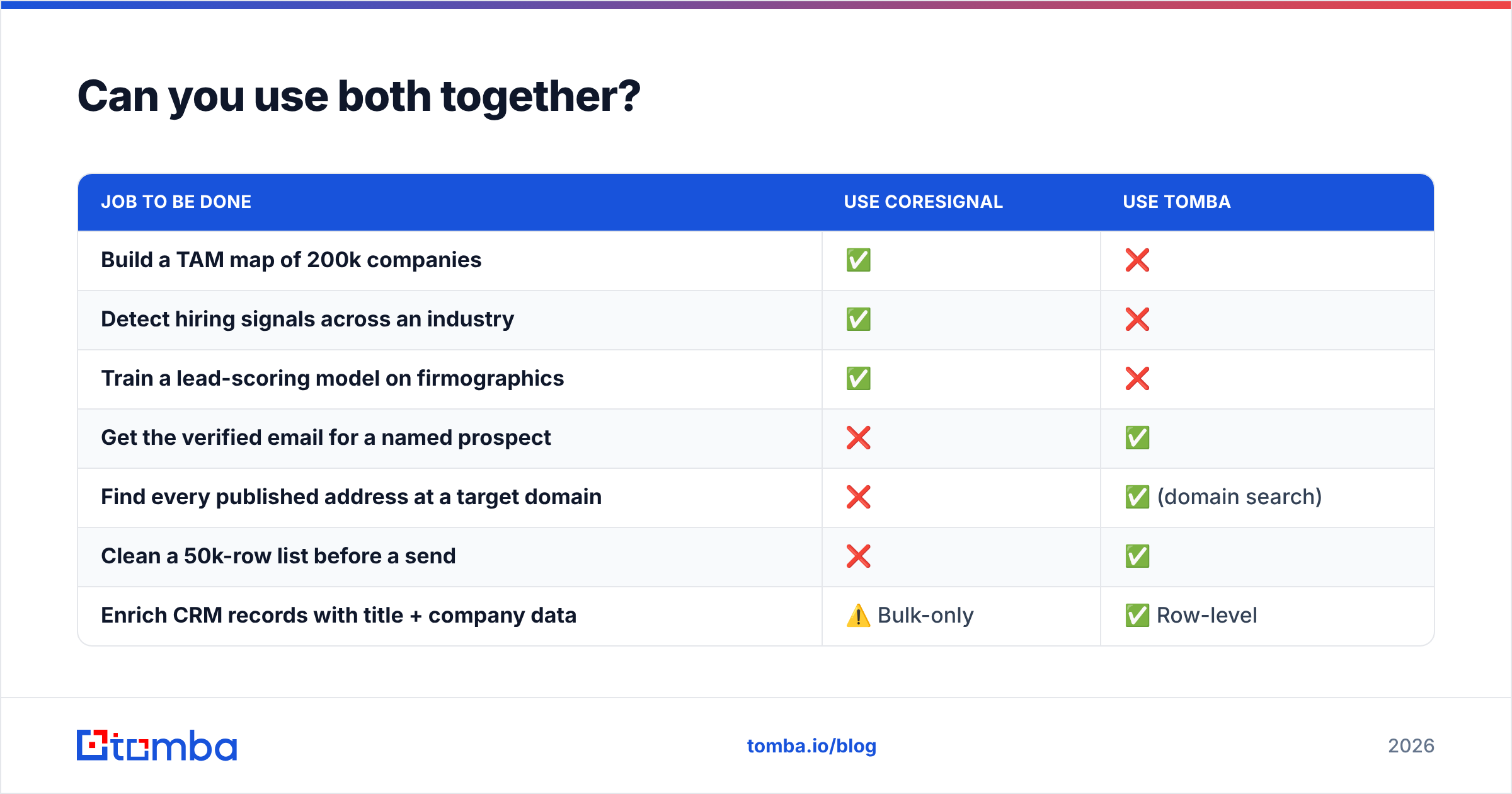
Can you use both together?#
Yes. For a certain profile of company, that is the correct answer.
The clean division of labor looks like this:
| Job to be done | Use Coresignal | Use Tomba |
|---|---|---|
| Build a TAM map of 200k companies | ✅ | ❌ |
| Detect hiring signals across an industry | ✅ | ❌ |
| Train a lead-scoring model on firmographics | ✅ | ❌ |
| Get the verified email for a named prospect | ❌ | ✅ |
| Find every published address at a target domain | ❌ | ✅ (domain search) |
| Clean a 50k-row list before a send | ❌ | ✅ |
| Enrich CRM records with title + company data | ⚠️ Bulk-only | ✅ Row-level |
A data-mature GTM org can run Coresignal for the account layer and an email finder for the contact layer, with both wired into the CRM. That is a legitimate architecture. It just needs a team that can maintain it.
What does not work is buying a dataset instead of an email finder. You end up hoping the addresses inside are good enough. They usually are not, and your bounce rate tells you so.

What are the other options worth knowing about?#
Neither tool exists in a vacuum. Depending on the job, three other kinds of vendor are worth a look:
- Sales-intelligence platforms (Apollo, ZoomInfo, RocketReach) bundle a contact database with a sequencer. That is convenient. But you are renting a static database, and you pay for the sequencer either way. If that is your stack today, an Apollo alternative comparison is the natural next read.
- Verified-list providers like BookYourData fit when you want a clean, pre-verified list you can buy outright and load into a campaign. No engineering, no per-search metering, and accuracy guarantees attached. If your motion is "give me 5,000 good contacts in this ICP, today," that is a genuinely good path.
- Pure verification tools (ZeroBounce, NeverBounce) do one job well. Useful when your data source is settled and only hygiene is missing.
You can read more on how contact data is sourced and scored — including where Tomba gets its data. Cross-check any vendor's real-world reputation on G2 before you commit. For background on the dataset-vendor model itself, data-as-a-service is a useful primer.
Coresignal vs Tomba: so who wins?#
It depends on what you are building. But for 90% of the people searching this comparison, it is Tomba.
Choose Coresignal if you are a data or product team that needs breadth. Millions of structured company and employee records, refreshed on a schedule, feeding a model, a dashboard, or a customer-facing feature. You have engineers. You have a budget line for data. You measure in records, not replies.
Choose Tomba if you are a sales, marketing, recruiting, or founder-led team that needs specific verified contacts today. You measure in replies. You want a $49/mo line item, not a procurement cycle. You want the address to work when you press send.
The mistake to avoid is buying dataset infrastructure to solve a lookup problem. It is the most expensive way to end up with an unverified email address.
Ready to skip the data-engineering detour? Start with the Tomba Email Finder. Your first 25 searches are free, and no card is required. Paste a name and a domain, and get a verified, source-cited email address in seconds. Scale it later through the API, the Chrome extension, or Google Sheets. If your bounce rate is the thing keeping you up at night, that is the fix.
Related guides#
Ready to find emails that actually work?
Join 150,000+ professionals who stopped guessing and started sending. Free credits on signup — no credit card required.
Get the Tomba newsletter
Practical outbound tactics and product updates — once every two weeks.
About the author