Coresignal vs Wiza: Which B2B Data Tool Wins in 2026?
Coresignal sells raw firmographic and employee datasets by the million. Wiza pulls verified emails out of LinkedIn lists. They barely compete — and picking wrong costs you months. Here's the honest breakdown.
TL;DR#
- Coresignal is a data provider, not a prospecting tool. It sells bulk firmographic, employee, and job-posting datasets via API or S3 delivery — you get JSON, not a contact list you can email tomorrow.
- Wiza is a LinkedIn-first contact extractor. Point it at a Sales Navigator search, get back names, verified emails, and phone numbers in CSV. It stops there.
- They rarely compete for the same buyer. Coresignal wins when you're building a product or a data warehouse. Wiza wins when an SDR needs 500 emails before Friday.
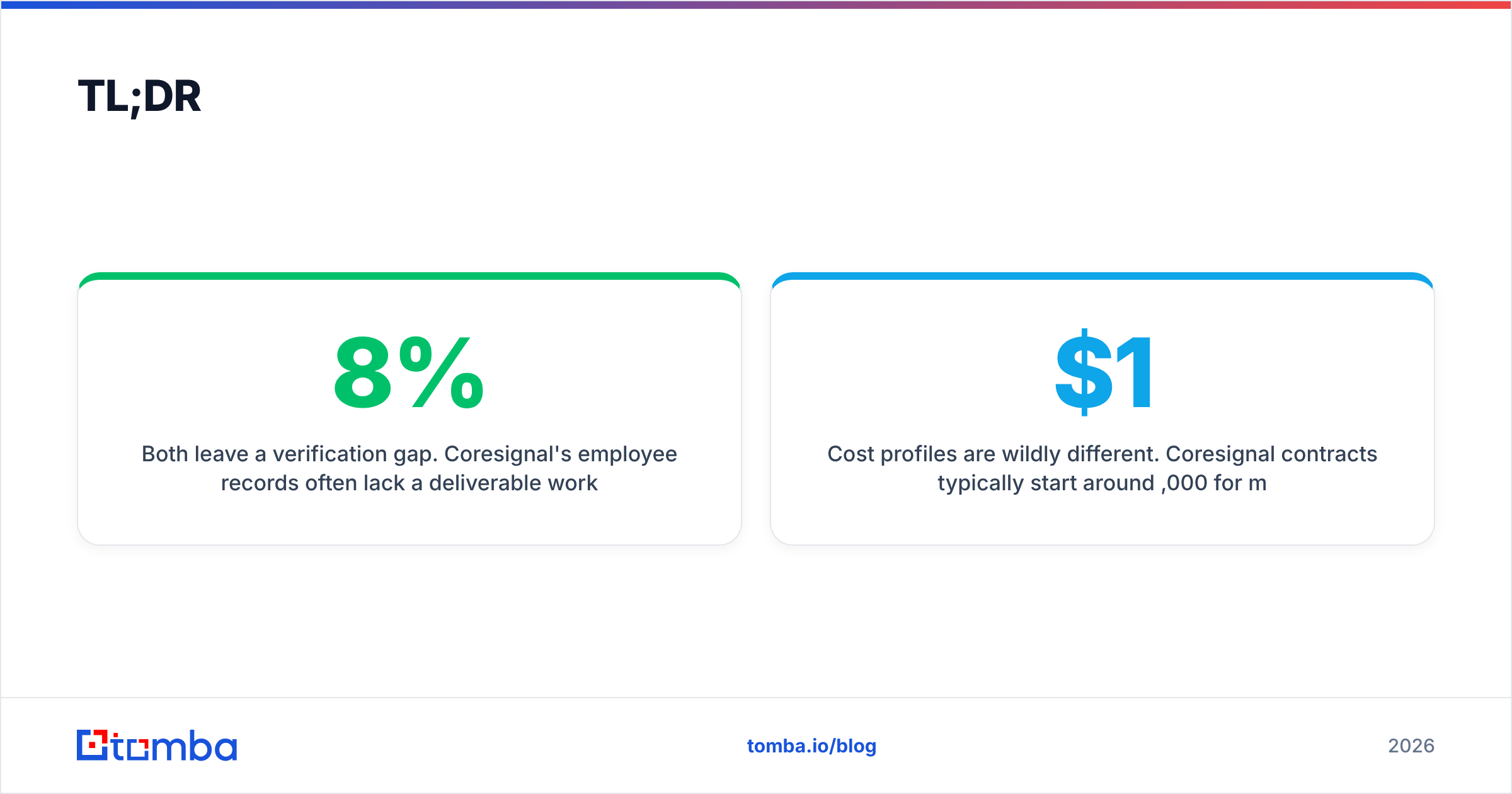
- Both leave a verification gap. Coresignal's employee records often lack a deliverable work email; Wiza's exports still bounce at 3–8% in the wild.
- Cost profiles are wildly different. Coresignal contracts typically start around $1,000/mo for meaningful volume; Wiza starts at roughly $83/mo (annual) for 100 credits.
What is Coresignal and who actually buys it?#
Coresignal is a B2B data-as-a-service company. It scrapes and structures public web data — company profiles, employee records, job postings, technology signals, funding events — and sells it as a feed. You consume it through a REST API, bulk file delivery, or a datasets subscription.
The buyer is almost never an SDR. It's an engineer at a HR-tech startup building a talent-intelligence product, a quant fund modeling headcount growth as a hiring signal, or a RevOps team stuffing a warehouse to power lead scoring. Check Coresignal's own site and the language gives it away: "datasets," "records," "delivery."
What you get is coverage and depth. What you do not get is a workflow. There's no "find this person's email" button, no Chrome extension, no campaign sync. Coresignal hands you raw material.
The critical gotcha: employee records frequently ship without a verified work email. Coresignal's professional profiles are built from public web sources, and email is the field most likely to be missing or inferred. If your plan is "buy Coresignal, blast a sequence," you will discover this on day three.
What is Wiza and where does its data come from?#
Wiza is the opposite shape: a thin, fast layer on top of LinkedIn. You run a Sales Navigator search, hit the Wiza extension, and it pulls the list — then enriches each row with an email address and, on paid tiers, a mobile number.
The workflow is the product. Wiza is genuinely good at it. Export a 2,500-person Sales Nav list, get a CSV with real names and real inboxes in under an hour. For a two-person outbound team, that's a Tuesday afternoon solved.
The constraint is equally clear: Wiza's universe is LinkedIn's universe. If your ICP doesn't maintain LinkedIn profiles — regional manufacturers, family-run distributors, most of the SMB long tail outside North America — Wiza has nothing to give you. It also can't answer questions like "which companies hired three AWS engineers last quarter," because that's a dataset question, not a list question.

Coresignal vs Wiza: how do they compare head to head?#
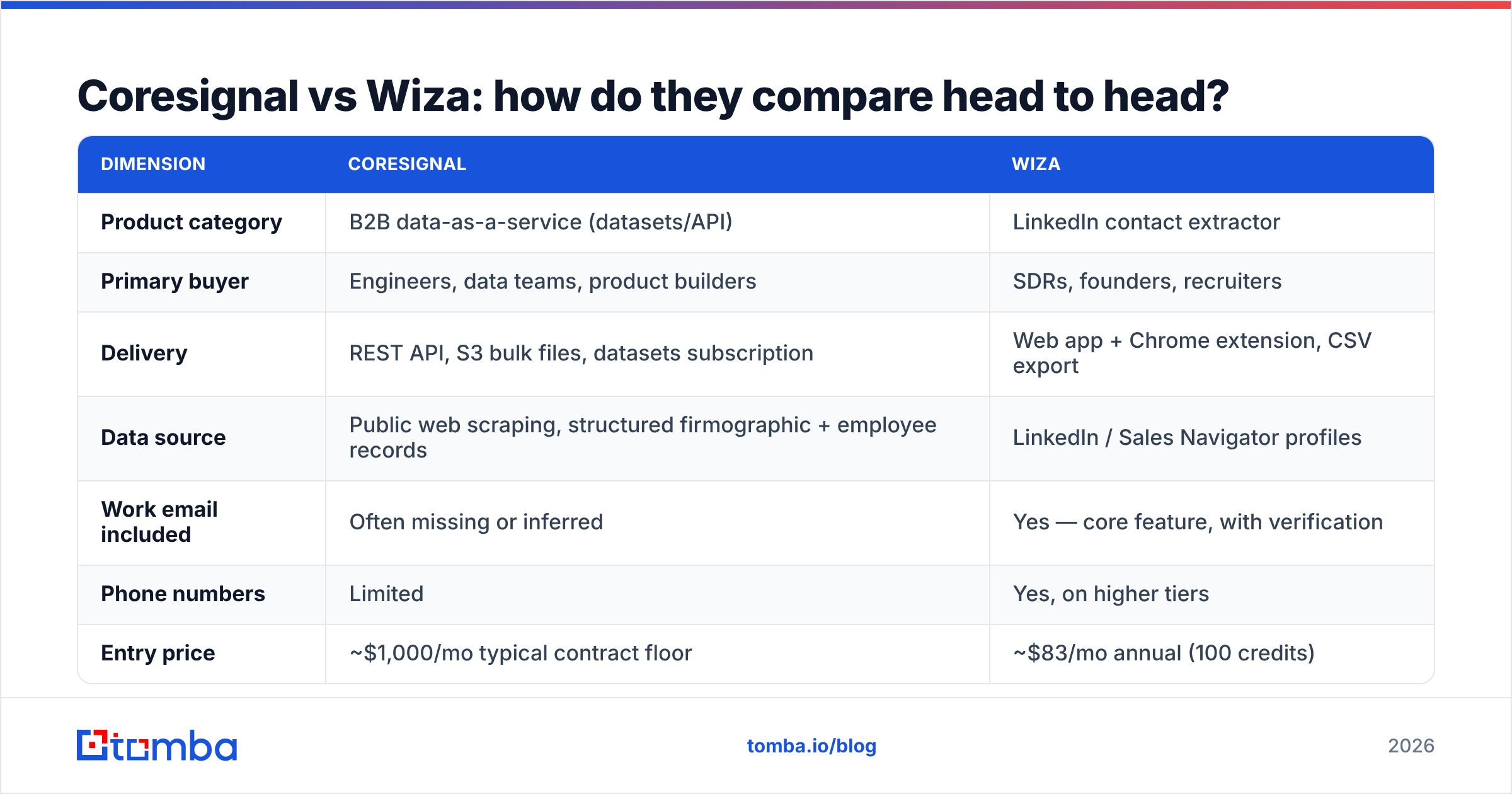
| Dimension | Coresignal | Wiza |
|---|---|---|
| Product category | B2B data-as-a-service (datasets/API) | LinkedIn contact extractor |
| Primary buyer | Engineers, data teams, product builders | SDRs, founders, recruiters |
| Delivery | REST API, S3 bulk files, datasets subscription | Web app + Chrome extension, CSV export |
| Data source | Public web scraping, structured firmographic + employee records | LinkedIn / Sales Navigator profiles |
| Work email included | Often missing or inferred | Yes — core feature, with verification |
| Phone numbers | Limited | Yes, on higher tiers |
| Entry price | ~$1,000/mo typical contract floor | ~$83/mo annual (100 credits) |
| Free option | Trial / sample data on request | 20 free credits |
| Time to first usable lead | Days to weeks (build required) | Under 10 minutes |
| Best at | Scale, depth, custom signals | Speed, simplicity, LinkedIn ICPs |
| Worst at | Anything an SDR needs today | Anything outside LinkedIn |
Read that table honestly and you'll notice these tools overlap on maybe two rows. Anyone framing this as a straight fight is selling you something.
Which one should you pick for your use case?#
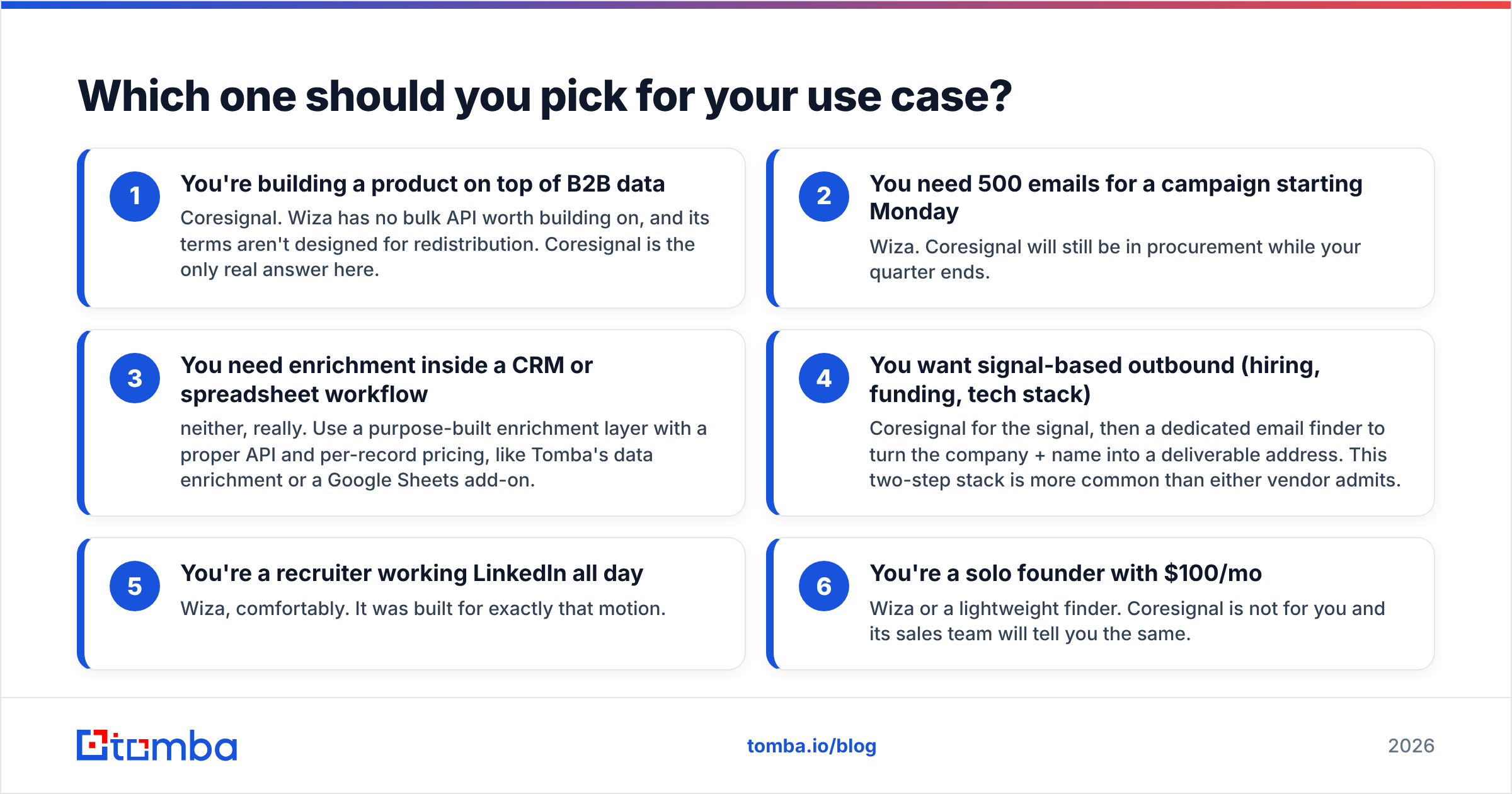
Rather than crowning a winner, match the tool to the job:
- You're building a product on top of B2B data — Coresignal. Wiza has no bulk API worth building on, and its terms aren't designed for redistribution. Coresignal is the only real answer here.
- You need 500 emails for a campaign starting Monday — Wiza. Coresignal will still be in procurement while your quarter ends.
- You need enrichment inside a CRM or spreadsheet workflow — neither, really. Use a purpose-built enrichment layer with a proper API and per-record pricing, like Tomba's data enrichment or a Google Sheets add-on.
- You want signal-based outbound (hiring, funding, tech stack) — Coresignal for the signal, then a dedicated email finder to turn the company + name into a deliverable address. This two-step stack is more common than either vendor admits.
- You're a recruiter working LinkedIn all day — Wiza, comfortably. It was built for exactly that motion.
- You're a solo founder with $100/mo — Wiza or a lightweight finder. Coresignal is not for you and its sales team will tell you the same.
How does pricing really compare?#
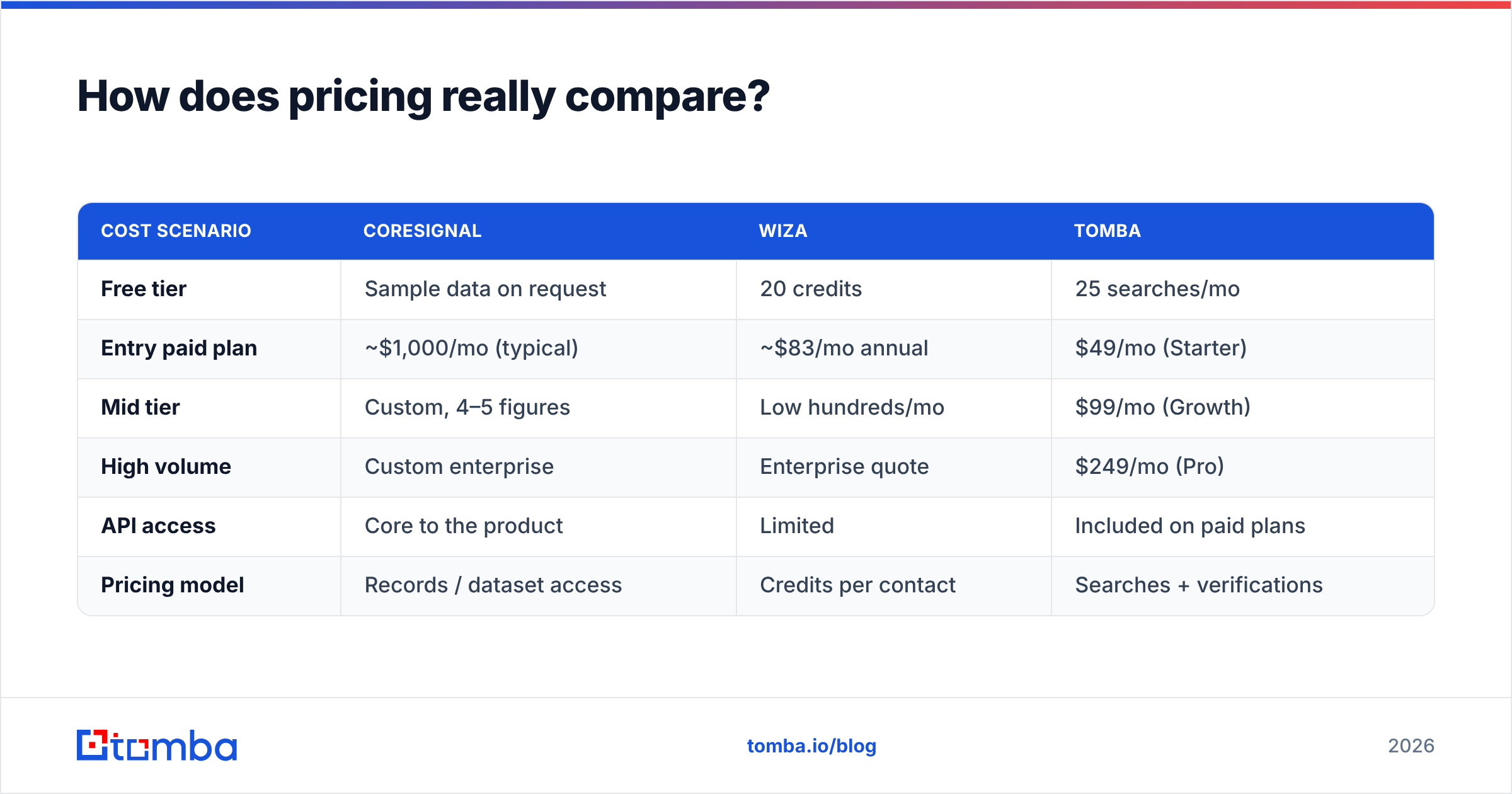
Coresignal publishes tiered dataset pricing but the practical floor for a usable commercial contract lands around $1,000/mo, scaling into five figures for full-firehose access. It's priced like infrastructure, because it is.
Wiza prices per credit. One credit ≈ one contact with an email; phone numbers cost more. Public tiers run roughly $83/mo (billed annually) for 100 credits at the entry level, up to several hundred per month for higher volumes, with an enterprise tier above that. Twenty free credits let you test before paying.
| Cost scenario | Coresignal | Wiza | Tomba |
|---|---|---|---|
| Free tier | Sample data on request | 20 credits | 25 searches/mo |
| Entry paid plan | ~$1,000/mo (typical) | ~$83/mo annual | $49/mo (Starter) |
| Mid tier | Custom, 4–5 figures | Low hundreds/mo | $99/mo (Growth) |
| High volume | Custom enterprise | Enterprise quote | $249/mo (Pro) |
| API access | Core to the product | Limited | Included on paid plans |
| Pricing model | Records / dataset access | Credits per contact | Searches + verifications |
The gap between those first two columns isn't a discount opportunity. It's evidence they're solving different problems. If you're staring at a $1,000/mo quote for what you thought was a lead list, you're in the wrong aisle — and something like Tomba pricing or Wiza's entry plan is where you actually belong.
How accurate is each one, and where does verification break?#
Accuracy claims in this category are mostly marketing. What matters is where each tool's data goes stale.
Coresignal refreshes company and employee records on a cadence, and its firmographic layer is genuinely solid. But professional profiles inherit LinkedIn's staleness problem — people change jobs and don't update for months. And again: the email field is the weakest column in the schema. Treat any address you get as a hypothesis, not a fact.
Wiza verifies emails as part of its flow and reports high validity rates. Real-world bounce rates on Wiza exports typically land in the 3–8% range depending on ICP — respectable, but not zero, and enough to hurt your sender reputation if you skip a second pass. Catch-all domains are the usual culprit: Wiza will mark them accepted, your ESP will mark them a coin flip.
The fix, in both cases, is the same and it's boring: run every list through an independent email verifier before it touches your sequencer. A dedicated catch-all verifier handles the ambiguous domains that generic checks punt on. This costs pennies per record and saves domains that cost thousands to rebuild.

What are the honest alternatives to both?#
Neither tool is the default answer for most B2B teams, so it's worth naming the field.
- Apollo — huge database plus a sequencer, but data quality varies by segment and the platform is heavy. See Apollo alternatives if you've outgrown it.
- BookYourData — a strong pick when you want pre-built, human-verified B2B lists with a pay-as-you-go model and a bounce guarantee. It skips the scraping-and-enriching step entirely, which suits teams that want a list, not a pipeline. G2 reviews back up the accuracy claims; you can compare vendor ratings yourself on G2's lead intelligence category.
- Clearbit / HubSpot Breeze — enrichment-first, deeply tied to the HubSpot ecosystem now. Good if you already live there; see HubSpot's own data enrichment docs for how it plugs in.
- Tomba — the email-finding and verification layer specifically. It doesn't try to be a database subscription or a LinkedIn scraper; it turns names and domains into verified, deliverable addresses via API, CLI, extension, or bulk upload.
- RocketReach, ContactOut, Lusha — the crowded middle. Each is a fine contact finder with different coverage quirks; test on your own ICP before committing.
The stack most competent outbound teams actually run: one source of company/person signal, one finder to resolve the address, one verifier to protect deliverability. Very few teams need all three from one vendor, and the ones who buy the all-in-one usually end up paying for two products they don't use.
Can you combine Coresignal and Wiza — or skip both?#
You can, and some teams do. A common pattern:
- Coresignal identifies accounts matching a signal (hiring three sales roles, just raised a Series A, adopted Snowflake).
- A finder or enrichment API resolves the specific decision-maker's work email at that account.
- A verifier clears the list before it enters the sequencer.
Wiza doesn't fit neatly into that chain because it starts from a LinkedIn list, not from a signal. It's a parallel motion, not a stage in the pipeline.
The skip-both option is legitimate for a large slice of teams: if you already know the companies you want and roughly who you need to reach, you don't need a dataset subscription or a LinkedIn scraper. You need a domain search to see who works there, an email finder to resolve the address, and a verifier to confirm it. Three cheap steps, no six-figure contract, no browser extension that breaks every time LinkedIn ships a redesign.
Final verdict: which one wins?#
Coresignal wins if you're building. It's the right tool when your output is a product, a model, or a warehouse table — and when you have engineers to consume JSON. It is the wrong tool if your output is a sent email this week.
Wiza wins if you're prospecting on LinkedIn. It's fast, cheap relative to its peers, and does exactly one thing well. It is the wrong tool if your ICP isn't on LinkedIn, or if you need programmatic access at scale.
Most readers of this post need neither. If you landed here searching "coresignal vs wiza," there's a decent chance you're actually trying to answer a simpler question: how do I get accurate, deliverable email addresses for the people I already want to reach? That's a finder-and-verifier problem, not a data-platform problem, and the price difference between the two framings is roughly 20x.
Start with the cheap answer. If it doesn't scale, escalate. Almost nobody regrets that order; plenty of teams regret the reverse.
Ready to skip the data-platform detour? The Tomba Email Finder resolves a name and a company domain into a verified work email in seconds — no LinkedIn dependency, no six-figure contract, no engineering sprint. Start free with 25 searches a month, then move to Starter at $49/mo when you need volume. Pair it with the built-in verifier and your bounce rate stops being a variable you worry about.
Related guides#
Ready to find emails that actually work?
Join 150,000+ professionals who stopped guessing and started sending. Free credits on signup — no credit card required.
Get the Tomba newsletter
Practical outbound tactics and product updates — once every two weeks.
About the author