Coresignal vs ZoomInfo: Which B2B Data Provider Wins in 2026?
Coresignal sells raw B2B datasets through an API. ZoomInfo sells a seat-based GTM platform. They are not the same purchase — and picking wrong costs you five figures.
Most "Coresignal vs ZoomInfo" comparisons are written as if these two tools do the same job. They don't. One sells you a firehose of structured data you have to build something with. The other sells you a platform your SDRs log into every morning. If you evaluate them on the same scorecard, you will end up with the wrong contract.
Here's the honest breakdown.
TL;DR#
- Coresignal is a data provider, not a sales tool. It ships company, employee, and job-posting datasets over an API or as bulk files. There is no dashboard for your reps, no sequencer, no CRM sync out of the box.
- ZoomInfo is a GTM platform. Contact records, intent signals, conversation intelligence, a dialer, workflow automation — sold per seat, on annual contracts that commonly land in the five figures.
- The buyer is different. Coresignal's customer is usually a data engineer or a product team building a feature. ZoomInfo's customer is a VP of Sales buying seats.
- Both are expensive relative to the job most teams actually need done — which is "find and verify the email address of a specific person at a specific company." For that narrow job, a dedicated email finder costs a fraction of either.
- Fastest way to decide: if you're writing code against the data, look at Coresignal. If you're staffing a sales floor, look at ZoomInfo. If you just need accurate contact data piped into your stack, neither is the cheapest correct answer.
What is Coresignal and who is it built for?#
Coresignal is a B2B data-as-a-service company. It aggregates public web data — company profiles, employee records, job postings, funding events, technographics — cleans it, structures it, and sells access through REST APIs, a search-and-filter API, and bulk dataset delivery (CSV, JSON, direct-to-cloud drops into S3 or similar).
What you get is raw material. What you do not get:
- A UI for salespeople. There's a dashboard for API keys and usage, not a prospecting workspace.
- Verified email addresses as a first-class product. Coresignal's strength is firmographic and employment data — headcount trends, job changes, hiring signals, tech stack. Direct-dial phone numbers and validated work emails are not its core promise.
- Sequencing, dialing, or CRM writeback. You build all of that.
Who actually buys it: HR-tech and talent-intelligence products that need employee-count and job-change data; investment firms tracking headcount as a growth proxy; ABM vendors enriching their own databases; anyone shipping a feature that requires company data at scale. It's an infrastructure purchase.
If your team can't name the engineer who will consume the API, you are not the customer.
What is ZoomInfo and who is it built for?#
ZoomInfo is the incumbent. It's a full go-to-market platform: a searchable contact and company database, buyer intent data (via its Bombora-style intent topics), website visitor identification, a native dialer, email sequencing, conversation intelligence (Chorus), and deep CRM integrations with Salesforce and HubSpot.
The pitch is consolidation: one vendor, one contract, one login for the whole revenue org. That's genuinely valuable if you're running 30 SDRs and you want them living in one tool with admin controls, usage reporting, and territory management.
The friction is also well documented on review sites like G2 and Capterra:
- Annual contracts with seat minimums. There is no meaningful self-serve tier. You talk to a rep, you get a quote, you negotiate.
- Credit systems. Exports are metered. Bulk enrichment burns credits fast, and overages are a common source of surprise invoices.
- Auto-renewal clauses. Buyers routinely flag this. Read the renewal terms before you sign.
- Data decay on contacts. Every provider suffers from this — people change jobs — but at ZoomInfo's price point expectations are higher than delivery in some segments (SMB, non-US, technical roles).

Coresignal vs ZoomInfo: how do they actually compare?#
The core distinction: Coresignal sells you data. ZoomInfo sells you a workflow.
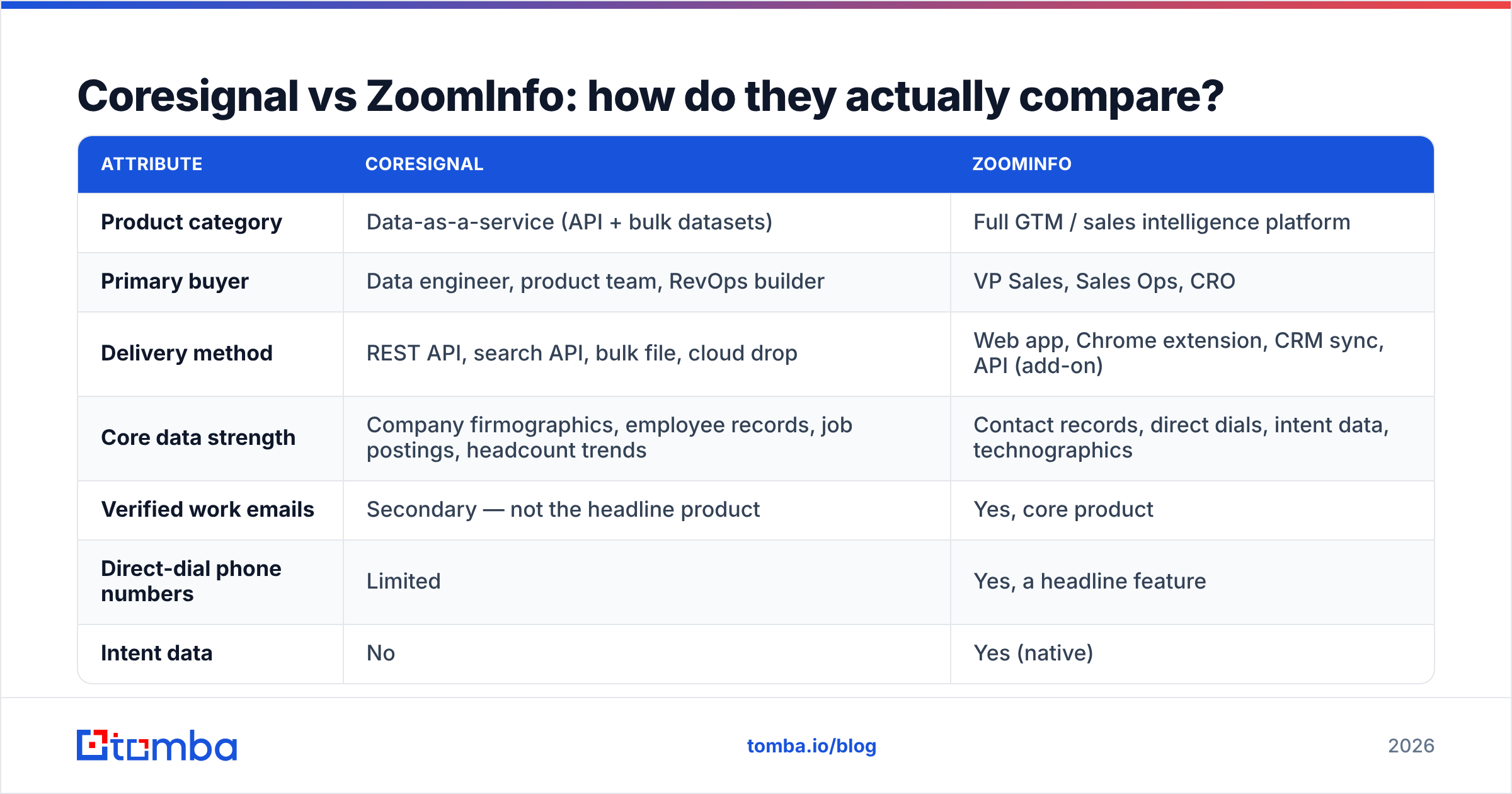
| Attribute | Coresignal | ZoomInfo |
|---|---|---|
| Product category | Data-as-a-service (API + bulk datasets) | Full GTM / sales intelligence platform |
| Primary buyer | Data engineer, product team, RevOps builder | VP Sales, Sales Ops, CRO |
| Delivery method | REST API, search API, bulk file, cloud drop | Web app, Chrome extension, CRM sync, API (add-on) |
| Core data strength | Company firmographics, employee records, job postings, headcount trends | Contact records, direct dials, intent data, technographics |
| Verified work emails | Secondary — not the headline product | Yes, core product |
| Direct-dial phone numbers | Limited | Yes, a headline feature |
| Intent data | No | Yes (native) |
| Sequencing / dialer | No | Yes (ZoomInfo Engage / Copilot) |
| Contract model | Usage/volume-based; monthly or annual API plans | Annual seat-based contract, credit-metered |
| Typical entry cost | Low four figures per month for meaningful API volume | Commonly $15k–$40k+/year depending on seats and modules |
| Free tier | Trial / limited test credits | No true free tier — demo-gated |
| Best for | Building a data product or enriching an internal DB at scale | Running a staffed outbound team end to end |
Read that table twice. If you find yourself wanting columns from both sides, that's a signal you're actually shopping for two different tools — and that a cheaper, focused stack may beat either monolith.
How do pricing and contracts really differ?#
This is where most evaluations go sideways, because the two vendors don't quote the same unit.
Coresignal prices on data volume: records fetched, API calls, dataset size, refresh frequency. Its published self-serve tiers start modest and scale into enterprise territory, and bulk dataset licensing is quoted per dataset. The good news: your bill tracks your usage. The bad news: usage at scale isn't cheap, and a naive integration that re-fetches records can burn budget quietly.
ZoomInfo prices on seats plus credits, annually. Buyer reports on procurement sites consistently show entry deals landing in the mid-five figures once you add seats and modules, with the price climbing as you attach intent, Engage, or Chorus. Negotiation matters — a lot. So does reading the auto-renew clause.
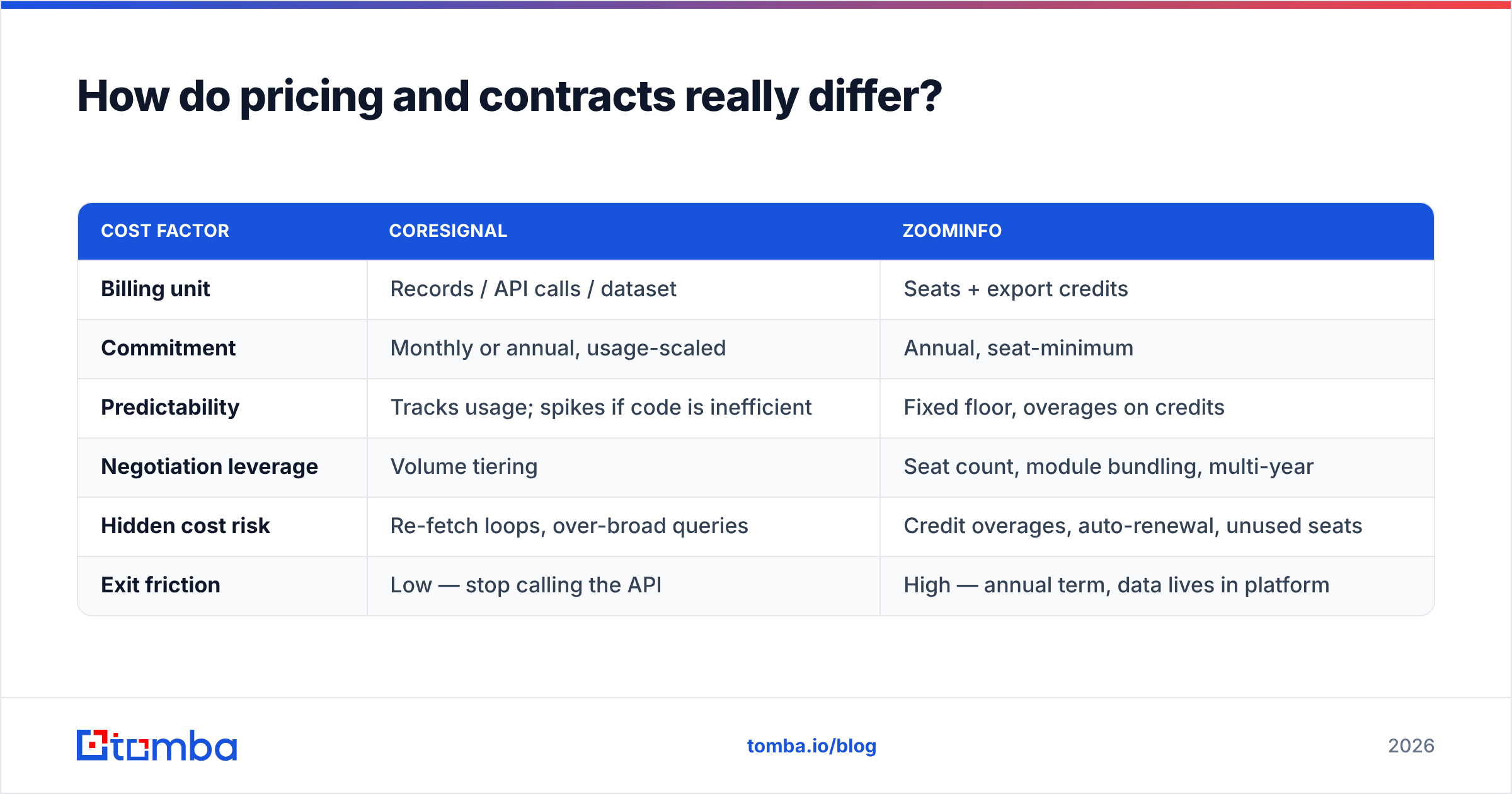
| Cost factor | Coresignal | ZoomInfo |
|---|---|---|
| Billing unit | Records / API calls / dataset | Seats + export credits |
| Commitment | Monthly or annual, usage-scaled | Annual, seat-minimum |
| Predictability | Tracks usage; spikes if code is inefficient | Fixed floor, overages on credits |
| Negotiation leverage | Volume tiering | Seat count, module bundling, multi-year |
| Hidden cost risk | Re-fetch loops, over-broad queries | Credit overages, auto-renewal, unused seats |
| Exit friction | Low — stop calling the API | High — annual term, data lives in platform |
Compare that to a per-lookup model. Tomba's pricing runs Free (25 searches/mo), Starter at $49/mo, Growth at $99/mo, Pro at $249/mo, and custom Enterprise — no seat minimum, no annual lock-in. That's not a like-for-like replacement for ZoomInfo's dialer or Coresignal's job-posting dataset. It is a like-for-like replacement for the "find and verify a work email" job that a surprising share of both contracts get bought for.
Which one has better data coverage and freshness?#
Depends entirely on the field you care about.
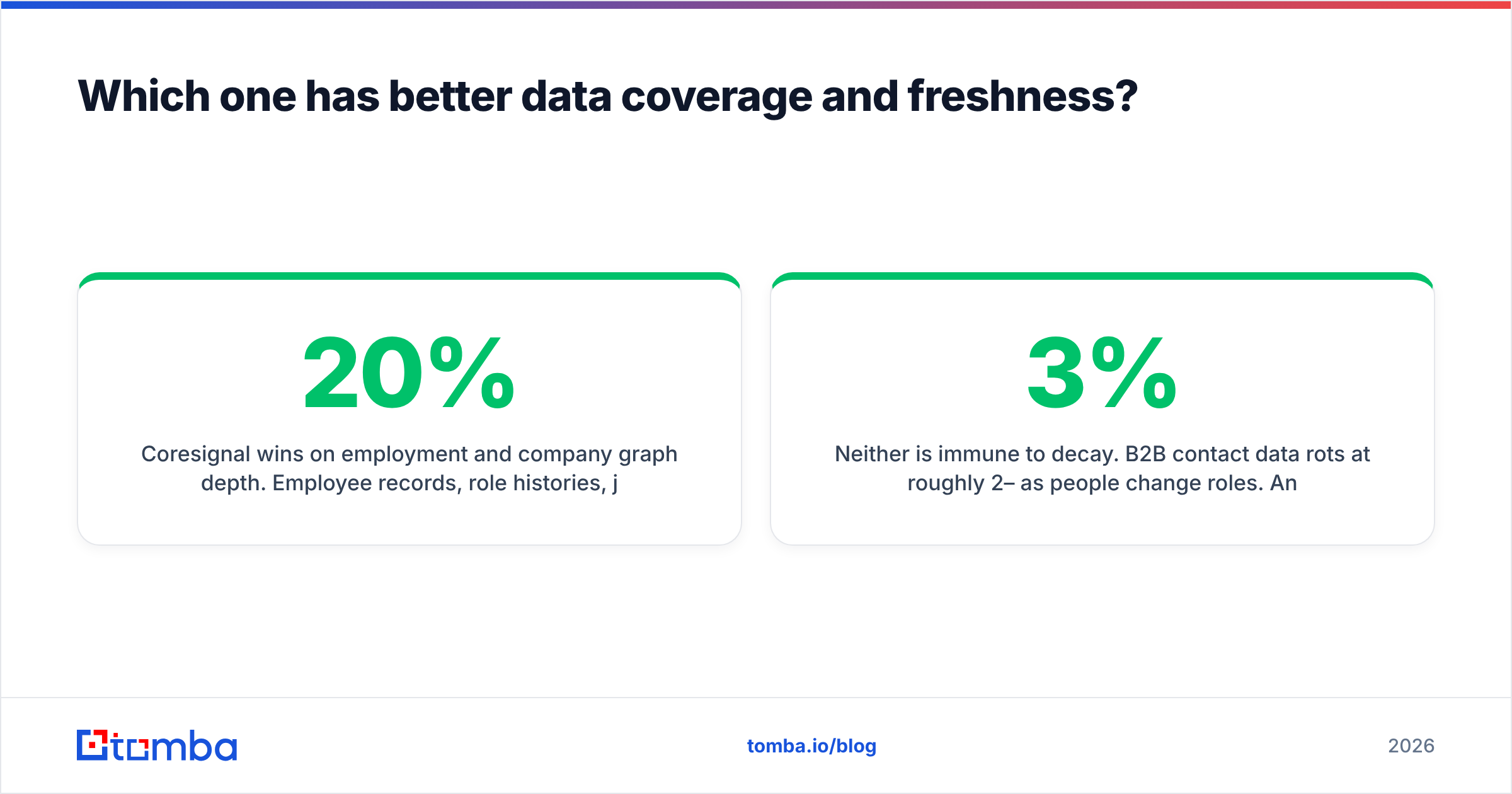
Coresignal wins on employment and company graph depth. Employee records, role histories, job changes, hiring velocity, headcount over time. If your use case is "tell me which companies grew engineering headcount 20% last quarter," Coresignal is built for that and ZoomInfo isn't.
ZoomInfo wins on direct dials and contact reach. Its phone data is genuinely a differentiator — it's the reason a lot of enterprise teams keep renewing despite the price. If your motion is cold calling, that matters.
Neither is immune to decay. B2B contact data rots at roughly 2–3% per month as people change roles. Any provider quoting a static "97% accuracy" figure is quoting a lab number, not your list on the day you export it. The practical move is the same regardless of vendor: verify before you send. Run every list through an email verifier and treat catch-all domains as a separate bucket with a catch-all verifier rather than assuming the source is clean.
If you skip that step, you inherit whatever bounce rate the vendor's last refresh cycle left behind — and your sender reputation pays for it, not theirs.
Is ZoomInfo worth it if you just need emails?#
No — and this is the single most common overbuy in B2B.
Teams sign a $30k ZoomInfo contract, then use it almost exclusively to look up email addresses for a target list they already built in LinkedIn Sales Navigator. They're paying enterprise platform prices for a lookup they could do at a per-search rate.
Ask these five questions before signing anything:
- Will more than three people log into this tool weekly? If no, seat-based pricing is working against you.
- Do you need phone numbers, or do you just say you might? Cold calling is a real motion. Aspirational cold calling is an expensive line item.
- Do you need intent data — and do you have the headcount to act on it within 48 hours? Intent signals you can't act on quickly are decoration.
- Is anyone on your team going to consume this via API? If yes, check the API pricing separately; on some platforms it's an add-on, not included.
- What percentage of your usage is literally "find this person's email"? If it's above 60%, you're buying a platform to solve a utility problem.

When should you look at a third option instead?#
Because "Coresignal vs ZoomInfo" is often a false binary. The market has three usable shapes:
- Raw data infrastructure — Coresignal, and similar dataset vendors. Buy when you're building.
- Full GTM platform — ZoomInfo, Apollo. Buy when you're staffing a floor and want one login. (If ZoomInfo's contract terms are the blocker rather than the product, an Apollo alternative comparison is a more useful next read than another ZoomInfo review.)
- Focused contact-data utilities — Tomba, and list-purchase specialists like BookYourData, which does something ZoomInfo deliberately doesn't: sells you a defined, filtered list outright, with a bounce guarantee, and no seat contract. For teams that want a clean list rather than a subscription to a database, that's a legitimately different and often better-fitting purchase.
The utility layer is where most SMB and mid-market teams should start. Concretely: use domain search to pull the addressable contacts at a target account, the LinkedIn finder to convert a Sales Navigator list into work emails, bulk email finder for list-scale processing, and the Tomba API if you do want to build — at a fraction of an enterprise data contract.
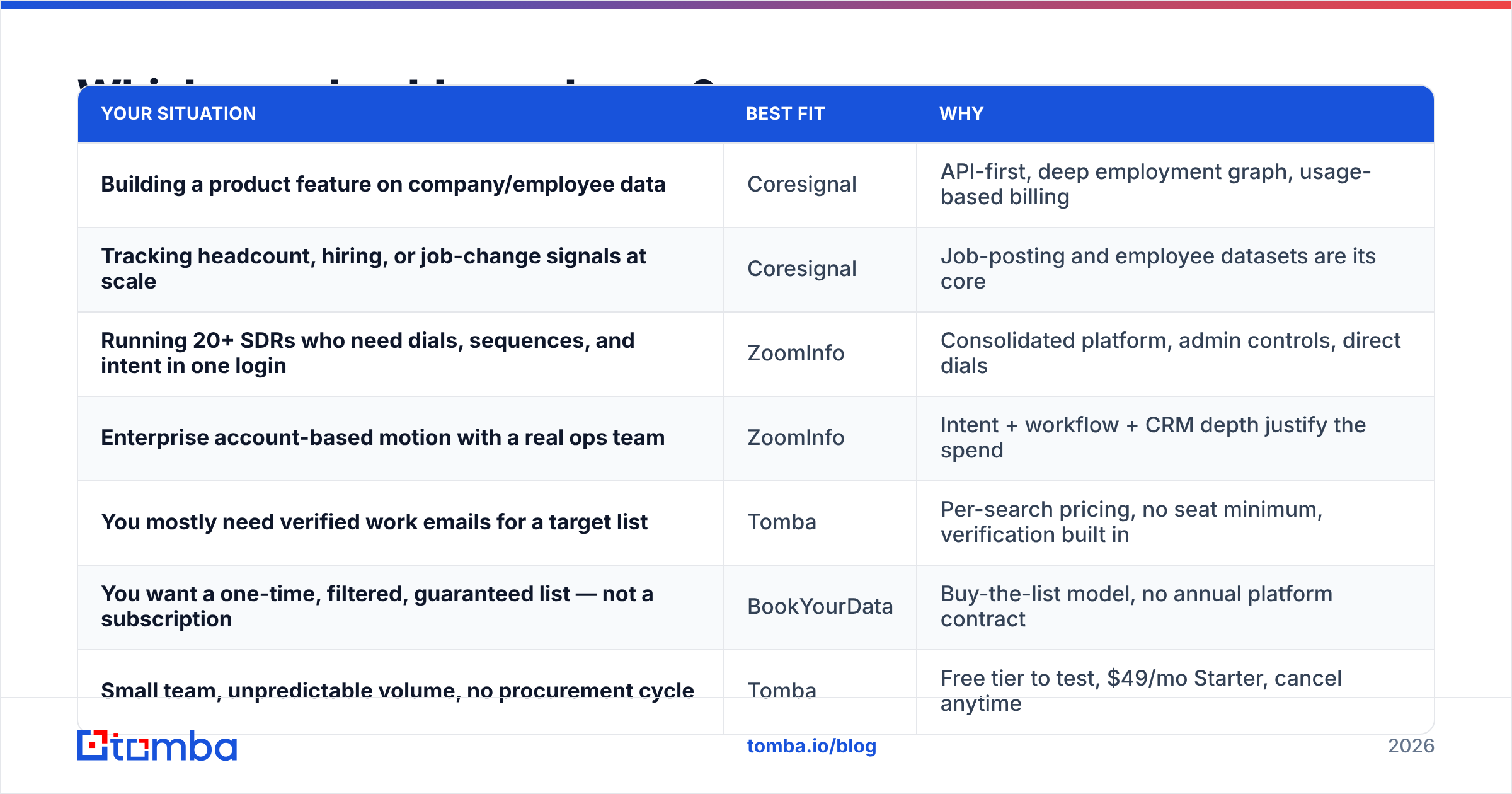
Which one should you choose?#
| Your situation | Best fit | Why |
|---|---|---|
| Building a product feature on company/employee data | Coresignal | API-first, deep employment graph, usage-based billing |
| Tracking headcount, hiring, or job-change signals at scale | Coresignal | Job-posting and employee datasets are its core |
| Running 20+ SDRs who need dials, sequences, and intent in one login | ZoomInfo | Consolidated platform, admin controls, direct dials |
| Enterprise account-based motion with a real ops team | ZoomInfo | Intent + workflow + CRM depth justify the spend |
| You mostly need verified work emails for a target list | Tomba | Per-search pricing, no seat minimum, verification built in |
| You want a one-time, filtered, guaranteed list — not a subscription | BookYourData | Buy-the-list model, no annual platform contract |
| Small team, unpredictable volume, no procurement cycle | Tomba | Free tier to test, $49/mo Starter, cancel anytime |
The uncomfortable truth: a large share of teams comparing Coresignal and ZoomInfo don't need either. They need reliable contact data, verified, delivered into their CRM or sequencer, without a five-figure commitment and a twelve-month term.
What's the fastest way to test this before you commit?#
Run a bake-off on your own list. Not the vendor's demo list — yours.
Take 200 target contacts you actually want to reach. Run them through each provider's trial. Then measure three things: match rate (how many returned an address at all), bounce rate (how many survived verification and a real send), and cost per usable contact (total spend ÷ contacts that made it through both). That third number is the only one that matters, and it's the one no vendor puts on their pricing page.
You will usually find the enterprise platform wins on match rate and loses badly on cost per usable contact.
Start with the cheapest test that gives you a real answer. Before you sit through a ZoomInfo demo or scope a Coresignal integration, run your target list through the Tomba Email Finder — 25 free searches, no card, no sales call. If the match and verification rates cover your motion, you just avoided a five-figure contract for a job that costs $49/mo. If they don't, you'll walk into that vendor call with a real benchmark instead of a brochure.
Related guides#
Ready to find emails that actually work?
Join 150,000+ professionals who stopped guessing and started sending. Free credits on signup — no credit card required.
Get the Tomba newsletter
Practical outbound tactics and product updates — once every two weeks.
About the author