The Real Cost of Lead Generation in 2026: A CPL Breakdown
Most teams quote a cost per lead that ignores half the invoice. Here is what lead generation actually costs in 2026 — channel by channel, with the hidden line items nobody budgets for.
TL;DR
- Blended B2B cost per lead in 2026 lands between $40 and $250, but the spread inside that range is driven almost entirely by channel and lead definition — not by how good your team is.
- The number most teams report is wrong because it excludes salary, tooling, data waste, and bounced sends. Fully loaded CPL is typically 2–3x the "media spend ÷ leads" figure.
- Paid search and paid social have the highest raw CPL. Outbound has the lowest raw CPL and the highest hidden labor cost.
- The single cheapest lever most teams ignore: data quality. A 25% bad-email rate silently inflates every downstream cost per lead by roughly a third.
- Build your CPL model once, per channel, fully loaded. Then optimize the biggest line item — not the loudest one.
What does "cost of lead generation" actually mean?#
Cost of lead generation is the total spend required to produce one lead that your sales team agrees is a lead. That last clause is where most models fall apart.
Think of it like the cost of a meal. The menu price is the ad spend. But the real cost includes the ingredients you threw out, the hour you spent cooking, and the dish you burned. Marketing teams quote the menu price. Finance wants the whole bill.
A defensible cost of lead generation formula looks like this:
Fully loaded CPL = (Media spend + Tooling + Data + Loaded labor + Waste) ÷ Accepted leads
Two of those terms do most of the damage:
- Loaded labor — the fraction of an SDR, marketer, or ops person's salary attributable to the channel, including benefits and overhead (usually 1.25–1.4x base).
- Waste — leads that bounced, duplicated, were unreachable, or got rejected by sales. If you divide by generated leads instead of accepted leads, you are lying to yourself by 20–40%.
The difference between the two numbers is not academic. A team reporting $65 CPL on a $50k budget may actually be running at $180 once labor and waste are in. That gap decides whether a channel gets funded next quarter.
What is a realistic cost per lead by channel in 2026?#
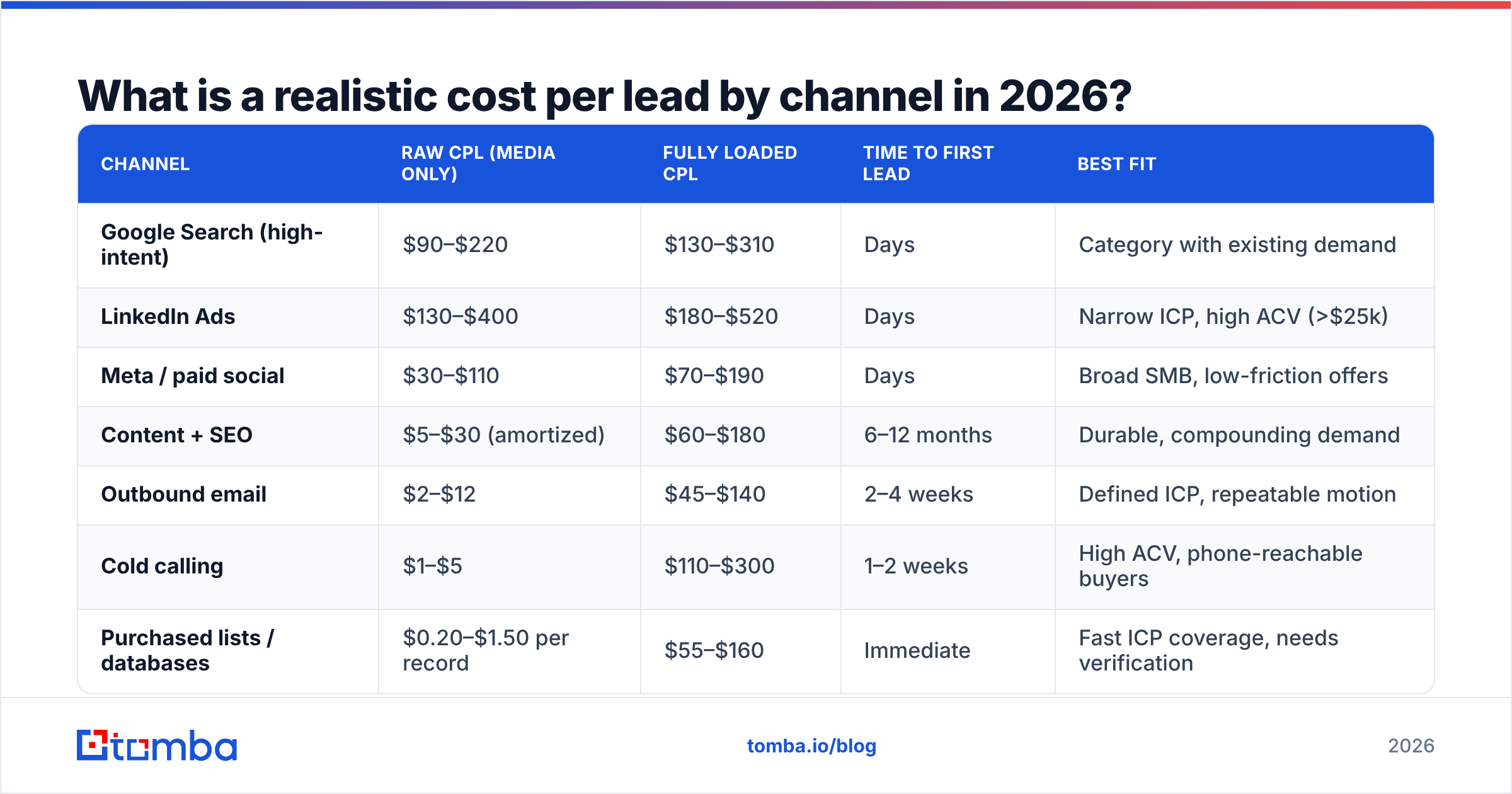
Here are the ranges we see across B2B teams in the $1M–$50M ARR band. Treat them as calibration, not gospel — your vertical, ACV, and geography move these by 2x in either direction.
| Channel | Raw CPL (media only) | Fully loaded CPL | Time to first lead | Best fit |
|---|---|---|---|---|
| Google Search (high-intent) | $90–$220 | $130–$310 | Days | Category with existing demand |
| LinkedIn Ads | $130–$400 | $180–$520 | Days | Narrow ICP, high ACV (>$25k) |
| Meta / paid social | $30–$110 | $70–$190 | Days | Broad SMB, low-friction offers |
| Content + SEO | $5–$30 (amortized) | $60–$180 | 6–12 months | Durable, compounding demand |
| Outbound email | $2–$12 | $45–$140 | 2–4 weeks | Defined ICP, repeatable motion |
| Cold calling | $1–$5 | $110–$300 | 1–2 weeks | High ACV, phone-reachable buyers |
| Purchased lists / databases | $0.20–$1.50 per record | $55–$160 | Immediate | Fast ICP coverage, needs verification |
| Events / field | $250–$900 | $400–$1,200 | Months | Enterprise, relationship-led |
| Referral / partner | $0–$50 | $30–$90 | Variable | Post-PMF, existing customer base |
Two patterns jump out.
First, raw CPL and loaded CPL rank channels differently. Outbound and cold calling look nearly free on media spend and expensive once you price the human. Paid search looks expensive on media and barely moves when you add labor, because the labor is thin. If you optimize on raw CPL, you will systematically over-invest in labor-heavy channels and under-invest in capital-heavy ones.
Second, the cheapest channels on this table are the slowest. SEO amortizes beautifully at month 18 and produces nothing at month 3. Anyone quoting you a blended CPL without a time axis is selling something.
Why is your reported CPL lower than your real CPL?#
Because four line items almost never make it into the spreadsheet.
- Loaded salary. An SDR at $65k base costs roughly $85k loaded. If that SDR sources 25 accepted leads a month, that is $283 of labor per lead before you spend a dollar on tooling. Most outbound CPL models quietly report the $8 data cost and stop.
- Data decay and bad records. B2B contact data degrades at roughly 25–30% per year — people change jobs, companies rebrand, domains consolidate. Every stale record you email is a send you paid for, a reply you didn't get, and a deliverability hit you'll pay for later.
- Rejected leads. If sales accepts 60% of what marketing passes, your true CPL is your reported CPL divided by 0.6 — a 67% increase. Track marketing qualified lead acceptance rate or your model is fiction.
- Tool sprawl. Enrichment, sequencer, verifier, CRM seats, intent data, warmup. A five-person GTM team routinely runs $1,500–$4,000/month in tooling that never gets allocated to any channel's CPL.
Put those back in and a typical "we're at $70 CPL" outbound program is really running at $150–$200. That is still competitive. It is just not $70, and the difference determines whether you hire a second SDR or buy better data.
How much does bad data really cost you?#
More than the data itself. This is the least intuitive line item on the whole P&L, so run the arithmetic.
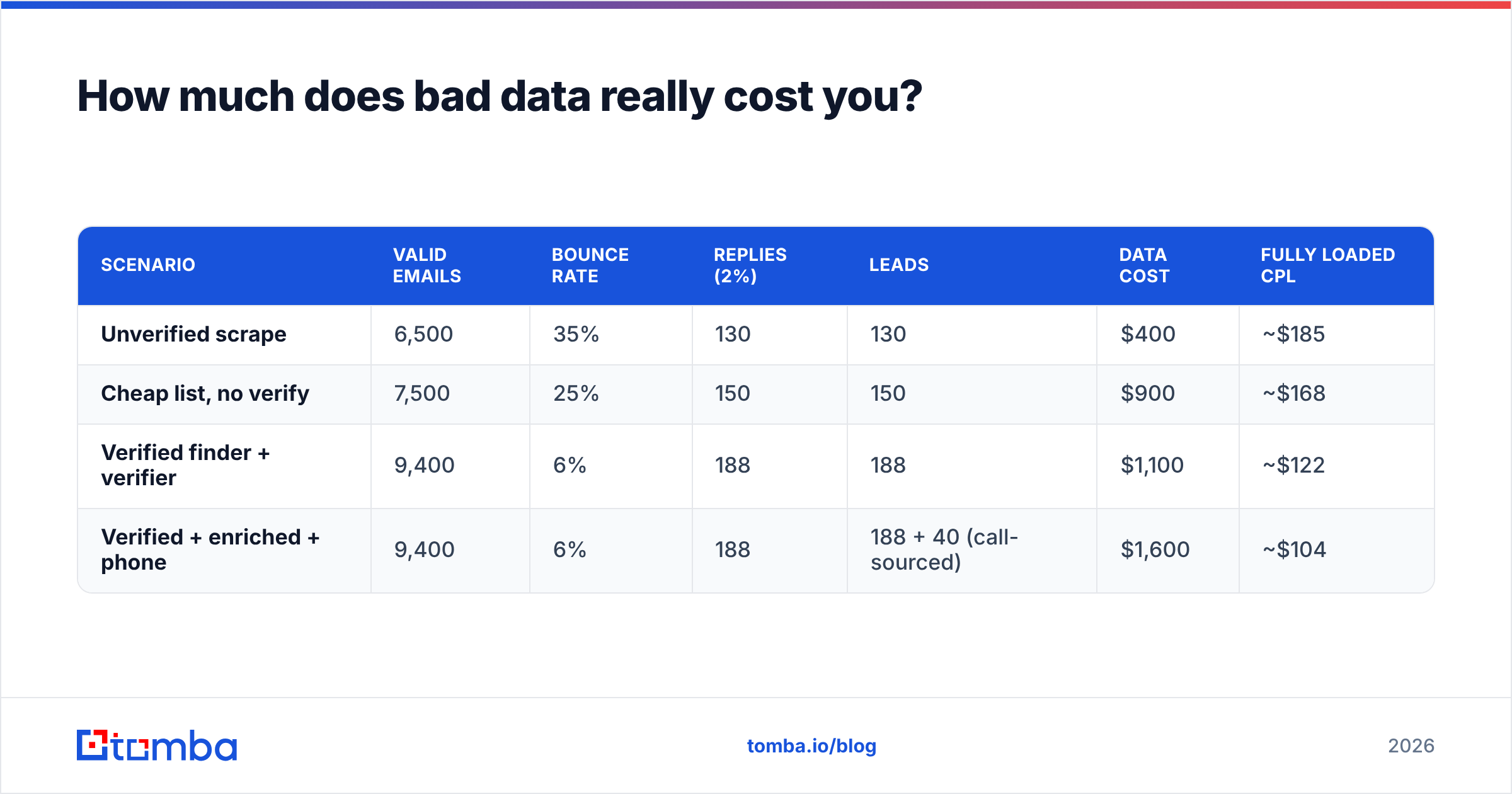
Take 10,000 prospects, a $2,000 sequencing stack, and a 2% reply-to-lead rate on valid contacts.
| Scenario | Valid emails | Bounce rate | Replies (2%) | Leads | Data cost | Fully loaded CPL |
|---|---|---|---|---|---|---|
| Unverified scrape | 6,500 | 35% | 130 | 130 | $400 | ~$185 |
| Cheap list, no verify | 7,500 | 25% | 150 | 150 | $900 | ~$168 |
| Verified finder + verifier | 9,400 | 6% | 188 | 188 | $1,100 | ~$122 |
| Verified + enriched + phone | 9,400 | 6% | 188 | 188 + 40 (call-sourced) | $1,600 | ~$104 |
Same list. Same copy. Same rep. The only variable is whether the contact data was verified before it entered the sequence — and the fully loaded cost of lead generation swings by 44%.
There is a second-order cost, too. A 25%+ bounce rate does not just waste sends; it torches your sending domain. Once your sender reputation drops, even your valid contacts stop landing in the inbox, and CPL climbs on a channel you thought was healthy. Google and Yahoo's bulk-sender requirements put a hard ceiling on spam complaints and effectively price bad data into your deliverability. You can read the current thresholds in Google's sender guidelines.
The fix is unglamorous: verify before you send. Run new records through an email verifier, handle catch-all domains separately with a catch-all verifier, and re-verify anything older than 90 days. It is the cheapest CPL reduction available to most teams, and it takes an afternoon.
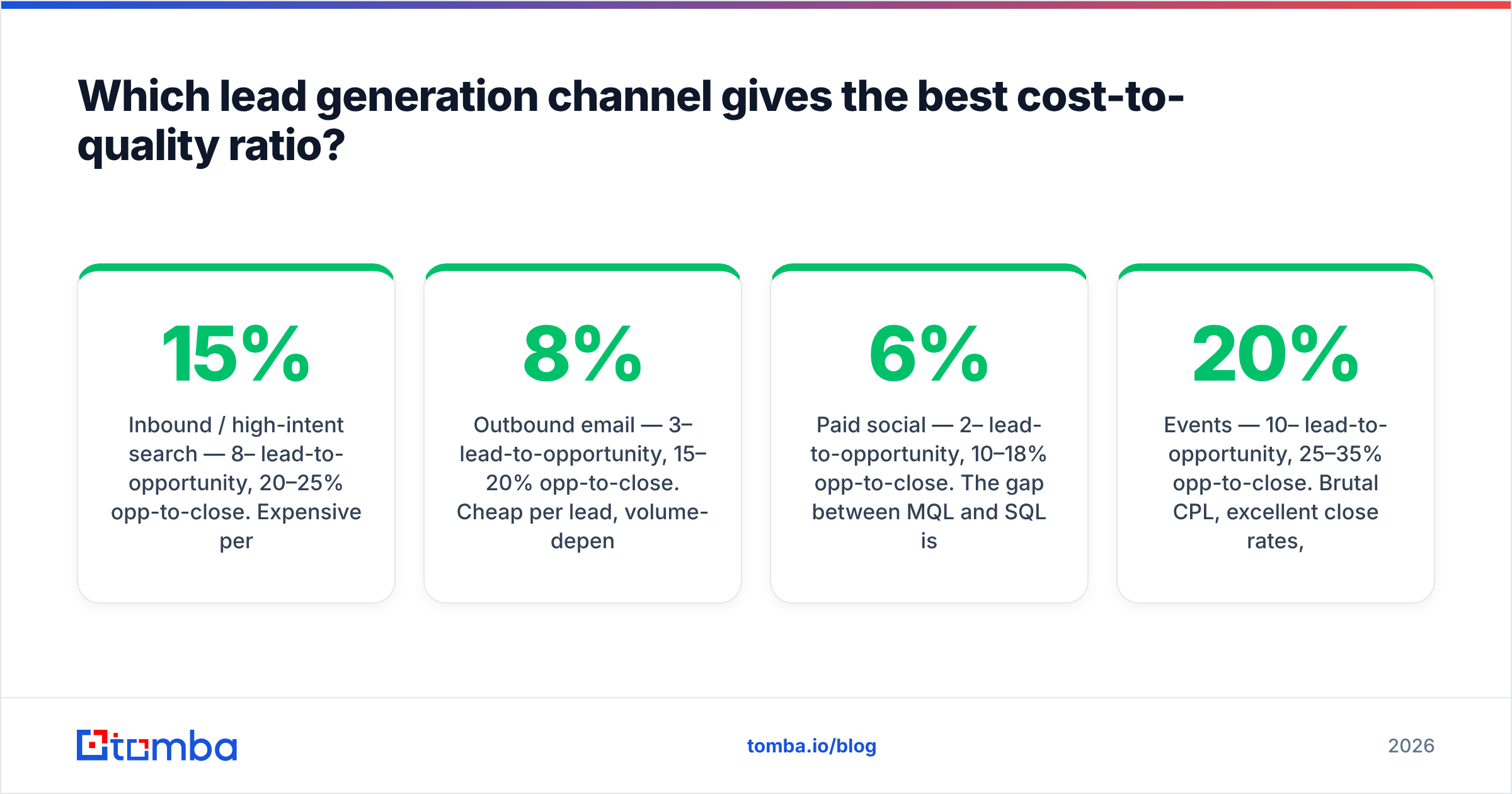
Which lead generation channel gives the best cost-to-quality ratio?#
Cheap leads that never close are the most expensive leads you can buy. So rank channels on cost per closed-won, not cost per lead.
Rough conversion math across a typical mid-market B2B funnel:
- Inbound / high-intent search — 8–15% lead-to-opportunity, 20–25% opp-to-close. Expensive per lead, cheapest per deal. Buyers are already in-market.
- Outbound email — 3–8% lead-to-opportunity, 15–20% opp-to-close. Cheap per lead, volume-dependent per deal. Quality tracks your ICP definition almost perfectly.
- Paid social — 2–6% lead-to-opportunity, 10–18% opp-to-close. The gap between MQL and SQL is widest here; gated-ebook leads are the classic trap.
- Events — 10–20% lead-to-opportunity, 25–35% opp-to-close. Brutal CPL, excellent close rates, terrible scalability.
- Referral — 25–40% lead-to-opportunity, 35–50% opp-to-close. Best ratio on the board and the hardest to manufacture on demand.
Run your own numbers and you will usually find two channels doing 80% of the work. Fund those. The rest is portfolio insurance.
One caveat worth stating plainly: channel CPL is downstream of ICP precision. A vague ICP makes every channel expensive, because you are paying to reach people who were never going to buy. Tightening your ICP from "SaaS companies" to "Series A–B SaaS, 20–200 headcount, product-led, US/UK" typically cuts CPL more than any bidding or copy change ever will.

How do you actually reduce your cost of lead generation?#
Six levers, ordered by return on effort:
- Fix data quality first. Verify emails before sending, dedupe on import, and re-verify quarterly. This is the only lever that improves CPL on every channel at once, including paid — cleaner CRM data means better lookalike audiences and less wasted retargeting.
- Divide by accepted leads, not generated leads. Once your dashboard shows the honest number, the wasteful channel usually identifies itself within a week.
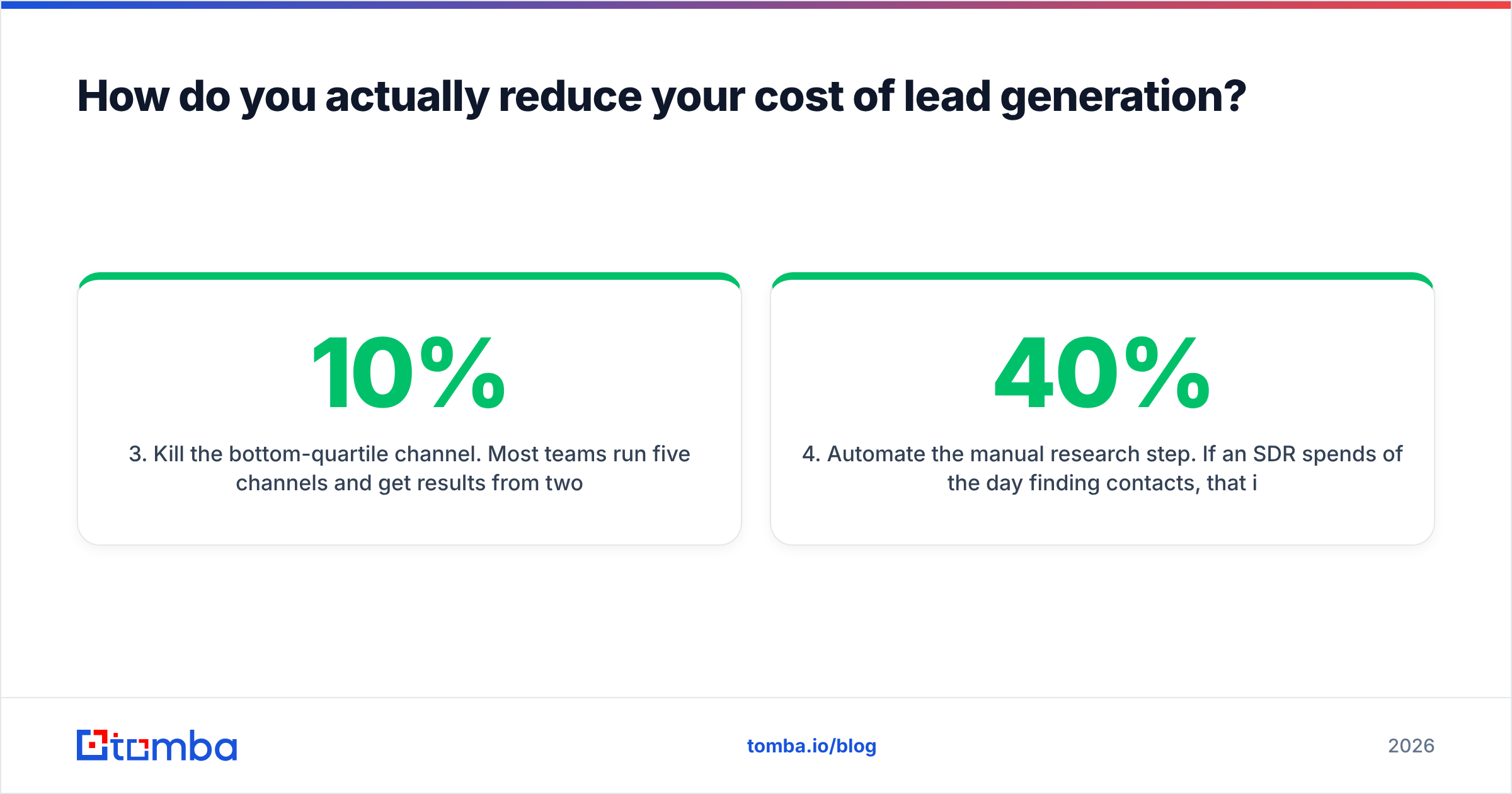
- Kill the bottom-quartile channel. Most teams run five channels and get results from two. Reallocating the bottom channel's budget to the top one typically beats a 10% efficiency gain in the bottom one.
- Automate the manual research step. If an SDR spends 40% of the day finding contacts, that is 40% of a loaded salary sitting in your CPL. An email finder plus domain search turns a 6-minute manual lookup into a batch job.
- Buy data at the right layer. Full-service databases like BookYourData work well when you need broad, pre-built ICP coverage fast; API-first finders work well when you already know your accounts and just need reachable contacts. Both are legitimate — the mistake is paying database prices for lookups you could resolve yourself, or hand-building a list you could have bought.
- Extend lead lifespan. Nurture beats replacement. Re-engaging a six-month-old lead costs a fraction of sourcing a new one, and most CRMs are sitting on thousands of them. Check G2's category benchmarks if you want to see how vendors position on this.
What should you budget for lead generation in 2026?#
A workable planning heuristic, assuming you know your ACV and target pipeline:
- Pipeline needed = ARR target ÷ win rate (see win rate if you need the definition)
- Opportunities needed = pipeline ÷ ACV
- Leads needed = opportunities ÷ lead-to-opp rate
- Budget = leads needed × fully loaded CPL
Worked example: $2M new ARR target, 22% win rate, $30k ACV, 6% lead-to-opp rate, $140 fully loaded CPL.
Pipeline needed = $9.1M. Opportunities = 303. Leads = 5,050. Budget = $707,000.
That number is usually a shock, and it should be — it is the first honest look most teams get at what their growth plan actually costs. It also tells you exactly where to push: shaving CPL from $140 to $100 saves $202k. Lifting the win rate from 22% to 26% saves more than that. Data quality moves both.
Benchmark yourself against outside sources rather than your own history alone — HubSpot's State of Marketing research and analyst coverage from Gartner are the usual reference points for channel-level CAC and CPL trends.
Where does most of the waste actually hide?#
In the gap between "we found a contact" and "we reached a human."
That gap is made of bounced emails, wrong-role contacts, catch-all domains nobody checked, duplicate records across two tools, and phone numbers that ring a defunct switchboard. None of it shows up as a line item. All of it shows up as CPL.
If you want one number to watch weekly, watch valid-contact rate: the share of records that survive verification and are reachable at the role you targeted. Teams above 90% run structurally cheaper lead generation than teams at 70%, regardless of channel mix, copy, or headcount. The math is unavoidable — you are dividing the same spend by more usable leads.
Start with the data layer. Before you re-bid your ad accounts or rewrite your sequences, make sure the contacts entering your funnel are real. Tomba's Email Finder finds verified professional emails by name, domain, or company, with a free tier of 25 searches a month and paid plans starting at $49/mo on Tomba pricing — cheaper than a single wasted week of SDR research, and it lowers the cost of lead generation on every channel you run, not just outbound.
Related guides#
Ready to find emails that actually work?
Join 150,000+ professionals who stopped guessing and started sending. Free credits on signup — no credit card required.
Get the Tomba newsletter
Practical outbound tactics and product updates — once every two weeks.
About the author