The True Cost of Sales Tech Stack Ownership in 2026
Most teams budget for license fees and get blindsided by seats, overages, onboarding, and integration debt. Here is the real cost of sales tech stack ownership per rep in 2026 — and which line items you can cut without losing pipeline.
The cost of sales tech stack ownership runs about 3x the sticker price. Below are the 2026 numbers per rep, the fees vendors bury, and the line items you can cut today.
TL;DR
- The average B2B sales team runs 7-10 tools per rep. Sticker price is rarely more than a third of the true cost of sales tech stack ownership.
- Budget for four buckets, not one: licenses, usage overages, implementation/admin time, and integration debt. The last two are where budgets quietly die.
- A realistic fully-loaded cost of sales tech stack ownership in 2026 is $180-$420 per rep per month for a mid-market stack. Add an intent/ABM layer and it passes $600.
- Data tools are the easiest place to overpay. Seat-based prospecting suites bill you for people who never log in. Credit-based finders bill you for what you actually use.
- Run a 90-day utilization audit before every renewal. Most teams find 20-35% of spend attached to logins with near-zero activity, and the cost of sales tech stack ownership drops fast once they cut it.
What actually counts as a "sales tech stack" cost?#
Start with a definition. The number you report to finance depends entirely on where you draw the line.
A sales tech stack is every tool a rep touches between "we should sell to this company" and "the deal is closed-won in the CRM." That typically spans:
- System of record — your CRM. Salesforce, HubSpot, Pipedrive. This is the anchor line item and the hardest to rip out.
- Data layer — contact data, email finder tools, verification, enrichment, firmographic and technographic databases.
- Engagement layer — sequencers, dialers, LinkedIn automation, meeting schedulers.
- Intelligence layer — call recording, conversation AI, forecasting, intent signals.
- Enablement + admin — content management, e-signature, CPQ, plus the RevOps humans who hold it all together.
Most cost models stop at bucket 1-3 and call it a day. That is why the "we spend $X per rep" number in your CFO's spreadsheet is almost always wrong by a factor of two or three. Licenses are just the entry fee.

Why is the sticker price never the real price?#
Because vendors price the thing you sign for, not the thing you operate. Think of it like buying a car. The MSRP is real, but insurance, fuel, tires, and the two Saturdays a year you spend at the dealer are the actual cost of driving.
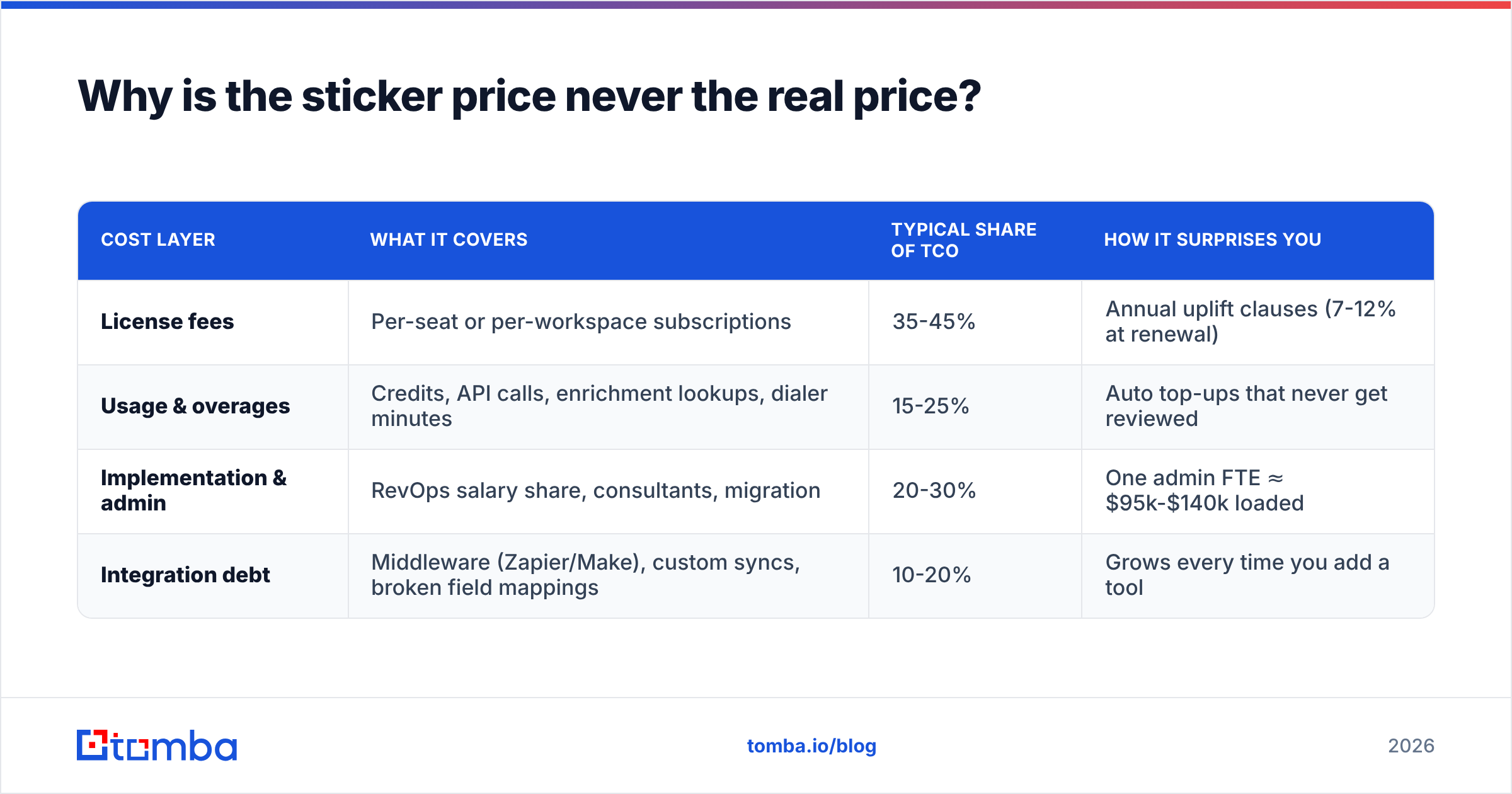
Here are the four cost layers, and roughly how they stack up for a 10-rep team:
| Cost layer | What it covers | Typical share of TCO | How it surprises you |
|---|---|---|---|
| License fees | Per-seat or per-workspace subscriptions | 35-45% | Annual uplift clauses (7-12% at renewal) |
| Usage & overages | Credits, API calls, enrichment lookups, dialer minutes | 15-25% | Auto top-ups that never get reviewed |
| Implementation & admin | RevOps salary share, consultants, migration | 20-30% | One admin FTE ≈ $95k-$140k loaded |
| Integration debt | Middleware (Zapier/Make), custom syncs, broken field mappings | 10-20% | Grows every time you add a tool |
Two of those four layers never appear on an invoice. That is the whole problem. A team paying $12,000/year in visible licenses often spends $28,000-$34,000 all-in once you charge admin hours and middleware to the stack.
Gartner's research has been consistent for years: most seller-facing tools are under-utilized, and adoption — not procurement — is where value leaks. Their sales technology coverage gives the market-level view.
What is the cost of sales tech stack ownership per rep in 2026?#
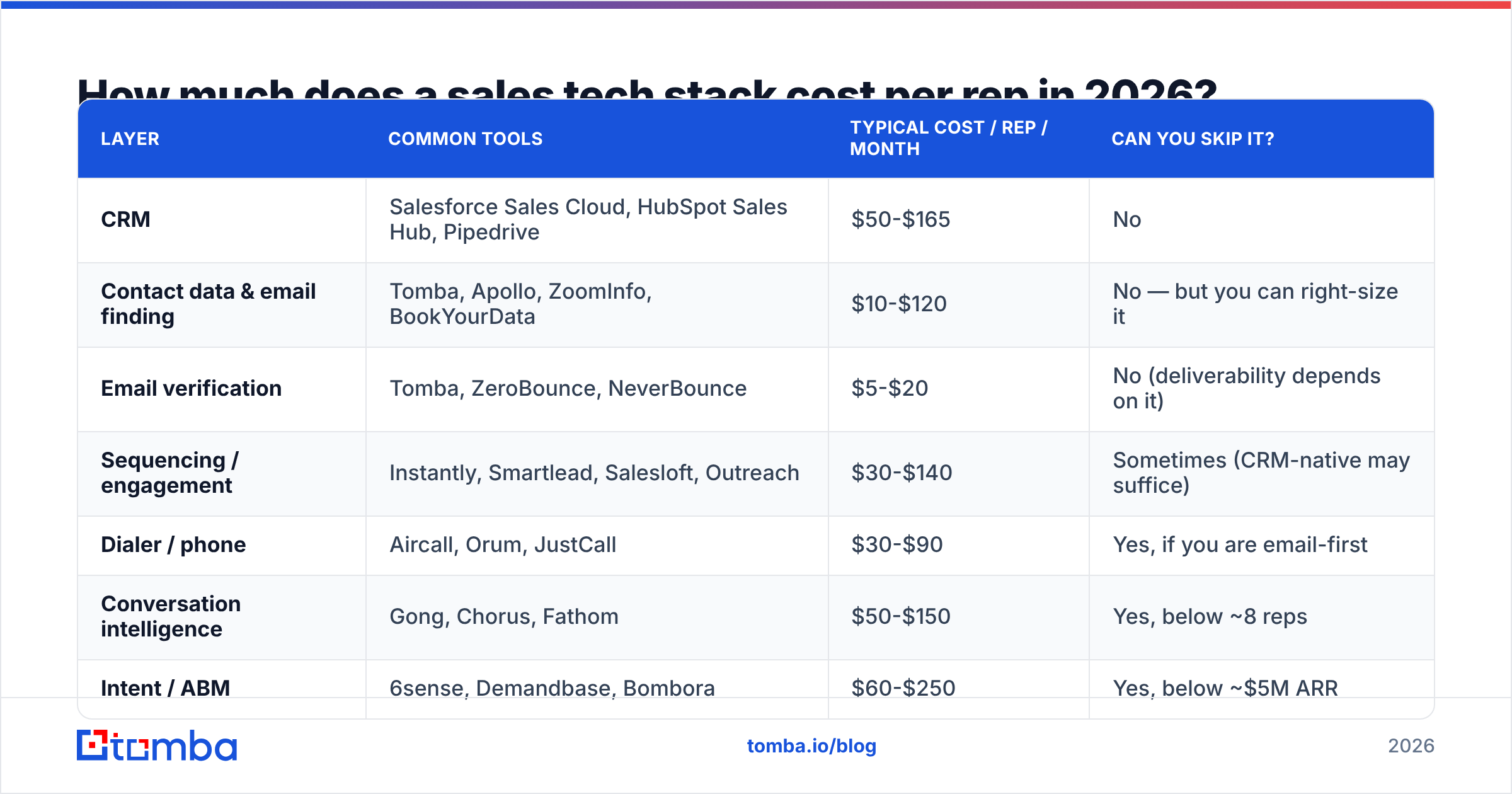
Here is a concrete, buildable model. These are list prices or well-documented public ranges as of 2026. Always confirm with the vendor, since annual contracts and volume tiers move these numbers by 20-40%.
| Layer | Common tools | Typical cost / rep / month | Can you skip it? |
|---|---|---|---|
| CRM | Salesforce Sales Cloud, HubSpot Sales Hub, Pipedrive | $50-$165 | No |
| Contact data & email finding | Tomba, Apollo, ZoomInfo, BookYourData | $10-$120 | No — but you can right-size it |
| Email verification | Tomba, ZeroBounce, NeverBounce | $5-$20 | No (deliverability depends on it) |
| Sequencing / engagement | Instantly, Smartlead, Salesloft, Outreach | $30-$140 | Sometimes (CRM-native may suffice) |
| Dialer / phone | Aircall, Orum, JustCall | $30-$90 | Yes, if you are email-first |
| Conversation intelligence | Gong, Chorus, Fathom | $50-$150 | Yes, below ~8 reps |
| Intent / ABM | 6sense, Demandbase, Bombora | $60-$250 | Yes, below ~$5M ARR |
| Scheduling + e-sign | Calendly, DocuSign, PandaDoc | $15-$40 | Rarely worth cutting |
| Fully loaded blended | — | $180-$420 (lean-to-mid) $600+ (enterprise) |
— |
Three sanity checks against that table:
- Seed / sub-$1M ARR: you should be under $120/rep/month. CRM + data + sequencer. That is it.
- Mid-market ($5-$30M ARR): $250-$400/rep/month is normal and defensible.
- Enterprise: $600-$900/rep/month is common. Roughly a third of it is intent data and conversation AI, and that only pays back if managers actually coach off it.
Above these bands, you do not have a pricing problem. You have a redundancy problem. Usually two tools do the same job because two leaders bought them eighteen months apart.
Where does sales tech budget actually get wasted?#
Four failure modes, in order of how much money they burn.
1. Seats for people who never log in. This is the single biggest line item you can recover. Seat-based suites bill annually for every named user. Reps churn. SDRs move to AE. A marketer got a seat for one campaign in March. Nobody deprovisions. Pull a 90-day login report before every renewal — most teams find 20-35% of seats are dormant.
2. Paying platform prices for a single feature. The classic: a team buys an all-in-one platform at $99-$149/user/month because they need contact data, then uses 8% of the product. The engagement module goes unused, because they already have a sequencer. The intent feed goes unused, because nobody built a play around it. You are renting a bundle to use one drawer of it.
3. Bad data charged twice. An invalid email costs you the credit to find it and the deliverability damage when it bounces. Bounce rates above 3% start degrading sender reputation. A damaged domain is the most expensive thing on this list, because you cannot buy your way out of it quickly. Verification is a rounding error on the cost of sales tech stack ownership and a load-bearing wall for your pipeline. Run every list through an email verifier before it hits the sequencer.
4. Integration sprawl. Every tool you add creates new connections. Five tools is manageable. Nine tools means someone is fixing Zapier steps at 2 a.m. because a field mapping changed. Budget middleware and RevOps hours as a real cost of each new purchase, not as overhead.

Is an all-in-one platform cheaper than best-of-breed?#
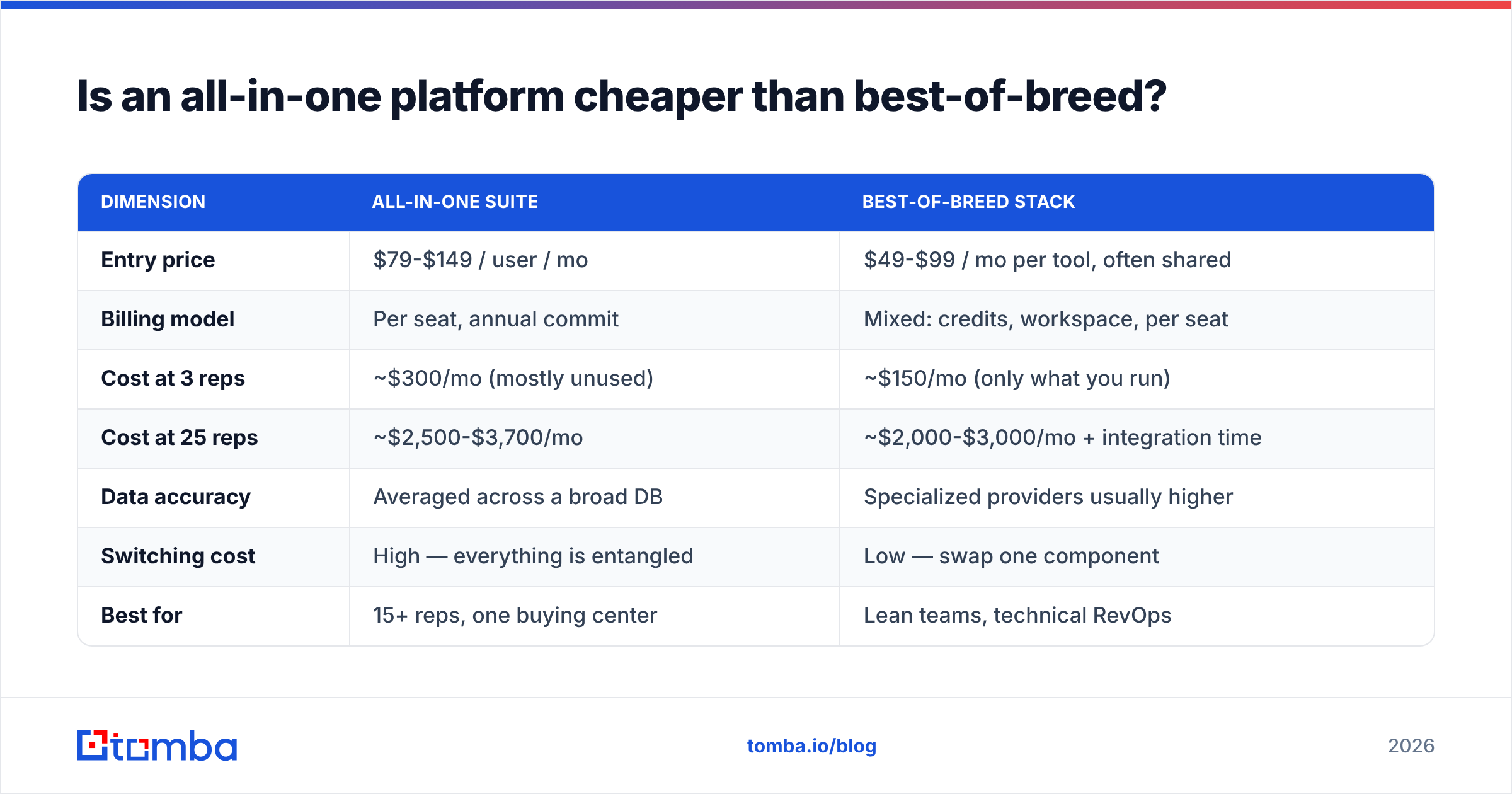
Sometimes. It depends on how many modules you will genuinely operationalize.
The bundle math works when you would otherwise buy four or more of the included tools and you would actually use them. It fails when you buy the bundle for one module and let the rest rot. That is the more common outcome.
| Dimension | All-in-one suite | Best-of-breed stack |
|---|---|---|
| Entry price | $79-$149 / user / mo | $49-$99 / mo per tool, often shared |
| Billing model | Per seat, annual commit | Mixed: credits, workspace, per seat |
| Cost at 3 reps | ~$300/mo (mostly unused) | ~$150/mo (only what you run) |
| Cost at 25 reps | ~$2,500-$3,700/mo | ~$2,000-$3,000/mo + integration time |
| Data accuracy | Averaged across a broad DB | Specialized providers usually higher |
| Switching cost | High — everything is entangled | Low — swap one component |
| Best for | 15+ reps, one buying center | Lean teams, technical RevOps |
The honest conclusion: under ~12 reps, best-of-breed almost always wins on cost. Above that, the suite starts to pay for itself in reduced admin overhead — but only if you enforce adoption on every module you pay for.
A useful middle path is to keep the CRM and sequencer as your platform anchors. Then buy data as a usage-based component rather than a seat-based one. Data consumption is spiky: a launch month is 10x a quiet month. Paying a flat per-seat rate for spiky consumption is how you fund your vendor's margin.
That is where a credit-model finder cuts the cost of sales tech stack ownership at the root. Tomba's pricing runs a free tier at 25 searches/month, Starter at $49/mo, Growth at $99/mo, and Pro at $249/mo. Credits are pooled across the workspace rather than fenced per seat, so a 6-person team on a $99 plan is not paying six times for a shared list-build. Compare that to $120/user/month for a seat-based suite. Over a year, the gap is real money.
If you need volume rather than breadth, providers like BookYourData work well for buying verified lists outright. The two models coexist fine. Buy a static list where the segment is stable, and use a live domain search or bulk email finder where the segment moves.
How do you audit your sales tech stack in 90 days?#
Six steps. This is the exact sequence to run before your next renewal cliff.
Steps 1-3 build the evidence base:
- Inventory everything, including the shadow spend. Pull the last 12 months of card statements and AP, not just the tools RevOps knows about. There is always a $40/month tool a manager expensed.
- Map tool → job-to-be-done. One row per tool, one column for the job it does. If two tools claim the same job, one is a cut candidate. If a tool has no job, it is already dead.
- Pull utilization data. Logins in the last 90 days, per seat. Credits consumed vs. credits purchased. Sequences sent per user. Do not negotiate on vibes.
Steps 4-6 turn that evidence into money:
- Charge the invisible costs. Estimate admin hours per tool per month × loaded hourly rate. Add middleware tasks. Now recompute the cost of sales tech stack ownership per rep. This is the number that matters.
- Score each tool: keep / downgrade / consolidate / kill. Downgrade is the most under-used option. Many teams sit on an Enterprise tier for one feature they could replace with a $49 point tool and a Zapier integration.
- Renegotiate with data, not hope. Bring the login report to the renewal call. "We're paying for 22 seats and 14 are active" is a leverage position. Vendors would rather right-size than lose you, and G2's category comparisons give you credible alternatives to name in the room.
Do this once and you will typically find 15-30% of stack spend recoverable in the first pass. Do it every year and the stack stops metastasizing.
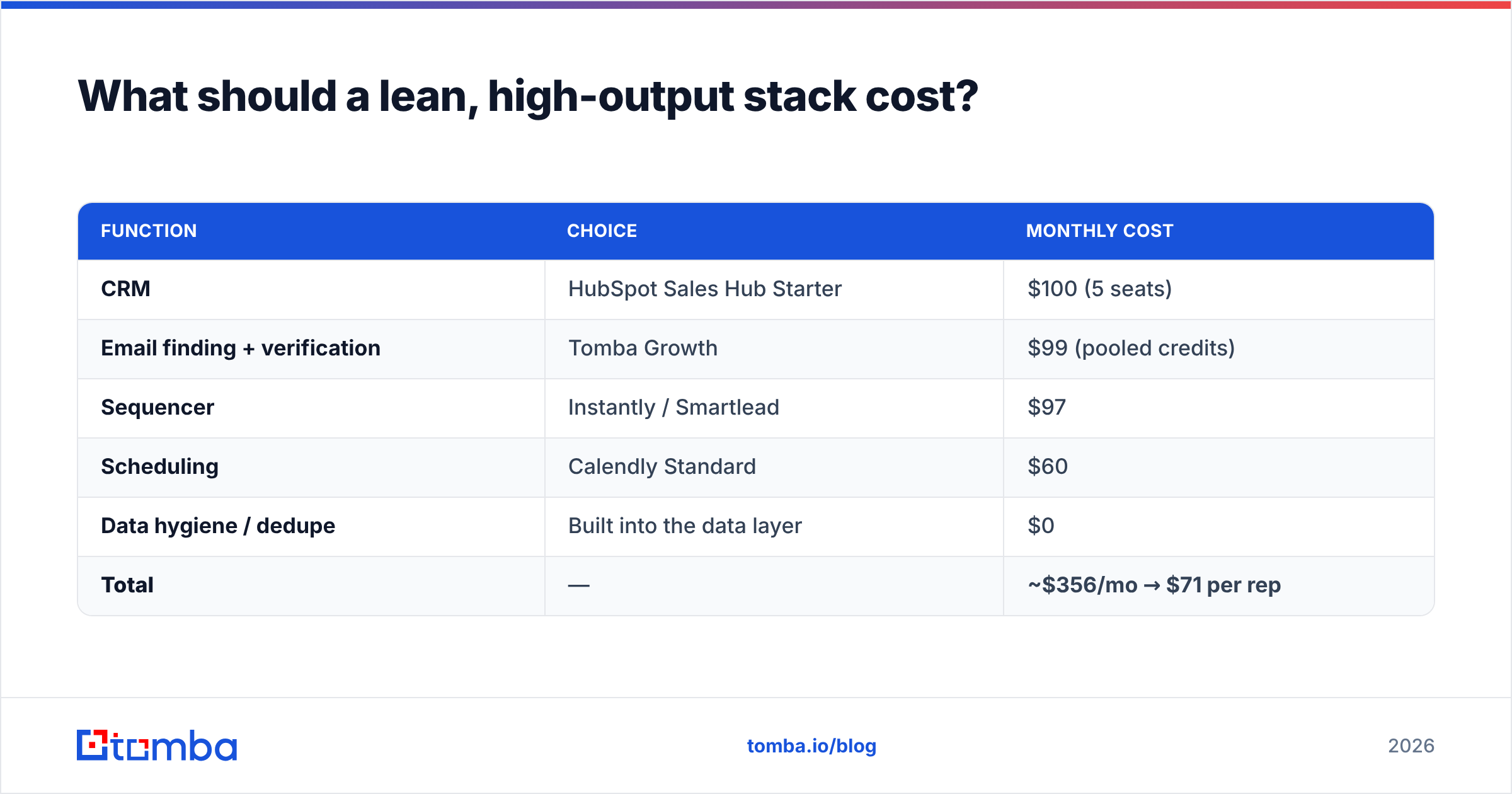
What should a lean, high-output stack cost?#
Here is a working reference build for a 5-rep outbound team that wants full coverage without enterprise rates.
| Function | Choice | Monthly cost |
|---|---|---|
| CRM | HubSpot Sales Hub Starter | $100 (5 seats) |
| Email finding + verification | Tomba Growth | $99 (pooled credits) |
| Sequencer | Instantly / Smartlead | $97 |
| Scheduling | Calendly Standard | $60 |
| Data hygiene / dedupe | Built into the data layer | $0 |
| Total | — | ~$356/mo → $71 per rep |
That is a functioning outbound motion at roughly a fifth of what a per-seat suite plus intent layer would cost the same team. It is not the right stack for everyone. A 60-rep enterprise org genuinely needs conversation intelligence and forecasting rigor. But the point holds: the cost of sales tech stack ownership scales with the number of jobs you actually run, not with the number of logos in your stack diagram.
The other lever is the API. If you have any engineering capacity, hit a data provider directly via the Tomba API instead of a seat license. That removes an entire category of per-user cost. You pay for lookups, and the lookups map cleanly to pipeline. HubSpot's CRM platform docs show how to wire enrichment into a lifecycle stage rather than a manual rep workflow.
The bottom line#
The cost of sales tech stack ownership is not a pricing-page problem. It is an operating problem. Licenses are what you sign. Utilization, data quality, and integration overhead are what you pay. Audit the stack against jobs-to-be-done, charge the invisible costs honestly, and move spiky consumption off seat-based billing and onto credits.
Start with the layer that has the best cost-to-pipeline ratio: contact data that is actually accurate. The Tomba Email Finder gives you verified professional emails by name, domain, or company. Credits are pooled, so adding a teammate does not raise your bill. The free tier covers 25 searches/month, and paid starts at $49/mo when you outgrow it. Find the contacts, verify them before they hit your sequencer, and let the rest of the stack earn its line item.
Related guides#
// get started
Find, verify and enrich your first contacts today
Start on the free plan with 25 searches a month, then scale when your team is ready.
Free plan · No credit card required · GDPR & CCPA
// about the author