Cost Per Acquisition (CPA): Formula, Benchmarks, and Fixes
Cost per acquisition is the number that decides whether your growth is a business or a hobby. Here's the formula, real 2026 benchmarks by channel, and the five levers that actually move it.
TL;DR
- Cost per acquisition (CPA) = total spend on a channel or campaign ÷ number of acquisitions it produced. The fight is never about the formula — it's about what counts as "spend" and what counts as an "acquisition."
- CPA is not CAC. CPA measures the cost of a defined conversion event (a lead, a trial, a first order). CAC measures the fully loaded cost of a new paying customer, including sales salaries. Confusing them is how teams end up celebrating a $40 CPA on a channel that loses money.
- A "good" CPA only exists relative to LTV. The working rule in B2B SaaS is LTV:CAC ≥ 3:1 with payback under 12 months. Below that, you're buying revenue at a loss and calling it growth.
- Most CPA bloat is a data problem, not a bidding problem. Bounced emails, wrong contacts, and duplicate records inflate the denominator's cost without adding conversions.
- The five levers that actually work: tighten targeting, fix list quality before send, raise conversion rate mid-funnel, shorten the sales cycle, and kill channels that don't clear payback.
Your CFO does not care how many impressions you bought. They care what one new customer costs and how long it takes to earn that money back. Cost per acquisition is where that conversation starts, and it's also where most marketing and sales teams quietly fudge the numbers — usually without meaning to.
This guide covers the definition, the formula (including the parts people leave out), realistic 2026 benchmarks by channel, how CPA interacts with LTV and payback, and the specific operational fixes that bring the number down. No fluff, no "align your funnel" platitudes.
What is cost per acquisition?#
Cost per acquisition is the average amount you spend to produce one acquisition event. That's it.
The complexity is entirely in the word "acquisition." Depending on who's in the room, it can mean:
- A lead — someone filled out a form. Cheapest definition, least meaningful.
- A qualified lead (MQL/SQL) — the lead matched your ICP and showed intent. See what actually counts as a marketing qualified lead before you build a metric on it.
- A trial or demo — a real product or sales touchpoint. Useful mid-funnel.
- A first purchase — the ecommerce default, and the closest thing to a universal definition.
- A new paying customer — this is where CPA starts overlapping with CAC.
Pick one. Write it down. Make everyone use it. Half the CPA arguments inside a company are two people using the same acronym for different events.
The base formula:
CPA = Total campaign cost / Number of acquisitionsSpend $12,000 on LinkedIn ads, book 40 demos, and your cost per demo is $300. Simple — until you ask whether the $12,000 includes the agency retainer, the designer's time, the sales rep who followed up, and the data tool that supplied the contacts. It usually doesn't. That's the first place CPA goes wrong.
Is CPA the same as CAC?#
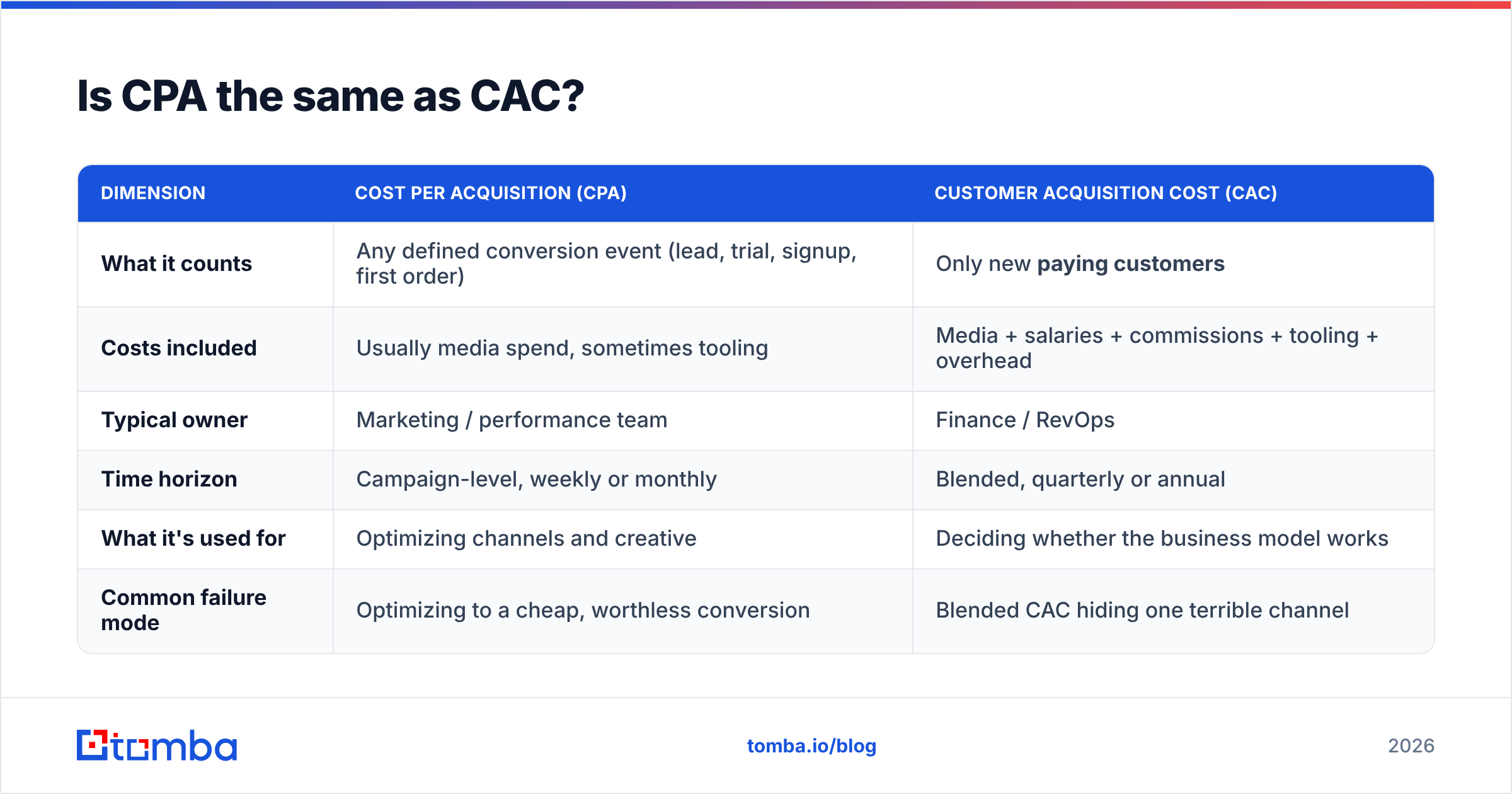
No, and treating them as interchangeable is the single most expensive reporting error in B2B.
| Dimension | Cost Per Acquisition (CPA) | Customer Acquisition Cost (CAC) |
|---|---|---|
| What it counts | Any defined conversion event (lead, trial, signup, first order) | Only new paying customers |
| Costs included | Usually media spend, sometimes tooling | Media + salaries + commissions + tooling + overhead |
| Typical owner | Marketing / performance team | Finance / RevOps |
| Time horizon | Campaign-level, weekly or monthly | Blended, quarterly or annual |
| What it's used for | Optimizing channels and creative | Deciding whether the business model works |
| Common failure mode | Optimizing to a cheap, worthless conversion | Blended CAC hiding one terrible channel |
CPA is a tactical metric — it tells you which ad, list, or channel is efficient. CAC is a strategic metric — it tells you whether you have a business. A team can drive CPA down 40% by chasing cheap, low-intent signups and simultaneously drive CAC up, because none of those signups convert and the sales team burns hours qualifying them out.
If your org has a revenue operations function, this is exactly the kind of definitional plumbing they should own. If it doesn't, someone in marketing needs to volunteer.
How do you calculate CPA correctly?#
The honest version of the formula includes everything you'd stop paying for if you killed the channel tomorrow.
Include these in "total cost":
- Media spend — the obvious one. Ad platform invoices, sponsorship fees, paid placements.
- Data and tooling costs — the prospecting database, the enrichment API, the sequencer, the verification tool. If a channel needs it, it belongs in that channel's cost.
- Creative and content production — the designer, the copywriter, the video editor. Amortize over the campaign's actual life, not the month you paid the invoice.
- Human time — the SDR sending the sequence, the marketer managing the account. Use a loaded hourly rate (salary × 1.25 for benefits and overhead ÷ ~2,000 hours).
- Agency or freelancer fees — retainers and performance bonuses, allocated per channel.
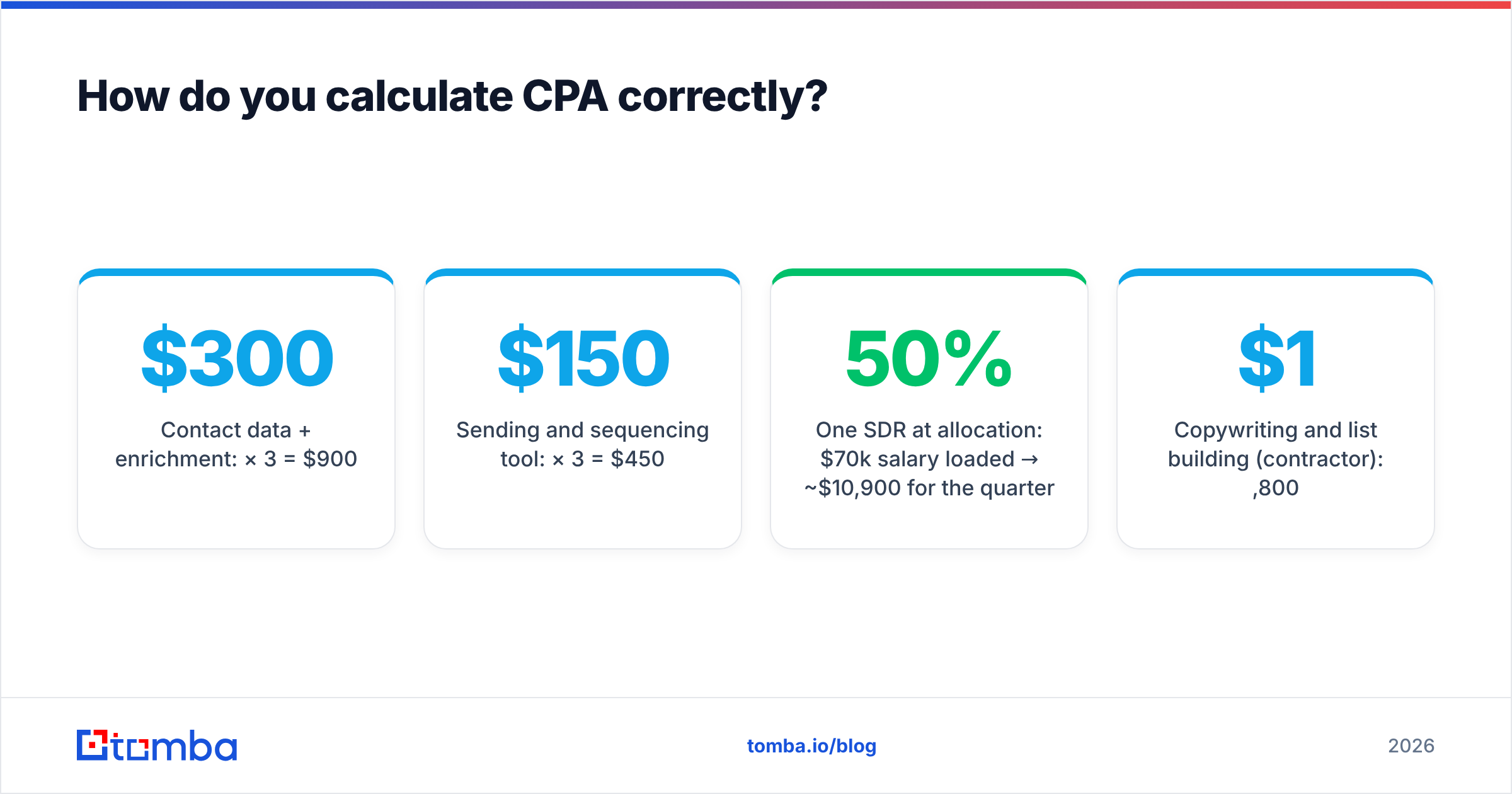
A worked example. You run an outbound campaign for a quarter:
- Contact data + enrichment: $300/mo × 3 = $900
- Sending and sequencing tool: $150/mo × 3 = $450
- One SDR at 50% allocation: $70k salary loaded → ~$10,900 for the quarter
- Copywriting and list building (contractor): $1,800
Total: $14,050. That quarter produces 47 booked meetings and 9 closed customers.
- CPA (per meeting): $14,050 ÷ 47 = $299
- CPA (per customer, channel-level): $14,050 ÷ 9 = $1,561
Now you have two numbers that mean different things and you can defend both. The $299 tells you whether the campaign is working. The $1,561 tells you whether to keep funding it — and that only makes sense next to lifetime value.
What is a good cost per acquisition in 2026?#
There is no universal good CPA. A $900 CPA is catastrophic for a $30/month product and a bargain for a $60k ACV enterprise contract. The only test that generalizes:
Your CPA is good if the customer's lifetime value is at least 3× the fully loaded cost of acquiring them, and you recover that cost in under 12 months.
That's the LTV:CAC ≥ 3:1 rule, and the payback-period constraint is the half people forget. A 5:1 LTV:CAC ratio with a 30-month payback will still starve your cash flow to death.
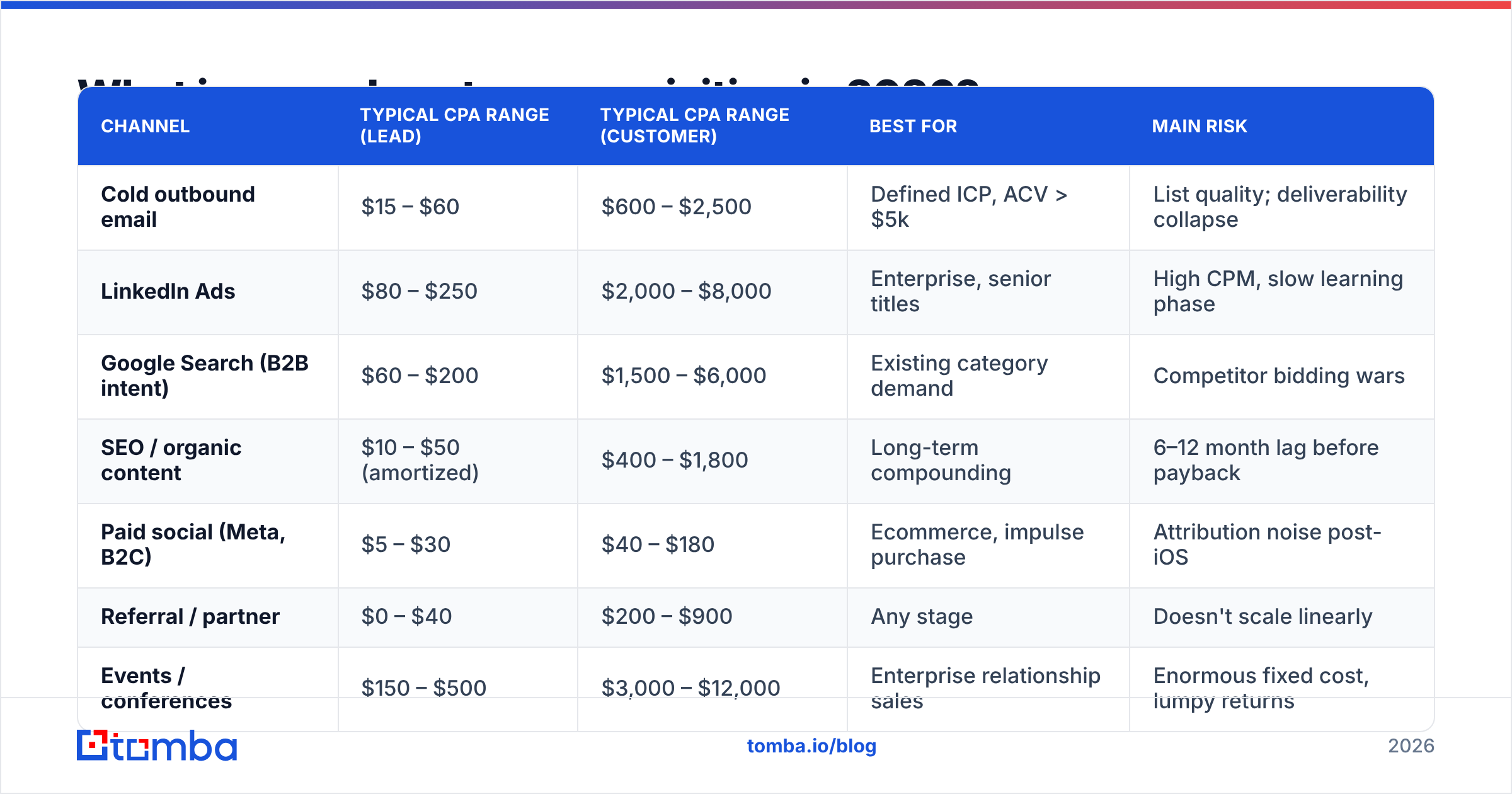
With that caveat loud and clear, here are directional ranges teams are seeing in 2026. Treat them as sanity checks, not targets — your industry, ACV, and geography move these dramatically.
| Channel | Typical CPA range (lead) | Typical CPA range (customer) | Best for | Main risk |
|---|---|---|---|---|
| Cold outbound email | $15 – $60 | $600 – $2,500 | Defined ICP, ACV > $5k | List quality; deliverability collapse |
| LinkedIn Ads | $80 – $250 | $2,000 – $8,000 | Enterprise, senior titles | High CPM, slow learning phase |
| Google Search (B2B intent) | $60 – $200 | $1,500 – $6,000 | Existing category demand | Competitor bidding wars |
| SEO / organic content | $10 – $50 (amortized) | $400 – $1,800 | Long-term compounding | 6–12 month lag before payback |
| Paid social (Meta, B2C) | $5 – $30 | $40 – $180 | Ecommerce, impulse purchase | Attribution noise post-iOS |
| Referral / partner | $0 – $40 | $200 – $900 | Any stage | Doesn't scale linearly |
| Events / conferences | $150 – $500 | $3,000 – $12,000 | Enterprise relationship sales | Enormous fixed cost, lumpy returns |
Two patterns are worth naming.
Organic and referral almost always win on CPA — and almost never win on volume. You can't triple your referral pipeline next quarter by deciding to. Paid channels are expensive precisely because they're controllable.
Outbound has the widest variance of any channel on this list. The same playbook, same ACV, same team can produce a $600 or a $2,500 customer CPA depending entirely on whether the contact data was accurate. Which brings us to the least glamorous, highest-leverage fix available.
Why is your CPA higher than it should be?#
Most teams reach for bidding strategy or ad creative first. Those matter at the margin. But in outbound and lead-gen motions, the biggest CPA inflator is almost always upstream: you're paying full price to contact people who don't exist.
Think of it like a leaking bucket. You can keep pouring water in faster (more spend, more sends, more SDR headcount) or you can patch the holes. The holes are cheaper.
Here's how bad data mechanically raises CPA:
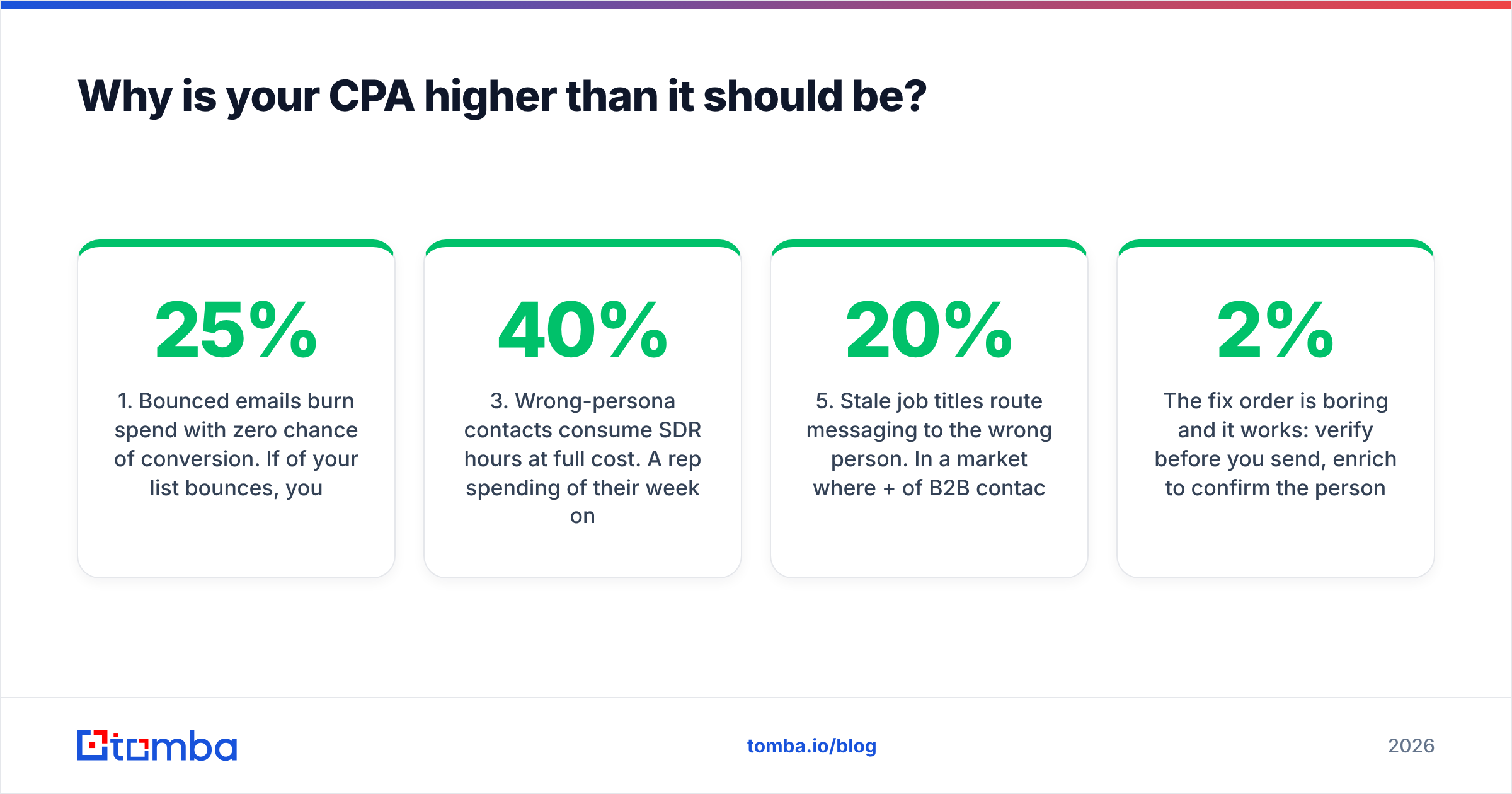
- Bounced emails burn spend with zero chance of conversion. If 25% of your list bounces, you just paid for 25% more contacts than you actually reached, and your CPA rises by ~33% before anything else goes wrong.
- Bounces destroy sender reputation, which suppresses the good contacts too. A high bounce rate pushes your domain toward the spam folder. Now the valid addresses on your list stop converting either. This is the compounding failure — see the email deliverability mechanics for why.
- Wrong-persona contacts consume SDR hours at full cost. A rep spending 40% of their week on prospects who were never buyers is a 40% tax on every acquisition that channel produces.
- Duplicates double-count spend against a single conversion. Two records, two touches, one human, one deal. Your CPA math thinks you tried twice as hard as you did.
- Stale job titles route messaging to the wrong person. In a market where 20%+ of B2B contacts change roles annually, a 12-month-old list is materially wrong.
The fix order is boring and it works: verify before you send, enrich to confirm the person is still in the role, deduplicate, then optimize creative. Running an email verifier over a list before a campaign costs a fraction of a cent per record and routinely cuts bounce rates from double digits to under 2%. That's not a marginal gain — that's the difference between a channel that clears payback and one that doesn't.
What are the five levers that actually lower CPA?#
CPA is a ratio. You lower it by shrinking the numerator or growing the denominator. Everything below is one of those two.
1. Tighten targeting before you tighten bids. Narrowing your ICP raises your cost per impression and lowers your cost per acquisition, because conversion rate climbs faster than CPM does. A campaign targeting "all SaaS companies" and one targeting "Series A–B SaaS companies with 20–100 employees and a named VP of Sales" will have wildly different economics, and the narrow one usually wins even at a higher click cost.
2. Fix list quality before send, not after. Verification and enrichment are pre-flight checks, not post-mortems. Build the email finder → verify → enrich sequence into your pipeline as a hard gate. Nothing sends until it passes. HubSpot's own research on email marketing benchmarks has consistently shown list hygiene as one of the strongest predictors of campaign performance — it's the cheapest optimization available and the one most teams skip.
3. Raise mid-funnel conversion rate. Going from a 2% to a 3% demo-to-close rate cuts your customer CPA by a third, and costs you nothing in media spend. Audit the boring stuff: how fast do you follow up (minutes, not days), how many touches before you give up (5–8, not 2), does the demo actually match what the ad promised.
4. Shorten the sales cycle. Every extra week a deal sits in pipeline is another week of loaded SDR/AE cost attributed to that acquisition. Salesforce's sales productivity research repeatedly finds reps spend the minority of their week actually selling. Removing one qualification call, one internal approval step, or one manual data-entry task from the cycle drops CPA without touching a single ad.
5. Kill channels that don't clear payback — actually kill them. This is the one nobody does. Every quarter, run each channel's fully loaded CPA against its cohort LTV. If a channel can't clear 3:1 with a sub-12-month payback and has had two quarters to prove itself, cut it and redeploy. Sunk-cost loyalty to a channel is the most expensive habit in marketing. (For the formal definition of the metric family, Wikipedia's entry on cost per action is a reasonable neutral baseline.)
How do you track CPA without lying to yourself?#
Three rules.
Attribute honestly, then attribute consistently. Last-touch attribution overcredits the bottom of the funnel; first-touch overcredits the top. Neither is correct. Pick a model, document it, and — this is the part that matters — don't change it mid-year to make a channel look better. Consistency beats accuracy here, because CPA is most useful as a trend line.
Report blended and channel-level CPA side by side. Blended CPA is what the business actually pays. Channel-level CPA is what you optimize. Showing only blended lets a disaster channel hide behind a great one. Showing only channel-level lets you ignore the overhead nobody owns.
Cohort your payback. A $1,500 CPA that pays back in 5 months and a $1,500 CPA that pays back in 20 months are not the same number, and a spreadsheet that averages them is actively misleading you.
If you're running any of this at volume, the operational answer is to make data quality a pipeline step rather than a person's job. Bulk verification before every campaign push, enrichment on inbound form fills, and an automated dedupe pass on CRM import will do more for your CPA than a quarter of creative testing.
Cut the wasted spend at the source#
Your cost per acquisition is a downstream symptom. The upstream cause, more often than not, is that you're paying to reach contacts who bounced, moved, or never matched your ICP in the first place.
Tomba's Email Finder is where that gets fixed — find verified, current professional email addresses by domain, name, or company, so the list you spend money against is a list of people who actually exist. Start free with 25 searches a month, or check Tomba pricing if you're running volume: Starter is $49/mo, Growth $99/mo, Pro $249/mo.
Verify first. Then optimize the ads. Your CPA will thank you, and so will your CFO.
Related guides#
Ready to find emails that actually work?
Join 150,000+ professionals who stopped guessing and started sending. Free credits on signup — no credit card required.
Get the Tomba newsletter
Practical outbound tactics and product updates — once every two weeks.
About the author