Cost Per Lead in 2026: How to Calculate, Benchmark and Cut It
Most B2B teams calculate cost per lead wrong, then optimize the wrong channel. Here are the 2026 benchmarks, the formula that includes hidden costs, and the levers that actually move CPL down.
TL;DR
- Cost per lead (CPL) = total campaign spend ÷ qualified leads generated. Most teams break it by counting raw form fills instead of qualified leads, and by leaving tools, data, and salaries out of "spend."
- B2B CPL in 2026 ranges from roughly $30 on organic/outbound-heavy motions to $400+ on paid search in competitive SaaS and fintech categories.
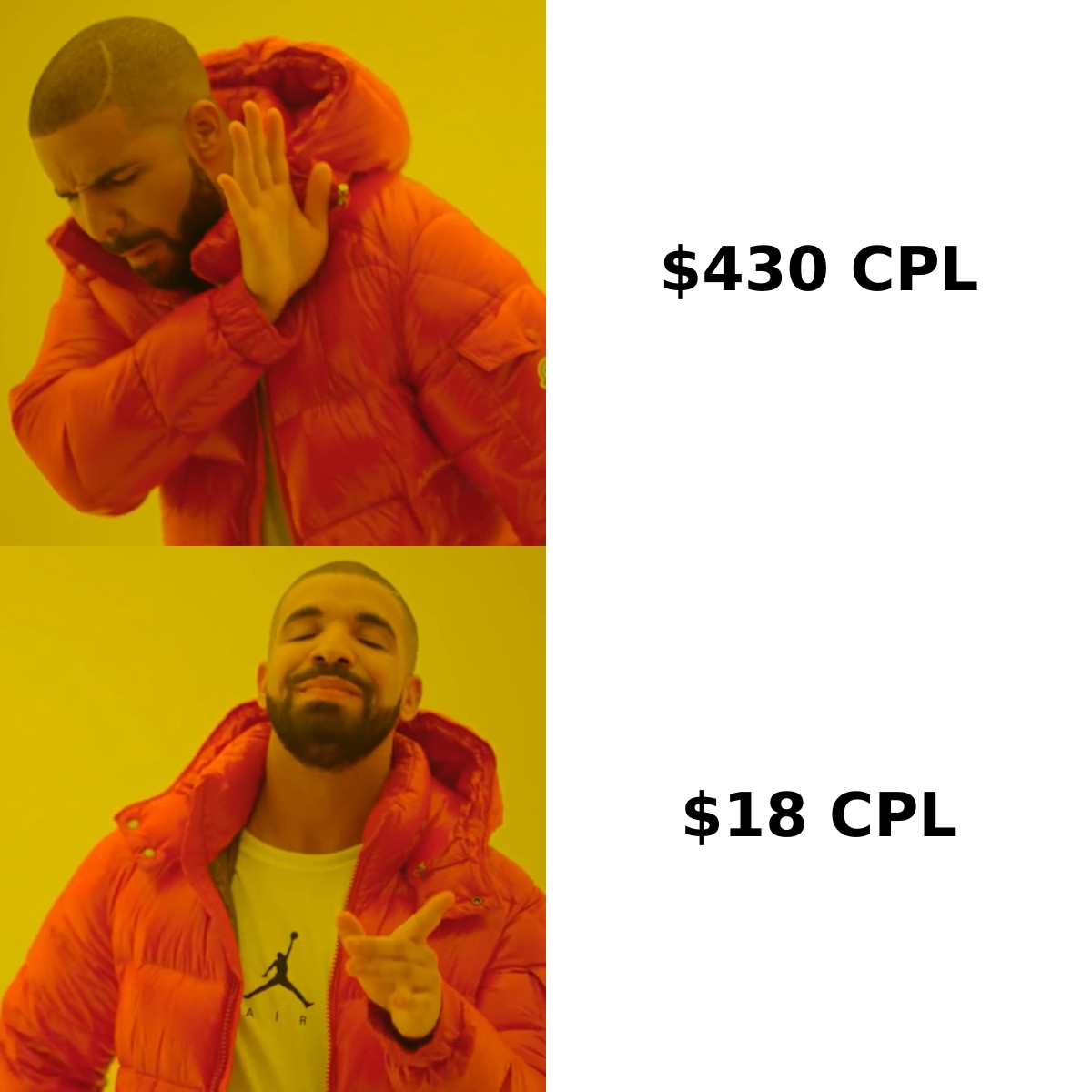
- A low CPL is not automatically good. A $22 lead that never converts is more expensive than a $250 lead that closes at 20%.
- The single biggest hidden CPL tax in outbound is bad data: bounced emails, wrong contacts, and duplicate records inflate your denominator's cost without adding a single real conversation.
- The fastest CPL wins are usually (1) killing your worst channel, (2) fixing lead quality gates, and (3) cleaning your contact data before you spend a cent on sending.
What is cost per lead, exactly?#
Cost per lead is the average amount you spend to acquire one lead. The formula is deceptively simple:
CPL = Total campaign spend ÷ Number of leads generated
Spend $10,000 on LinkedIn Ads, get 100 leads, and your CPL is $100. Done.
Except it almost never is. Two things quietly wreck this number in practice:
- What counts as "spend"? Ad budget is obvious. The $99/mo data tool, the $6k/mo SDR salary, the agency retainer, and the design hours for the landing page are less obvious — and they're real.
- What counts as a "lead"? If you count every newsletter subscriber and every "just browsing" form fill, your CPL looks fantastic and means nothing.
A CPL calculated on raw form fills is a vanity metric. A CPL calculated on qualified leads — people who match your ICP and showed real buying intent — is a decision-making metric.
The four CPL variants worth tracking#
- Raw CPL — spend ÷ all captured contacts. Useful only for measuring top-of-funnel efficiency of a specific ad creative.
- Cost per MQL — spend ÷ marketing qualified leads. This is what most marketing teams report.
- Cost per SQL — spend ÷ sales-accepted leads. This is the number sales actually cares about, and it's usually 3–5x the raw CPL.
- Cost per opportunity — spend ÷ leads that reached a real pipeline stage. The closest leading indicator of CAC.
If your team only tracks one, track cost per SQL. It's the first number in the chain that survives contact with reality.
How do you calculate cost per lead without lying to yourself?#
Here's the honest formula:
CPL = (Ad spend + Tooling + Content/creative + Fully-loaded headcount time + Data costs) ÷ Qualified leads
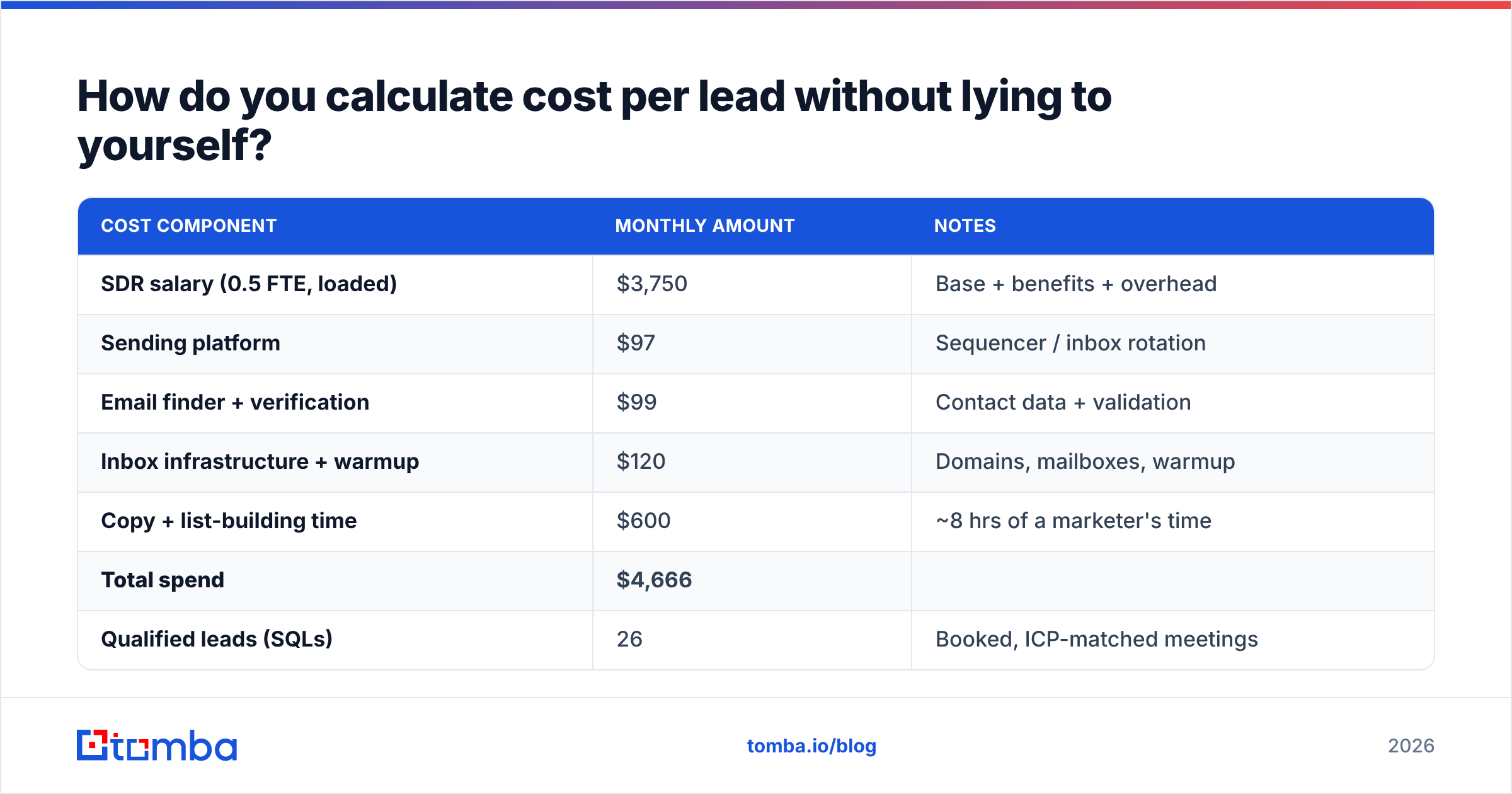
Run it on a single channel over a single month. Let's do a realistic outbound example.
| Cost component | Monthly amount | Notes |
|---|---|---|
| SDR salary (0.5 FTE, loaded) | $3,750 | Base + benefits + overhead |
| Sending platform | $97 | Sequencer / inbox rotation |
| Email finder + verification | $99 | Contact data + validation |
| Inbox infrastructure + warmup | $120 | Domains, mailboxes, warmup |
| Copy + list-building time | $600 | ~8 hrs of a marketer's time |
| Total spend | $4,666 | |
| Qualified leads (SQLs) | 26 | Booked, ICP-matched meetings |
| Cost per SQL | $179 |
That $179 is the number you can actually act on. Compare it to the paid-search version of the same exercise and you'll usually find one channel is quietly subsidizing another's bad math.
Two rules make this work:
- Attribute over the right window. A 45-day sales cycle means January's spend produces February's leads. Comparing same-month spend to same-month leads on a long-cycle product will make your CPL look wildly volatile.
- Include the failures. The 4,000 emails that bounced cost you money — in data credits, in sender reputation, and in the deals you never got because your domain got throttled. Bake that in.
What is a good cost per lead in 2026?#
There is no universal "good." A $400 CPL is excellent if your ACV is $80,000 and terrible if you're selling a $29/mo product. But benchmarks give you a sanity check.
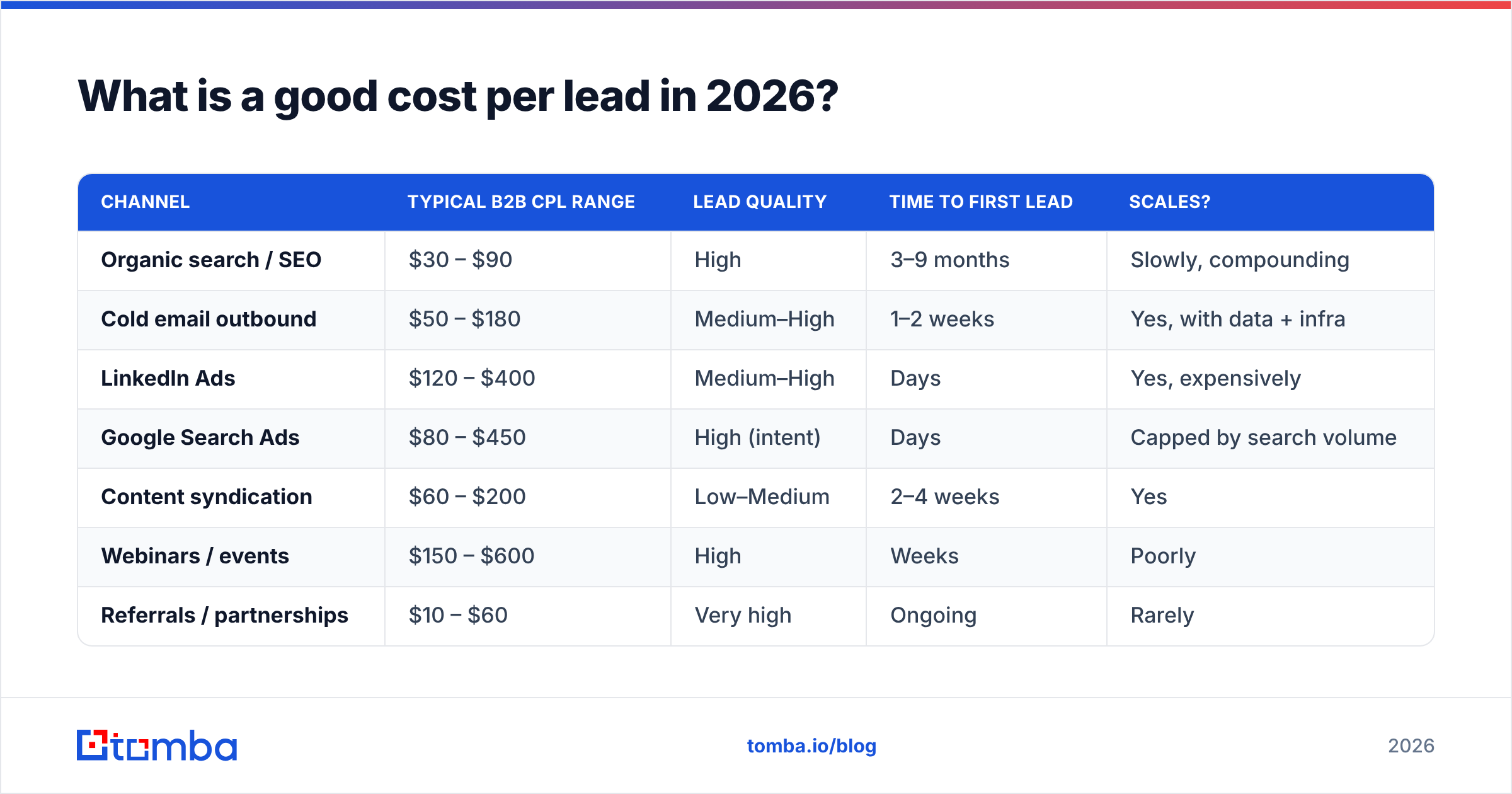
Here's where B2B CPL generally lands by channel in 2026, based on aggregated vendor reporting and practitioner surveys:
| Channel | Typical B2B CPL range | Lead quality | Time to first lead | Scales? |
|---|---|---|---|---|
| Organic search / SEO | $30 – $90 | High | 3–9 months | Slowly, compounding |
| Cold email outbound | $50 – $180 | Medium–High | 1–2 weeks | Yes, with data + infra |
| LinkedIn Ads | $120 – $400 | Medium–High | Days | Yes, expensively |
| Google Search Ads | $80 – $450 | High (intent) | Days | Capped by search volume |
| Content syndication | $60 – $200 | Low–Medium | 2–4 weeks | Yes |
| Webinars / events | $150 – $600 | High | Weeks | Poorly |
| Referrals / partnerships | $10 – $60 | Very high | Ongoing | Rarely |
Three things jump out of this table every time:
- Referrals are always the cheapest and always the hardest to scale. Everyone knows this. Almost nobody builds a system for it.
- Paid search has the widest range because it's an auction. In crowded categories (cybersecurity, HR tech, fintech), CPCs of $30+ are routine and a 2% form conversion rate puts you well north of $400 per lead.
- Cold email has the best CPL-to-control ratio. You control the list, the message, and the volume. Which is exactly why the data underneath it decides whether your CPL is $50 or $180.
For a more granular view, HubSpot's annual State of Marketing research and G2's category reports are the two sources worth checking against your own numbers rather than trusting a single blog's chart.
Why is your cost per lead higher than you think?#
Because of the denominator. Every lead you count that isn't real inflates the illusion of efficiency, and every dollar you spend reaching someone unreachable is pure waste.
Four hidden CPL taxes, in rough order of how much money they burn:
1. Bad contact data. This is the big one for any outbound motion. If 30% of your emails bounce, you didn't just lose 30% of your list — you damaged sender reputation, which suppresses inbox placement for the 70% that were valid. Your effective CPL can double from a single dirty list. Running contacts through an email verifier before send is the cheapest CPL reduction available to most teams.
2. Counting the wrong leads. Ebook downloads are not leads. If marketing reports a $40 CPL and sales says "none of these are real," you don't have a cheap channel — you have a measurement problem. Define the qualification gate before the campaign starts, not after.
3. Duplicate and stale records. The same person entering your CRM three times from three campaigns triples your apparent lead count and destroys your CPL math. B2B contact data decays at roughly 25–30% per year as people change jobs.
4. Untracked human hours. The SDR who spends 11 hours a week manually hunting for email addresses on LinkedIn is a real cost. At a loaded rate of $45/hr, that's $2,000/month of pure list-building — often more than every tool in the stack combined.

How do you actually lower cost per lead?#
Six levers, ordered by speed of payoff.
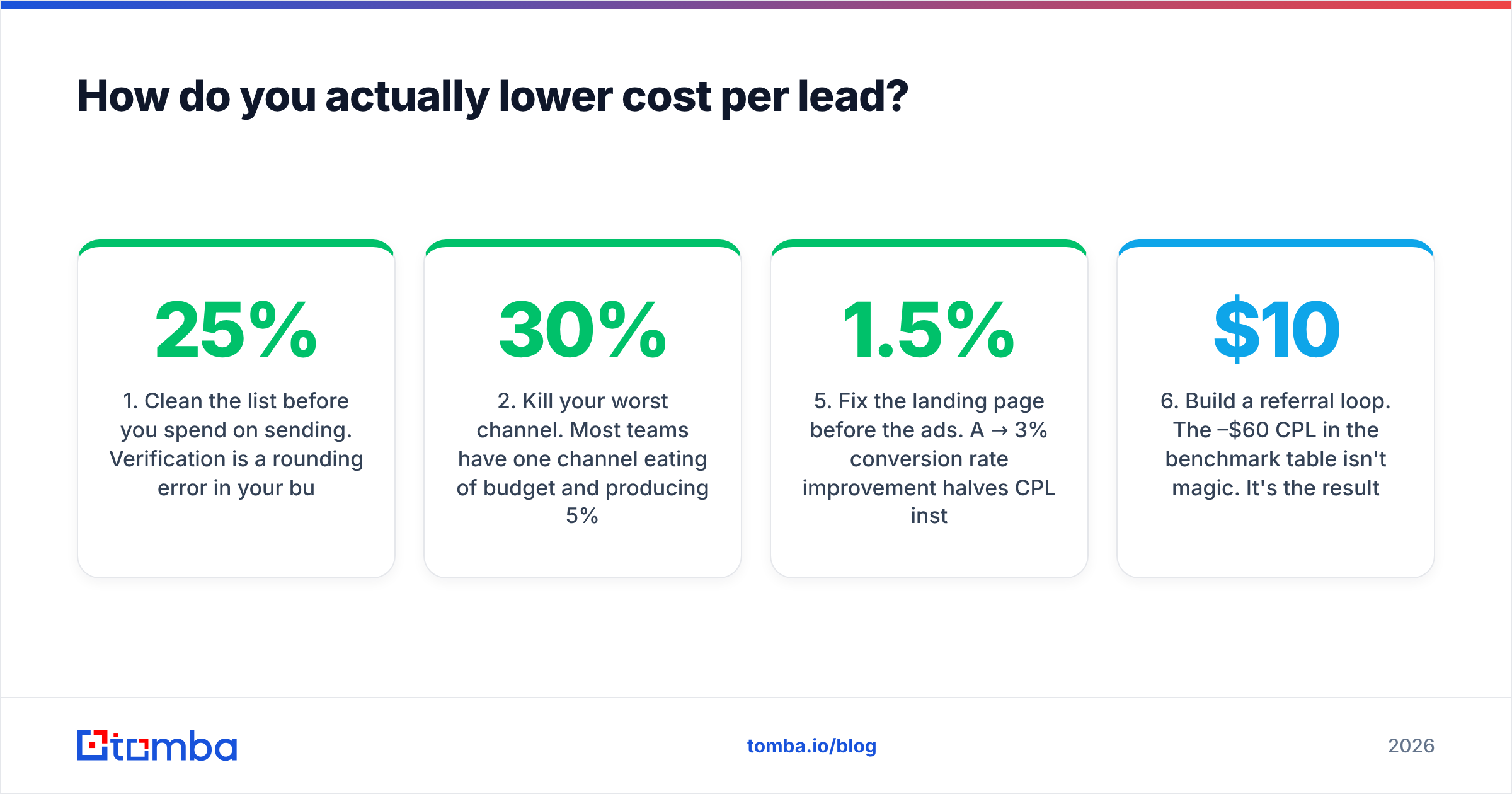
1. Clean the list before you spend on sending. Verification is a rounding error in your budget and one of the largest multipliers on effective CPL. Pair it with a catch-all verifier so catch-all domains don't get dumped into "unknown" and silently skipped — in most B2B lists, catch-all domains are 15–25% of enterprise targets and skipping them means skipping your best accounts.
2. Kill your worst channel. Most teams have one channel eating 30% of budget and producing 5% of qualified pipeline. Everyone knows which one it is. Nobody wants to say it in the meeting. Cutting it and redistributing the spend usually drops blended CPL 15–25% in one quarter.
3. Tighten the ICP, not the message. Broad targeting produces cheap raw leads and expensive qualified leads. Narrowing your target list from "all SaaS companies" to "Series A–B SaaS, 20–200 employees, US, with a named Head of Growth" will raise your raw CPL and cut your cost per SQL — which is the one that matters.
4. Automate list building. If your reps are copy-pasting from LinkedIn, you're paying senior-ish salaries for junior data entry. A bulk email finder or a domain search run against your target account list turns an 11-hour week into a 20-minute job.
5. Fix the landing page before the ads. A 1.5% → 3% conversion rate improvement halves CPL instantly at the same ad spend. It is almost always cheaper to improve conversion than to buy more traffic.
6. Build a referral loop. The $10–$60 CPL in the benchmark table isn't magic. It's the result of one person owning partner and customer referral motions as a real job, with a real target.
Which lead-source approach gives the best CPL?#
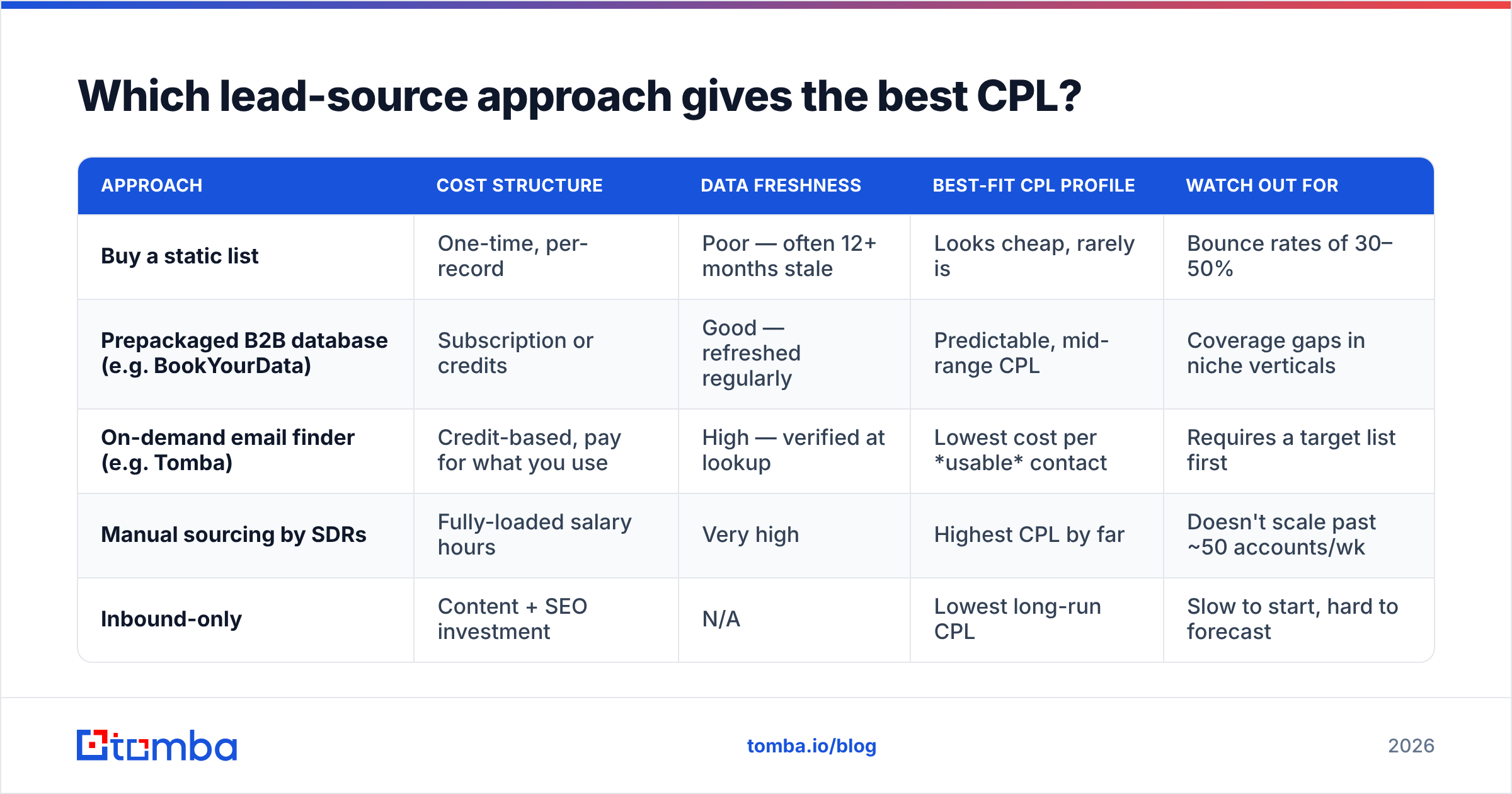
It depends on your motion — but here's how the main approaches compare on the metrics that drive CPL.
| Approach | Cost structure | Data freshness | Best-fit CPL profile | Watch out for |
|---|---|---|---|---|
| Buy a static list | One-time, per-record | Poor — often 12+ months stale | Looks cheap, rarely is | Bounce rates of 30–50% |
| Prepackaged B2B database (e.g. BookYourData) | Subscription or credits | Good — refreshed regularly | Predictable, mid-range CPL | Coverage gaps in niche verticals |
| On-demand email finder (e.g. Tomba) | Credit-based, pay for what you use | High — verified at lookup | Lowest cost per usable contact | Requires a target list first |
| Manual sourcing by SDRs | Fully-loaded salary hours | Very high | Highest CPL by far | Doesn't scale past ~50 accounts/wk |
| Inbound-only | Content + SEO investment | N/A | Lowest long-run CPL | Slow to start, hard to forecast |
The pragmatic answer for most teams under 50 people: build your target account list deliberately, then use an on-demand finder to resolve contacts only for accounts you actually intend to work. You stop paying for records you'll never touch, which is the core reason bought lists produce inflated CPLs.
For reference on how contact data is sourced and refreshed, it's worth reading the vendors' own documentation — Tomba's data sources page and any equivalent from your current provider — before you assume records are current.
How does CPL relate to CAC and payback?#
CPL is an input. CAC is the outcome. Chasing CPL without watching the chain downstream is how teams end up celebrating a cheap lead that never becomes revenue.
The chain looks like this:
- CPL — what you paid for the lead.
- Lead → SQL rate — typically 10–25% in B2B.
- SQL → opportunity rate — typically 30–50%.
- Opportunity → closed-won rate — your win rate, typically 15–30%.
- CAC = CPL ÷ (product of those three rates).
Plug in a $100 CPL with a 20% → 40% → 25% chain and your CAC is $5,000. Halve the CPL to $50 and CAC drops to $2,500 — but so does it if you lift close rate from 25% to 50% at the same CPL. Both levers work. Only one of them is usually cheaper to pull.
The trap: aggressively optimizing CPL down often degrades the rates below it. Cheaper leads are usually less qualified leads. Track the full chain, or you'll optimize your way into a bigger, worse funnel. Gartner's demand-generation research makes the same point repeatedly — pipeline efficiency beats top-of-funnel volume in every downturn.
What should you measure weekly?#
Keep the dashboard short. Five numbers:
- Cost per SQL by channel — the headline. Trend it, don't snapshot it.
- Bounce rate — your early-warning system for data quality and deliverability.
- Lead → SQL conversion by source — tells you which cheap channel is actually expensive.
- Time to first touch — leads contacted in under 5 minutes convert dramatically better; slow follow-up silently raises effective CPL.
- Blended CPL — for the board. Useless for decisions, necessary for reporting.
If you can only fix one, fix bounce rate first. It's the fastest, cheapest, and most under-measured lever in the whole list.
Start with the data layer#
The cheapest way to cut cost per lead isn't a new channel, a new agency, or a better ad. It's making sure every dollar you spend on outreach reaches a real, current, ICP-matched human.
That's exactly what the Tomba Email Finder is for — find verified professional email addresses by domain, name, or company, so the list you spend money sending to is one that actually lands. It starts free with 25 searches a month, and paid plans begin at $49/mo; full Tomba pricing is public if you want to run the CPL math yourself before committing.
Run one campaign with a verified list and one with your current list. Compare cost per SQL. The number will tell you what to do next.
Related guides#
Ready to find emails that actually work?
Join 150,000+ professionals who stopped guessing and started sending. Free credits on signup — no credit card required.
Get the Tomba newsletter
Practical outbound tactics and product updates — once every two weeks.
About the author