Courtesy Follow Up Emails: When They Work and When They Don't
A courtesy follow up is the most-sent and least-effective email in B2B. Here's when a polite nudge actually earns a reply, when it burns the thread, and the templates and timing that work in 2026.
TL;DR
- A courtesy follow up is a polite, low-pressure email sent to acknowledge, thank, or gently remind someone after a prior interaction. It is the most common follow-up in B2B and the weakest performer.
- The failure mode is predictable: the email carries no new information. "Just checking in" gives the recipient nothing to react to, so they don't.
- Courtesy follow ups earn their place in exactly three situations — post-meeting thank-yous, post-proposal acknowledgments, and relationship maintenance with warm contacts. Everywhere else, use a value-add follow up instead.
- Timing beats politeness. A 24-hour post-meeting note outperforms a 10-day "circling back" by a wide margin.
- Half of "no reply" cases are not rejection at all — they're bad addresses, spam-foldered sends, or the wrong person. Fix the data before you blame the copy.
What is a courtesy follow up?#
A courtesy follow up is an email whose primary purpose is social, not informational. You're not delivering a new insight, asking a new question, or moving a deal to the next stage. You're signaling attentiveness: thanks for your time, I haven't forgotten you, the ball is in your court.
Think of it like a handshake at the end of a meeting. The handshake doesn't advance the negotiation, but its absence is noticed. That's exactly the tension in this format — the courtesy follow up is polite, expected, and often completely inert.
Typical examples you've sent (or received) a hundred times:
- "Thanks for the great conversation today."
- "Just checking in to see if you had a chance to review."
- "Bumping this to the top of your inbox."
- "Circling back on my note from last week."
The first one is legitimate. The last three are the same email wearing different hats, and none of them give the recipient a reason to move.
Why do most courtesy follow ups get ignored?#
Because they ask the recipient to do all the work.
A buying committee at a mid-market company is fielding dozens of vendor threads. When your email lands with no new fact, no new document, and no clear decision to make, the recipient has to reconstruct the entire context of your last conversation before they can even decide whether to reply. That reconstruction cost is why the message sits unread. Gartner's research on the B2B buying journey makes the same point from the buyer's side: buyers spend the majority of their time not talking to sellers, and information that doesn't help them make progress is noise.
There are three specific reasons a courtesy follow up dies:
- No new information. The email restates what the recipient already knows. There is nothing to react to, so no reaction happens.
- No clear next step. "Let me know your thoughts" is an open-ended request. Open-ended requests get deferred, and deferred means forgotten.
- It arrives on your schedule, not theirs. Following up on day 7 because your sequence said day 7 has nothing to do with when the recipient's internal review actually happens.
There's also a fourth cause that has nothing to do with your writing: the email never arrived. Silence looks identical whether the prospect ignored you or your message bounced into a catch-all void. Before rewriting your copy for the third time, confirm the address is real with an email verifier and check that your domain isn't quietly damaging your email deliverability.

When is a courtesy follow up actually the right move?#
Three cases. That's it.
1. The post-meeting thank-you (within 24 hours). This is the strongest use of the format. You're confirming what was discussed, restating the agreed next step, and putting a written record in the thread. It's courteous and useful. Keep it under 100 words.
2. The post-proposal acknowledgment. After you send pricing or a contract, a short "sent — happy to walk through anything that's unclear" note reduces friction. It gives the buyer permission to ask a dumb question without scheduling a call.
3. Relationship maintenance with a warm, non-active contact. A former champion who moved companies, a customer who churned amicably, a prospect who said "not this year." A no-ask, genuinely-no-agenda check-in every quarter or two is legitimate networking. It only works if you actually don't pitch.
Everywhere else — mid-cycle deals, unresponsive cold prospects, stalled opportunities — the courtesy follow up is the wrong tool. What you want is a value-add follow up: same politeness, but carrying something the recipient didn't have before.
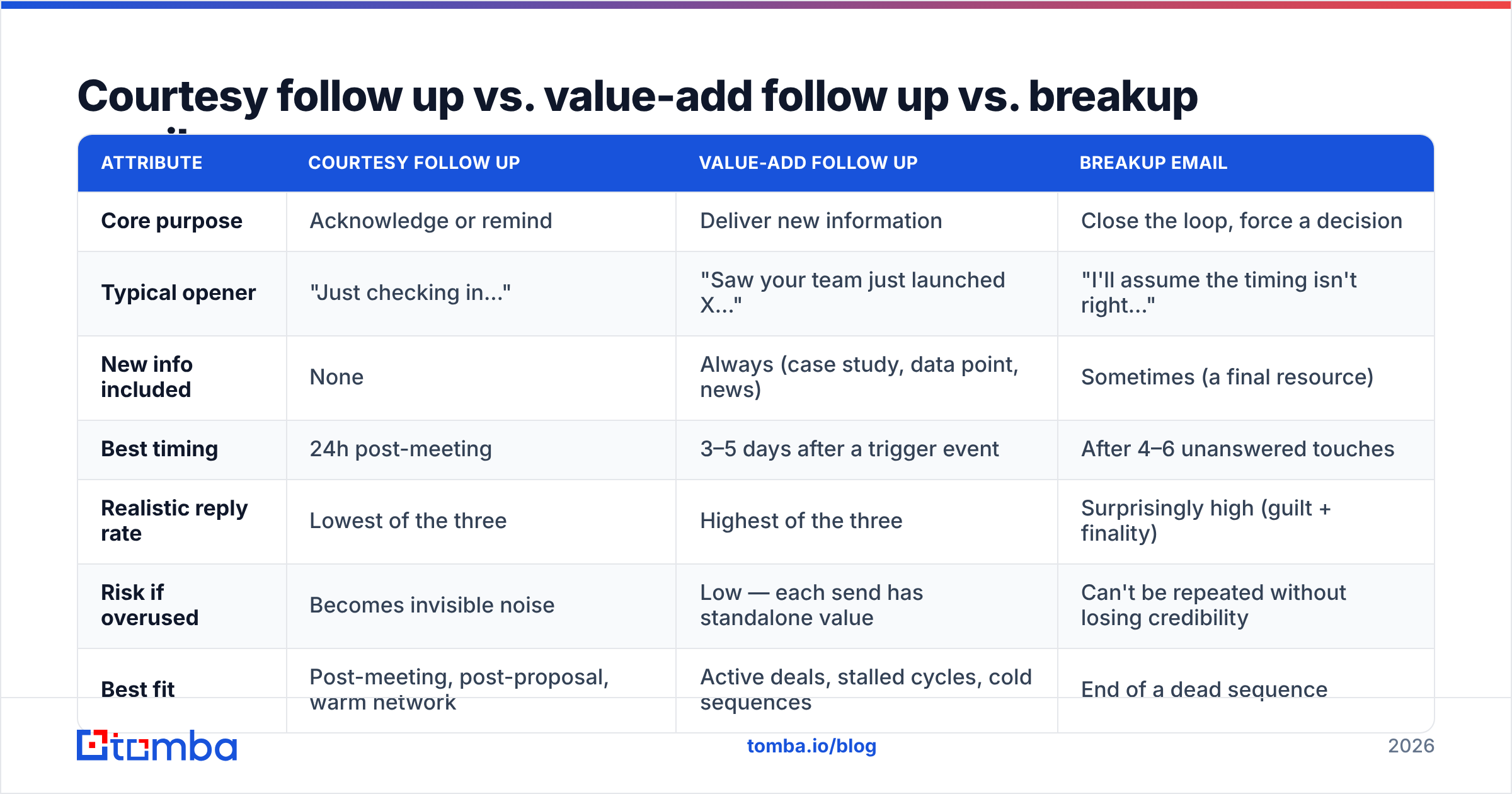
Courtesy follow up vs. value-add follow up vs. breakup email#
| Attribute | Courtesy follow up | Value-add follow up | Breakup email |
|---|---|---|---|
| Core purpose | Acknowledge or remind | Deliver new information | Close the loop, force a decision |
| Typical opener | "Just checking in…" | "Saw your team just launched X…" | "I'll assume the timing isn't right…" |
| New info included | None | Always (case study, data point, news) | Sometimes (a final resource) |
| Best timing | 24h post-meeting | 3–5 days after a trigger event | After 4–6 unanswered touches |
| Realistic reply rate | Lowest of the three | Highest of the three | Surprisingly high (guilt + finality) |
| Risk if overused | Becomes invisible noise | Low — each send has standalone value | Can't be repeated without losing credibility |
| Best fit | Post-meeting, post-proposal, warm network | Active deals, stalled cycles, cold sequences | End of a dead sequence |
| Ideal length | 50–100 words | 80–140 words | 40–70 words |
The pattern in that table is the whole lesson: the email that carries information outperforms the email that carries a feeling. Politeness is table stakes, not a strategy.
How do you rewrite a courtesy follow up so it earns a reply?#
Take the dead version and add one unit of new information. That's the entire operation.
Before (courtesy, inert):
Subject: Checking in
Hi Dana,
Just wanted to check in and see if you had a chance to look at the proposal I sent last week. Let me know your thoughts.
Best,
Sam
After (courtesy + value, alive):
Subject: The onboarding question from Tuesday
Hi Dana,
You asked how long onboarding takes with a 12-person ops team. I pulled the numbers: our last four customers at that size were live in 9–14 days, and the long pole was always SSO provisioning, not data migration.
If SSO is handled on your side, you're realistically looking at two weeks.
Worth a 15-minute call Thursday to map it out, or should I send the migration checklist and let you review it internally first?
Sam
Three things changed. The subject line references a specific moment the recipient remembers. The body answers a question they actually asked. The close offers a binary choice — call or checklist — instead of a vague "let me know."
That last move matters more than people expect. A binary close converts a passive read into a two-second decision. HubSpot's sales team has written about this for years, and the mechanism is simple: a question with two concrete options is easier to answer than a question with infinite options.
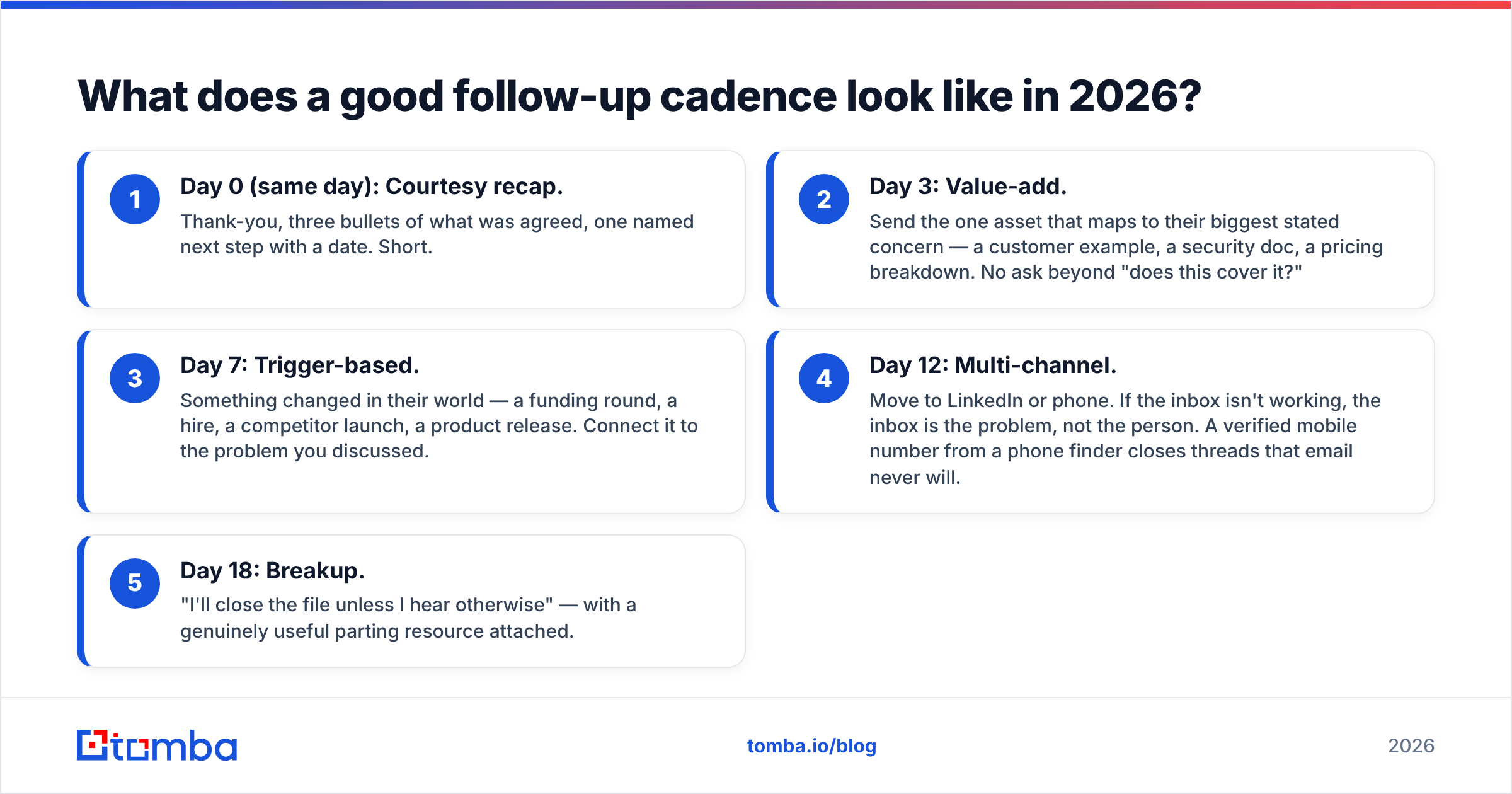
What does a good follow-up cadence look like in 2026?#
Cadence is where courtesy follow ups do the most damage, because they're the easiest email to automate and therefore the one that fills the gaps in a bad sequence.
Here's a sequence structure that works for an active B2B deal after a first meeting:
- Day 0 (same day): Courtesy recap. Thank-you, three bullets of what was agreed, one named next step with a date. Short.
- Day 3: Value-add. Send the one asset that maps to their biggest stated concern — a customer example, a security doc, a pricing breakdown. No ask beyond "does this cover it?"
- Day 7: Trigger-based. Something changed in their world — a funding round, a hire, a competitor launch, a product release. Connect it to the problem you discussed.
- Day 12: Multi-channel. Move to LinkedIn or phone. If the inbox isn't working, the inbox is the problem, not the person. A verified mobile number from a phone finder closes threads that email never will.
- Day 18: Breakup. "I'll close the file unless I hear otherwise" — with a genuinely useful parting resource attached.
Notice there is exactly one courtesy email in that five-touch sequence, and it sits at the front where it belongs. Every subsequent touch carries new information.
Two structural notes. First, don't send follow-ups on the same weekday at the same hour — you become pattern-recognizable and get filtered mentally before you get filtered technically. Second, always reply in-thread for a recap, but start a new thread with a new subject line for a value-add touch. Threads that are six replies deep with no responses are visually dead; a fresh subject line resets the reader.
What tools and data actually change follow-up performance?#
Follow-up copy gets 90% of the attention and delivers maybe 30% of the outcome. The other 70% sits upstream, in whether your email reached a real human at the right company.
Here's the honest hierarchy of what to fix, in order:
- Address validity. A follow-up to a dead mailbox is a follow-up to no one. Bounces also degrade your sender reputation, which quietly suppresses the emails that would have landed. Verify before you sequence, not after.
- Right person, right role. Following up with a champion who left the company three months ago is the most common invisible failure in B2B outbound. Re-enrich your list quarterly.
- Catch-all domains. Many enterprise domains accept everything, so a standard verifier returns "unknown." A dedicated catch-all verifier resolves a chunk of these instead of leaving you guessing.
- Deliverability hygiene. SPF, DKIM, DMARC, and a warmed domain. A perfect follow-up in the spam folder performs identically to no follow-up at all.
- Then, and only then, copy. Rewrite the subject line. Add the value unit. Use the binary close.
Most teams do this list in reverse and wonder why their tenth template rewrite didn't move reply rates. If you want to sanity-check where your list came from and how fresh it is, look at the vendor's data sources — every serious provider publishes theirs, and the ones that don't are telling you something. Comparing tools on real-world accuracy rather than marketing claims is worth an hour of your time; review sites like G2 are a reasonable starting point for how teams actually rate accuracy in practice.
Frequently asked questions about courtesy follow ups#
How many times should you follow up before giving up? Four to six touches across a 2–3 week window for an active deal, ending with a breakup email. More than that on a cold thread produces annoyance, not persistence. If a warm contact goes dark after a live meeting, you can stretch this — but change the channel, not just the copy.
Is "just checking in" ever acceptable? Only in the 24-hour post-meeting recap, and even then, only as a framing phrase — never as the entire email's purpose. If you delete "just checking in" from your draft and nothing of substance remains, the email shouldn't be sent.
Should a courtesy follow up be in the same thread? Yes for recaps and proposal acknowledgments — thread continuity preserves context. No for value-add touches after a stall — start a fresh subject line so the message reads as new rather than as the sixth entry in a dead thread.
What's a realistic reply rate? Post-meeting recaps get replies because the relationship is warm. Mid-cycle "bumping this" emails to unresponsive prospects should be expected to underperform every other touch in your sequence. If your courtesy emails are your best performers, that's usually a sign your other touches aren't carrying enough information — not that "checking in" works.
Does automation ruin courtesy follow ups? Automation ruins generic courtesy follow ups faster, at scale. Automating the timing is fine. Automating the substance is what makes every email read like every other email in the inbox.
The takeaway#
A courtesy follow up is a social gesture, not a sales mechanism. Send it when a gesture is what's actually called for — right after a meeting, right after a proposal, once in a while to someone you genuinely value. Send anything else, and you're asking a busy person to do the work of remembering you.
The rest of the time, replace the courtesy with a reason. One new fact. One specific question. One binary choice.
And before you spend another cycle rewriting subject lines, make sure the emails are landing. Run your list through the Tomba Email Finder to get verified, current addresses for the people you're actually trying to reach — the free tier covers 25 searches a month, and paid plans start at $49/mo on Tomba pricing. A follow-up that reaches a real inbox is the only one that can be ignored on purpose.
Related guides#
Ready to find emails that actually work?
Join 150,000+ professionals who stopped guessing and started sending. Free credits on signup — no credit card required.
Get the Tomba newsletter
Practical outbound tactics and product updates — once every two weeks.
About the author