7 Best Cratio CRM Alternatives for 2026 (Compared & Ranked)
Cratio CRM is cheap and India-friendly, but it is not the right fit for every sales team. Here are seven alternatives compared on price, data quality, automation, and how painful the switch actually is.
TL;DR
- Cratio CRM is a low-cost, India-first sales CRM built around lead capture, telecalling, and field-sales tracking. It is genuinely cheap and genuinely narrow.
- Most teams leave for one of three reasons: they outgrow the automation depth, they want a bigger app/integration ecosystem, or they need a CRM their global team will actually adopt.
- The strongest Cratio CRM alternatives in 2026 are Zoho CRM (best value), HubSpot (best ecosystem), Freshsales (best AI-assisted selling), Pipedrive (best pure pipeline), Kylas (best unlimited-user pricing), LeadSquared (best for high-volume inside sales), and Salesmate (best mid-market balance).
- Switching CRMs fixes workflow problems. It does not fix bad contact data — a CRM full of bounced emails is still a CRM full of bounced emails after migration.
- Budget for two line items, not one: the CRM seat cost, and the data layer that keeps records accurate.
What is Cratio CRM, and who is it actually for?#
Cratio CRM is a sales CRM aimed squarely at Indian SMBs — real estate, education, insurance, manufacturing, staffing, and anyone running a phone-heavy inside-sales motion. Its core loop is: capture leads from web forms, portals, and calls; auto-assign them to reps; track calls and follow-ups; monitor field reps via a mobile app with GPS check-ins.
Check the official Cratio site and you will see the positioning immediately: lead management, telecalling, field-sales tracking, and mobile CRM. That focus is a feature, not a bug. If your reps live on the phone and on the road, Cratio does the job at a price that would make a Salesforce AE laugh.
Where it gets thin:
- Automation depth. Rule-based assignment and reminders are solid. Multi-branch, event-driven workflows across marketing, sales, and support are not the product's center of gravity.
- Ecosystem. The native integration list is short compared to what Zoho, HubSpot, or Pipedrive ship. If your stack has ten SaaS tools in it, expect middleware.
- Reporting. Fine for activity and pipeline basics. Weak if you want cohort analysis, attribution, or revenue forecasting your CFO trusts.
- Global usability. The UI, support hours, and go-to-market are India-centric. Distributed teams often push back.
None of that is disqualifying. It just means the tool has a ceiling — and if you are reading this, you are probably standing on it.
Why do teams look for Cratio CRM alternatives?#
From talking to teams who have made the move, the reasons cluster into five buckets:
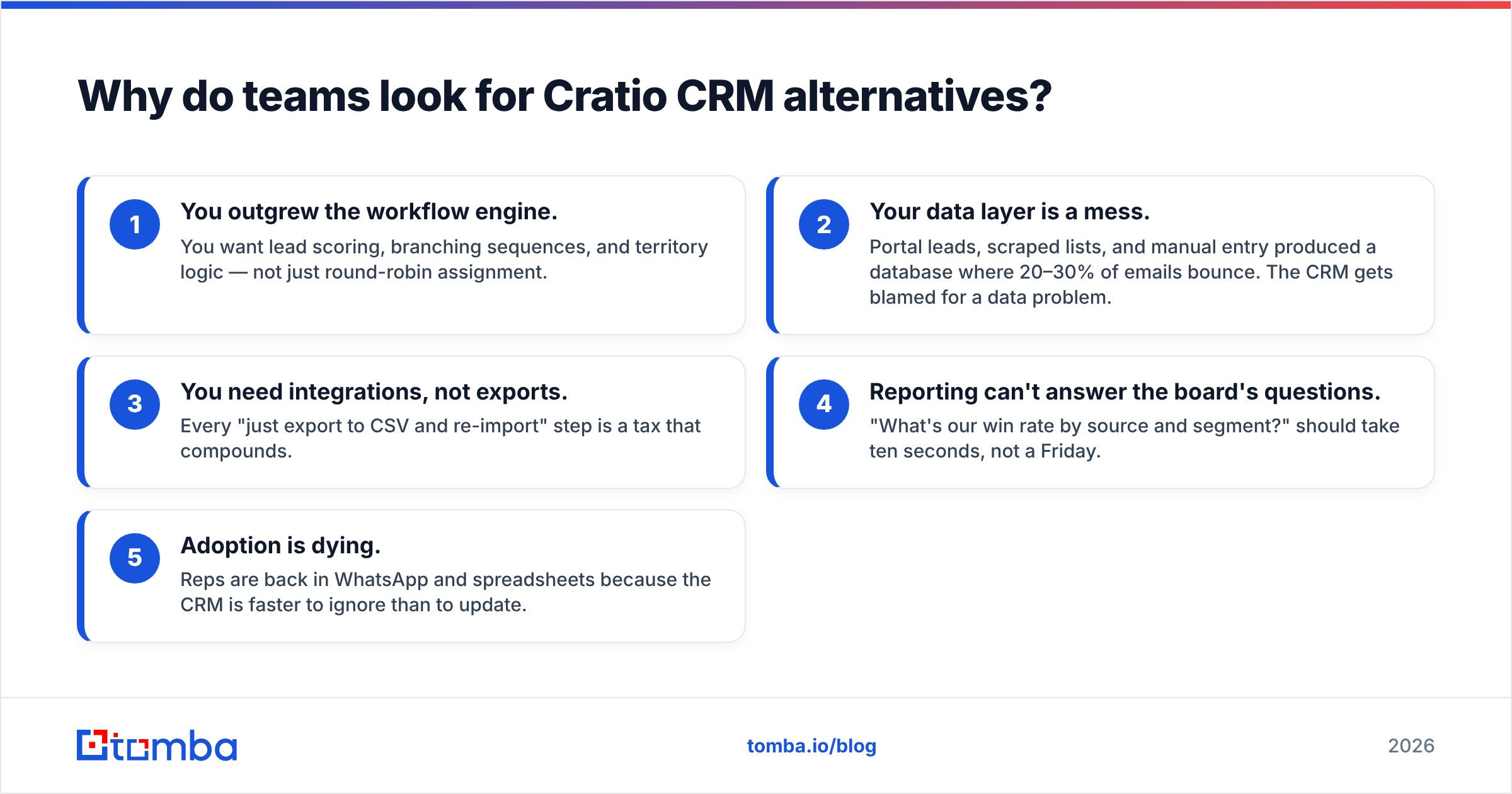
- You outgrew the workflow engine. You want lead scoring, branching sequences, and territory logic — not just round-robin assignment.
- Your data layer is a mess. Portal leads, scraped lists, and manual entry produced a database where 20–30% of emails bounce. The CRM gets blamed for a data problem.
- You need integrations, not exports. Every "just export to CSV and re-import" step is a tax that compounds.
- Reporting can't answer the board's questions. "What's our win rate by source and segment?" should take ten seconds, not a Friday.
- Adoption is dying. Reps are back in WhatsApp and spreadsheets because the CRM is faster to ignore than to update.
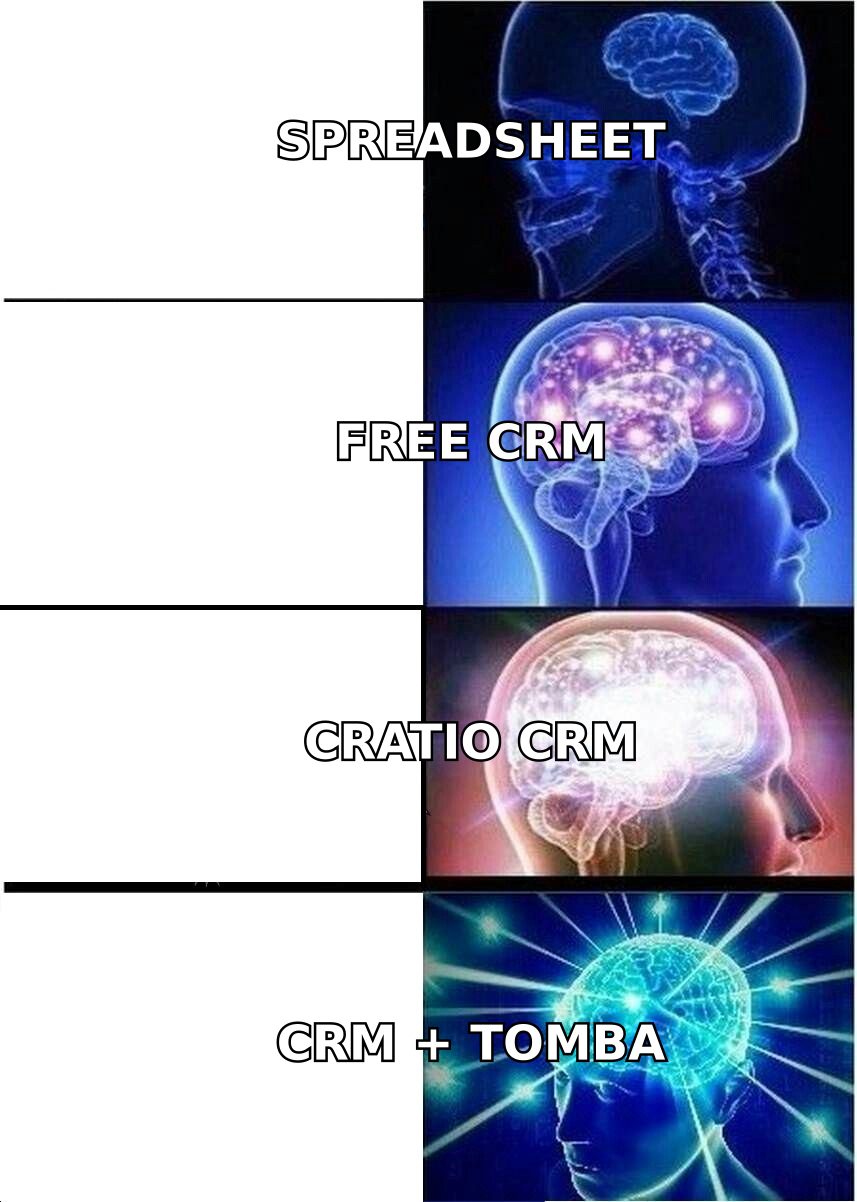
If your reason is #2, read the data section further down before you sign anything. Migrating dirty data into a nicer CRM produces the same bounce rate with a better UI.
What should you compare before switching?#
Before you look at a single demo, write down where you land on these six. It will cut your shortlist in half.
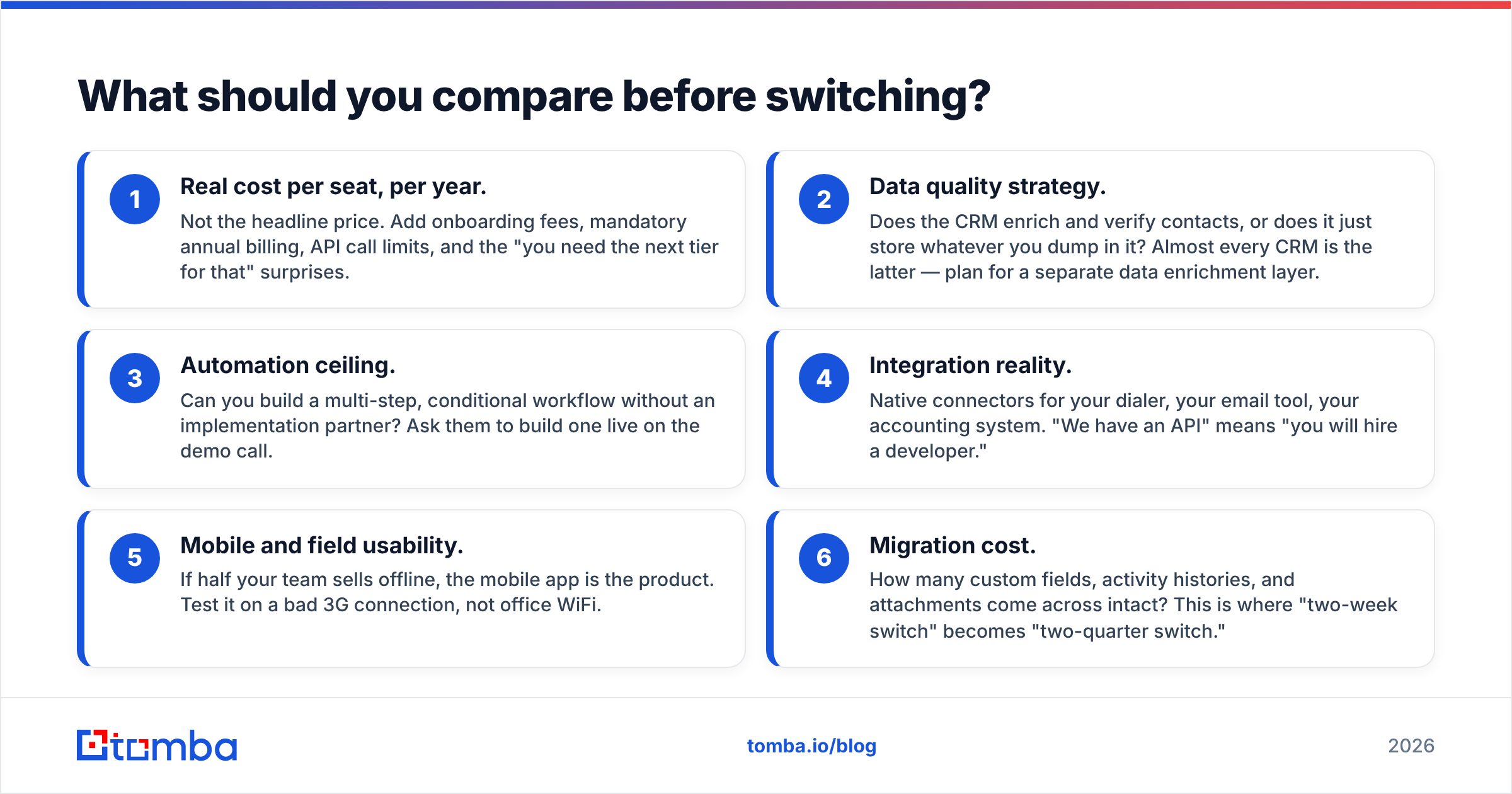
- Real cost per seat, per year. Not the headline price. Add onboarding fees, mandatory annual billing, API call limits, and the "you need the next tier for that" surprises.
- Data quality strategy. Does the CRM enrich and verify contacts, or does it just store whatever you dump in it? Almost every CRM is the latter — plan for a separate data enrichment layer.
- Automation ceiling. Can you build a multi-step, conditional workflow without an implementation partner? Ask them to build one live on the demo call.
- Integration reality. Native connectors for your dialer, your email tool, your accounting system. "We have an API" means "you will hire a developer."
- Mobile and field usability. If half your team sells offline, the mobile app is the product. Test it on a bad 3G connection, not office WiFi.
- Migration cost. How many custom fields, activity histories, and attachments come across intact? This is where "two-week switch" becomes "two-quarter switch."
What are the best Cratio CRM alternatives in 2026?#
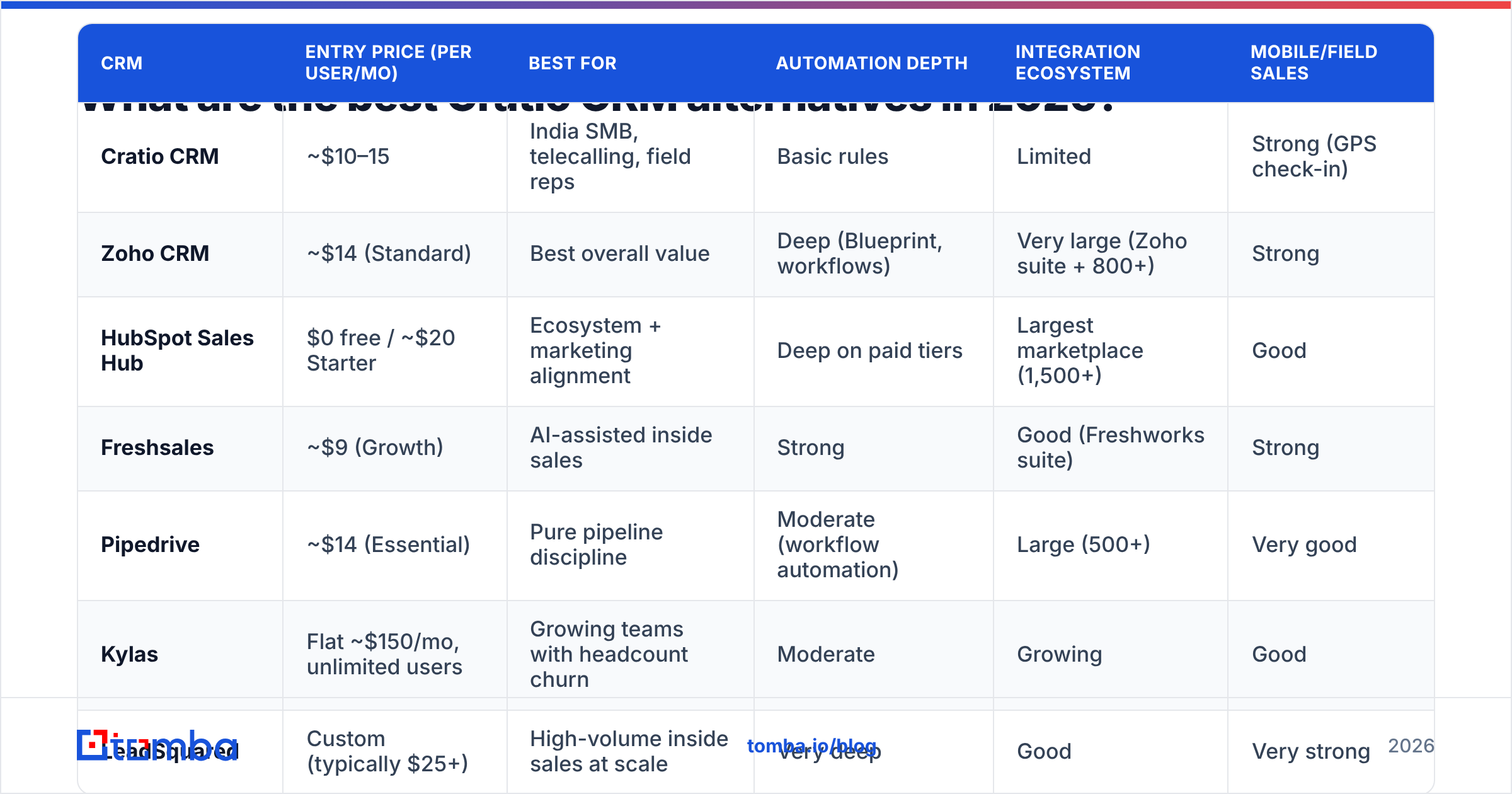
Prices below reflect published list pricing at the time of writing and are rounded to USD equivalents where vendors bill regionally. Always re-check the vendor page — CRM pricing changes more often than the vendors admit.
| CRM | Entry price (per user/mo) | Best for | Automation depth | Integration ecosystem | Mobile/field sales |
|---|---|---|---|---|---|
| Cratio CRM | ~$10–15 | India SMB, telecalling, field reps | Basic rules | Limited | Strong (GPS check-in) |
| Zoho CRM | ~$14 (Standard) | Best overall value | Deep (Blueprint, workflows) | Very large (Zoho suite + 800+) | Strong |
| HubSpot Sales Hub | $0 free / ~$20 Starter | Ecosystem + marketing alignment | Deep on paid tiers | Largest marketplace (1,500+) | Good |
| Freshsales | ~$9 (Growth) | AI-assisted inside sales | Strong | Good (Freshworks suite) | Strong |
| Pipedrive | ~$14 (Essential) | Pure pipeline discipline | Moderate (workflow automation) | Large (500+) | Very good |
| Kylas | Flat ~$150/mo, unlimited users | Growing teams with headcount churn | Moderate | Growing | Good |
| LeadSquared | Custom (typically $25+) | High-volume inside sales at scale | Very deep | Good | Very strong |
| Salesmate | ~$23 (Basic) | Mid-market balance of power/price | Strong (incl. built-in calling) | Good | Good |
Zoho CRM — the default upgrade path#

If Cratio is the entry-level India-first CRM, Zoho CRM is what most teams graduate to. Same regional comfort (Indian support, INR billing, GST-aware invoicing via the wider Zoho suite), but with a workflow engine that scales into genuinely complex sales processes: Blueprint for process enforcement, scoring rules, territory management, and Zia for AI predictions.
The trade-off is Zoho's classic one — the suite is enormous, the UI reflects that, and admin overhead is real. You are buying power at the cost of simplicity.
Pick it if: you want the most capability per dollar and have someone willing to own CRM admin.
HubSpot — the ecosystem play#
HubSpot wins adoption arguments. Reps update it because it is pleasant. Marketing lives in the same object model, so lead-to-close attribution is finally answerable. The free tier is unusually generous, and Starter is cheap.
Then the bill arrives. Contact-tier pricing on Marketing Hub, seat pricing on Sales Hub, and a jump to Professional that surprises people. Model the 24-month cost, not month one.
Pick it if: marketing and sales must operate on one record, and adoption is your bottleneck.
Freshsales — AI-assisted inside sales#
Freshsales (Freshworks) sits close to Cratio's DNA — phone-first inside sales, built-in calling, lead scoring — with a considerably more modern automation layer and Freddy AI for deal insights and next-best-action nudges. Entry pricing is aggressive.
Pick it if: you want Cratio's telecalling motion with better AI and reporting, at a similar price point.
Pipedrive — pipeline discipline, nothing else#
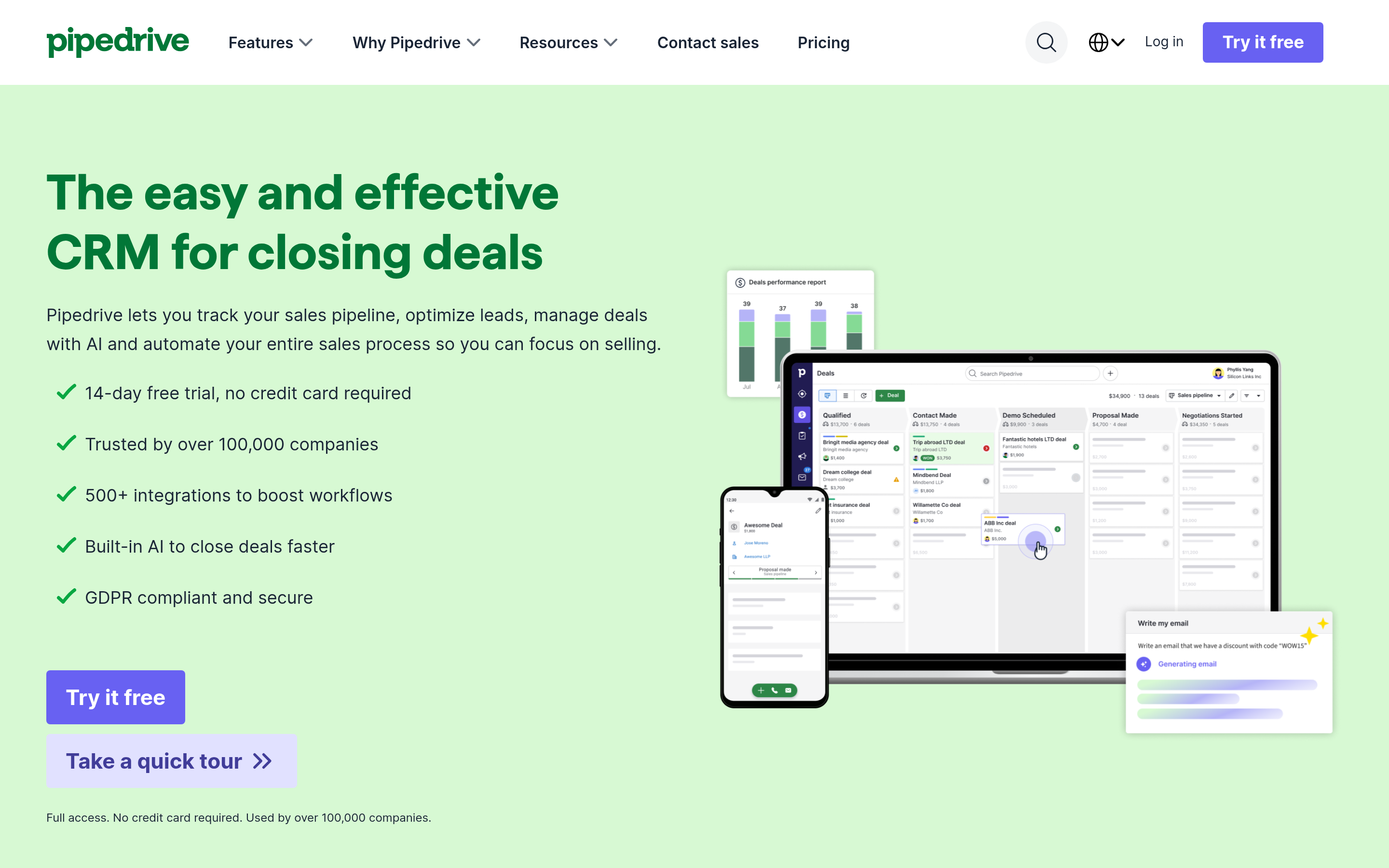
Pipedrive is a pipeline tool with a CRM attached, and it is honest about that. Reps understand it in a day. Deal rot, activity-based selling, and forecasting are excellent. Marketing automation, ticketing, and heavy customization are not the point.
Pick it if: your problem is deal hygiene, not process orchestration.
Kylas — unlimited users, flat fee#
Kylas prices per company, not per seat: one flat monthly fee, unlimited users. For a 25-person telecalling floor with churn, that math is brutal in your favor. The feature set is younger than Zoho's, and the ecosystem is still filling in.
Pick it if: headcount is high and volatile, and per-seat pricing is what actually hurts.
LeadSquared — high-volume inside sales at scale#
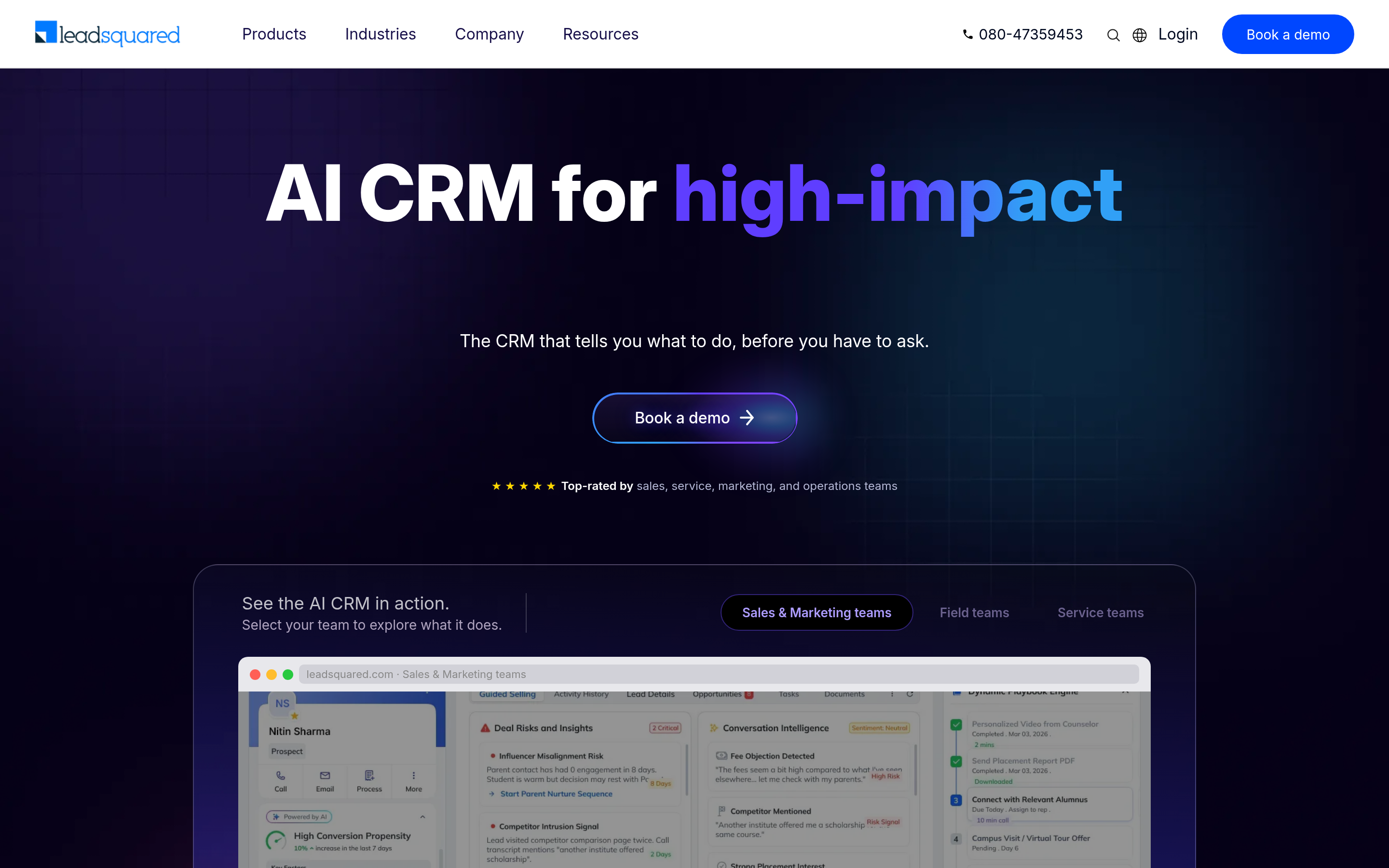
LeadSquared is what Cratio wants to be at 10x the scale: aggressive lead distribution, call-center-grade routing, deep sales-execution reporting, strong vertical templates (edtech, lending, healthcare). Pricing is custom and lands well above SMB tiers. Implementation is a project, not an afternoon.
Pick it if: you run hundreds of reps and lead volume is measured in tens of thousands per month.
Salesmate — the balanced mid-market option#
Salesmate bundles built-in calling, sequences, and pipeline automation without the enterprise sticker. It rarely wins a feature bake-off outright and rarely loses one badly either. Solid G2 standing; verify current ratings on G2 before you decide, since they move quarter to quarter.
Pick it if: you want one tool that does dialing, email, and pipeline without a suite commitment.
Is a CRM switch worth it, or is your data the real problem?#
Here is the uncomfortable part. In most Cratio migrations we have seen, the CRM was doing exactly what it was told. The database it was told to store was the problem.
A CRM is a filing cabinet with a calendar. It stores what you feed it. It does not know that rahul@company.in left the company nine months ago, that the domain now runs a catch-all, or that the mobile number in the record was fat-fingered on a Thursday in 2024. No CRM on the list above fixes that natively at the SMB tier.
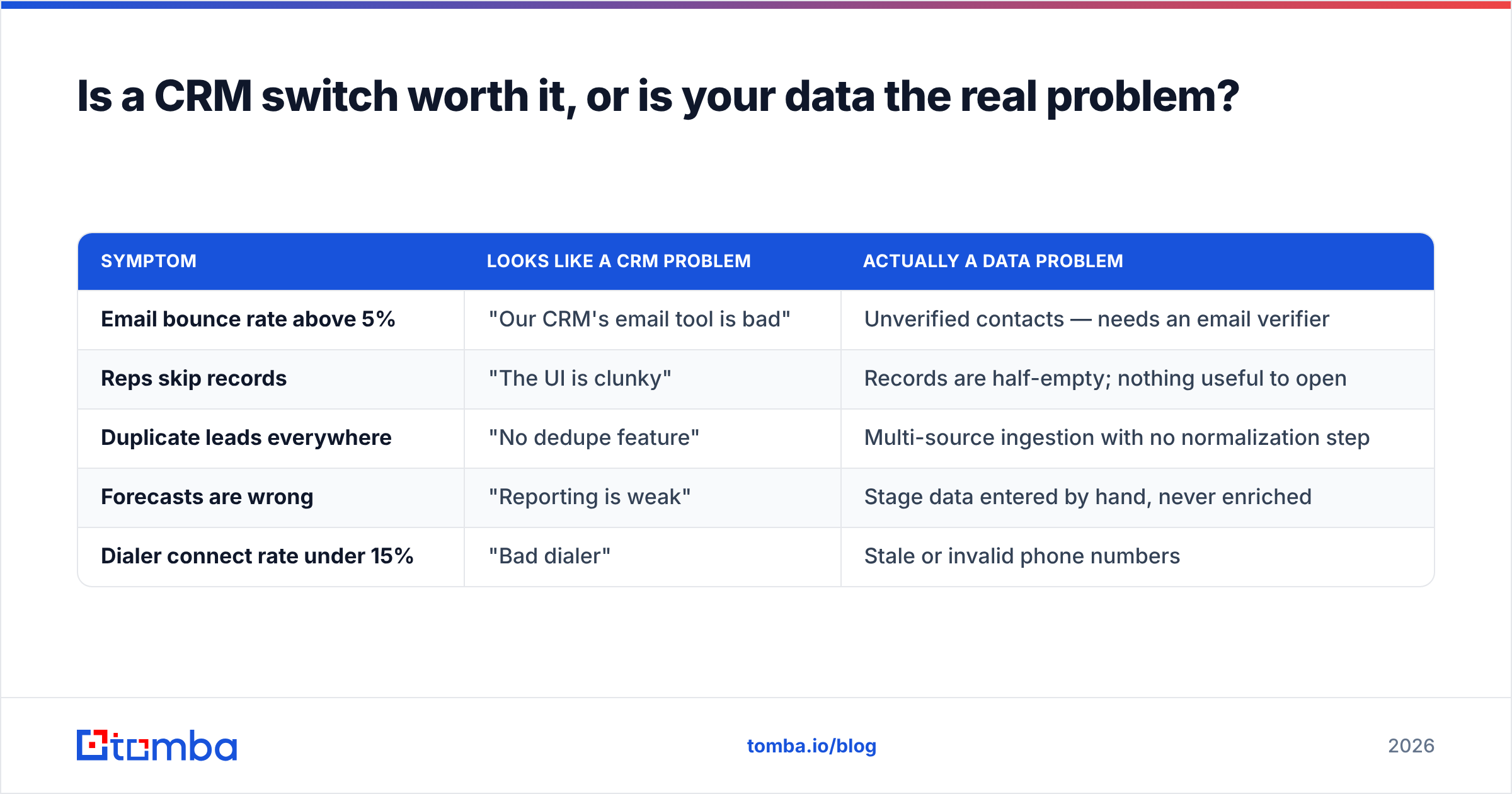
So run this diagnostic before you spend a rupee on migration:
| Symptom | Looks like a CRM problem | Actually a data problem |
|---|---|---|
| Email bounce rate above 5% | "Our CRM's email tool is bad" | Unverified contacts — needs an email verifier |
| Reps skip records | "The UI is clunky" | Records are half-empty; nothing useful to open |
| Duplicate leads everywhere | "No dedupe feature" | Multi-source ingestion with no normalization step |
| Forecasts are wrong | "Reporting is weak" | Stage data entered by hand, never enriched |
| Dialer connect rate under 15% | "Bad dialer" | Stale or invalid phone numbers |
If three or more of those land, fix the data layer first. The right sequence is: verify what you have, enrich what is thin, then migrate the survivors. Migrating 40,000 rows when 12,000 are dead is paying to move garbage into a nicer house.
Practically, that means a pipeline like this:
- Verify every email in the existing export before migration. Anything catch-all or risky gets quarantined, not imported.
- Enrich the surviving records with job title, company size, and LinkedIn so segmentation actually works in the new CRM.
- Find the missing decision-makers you never had — the CRM only knows the contacts you happened to capture.
- Sync the clean set into the new system through a real connector, such as the HubSpot integration, rather than a CSV you re-upload every quarter.
If you would rather buy a clean list outright than build one, BookYourData is a well-regarded option for pre-verified B2B contacts and pairs fine with any CRM on this list.
How do you migrate off Cratio without losing pipeline?#
- Freeze and export. Full export of leads, contacts, deals, activities, and attachments. Confirm what the export actually contains — activity history is the piece that most often gets dropped.
- Audit before import. Run the export through verification. Expect to disqualify 15–30% of a phone-first Indian lead database. That is normal and it is good news: you just cut your seat count requirement.
- Map fields deliberately. Every custom field either earns its place in the new schema or dies here. Migrations are the only moment anyone is willing to delete fields.
- Run parallel for two weeks. New deals in the new CRM, open deals finish where they started. Yes, it is annoying. It is less annoying than losing a quarter.
- Rebuild automation from scratch. Do not port Cratio's rules one-for-one. You are paying for a better engine — redesign the process to use it.
- Set a data refresh cadence. Monthly re-verification of active records, quarterly enrichment sweep. Otherwise you are back here in eighteen months with a different logo on the login screen.
Which Cratio CRM alternative should you actually pick?#
- Under 15 reps, cost-sensitive, India-based: Zoho CRM. It is the highest-ceiling option at the lowest realistic price.
- Marketing and sales must share one record: HubSpot, and budget for the Professional jump.
- Phone-heavy inside sales: Freshsales or Salesmate.
- Fluctuating headcount: Kylas, purely on the flat-fee math.
- Hundreds of reps, industrialized lead flow: LeadSquared.
- You just want deals to stop rotting: Pipedrive.
And in every one of those cases, the CRM is the second decision. The first is whether the contacts going into it are real.
Get the data layer right before you migrate#
Whichever CRM you land on, it will only be as good as the records inside it. Start by finding and verifying the contacts that matter: use the Tomba Email Finder to fill the gaps in your existing database, verify what you already have, and import a clean set instead of a hopeful one. The free tier gives you 25 searches a month to test the accuracy against contacts you can already confirm, and paid plans start at $49/mo — see Tomba pricing for the full breakdown. Clean data first, new CRM second. In that order, the switch actually pays for itself.
Related guides#
Ready to find emails that actually work?
Join 150,000+ professionals who stopped guessing and started sending. Free credits on signup — no credit card required.
Get the Tomba newsletter
Practical outbound tactics and product updates — once every two weeks.
About the author