Crayon Pricing Reviews Pros and Cons: 2026 Buyer's Guide
Crayon doesn't publish a price list. Here's what teams actually pay, what reviewers praise, where the platform frustrates users, and when a cheaper competitive-intel stack does the same job.
TL;DR
- Crayon does not publish pricing. Every deal is a quote, and reported annual contracts cluster roughly between $12,000 and $50,000+ per year depending on seat count, tracked competitors, and whether you buy the battlecard/enablement layer.
- Reviewers consistently praise automated competitor tracking, battlecards, and Slack/Salesforce delivery. The recurring complaints are noise volume, per-competitor cost creep, and time-to-value.
- Crayon is strongest for enablement-led teams at 100+ employees with a dedicated competitive intelligence (CI) owner. It's overkill if nobody is going to curate the feed.
- The honest comparison set is Klue, Kompyte (Semrush), Similarweb, and a DIY stack. A DIY stack costs a fraction but eats analyst hours.
- If your real problem is reaching the buyers you just out-positioned, a CI platform won't fix it. Pair intel with contact data — that's the gap most teams under-fund.
Crayon comes up in almost every competitive intelligence shortlist. It is also one of the hardest tools to price without booking a demo. That is why this page exists. Below is a neutral Crayon pricing reviews pros and cons breakdown: what you actually pay, what buyers say after a year, and whether the line item earns its keep in 2026.
What is Crayon and who is it actually for?#
Crayon is a competitive intelligence platform. It crawls your competitors' public footprint: websites, pricing pages, job postings, review-site profiles, press, social, ad creative, and product changelogs. It turns every change into a feed of "competitive insights." A CI owner curates that feed, and the good stuff gets packaged into battlecards that sales reps consume inside Slack, Salesforce, HubSpot, or Crayon's own app.
The core promise is simple: your competitors change something, you know about it within a day, and your reps have a rebuttal before the next deal cycle. See Crayon's own product pages for the vendor's framing.
Who it fits:
- Product marketing teams with a named CI owner. Someone must curate. Crayon surfaces signal and noise, and un-curated feeds die in three weeks.
- Companies with 3–15 real competitors. Fewer than three, a spreadsheet works. More than fifteen, you're paying per-competitor fees that add up fast.
- Sales orgs of 20+ reps where battlecard adoption actually moves win rate. Below that, the enablement layer is doing very little work.
- Crowded categories — martech, HR tech, fintech, cybersecurity — where positioning shifts monthly and losing a deal to a feature claim is common.
- Teams that already report on competitive win rate. If you can't measure competitive win rate today, you can't prove Crayon's ROI later.
Who it does not fit: pre-PMF startups, teams where "competitive intelligence" means one slide in the QBR, and orgs with no budget owner for it.
How much does Crayon pricing actually cost in 2026?#
Crayon is quote-only. There is no public price list, no self-serve checkout, and no published free tier beyond limited trials. That is a deliberate enterprise sales motion. So every number you see online, including the ones below, is a reported range. It comes from buyer communities, procurement platforms, and review-site disclosures, not an official rate card.
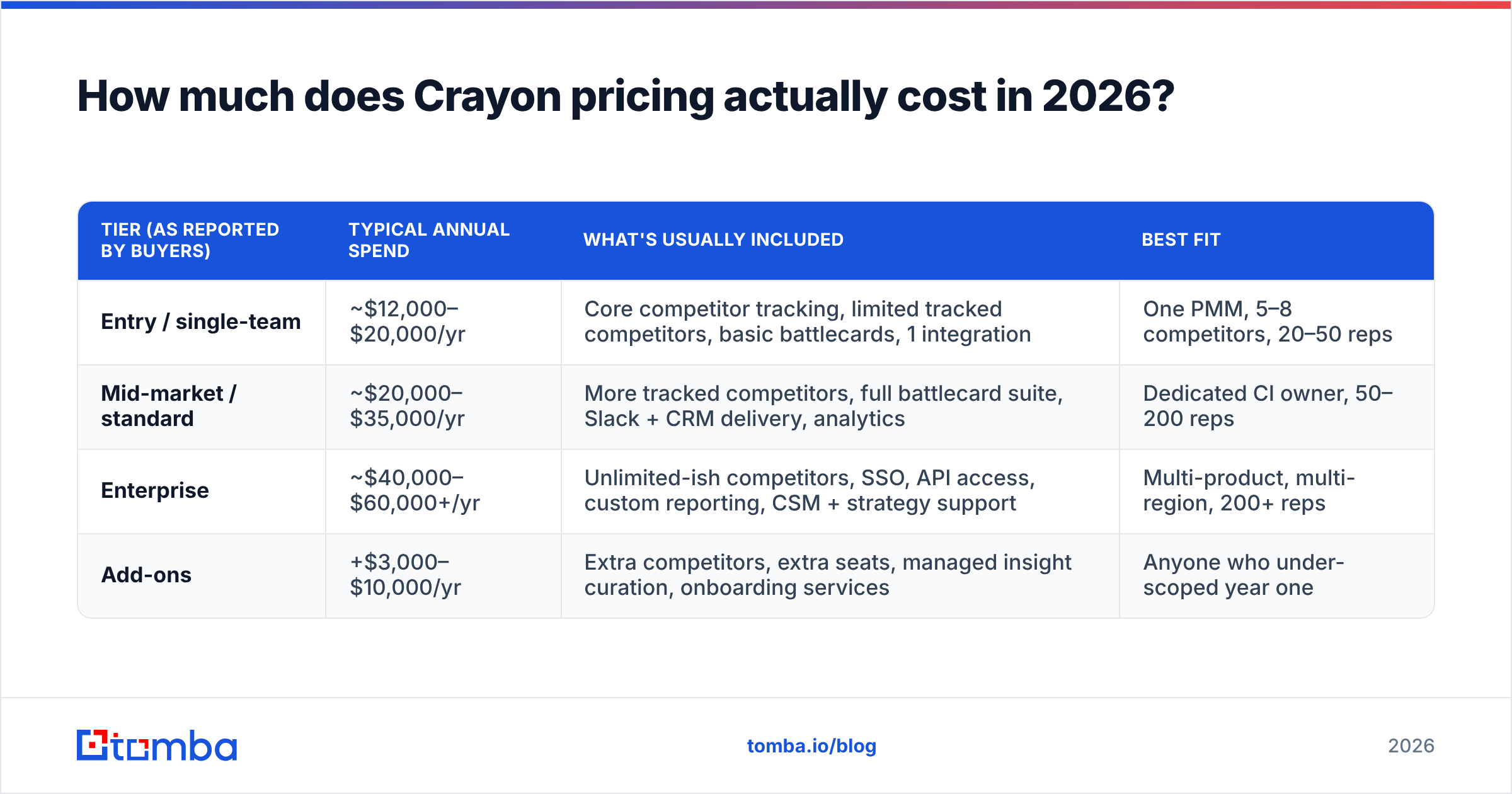
Based on what buyers publicly report, contracts tend to land in these bands:
| Tier (as reported by buyers) | Typical annual spend | What's usually included | Best fit |
|---|---|---|---|
| Entry / single-team | ~$12,000–$20,000/yr | Core competitor tracking, limited tracked competitors, basic battlecards, 1 integration | One PMM, 5–8 competitors, 20–50 reps |
| Mid-market / standard | ~$20,000–$35,000/yr | More tracked competitors, full battlecard suite, Slack + CRM delivery, analytics | Dedicated CI owner, 50–200 reps |
| Enterprise | ~$40,000–$60,000+/yr | Unlimited-ish competitors, SSO, API access, custom reporting, CSM + strategy support | Multi-product, multi-region, 200+ reps |
| Add-ons | +$3,000–$10,000/yr | Extra competitors, extra seats, managed insight curation, onboarding services | Anyone who under-scoped year one |
Treat these as a negotiating baseline, not gospel. Two things move the number more than anything else:
- Number of tracked competitors. This is the meter that spins. Teams routinely scope 5 at signature and want 12 by month four.
- Seats. Reader/consumer seats are cheaper than editor seats, but "everyone in sales gets a login" is how a $20k deal becomes a $35k deal.
The practical read: assume a real first-year cost of $25k–$30k all-in for a mid-market team once you add onboarding, an extra competitor or two, and the seats you forgot about. If that number makes you flinch, that's useful information — flinching now is cheaper than flinching at renewal.
Crayon pricing reviews pros and cons: what reviewers actually say#
Aggregate sentiment on G2 and Capterra is genuinely positive. Crayon sits in the leader quadrant of most CI grids, and reviewers rate it well above average. But the shape of the reviews matters more than the star average. Read fifty of them and the same four themes repeat.
What reviewers reliably praise:
- Automated capture. "I found out about a competitor's pricing change before their own customers did" is the single most common positive. The crawler is good.
- Battlecards reps actually open. The Slack and CRM delivery is the difference between a battlecard living in a wiki nobody reads and one that gets used mid-deal.
- Win/loss and deal-level attribution. Being able to tie a battlecard view to a closed-won deal is what gets the renewal approved.
- Support and CSM quality. Repeatedly called out as strong, especially during onboarding.
What reviewers reliably complain about:
- Noise. The feed captures everything, including a competitor changing a footer link. Without curation discipline, the signal-to-noise ratio degrades and users stop opening it.
- Cost relative to usage. The most damning reviews aren't "it's bad," they're "we paid a lot and three people logged in." That's an adoption problem, but you still paid.
- Time to value. Expect 30–60 days before the battlecards are worth reading. Budget for the ramp.
- Search and organization inside the app. Finding an insight from four months ago is harder than it should be.
Notice the pattern: almost none of the criticism is about the technology. It's about operating model. Crayon is a good tool that punishes teams without an owner.
What are Crayon's biggest pros?#
- Breadth of capture. Pricing pages, ad creative, job posts, review sites, and content — few competitors cover as many surfaces in one crawl.
- Enablement is first-class, not bolted on. Battlecards, Slack alerts, and CRM embeds are the product, not a roadmap item.
- Measurable output. Battlecard usage → deal influence → competitive win rate is a real reporting chain. Most CI tools stop at "here's a feed."
- Integration depth. Salesforce, Slack, HubSpot, Teams, and Highspot connections are mature.
- Analyst-grade credibility. It's a name your CRO has heard of, which matters more in budget defense than anyone admits.
What are Crayon's real cons?#
- Opaque pricing. You cannot budget without a call. For a lot of buyers, that alone disqualifies it at the shortlist stage.
- Per-competitor economics. The pricing model quietly punishes exactly the companies with the most competitors — i.e., the ones who need CI most.
- Curation tax. Budget 5–10 hours/week of a human's time. If you don't have that human, you are buying an expensive RSS feed.
- Weak below ~50 reps. The enablement layer is where the value lives, and it doesn't compound in a small sales org.
- It tells you what changed, not who to call. Crayon is an intelligence layer, not a contact-data layer. Those are different budgets solving different problems — and teams routinely conflate them.
That last point is the one most buyers get wrong, so let's sit on it.
Is Crayon better than Klue, Kompyte, or a DIY stack?#
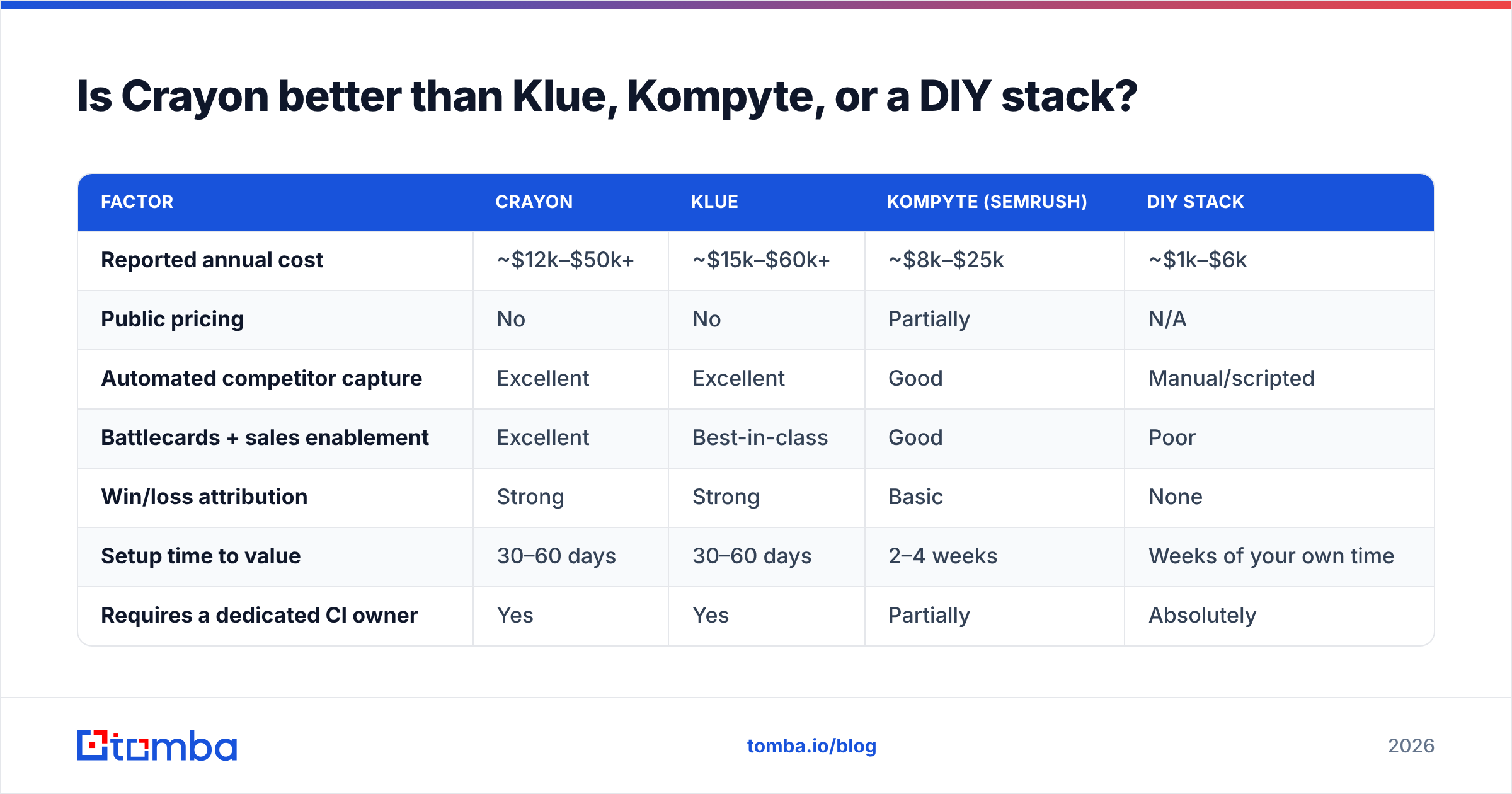
Here's the honest head-to-head. Every one of these is quote-based except the DIY column, so the pricing row is again a reported range, not a rate card.
| Factor | Crayon | Klue | Kompyte (Semrush) | DIY stack |
|---|---|---|---|---|
| Reported annual cost | ~$12k–$50k+ | ~$15k–$60k+ | ~$8k–$25k | ~$1k–$6k |
| Public pricing | No | No | Partially | N/A |
| Automated competitor capture | Excellent | Excellent | Good | Manual/scripted |
| Battlecards + sales enablement | Excellent | Best-in-class | Good | Poor |
| Win/loss attribution | Strong | Strong | Basic | None |
| Setup time to value | 30–60 days | 30–60 days | 2–4 weeks | Weeks of your own time |
| Requires a dedicated CI owner | Yes | Yes | Partially | Absolutely |
| Best for | PMM-led mid-market/enterprise | Enterprise sales enablement | Budget-conscious mid-market | Startups, lean teams |
Reading the table honestly:
- Klue vs Crayon is close enough that the deciding factor is usually your buying center. Sales-enablement-led orgs tend to prefer Klue's rep experience; PMM-led orgs tend to prefer Crayon's capture breadth. Both will quote you similarly.
- Kompyte is the value play. You give up some polish and attribution depth and keep a five-figure sum.
- DIY — Google Alerts, Visualping on pricing pages, a Slack channel, a Notion battlecard, and a monthly review — genuinely works for teams under 50 people. It fails at scale because nobody maintains it.
What does a competitive intelligence platform not solve?#
This is the part vendors skip. A CI platform improves the quality of the conversation you have with a buyer already in your pipeline. It does almost nothing to increase the number of qualified buyers entering it.
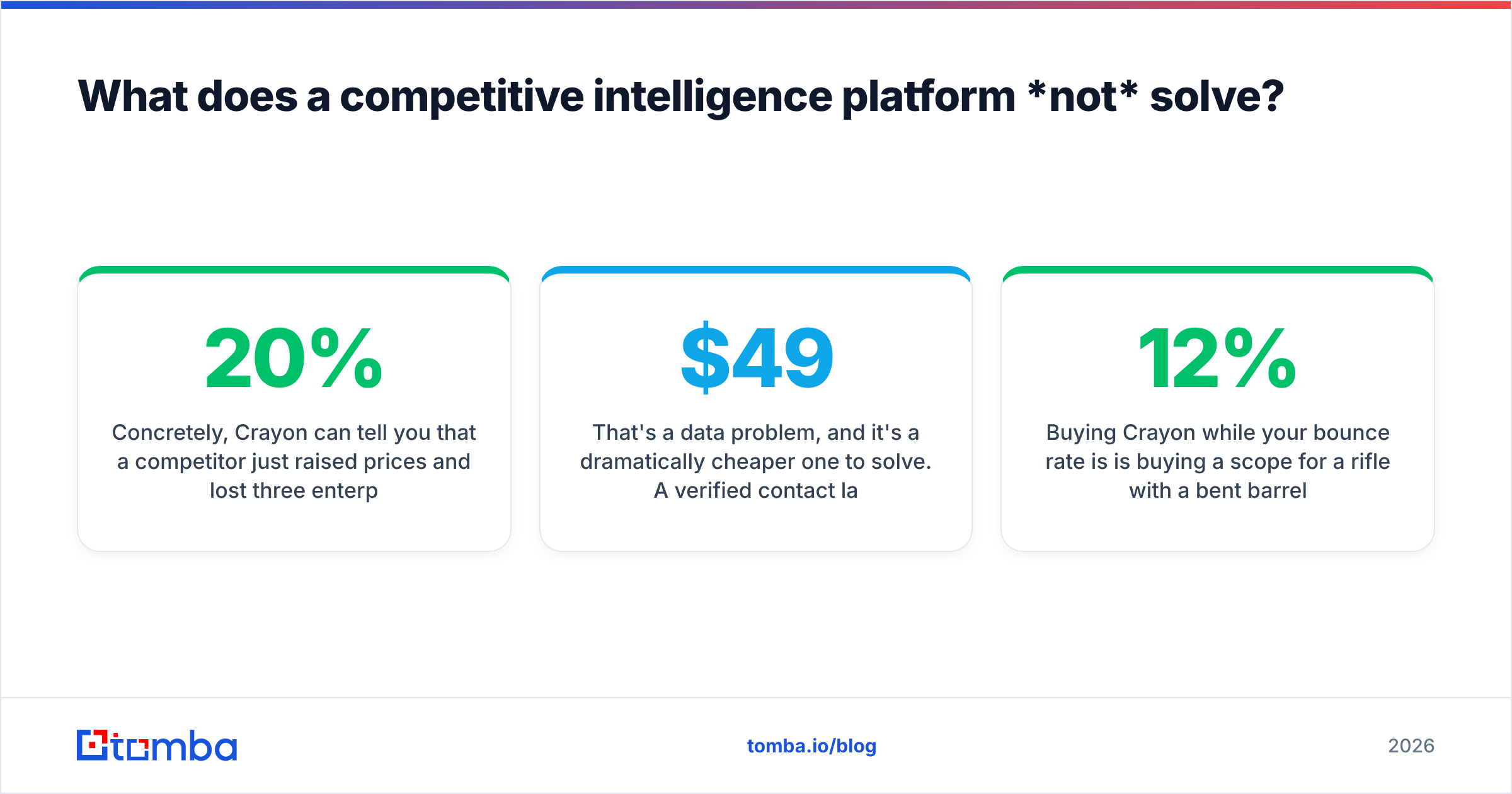
Concretely, Crayon can tell you that a competitor just raised prices 20% and lost three enterprise logos. Excellent. Now: who at those accounts do you email, and at what address? Crayon doesn't answer that, and it isn't trying to.
That's a data problem, and it's a dramatically cheaper one to solve. A verified contact layer — find email addresses by name and domain, verify emails before you send, run a domain search to map an entire account's org chart — typically costs a fraction of a CI contract while directly increasing pipeline volume. Tomba's own plans run Free (25 searches/mo), Starter $49/mo, Growth $99/mo, Pro $249/mo; you can see the full Tomba pricing breakdown for what each tier includes.
The sequencing lesson from teams who've bought both:
- Fix contact data first. If your reps can't reliably reach a decision maker, a better battlecard is a better argument delivered to nobody.
- Fix email deliverability second. Verified addresses, clean lists, warm domain.
- Buy CI third — once the pipeline is full enough that losing competitive deals is your actual bottleneck.
Buying Crayon while your bounce rate is 12% is buying a scope for a rifle with a bent barrel.
Is Crayon worth it for your team?#
Use this as a five-question gate before you take the demo:
- Do you have a named CI owner with 5+ hours/week? No → don't buy any CI platform yet.
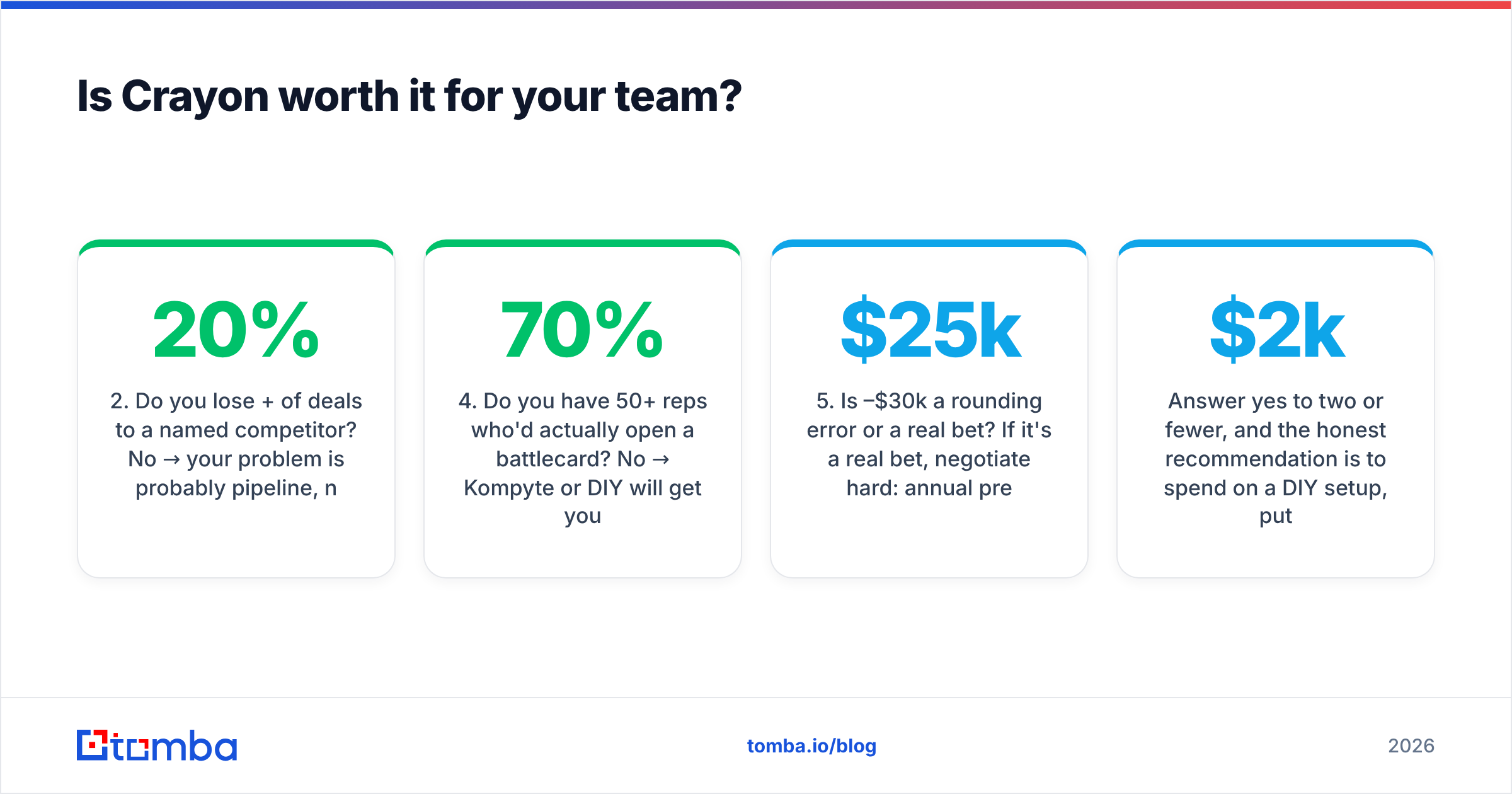
- Do you lose 20%+ of deals to a named competitor? No → your problem is probably pipeline, not positioning.
- Can you measure competitive win rate today? No → you won't be able to prove ROI at renewal, and the renewal will be a fight.
- Do you have 50+ reps who'd actually open a battlecard? No → Kompyte or DIY will get you 70% of the value for 25% of the cost.
- Is $25k–$30k a rounding error or a real bet? If it's a real bet, negotiate hard: annual prepay discounts, competitor-count headroom, and a usage clause are all obtainable.
Answer yes to four or five of those and Crayon is a defensible purchase. It is a mature product with strong reviews and a real enablement layer, and buyers who fit the profile renew.
Answer yes to two or fewer, and the honest recommendation is simple. Spend $2k on a DIY setup, put the other $28k into pipeline generation, and revisit CI next year once the bottleneck has moved. Analysts at Gartner make this point about intelligence tooling in general: capability without an operating model is shelfware with a nicer UI.
What should you do before you sign?#
- Get the quote in writing with competitor and seat counts explicit. Ask what happens in month seven when you add three competitors.
- Ask for the utilization data from a reference customer your size. "How many weekly active users after six months?" is the only question that predicts renewal.
- Negotiate a 60-day success clause. If battlecard adoption is under X%, you get a pricing adjustment or an exit.
- Baseline your competitive win rate today. Without a before-number, you have no after-story.
- Audit your contact data in parallel. If your outbound list is 80% accurate, fixing that is a bigger revenue lever than any battlecard — and costs two orders of magnitude less.
Crayon is a good product with a real problem it solves well. It is sold at a price that demands a real operating model behind it. That is the whole Crayon pricing reviews pros and cons verdict: the pros are genuine, the cons are organizational more than technical, and the pricing is opaque enough that you should walk into the call with the ranges above in your head.
Before you spend $30k knowing more about your competitors, spend a little knowing how to reach your buyers. Tomba Email Finder turns a name and a domain into a verified, deliverable email address — so the deals you win on positioning are deals you actually got into. Start free with 25 searches a month, no card required, and see how much of your pipeline gap was never a positioning problem at all.
Related guides#
Ready to find emails that actually work?
Join 150,000+ professionals who stopped guessing and started sending. Free credits on signup — no credit card required.
Get the Tomba newsletter
Practical outbound tactics and product updates — once every two weeks.
About the author