Creatio vs Salesforce (2026): Which CRM Actually Wins?
Creatio sells no-code speed and flat pricing. Salesforce sells the deepest ecosystem in software. Here is the honest breakdown of cost, AI, admin load, and who should pick which.
TL;DR
- Creatio wins on speed-to-change: no-code process designer, flat per-user pricing, and a composable app marketplace mean your ops team can ship a new workflow in an afternoon without a certified developer.
- Salesforce wins on ecosystem depth: 3,000+ AppExchange apps, every consultant on earth knows it, and Agentforce/Data Cloud give you an AI and data layer nobody else matches at enterprise scale.
- Real cost diverges fast. Creatio starts around $25/user/mo plus a platform fee; Salesforce Sales Cloud Enterprise lists at $165/user/mo before Einstein, CPQ, sandboxes, or the implementation partner you will hire.
- Admin load is the hidden line item. Salesforce orgs at 100+ seats typically need a dedicated admin (or agency retainer). Creatio is designed so a RevOps generalist can own it.
- Neither one fills your pipeline. Both are systems of record. The contact data going in still has to come from somewhere — that's where an email finder and enrichment layer sit.
What is Creatio, and who actually uses it?#
Creatio is a no-code platform with CRM applications on top — Sales Creatio, Marketing Creatio, and Service Creatio, all sitting on a shared process-automation engine (BPM roots, if you remember Terrasoft/bpm'online). The pitch is simple: your business processes change constantly, so the tool that models them should be editable by the people who own the process, not by a developer sprint.
In practice, Creatio lands with mid-market companies (roughly 50–1,000 employees) that have real process complexity — lending, insurance, manufacturing, logistics, telecom — but not a Salesforce-sized IT budget. It's a regular in analyst reports; Gartner has repeatedly named it a Leader for sales force automation and low-code application platforms, and it holds strong user-satisfaction scores on G2.
The thing Creatio does that Salesforce doesn't do as gracefully: it lets a non-engineer draw a workflow — approval chain, lead-routing rule, SLA escalation — on a canvas and push it live the same day. If your sales motion is genuinely weird, that matters more than a marketplace with 3,000 apps you'll never install.
What is Salesforce, and why is it still the default?#
Salesforce is a CRM that became an operating system. Sales Cloud is the core, but the actual product you buy by year three is Sales Cloud + Service Cloud + a data layer (Data Cloud) + AI (Agentforce/Einstein) + integration (MuleSoft) + analytics (Tableau) + whatever four AppExchange apps your team can't live without.
Why it stays the default:
- Hiring. You can post a Salesforce admin role and get 200 applicants. You cannot do that for Creatio.
- Integrations. Every serious B2B tool ships a Salesforce connector first and everything else second.
- Board comfort. Nobody gets fired for choosing Salesforce, which is a real (if unflattering) buying criterion at Series C and beyond.
- Depth of the object model. Territory management, complex CPQ, revenue recognition, multi-org consolidation after an acquisition — Salesforce handles all of it, and most challengers hit a ceiling.
The cost of that depth is exactly what you'd expect. Check the official Salesforce pricing page and you're looking at list prices per user, per month, billed annually — and list price is where the conversation starts, not where it ends.

Creatio vs Salesforce: how do they compare head-to-head?#
Here is the honest side-by-side. Prices are list, in USD, and change — always confirm on the vendor's own site before you budget.
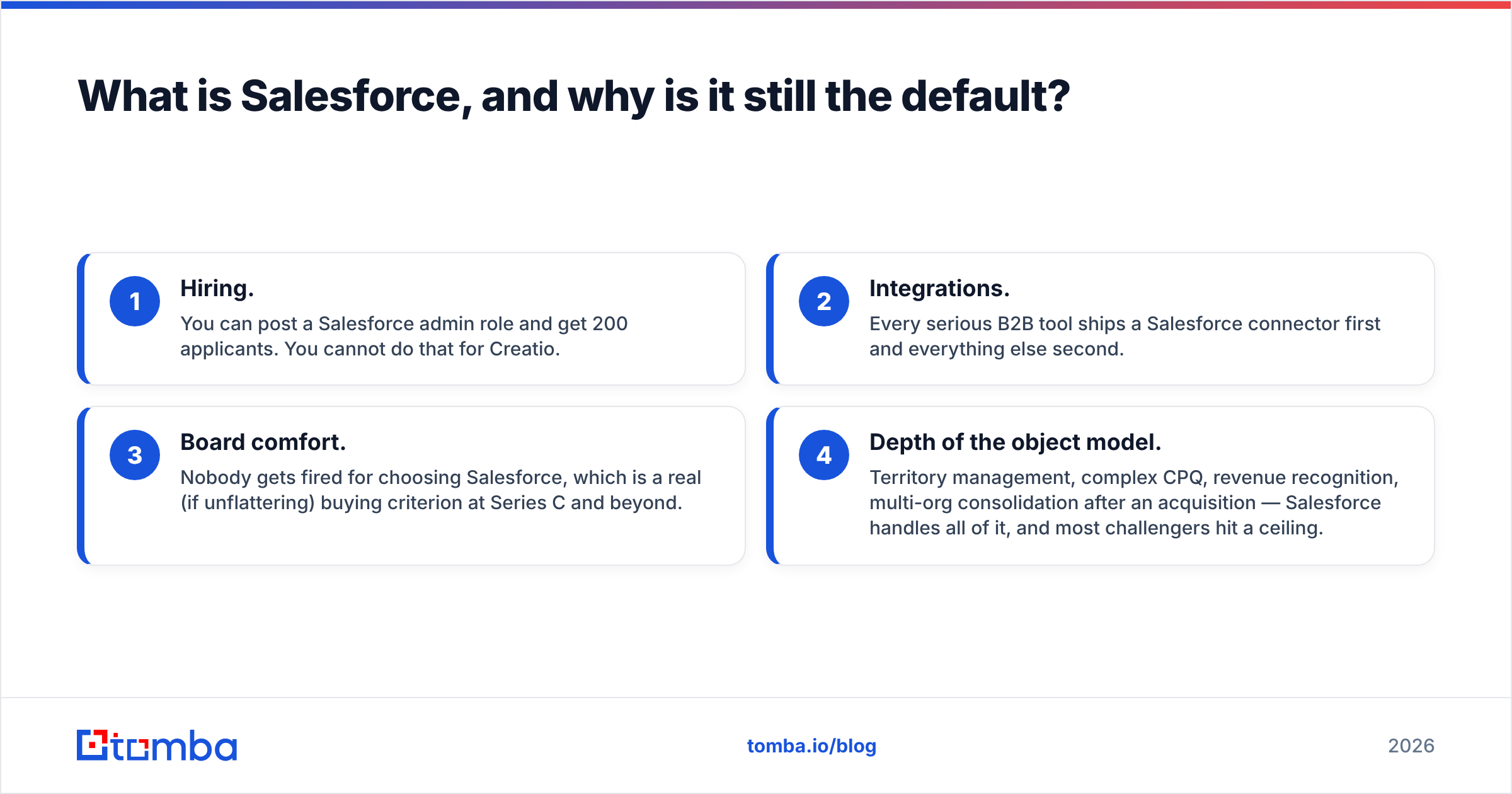
| Dimension | Creatio | Salesforce (Sales Cloud) |
|---|---|---|
| Entry price | ~$25/user/mo (Growth) + platform fee | $25/user/mo (Starter, limited) |
| Realistic mid-market tier | ~$55–85/user/mo (Enterprise/Unlimited) | $165/user/mo (Enterprise) |
| Top tier | ~$85/user/mo + add-ons | $330–$550/user/mo (Unlimited / Einstein 1) |
| Platform fee | Yes — separate from CRM seats | Folded into seat price |
| No-code workflow builder | Core product, business-user friendly | Flow Builder — capable, but admin-grade |
| Custom dev language | Low-code + .NET extensions | Apex, LWC (specialist skills) |
| AI | Creatio AI (native, included on higher tiers) | Agentforce / Einstein (usually paid add-on) |
| App marketplace | Creatio Marketplace (~700 apps) | AppExchange (3,000+ apps) |
| Typical implementation | 6–12 weeks, often partner-light | 3–9 months, partner near-mandatory |
| Admin requirement | RevOps generalist can own it | Dedicated admin at ~100+ seats |
| Talent pool | Small | Enormous |
| Best fit | Process-heavy mid-market | Enterprise, complex GTM, big ecosystem needs |
Two things jump out of that table.
First, the sticker prices are not comparable line-for-line. Creatio splits its bill into a platform fee plus CRM seats; Salesforce bundles more into the seat but charges much more per seat at the tier most companies actually land on. Model both against your real headcount for three years, not one.
Second, implementation is the number people forget. A Salesforce Enterprise rollout with a partner routinely costs 1–2x the first year of license fees. Creatio's no-code layer genuinely compresses that, but "no-code" does not mean "no consultant" — it means the consultant is cheaper and the handover to your team is faster.
Which one is cheaper once you add everything up?#
Creatio, in most mid-market scenarios. Salesforce, in almost none — unless you were going to buy Tableau, MuleSoft, and Slack anyway, in which case the bundle math changes.
Run this exercise before you sign anything. For a 40-seat sales org over 3 years:
- Licenses. Seats × price × 36. Include the Creatio platform fee. Include Salesforce sandboxes, extra API calls, and any Einstein/Agentforce SKU your AE quietly assumed.
- Implementation. Partner day rate × days. Ask both vendors for a reference customer at your size and ask that customer what they actually paid.
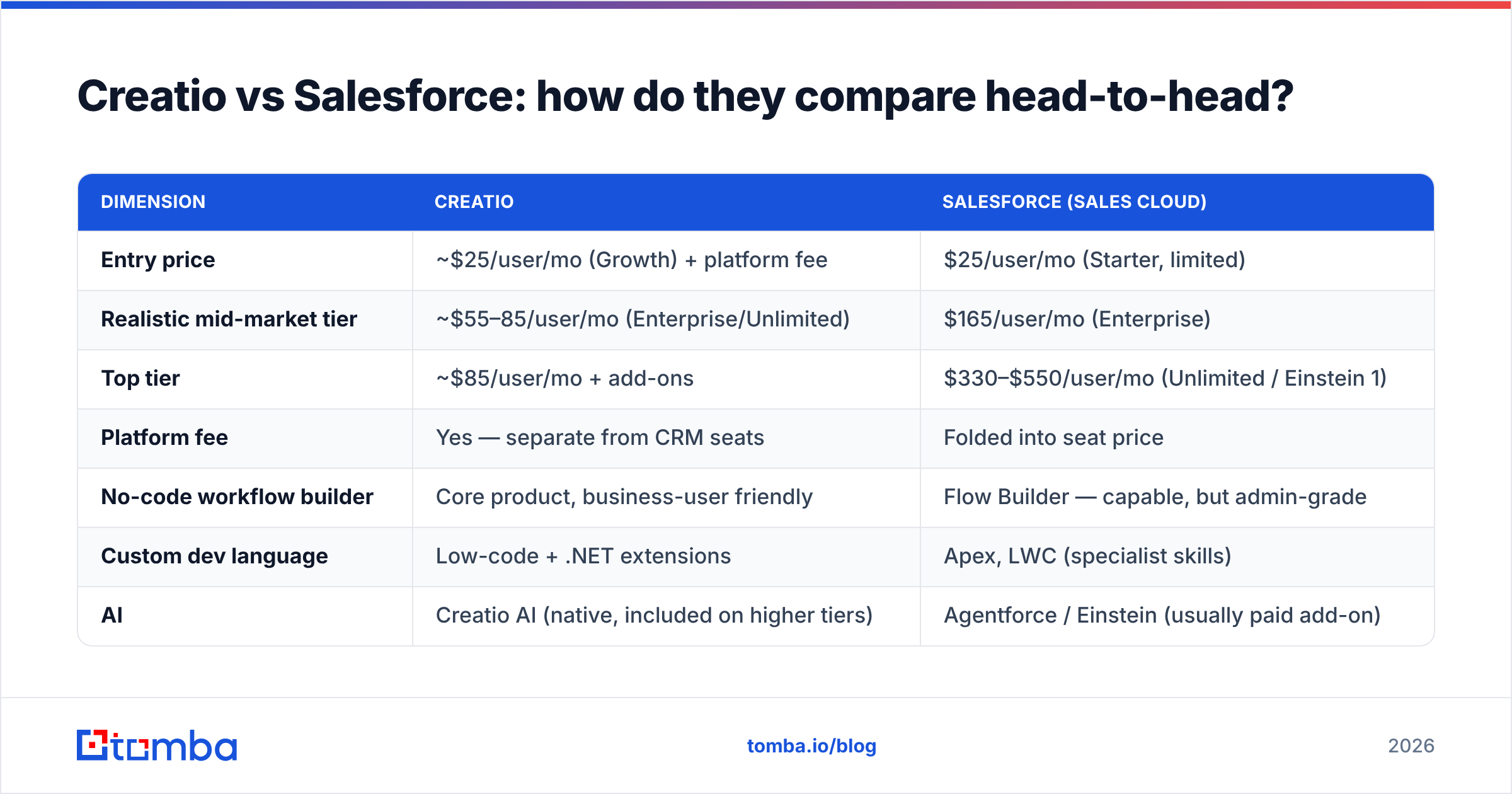
- Ongoing admin. A Salesforce admin costs $85k–$120k fully loaded in the US, or roughly $2k–5k/mo as an agency retainer. Creatio orgs often absorb this into an existing RevOps hire.
- Data. Neither vendor gives you contacts. Budget separately for prospecting data, enrichment, and verification — see below.
- Switching cost later. Salesforce is stickier. That's a feature when you're happy and a tax when you're not.
The pattern I see repeatedly: companies underestimate item 3 by an order of magnitude. Licenses are the visible cost; the admin, the consultant, and the six months of "we're still configuring it" are the real ones.
Is Creatio's no-code actually no-code, or is that marketing?#
Mostly real, with a caveat.
The process designer is genuinely usable by an operations person who understands flowcharts. Lead routing, approval chains, escalation rules, custom objects, page layouts, and business logic can be built and shipped without touching a line of code. That's not true of Salesforce, where Flow Builder is powerful but still expects someone who thinks like an admin, and anything past a certain complexity drops you into Apex.
The caveat: integrations and edge cases still need engineers. If you need Creatio talking to a bespoke internal system, someone is writing .NET or wiring up the REST API. "No-code" describes the 80% of configuration work, not the last 20%.
Salesforce's counter-argument is that the AppExchange means you don't build — you install. That's fair when a good app exists. It's less fair when your process is unusual, which, if you're a mid-market company with a niche, it probably is.
How does AI compare in 2026?#
Both vendors have shipped agentic AI, and both will tell you it's transformative. Here's the sober version.
- Salesforce Agentforce is the more ambitious product: autonomous agents that resolve service cases, qualify inbound leads, and act across Data Cloud's unified record. It's genuinely impressive at enterprise data volume, and genuinely expensive — usually a separate SKU or a jump to the Einstein 1 tier.
- Creatio AI is more modest and more included: predictive scoring, next-best-action recommendations, and a copilot that helps build processes inside the no-code designer. It's bundled further down the price ladder.
The uncomfortable truth about both: AI on a CRM is only as good as the data in the CRM. An agent that scores leads from stale, half-empty records will confidently score them wrong. Before you pay for the AI tier, audit what percentage of your contact records have a valid, deliverable email address. If it's under 80%, fix the data layer first — the AI upgrade will not save you, and data enrichment is a fraction of the cost.
Which CRM should you pick? A decision framework#
Pick Creatio if:
- Your process is unusual and you rewrite it more than twice a year. The no-code designer pays for itself the first time you avoid a dev sprint.
- You don't want to hire a dedicated admin. A single RevOps generalist can realistically own Creatio; that's a stretch on Salesforce past 100 seats.
- You're 50–1,000 employees with real workflow complexity but no nine-figure IT budget.
- Time-to-value matters more than ecosystem breadth. Weeks, not quarters.
Pick Salesforce if:
- You're enterprise, or credibly heading there. Multi-org, multi-currency, territory management, complex CPQ — Salesforce handles it and challengers strain.
- Your stack is already Salesforce-adjacent (Slack, Tableau, MuleSoft) and the bundle changes the math.
- You need the talent pool. If your CRM owner quits, you can replace them in three weeks.
- A specific AppExchange app is load-bearing for your business and has no equivalent elsewhere.
Pick neither if you're under 20 people and mostly need a pipeline you can see. HubSpot or Pipedrive will serve you better and cost a tenth as much; both Creatio and Salesforce are overkill at that stage, and HubSpot's own comparison content is refreshingly honest about where the line sits.
What neither CRM gives you (and how to fix it)#
A CRM is a system of record. It records what you put into it. Neither Creatio nor Salesforce will tell you the email address of the VP of Operations at a company you've never contacted, and neither will tell you that 22% of the contacts already sitting in your database bounce.
This is the gap that kills CRM ROI. Teams spend six months and six figures on implementation, then feed the shiny new system a spreadsheet of guessed email addresses from 2023. The forecast looks great. The reply rate doesn't.
What a working data layer looks like alongside either CRM:
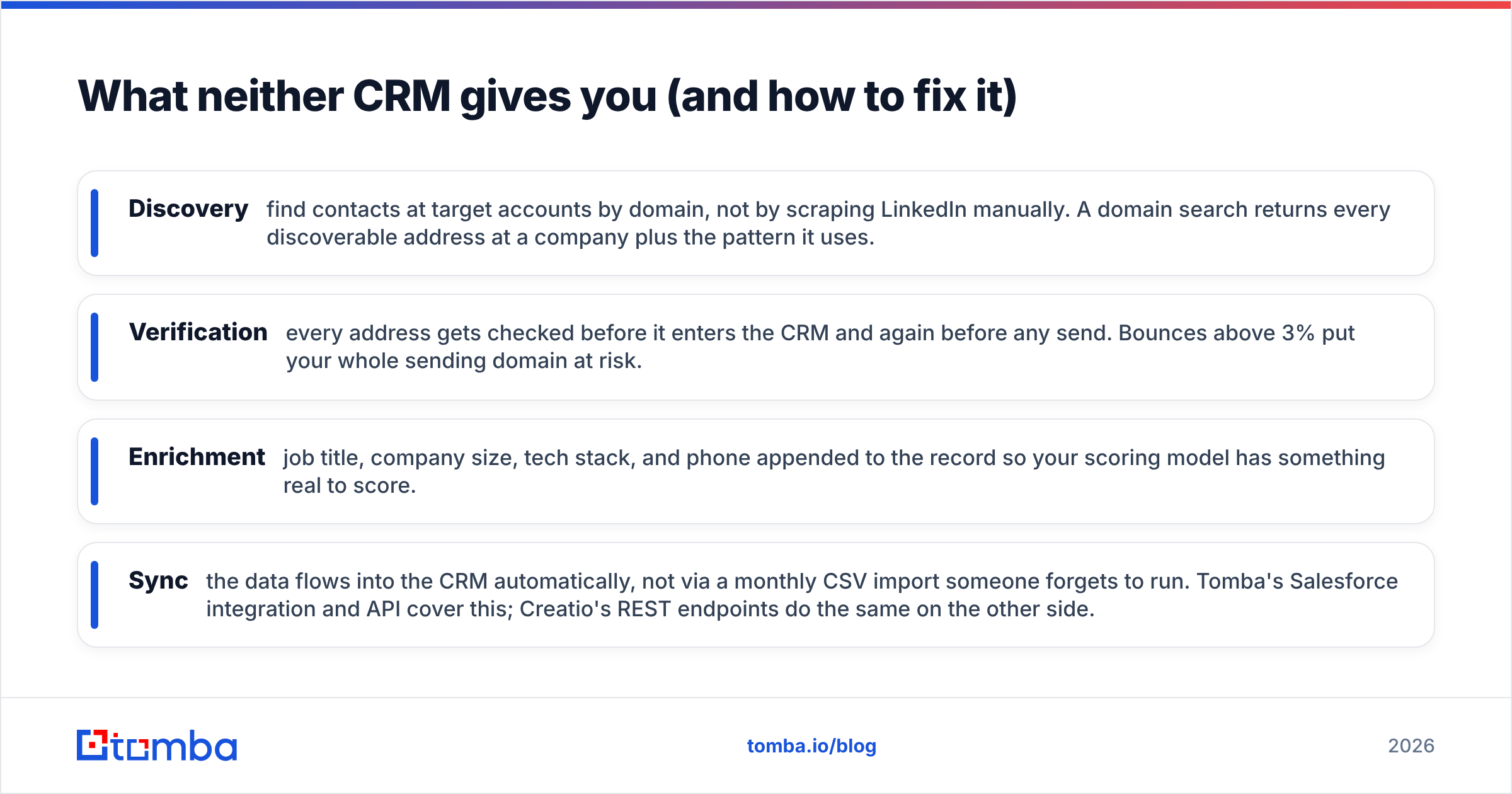
- Discovery — find contacts at target accounts by domain, not by scraping LinkedIn manually. A domain search returns every discoverable address at a company plus the pattern it uses.
- Verification — every address gets checked before it enters the CRM and again before any send. Bounces above 3% put your whole sending domain at risk.
- Enrichment — job title, company size, tech stack, and phone appended to the record so your scoring model has something real to score.
- Sync — the data flows into the CRM automatically, not via a monthly CSV import someone forgets to run. Tomba's Salesforce integration and API cover this; Creatio's REST endpoints do the same on the other side.
Do this and the AI tier you're being upsold suddenly has something to work with. Skip it and you've bought an expensive, beautifully configured filing cabinet full of dead addresses.
Creatio vs Salesforce: the verdict#
For most mid-market B2B companies, Creatio is the better buy in 2026 — lower total cost, dramatically faster to change, and no dedicated admin required. For enterprises with genuinely complex GTM motions or a stack already anchored to the ecosystem, Salesforce remains worth its price — the depth is real and the talent pool is unmatched.
The mistake is treating this as the whole decision. The CRM is the container. What determines whether your pipeline grows is the quality of the contact data you pour into it, and that's a separate purchase with a separate ROI — usually a much better one.
Before you migrate to either CRM, fix the data. Tomba's Email Finder locates verified professional email addresses by domain, name, or company, with confidence scoring on every result and an API that pipes straight into Creatio, Salesforce, or whatever you land on. Start free with 25 searches a month, or check Tomba pricing — the Starter plan is $49/mo, roughly the cost of a single Salesforce Enterprise seat, and it fills the gap that neither CRM will.
Related guides#
Ready to find emails that actually work?
Join 150,000+ professionals who stopped guessing and started sending. Free credits on signup — no credit card required.
Get the Tomba newsletter
Practical outbound tactics and product updates — once every two weeks.
About the author