CRM and Sales Funnel: How to Align Them the Right Way
A CRM and a sales funnel are not the same thing — and confusing them quietly leaks revenue. Here's how to connect the two so no deal slips through the cracks.
Most teams treat "CRM" and "sales funnel" as synonyms. They aren't — and every week you blur them, deals slip through gaps nobody is watching.
A sales funnel is the map of how a stranger becomes a customer. A CRM is the system of record that tracks each real person moving across that map. You need both, wired together, or you're either flying blind or drowning in data you never act on.
TL;DR#
- A sales funnel is a model; a CRM is the database. The funnel describes stages (awareness → close); the CRM stores the actual contacts, deals, and activity at each stage.
- The gap between them is where revenue leaks. Funnels without a CRM are guesswork; a CRM without a funnel is a contact list nobody uses to forecast.
- Alignment starts with clean data. Bad emails and stale contacts corrupt every stage metric — enrich and verify before you build stages on top.
- Your stage definitions should map to buyer behavior, not internal wishful thinking. Exit criteria per stage kill "happy ears" forecasting.
- Tools matter less than the handoff. A $99/mo stack that's used beats a $2,000/mo stack that's ignored.
What is the difference between a CRM and a sales funnel?#
Think of it like a subway system. The sales funnel is the route map on the wall — a clean diagram of the line from "just arrived" to "reached the destination." The CRM is the live control room tracking where every actual train is right now, how full it is, and which ones are stalled.
The route map never changes much. The control room is chaos in motion. Confusing the two is like staring at the pretty wall map while three trains are stuck in a tunnel.
Formally:
- A sales funnel (or pipeline) is a conceptual model of stages a prospect passes through: awareness, interest, evaluation, decision, purchase. It answers "what does our buying journey look like?"
- A CRM (customer relationship management system) is software that stores every contact, company, deal, email, call, and note. It answers "who is where, and what happened last?"
You design a funnel. You operate a CRM. When they're connected, the CRM's deal stages literally mirror your funnel stages, so a report in the CRM tells you exactly where the funnel is bleeding.
Why do CRM and sales funnel get confused?#
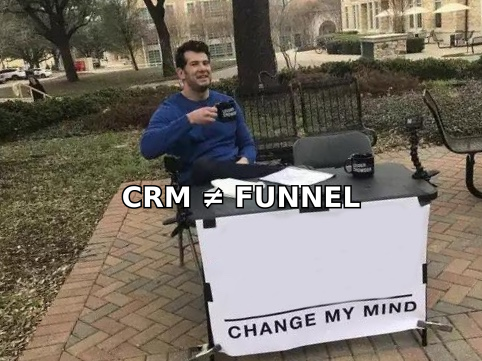
Because most CRMs ship with a "pipeline" view that looks like a funnel, people assume the tool is the strategy. It isn't.
Here's the trap: you buy HubSpot or Salesforce, accept the default stages ("Qualified," "Proposal," "Closed Won"), and never define what those stages actually mean. Reps drag deals around based on gut feel. Your funnel is now a mood ring, not a forecast.
The funnel is the thinking. The CRM is the tracking. If you skip the thinking, the tracking just records your confusion in higher resolution.
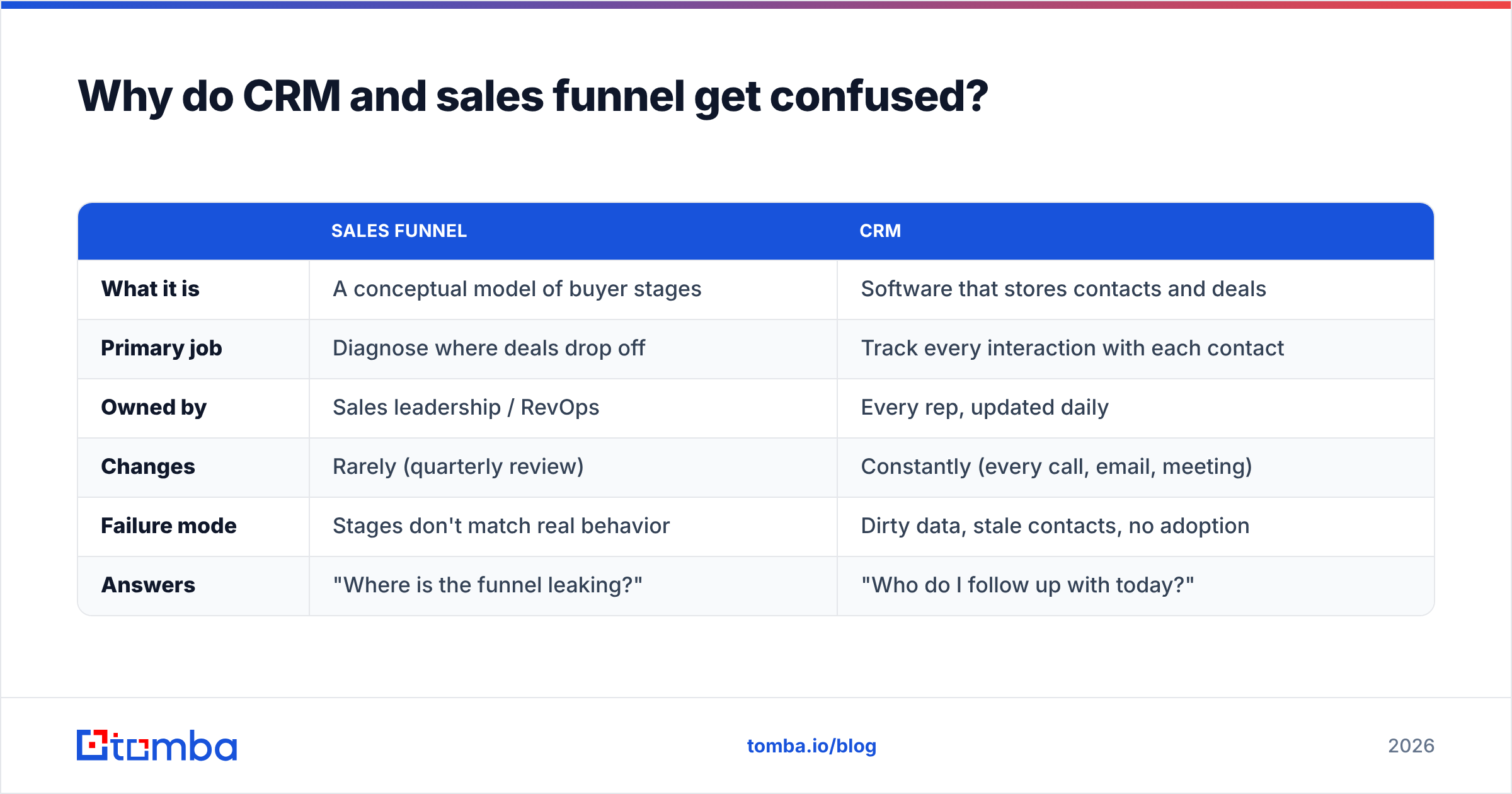
| Sales Funnel | CRM | |
|---|---|---|
| What it is | A conceptual model of buyer stages | Software that stores contacts and deals |
| Primary job | Diagnose where deals drop off | Track every interaction with each contact |
| Owned by | Sales leadership / RevOps | Every rep, updated daily |
| Changes | Rarely (quarterly review) | Constantly (every call, email, meeting) |
| Failure mode | Stages don't match real behavior | Dirty data, stale contacts, no adoption |
| Answers | "Where is the funnel leaking?" | "Who do I follow up with today?" |
How do a CRM and sales funnel work together?#
The CRM makes the funnel measurable. Without it, "our funnel" is a slide. With it, every stage has a live count, a conversion rate, and an average time-in-stage you can actually manage.
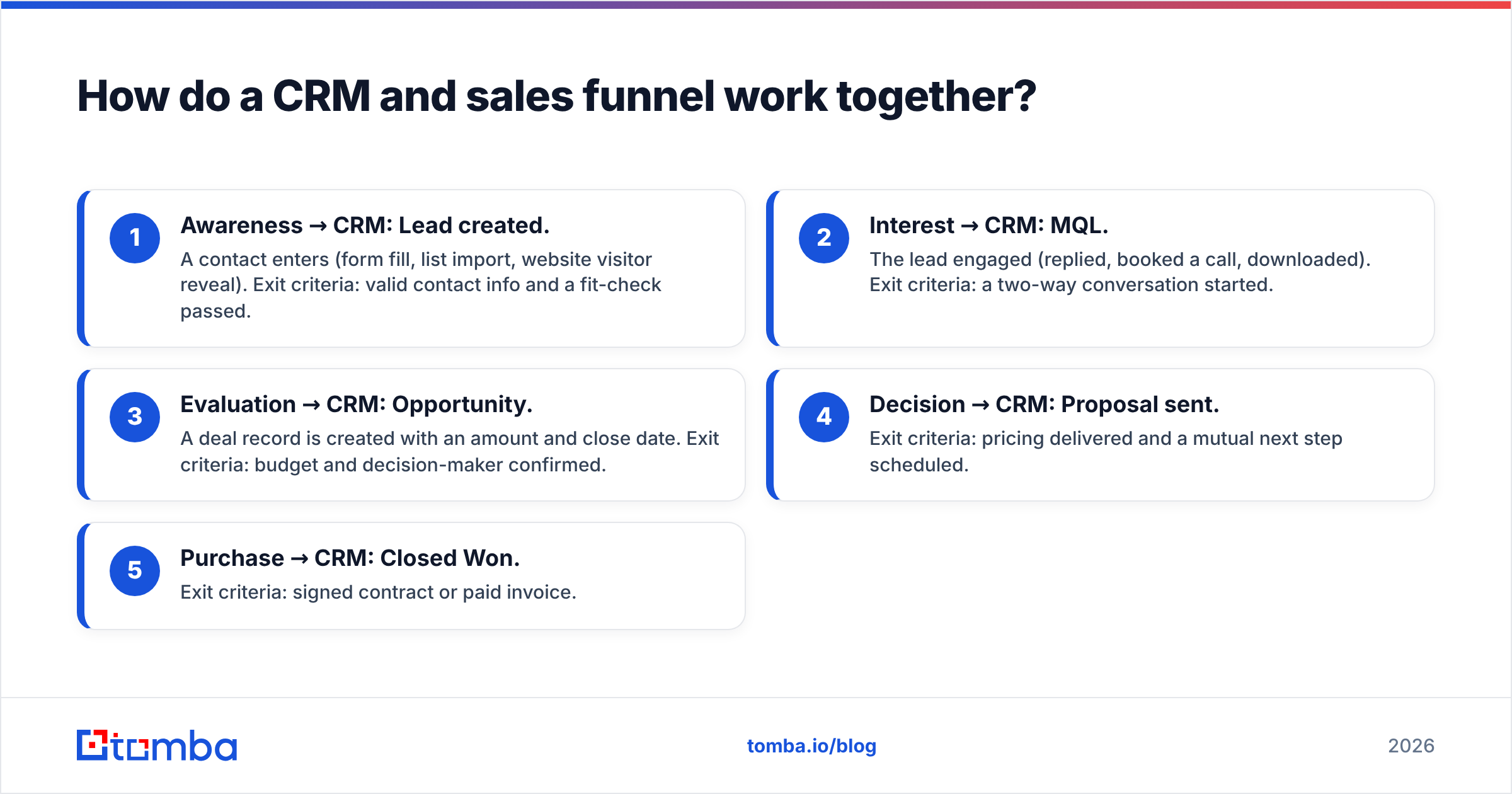
The connective tissue is your stage definitions with exit criteria. Each funnel stage becomes a CRM deal stage, and a deal only advances when a concrete, observable event happens — not when a rep "feels good about it."
A workable mapping looks like this:
- Awareness → CRM: Lead created. A contact enters (form fill, list import, website visitor reveal). Exit criteria: valid contact info and a fit-check passed.
- Interest → CRM: MQL. The lead engaged (replied, booked a call, downloaded). Exit criteria: a two-way conversation started.
- Evaluation → CRM: Opportunity. A deal record is created with an amount and close date. Exit criteria: budget and decision-maker confirmed.
- Decision → CRM: Proposal sent. Exit criteria: pricing delivered and a mutual next step scheduled.
- Purchase → CRM: Closed Won. Exit criteria: signed contract or paid invoice.
Notice that every transition is a verb someone did, not an adjective a rep chose. That's the whole game.
Why does data quality decide whether the whole thing works?#
Garbage contacts poison every stage metric — this is the failure nobody puts on a slide. If 20% of your "Leads" have dead email addresses, your Lead → MQL conversion rate is a lie, and every downstream forecast inherits that lie.
It's like weighing yourself on a broken scale. You can build a beautiful diet plan around the number, but the number is fiction, so the plan is too.
Two habits keep the funnel honest:
- Verify before a contact enters a stage. Run new contacts through an email verifier so bounces don't inflate your top-of-funnel counts.
- Enrich sparse records. A lead with just a first name and a company is barely a lead. Data enrichment fills in the role, verified email, and company context so your qualification stage isn't guessing.
This is also where an email-finding layer feeds the CRM directly. If your inbound is thin, you fill the top of the funnel with outbound — and outbound needs accurate contact data at scale. Tomba's email finder and domain search push verified contacts straight into the CRM so stage one starts with real people, not placeholder rows.
What does a good CRM + funnel stack cost?#
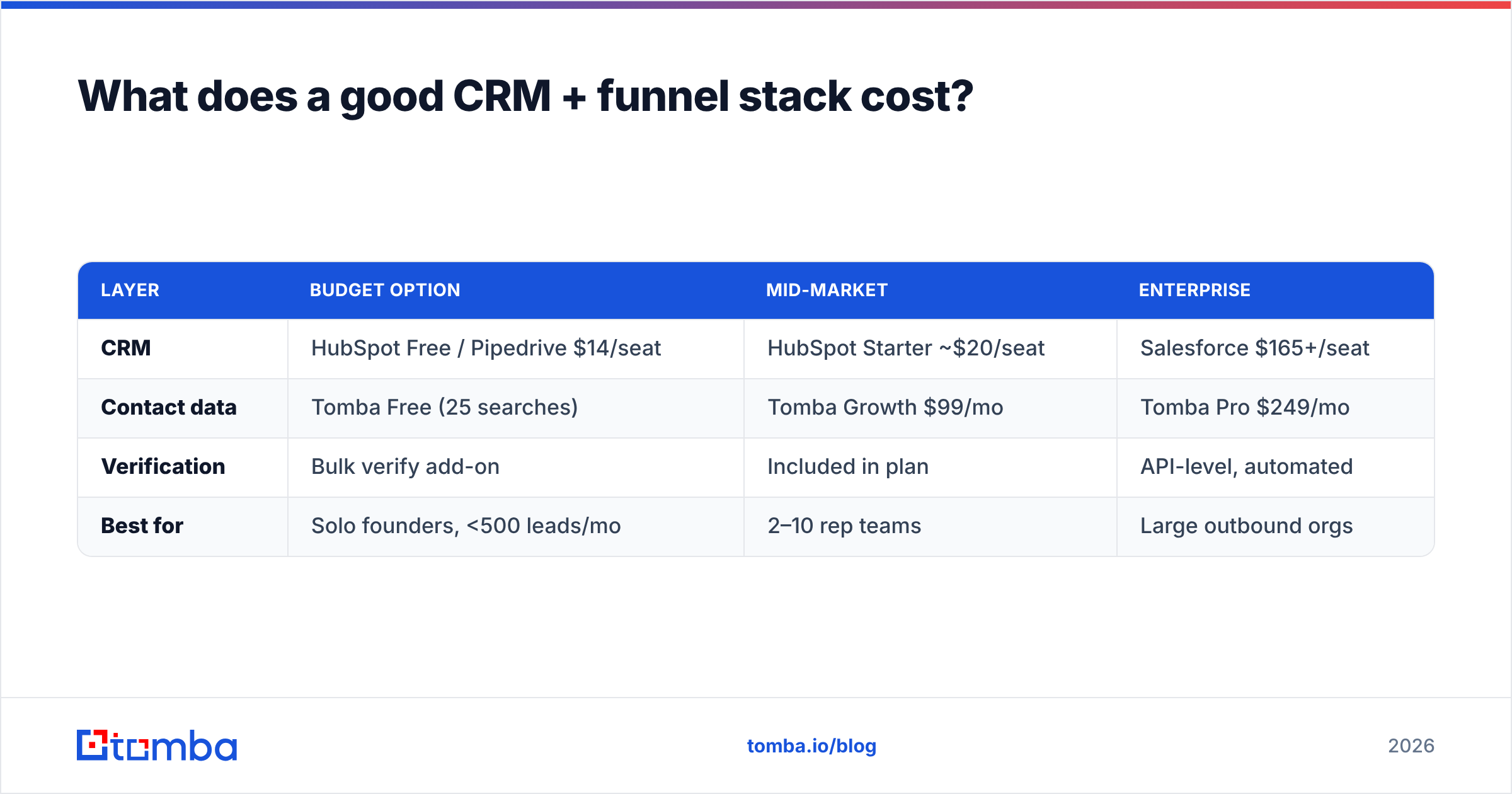
You do not need enterprise pricing to run a disciplined funnel. The differentiator is whether the data feeding it is clean — a lesson many teams learn after paying for seats they never fill.
| Layer | Budget option | Mid-market | Enterprise |
|---|---|---|---|
| CRM | HubSpot Free / Pipedrive $14/seat | HubSpot Starter ~$20/seat | Salesforce $165+/seat |
| Contact data | Tomba Free (25 searches) | Tomba Growth $99/mo | Tomba Pro $249/mo |
| Verification | Bulk verify add-on | Included in plan | API-level, automated |
| Best for | Solo founders, <500 leads/mo | 2–10 rep teams | Large outbound orgs |
The pattern that wins: spend modestly on the CRM, invest in the quality of what enters it. A cheap CRM full of verified, enriched contacts outperforms an expensive one full of bounces. You can compare CRM options honestly on G2 before committing seats.
How do you connect your data source to your CRM?#
Automate the handoff so reps never copy-paste a contact again. Manual entry is where both data quality and adoption go to die — every field a human types by hand is a field they'll eventually skip.
The clean setup:
- Native integration where it exists. Tomba's HubSpot integration and Salesforce integration push found and verified contacts into the CRM with their stage pre-set.
- Zapier or Make for the long tail. Trigger enrichment when a deal hits a stage, or auto-verify emails on contact creation.
- Bulk for backfill. When you import an old list, run it through bulk verification first so you're not importing 2023's dead contacts into 2026's funnel.
The rule: every contact that lands in stage one should arrive already verified and enriched. If a rep has to fix data before they can work a lead, they won't — they'll just skip it, and your funnel silently narrows at the top.
What metrics prove the funnel is actually working?#
Track movement and velocity, not vanity totals. "We have 5,000 leads" tells you nothing; "Lead → MQL is converting at 8% and taking 11 days" tells you exactly where to intervene.
The four that matter:
- Stage conversion rate. What percent of deals advance from each stage to the next? Find the worst-converting transition — that's your bottleneck.
- Time-in-stage. Deals rotting in "Evaluation" for 60 days aren't pipeline, they're graveyard. Set a max age and flag stragglers.
- Win rate by source. Which lead sources actually close? Cut spend on the ones that don't.
- Pipeline coverage. Do you have 3–4x your quota in active pipeline? If not, the top of the funnel needs more verified contacts, not more meetings about the bottom.
A CRM gives you these for free if your stages are defined and your data is clean. It gives you nonsense if they aren't. That's the entire argument of this article in one sentence.
Common mistakes that break the CRM-funnel link#
Even teams with good tools sabotage themselves. The usual suspects:
- Too many stages. Nine stages feel thorough and forecast worse than five. Every stage a rep has to think about is a stage they'll fudge.
- Subjective exit criteria. "Prospect is interested" is not a criterion. "Prospect booked a demo" is.
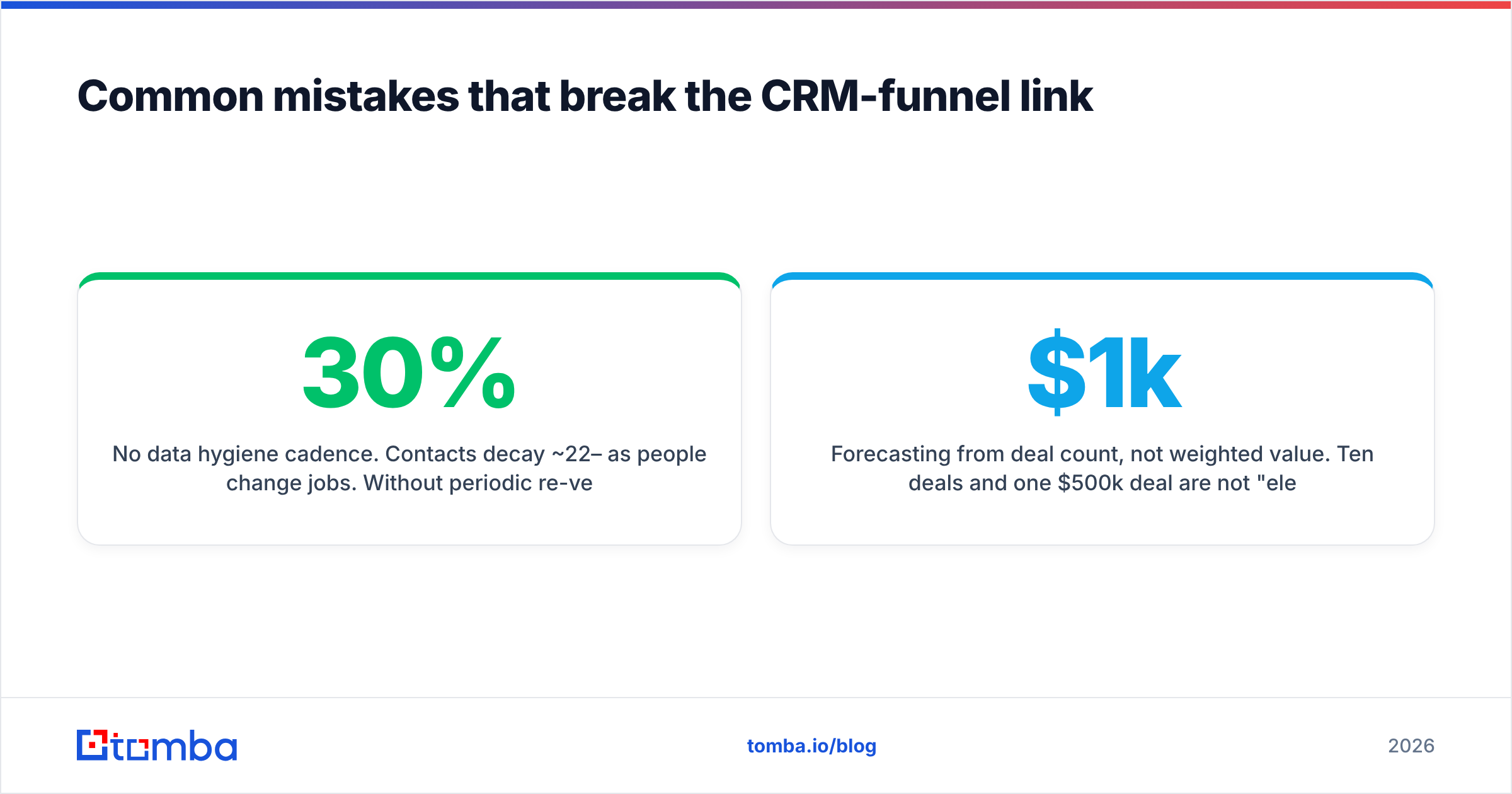
- No data hygiene cadence. Contacts decay ~22–30% per year as people change jobs. Without periodic re-verification, your CRM ages into a liability. A quarterly pass through your email verifier keeps it alive.
- Treating the CRM as a sales-only tool. Marketing feeds the top, success owns the bottom. If only reps touch it, the funnel has blind spots on both ends.
- Forecasting from deal count, not weighted value. Ten $1k deals and one $500k deal are not "eleven deals." Weight by amount and stage probability.
Fix these and the funnel stops being a slide you present and becomes a system you steer.
Frequently asked questions#
Is a sales funnel the same as a sales pipeline? Nearly. "Funnel" emphasizes volume dropping at each stage (marketing's view); "pipeline" emphasizes individual deals moving forward (sales' view). Same journey, two lenses. Your CRM usually calls it a pipeline.
Do I need a CRM if I have a small team? Yes — even a free CRM beats a spreadsheet the moment you have more than a handful of active deals, because a spreadsheet can't track activity, remind you to follow up, or report conversion. Start with a free tier and clean data.
How do I fill the top of my funnel? Combine inbound (content, website visitor reveal) with outbound. For outbound you need verified contact data at volume — that's where an email finder feeds the funnel directly.
How often should I clean my CRM data? Verify on entry, and re-verify the whole database quarterly. B2B contacts decay fast; a stale CRM produces stale forecasts.
Connect a clean funnel to real contacts#
Your funnel is only as good as the people inside it. Default stages and dirty data turn a CRM into an expensive contact graveyard — but stage definitions with exit criteria, plus verified contacts entering at the top, turn the same tool into a forecast you can trust.
Start where the leak is biggest: the data feeding stage one. Use the Tomba Email Finder to find and verify professional contacts by name, company, or domain, then push them straight into your CRM through the HubSpot or Salesforce integration. The free tier gives you 25 searches to test the flow, and Tomba pricing scales from $49/mo as your funnel fills. Clean data in — reliable pipeline out.
Related guides#
Ready to find emails that actually work?
Join 150,000+ professionals who stopped guessing and started sending. Free credits on signup — no credit card required.
Get the Tomba newsletter
Practical outbound tactics and product updates — once every two weeks.
About the author