CRM Data Governance in 2026: A Practical Playbook
Dirty CRM data quietly wrecks forecasts, routing, and rep trust. Here's a practical CRM data governance framework you can stand up this quarter.
Your CRM is only as good as the data inside it — and most CRMs are quietly rotting. Duplicate accounts, dead email addresses, half-filled records, and mystery field values don't just annoy reps; they break forecasting, misroute leads, and torch campaign deliverability. CRM data governance is the discipline that stops the rot.
This guide is a practical playbook, not a lecture. You'll get a working definition, a framework you can stand up this quarter, a roles-and-rules table, the metrics that actually matter, and the tooling that keeps records clean without turning your ops team into full-time janitors.
TL;DR#
- CRM data governance is the set of rules, owners, and automated checks that keep your customer records accurate, complete, consistent, and compliant over time.
- The biggest ROI is at the point of entry: validate and enrich data as it comes in, not in a quarterly cleanup panic.
- Assign a data owner and a data steward per object (accounts, contacts, leads) — governance without named humans fails.
- Track four things: completeness, accuracy, duplication rate, and freshness. If you can't measure them, you can't govern them.
- Automate verification with an API-first stack. Manual dedupe doesn't scale past a few thousand records.
What is CRM data governance?#
CRM data governance is the framework of policies, roles, and automated controls that keep the data in your CRM trustworthy across its whole lifecycle — from the moment a record is created to the day it's archived.
Think of it like food safety in a restaurant kitchen. Nobody sees the temperature logs, the labeled containers, or the wash stations, but they're the reason nobody gets sick. Governance is the invisible discipline that makes the visible output — your forecast, your routing, your outreach — safe to rely on. Skip it and everything looks fine until someone gets burned.
Technically, governance covers five dimensions:
- Accuracy — does the data match reality? Is that email address real and reachable?
- Completeness — are the fields your process depends on actually filled in?
- Consistency — is "United States" always "United States," not "US," "U.S.A.," and "usa"?
- Timeliness — how stale is the record? A contact who changed jobs six months ago is a liability.
- Compliance — do you have a lawful basis to hold and process the record (GDPR, CCPA)?
Governance is not a one-time data-cleaning project. A cleanup is a snapshot; governance is the process that keeps the snapshot from going blurry again next quarter.

Why does dirty CRM data cost so much?#
Because every downstream system trusts the CRM, and bad inputs compound. Gartner has estimated that poor data quality costs organizations an average of $12.9 million per year. You don't need to hit that number to feel the pain.
Here's how the damage spreads:
- Forecasting breaks. Duplicate opportunities inflate pipeline. Stale close dates make the board question every number you present.
- Routing misfires. A lead with a blank "country" or "company size" field can't be routed by your rules, so it sits unassigned while the buyer talks to a competitor.
- Deliverability tanks. Sending to dead or mistyped addresses spikes your bounce rate, and mailbox providers punish your sender reputation — which drags down deliverability for the good addresses too.
- Reps stop trusting the system. The fastest way to kill CRM adoption is to let reps discover the data is wrong. Once trust is gone, they keep their real pipeline in a spreadsheet and your governance problem becomes invisible.
The through-line: bad data isn't a data-team problem. It's a revenue problem wearing a data-team costume.
What does a CRM data governance framework look like?#
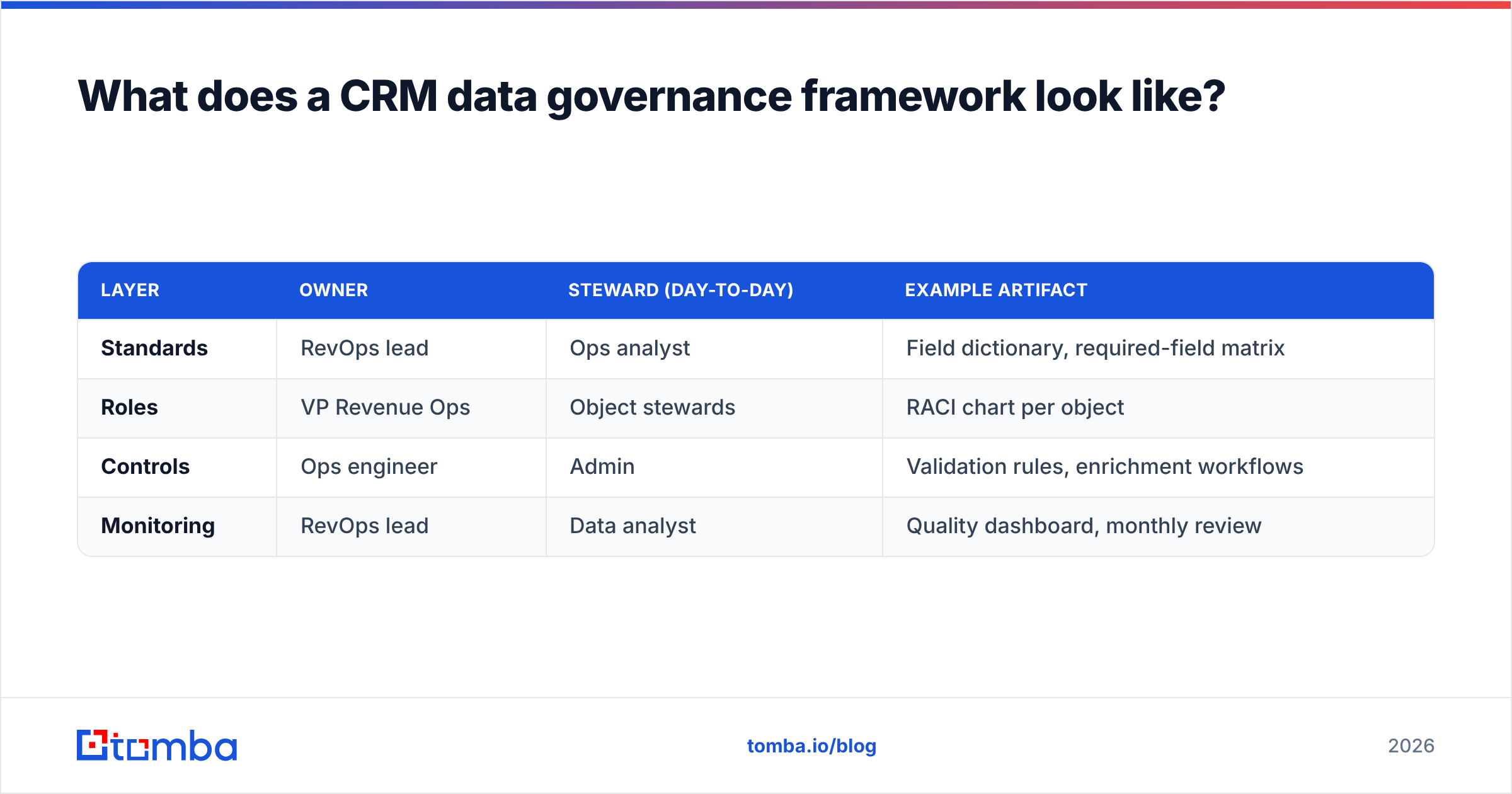
A working framework has four layers. Each one closes a gap the layer above it can't.
1. Standards — the definitions. What does a "qualified lead" mean? What's the required format for a phone number? Which fields are mandatory at each stage? Write these down. Undocumented standards are just tribal knowledge that leaves when the person does.
2. Roles — the humans. Every core object needs a data owner (accountable for the policy) and a data steward (responsible for day-to-day quality). No names, no governance.
3. Controls — the automation. Validation rules at entry, dedupe logic, enrichment on create, verification on a schedule. This is where tooling lives.
4. Monitoring — the feedback loop. Dashboards on your quality metrics, plus a review cadence so problems surface in weeks, not quarters.
Here's how the responsibilities typically split across a revenue org:
| Layer | Owner | Steward (day-to-day) | Example artifact |
|---|---|---|---|
| Standards | RevOps lead | Ops analyst | Field dictionary, required-field matrix |
| Roles | VP Revenue Ops | Object stewards | RACI chart per object |
| Controls | Ops engineer | Admin | Validation rules, enrichment workflows |
| Monitoring | RevOps lead | Data analyst | Quality dashboard, monthly review |
Notice that governance is a shared job. When it belongs to "everyone," it belongs to no one — so the table names specific accountable roles.
Where should you enforce data quality — entry or cleanup?#
At entry. Every time. Cleanup is the expensive, low-leverage fallback you run because entry controls failed.
The cost of fixing a bad record climbs the longer it lives in your system. A validation rule that blocks a malformed email at creation costs nothing. That same bad record, discovered six months later after it bounced a campaign and skewed a report, costs hours of investigation and a chunk of sender reputation.

This is the single highest-ROI move in CRM data governance: shift left. Push validation, deduplication, and enrichment as close to the point of data creation as you can.
Concretely, at the moment a record is created — whether by a rep, a web form, or an import — you want to:
- Validate the email address is real and deliverable before it's saved. An email verifier catches typos, dead mailboxes, and spam traps in real time.
- Check for duplicates against existing records before creating a new one.
- Enrich the record with firmographic and contact data so reps don't leave fields blank.
- Normalize formats — phone, country, industry — to your standard values.
Do this at entry and your quarterly cleanup shrinks from a fire drill to a spot check.
What metrics actually measure CRM data health?#
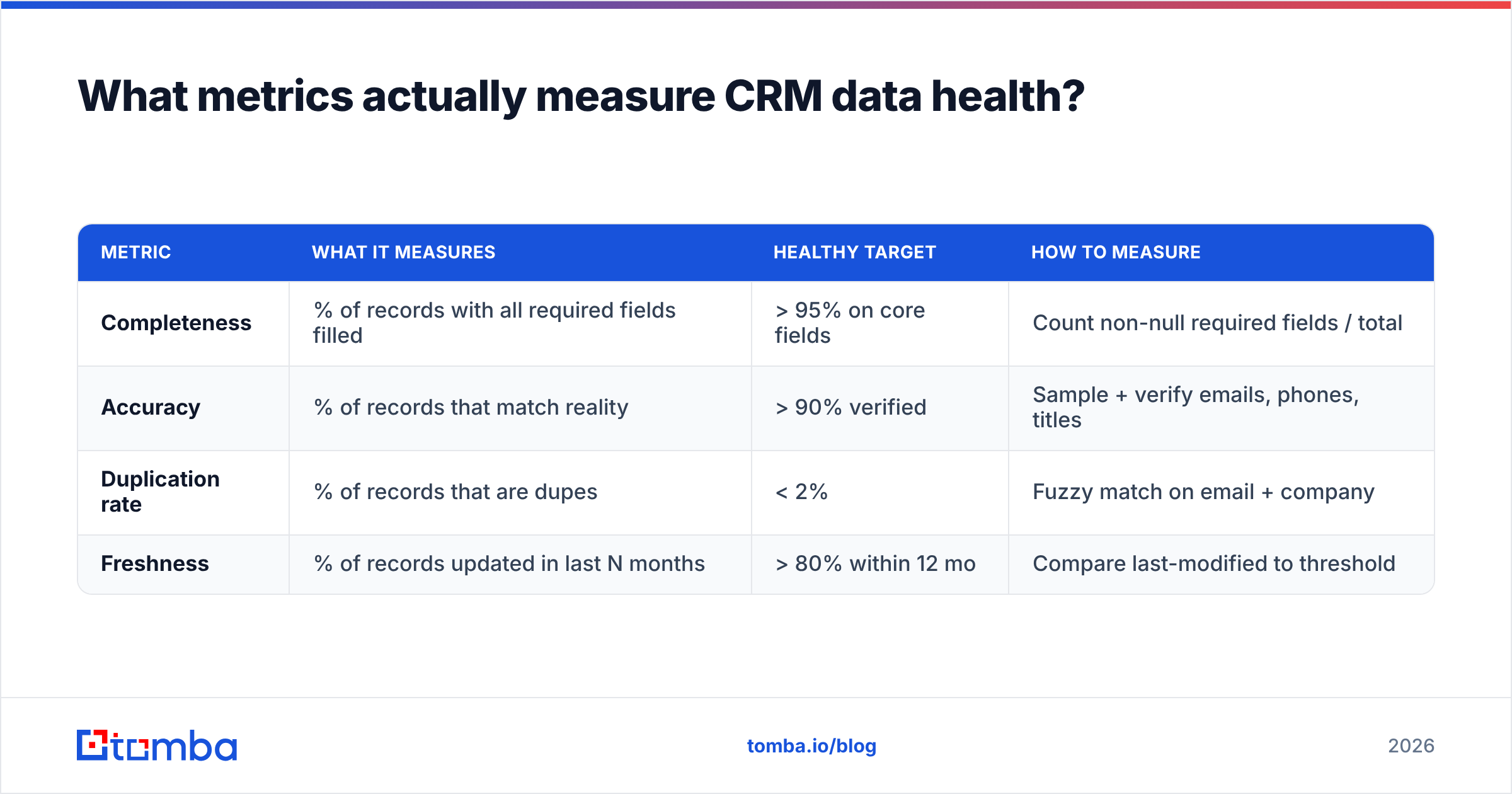
Four core metrics. If you track nothing else, track these — and put them on a dashboard the whole revenue team can see.
| Metric | What it measures | Healthy target | How to measure |
|---|---|---|---|
| Completeness | % of records with all required fields filled | > 95% on core fields | Count non-null required fields / total |
| Accuracy | % of records that match reality | > 90% verified | Sample + verify emails, phones, titles |
| Duplication rate | % of records that are dupes | < 2% | Fuzzy match on email + company |
| Freshness | % of records updated in last N months | > 80% within 12 mo | Compare last-modified to threshold |
A couple of notes on using these:
- Accuracy is the hard one because you can't eyeball it. You verify a sample. For email specifically, run the list through verification and treat bounce-risk records as inaccurate. Tools like an email verifier or a catch-all verifier turn "we think it's accurate" into a real number.
- Freshness beats completeness when you have to choose. A complete record full of two-year-old data is more dangerous than an incomplete fresh one, because it looks trustworthy.
Set baselines this month, then review monthly. Governance you don't measure is just hope with a policy document attached.
How do you keep records clean at scale?#
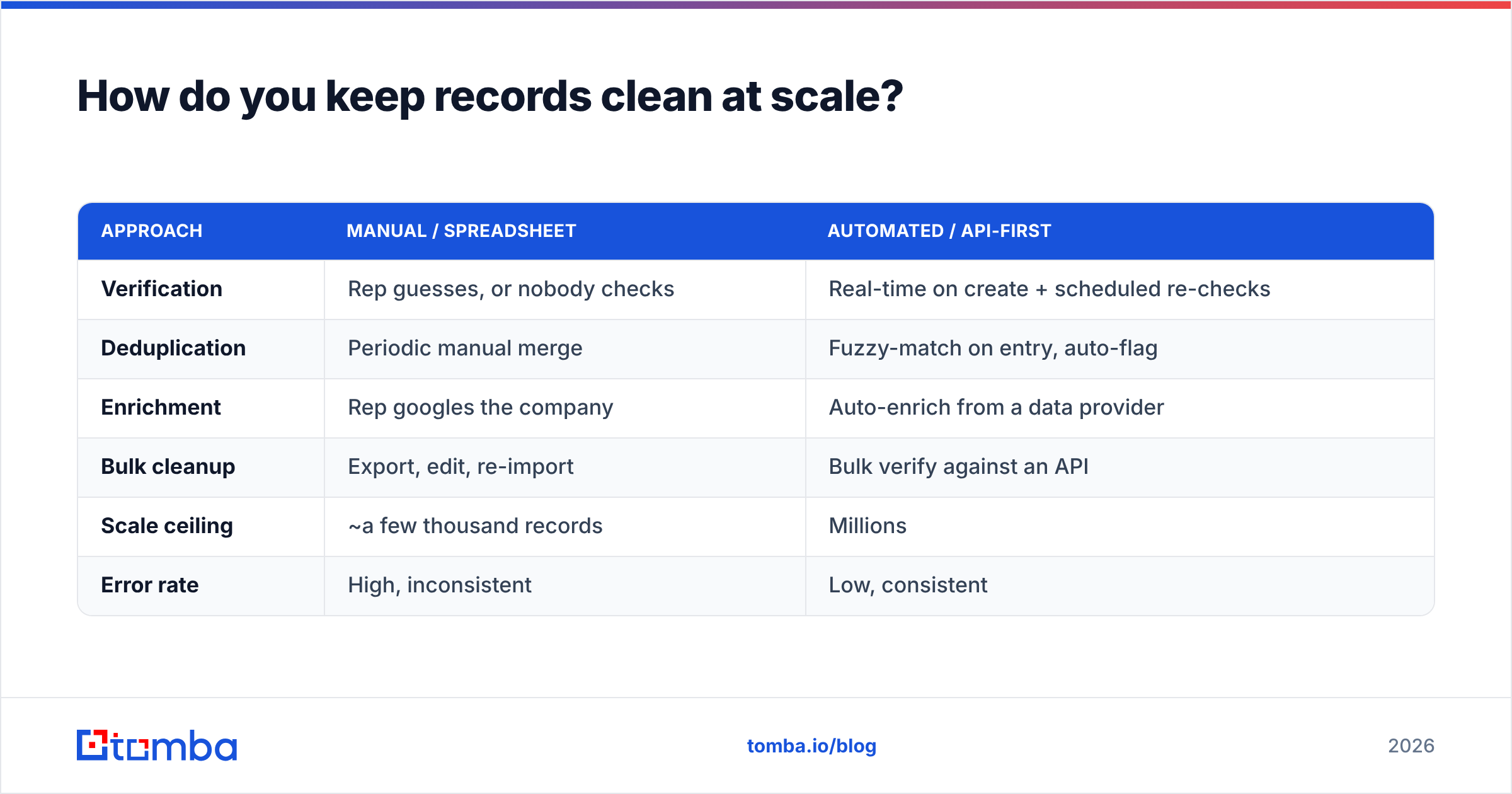
You automate. Manual dedupe and hand-verification work at a few hundred records and collapse somewhere in the low thousands. Past that, an API-first stack is the only thing that keeps up.
Here's the difference in practice:
| Approach | Manual / spreadsheet | Automated / API-first |
|---|---|---|
| Verification | Rep guesses, or nobody checks | Real-time on create + scheduled re-checks |
| Deduplication | Periodic manual merge | Fuzzy-match on entry, auto-flag |
| Enrichment | Rep googles the company | Auto-enrich from a data provider |
| Bulk cleanup | Export, edit, re-import | Bulk verify against an API |
| Scale ceiling | ~a few thousand records | Millions |
| Error rate | High, inconsistent | Low, consistent |
The automated column is built on a few reusable capabilities:
- Verification at entry — validate every new email and phone before the record saves.
- Enrichment at entry — auto-fill firmographics so required fields are never blank. Data enrichment turns a bare email into a full contact.
- Scheduled re-verification — run existing records back through verification quarterly to catch decay (people change jobs).
- Bulk hygiene runs — process large historical lists in one pass with a bulk email finder and verifier.
You wire these into your CRM through native integrations or an API. If your team lives in HubSpot or Salesforce, the enrichment and verification calls can fire automatically on record creation, so governance runs without anyone thinking about it.
Which tools fit into a governance stack?#
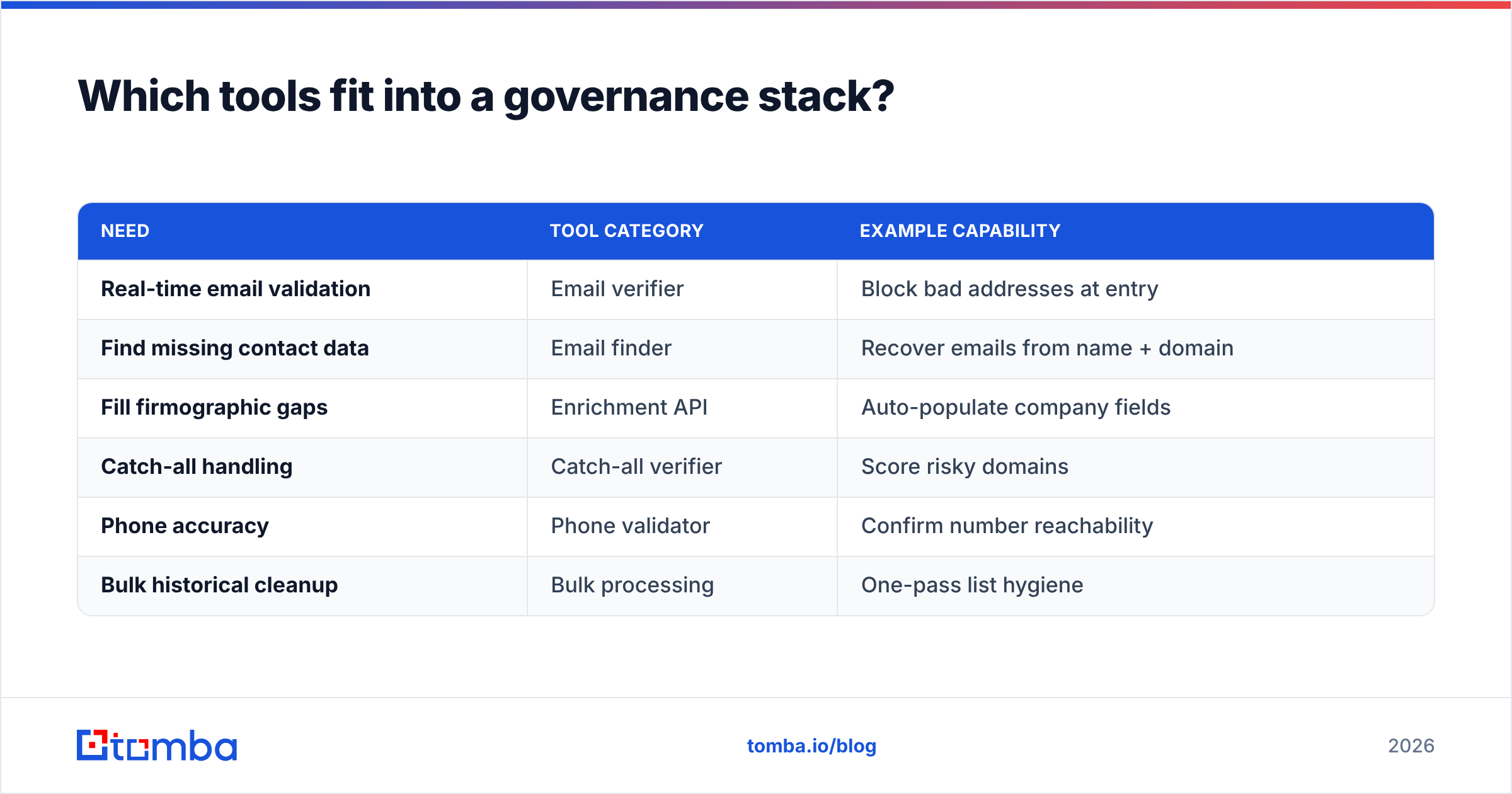
There's no single "governance tool" — you assemble a stack from a few categories. Here's how the pieces map to the controls layer of your framework:
| Need | Tool category | Example capability |
|---|---|---|
| Real-time email validation | Email verifier | Block bad addresses at entry |
| Find missing contact data | Email finder | Recover emails from name + domain |
| Fill firmographic gaps | Enrichment API | Auto-populate company fields |
| Catch-all handling | Catch-all verifier | Score risky domains |
| Phone accuracy | Phone validator | Confirm number reachability |
| Bulk historical cleanup | Bulk processing | One-pass list hygiene |
Tomba covers the data-quality side of this stack through a single API. The Tomba API exposes email finding, verification, catch-all checks, phone validation, and enrichment, so you can enforce entry-point governance without stitching together five vendors. The email finder recovers missing contact data, the email verifier blocks bad addresses, and the phone validator does the same for numbers.
For teams comparing providers, independent directories like G2 are a good neutral starting point — check verification accuracy claims against real reviews, not just marketing pages. And whichever vendor you choose, confirm they document where their data comes from; opaque data sourcing is a compliance risk you inherit.
How do you roll this out without stalling the team?#
Start narrow, prove value, expand. A big-bang governance program that tries to fix everything at once dies in committee. Here's a 90-day sequence that ships:
- Weeks 1–2: Baseline. Measure your four core metrics as they stand today. Ugly numbers are fine — they're your before picture.
- Weeks 3–4: Standards. Document required fields per object and the standard values for your top 10 picklists. Get the RevOps lead to sign off.
- Weeks 5–8: Entry controls. Turn on validation rules and email verification at the point of creation. This is where the metrics start to move.
- Weeks 9–10: Enrichment. Auto-fill firmographics on new records so completeness climbs without rep effort.
- Weeks 11–12: Monitoring. Stand up the dashboard, schedule the monthly review, and assign stewards by name.
Then, and only then, tackle the historical backlog with a bulk cleanup run. Fixing the past before you've stopped the bleeding just refills the same bucket.
One cultural note: publish the dashboard where reps can see it. When the team watches the duplication rate drop and completeness climb, governance stops feeling like the ops police and starts feeling like the reason their pipeline is finally trustworthy. That's the flip that makes it stick.
Frequently asked questions#
Is CRM data governance only for large enterprises? No. The principles scale down cleanly. A 10-person team with entry-point email verification and one named data steward has better governance than a 500-person org that "cleans up quarterly." Start with the four metrics and entry controls regardless of size.
How often should I re-verify existing records? Quarterly is a reasonable default for B2B, because roughly 2–3% of professional contacts change jobs every month. High-velocity segments (startups, sales roles) decay faster and deserve a monthly re-check.
Who owns CRM data governance — IT, RevOps, or Sales? RevOps typically owns the policy, IT or an ops engineer owns the technical controls, and object-level stewards handle day-to-day quality. The one wrong answer is "everyone," because shared-by-default means owned-by-nobody.
Can I automate governance without a developer? Largely, yes. Native CRM integrations for verification and enrichment cover most of the entry-point controls with configuration, not code. You'll want an engineer for custom validation logic or bulk API workflows, but the 80% case is no-code.
Clean data starts at the point of entry#
CRM data governance isn't a project you finish — it's a discipline you run. But the leverage is concentrated in one place: verify and enrich records the moment they're created, and most of your quality problems never happen.
That's exactly what Tomba is built for. Wire the Tomba Email Finder and verifier into your CRM's create flow and every new record arrives already checked and enriched. Start free with 25 searches a month, and see Tomba pricing when you're ready to cover the whole team — Starter runs $49/mo. Stop cleaning up dirty data and start preventing it.
Related guides#
Ready to find emails that actually work?
Join 150,000+ professionals who stopped guessing and started sending. Free credits on signup — no credit card required.
Get the Tomba newsletter
Practical outbound tactics and product updates — once every two weeks.
About the author