CRM Data Quality in 2026: The Complete Cleanup Playbook
Dirty CRM data quietly drains revenue, breaks forecasts, and burns rep hours. Here is how to measure, fix, and defend CRM data quality in 2026 — with a practical framework and tooling breakdown.
CRM Data Quality in 2026: The Complete Cleanup Playbook
Your CRM is only as good as the data inside it. Most teams treat the CRM like a filing cabinet — dump contacts in, hope they're right, and act surprised when the quarterly forecast misses by 20%. The reality is harsher: bad data isn't a passive cost, it actively steers reps toward dead leads, corrupts your reporting, and erodes trust in every dashboard leadership looks at.
This guide is the practical version. No abstract "data is the new oil" filler — just how to measure CRM data quality, what to fix first, and how to keep the database clean once you've done the work.
TL;DR#
- CRM data quality is measurable. Track completeness, accuracy, consistency, uniqueness, and freshness — not a vague "the data feels off."
- The cost is real and quantifiable. Bounced emails, wasted rep hours, and skewed forecasts trace directly back to dirty records.
- Cleanup is a workflow, not a one-time project. Audit → dedupe → verify → enrich → standardize → monitor, repeated on a cadence.
- Verification and enrichment are the highest-leverage steps. Confirming an email is deliverable and filling missing firmographics fixes the two failures that hurt outreach most.
- Prevention beats cleanup. Validate at the point of entry so garbage never lands in the CRM in the first place.
What is CRM data quality?#
CRM data quality is the degree to which the contact, account, and activity records in your CRM are accurate, complete, consistent, unique, and current enough to be trusted for decisions and action.
Think of your CRM like a restaurant's ingredient inventory. If the labels are wrong, half the shelves are empty, and three jars all claim to be "oregano," the chef can't cook a reliable meal no matter how skilled they are. Your reps are the chefs — they can only work with what's on the shelf.
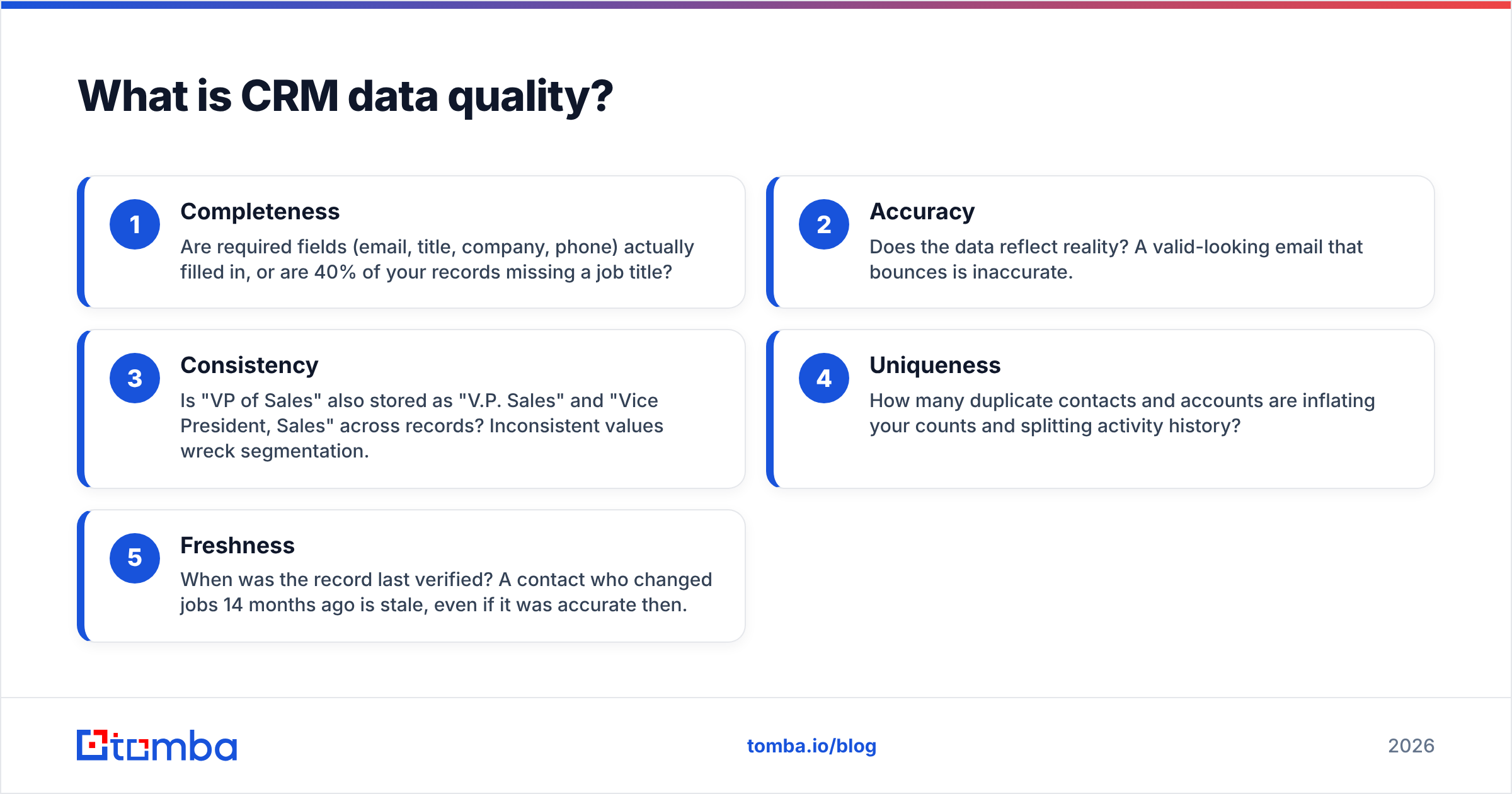
Quality breaks down along five concrete dimensions:
- Completeness — Are required fields (email, title, company, phone) actually filled in, or are 40% of your records missing a job title?
- Accuracy — Does the data reflect reality? A valid-looking email that bounces is inaccurate.
- Consistency — Is "VP of Sales" also stored as "V.P. Sales" and "Vice President, Sales" across records? Inconsistent values wreck segmentation.
- Uniqueness — How many duplicate contacts and accounts are inflating your counts and splitting activity history?
- Freshness — When was the record last verified? A contact who changed jobs 14 months ago is stale, even if it was accurate then.
Why does dirty CRM data cost so much?#
Because every downstream decision inherits the errors. Bad data doesn't stay contained in one field — it propagates into forecasts, routing, scoring, and the emails your reps actually send.
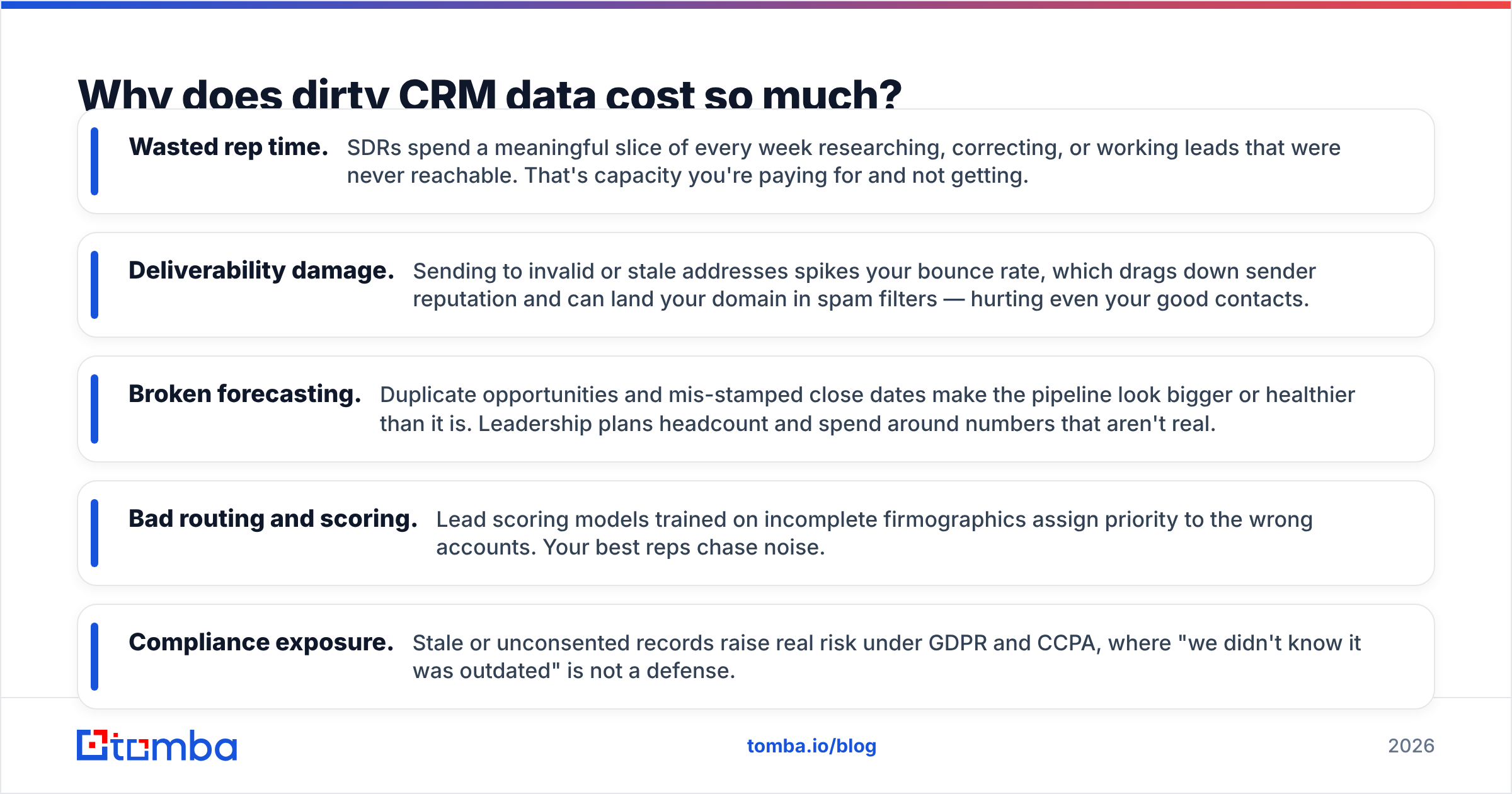
Here's how the damage compounds:
- Wasted rep time. SDRs spend a meaningful slice of every week researching, correcting, or working leads that were never reachable. That's capacity you're paying for and not getting.
- Deliverability damage. Sending to invalid or stale addresses spikes your bounce rate, which drags down sender reputation and can land your domain in spam filters — hurting even your good contacts.
- Broken forecasting. Duplicate opportunities and mis-stamped close dates make the pipeline look bigger or healthier than it is. Leadership plans headcount and spend around numbers that aren't real.
- Bad routing and scoring. Lead scoring models trained on incomplete firmographics assign priority to the wrong accounts. Your best reps chase noise.
- Compliance exposure. Stale or unconsented records raise real risk under GDPR and CCPA, where "we didn't know it was outdated" is not a defense.
Industry analysts have flagged for years that a large share of B2B contact data decays annually as people change roles, companies rebrand, and phone systems get swapped. Left unmanaged, a "clean" database rots on its own — you don't have to do anything wrong for quality to slide.
How do you measure CRM data quality?#
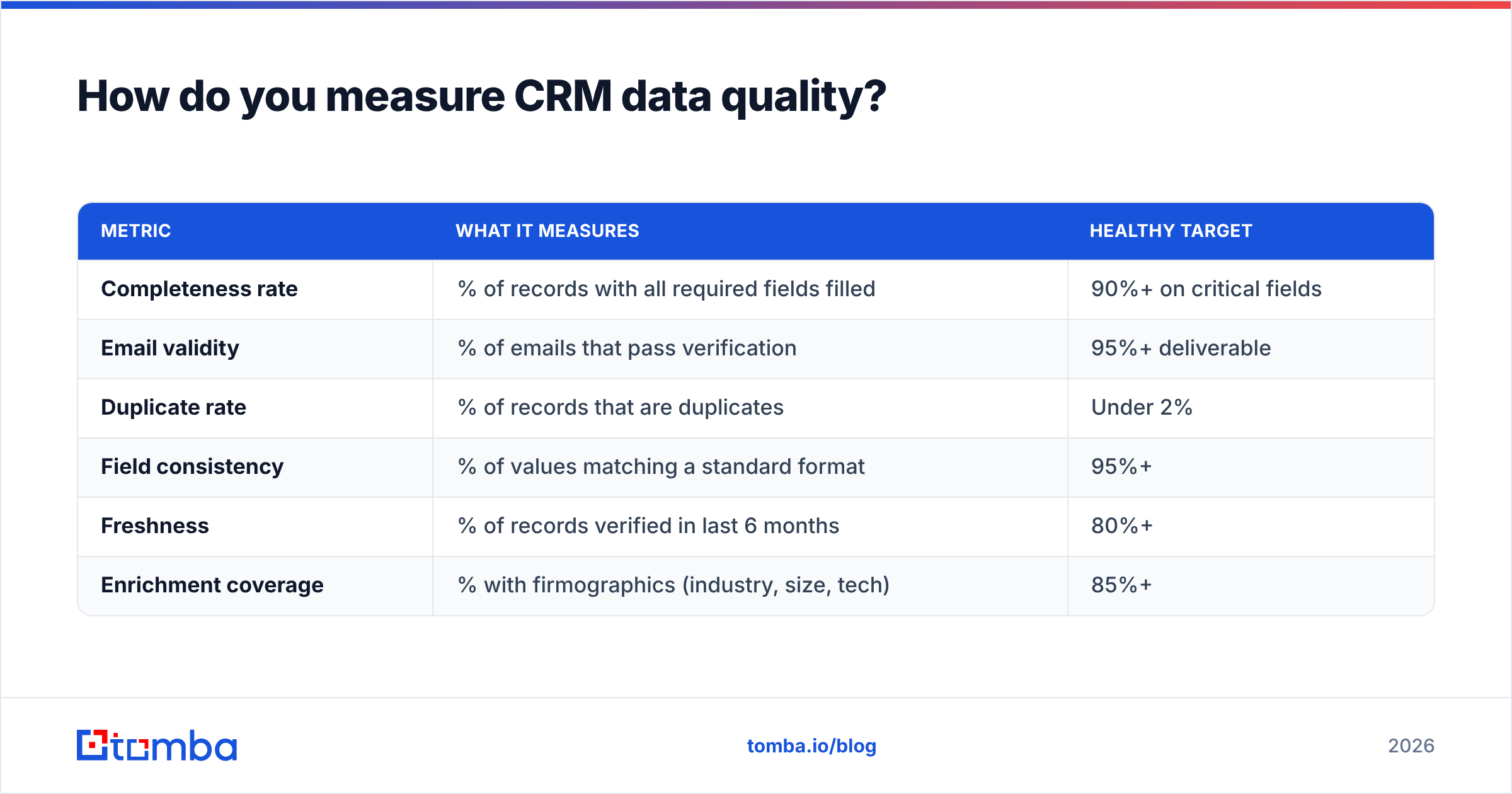
Start with a data audit that produces numbers, not opinions. You can't improve what you refuse to quantify, and "the data seems bad" never survives a budget conversation.
Run these checks across your core objects (contacts, accounts, opportunities):
| Metric | What it measures | Healthy target |
|---|---|---|
| Completeness rate | % of records with all required fields filled | 90%+ on critical fields |
| Email validity | % of emails that pass verification | 95%+ deliverable |
| Duplicate rate | % of records that are duplicates | Under 2% |
| Field consistency | % of values matching a standard format | 95%+ |
| Freshness | % of records verified in last 6 months | 80%+ |
| Enrichment coverage | % with firmographics (industry, size, tech) | 85%+ |
Export a sample of 500–1,000 records and score them against this table. The gap between your numbers and the targets is your backlog, ranked by how much each field actually gets used in outreach and reporting. Don't try to fix everything — fix the fields your reps and models depend on daily first.
A quick way to sanity-check email validity without touching your whole database: run a batch through an email verifier and see what share comes back as risky, invalid, or catch-all. That single number usually reframes the whole conversation.
What does a CRM cleanup workflow look like?#
Cleanup is a repeatable pipeline, not a heroic weekend. Run it end to end once to fix the backlog, then run the last step continuously.
1. Audit. Score your data against the metrics above. Identify the worst offenders — which fields, which segments, which import sources.
2. Deduplicate. Merge duplicate contacts and accounts, preserving the richest record and consolidating activity history. Match on email plus fuzzy name/company matching, not email alone. A remove-duplicates tool handles the list-level pass before records ever re-enter the CRM.
3. Verify. Confirm every email is deliverable and every phone number is valid. This is where you catch the silent killers — addresses that look fine but bounce. Verify catch-all domains separately, since they need a different confidence treatment.
4. Enrich. Fill the gaps. Missing job titles, company size, industry, and LinkedIn URLs get back-filled from a data enrichment source so segmentation and scoring have something to work with.
5. Standardize. Normalize formats — job titles, country codes, company names, phone formats. Pick one canonical form per field and transform everything to match.
6. Monitor. Set a recurring re-verification cadence (quarterly is a sane default) and validate all new records at entry. This is the step that keeps you out of the cleanup business permanently.
Which tools fix CRM data quality?#
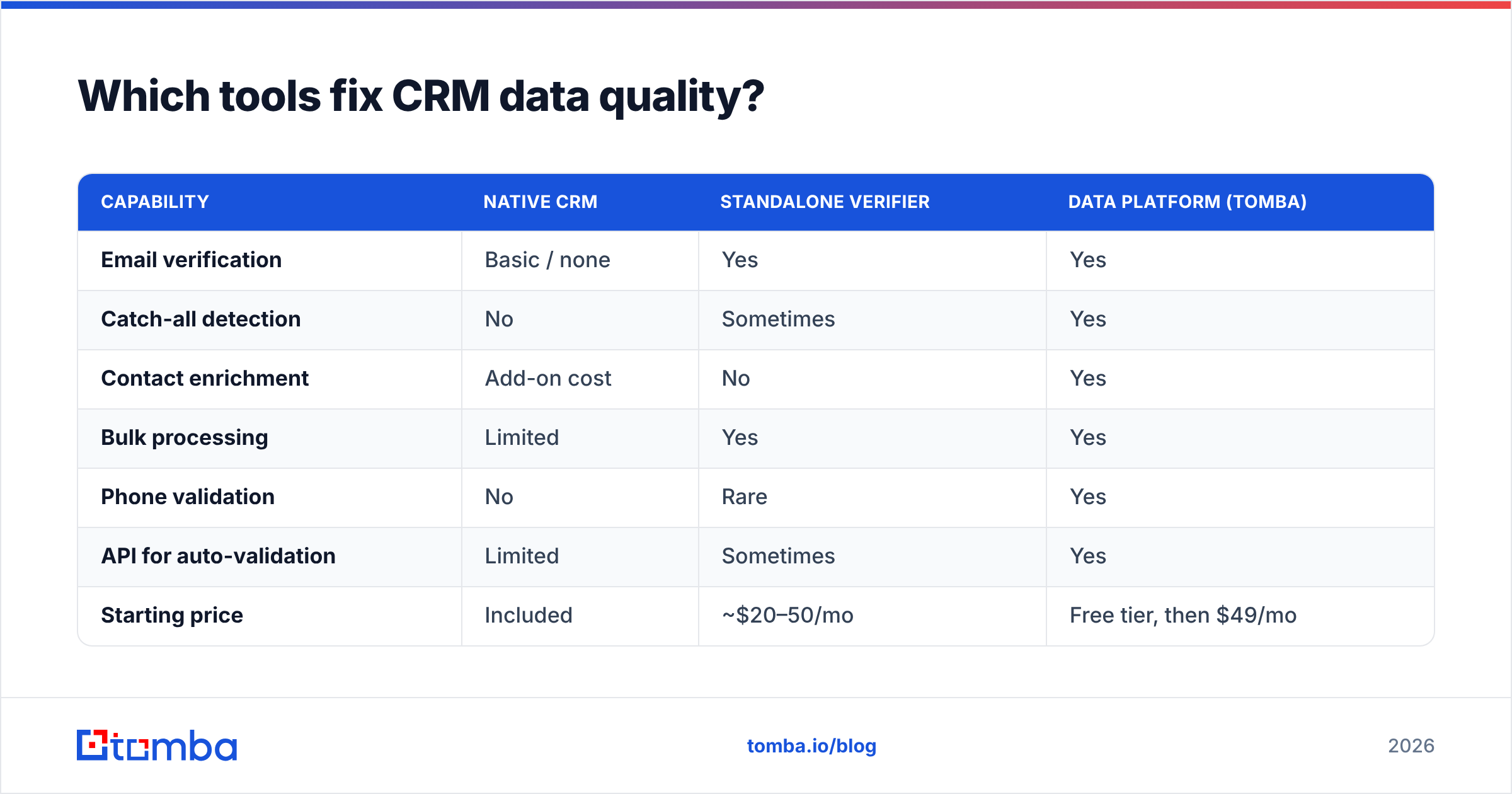
Different failures need different tools. Deduplication software won't tell you an email bounces, and a verifier won't fill a missing job title. Here's how the main categories compare on what they actually solve.
| Capability | Native CRM | Standalone verifier | Data platform (Tomba) |
|---|---|---|---|
| Email verification | Basic / none | Yes | Yes |
| Catch-all detection | No | Sometimes | Yes |
| Contact enrichment | Add-on cost | No | Yes |
| Bulk processing | Limited | Yes | Yes |
| Phone validation | No | Rare | Yes |
| API for auto-validation | Limited | Sometimes | Yes |
| Starting price | Included | ~$20–50/mo | Free tier, then $49/mo |
A few honest notes on the landscape:
- Native CRM tools (HubSpot's duplicate manager, Salesforce's matching rules) are fine for basic dedupe but weak on verification and enrichment. Good starting point, not a complete answer. See the HubSpot data quality docs for what's included natively.
- Dedicated verification tools nail deliverability but leave enrichment and phone data untouched — you end up stacking three subscriptions.
- Full data platforms cover verify + enrich + find in one place, which matters when your workflow is "clean the record and fill the holes" rather than just "check the email."
For teams that want peer comparisons before committing, G2's data quality category is a reasonable neutral reference for how tools stack up on real user reviews.
Where Tomba fits: it combines the email verifier, catch-all verifier, enrichment, and a bulk email finder so a single cleanup pass covers verification, gap-filling, and re-finding lost contacts. You can check current Tomba pricing — the free tier (25 searches/mo) is enough to audit a sample before you commit to anything.
How do you keep CRM data clean long-term?#
Prevention. The cheapest dirty record is the one that never entered your CRM. Once you've done the big cleanup, shift almost all your effort upstream to entry-point validation.
Three habits that keep quality from sliding:
- Validate at the point of entry. Wire an email verification API into your web forms, imports, and sync jobs so invalid addresses get flagged or rejected before they're saved. This is the single highest-ROI change most teams never make.
- Set field standards and enforce them. Required fields, picklists instead of free text, and validation rules turn "VP Sales / V.P. of Sales / vp, sales" into one canonical value automatically.
- Schedule re-verification. People change jobs constantly. A quarterly bulk re-check catches decay before it shows up as a bounce spike or a rep complaining that "half my list is dead."
Assign an owner. Data quality with no owner degrades by default — it's nobody's job until the forecast breaks, and by then you're back to a weekend cleanup. Make it one person's explicit responsibility with a metric they report on, the same way you'd own revenue operations or pipeline hygiene.
Frequently asked questions#
How often should I clean my CRM data? Run a full audit quarterly and validate new records continuously at entry. If you do heavy inbound or list imports, tighten the audit to monthly.
What's the difference between verification and enrichment? Verification confirms existing data is correct (does this email deliver?). Enrichment adds missing data (what's this person's job title and company size?). You need both — one checks, the other fills.
Can I fix CRM data quality without new tools? Partially. Native dedupe and validation rules go a long way, but verification and enrichment realistically require a dedicated data source. Manual research doesn't scale past a few hundred records.
Does dirty data really affect email deliverability? Yes, directly. Sending to invalid addresses raises bounce rates, which mailbox providers read as a spam signal and use to throttle or block your domain — including delivery to your good contacts.
Clean data is a system, not a project#
The teams that trust their pipeline aren't the ones that ran a big cleanup once. They're the ones that built verification and enrichment into the workflow so quality maintains itself. Measure the five dimensions, fix the backlog in a repeatable pass, then move your effort to the entry point where prevention actually pays off.
If you want to start with the highest-leverage step, run a sample of your worst records through the Tomba Email Finder and verifier — find the contacts that changed jobs, confirm the ones still valid, and see exactly how much of your database is quietly costing you. The free tier is enough to prove the case before you spend a dollar; check Tomba plans when you're ready to run it across the whole CRM.
Related guides#
Ready to find emails that actually work?
Join 150,000+ professionals who stopped guessing and started sending. Free credits on signup — no credit card required.
Get the Tomba newsletter
Practical outbound tactics and product updates — once every two weeks.
About the author