CRM Funnel Stages in 2026: The Complete Guide to Every Step
CRM funnel stages turn a messy pile of contacts into a predictable revenue engine. Here's every stage, the metrics that matter, and how to stop leads leaking out.
Your CRM is only as useful as the funnel stages inside it. Get the stages right and every deal has a clear next step, every rep knows what "qualified" means, and your forecast stops being a guessing game. Get them wrong and your pipeline becomes a graveyard of contacts nobody remembers adding.
This guide breaks down every CRM funnel stage, what should happen at each one, the metrics to watch, and the common mistakes that quietly leak revenue.
TL;DR#
- CRM funnel stages are the defined steps a contact moves through inside your CRM, from first touch to closed deal (and beyond).
- A clean funnel usually has 6–7 stages: Lead → MQL → SQL → Opportunity → Proposal → Closed Won/Lost, plus a retention loop.
- Each stage needs one thing: a clear entry criterion and a clear exit action. Vague stages are why deals stall.
- Track conversion rate between stages, not just total pipeline value — that's where you find the leak.
- Feeding your funnel with accurate contact data at the top matters more than any downstream optimization. Bad data poisons every stage after it.
What are CRM funnel stages?#
CRM funnel stages are the labeled steps that describe where a deal sits in your sales process. Think of them like the gates on an assembly line: a contact enters at the top, and to move to the next gate it has to meet a specific condition. When every rep agrees on what each gate means, your CRM becomes a shared language instead of 12 salespeople each inventing their own definition of "hot lead."
The funnel is a metaphor for volume. Many contacts enter the top; fewer survive each stage; a smaller number close. The narrowing is normal and expected — the goal is not to keep everyone, but to lose the wrong people early and cheaply while advancing the right ones efficiently.
A useful way to picture it: the funnel is a restaurant kitchen. Orders come in (leads), get checked against the menu (qualification), get cooked (opportunity work), get plated and served (proposal and close). If any station has no clear hand-off, food piles up and gets cold. In sales, "cold food" is a stalled deal.
What are the standard stages of a CRM sales funnel?#
Most B2B teams run some version of these seven stages. Names vary by company, but the logic is nearly universal.
- Lead / New — A contact enters your database. No qualification yet. Source could be a form fill, a list import, an event scan, or data enrichment.
- Marketing Qualified Lead (MQL) — The contact has shown intent (downloaded a guide, requested a demo) and fits your basic profile. See what separates a real marketing qualified lead from noise.
- Sales Qualified Lead (SQL) — A rep has confirmed budget, authority, need, and timeline (or your qualification framework of choice). The deal is worth active selling time.
- Opportunity — A genuine deal with an identified pain, stakeholders, and a rough deal size. This is where discovery and solution mapping happen.
- Proposal / Negotiation — You've sent pricing or a formal proposal. Objections, procurement, and terms get worked here.
- Closed Won — Signed. Revenue booked. Hand-off to onboarding.
- Closed Lost — Dead, disqualified, or pushed indefinitely. Tagged with a reason so you can learn from it.
Some teams add a Retention / Expansion stage after Closed Won to track renewals and upsells, because the cheapest revenue is from a customer you already have.
How is each stage defined? Entry and exit criteria#
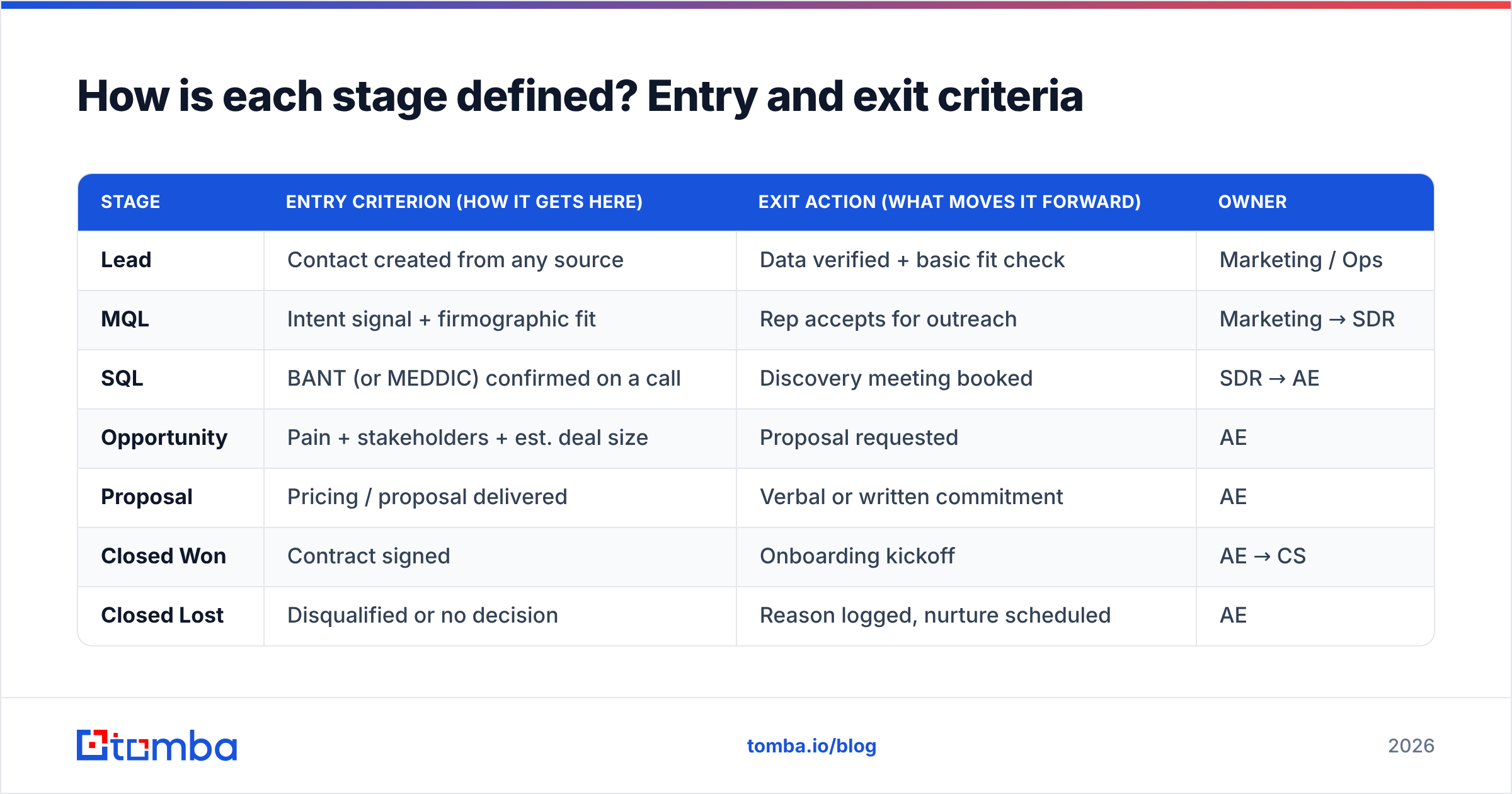
The single biggest fix most teams can make is writing down what it takes to enter and leave each stage. Without that, stages become storage bins where deals rot.
Here's a practical framework you can copy:
| Stage | Entry criterion (how it gets here) | Exit action (what moves it forward) | Owner |
|---|---|---|---|
| Lead | Contact created from any source | Data verified + basic fit check | Marketing / Ops |
| MQL | Intent signal + firmographic fit | Rep accepts for outreach | Marketing → SDR |
| SQL | BANT (or MEDDIC) confirmed on a call | Discovery meeting booked | SDR → AE |
| Opportunity | Pain + stakeholders + est. deal size | Proposal requested | AE |
| Proposal | Pricing / proposal delivered | Verbal or written commitment | AE |
| Closed Won | Contract signed | Onboarding kickoff | AE → CS |
| Closed Lost | Disqualified or no decision | Reason logged, nurture scheduled | AE |
Notice that every row has an owner. Ambiguous ownership is the second-biggest cause of leakage after ambiguous criteria — a deal "in Proposal" with no clear owner is a deal nobody is chasing.
Which metrics should you track at each CRM funnel stage?#
Total pipeline value is a vanity number on its own. What tells you the truth is the conversion rate between adjacent stages and the average time in stage. Together they show you exactly where deals die and where they get stuck.
- Stage-to-stage conversion rate — Of everything that entered SQL, what percent reached Opportunity? A sudden drop between two stages is your leak.
- Velocity (time in stage) — If deals sit in Proposal for 40 days on average, your closing motion, not your top of funnel, is the problem.
- Win rate — Closed Won divided by all closed deals. Track your win rate by segment, not just overall.
- Pipeline coverage — Total open pipeline versus quota. Most teams want 3–4x coverage to hit target.
- Lead-to-customer rate — The full-funnel number that tells you how efficient the whole machine is.
According to HubSpot's sales benchmark research, response speed and consistent follow-up dramatically affect conversion between early stages — which is why velocity metrics deserve as much attention as the raw counts.
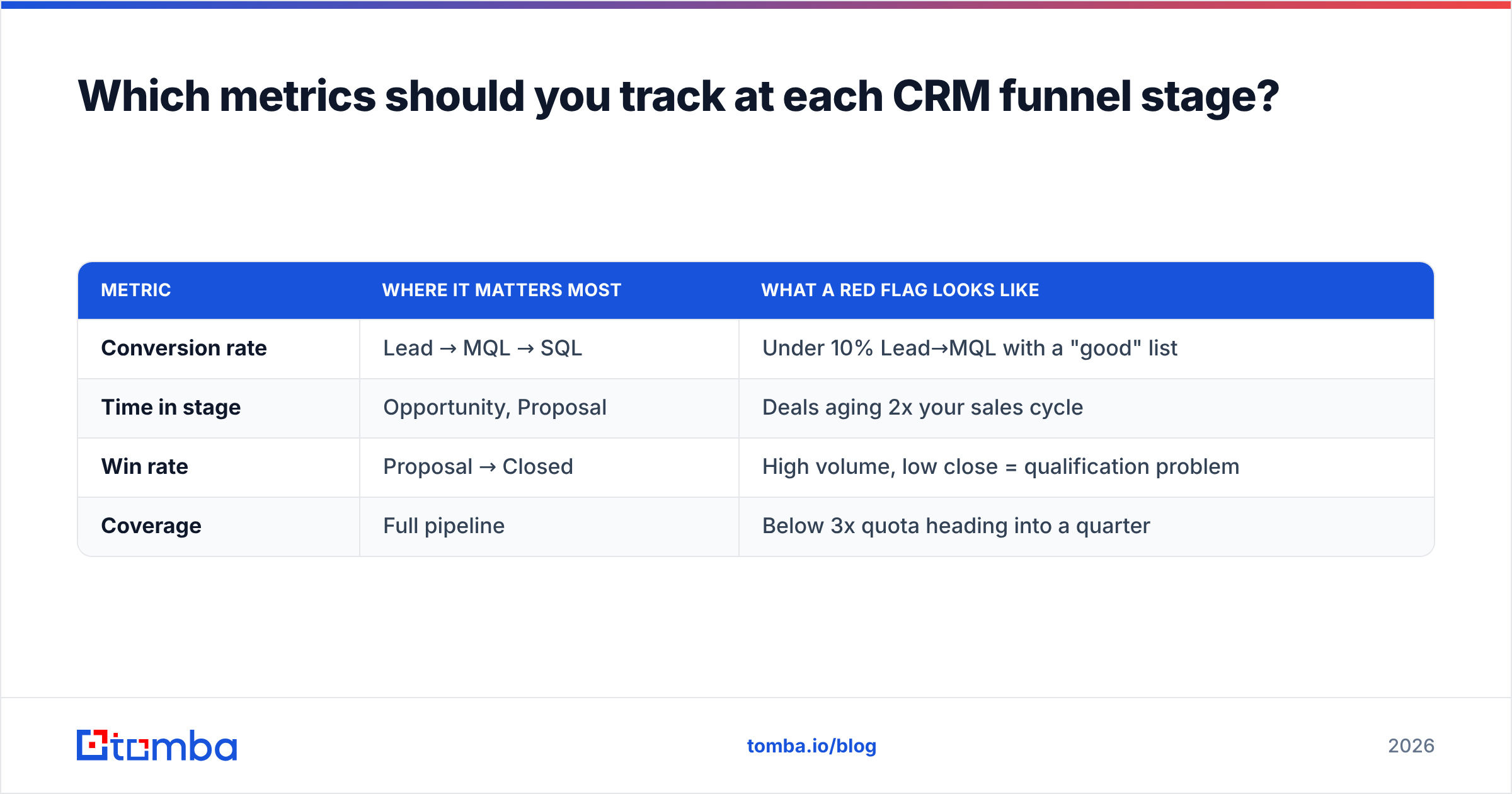
A quick reference for what "good" attention looks like per stage:
| Metric | Where it matters most | What a red flag looks like |
|---|---|---|
| Conversion rate | Lead → MQL → SQL | Under 10% Lead→MQL with a "good" list |
| Time in stage | Opportunity, Proposal | Deals aging 2x your sales cycle |
| Win rate | Proposal → Closed | High volume, low close = qualification problem |
| Coverage | Full pipeline | Below 3x quota heading into a quarter |
Why do leads leak out of the funnel?#
Leads leak for boring, fixable reasons. The dramatic ones (competitor stole the deal) are rarer than the mundane ones (nobody followed up, the email bounced, the stage criteria were fuzzy).
The most common culprits:
- Bad contact data at the top. If the email is wrong, the deal never even starts. Verified contact data is the foundation everything else sits on.
- No defined exit action, so deals sit in a stage indefinitely.
- Slow or missing follow-up. Improving your response rate with faster, more relevant outreach recovers deals you'd otherwise lose.
- Stage inflation — reps push weak deals into Opportunity to look busy, inflating the forecast and hiding the real conversion rate.
- No nurture path for Closed Lost. "No decision" today is often "yes" in six months, but only if you keep the relationship warm.
How do you build accurate CRM funnel stages from scratch?#
Start narrow and add complexity only when the data demands it. A five-stage funnel that everyone uses correctly beats a nine-stage funnel that reps ignore.
Step-by-step:
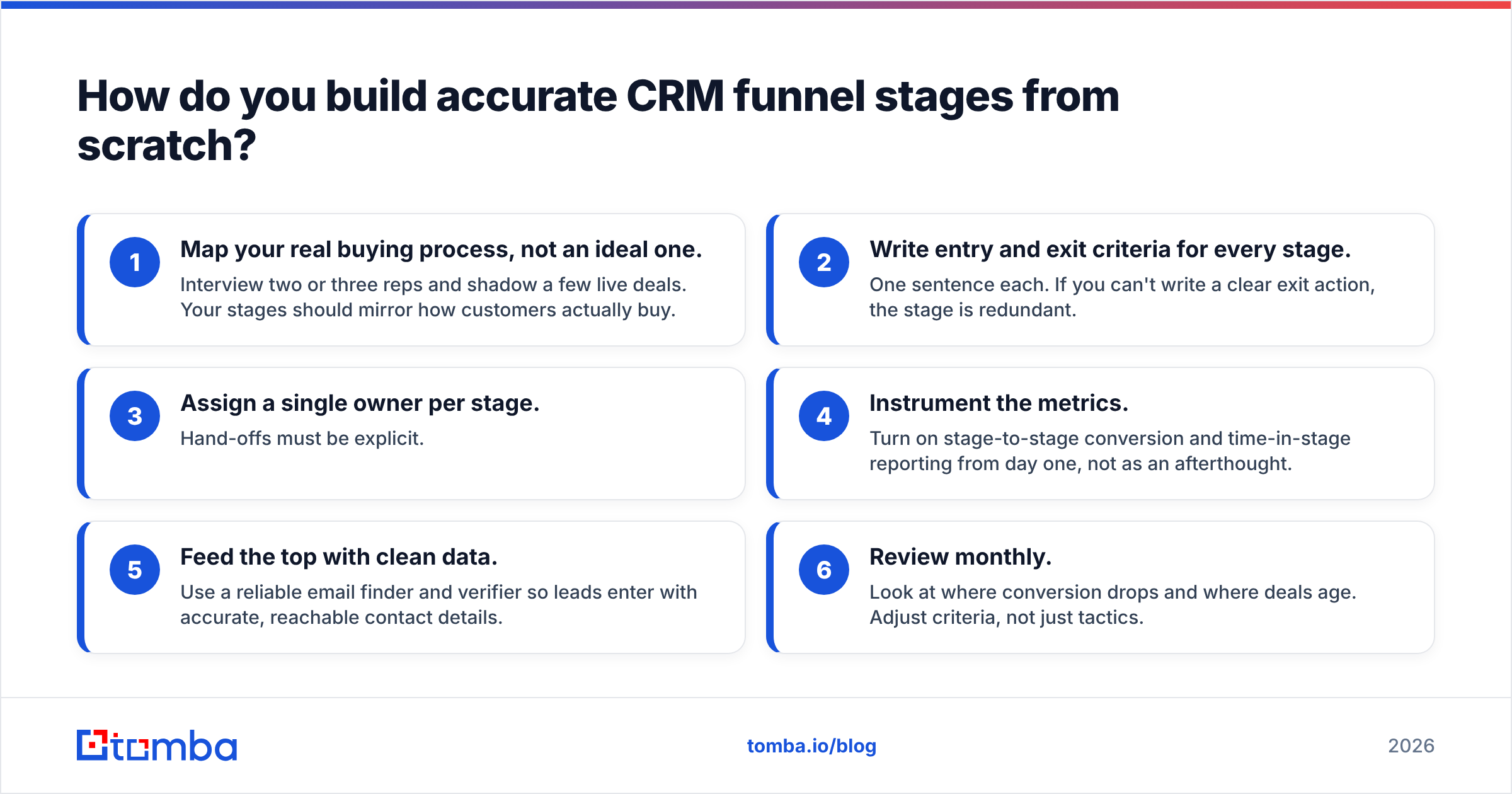
- Map your real buying process, not an ideal one. Interview two or three reps and shadow a few live deals. Your stages should mirror how customers actually buy.
- Write entry and exit criteria for every stage. One sentence each. If you can't write a clear exit action, the stage is redundant.
- Assign a single owner per stage. Hand-offs must be explicit.
- Instrument the metrics. Turn on stage-to-stage conversion and time-in-stage reporting from day one, not as an afterthought.
- Feed the top with clean data. Use a reliable email finder and verifier so leads enter with accurate, reachable contact details.
- Review monthly. Look at where conversion drops and where deals age. Adjust criteria, not just tactics.
For a deeper structural view, Salesforce's guidance on sales pipeline stages is a solid neutral reference for aligning your CRM configuration with a repeatable process, and analyst firms like Gartner publish ongoing research on how B2B buying journeys are shifting toward self-service and multi-stakeholder buying groups.
CRM funnel vs. sales pipeline: what's the difference?#
People use "funnel" and "pipeline" interchangeably, but there's a useful distinction.
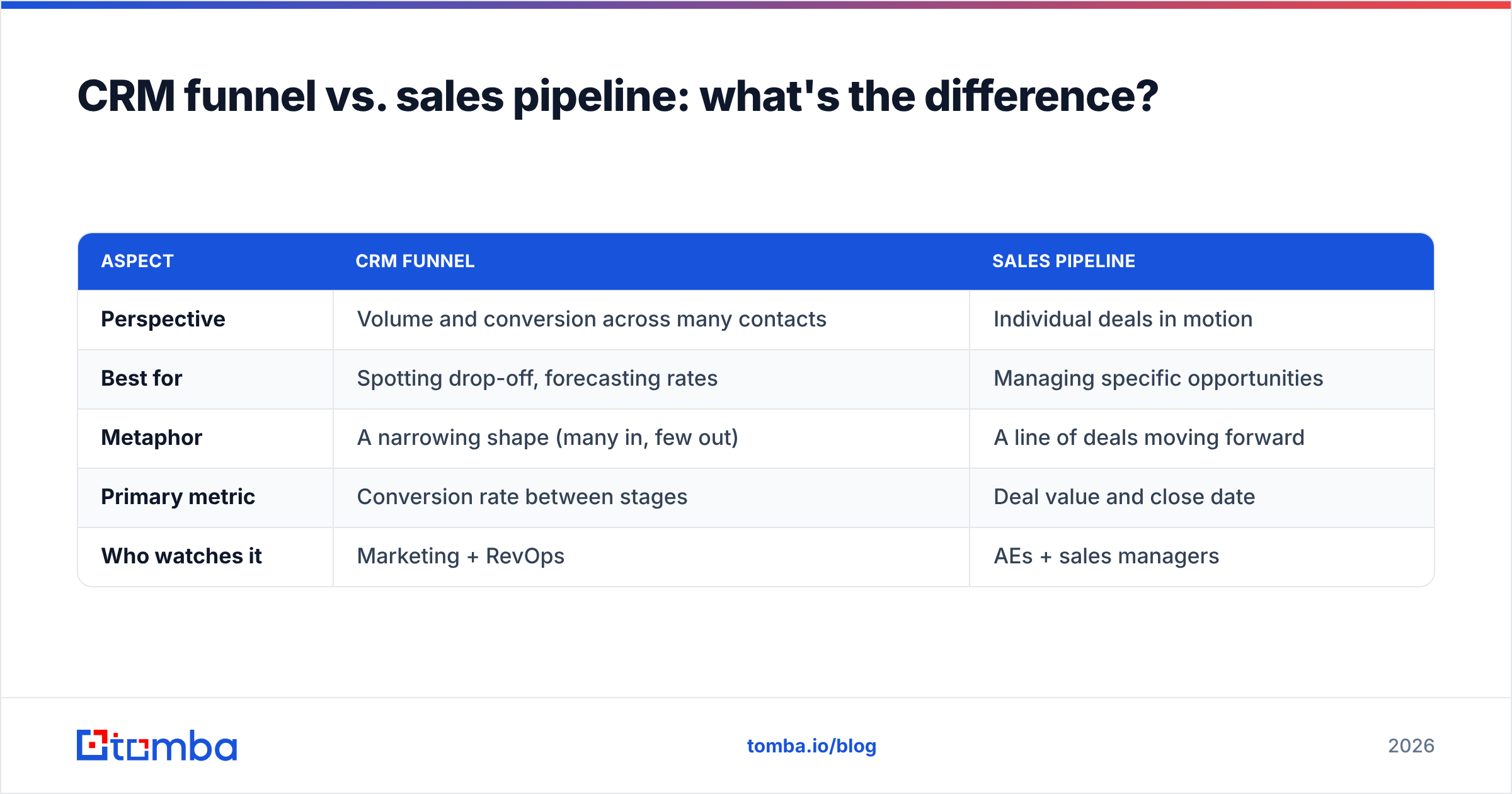
| Aspect | CRM funnel | Sales pipeline |
|---|---|---|
| Perspective | Volume and conversion across many contacts | Individual deals in motion |
| Best for | Spotting drop-off, forecasting rates | Managing specific opportunities |
| Metaphor | A narrowing shape (many in, few out) | A line of deals moving forward |
| Primary metric | Conversion rate between stages | Deal value and close date |
| Who watches it | Marketing + RevOps | AEs + sales managers |
In practice they share the same underlying stages inside your CRM. The funnel is the aggregate view (how efficient is the machine?); the pipeline is the operational view (which deals do I work today?). You need both, and a well-built CRM gives you each from the same data.
How does data quality affect your funnel stages?#
Everything downstream inherits the quality of what you put in at the top. A funnel built on unverified contacts is a funnel with an invisible leak between "Lead" and "MQL" that no amount of coaching will fix.
Consider two teams with identical processes. Team A imports a list where 30% of emails are invalid or outdated. Team B verifies and enriches the same list first. Team A's SDRs waste a third of their outreach on bounces and dead numbers, their sender reputation takes a hit, and their Lead→MQL rate looks terrible — not because the process is broken, but because the fuel is contaminated.
This is why the highest-ROI investment in most funnels isn't a new stage or a new tool — it's clean, verified, enriched data feeding the top. When your contacts are accurate, every conversion rate below reflects your selling, not your data hygiene, and you can finally trust your funnel to tell you the truth. Compare Tomba plans if you want to see how verified data at the top changes what the rest of the funnel reports.
What's the biggest mistake teams make with funnel stages?#
Treating stages as decoration instead of decisions. A stage should exist only if a deal behaves differently once it enters. If "Opportunity" and "Proposal" trigger the same activities, they're one stage wearing two names, and merging them will make your reporting cleaner and your reps happier.
The second-biggest mistake is optimizing the middle while ignoring the top. Reps and managers love to tune closing tactics because that's where the drama is. But if your Lead→MQL conversion is 4% because half your contacts are unreachable, no amount of negotiation training moves the number. Fix the fuel before you tune the engine.
Frequently asked questions#
How many stages should a CRM funnel have? Most B2B teams do well with six to seven. Fewer than five usually means you're skipping meaningful hand-offs; more than eight usually means reps stop updating them accurately.
Should Closed Lost be a stage? Yes — with a mandatory reason field. Closed Lost data is how you learn which segments, objections, or sources to stop chasing, and which deals to re-engage later.
What tool do I need to start? Any CRM with customizable stages works. The differentiator is the data you feed it. Accurate, verified contacts at the top make every stage below more reliable.
The bottom line#
Well-designed CRM funnel stages turn selling from a gut-feel activity into a measurable one. Define clear entry and exit criteria, assign an owner to each stage, watch the conversion rate between stages, and above all, feed the top of the funnel with accurate data.
That last part is where most funnels quietly break. If you want every stage below to reflect your real selling performance instead of your data problems, start by making sure the contacts entering your funnel are real and reachable. The Tomba Email Finder finds and verifies professional email addresses by name, domain, or company — so your funnel starts clean and every conversion rate you measure afterward is one you can actually trust. Start free with 25 searches a month and see what accurate data does to your top of funnel.
Related guides#
Ready to find emails that actually work?
Join 150,000+ professionals who stopped guessing and started sending. Free credits on signup — no credit card required.
Get the Tomba newsletter
Practical outbound tactics and product updates — once every two weeks.
About the author