The CRM Lead Management Process: A Step-by-Step 2026 Guide
Most CRMs are graveyards of dead leads. This guide breaks the CRM lead management process into six repeatable stages so leads get captured, scored, routed, and closed instead of rotting in a pipeline.
Your CRM is only as good as the process behind it. Buy the best platform on the market, skip the workflow, and you get the same result every underperforming sales team gets: a database full of leads nobody follows up on, reps working the loudest deal instead of the best one, and marketing convinced sales wasted their leads. The fix is not more software. It is a defined CRM lead management process that every lead passes through the same way, every time.
This guide breaks that process into six concrete stages, shows you where teams leak revenue, and gives you a scoring and routing model you can copy today.
TL;DR#
- The CRM lead management process has six stages: capture, enrich, score, route, nurture, and convert — skip any one and the rest degrades.
- Leads rot when there is no owner and no SLA. Assign both at the moment of capture, not after a rep gets around to it.
- Lead scoring (fit + behavior) is what separates a pipeline from a to-do list. Route your reps' time to the top decile.
- Data quality is the silent killer: 30%+ of B2B contact data decays yearly, so enrichment and verification are process steps, not one-time cleanups.
- A repeatable process beats a bigger CRM. Most teams already own the tools — they just have no defined path from raw lead to closed deal.
What is the CRM lead management process?#
The CRM lead management process is the repeatable path a lead travels from first touch to closed deal (or disqualification) inside your CRM. Think of it like an airport: a passenger does not wander onto a random plane. They check in, get screened, are routed to a gate, and board a specific flight — each step handing off cleanly to the next. A lead should move the same way, with no leads left standing in the terminal because nobody told them where to go.
Technically, it is the combination of rules, fields, and automations that govern how leads are captured, qualified, assigned, and worked. Without it, your CRM is a filing cabinet. With it, your CRM becomes a conveyor belt that surfaces the right lead to the right rep at the right time.
The process matters because the alternative is expensive. According to Gartner, poor lead handoffs and slow follow-up are among the most common reasons pipeline value never converts. A defined process is the cheapest revenue lever most teams ignore.
What are the six stages of lead management?#
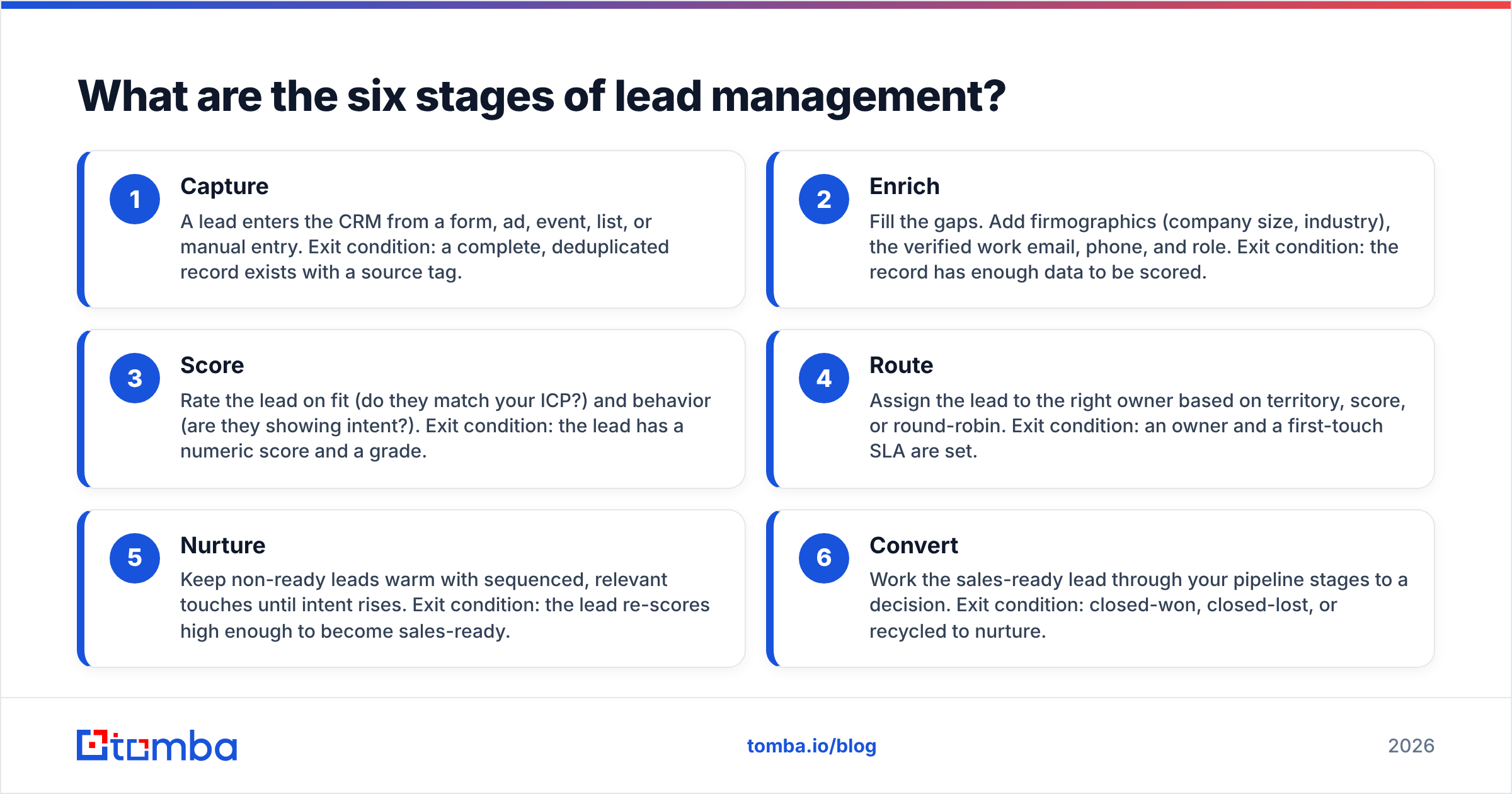
Here is the full path, stage by stage. Each stage has an owner, an input, and an exit condition — that is what makes it a process instead of a vibe.
- Capture — A lead enters the CRM from a form, ad, event, list, or manual entry. Exit condition: a complete, deduplicated record exists with a source tag.
- Enrich — Fill the gaps. Add firmographics (company size, industry), the verified work email, phone, and role. Exit condition: the record has enough data to be scored.
- Score — Rate the lead on fit (do they match your ICP?) and behavior (are they showing intent?). Exit condition: the lead has a numeric score and a grade.
- Route — Assign the lead to the right owner based on territory, score, or round-robin. Exit condition: an owner and a first-touch SLA are set.
- Nurture — Keep non-ready leads warm with sequenced, relevant touches until intent rises. Exit condition: the lead re-scores high enough to become sales-ready.
- Convert — Work the sales-ready lead through your pipeline stages to a decision. Exit condition: closed-won, closed-lost, or recycled to nurture.
Miss stage two and your scoring in stage three runs on garbage. Miss stage four and even a perfectly scored lead sits untouched. The stages are a chain, not a menu.
Why do leads die in the CRM?#
Leads die for boring, fixable reasons — not because the market is soft.
- No owner. A lead with no assigned rep is a lead nobody follows up on. Diffusion of responsibility guarantees it.
- No speed. HubSpot research and countless studies since have shown that response time in the first few minutes dramatically outperforms hours-later follow-up. Most CRMs do not enforce this; your process must.
- No data. A record that says "John — Acme" with no verified email or phone is un-workable. The rep skips it and moves on.
- No scoring. Without a score, every lead looks equal, so reps work the newest or the loudest, not the best.
- No recycling. Leads marked "not ready" vanish instead of dropping back into nurture. That is pipeline you already paid for, thrown away.
The pattern is consistent: process gaps, not lead quality, kill most pipelines.
How does lead scoring actually work?#
Lead scoring assigns a number to each lead so your team can prioritize by likelihood to convert. The reliable model combines two axes.
Fit score (who they are): How closely the lead matches your ideal customer profile. Company size, industry, role, region, tech stack. This tells you whether the lead is worth pursuing.
Behavior score (what they do): Engagement signals. Pricing-page visits, demo requests, email replies, content downloads, repeat sessions. This tells you whether the lead is ready now.
A lead that scores high on both is a hand-raiser — route to sales instantly. High fit, low behavior? Nurture. Low fit, high behavior? Usually a tire-kicker; keep them in marketing. Low on both? Disqualify or park.
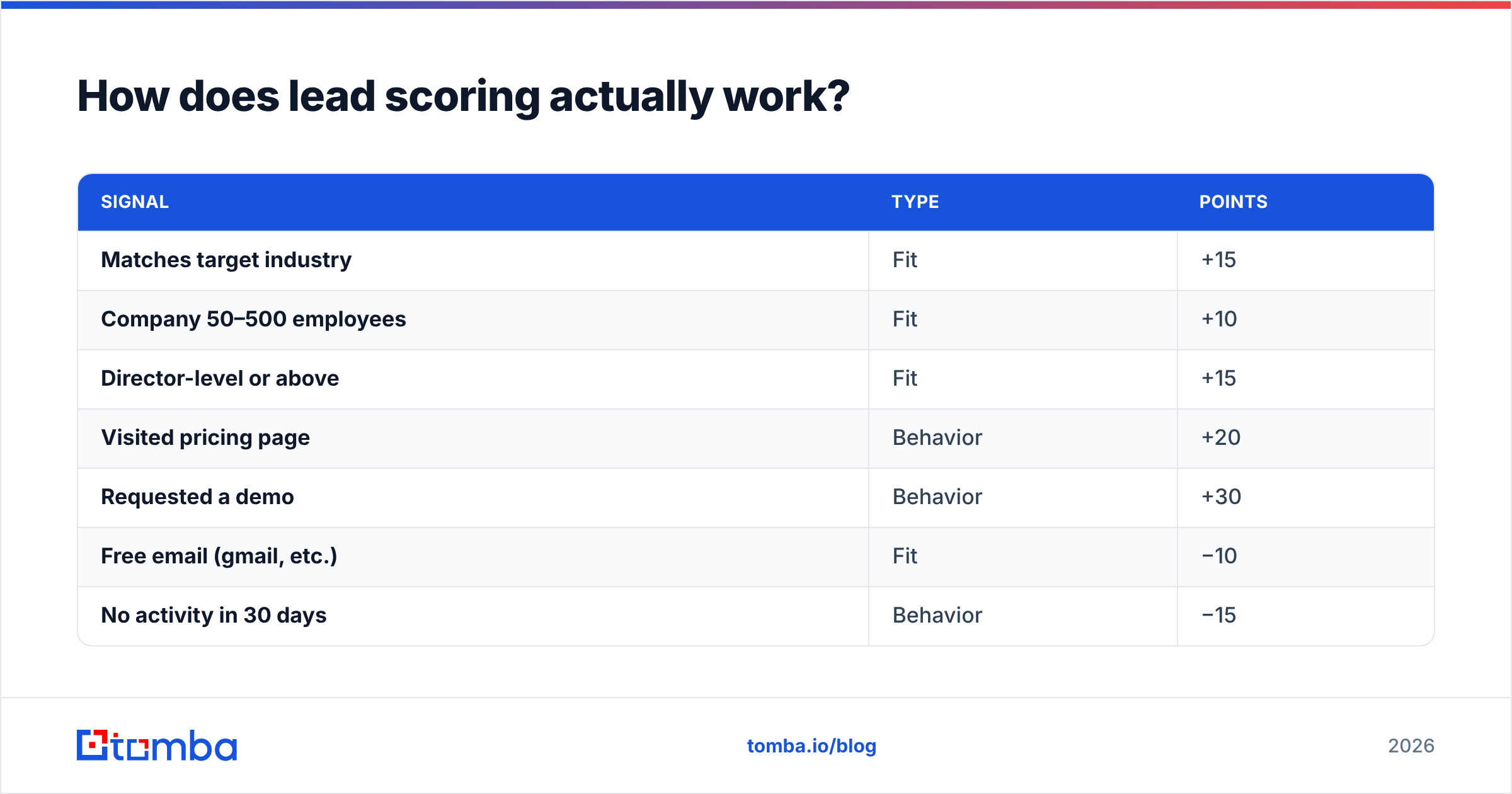
You do not need machine learning to start. A simple points table works:
| Signal | Type | Points |
|---|---|---|
| Matches target industry | Fit | +15 |
| Company 50–500 employees | Fit | +10 |
| Director-level or above | Fit | +15 |
| Visited pricing page | Behavior | +20 |
| Requested a demo | Behavior | +30 |
| Free email (gmail, etc.) | Fit | −10 |
| No activity in 30 days | Behavior | −15 |
Set a threshold — say, 50 points — that promotes a lead from marketing-qualified to sales-ready. Learn what a marketing qualified lead means for your funnel and calibrate from there. The exact numbers matter less than applying them consistently.
What tools do you need at each stage?#
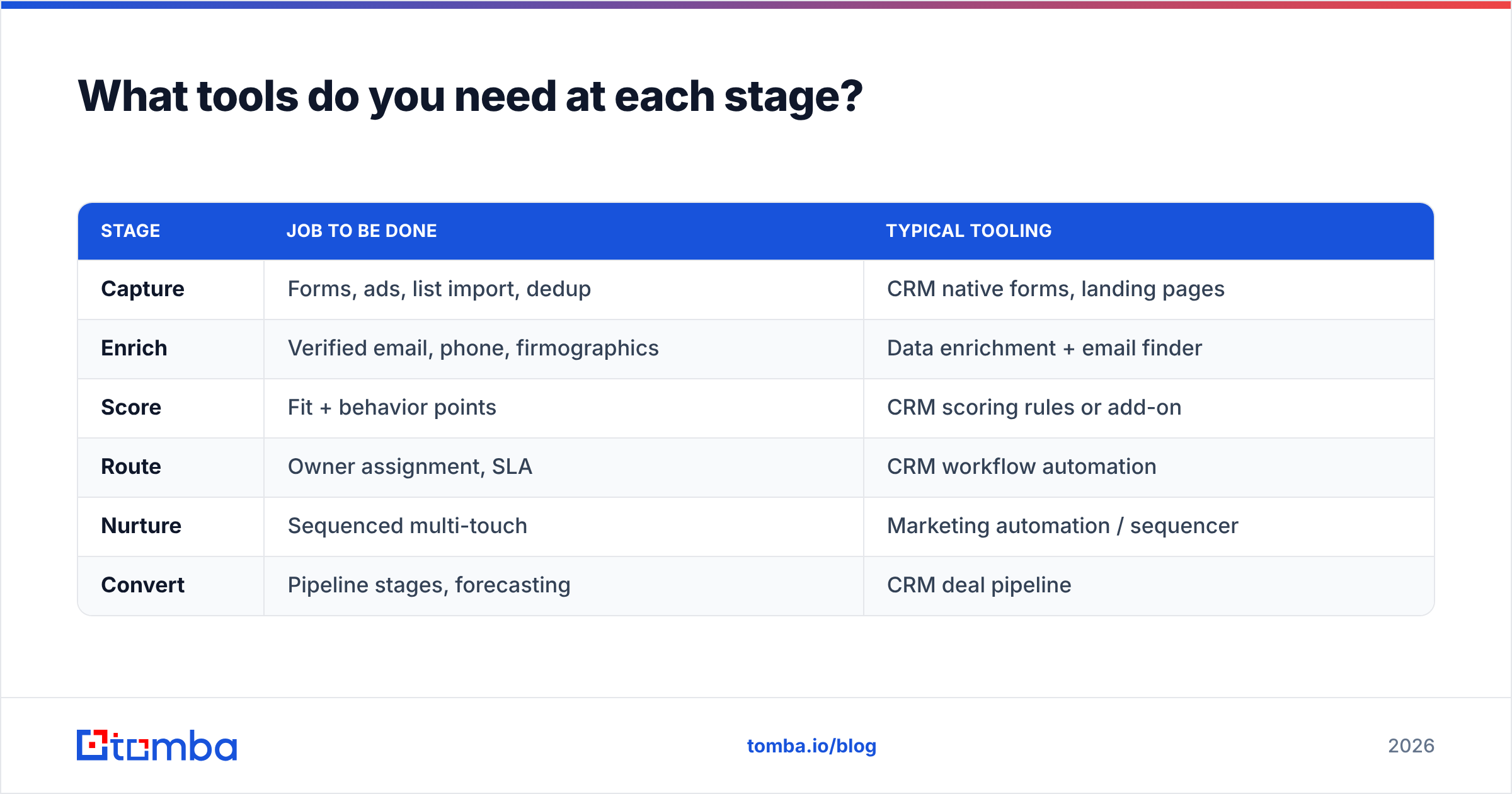
You do not need a 15-app stack. You need coverage for each stage, and many teams already own most of it. Here is how the layers map.
| Stage | Job to be done | Typical tooling |
|---|---|---|
| Capture | Forms, ads, list import, dedup | CRM native forms, landing pages |
| Enrich | Verified email, phone, firmographics | Data enrichment + email finder |
| Score | Fit + behavior points | CRM scoring rules or add-on |
| Route | Owner assignment, SLA | CRM workflow automation |
| Nurture | Sequenced multi-touch | Marketing automation / sequencer |
| Convert | Pipeline stages, forecasting | CRM deal pipeline |
The stage teams most often under-tool is enrichment. A lead that arrives with only a name and company needs a verified contact path before a rep can touch it. Running that record through an email verifier before it hits a rep's queue keeps your sender reputation intact and your reps out of dead-inbox purgatory. If you are working inbound domains, a quick domain search fills out the account's other decision-makers so one lead becomes a buying committee.
Manual vs automated lead management: which wins?#
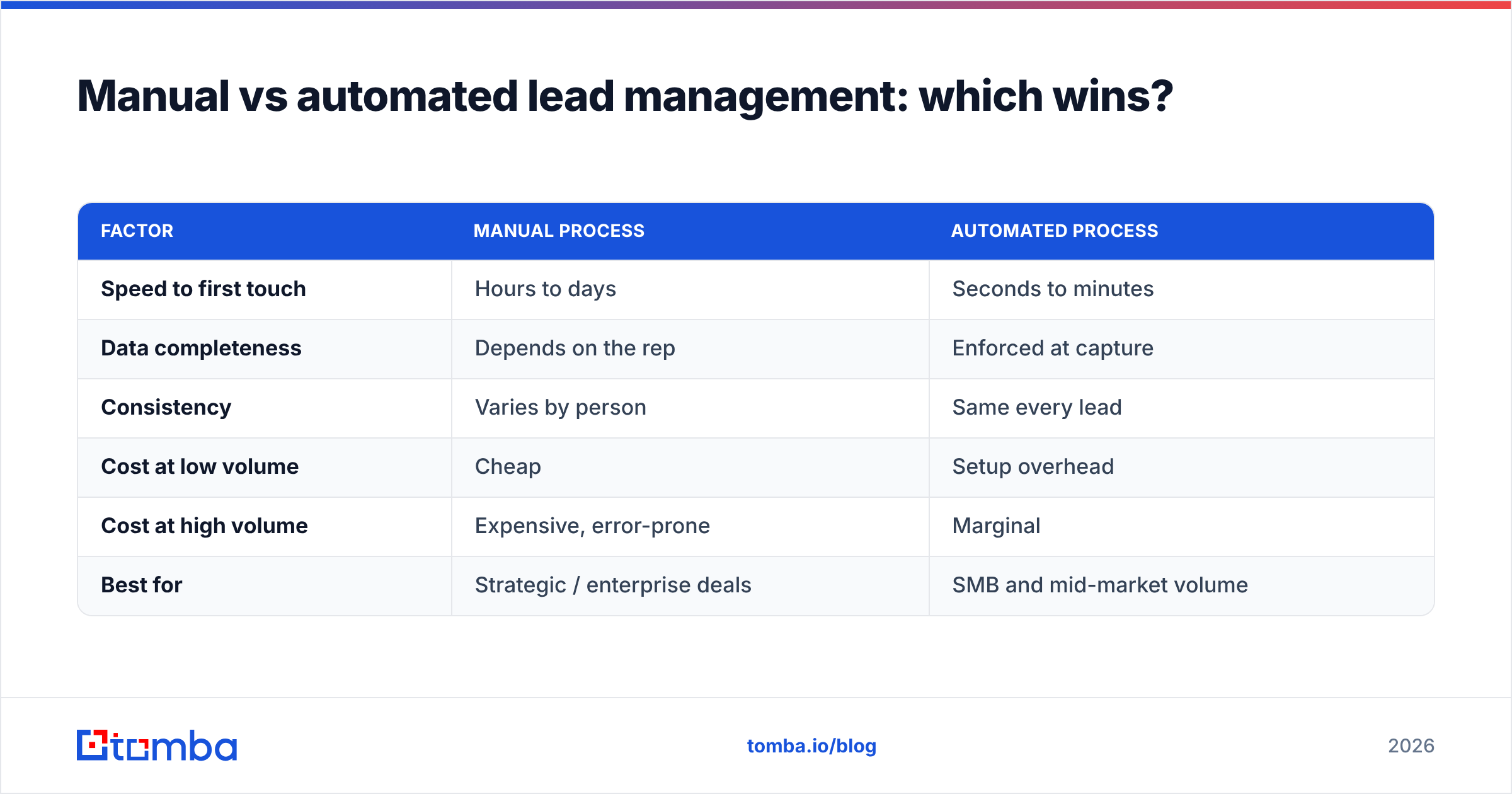
Automated wins on everything that scales, but manual still has a place for high-value, complex deals. The honest breakdown:
| Factor | Manual process | Automated process |
|---|---|---|
| Speed to first touch | Hours to days | Seconds to minutes |
| Data completeness | Depends on the rep | Enforced at capture |
| Consistency | Varies by person | Same every lead |
| Cost at low volume | Cheap | Setup overhead |
| Cost at high volume | Expensive, error-prone | Marginal |
| Best for | Strategic / enterprise deals | SMB and mid-market volume |
The right answer for most teams is a hybrid: automate capture, enrichment, scoring, and routing so nothing falls through, then let reps spend their human judgment on the convert stage where it actually moves deals. Automating the boring 80% is what frees your team to be excellent at the 20% that closes.
How do you route leads to the right rep?#
Routing is where a good process quietly makes money. The three common models:
- Round-robin — Distribute evenly across reps. Fair, simple, ignores fit. Fine for uniform SMB leads.
- Territory / segment — Assign by geography, industry, or company size so specialists work the accounts they know. Better win rates, more setup.
- Score-based — The hottest leads go to your strongest closers; the rest enter nurture or a pooled queue. Highest ROI, requires reliable scoring first.
Whichever you pick, attach a first-touch SLA — for example, "sales-ready leads contacted within 15 minutes." An SLA without a timer is a wish. Configure your CRM to alert or reassign when the clock runs out. This single rule recovers more pipeline than most reps realize, because speed compounds: the first vendor to respond frequently wins the deal outright.
How do you keep the CRM data clean?#
Treat data hygiene as a recurring process step, not a spring-cleaning project. B2B contact data decays fast — people change jobs, companies rebrand, emails die — and a database degrading 25–30% per year will quietly wreck your scoring and deliverability.
Three habits keep it healthy:
- Verify at entry. Every new email gets validated before it is workable. Catch-all domains get flagged for extra checks with a catch-all verifier so you are not guessing.
- Dedup on a schedule. Merge duplicate records weekly. Two half-complete records of the same person are worse than one complete one.
- Re-enrich the aging tail. Records untouched for 90+ days get re-checked. A bulk email finder run against your stale segment refreshes contact paths in one pass instead of one lead at a time.
Clean data is not glamorous, but it is the foundation the other five stages stand on. Garbage in, garbage scored, garbage routed.
What metrics prove the process is working?#
Track a small set of process metrics, not vanity counts. If these move in the right direction, the machine is working:
- Speed to lead — median time from capture to first touch. Lower is better; target minutes for sales-ready leads.
- Lead-to-opportunity rate — share of qualified leads that become real opportunities. This tests your scoring accuracy.
- Response SLA compliance — percentage of leads contacted inside the SLA. A leading indicator; it moves before revenue does.
- Stage conversion rates — where leads stall between the six stages. Your biggest drop-off is your next fix.
- Data completeness — share of records with a verified email and phone. Below 80% and enrichment is your bottleneck.
Review these monthly and change exactly one thing per cycle. Process improvement is a series of small, measured corrections — not a big-bang re-platforming.
Build the process on data you can trust#
The six-stage process only works if the leads flowing through it are real, reachable, and complete. That is the part most teams get wrong — they invest in workflow automation while feeding it half-empty records that no scoring model or routing rule can rescue.
Start at the source. The Tomba Email Finder turns a name and a company into a verified professional email so every lead enters your CRM workable from stage one, with the firmographics your scoring model needs already attached. Pair it with verification and enrichment and your capture stage stops leaking. Plans start free with 25 searches a month, and paid tiers begin at $49/mo — see Tomba pricing to match a plan to your lead volume.
Fix the data at the front of the process, and the other five stages finally do what your CRM promised. Define the path, enforce the SLA, score by fit and intent, and stop letting good leads die in the pipeline.
Related guides#
Ready to find emails that actually work?
Join 150,000+ professionals who stopped guessing and started sending. Free credits on signup — no credit card required.
Get the Tomba newsletter
Practical outbound tactics and product updates — once every two weeks.
About the author