CRM Opportunity Management: The Complete 2026 Playbook
A practical guide to CRM opportunity management in 2026: stages, fields, data hygiene, and forecasting habits that actually move deals to closed-won.
TL;DR
- CRM opportunity management is the discipline of tracking every revenue deal through defined stages, with clean data and clear exit criteria at each step.
- Most pipelines don't fail because of the tool — they fail because stages are vague, fields are half-filled, and contact data is stale.
- A good opportunity record answers five questions: who, how much, what stage, why it will (or won't) close, and what happens next.
- Stage-exit criteria plus weekly hygiene beats any AI forecast built on garbage inputs.
- Enrich contacts at the top of the funnel so every opportunity starts with verified emails and decision-maker data, not guesses.
Opportunity management is the difference between a pipeline you can forecast and a spreadsheet full of wishful thinking. Do it well and your CRM becomes a live model of future revenue. Do it badly and every deal review turns into a guessing game. This guide walks through what CRM opportunity management is, how to structure it, and the habits that keep it honest in 2026.
What is CRM opportunity management?#
CRM opportunity management is the process of creating, tracking, and updating individual sales deals ("opportunities") as they move from first qualified interest to a closed outcome. Think of it like an air-traffic control tower: every deal is a plane, each stage is an altitude band, and your job is to know exactly where each one is, whether it's on course, and what needs to happen before it can land.
An opportunity is more than a contact or a lead. A marketing qualified lead is a person who showed interest. An opportunity is a specific deal with a dollar value, a close date, and a buyer you can name. The moment a qualified lead has budget, authority, need, and a timeline, it graduates into an opportunity — and that's when disciplined tracking starts to matter.
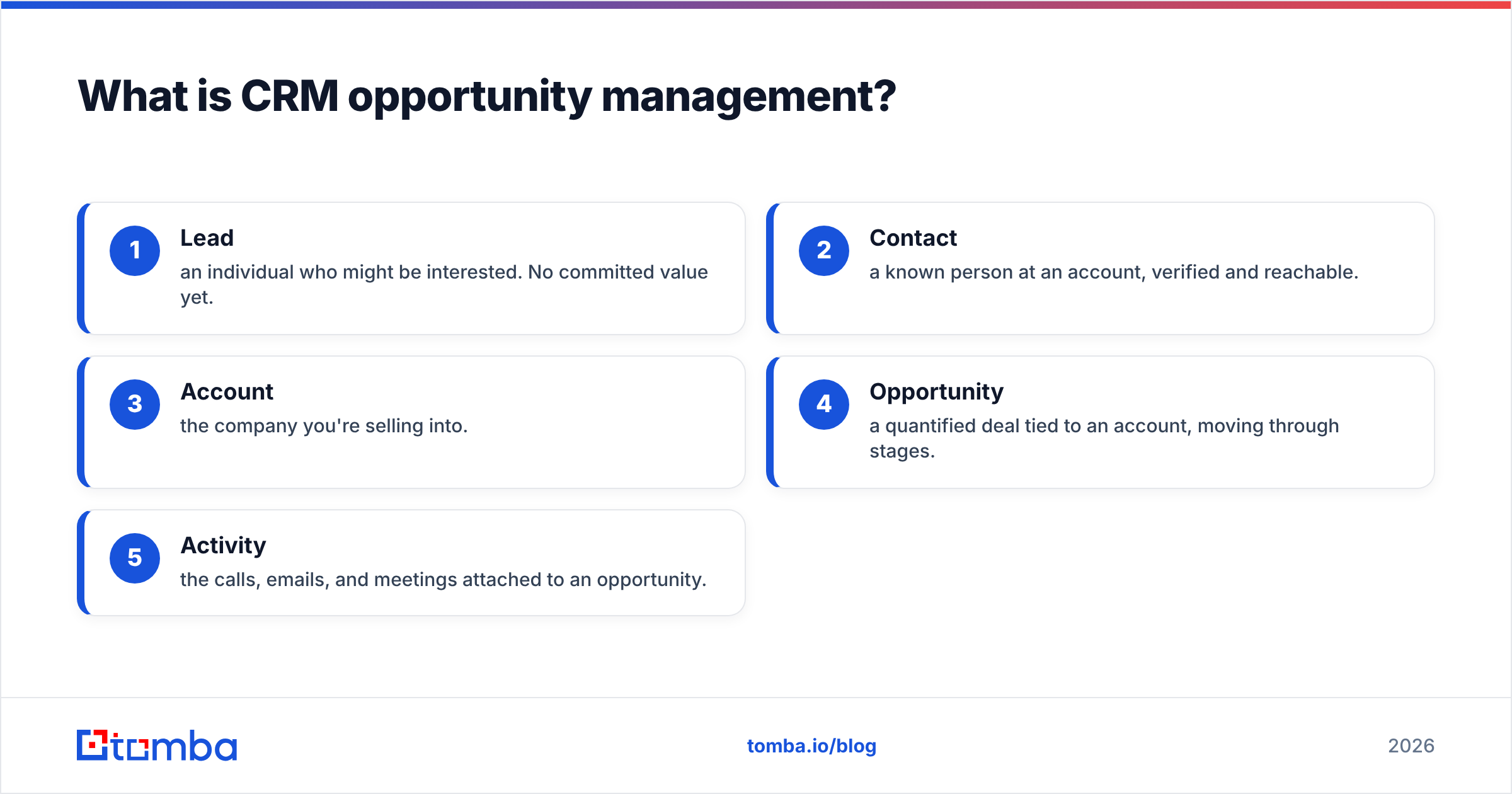
Here's the distinction that trips teams up:
- Lead — an individual who might be interested. No committed value yet.
- Contact — a known person at an account, verified and reachable.
- Account — the company you're selling into.
- Opportunity — a quantified deal tied to an account, moving through stages.
- Activity — the calls, emails, and meetings attached to an opportunity.
Opportunity management sits on top of solid contact data. If the email bounces or the decision-maker left six months ago, the deal record is fiction. That's why the strongest teams enrich and verify contacts before a deal enters the pipeline, using a data enrichment step so every opportunity starts with a real, reachable buyer.

Why does opportunity management matter more in 2026?#
Because forecasting is now a board-level metric, and boards no longer accept "gut feel" answers. Buying committees have grown — the average B2B deal now involves six to ten stakeholders, according to Gartner research on the buying group. A single opportunity record has to capture more people, more objections, and more competing priorities than it did five years ago.
Three forces make clean opportunity management non-negotiable this year:
- Longer, multi-threaded deals. One champion is no longer enough. You need contacts and roles mapped across the account.
- AI forecasting. Revenue teams are pointing AI at pipeline data. AI amplifies whatever you feed it — accurate stages produce accurate forecasts, sloppy stages produce confident nonsense.
- RevOps accountability. Revenue operations teams now own the definition of a "qualified" opportunity and enforce it. The days of every rep inventing their own stage logic are ending.
The tooling got smarter. The problem is that smarter tools make bad data more dangerous, not less. A confident wrong forecast costs more than an honest "we don't know."
What does a healthy opportunity record contain?#
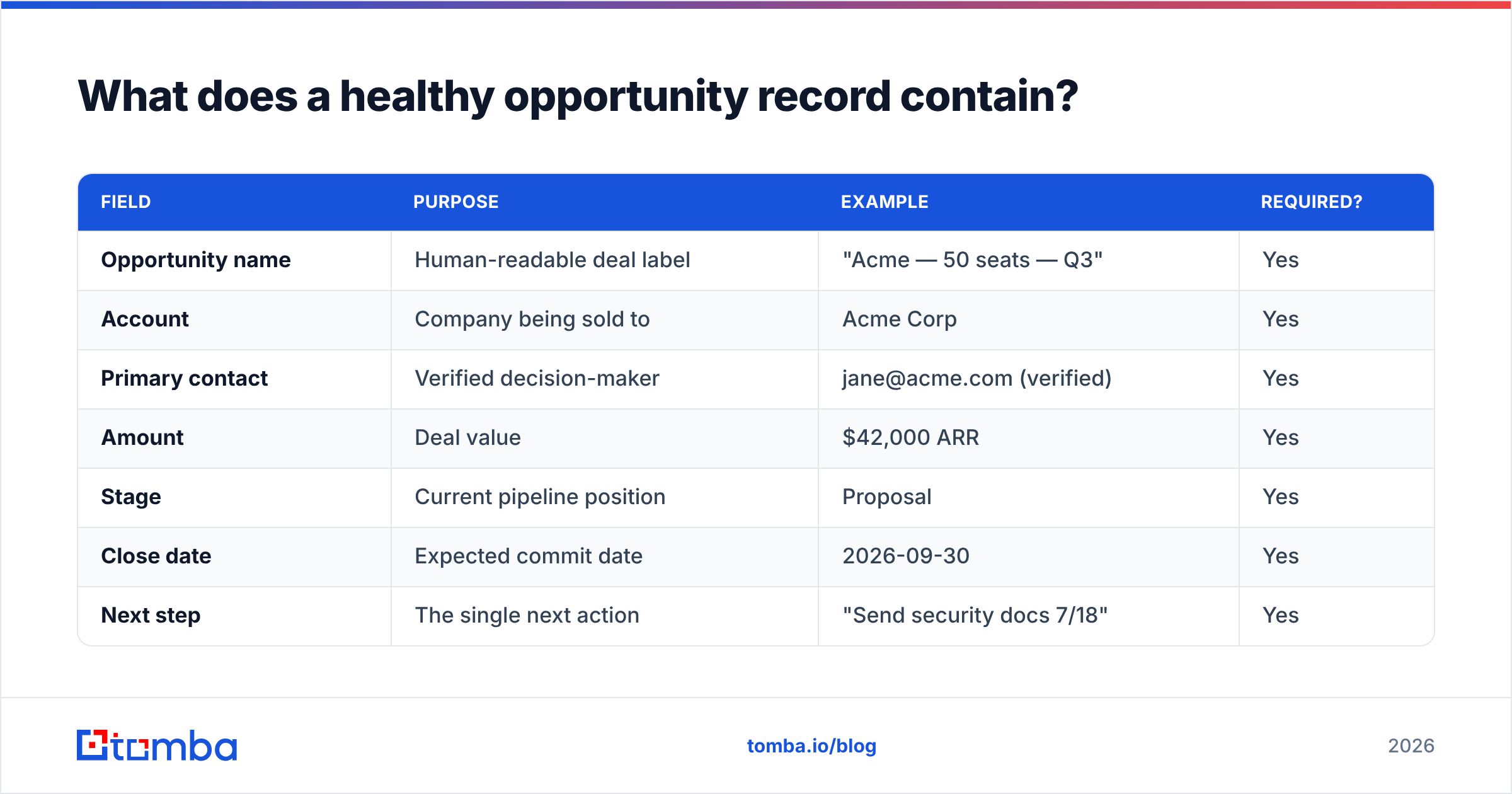
A healthy opportunity answers five questions at a glance: who's buying, how much, what stage, why it will close, and what happens next. Below is a field structure that works across most B2B CRMs without overloading reps.
| Field | Purpose | Example | Required? |
|---|---|---|---|
| Opportunity name | Human-readable deal label | "Acme — 50 seats — Q3" | Yes |
| Account | Company being sold to | Acme Corp | Yes |
| Primary contact | Verified decision-maker | jane@acme.com (verified) | Yes |
| Amount | Deal value | $42,000 ARR | Yes |
| Stage | Current pipeline position | Proposal | Yes |
| Close date | Expected commit date | 2026-09-30 | Yes |
| Next step | The single next action | "Send security docs 7/18" | Yes |
| Competitor | Who else is in the deal | Incumbent renewal | No |
| Loss reason | Why it died (if closed-lost) | Budget frozen | On close |
The two fields reps skip most — next step and loss reason — are the two that carry the most forecasting value. A next step is your proof the deal is alive. A loss reason is how you get smarter next quarter. Make both mandatory on their respective triggers.
Notice the primary contact field says verified. An opportunity built on an unverified email is a liability. Run new contacts through an email verifier before you attach them, and pull missing decision-maker details with a domain search so the record is complete on day one.
How should you structure your opportunity stages?#
Stages should describe buyer behavior, not seller optimism. The classic mistake is naming stages after what your rep did ("Demo given") instead of what the buyer committed to ("Demo requested next step scheduled"). The fix is exit criteria: a deal can't advance until an objective, buyer-side condition is met.
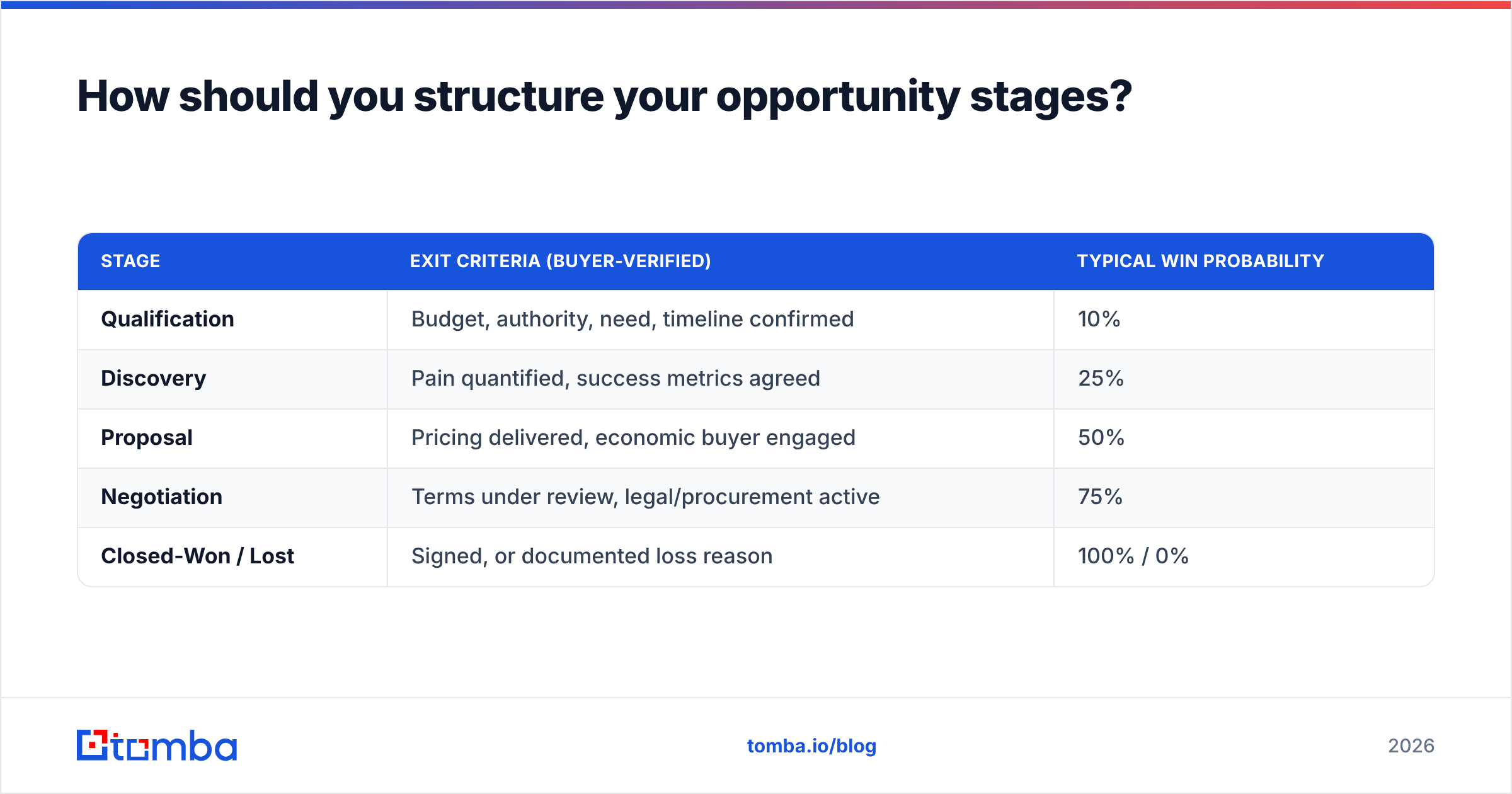
Here's a lean, defensible stage model with exit criteria:
| Stage | Exit criteria (buyer-verified) | Typical win probability |
|---|---|---|
| Qualification | Budget, authority, need, timeline confirmed | 10% |
| Discovery | Pain quantified, success metrics agreed | 25% |
| Proposal | Pricing delivered, economic buyer engaged | 50% |
| Negotiation | Terms under review, legal/procurement active | 75% |
| Closed-Won / Lost | Signed, or documented loss reason | 100% / 0% |
Two rules keep this honest:
- A stage only advances on evidence. "I have a good feeling" is not evidence. "The buyer scheduled a procurement call" is.
- Probability is a property of the stage, not the rep's mood. If reps hand-edit win probability per deal, your forecast becomes a mood ring. Let the stage set it, and use a manual override only with a written reason.
This is where a lot of pipelines quietly break. One does not simply forecast revenue from stages that everyone defines differently.

How do you keep opportunity data clean?#
You keep it clean with a weekly hygiene ritual and a few automated guardrails — not with a quarterly cleanup that nobody enjoys. Data decay is relentless: B2B contact data degrades roughly 2–3% per month as people change jobs, so a pipeline left untouched for a quarter is already meaningfully wrong.
A workable hygiene cadence:
- Every stage change — require a next step and an updated close date. No exceptions.
- Weekly — flag any open opportunity with no activity in 14 days as "at risk."
- Weekly — re-verify the primary contact's email on late-stage deals so a bounce doesn't kill a signature.
- Monthly — audit close dates that are in the past but still marked open (the classic "zombie deal").
- Quarterly — enrich stalled accounts with fresh decision-maker contacts in case your champion left.
Automation carries most of this load. Push new opportunities and contacts through your stack with a HubSpot integration or Salesforce integration so enrichment and verification happen the moment a deal is created, not weeks later. For bulk cleanup of an existing pipeline, a bulk email finder can re-verify hundreds of primary contacts in one pass.
The goal is simple: no rep should ever be forecasting off a deal whose buyer they can't actually reach.
What tools do you need beyond the CRM itself?#
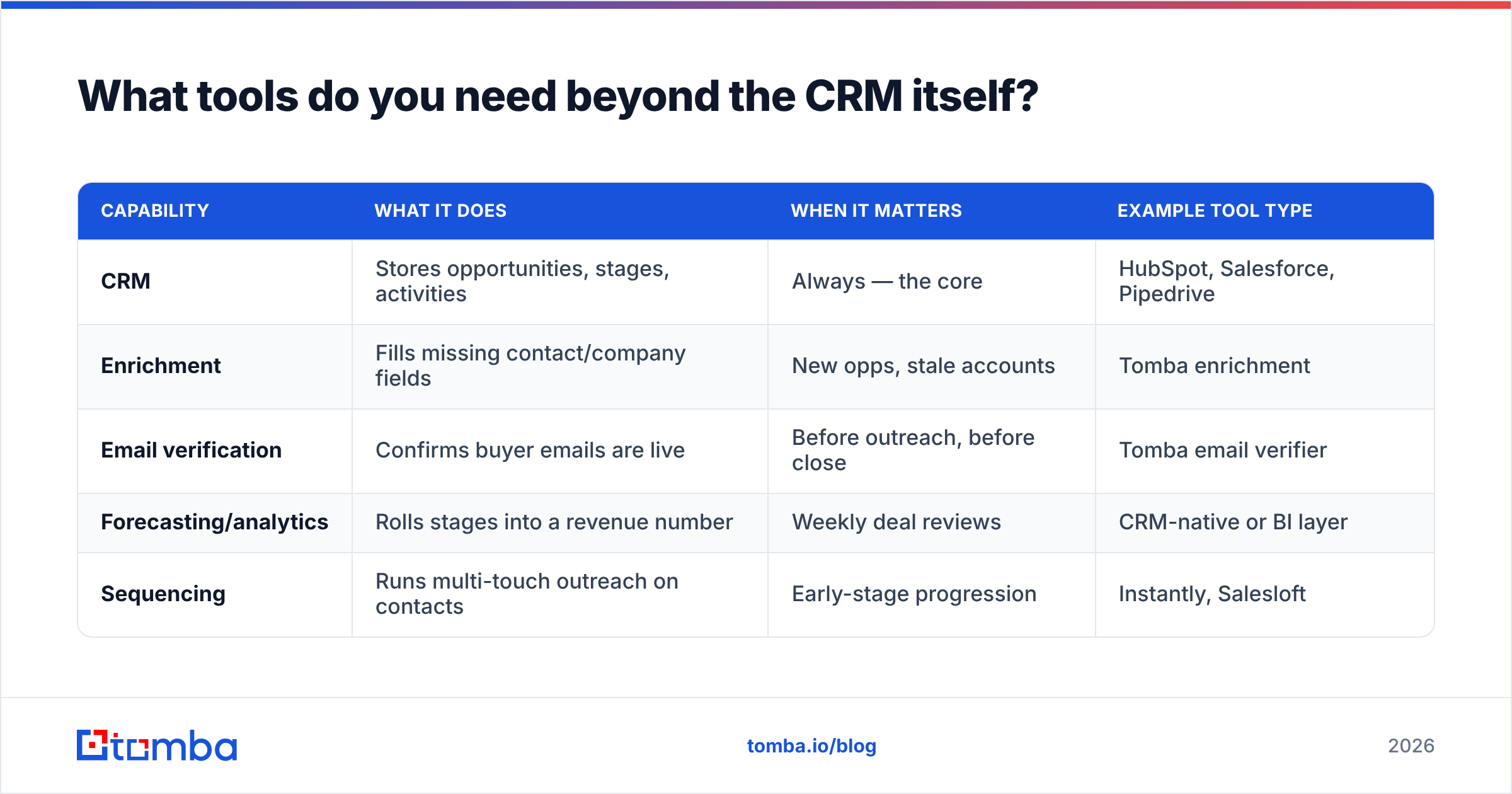
The CRM is the system of record, but opportunity management pulls in a small stack around it. Here's how the pieces compare and where each fits.
| Capability | What it does | When it matters | Example tool type |
|---|---|---|---|
| CRM | Stores opportunities, stages, activities | Always — the core | HubSpot, Salesforce, Pipedrive |
| Enrichment | Fills missing contact/company fields | New opps, stale accounts | Tomba enrichment |
| Email verification | Confirms buyer emails are live | Before outreach, before close | Tomba email verifier |
| Forecasting/analytics | Rolls stages into a revenue number | Weekly deal reviews | CRM-native or BI layer |
| Sequencing | Runs multi-touch outreach on contacts | Early-stage progression | Instantly, Salesloft |
You don't need all of these on day one. But the two that pay for themselves fastest are enrichment and verification, because they protect the input data every other tool depends on. A forecasting engine is only as good as the stages and amounts feeding it, and those in turn depend on reaching the right, real buyer.
If you're evaluating where your budget goes, compare the Tomba pricing tiers — Free (25 searches/mo), Starter at $49/mo, Growth at $99/mo, and Pro at $249/mo — against the cost of one forecast that misses because a champion's email silently bounced. Clean data is the cheapest insurance in the stack. For teams that also want mobile touchpoints on high-value deals, a phone finder adds direct-dial numbers to the opportunity record so you're not stuck waiting on email alone.
How do you turn opportunity data into a reliable forecast?#
You turn it into a forecast by trusting the process, not the optimism. Once your stages have real exit criteria and your data is clean, forecasting becomes arithmetic instead of astrology. Three methods, from simplest to most rigorous:
- Stage-weighted forecast. Multiply each open deal's amount by its stage probability and sum. Fast, transparent, and honest if your stages are honest.
- Commit / best-case / pipeline. Reps sort deals into three buckets. Commit = "I'll bet my quota on it." This surfaces conviction that a formula can't.
- AI/historical model. Feed closed-won and closed-lost history into a model that learns which signals actually predict wins. Powerful — but only on clean historical data.
The through-line: every method degrades the instant your inputs are wrong. An AI model trained on deals with fabricated stages and bounced contacts will forecast with total confidence and total inaccuracy. Garbage in, confident garbage out.
That's why the unglamorous work — exit criteria, mandatory next steps, verified emails, documented loss reasons — is the actual competitive edge. Tools have converged; discipline hasn't. To go deeper on the outreach side of the funnel that feeds these opportunities, our guide on response rate benchmarks shows how much reachable, verified contact data changes what makes it into the pipeline in the first place. Industry reviews on G2 reinforce the same pattern: the teams that win at CRM aren't the ones with the fanciest tool, they're the ones who enforce data standards.
Common opportunity management mistakes to avoid#
- Vague stages. "Working it" is not a stage. Define buyer-verified exit criteria or your forecast is fiction.
- Optional required fields. If amount, close date, and next step aren't enforced, half your pipeline is blank.
- Ignoring loss reasons. Closed-lost with no reason is a lesson thrown in the trash.
- Stale contacts. A perfect stage on an unreachable buyer is still a dead deal.
- Zombie deals. Past-due close dates on open opportunities inflate your forecast and hide your real number.
- Rep-edited probabilities. Let the stage own the probability; overrides need a written reason.
Fix these six and your forecast accuracy jumps before you ever touch an AI feature.
Get every opportunity started with real buyer data#
Great CRM opportunity management is a data problem before it's a process problem. You can design perfect stages, but if the buyer in the record can't be reached, the deal was never real. Start every opportunity with verified, enriched contact data — accurate emails, correct decision-makers, and direct numbers where you need them.
That's exactly what the Tomba Email Finder is built for: find and verify professional email addresses by name, company, or domain, then push them straight into your CRM so every opportunity begins with a real, reachable buyer instead of a guess. Pair it with verification and enrichment, enforce your stage discipline, and your pipeline stops being a spreadsheet of hope and starts being a forecast you can defend. Try it free with 25 searches a month and see how much cleaner your next deal review feels.
Related guides#
Ready to find emails that actually work?
Join 150,000+ professionals who stopped guessing and started sending. Free credits on signup — no credit card required.
Get the Tomba newsletter
Practical outbound tactics and product updates — once every two weeks.
About the author