CRM Strategy in 2026: A Practical Framework That Ships
Most CRM rollouts fail on strategy, not software. Here's a step-by-step CRM strategy framework for 2026 — data, process, adoption, and the metrics that prove it worked.
Your CRM is not your CRM strategy. The software is a filing cabinet; the strategy is what you decide to file, why, who touches it, and what you do with it after. Teams that skip the second part end up paying $150 a seat for a very expensive contact list nobody trusts.
This guide walks through a CRM strategy you can actually implement in 2026 — from the data that feeds it to the metrics that prove it worked.
TL;DR#
- A CRM strategy is a plan for how your revenue team captures, enriches, and acts on customer data — not a decision about which vendor to buy.
- The four pillars are data quality, process design, adoption, and measurement. Skip any one and the whole thing rots.
- Dirty data is the silent killer: garbage in means reps ignore the system, and ignored systems die.
- Start with the customer journey and reverse-engineer your pipeline stages from it — not the other way around.
- Measure adoption and data health before you measure revenue impact; the leading indicators tell you months earlier whether it's working.
What is a CRM strategy, really?#
A CRM strategy is your written plan for turning customer data into revenue. Think of it like a kitchen. Buying a professional-grade oven (the software) does not make you a chef. The strategy is your menu, your prep list, your station layout, and the rule that says the walk-in gets cleaned every night. Without those, the fancy oven just heats up a messy kitchen faster.
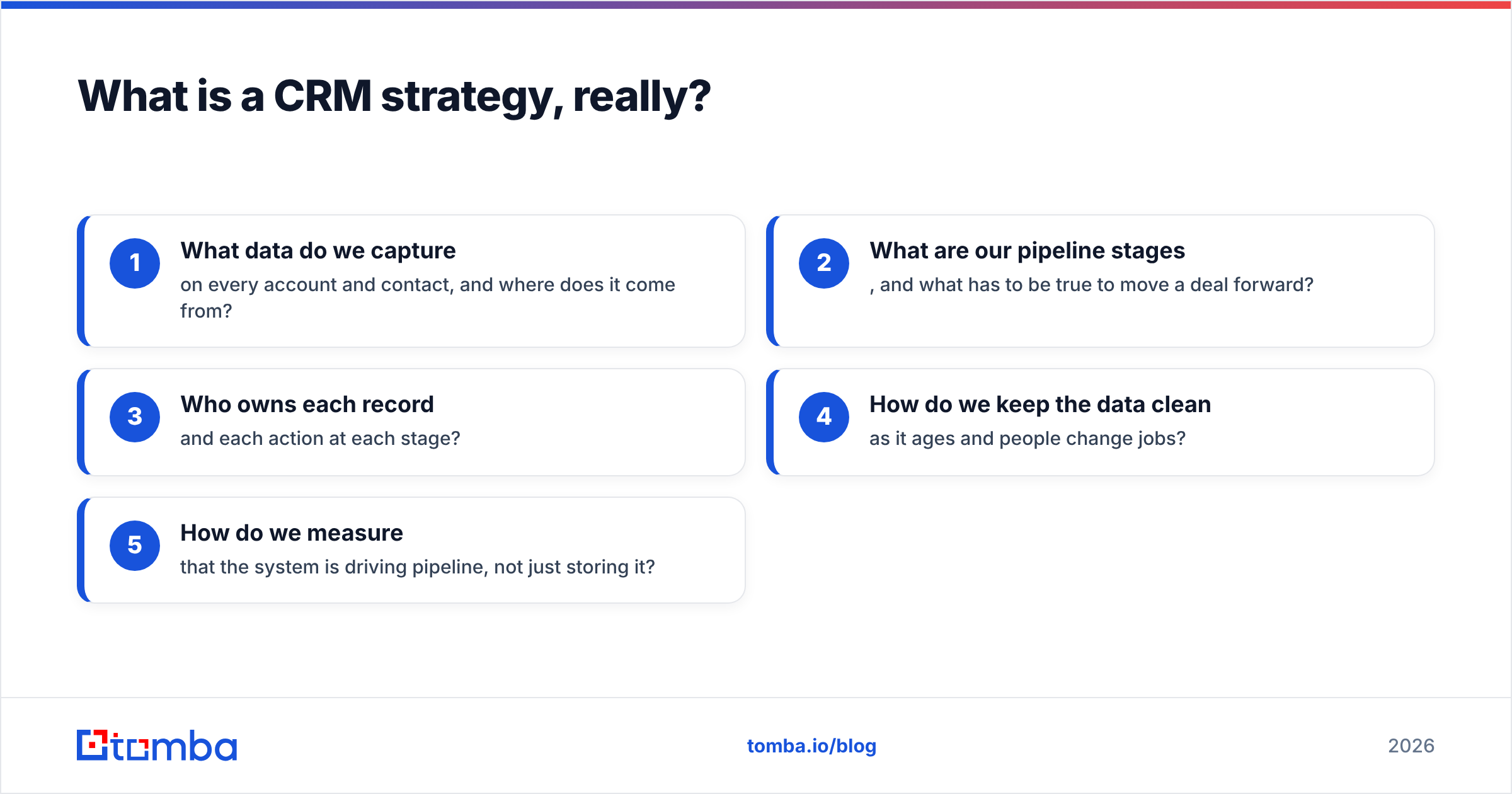
Concretely, a good CRM strategy answers five questions:
- What data do we capture on every account and contact, and where does it come from?
- What are our pipeline stages, and what has to be true to move a deal forward?
- Who owns each record and each action at each stage?
- How do we keep the data clean as it ages and people change jobs?
- How do we measure that the system is driving pipeline, not just storing it?
Notice that "which CRM should we buy" is not on that list. Vendor choice matters, but it's a downstream decision. According to Gartner, the majority of CRM value is realized or lost in the process and adoption layers, not the feature comparison.
Why do most CRM strategies fail?#
They fail because of data, and then they fail because of adoption — usually in that order.
Here's the death spiral. A rep opens an account and sees a stale phone number, a title that's two promotions old, and no email. They spend four minutes fixing it manually, or they don't bother and work off LinkedIn instead. Multiply that by every rep, every day, and within a quarter the CRM is a museum of who-worked-here-in-2024. Leadership sees low usage, blames the tool, and starts a new "CRM initiative" — which is the same strategy with a different logo.
The root cause is almost never the software. Salesforce's own research repeatedly points to data quality and unclear process as the top reasons deployments underdeliver. Fix those two and adoption tends to follow, because reps use tools that make their day easier.
This is where a CRM strategy connects to the rest of your revenue operations motion: the CRM is only as good as the data pipeline feeding it, and that pipeline is a RevOps responsibility, not an afterthought.
The four pillars of a CRM strategy#
Every durable CRM strategy stands on the same four pillars. Weakness in one collapses the others.
- Data quality — Records are complete, current, deduplicated, and enriched. This is the foundation; everything else is built on it.
- Process design — Pipeline stages, entry/exit criteria, required fields, and handoffs are defined and enforced. Reps always know the next action.
- Adoption — The system is genuinely easier than the workaround. Training, incentives, and low-friction data entry make usage the path of least resistance.
- Measurement — Leading indicators (data health, activity, stage velocity) and lagging indicators (win rate, cycle length, revenue) are tracked and reviewed.
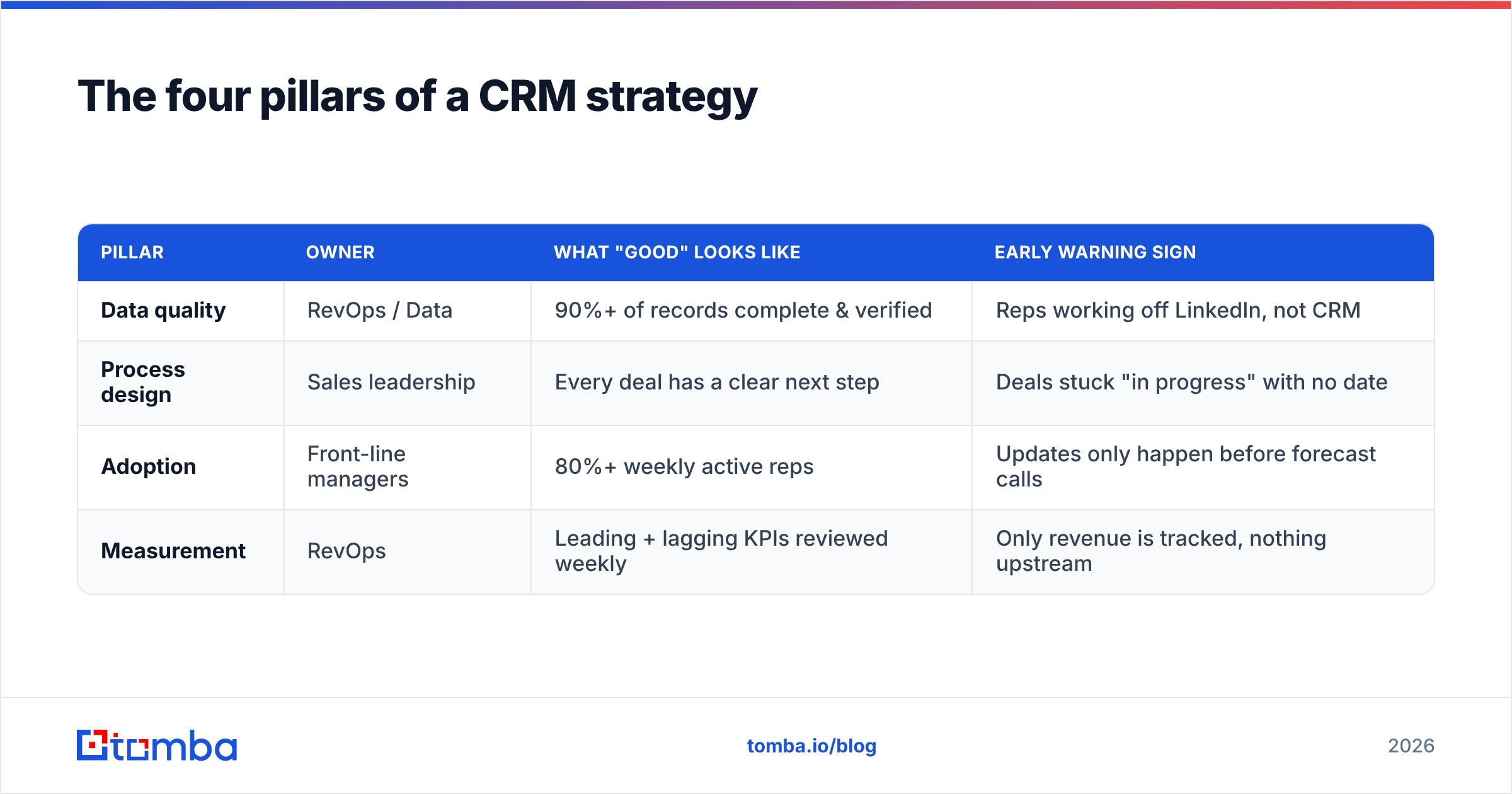
Here's how the four pillars map to concrete owners and health signals:
| Pillar | Owner | What "good" looks like | Early warning sign |
|---|---|---|---|
| Data quality | RevOps / Data | 90%+ of records complete & verified | Reps working off LinkedIn, not CRM |
| Process design | Sales leadership | Every deal has a clear next step | Deals stuck "in progress" with no date |
| Adoption | Front-line managers | 80%+ weekly active reps | Updates only happen before forecast calls |
| Measurement | RevOps | Leading + lagging KPIs reviewed weekly | Only revenue is tracked, nothing upstream |
If you can't name the owner for each row, that's your first gap to close.
How do you build a CRM strategy step by step?#
Work from the customer outward, not from the software inward.
Step 1 — Map the customer journey. Write down the real path from stranger to closed customer to renewal. Where do leads come from? What triggers a sales conversation? What has to happen for someone to buy? This map becomes the backbone of everything else.
Step 2 — Design pipeline stages from that journey. Each stage should represent a meaningful change in buyer intent, with clear entry and exit criteria. "Qualified" should mean something specific — for example, a defined marketing qualified lead threshold — not a rep's gut feeling.
Step 3 — Define the minimum data model. For each object (lead, contact, account, opportunity), decide the handful of fields that are genuinely required. Resist the urge to require 40 fields; you'll get 40 fields of junk. Require the five that drive routing, scoring, and outreach.
Step 4 — Build the data pipeline that fills those fields. This is where most strategies wave their hands. Decide exactly how a contact gets a verified email, a direct phone, a current title, and firmographics — at the moment it enters the system, not weeks later. Enrichment at the point of capture is what keeps records from rotting.
Step 5 — Set adoption rules and remove friction. Auto-log activity where you can. Pre-fill fields with enriched data. Make the "next action" impossible to miss. Then train, and tie a slice of comp or QBR review to CRM hygiene.
Step 6 — Instrument it. Stand up dashboards for both leading and lagging metrics before go-live, so you have a baseline on day one.
What role does data enrichment play in a CRM strategy?#
Data enrichment is the difference between a CRM that decays and one that compounds. It's the nightly kitchen cleaning that keeps the whole operation usable.
Contacts go stale fast — people change jobs, companies rebrand, direct dials get reassigned. A CRM strategy that assumes data stays fresh on its own is planning to fail. The fix is to enrich at two moments:
- On entry — when a lead or contact is created, automatically append a verified work email, direct phone, current title, and company firmographics so reps never start from a blank record.
- On a schedule — periodically re-verify existing records and flag or refresh anything that's decayed, so your database gets more accurate over time instead of less.
This is exactly where a dedicated data layer earns its keep. Tools like Tomba's data enrichment plug into the pipeline so records arrive complete: you can find email addresses by name and company, verify emails before they ever touch a sequence, and pull B2B phone numbers for the accounts worth calling. The CRM stays the system of record; enrichment keeps that record true.
A quick honesty check on vendors: no enrichment source is 100% accurate, and anyone claiming otherwise is selling. What matters is verified coverage on the segments you sell to. Respected data providers — including partners like BookYourData — and verification-first tools each have strengths; the right move is to test accuracy on a sample of your actual target accounts before committing.
How do you drive CRM adoption?#
Make the right way the easy way. Reps are rational — they use whatever gets them to a booked meeting fastest.
Adoption tactics that actually move the needle:
- Cut manual entry to near zero. Every field a rep has to type by hand is a field they'll eventually skip. Auto-log emails and calls; auto-enrich new records.
- Show the payoff. When a rep opens an account and it already has a verified email and a direct dial waiting, the CRM just saved them ten minutes. That's the moment adoption is won.
- Train on workflows, not features. Nobody cares about "custom objects." They care about "here's how you go from a new lead to a booked call in three clicks."
- Manage to leading indicators. Front-line managers should coach on activity and hygiene weekly, not just review the forecast quarterly.
- Align incentives. A small, explicit link between CRM hygiene and comp or QBR standing changes behavior fast — without turning the system into a surveillance tool.
What metrics prove your CRM strategy is working?#
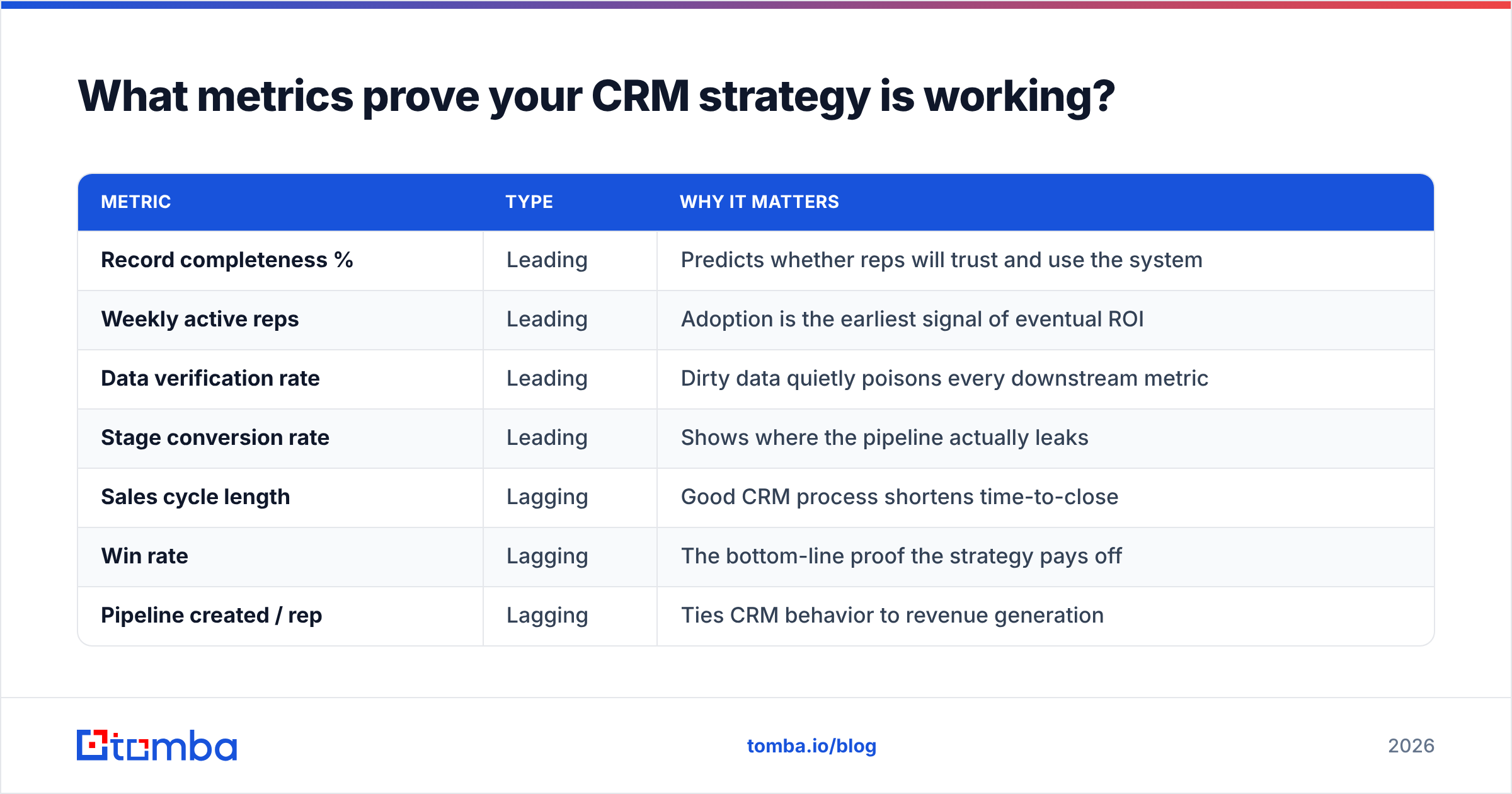
Track leading indicators to catch problems early, and lagging indicators to prove ROI. Watching only revenue is like checking your bank balance once a year and hoping.
| Metric | Type | Why it matters |
|---|---|---|
| Record completeness % | Leading | Predicts whether reps will trust and use the system |
| Weekly active reps | Leading | Adoption is the earliest signal of eventual ROI |
| Data verification rate | Leading | Dirty data quietly poisons every downstream metric |
| Stage conversion rate | Leading | Shows where the pipeline actually leaks |
| Sales cycle length | Lagging | Good CRM process shortens time-to-close |
| Win rate | Lagging | The bottom-line proof the strategy pays off |
| Pipeline created / rep | Lagging | Ties CRM behavior to revenue generation |
Review the leading metrics weekly and the lagging ones monthly. If completeness and active usage are climbing, win rate and cycle time will follow — usually one to two quarters later. If the leading indicators are flat, don't wait for revenue to confirm the bad news; intervene now.
CRM strategy vs. buying a CRM: what's the difference?#
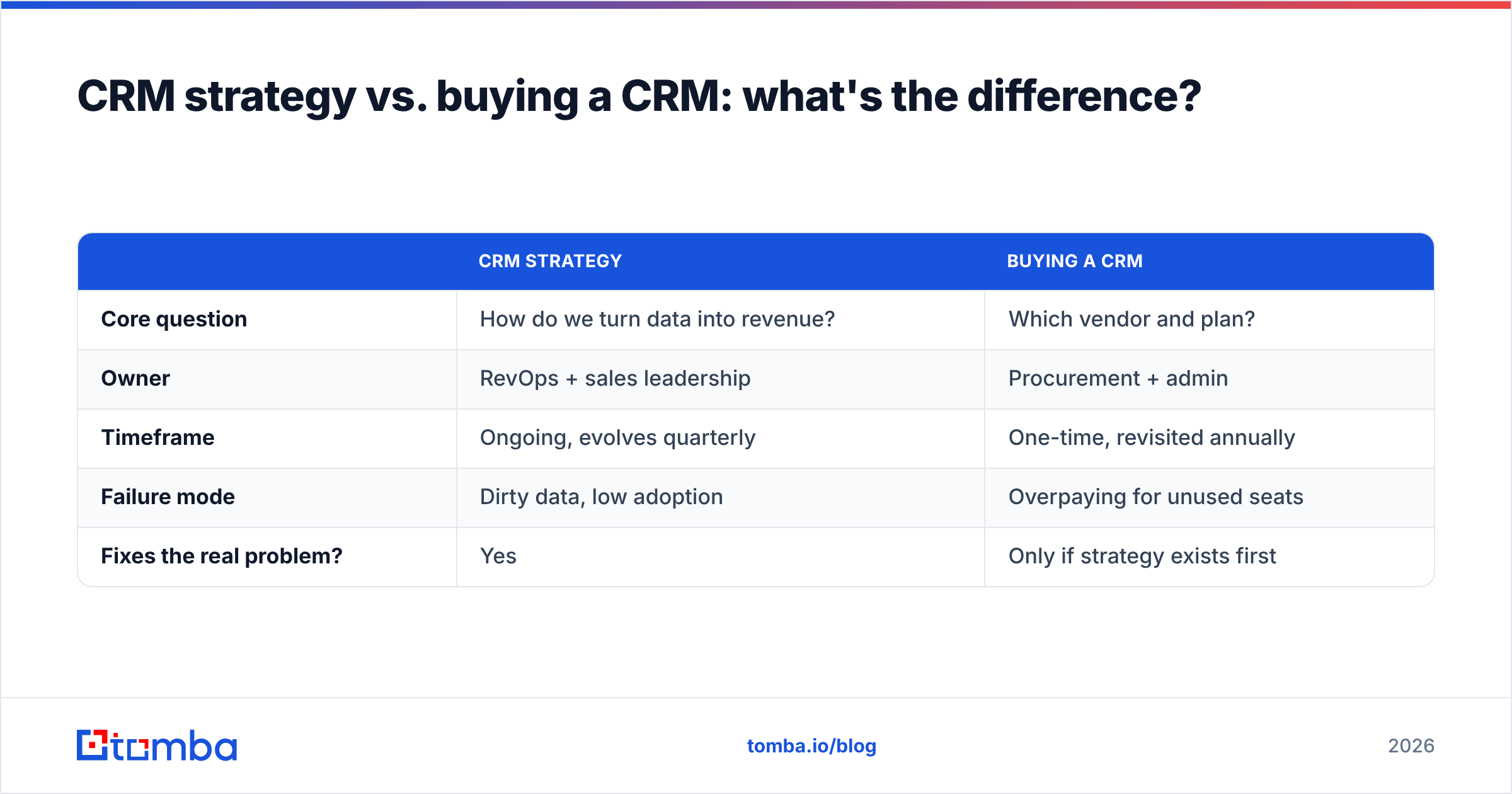
They're not the same decision, and confusing them is the classic mistake.
| CRM strategy | Buying a CRM | |
|---|---|---|
| Core question | How do we turn data into revenue? | Which vendor and plan? |
| Owner | RevOps + sales leadership | Procurement + admin |
| Timeframe | Ongoing, evolves quarterly | One-time, revisited annually |
| Failure mode | Dirty data, low adoption | Overpaying for unused seats |
| Fixes the real problem? | Yes | Only if strategy exists first |
The practical takeaway: you can succeed with a mid-tier CRM and a great strategy, and you can absolutely fail with the most expensive platform on the market and no strategy. Software is the amplifier, not the plan. Software review sites like G2 are useful for the buying decision — but only after your strategy tells you what you actually need the tool to do.
Common CRM strategy mistakes to avoid#
- Requiring too many fields. More required fields means more junk and less adoption. Require the vital few.
- Treating enrichment as one-time. Data decays continuously; your refresh cadence should too.
- Measuring only revenue. By the time revenue moves, you're two quarters late to fix the real problem.
- Copying someone else's pipeline stages. Your stages must reflect your buyer's journey, not a template.
- Blaming the tool. If reps aren't using it, the workaround is easier than the system. Fix the friction, not the logo.
Put your CRM strategy on a clean data foundation#
A CRM strategy lives or dies on the quality of the data flowing into it. Nail the process and adoption, and it still collapses if reps open records that are empty or wrong. Get the data right, and the whole system compounds in value every quarter.
That's the layer to solve first. Use the Tomba Email Finder to populate new records with verified professional emails at the moment of capture, verify them before they hit a sequence, and enrich accounts with the firmographics and direct dials your reps actually need. Start free with 25 searches a month, and check Tomba pricing — Starter is $49/mo — when you're ready to scale it across the team. Build the strategy on data your reps can trust, and adoption stops being a fight.
Related guides#
Ready to find emails that actually work?
Join 150,000+ professionals who stopped guessing and started sending. Free credits on signup — no credit card required.
Get the Tomba newsletter
Practical outbound tactics and product updates — once every two weeks.
About the author