Crococlick Pricing Reviews Pros and Cons: 2026 Buyer Guide
A neutral 2026 breakdown of Crococlick pricing, real user reviews, and the honest pros and cons — plus who it fits, where it falls short, and the data stack that actually feeds your outreach.
Crococlick markets itself as a click-tracking and ad-cloaking platform for paid media buyers and affiliate marketers. This guide is a neutral look at Crococlick pricing reviews pros and cons for 2026. If you run paid campaigns, you may wonder whether it earns a line item in your budget. Here you get the honest breakdown: what it costs, what real users say, and where it quietly falls short.
TL;DR — Crococlick pricing reviews pros and cons#
- What it is: a click-tracking, filtering, and ad-cloaking tool built for performance marketers who need to route human traffic and bots to different destinations.
- Pricing shape: tiered monthly subscriptions that scale by click volume and campaign count, with the entry plan aimed at solo affiliates and higher tiers at agencies. Always confirm current numbers on the official pricing page — they change.
- Biggest pro: granular traffic filtering (geo, device, ISP, bot detection) that most generic link shorteners can't match.
- Biggest con: it's a narrow, single-purpose tool. It tracks and routes clicks — it does not build your audience, find contacts, or enrich leads.
- The gap it leaves: you still need clean, verified contact data upstream. That's where a dedicated data layer like Tomba Email Finder does the heavy lifting Crococlick was never designed for.

What is Crococlick and who is it for?#
Think of Crococlick as a traffic bouncer at the door of your funnel. When a click arrives, the tool inspects it — where it came from, what device it's on, whether it looks like a real person or a scanning bot — and then decides which door to send it through. Real prospects go to your offer; suspicious or unwanted traffic gets a "safe" page instead. Technically, that's a combination of click tracking, rule-based filtering, and cloaking.
That makes it a tool for a specific crowd:
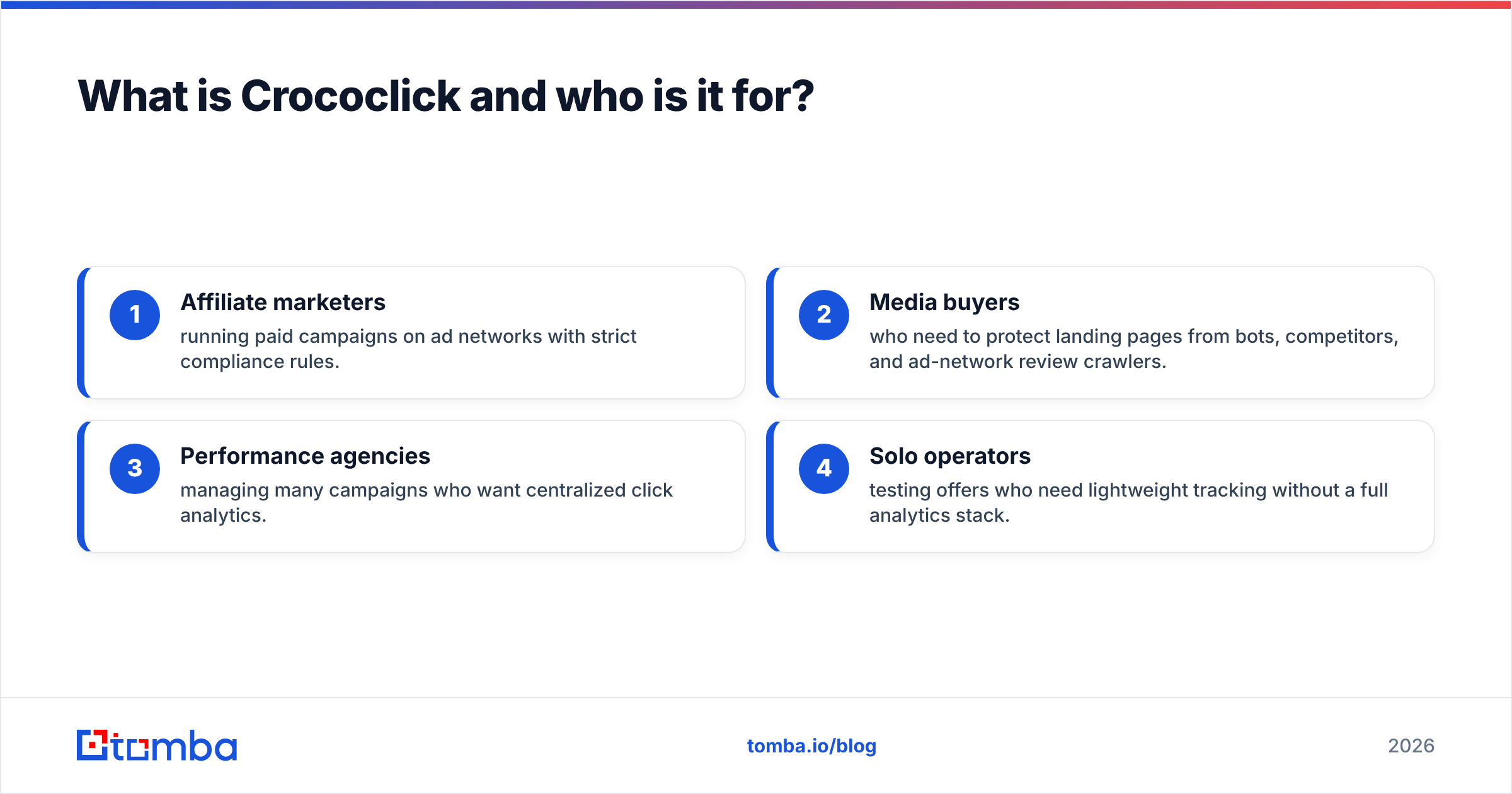
- Affiliate marketers running paid campaigns on ad networks with strict compliance rules.
- Media buyers who need to protect landing pages from bots, competitors, and ad-network review crawlers.
- Performance agencies managing many campaigns who want centralized click analytics.
- Solo operators testing offers who need lightweight tracking without a full analytics stack.
If you're a B2B sales or outbound team, notice what's missing from that list. Crococlick assumes you already have traffic and have an audience. It says nothing about how you find the people you want to reach in the first place. Hold that thought — it matters when we talk value for money.
How much does Crococlick cost in 2026?#
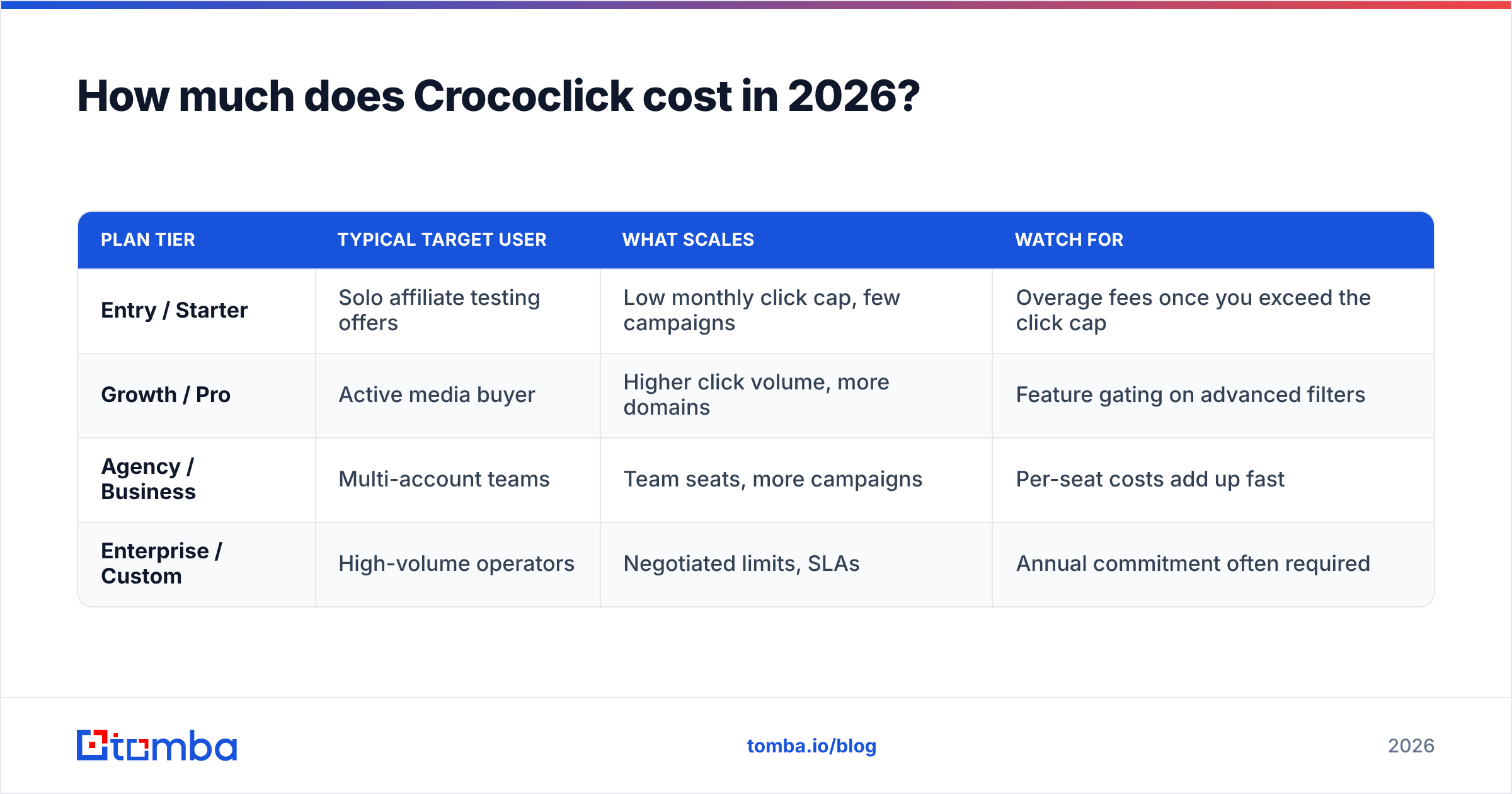
Crococlick uses a tiered subscription model. Like most click-tracking platforms, the price you pay scales with two levers: monthly click volume and the number of campaigns or domains you run. Entry tiers target individual affiliates; upper tiers unlock higher limits, more team seats, and priority support.
Because vendors in this category adjust pricing and rename plans frequently, treat the table below as a structure guide, not a locked quote. Verify the live figures on the official Crococlick site before you buy.
| Plan tier | Typical target user | What scales | Watch for |
|---|---|---|---|
| Entry / Starter | Solo affiliate testing offers | Low monthly click cap, few campaigns | Overage fees once you exceed the click cap |
| Growth / Pro | Active media buyer | Higher click volume, more domains | Feature gating on advanced filters |
| Agency / Business | Multi-account teams | Team seats, more campaigns | Per-seat costs add up fast |
| Enterprise / Custom | High-volume operators | Negotiated limits, SLAs | Annual commitment often required |
The pricing lesson here is the same one that trips up buyers of every usage-metered tool: the sticker price is not the real price. Your real cost is the sticker price plus overages once your traffic grows past the plan cap. Model your expected click volume before committing, and ask directly about overage rates — they're where the margin quietly disappears.
What do Crococlick reviews say?#
Public review coverage for niche cloaking and tracking tools is thinner than for mainstream SaaS, so weight what you find accordingly. Cross-referencing user sentiment on directories like G2 and Capterra with community discussion, a few consistent themes emerge.
What users praise:
- Filtering accuracy. The bot and geo filtering is the headline feature, and reviewers who rely on it tend to rate it highly.
- Speed. Redirect latency is low enough not to hurt campaign performance for most users.
- Purpose-built UX. Because it does one job, the dashboard is focused rather than bloated.
What users criticize:
- Learning curve. Rule setup and cloaking configuration aren't beginner-friendly; first-time buyers report a steep ramp.
- Support variability. Response times reportedly depend heavily on your plan tier.
- Narrow scope. Several reviewers note they still need three or four other tools around it to run a complete operation.
That last point is the recurring one, and it's the honest heart of any Crococlick review: it's a good specialist, not an all-in-one. Which brings us to the trade-off table.
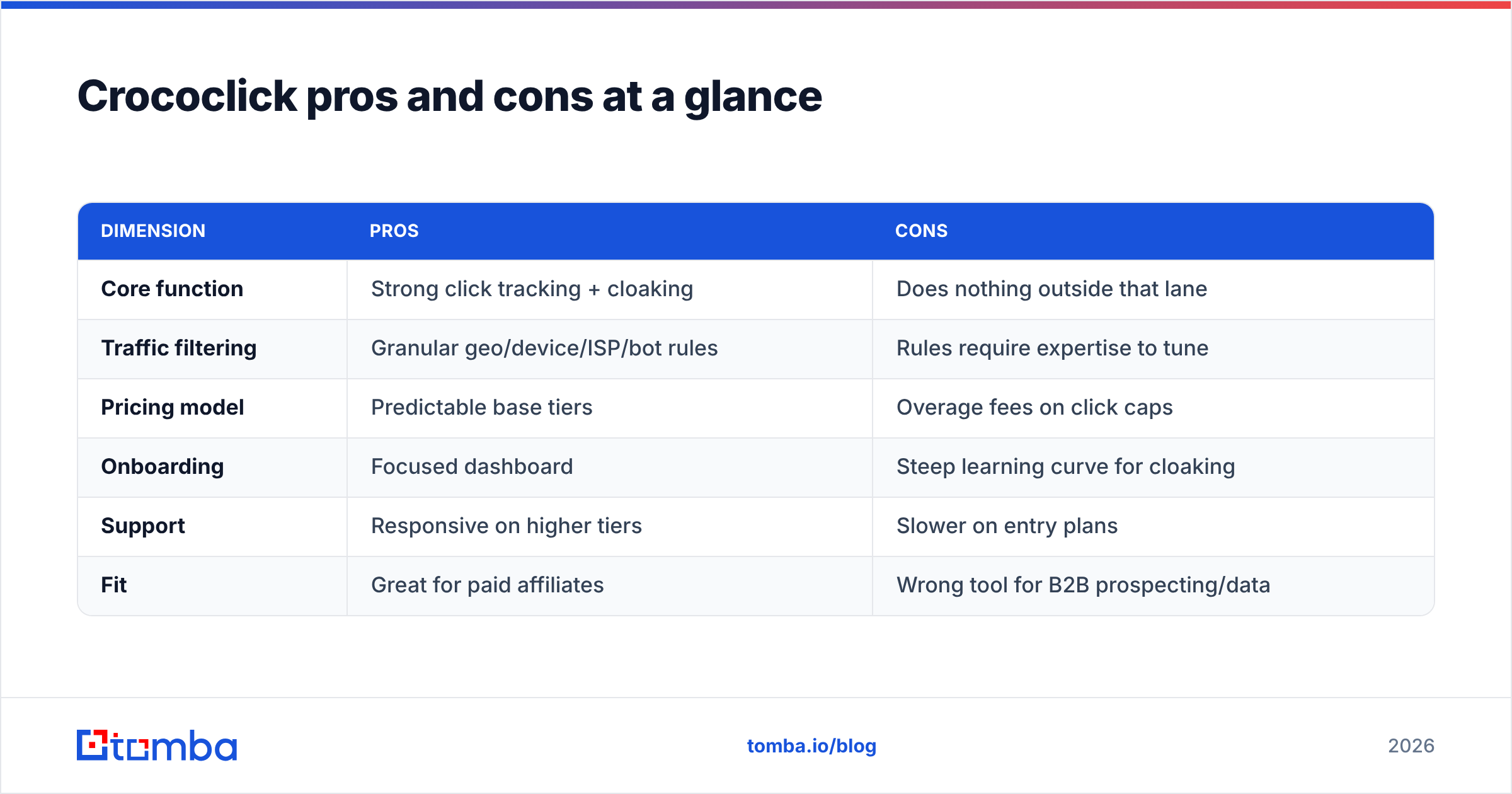
Crococlick pros and cons at a glance#
| Dimension | Pros | Cons |
|---|---|---|
| Core function | Strong click tracking + cloaking | Does nothing outside that lane |
| Traffic filtering | Granular geo/device/ISP/bot rules | Rules require expertise to tune |
| Pricing model | Predictable base tiers | Overage fees on click caps |
| Onboarding | Focused dashboard | Steep learning curve for cloaking |
| Support | Responsive on higher tiers | Slower on entry plans |
| Fit | Great for paid affiliates | Wrong tool for B2B prospecting/data |
Is Crococlick worth it for B2B and outbound teams?#
Short answer: only if your bottleneck is routing traffic you already have — not finding people to reach.
Here's the everyday analogy. Crococlick is like a high-end turnstile that decides who gets into your stadium. It's excellent at that job. But a turnstile doesn't sell tickets, doesn't fill seats, and doesn't tell you who the fans are. If your problem is an empty stadium — an empty pipeline — a better turnstile changes nothing.
Most B2B sales and RevOps teams don't have a click-routing problem. They have a contact-data problem: they can't reliably find, verify, and enrich the decision-makers they want to email or call. Spending on a cloaking tool while your prospect list is stale or unverified is optimizing the wrong end of the funnel.
If that's you, the money is better spent on the data layer:
- Finding the right contacts — use an email finder to turn a name and company into a verified professional email, or run a domain search to map every reachable contact at a target account.
- Keeping the list clean — an email verifier catches invalid and risky addresses before they wreck your sender reputation.
- Enriching what you already have — data enrichment fills the gaps in a thin CRM record so reps aren't flying blind.
None of that competes with Crococlick — it sits upstream of it. You find and verify the audience first, then route and track them however you like.
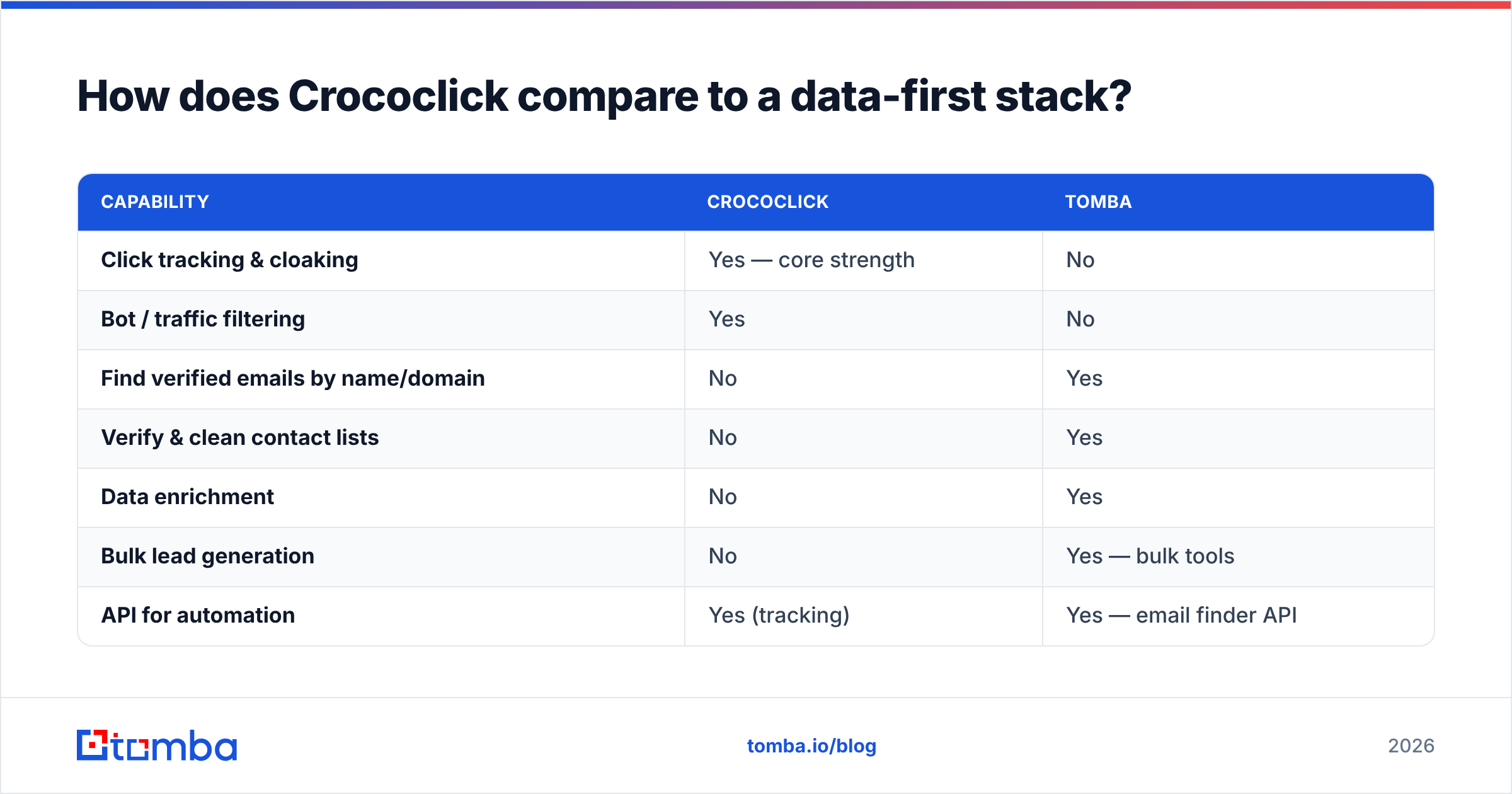
How does Crococlick compare to a data-first stack?#
This isn't apples to apples, and that's exactly the point buyers miss. The two solve different problems, so the smart question isn't "which one," it's "which one is my actual bottleneck."
| Capability | Crococlick | Tomba |
|---|---|---|
| Click tracking & cloaking | Yes — core strength | No |
| Bot / traffic filtering | Yes | No |
| Find verified emails by name/domain | No | Yes |
| Verify & clean contact lists | No | Yes |
| Data enrichment | No | Yes |
| Bulk lead generation | No | Yes — bulk tools |
| API for automation | Yes (tracking) | Yes — email finder API |
| Free tier to test | Varies | Yes — 25 searches/mo |
| Entry paid price | Confirm on site | $49/mo Starter |
For reference, Tomba pricing runs on a Free tier (25 searches/month), Starter at $49/mo, Growth at $99/mo, Pro at $249/mo, and custom Enterprise — priced on the data you pull, not the clicks you route.
The takeaway: if you run paid media and need cloaking, Crococlick earns its keep. If you run outbound and need contacts, no amount of click filtering fixes an empty list — you need a data source.
How to choose the right tool for your 2026 stack#
Skip the feature-checklist trap. Work backward from your bottleneck instead.
- Name the constraint. Is your problem too much junk traffic (a Crococlick job) or not enough qualified contacts (a data job)? Be honest.
- Model the real cost. For usage-metered tools, add expected overages to the base price. A "cheap" plan you constantly exceed is not cheap.
- Check the free tier first. Never pay to learn whether a tool fits. Crococlick's trial terms and Tomba's free 25 searches both exist so you can test before committing.
- Map the adjacent tools. If a "solution" needs four other products around it to function, factor those into total cost of ownership.
- Prioritize the upstream fix. Data quality feeds everything downstream — tracking, deliverability, conversion. Fix the source before you optimize the pipes.
A practical rule: buy the specialist tool for the job you actually have today, and don't pay for capabilities you're only imagining you'll grow into. Crococlick is a sharp specialist. Just make sure click routing — not contact data — is the problem you're actually solving.
The bottom line#
Here is the honest summary of Crococlick pricing reviews pros and cons. Crococlick is a competent, purpose-built click-tracking and cloaking platform. For paid affiliates and media buyers who need real bot filtering and traffic routing, it's a reasonable buy — provided you model overage costs and budget for the learning curve. The reviews back that up: strong at its one job, thin everywhere else.
But if you landed here as a B2B sales, marketing, or RevOps operator, the honest verdict is that Crococlick probably isn't your gap. Your gap is upstream — the verified, enriched contact data that decides whether your outreach lands at all.
That's exactly what Tomba is built for. Start free with 25 searches a month, then find, verify, and enrich the exact decision-makers you want to reach with Tomba Email Finder — the reliable data layer that makes every downstream tool, tracking included, worth paying for. Fix the source of your pipeline first, and everything after it works better.
Related guides#
Ready to find emails that actually work?
Join 150,000+ professionals who stopped guessing and started sending. Free credits on signup — no credit card required.
Get the Tomba newsletter
Practical outbound tactics and product updates — once every two weeks.
About the author