Cross-Selling B2B: A Practical 2026 Playbook for Revenue Teams
Cross-selling is the cheapest revenue you have — if you time it right. Here is a concrete 2026 framework for expanding B2B accounts without churning them.
Cross-Selling B2B: A Practical 2026 Playbook for Revenue Teams
TL;DR
- Cross-selling B2B means selling an adjacent product to an existing account — a second module, a new team, a complementary service — not a bigger version of what they already own.
- It is the cheapest revenue you have: no new logo cost, a warm relationship, existing usage data. But a mistimed cross-sell is the fastest way to spook a renewal.
- The winning motion is triggered by usage signals and account milestones, not by quota deadlines.
- Net revenue retention (NRR) above 110% is almost always a cross-sell and expansion story, not a new-logo story.
- Clean account data — accurate contacts, verified emails, org-chart coverage — is the unglamorous foundation that makes every cross-sell play land.
What is cross-selling B2B?#
Cross-selling B2B is selling a complementary product or service to a customer who already buys from you. It usually means a second SKU, an add-on module, a new department license, or a professional-services layer next to the core subscription.
Here is the everyday analogy: a bank that has your checking account offers you a credit card and a mortgage. That is cross-selling. Offering you a premium checking account is upselling. Same customer, different mechanics — and in B2B the distinction matters, because the buying committee, the budget line, and the internal champion are often different for each product.
The reason cross-selling gets so much airtime in 2026 is math. Acquiring a net-new B2B customer costs far more than expanding an existing one, and expansion revenue compounds. When boards ask why growth stalled, the answer is often simple. The company kept chasing new logos while ignoring the pipeline already sitting inside its customer base.
Cross-selling vs upselling: what's the difference?#
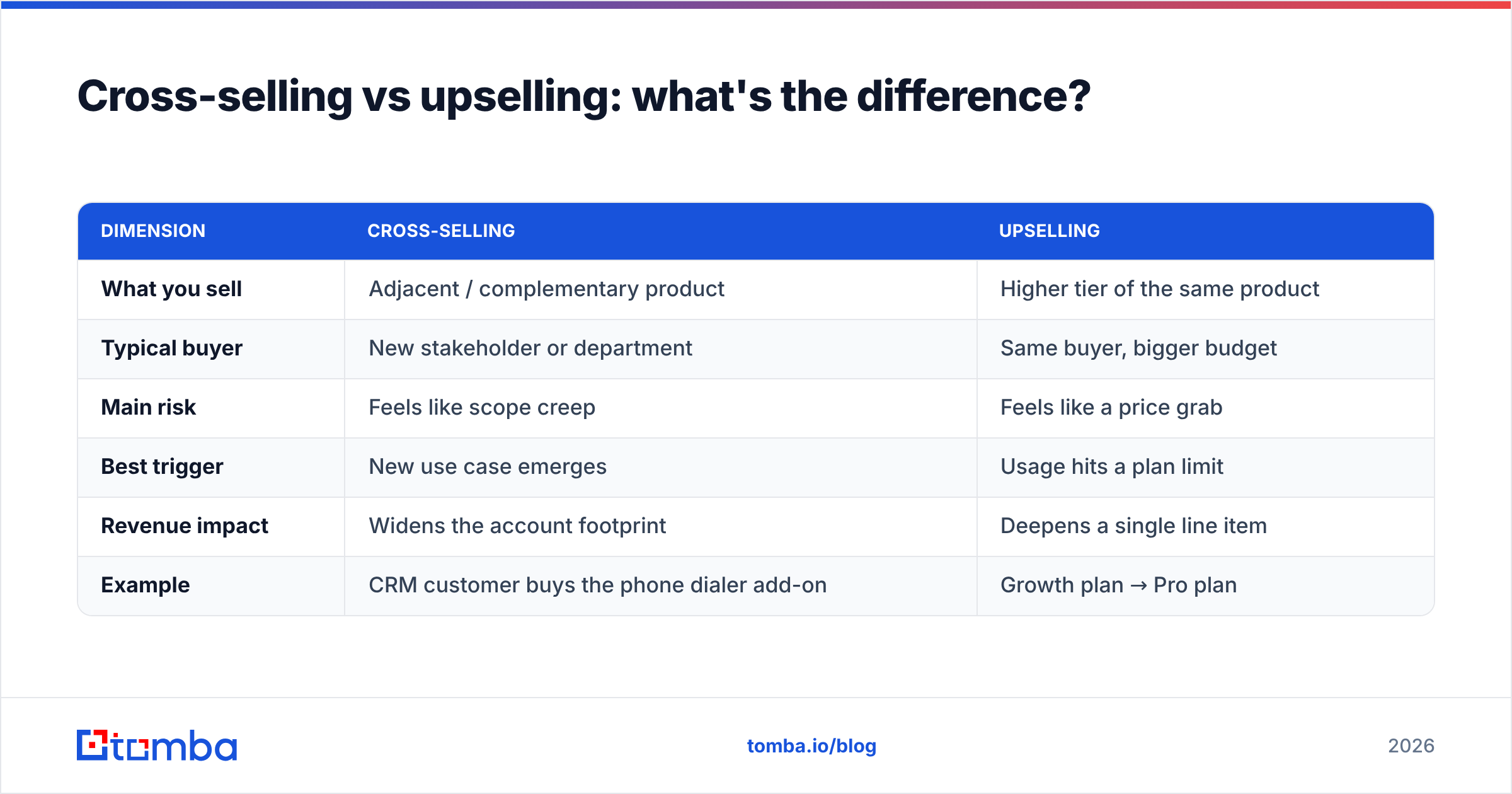
People use these terms interchangeably, and that sloppiness leads to bad plays. They are different motions with different risk profiles.
| Dimension | Cross-selling | Upselling |
|---|---|---|
| What you sell | Adjacent / complementary product | Higher tier of the same product |
| Typical buyer | New stakeholder or department | Same buyer, bigger budget |
| Main risk | Feels like scope creep | Feels like a price grab |
| Best trigger | New use case emerges | Usage hits a plan limit |
| Revenue impact | Widens the account footprint | Deepens a single line item |
| Example | CRM customer buys the phone dialer add-on | Growth plan → Pro plan |
The practical takeaway: cross-selling expands the surface area of the relationship. That makes accounts stickier and harder to rip out. Upselling deepens a single line, which is faster but more fragile at renewal. Healthy B2B revenue teams run both, but they sequence them differently across the customer lifecycle.
Why does cross-selling matter so much for B2B revenue?#
Expansion revenue is the quiet engine behind every efficient growth story. Analysts at Gartner and practitioners across the SaaS world keep landing on the same conclusion. Companies with strong net revenue retention need far less new-logo volume to hit the same growth target.
Three reasons cross-selling outperforms:
- The trust already exists. You have proof of delivery, a signed contract, and — if you did your job — measurable results. A cold prospect needs six touches to believe you. An existing customer needs one relevant idea.
- The data already exists. You know their tech stack, their team size, their usage patterns, and who signs off on spend. That context turns a generic pitch into a specific one.
- The buying friction is lower. Procurement, security review, and legal have already cleared you once. A second product often rides the same master agreement.
The catch is that all three advantages evaporate if your customer data is stale. Maybe the champion left. Maybe a new VP took over the adjacent team. Maybe a whole business unit spun up last quarter. If you don't know, you can't time the play — and a badly timed cross-sell reads as tone-deaf.
When is the right time to cross-sell?#
Conclusion first: cross-sell on signals, not on the calendar. The single biggest mistake B2B teams make is pushing a second product because the quarter is ending, not because the customer is ready.
Here are the signals worth building playbooks around:
- Onboarding success. The customer just hit first value on product one. Momentum is highest right after a win.
- Usage limits or adjacency. They're bumping against a boundary that the second product solves. This is the cleanest trigger.
- Org expansion. A new team, region, or department appears in the account. New stakeholder, new use case, new budget.
- Champion promotion. Your internal advocate gets more scope — and more buying power.
- Renewal runway. The 60–90 day window before renewal is ideal for packaging an expansion, not springing one at the last minute.
Notice what's missing: "we need the number this month." That's a you-problem, not a customer-signal, and buyers can smell it.
Which cross-selling plays actually work in 2026?#
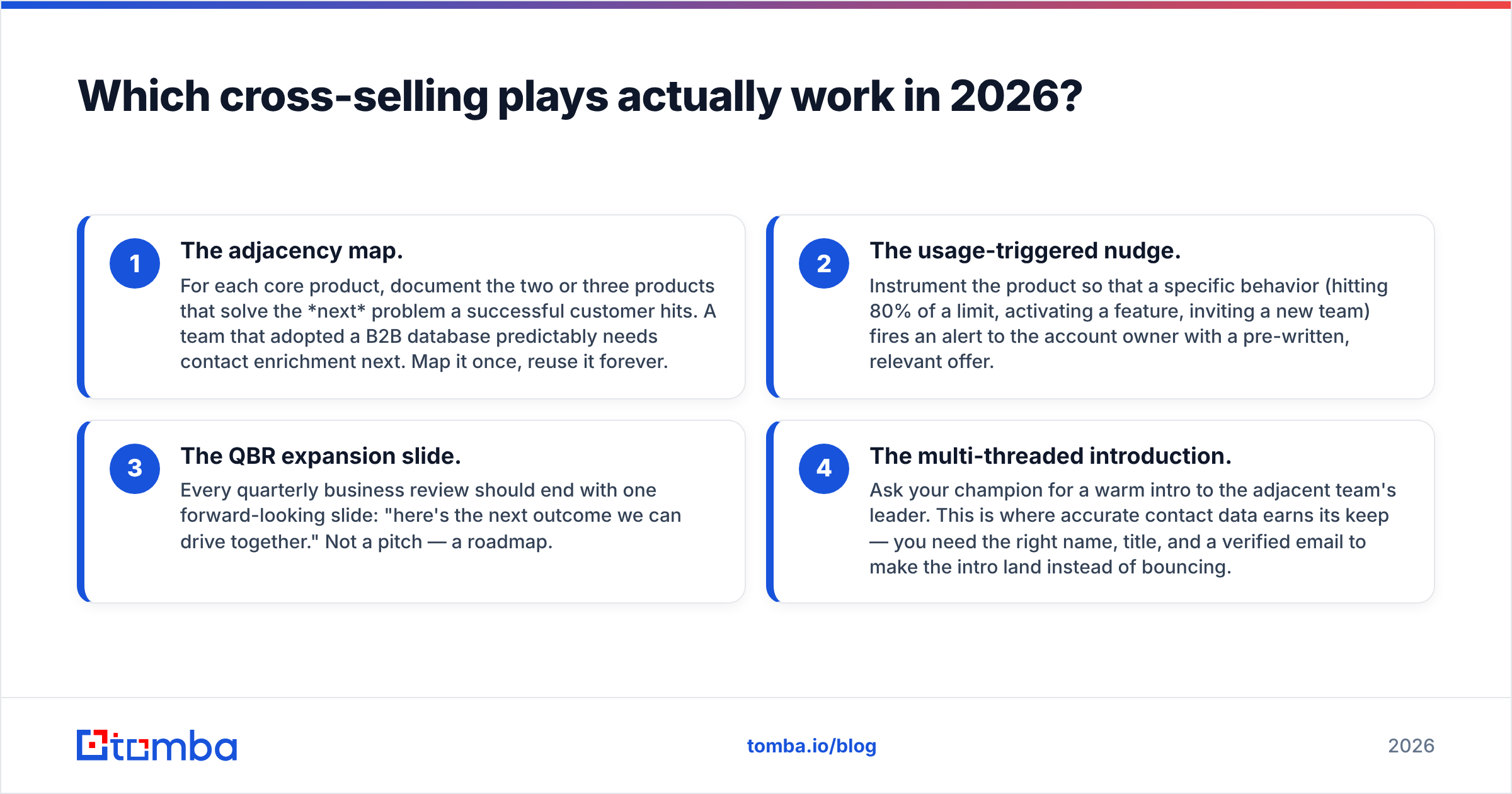
The plays that convert share one trait: they start from the customer's outcome, not your catalog. Below are the four that consistently produce expansion revenue.
- The adjacency map. For each core product, document the two or three products that solve the next problem a successful customer hits. A team that adopted a B2B database predictably needs contact enrichment next. Map it once, reuse it forever.
- The usage-triggered nudge. Instrument the product so that a specific behavior (hitting 80% of a limit, activating a feature, inviting a new team) fires an alert to the account owner with a pre-written, relevant offer.
- The QBR expansion slide. Every quarterly business review should end with one forward-looking slide: "here's the next outcome we can drive together." Not a pitch — a roadmap.
- The multi-threaded introduction. Ask your champion for a warm intro to the adjacent team's leader. This is where accurate contact data earns its keep — you need the right name, title, and a verified email to make the intro land instead of bouncing.
How do you find the right people to cross-sell to?#
The person who bought product one is often not the person who should buy product two. Cross-selling into a new department means finding a new decision-maker, and that's a data problem before it's a sales problem.
A repeatable workflow looks like this:
- Map the org. Use domain search to pull the company's known contacts and identify the adjacent team's leaders — the VP of the department your second product serves.
- Find the exact contact. Once you know the name, use an email finder to get their professional address instead of guessing at a
firstname@company.compattern that bounces. - Verify before you send. Run every new contact through an email verifier so your expansion outreach protects the sender reputation you built winning the account in the first place.
- Enrich the record. Layer in role, seniority, and recent activity so the message speaks to their outcome, not the original buyer's.
This is the unglamorous part nobody puts on a webinar slide, but it's the difference between an expansion motion that scales and a spreadsheet of stale contacts. If you want to see how source quality affects match rates, Tomba documents its data sources openly.
What does a healthy cross-sell funnel look like?#
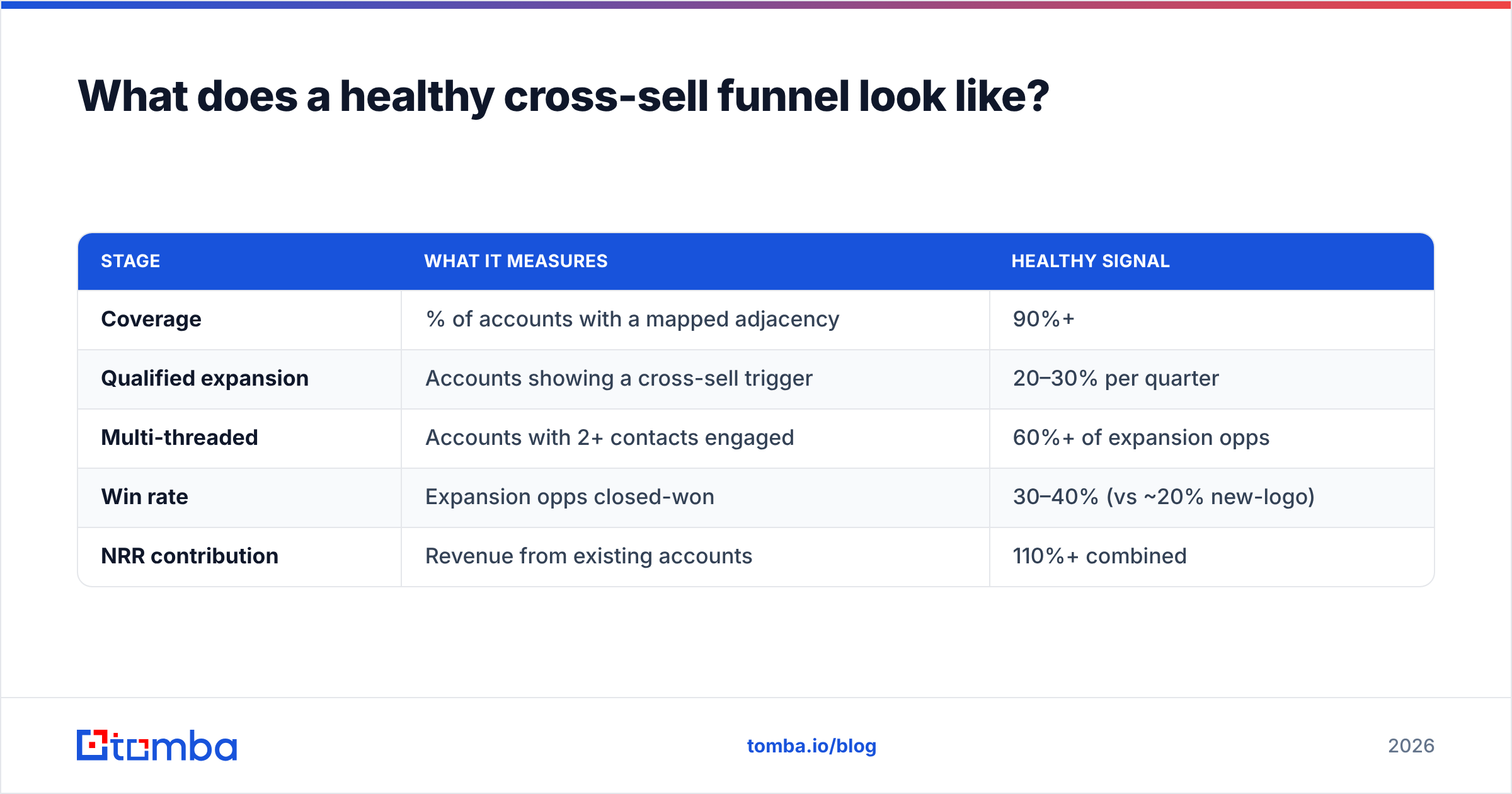
Treat expansion as its own funnel with its own metrics — not a footnote on the new-logo dashboard. Here's a benchmark-style view of the stages and what "good" looks like.
| Stage | What it measures | Healthy signal |
|---|---|---|
| Coverage | % of accounts with a mapped adjacency | 90%+ |
| Qualified expansion | Accounts showing a cross-sell trigger | 20–30% per quarter |
| Multi-threaded | Accounts with 2+ contacts engaged | 60%+ of expansion opps |
| Win rate | Expansion opps closed-won | 30–40% (vs ~20% new-logo) |
| NRR contribution | Revenue from existing accounts | 110%+ combined |
Expansion win rates should meaningfully beat new-logo win rates. If they don't, you're likely pitching the wrong product, to the wrong person, at the wrong time — usually all three, and usually because of a data gap upstream.
What are the biggest cross-selling mistakes to avoid?#
- Pitching before value is proven. If product one hasn't delivered a result yet, product two is noise. Sequence matters.
- Single-threading the account. Relying on one champion means one departure kills the whole expansion. Multi-thread early.
- Bundling for your convenience. Forcing a bundle the customer didn't ask for to hit a package price is a churn risk dressed up as a deal.
- Ignoring the second buyer's context. The adjacent-team leader has their own goals. Recycling the original pitch insults them.
- Letting data rot. Champions change jobs constantly. A cross-sell aimed at someone who left three months ago tells the account you're not paying attention. Keep a data enrichment routine running so records stay current.
For a deeper library of vendor-neutral tactics on account expansion and retention, the resource libraries at HubSpot and peer review sites like G2 are worth bookmarking alongside your own playbooks.
How do you build a cross-sell motion from scratch?#
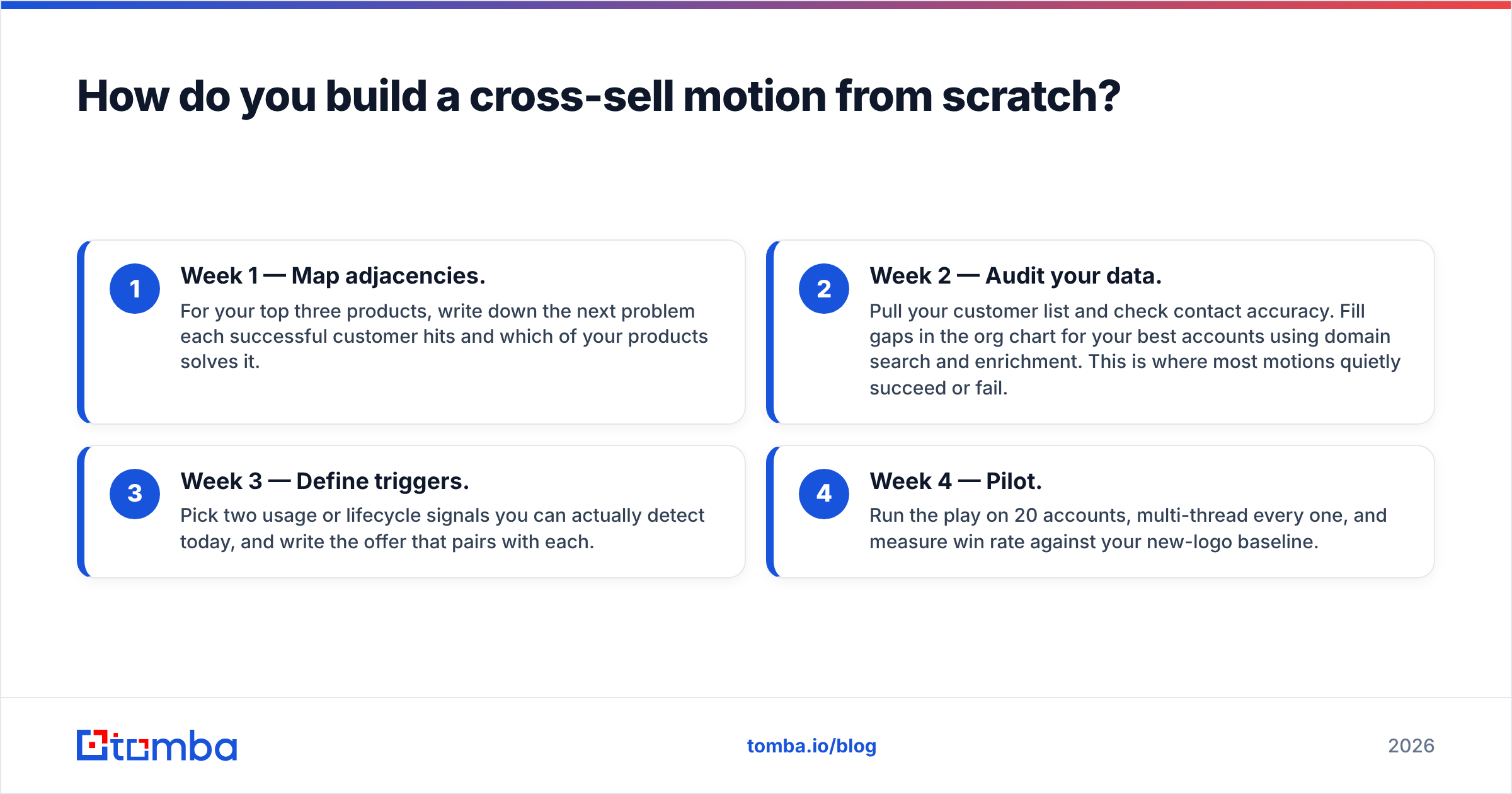
If you're starting cold, here's the 30-day version:
- Week 1 — Map adjacencies. For your top three products, write down the next problem each successful customer hits and which of your products solves it.
- Week 2 — Audit your data. Pull your customer list and check contact accuracy. Fill gaps in the org chart for your best accounts using domain search and enrichment. This is where most motions quietly succeed or fail.
- Week 3 — Define triggers. Pick two usage or lifecycle signals you can actually detect today, and write the offer that pairs with each.
- Week 4 — Pilot. Run the play on 20 accounts, multi-thread every one, and measure win rate against your new-logo baseline.
Iterate from there. The teams that win at cross-selling aren't smarter — they're more systematic, and they treat clean contact data as infrastructure rather than an afterthought.
The bottom line#
Cross-selling B2B is the highest-leverage revenue motion you have, but only when it's built on relevance and timing rather than quota panic. Map the adjacencies, watch the signals, multi-thread every account, and above all keep your contact data accurate — because you cannot expand into a team whose decision-makers you can't reach.
That last part is where Tomba fits. Before you launch any expansion play, use the Tomba Email Finder to pinpoint the exact decision-maker in the adjacent department, verify the address, and reach them on the first try. Start free with 25 searches a month, and see full Tomba pricing when you're ready to scale the motion across your whole customer base. The relationships are already yours — cross-selling is just the discipline of noticing when they're ready to grow.
Related guides#
Ready to find emails that actually work?
Join 150,000+ professionals who stopped guessing and started sending. Free credits on signup — no credit card required.
Get the Tomba newsletter
Practical outbound tactics and product updates — once every two weeks.
About the author