Cross Selling Benefits: The 2026 Playbook for B2B Revenue Teams
Cross-selling is the cheapest revenue you already own. Here are the real cross-selling benefits, the data behind them, and how to do it without annoying buyers.
Cross-selling gets treated like a bolt-on tactic — a "would you like fries with that" you sprinkle on at checkout. That framing undersells it. For B2B revenue teams, the biggest cross selling benefits show up on the metrics your board cares about most: acquisition cost, net revenue retention, and gross margin. You already paid to win the account. Cross-selling is how you get paid back for it.
This guide breaks down what cross-selling does for your numbers in 2026, where it goes wrong, and the data you need before you send a single "customers like you also use…" email.
TL;DR#
- Cross-selling is the cheapest revenue you own. Selling a second product to an existing account skips most of the acquisition cost you already paid, so margins on that revenue are much higher.
- The core cross selling benefits are financial: lower blended CAC, higher retention, bigger average account size, and stronger net revenue retention (NRR) — the metric SaaS investors weight most.
- It only works with clean data. Bad contact records, missing decision-makers, and stale account info turn cross-sell campaigns into spam that erodes trust.
- Cross-selling ≠ upselling. Cross-selling adds a different product; upselling grows the same one. They need different triggers and different plays.
- Relevance is the whole game. A well-timed, well-targeted cross-sell feels like service. A random one feels like a shakedown.
What is cross-selling, and how is it different from upselling?#
Cross-selling means selling an existing customer an additional, complementary product or service. A CRM vendor selling its customer a reporting add-on is cross-selling. A bank offering a checking-account holder a credit card is cross-selling.
Upselling is the close cousin people constantly confuse it with. Upselling moves a customer to a bigger or better version of what they already bought — more seats, a higher tier, a longer contract. Same product line, larger commitment.
Here's the clean split:
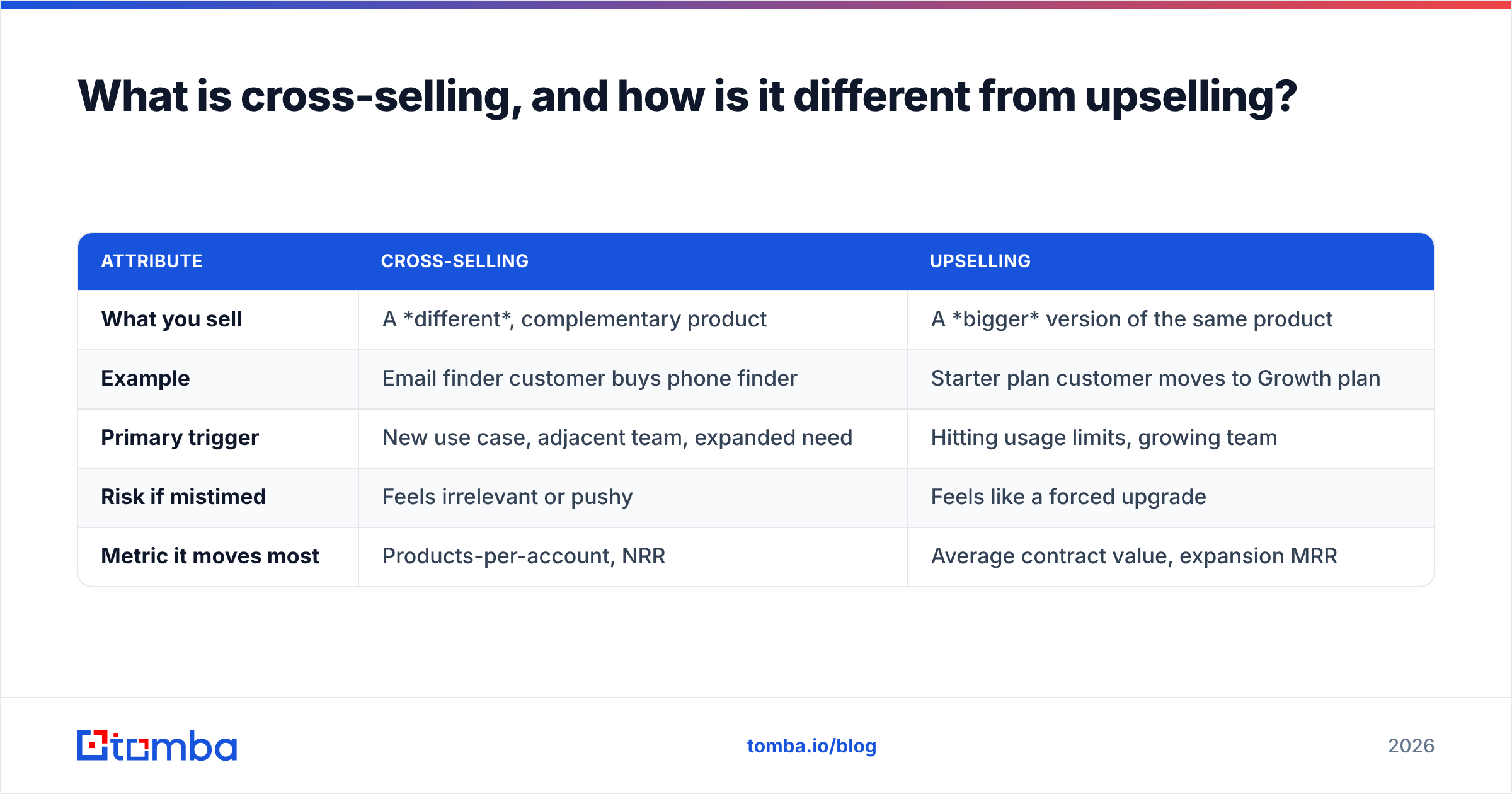
| Attribute | Cross-Selling | Upselling |
|---|---|---|
| What you sell | A different, complementary product | A bigger version of the same product |
| Example | Email finder customer buys phone finder | Starter plan customer moves to Growth plan |
| Primary trigger | New use case, adjacent team, expanded need | Hitting usage limits, growing team |
| Risk if mistimed | Feels irrelevant or pushy | Feels like a forced upgrade |
| Metric it moves most | Products-per-account, NRR | Average contract value, expansion MRR |
Both are expansion revenue. Both beat net-new acquisition on cost. But they fire on different signals, which is why lumping them together usually means you do neither one well.

Why do cross-selling benefits matter more in 2026?#
Because acquisition got expensive and boards started grading on retention. Two shifts made cross-selling a priority instead of an afterthought.
First, customer acquisition cost keeps climbing. Ad inventory, outbound saturation, and longer buying committees mean net-new logos cost more than they did three years ago. When new-logo revenue gets pricier, revenue you can grow inside the base looks a lot more attractive.
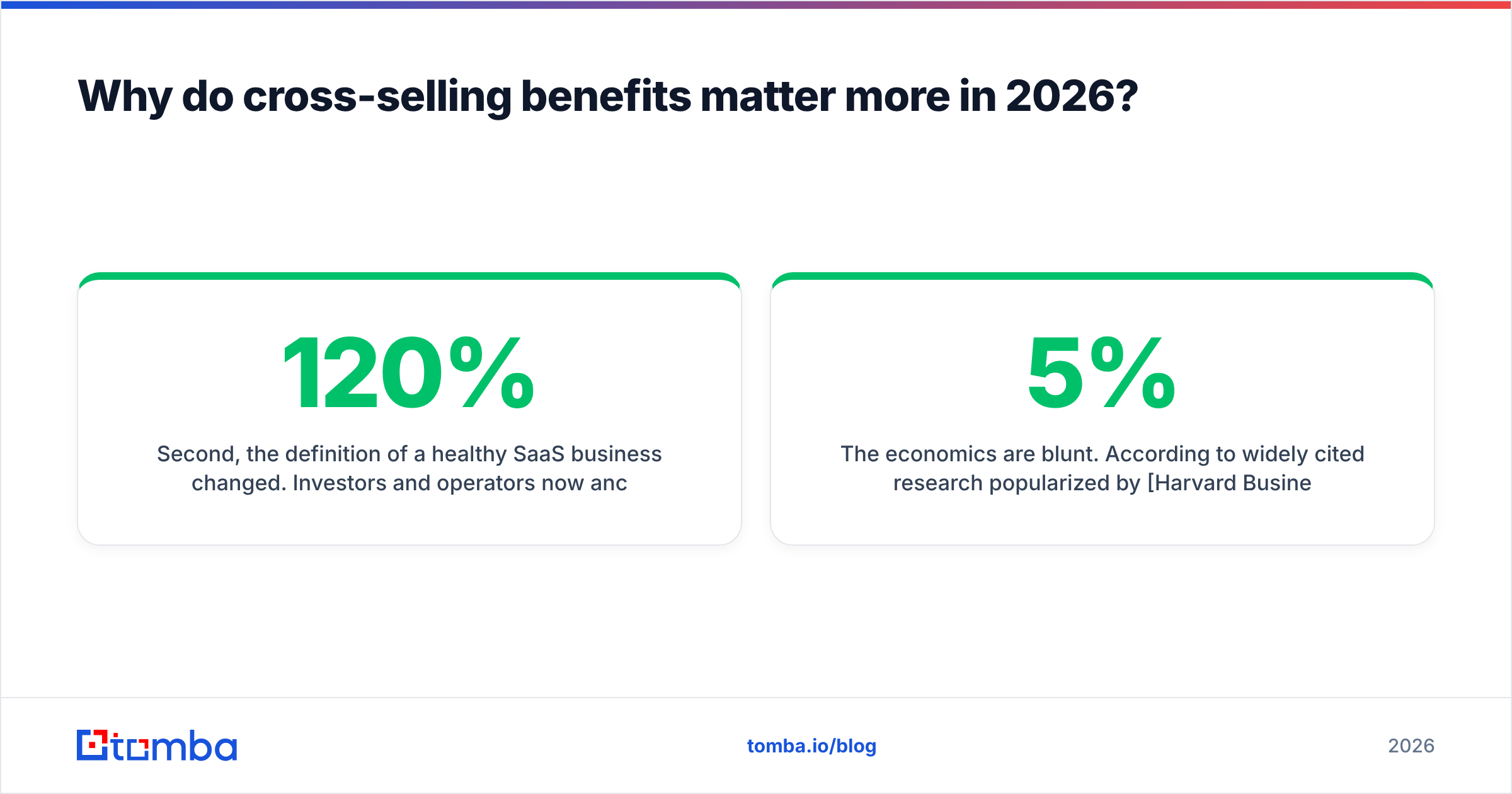
Second, the definition of a healthy SaaS business changed. Investors and operators now anchor on net revenue retention — how much a cohort of customers grows or shrinks over a year without counting new logos. Best-in-class B2B software companies run NRR above 120%, and you do not get there on renewals alone. You get there by expanding accounts, and cross-selling is one of the two levers (the other being upsell) that moves it.
The economics are blunt. Research popularized by Harvard Business Review and Bain makes the point. Raising retention by 5% can lift profit by 25% to 95%. And selling to an existing customer converts far more often than selling to a new prospect. Cross-selling sits right on top of that dynamic: it deepens retention and grows revenue at the same time.
What are the actual cross selling benefits?#
Let's get concrete. Here are the benefits that show up on a real P&L, not a motivational poster.
Lower blended acquisition cost. You already spent the marketing and sales dollars to land the account. A second product sold into that account carries almost none of that cost, so your blended CAC across the relationship drops and payback period shortens.
Higher lifetime value. Every additional product raises the revenue the account generates over its life. More importantly, accounts using multiple products churn less — switching costs go up with each integration, so LTV climbs on both the revenue and the retention side.
Stronger net revenue retention. Cross-sell revenue is expansion revenue. It directly offsets churn and downgrades, pushing NRR toward and past 100%, which is the line between a leaky bucket and a compounding one.
Bigger, stickier accounts. An account running three of your products is structurally harder to displace than one running a single tool. Each product is another root the relationship grows, another team that would feel the pain of leaving.
Better customer outcomes (when done right). A genuinely complementary product often makes the original purchase work better. Pairing an email finder with a phone finder, for instance, gives a sales team multiple ways to reach the same contact — the whole is worth more than the parts.
More efficient sales motion. Reps selling into a warm, known account skip discovery, trust-building, and procurement friction. Cross-sell deals typically close faster and at higher win rates than cold ones.
Here's the same idea as a side-by-side, because the gap between net-new and cross-sell is the whole argument:
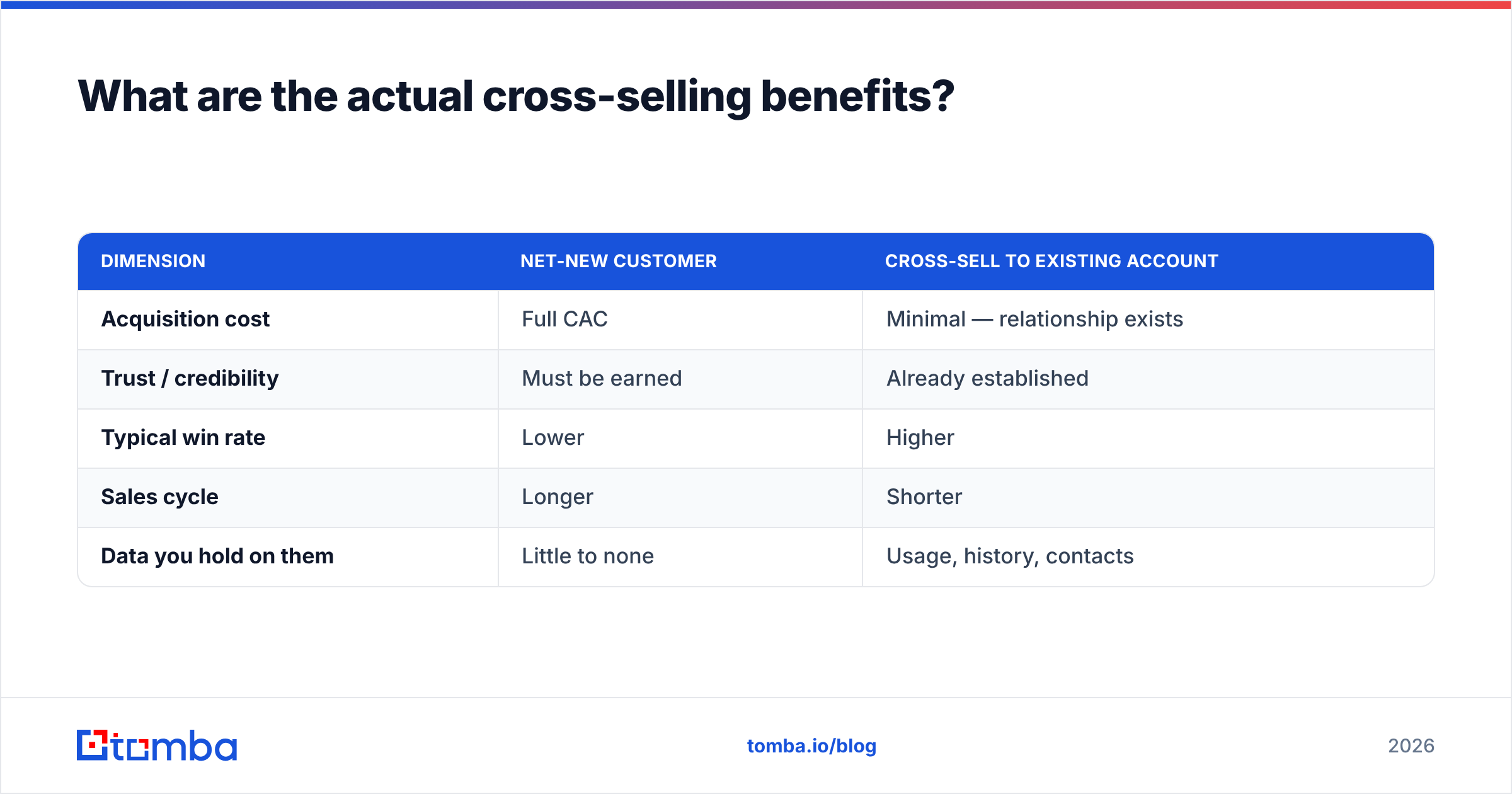
| Dimension | Net-New Customer | Cross-Sell to Existing Account |
|---|---|---|
| Acquisition cost | Full CAC | Minimal — relationship exists |
| Trust / credibility | Must be earned | Already established |
| Typical win rate | Lower | Higher |
| Sales cycle | Longer | Shorter |
| Data you hold on them | Little to none | Usage, history, contacts |
That last row is the one most teams underestimate — and it's where cross-selling quietly succeeds or fails.
What data do you need to cross-sell well?#
You need to know who's in the account, what they use, and who the adjacent buyer is — and most CRMs only reliably store the first part. This is the unglamorous foundation, and it's where good intentions die.
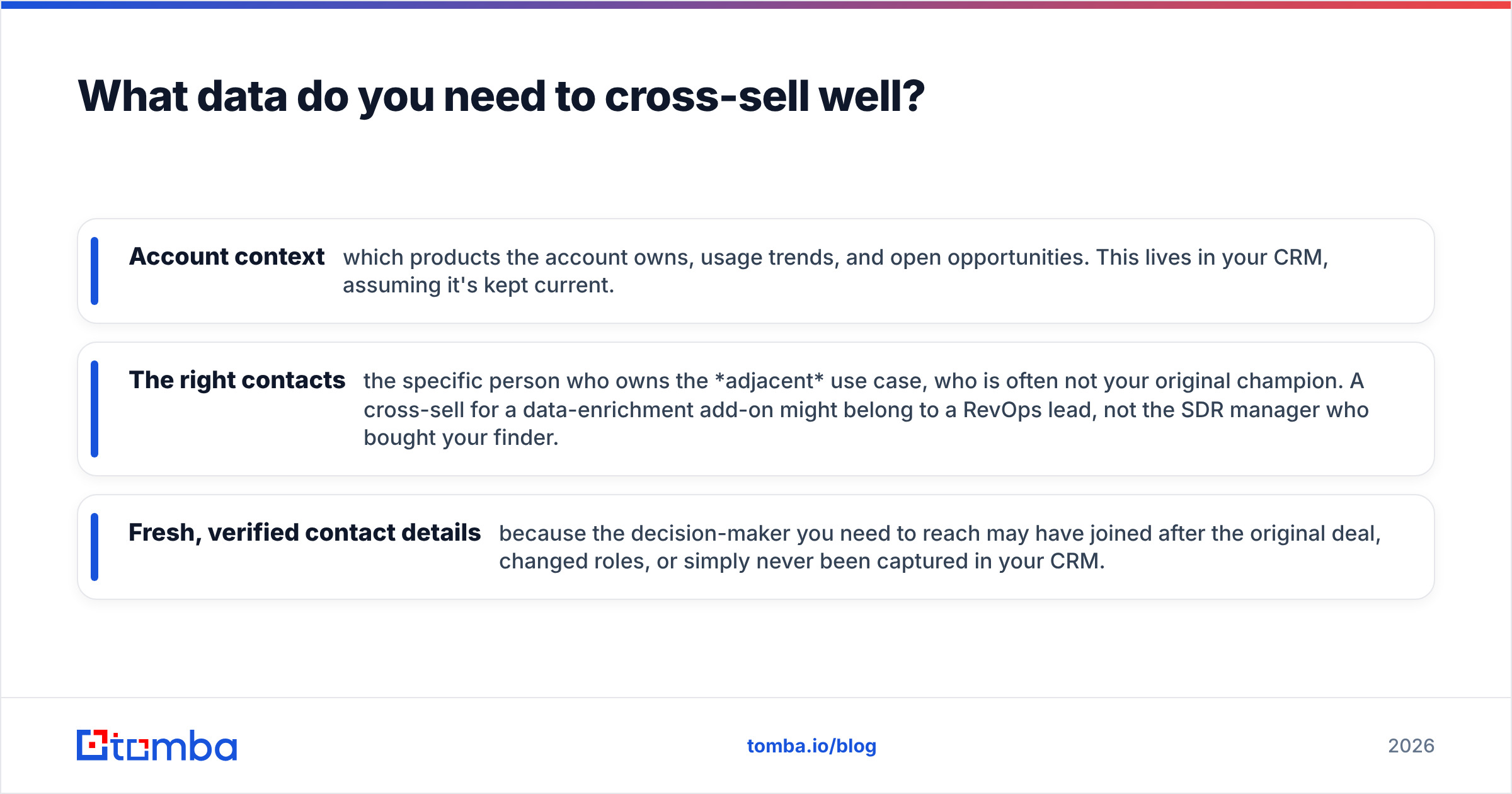
A cross-sell play aimed at the wrong person is worse than no play at all. Say your "you might also like our phone finder" email lands with the one champion who already told you they hate being upsold. Now you've spent trust you can't easily rebuild. Getting it right takes three data layers:
- Account context — which products the account owns, usage trends, and open opportunities. This lives in your CRM, assuming it's kept current.
- The right contacts — the specific person who owns the adjacent use case, who is often not your original champion. A cross-sell for a data-enrichment add-on might belong to a RevOps lead, not the SDR manager who bought your finder.
- Fresh, verified contact details — because the decision-maker you need may have joined after the original deal, changed roles, or simply never been captured in your CRM.
That third layer is where a lot of pipelines leak. B2B contact data decays fast — people change jobs constantly — so the champion you closed 18 months ago may be gone. Reaching the new stakeholder means finding and verifying a current email. That's exactly the job tools like Tomba's domain search and data enrichment are built for: they surface every relevant contact at an account you already own, with verified details, so your cross-sell reaches a real person who holds the budget.

How do you cross-sell without annoying customers?#
Anchor every cross-sell to a trigger, not a quota. The difference between helpful and gross is whether the offer maps to something the customer is actually living through. A few rules that keep cross-selling on the right side of that line:
- Wait for a signal. A usage pattern, a support ticket, a new team, a renewal chat — these are moments where a second product fits. "End of quarter" is not a customer trigger.
- Lead with their outcome. Frame the add-on as solving their problem, not hitting your number. "Teams that added phone finder cut no-contact rate by X" beats "check out our other products."
- Route it to the right owner. In most B2B accounts, the cross-sell should come from the CSM or account owner, not a new rep the customer has never met.
- Cap the frequency. One well-aimed offer per quarter builds trust. A drip of scattershot pitches trains customers to tune you out.
- Make it easy to say no. A cross-sell that respects a "not now" keeps the relationship alive. A pushy one poisons the account.
Vendors like Salesforce and HubSpot have built entire "customer 360" data models around this idea — the more context you have on an account, the more relevant (and less annoying) your expansion motion becomes. The tooling is downstream of the principle: relevance first, offer second.
What are the most common cross-selling mistakes?#
Even teams that believe in cross-selling manage to torch the benefits. The usual culprits:
- Selling on incentive, not fit. When comp plans reward product count over customer success, reps push add-ons that don't fit and churn goes up. The benefit flips into a retention liability.
- Targeting the wrong contact. Pitching the adjacent product to your original buyer, not the person who owns that use case. It's a data problem dressed up as a strategy problem.
- Ignoring product readiness. Selling product B to a customer who hasn't yet gotten value from product A. If the first purchase is struggling, a second one breeds resentment, not expansion.
- Treating it as a one-time campaign. Cross-sell is a continuous motion tied to the customer lifecycle, not a Q4 blast. One-off campaigns get one-off results.
- Running on stale data. Reaching contacts who left, at accounts that changed, with offers based on old usage. Nothing burns credibility faster.
Notice how many of these trace back to data quality and targeting. The strategy of cross-selling is simple; the execution lives or dies on knowing who to reach and why. That's why the strongest cross selling benefits go to teams that invest in a clean B2B database and enrichment layer before they invest in more sequences.
Is cross-selling worth the effort for smaller teams?#
Yes — arguably more so, because small teams can't afford wasted acquisition spend. You don't need a dedicated expansion team or a six-figure customer-data platform to start. You need to know your existing accounts well, spot genuine adjacent needs, and reach the right person with a verified contact and a relevant reason.
The barrier for most small B2B teams isn't strategy; it's execution capacity and data hygiene. Automating the boring part — finding and verifying the right contact inside an account you already own — is what frees a small team to run the play consistently, instead of once a quarter when someone remembers.
Turn accounts you already won into your cheapest pipeline#
The strongest cross selling benefits — lower CAC, higher NRR, stickier accounts — all depend on one unglamorous input: reaching the right person inside an account you already own, with a contact detail that actually works. That's the gap the Tomba Email Finder closes. Point it at an account you want to expand, and it surfaces the verified professional emails of the adjacent decision-makers your CRM never captured — the RevOps lead, the new VP, the team owner who holds budget for your second product.
Start on the free tier (25 searches a month), and scale into a paid plan when the cross-sell pipeline proves itself — the Starter plan runs $49/mo, with Growth and Pro above it. See the full breakdown on the Tomba pricing page. Win the account once; get paid for it many times.
Related guides#
Ready to find emails that actually work?
Join 150,000+ professionals who stopped guessing and started sending. Free credits on signup — no credit card required.
Get the Tomba newsletter
Practical outbound tactics and product updates — once every two weeks.
About the author