Cross-Selling Definition: What It Is and How to Do It in 2026
A plain-English cross selling definition, plus the difference from upselling, real examples, a metrics table, and a step-by-step playbook to grow revenue from customers you already have.
Cross-selling is one of the cheapest ways to grow revenue, yet most teams do it badly — random product pitches, wrong timing, and offers nobody asked for. This guide gives you a precise cross selling definition, shows how it differs from upselling, and hands you a repeatable playbook you can run this quarter.
TL;DR#
- Cross selling definition: selling an additional, complementary product or service to an existing customer — think fries with a burger, or a warranty with a laptop.
- It is not upselling. Upselling moves a buyer to a bigger/better version of the same thing; cross-selling adds a different thing alongside it.
- Existing customers convert at 60–70% vs 5–20% for new prospects (per widely cited Marketing Metrics benchmarks), so cross-selling has the best ROI in your funnel.
- The winning formula is relevance + timing + data: right offer, right moment, backed by clean account data.
- Done wrong it feels like spam and drives churn; done right it raises average order value, retention, and lifetime value.
What is the cross selling definition?#
Cross-selling is the practice of offering an existing customer a related product or service that complements what they already bought or are about to buy. The goal is to solve more of the customer's problem while increasing the total value of the relationship.
Here is the everyday analogy: cross-selling is the server asking "Would you like a coffee with that dessert?" The dessert is the original purchase; the coffee is a separate item that makes the experience better. You are not trying to sell a bigger dessert — that would be upselling. You are adding something adjacent.
In a B2B context, the same logic applies. A company that buys your CRM seats is a natural candidate for your reporting add-on, your onboarding service, or your data-enrichment module. They have already trusted you with one problem; you are earning the right to solve the next one.
Three things separate real cross-selling from a random pitch:
- Relevance — the second product genuinely complements the first.
- Timing — you offer it at a moment when the need is obvious (checkout, onboarding, a usage milestone).
- Evidence — you know enough about the account, via your CRM and enrichment data, to make the offer feel personal rather than automated.
Cross-selling vs upselling: what is the difference?#
The two get confused constantly, but the distinction is simple: upselling trades up within the same category; cross-selling adds a different category. A customer buying a mid-tier software plan gets upsold to the premium plan, and cross-sold a training package.
Both increase revenue per customer, and you often run them together. But they answer different questions. Upselling asks, "Do you want a better version of this?" Cross-selling asks, "Do you also need this related thing?"
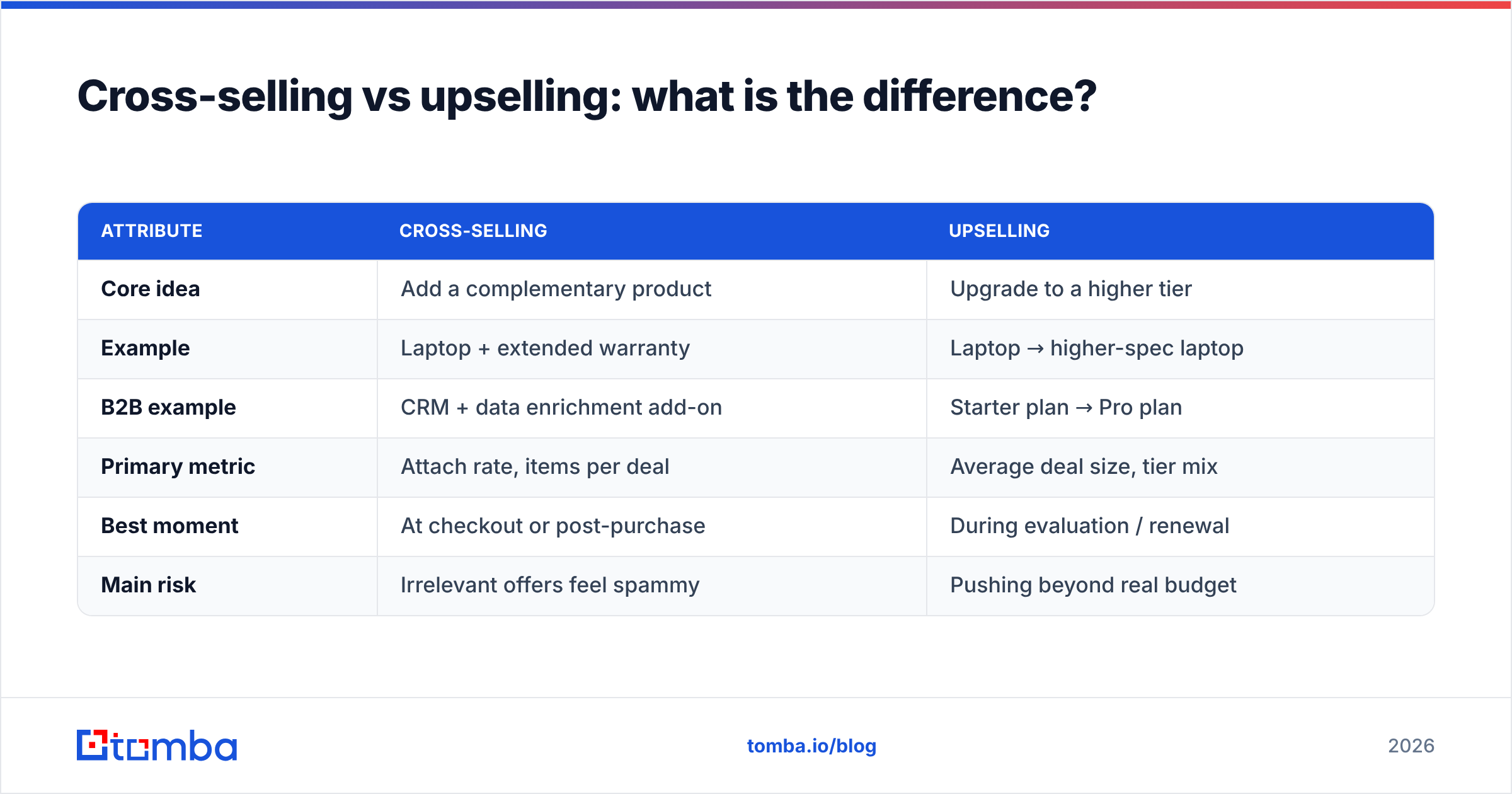
| Attribute | Cross-selling | Upselling |
|---|---|---|
| Core idea | Add a complementary product | Upgrade to a higher tier |
| Example | Laptop + extended warranty | Laptop → higher-spec laptop |
| B2B example | CRM + data enrichment add-on | Starter plan → Pro plan |
| Primary metric | Attach rate, items per deal | Average deal size, tier mix |
| Best moment | At checkout or post-purchase | During evaluation / renewal |
| Main risk | Irrelevant offers feel spammy | Pushing beyond real budget |
A useful rule: if the new offer changes what the customer owns, it is cross-selling. If it changes how much of the same thing they own, it is upselling. Most mature revenue teams — see how HubSpot structures its product tiers and add-ons — deliberately design catalogs so both motions are available at every stage.
Why does cross-selling matter so much?#
Because selling to someone who already trusts you is dramatically cheaper than acquiring a stranger. The economics are lopsided, which is why cross-selling shows up in nearly every serious growth plan.
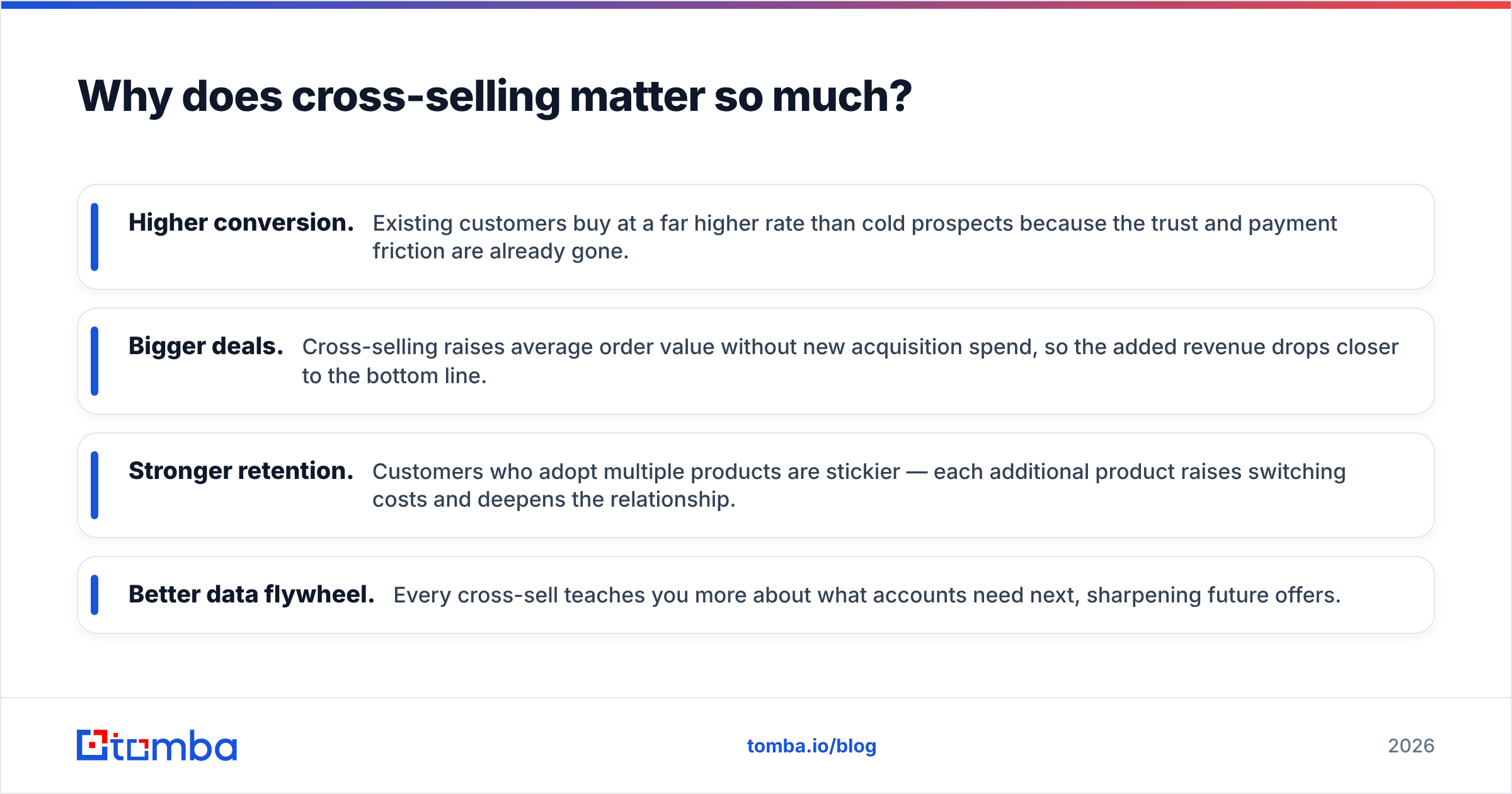
- Higher conversion. Existing customers buy at a far higher rate than cold prospects because the trust and payment friction are already gone.
- Bigger deals. Cross-selling raises average order value without new acquisition spend, so the added revenue drops closer to the bottom line.
- Stronger retention. Customers who adopt multiple products are stickier — each additional product raises switching costs and deepens the relationship.
- Better data flywheel. Every cross-sell teaches you more about what accounts need next, sharpening future offers.
The flip side is real: a clumsy cross-sell — offering something irrelevant, or pushing too hard, too soon — erodes trust and can accelerate churn. The consequence of getting it wrong is not neutral; it is negative.

What are real cross-selling examples?#
Concrete examples make the cross selling definition click. Notice how each pairs a primary purchase with a genuinely complementary add-on.
- E-commerce: "Frequently bought together" — a phone case and screen protector with a new phone.
- Banking: A customer opening a checking account is offered a credit card or savings product.
- SaaS: A team on a project-management tool is offered a time-tracking or reporting add-on.
- Travel: Booking a flight prompts an offer for a hotel, car rental, or travel insurance.
- B2B data: A sales team using an email finder adds an email verifier and phone-lookup module to complete each contact record.
That last one is worth expanding. A rep who finds a prospect's email still needs to confirm it is deliverable and, ideally, reach them by phone. Offering email verification and B2B phone numbers alongside the finder is textbook cross-selling: separate products, one connected workflow, obvious value.
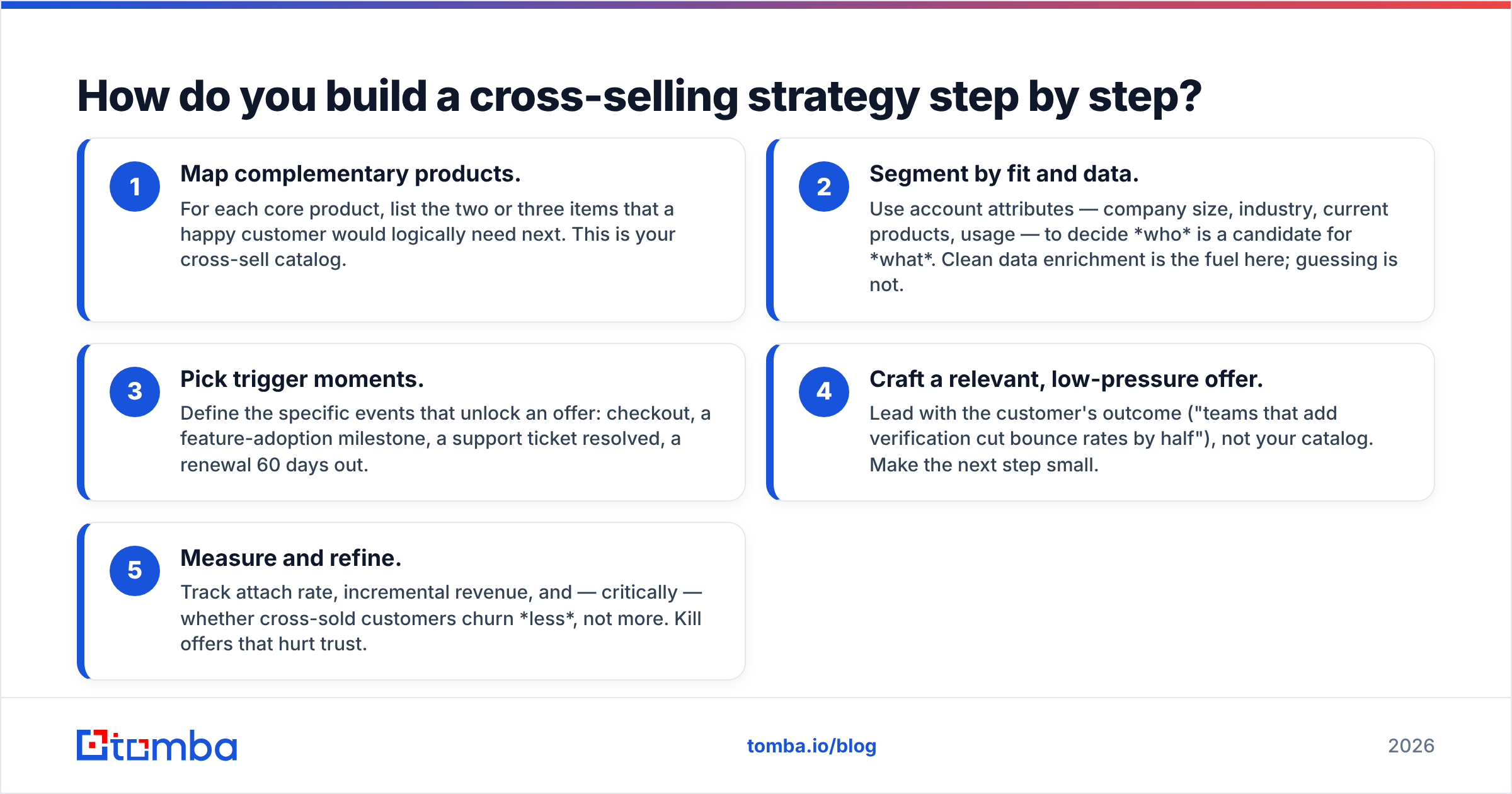
How do you build a cross-selling strategy step by step?#
Cross-selling works when it is a designed motion, not a lucky pitch. Here is a five-step framework you can implement without new headcount.
- Map complementary products. For each core product, list the two or three items that a happy customer would logically need next. This is your cross-sell catalog.
- Segment by fit and data. Use account attributes — company size, industry, current products, usage — to decide who is a candidate for what. Clean data enrichment is the fuel here; guessing is not.
- Pick trigger moments. Define the specific events that unlock an offer: checkout, a feature-adoption milestone, a support ticket resolved, a renewal 60 days out.
- Craft a relevant, low-pressure offer. Lead with the customer's outcome ("teams that add verification cut bounce rates by half"), not your catalog. Make the next step small.
- Measure and refine. Track attach rate, incremental revenue, and — critically — whether cross-sold customers churn less, not more. Kill offers that hurt trust.
The most common failure is skipping step two. When you cross-sell off bad or missing data, you make irrelevant offers, and irrelevant offers are indistinguishable from spam. That is why the teams with the highest response rate on expansion offers invest in data quality first and messaging second.
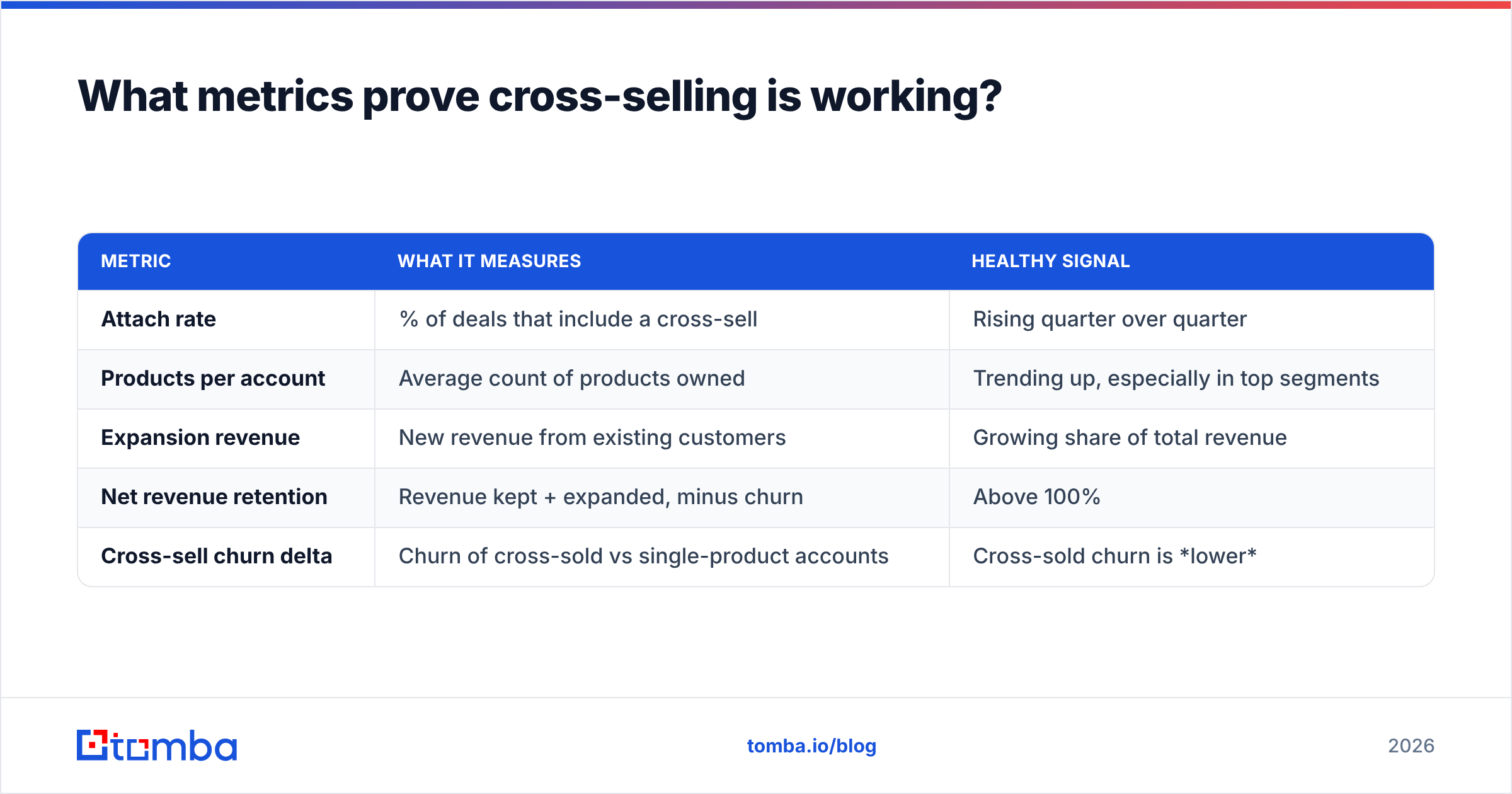
What metrics prove cross-selling is working?#
Track a small, honest set of numbers rather than a vanity dashboard. The table below shows what to watch and why.
| Metric | What it measures | Healthy signal |
|---|---|---|
| Attach rate | % of deals that include a cross-sell | Rising quarter over quarter |
| Products per account | Average count of products owned | Trending up, especially in top segments |
| Expansion revenue | New revenue from existing customers | Growing share of total revenue |
| Net revenue retention | Revenue kept + expanded, minus churn | Above 100% |
| Cross-sell churn delta | Churn of cross-sold vs single-product accounts | Cross-sold churn is lower |
If your cross-sell churn delta is negative — meaning cross-sold customers leave more — stop and diagnose. It usually means you are pushing offers on accounts that were not ready, which is a data and timing problem, not a demand problem.
What tools support cross-selling?#
You need three capabilities: a system of record, a signal layer, and a data layer.
- System of record (CRM): your source of truth for what each account owns and where they are in the lifecycle. This is where triggers live.
- Signal layer: usage analytics, support data, and website activity that tell you when an account is ready for the next product.
- Data layer: accurate contact and firmographic data so every offer reaches the right person with the right context.
The data layer is where most cross-sell programs quietly fail. If half your contact records are stale, your perfectly designed offers land in the wrong inboxes. That is where a tool like Tomba fits: it finds and verifies the contact data that makes targeted expansion offers possible, and connects to the systems your team already uses through native integrations. Compare the tiers on the Tomba pricing page to see where the free tier and paid plans line up with your volume.
What mistakes should you avoid?#
- Pitching too early. A customer who is still onboarding does not want a second product yet. Let value land first.
- Ignoring relevance. Offering an unrelated product signals you do not understand the account. Segment ruthlessly.
- Over-automating. Automation scales cross-selling, but a fully robotic sequence with no personalization reads as spam and damages sender reputation.
- Optimizing for the sale, not the relationship. If your cross-sell raises this quarter's number but increases churn, you lost. Measure retention alongside revenue.
- Working from dirty data. Bad emails and missing firmographics turn a smart strategy into random noise.
Avoid these and cross-selling becomes what it should be: a service to the customer that also happens to grow revenue.
Frequently asked questions#
Is cross-selling only for existing customers? Mostly, yes. The textbook cross selling definition centers on customers who have already bought or are at checkout. Offering complementary products to brand-new prospects is closer to bundling than true cross-selling.
Can you cross-sell and upsell at the same time? Absolutely, and you often should. A renewal conversation might upsell the plan tier and cross-sell an add-on. Just keep the offers relevant and don't overwhelm the buyer.
How is cross-selling different from bundling? Bundling packages products together upfront for a single price. Cross-selling offers a second product after interest in the first is established, usually as a separate decision.
Does cross-selling hurt customer trust? Only when it is irrelevant or pushy. Well-timed, genuinely useful offers increase trust because they show you understand the customer's evolving needs.
Start cross-selling with data you can trust#
Cross-selling lives or dies on knowing who to offer what, and reaching them with confidence. That starts with accurate, verified contact data for every account in your book of business. The Tomba Email Finder helps you find and confirm the right decision-maker's email by domain, name, or company — so your expansion offers land with the person who can actually say yes. Pair it with Tomba's verifier and enrichment tools, plug it into your CRM, and turn your existing customer list into your most reliable growth channel. Start free with 25 searches a month and scale as your cross-sell motion proves itself.
Related guides#
Ready to find emails that actually work?
Join 150,000+ professionals who stopped guessing and started sending. Free credits on signup — no credit card required.
Get the Tomba newsletter
Practical outbound tactics and product updates — once every two weeks.
About the author