Cross Selling Examples: 12 Real Tactics to Grow Revenue in 2026
Twelve concrete cross-selling examples pulled from real B2B and B2C playbooks, plus a framework for when to pitch, what to bundle, and how to avoid annoying buyers.
Cross-selling is the fastest revenue you already own. You paid the acquisition cost once. Now you sell a second or third product to a customer who already trusts you. This guide breaks down 12 cross selling examples that actually convert. You'll see when to trigger each one, and how to do it without sounding like a pushy checkout upsell.
TL;DR#
- Cross-selling = offering a complementary product to an existing customer (fries with the burger). Upselling = a bigger version of the same product (large fries). They're cousins, not twins.
- The best cross-sell examples are triggered by a real signal — a usage milestone, a support ticket, a renewal — not a random blast.
- Relevance beats volume. A well-timed, single-product recommendation outperforms a five-product "you might also like" wall.
- B2B cross-selling lives on clean contact and account data. If your CRM is stale, your "personalized" pitch lands on the wrong person.
- Measured right, cross-selling lifts revenue per account and retention at the same time — expansion customers churn less.
What is cross-selling (and how is it different from upselling)?#
Cross-selling is recommending a related product that complements what a customer already bought or uses. Think of a hardware store: you buy a drill, and the associate points you to the drill-bit set and the wall anchors. You came for one thing and left solving the whole job.
Upselling, by contrast, nudges you toward a premium version of the same purchase — the cordless drill with two batteries instead of one. Both increase order value, but they answer different questions. Cross-selling answers "what else do you need?" Upselling answers "want the better one?"
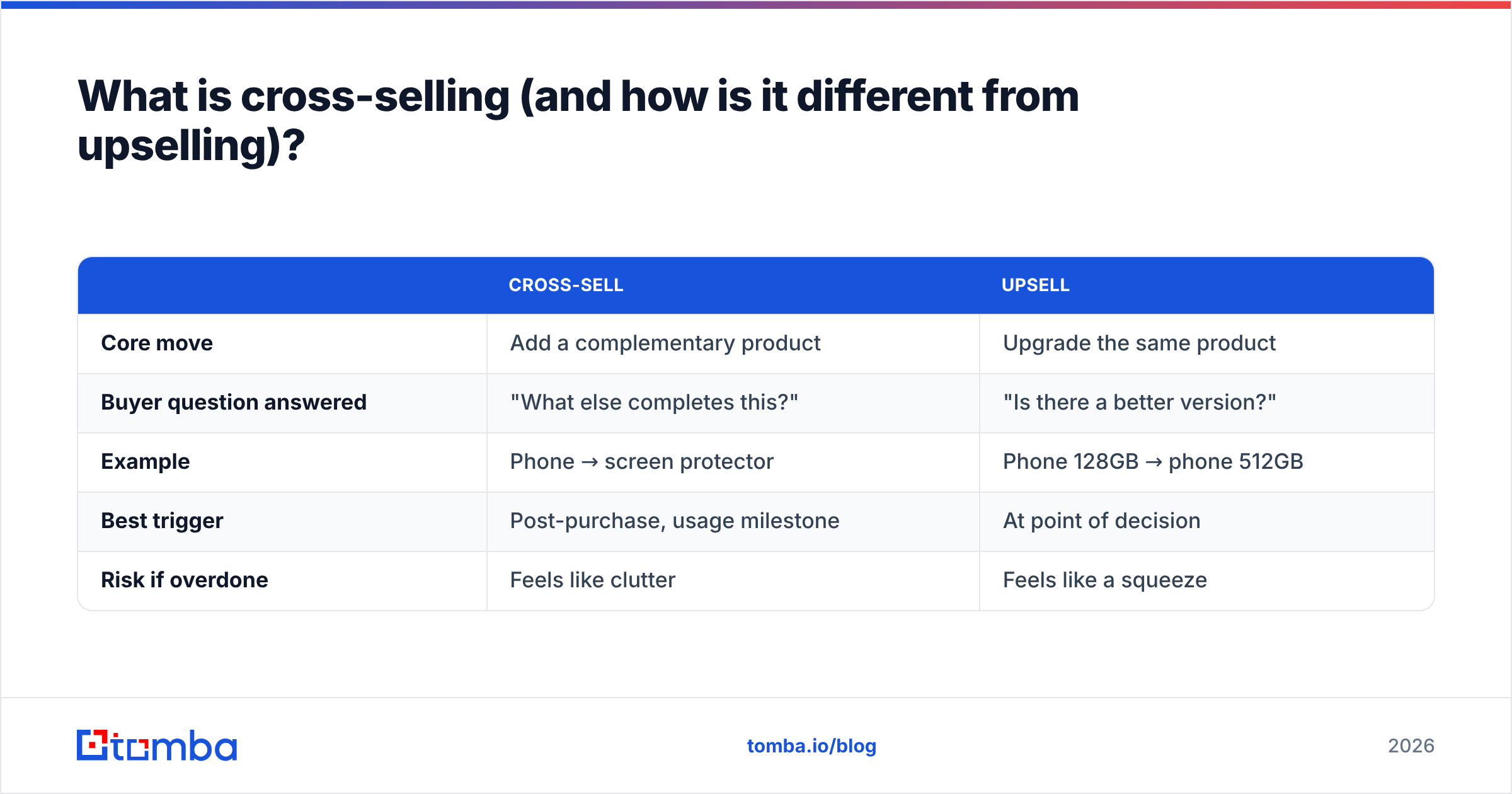
Here's the quick contrast:
| Cross-sell | Upsell | |
|---|---|---|
| Core move | Add a complementary product | Upgrade the same product |
| Buyer question answered | "What else completes this?" | "Is there a better version?" |
| Example | Phone → screen protector | Phone 128GB → phone 512GB |
| Best trigger | Post-purchase, usage milestone | At point of decision |
| Risk if overdone | Feels like clutter | Feels like a squeeze |
Both tactics share one dependency: you need to know who the customer is and what they already own. That's a data problem before it's a sales problem, which is why B2B teams lean on a clean B2B database and enrichment to know which accounts are even eligible for a second product.
What are the best cross selling examples in B2C and retail?#
Retail and consumer apps have run cross-sell experiments for decades, so their playbook is the most refined. Here are the patterns worth stealing.
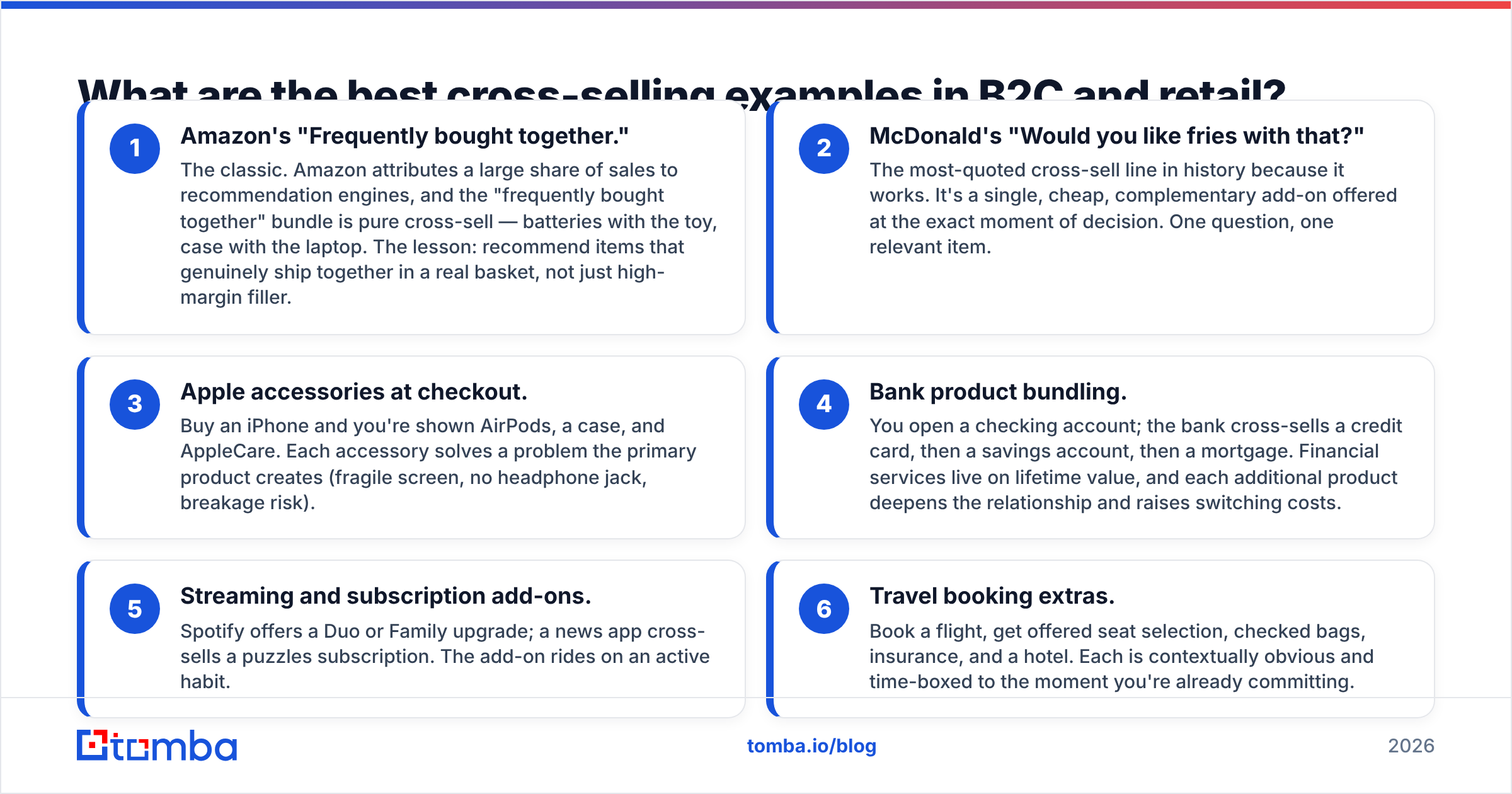
Amazon's "Frequently bought together." The classic. Amazon attributes a large share of sales to recommendation engines, and the "frequently bought together" bundle is pure cross-sell — batteries with the toy, case with the laptop. The lesson: recommend items that genuinely ship together in a real basket, not just high-margin filler.
McDonald's "Would you like fries with that?" The most-quoted cross-sell line in history because it works. It's a single, cheap, complementary add-on offered at the exact moment of decision. One question, one relevant item.
Apple accessories at checkout. Buy an iPhone and you're shown AirPods, a case, and AppleCare. Each accessory solves a problem the primary product creates (fragile screen, no headphone jack, breakage risk).
Bank product bundling. You open a checking account; the bank cross-sells a credit card, then a savings account, then a mortgage. Financial services live on lifetime value, and each added product deepens the relationship and raises switching costs.
Streaming and subscription add-ons. Spotify offers a Duo or Family upgrade; a news app cross-sells a puzzles subscription. The add-on rides on an active habit.
Travel booking extras. Book a flight, get offered seat selection, checked bags, insurance, and a hotel. Each is contextually obvious and time-boxed to the moment you're already committing.
The through-line: every strong B2C cross-sell is contextual and low-friction. It appears where the buyer already has intent, and it asks for one small yes.
What are strong B2B and SaaS cross selling examples?#
B2B cross-selling has higher stakes and longer cycles, but the same logic scales up. The difference is that the trigger is usually a data signal inside your product or CRM. The "recommendation" often comes from a human rep or a lifecycle email rather than a checkout page.
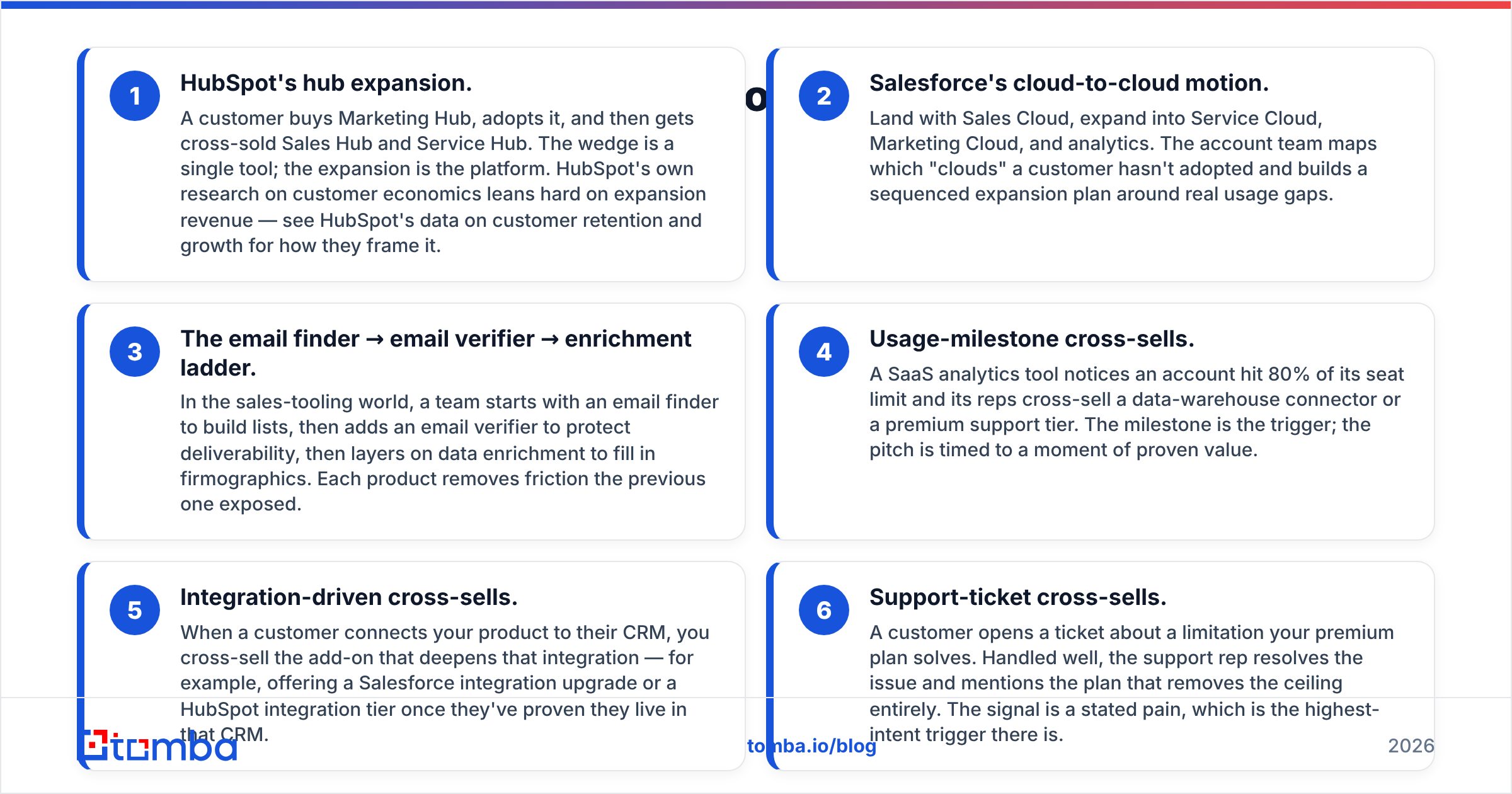
HubSpot's hub expansion. A customer buys Marketing Hub, adopts it, and then gets cross-sold Sales Hub and Service Hub. The wedge is a single tool; the expansion is the platform. HubSpot's own research on customer economics leans hard on expansion revenue — see HubSpot's data on customer retention and growth for how they frame it.
Salesforce's cloud-to-cloud motion. Land with Sales Cloud, expand into Service Cloud, Marketing Cloud, and analytics. The account team maps which "clouds" a customer hasn't adopted and builds a sequenced expansion plan around real usage gaps.
The email finder → email verifier → enrichment ladder. In the sales-tooling world, a team starts with an email finder to build lists, then adds an email verifier to protect deliverability, then layers on data enrichment to fill in firmographics. Each product removes friction the previous one exposed.
Usage-milestone cross-sells. A SaaS analytics tool notices an account hit 80% of its seat limit and its reps cross-sell a data-warehouse connector or a premium support tier. The milestone is the trigger; the pitch is timed to a moment of proven value.
Integration-driven cross-sells. When a customer connects your product to their CRM, you cross-sell the add-on that deepens that integration — for example, offering a Salesforce integration upgrade or a HubSpot integration tier once they've proven they live in that CRM.
Support-ticket cross-sells. A customer opens a ticket about a limitation your premium plan solves. Handled well, the support rep resolves the issue and mentions the plan that removes the ceiling entirely. The signal is a stated pain, which is the highest-intent trigger there is.
How do you know when to cross-sell? (the trigger framework)#
Conclusion first: cross-sell on a signal, never on a schedule. The single biggest reason cross-sell campaigns feel spammy is that they're sent to everyone at once instead of to the right customer at the right moment.
Use this four-part trigger checklist to decide whether an account is ready:
- Adoption signal — Has the customer actually used and gotten value from the first product? Cross-selling to an inactive account just accelerates churn.
- Fit signal — Does the complementary product solve a problem this specific customer has? Firmographic and behavioral data answer this. Enriching the account with accurate contact enrichment data tells you whether the second product even applies.
- Timing signal — Is there a natural moment (renewal, milestone, ticket, new hire in a relevant role) that makes the pitch feel helpful instead of interruptive?
- Owner signal — Do you know the right person to pitch? The champion for product A is often not the buyer for product B. You may need to find a new stakeholder's contact via domain search before you reach out.
If you can't check at least three of the four, hold the pitch. Premature cross-selling is one of the fastest ways to erode trust you spent months building.
Cross-selling vs. upselling vs. bundling: which should you use?#
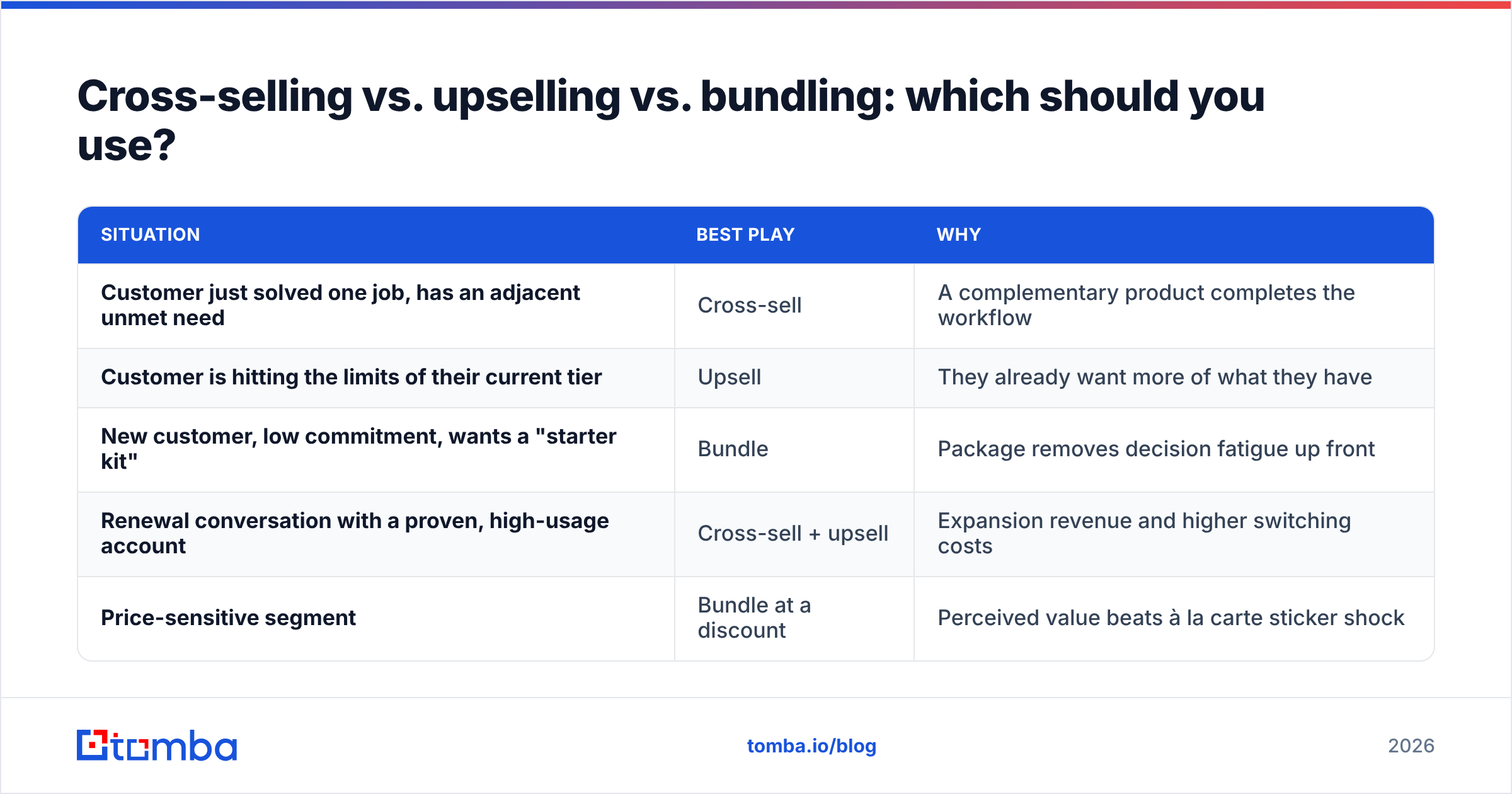
They're not mutually exclusive — mature teams run all three. But each fits a different situation. Here's how to choose:
| Situation | Best play | Why |
|---|---|---|
| Customer just solved one job, has an adjacent unmet need | Cross-sell | A complementary product completes the workflow |
| Customer is hitting the limits of their current tier | Upsell | They already want more of what they have |
| New customer, low commitment, wants a "starter kit" | Bundle | Package removes decision fatigue up front |
| Renewal conversation with a proven, high-usage account | Cross-sell + upsell | Expansion revenue and higher switching costs |
| Price-sensitive segment | Bundle at a discount | Perceived value beats à la carte sticker shock |
The revenue math favors expansion in all cases. Research from firms like Gartner consistently shows that selling to an existing customer costs a fraction of acquiring a new one, and expansion accounts tend to retain better. Cross-selling isn't just an upsell tactic — it's a retention strategy wearing a revenue costume.
What are the most common cross-selling mistakes?#
Even good teams sabotage cross-sell programs the same handful of ways. Avoid these:
- Pitching before value. Offering product B before the customer succeeded with product A. It reads as greed and predicts churn.
- Ignoring relevance. Recommending high-margin items nobody asked for instead of genuinely complementary ones. The McDonald's line works because fries actually go with a burger.
- Wrong contact. Sending the cross-sell to the original champion when the new product needs a different department head. This is a data hygiene failure more than a messaging one.
- Overloading the offer. Five recommendations dilute the one that matters. A single, confident, relevant suggestion converts better than a wall of options.
- No measurement. If you can't attribute revenue to the cross-sell motion, you can't improve it. Track expansion revenue, attach rate, and post-cross-sell retention separately.
Almost every one of these traces back to either bad timing or bad data. Fix the data layer and half the mistakes disappear on their own.
How does clean data make cross-selling actually work?#
Cross-selling is a targeting problem disguised as a messaging problem. The message ("here's a product that completes your setup") is easy. The hard part is knowing which customers qualify, and who inside the account to reach. That's entirely a data question.
Three data capabilities do the heavy lifting:
- Account enrichment tells you firmographics (size, industry, tech stack) so you can predict which second product fits. A 10-person startup and a 5,000-person enterprise need very different cross-sells.
- Contact discovery finds the right stakeholder for the new product, not just the person who bought the first one. When you need to reach a new department, an email finder or domain search surfaces the verified contact fast.
- Verification keeps your outreach deliverable. Cross-sell emails that bounce hurt your sender reputation and never reach the buyer. Running lists through an email verifier before you send protects both the campaign and your domain.
Teams that treat cross-selling as a data-driven motion — enrich, target, verify, then pitch on a trigger — consistently outperform teams that blast their whole customer base and hope. The tooling makes the difference between "personalized" as a buzzword and personalized as a fact.
Cross selling examples: your quick-start checklist#
Ready to run your own program? Start here:
- Map your product adjacencies. For each product, list the two or three products that genuinely complete the job.
- Define one trigger per adjacency. A milestone, a ticket type, a renewal window — something observable.
- Enrich and verify the account before you pitch, so the right person gets a deliverable message.
- Lead with the customer's problem, not your catalog. "You're hitting X limit — here's what removes it."
- Offer one thing. Confidence over volume.
- Measure attach rate and post-cross-sell retention, then iterate.
Ready to power your cross-sell motion with accurate data?#
Great cross-selling starts with knowing exactly who to reach inside every account — and reaching them with an address that actually lands. That's where Tomba Email Finder comes in. Find and verify the right stakeholder for your next product pitch by domain, name, or company, then enrich the account so your offer is relevant before you ever hit send. Start free with 25 searches a month, and scale up on the Starter plan at $49/mo when your expansion pipeline takes off. Your existing customers are your best next deals — go reach the right people inside them.
Related guides#
Ready to find emails that actually work?
Join 150,000+ professionals who stopped guessing and started sending. Free credits on signup — no credit card required.
Get the Tomba newsletter
Practical outbound tactics and product updates — once every two weeks.
About the author