Cross-Selling Strategies: The 2026 Playbook to Grow Accounts
Cross-selling is the cheapest revenue you own — if you time it right. Here are the frameworks, triggers, and real examples that lift revenue per account in 2026.
Cross-selling is the highest-margin revenue most teams ignore. You already paid to acquire the customer, you already built the trust, and the product is already live in their workflow. Selling them a second, relevant product is dramatically cheaper than closing a stranger — yet most companies leave it to chance.
This guide breaks down cross selling strategies that work in 2026: the frameworks, the timing triggers, the data you need, and the mistakes that quietly cap your account growth.
TL;DR#
- Cross-selling sells a complementary product to an existing customer (a CRM buyer adding a marketing tool); upselling sells more of the same (a bigger tier).
- Timing beats persuasion. The best cross-sell fires on a usage trigger — onboarding milestone, feature limit, renewal window — not a random quarterly push.
- Data is the bottleneck. You can only cross-sell what you can see. Enriched, complete account records turn guesswork into targeting.
- A structured motion wins. Map the second product to a real need, assign an owner, and measure attach rate — not just total revenue.
- Cross-selling lifts net revenue retention (NRR), the single metric investors care about most in 2026.
What is cross-selling, and how is it different from upselling?#
Cross-selling is like a good waiter suggesting a wine that actually pairs with your dish. You came for the steak; you leave having spent more because the second item made the first one better. Upselling is the waiter nudging you from the 8oz to the 12oz — same item, bigger size.
In B2B terms:
- Cross-sell: a customer on your email verifier adds your phone-finder product.
- Upsell: a customer on the $49/mo plan moves to the $99/mo plan for more volume.
Both expand revenue from accounts you already own, and both feed net revenue retention. But they require different plays. Upsell is usually a capacity conversation (you're hitting limits). Cross-sell is a needs conversation (you have a second problem this other product solves).
Getting the distinction right matters because the triggers differ. An upsell fires when usage approaches a ceiling. A cross-sell fires when you spot an adjacent need the customer hasn't connected to your catalog yet.

Why do cross selling strategies matter more in 2026?#
Because new-logo acquisition got expensive and boards started grading you on retention.
According to HubSpot's sales research, it costs several times more to acquire a new customer than to sell to an existing one, and existing customers convert at far higher rates. When budgets tighten, the math is brutal: expansion revenue is the cheapest growth on the P&L.
There's also a structural shift. Analysts at Gartner have documented buying committees getting larger and buying cycles getting longer for net-new deals. Inside an existing account, you skip most of that — you have a champion, a contract, and a paper trail. The friction that kills cold deals is already gone.
The result: teams that build a deliberate cross-sell motion see higher NRR, more predictable forecasts, and better unit economics than teams chasing only fresh pipeline.
What are the core cross-selling strategies that actually work?#
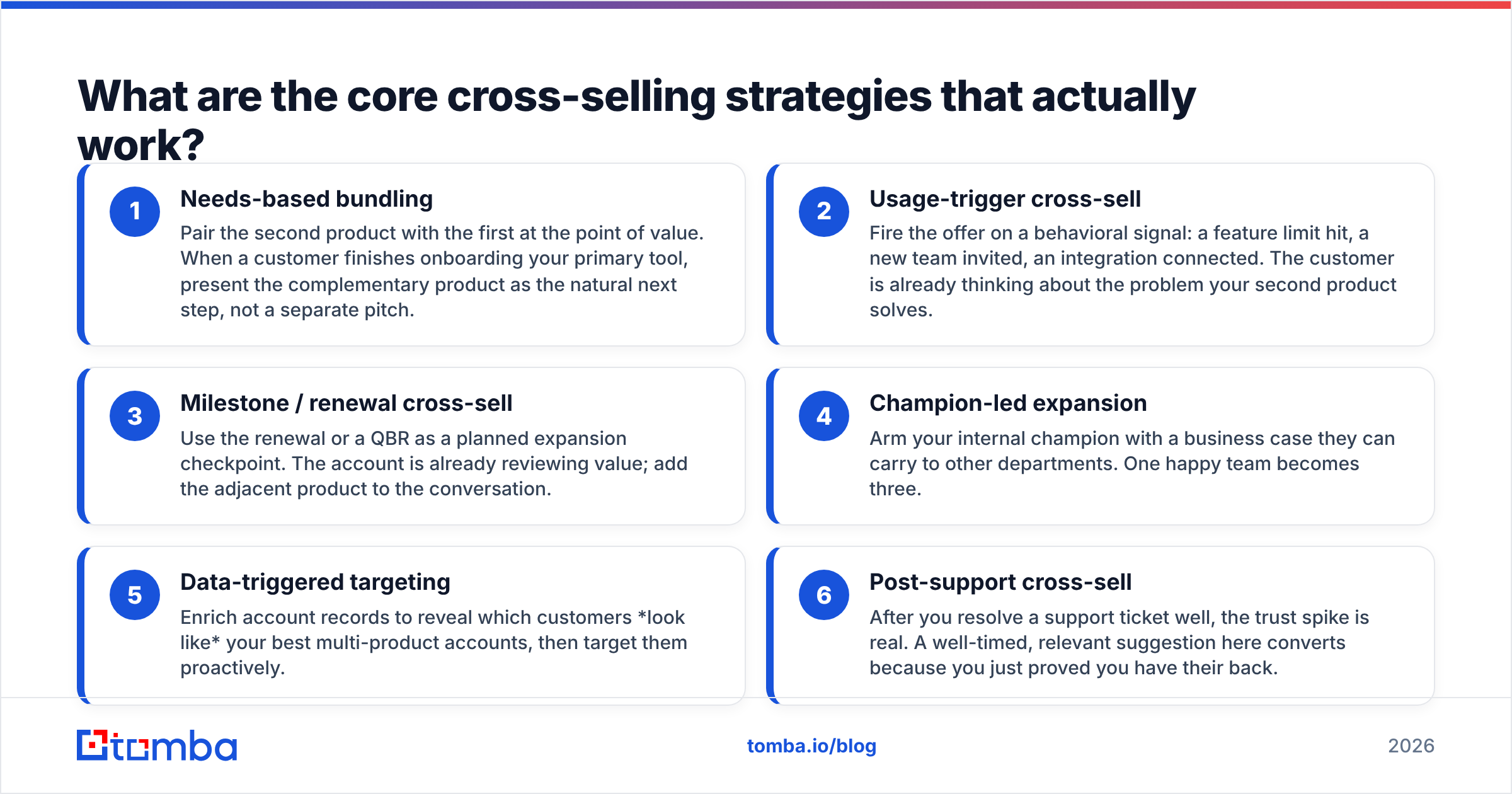
Here are the six plays that consistently produce attach, ranked from easiest to hardest to operationalize.
- Needs-based bundling — Pair the second product with the first at the point of value. When a customer finishes onboarding your primary tool, present the complementary product as the natural next step, not a separate pitch.
- Usage-trigger cross-sell — Fire the offer on a behavioral signal: a feature limit hit, a new team invited, an integration connected. The customer is already thinking about the problem your second product solves.
- Milestone / renewal cross-sell — Use the renewal or a QBR as a planned expansion checkpoint. The account is already reviewing value; add the adjacent product to the conversation.
- Champion-led expansion — Arm your internal champion with a business case they can carry to other departments. One happy team becomes three.
- Data-triggered targeting — Enrich account records to reveal which customers look like your best multi-product accounts, then target them proactively.
- Post-support cross-sell — After you resolve a support ticket well, the trust spike is real. A well-timed, relevant suggestion here converts because you just proved you have their back.
The common thread: every winning play is anchored to a moment of relevance, not a moment convenient for your quota.
How do you time a cross-sell so it doesn't feel pushy?#
Time it to the customer's problem, not your calendar quarter.
The fastest way to torch trust is to pitch a second product before the first one has delivered value. If the customer hasn't reached their initial "aha" moment, a cross-sell reads as a money grab. Wait for proof of value first.
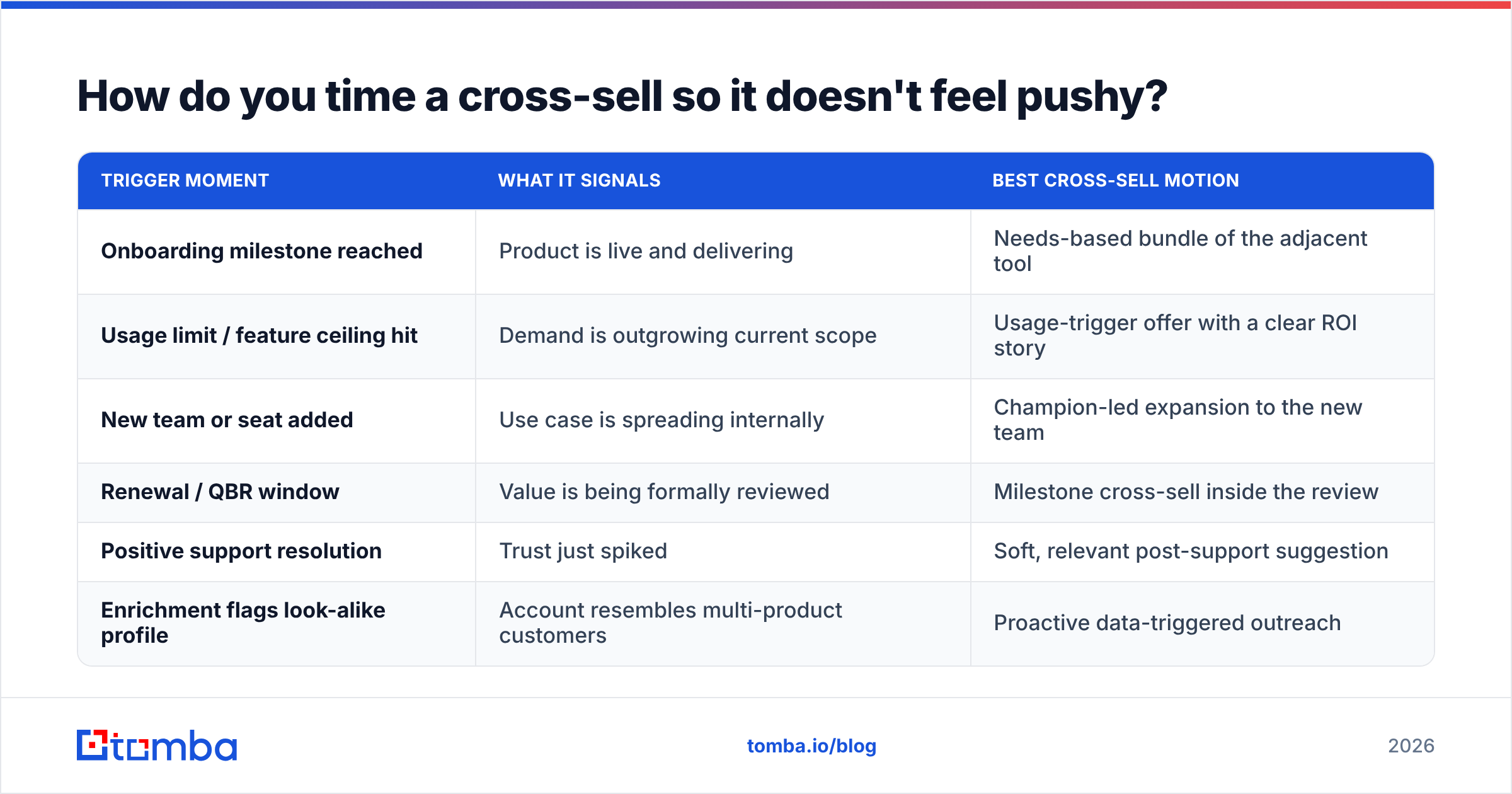
Here's a practical timing map:
| Trigger moment | What it signals | Best cross-sell motion |
|---|---|---|
| Onboarding milestone reached | Product is live and delivering | Needs-based bundle of the adjacent tool |
| Usage limit / feature ceiling hit | Demand is outgrowing current scope | Usage-trigger offer with a clear ROI story |
| New team or seat added | Use case is spreading internally | Champion-led expansion to the new team |
| Renewal / QBR window | Value is being formally reviewed | Milestone cross-sell inside the review |
| Positive support resolution | Trust just spiked | Soft, relevant post-support suggestion |
| Enrichment flags look-alike profile | Account resembles multi-product customers | Proactive data-triggered outreach |
Notice that none of these is "the start of Q3." Push cross-sells on a fixed corporate calendar and you'll catch most accounts at the wrong moment. Push them on triggers and you meet each account where it actually is.
What data do you need to cross-sell well?#
You can only sell what you can see — and most CRMs are half-blind.
The single biggest reason cross-sell programs stall is bad account data. If you don't know how many departments a customer has, who runs them, or what tools they already use, you're guessing. Guessing produces irrelevant offers, and irrelevant offers train customers to ignore you.
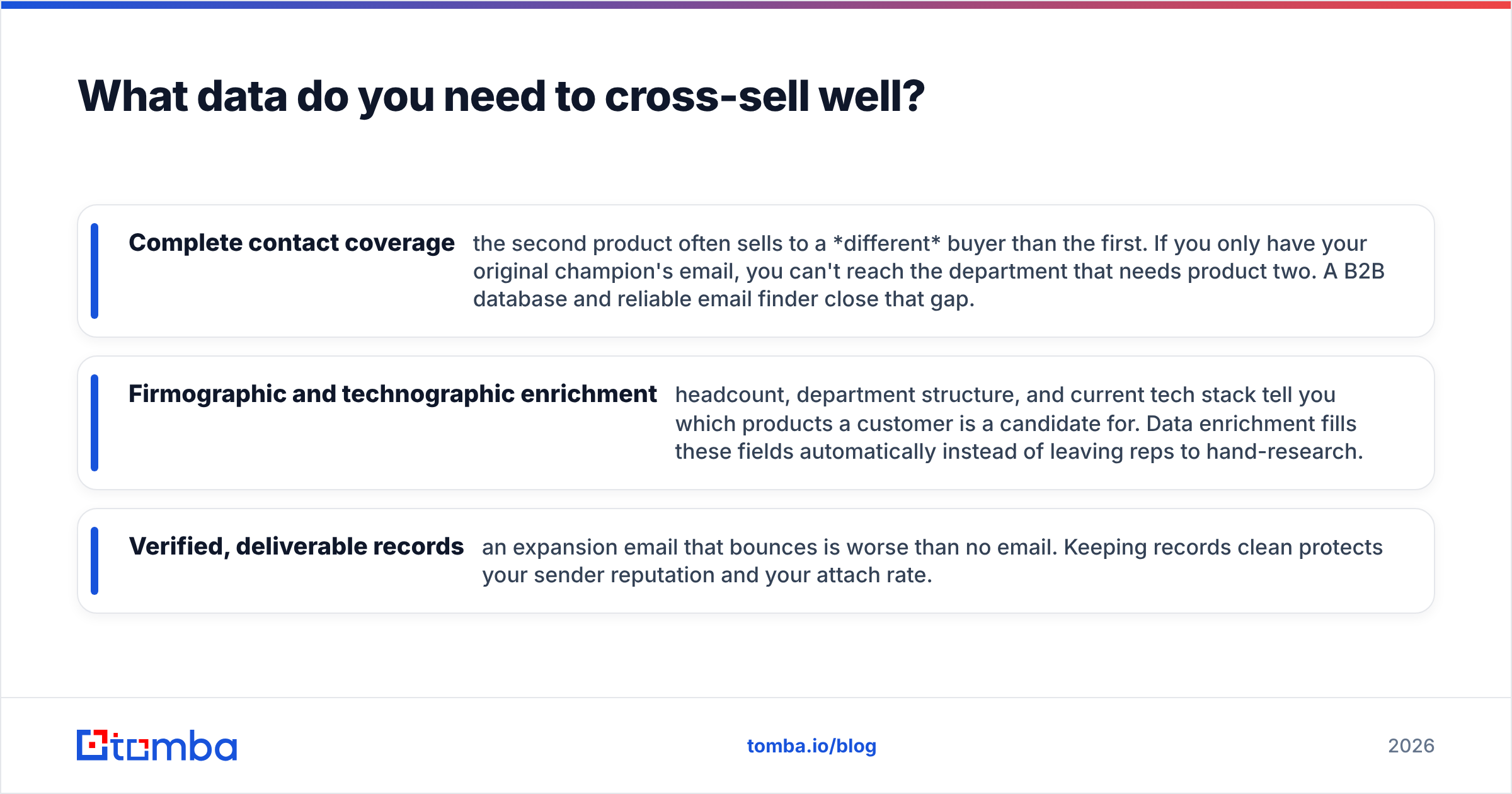
A workable cross-sell data layer needs three things:
- Complete contact coverage — the second product often sells to a different buyer than the first. If you only have your original champion's email, you can't reach the department that needs product two. A B2B database and reliable email finder close that gap.
- Firmographic and technographic enrichment — headcount, department structure, and current tech stack tell you which products a customer is a candidate for. Data enrichment fills these fields automatically instead of leaving reps to hand-research.
- Verified, deliverable records — an expansion email that bounces is worse than no email. Keeping records clean protects your sender reputation and your attach rate.
Feed that into your CRM and cross-sell targeting stops being a hunch. You can build a list of accounts that match your best multi-product customers and route them to the right owner.

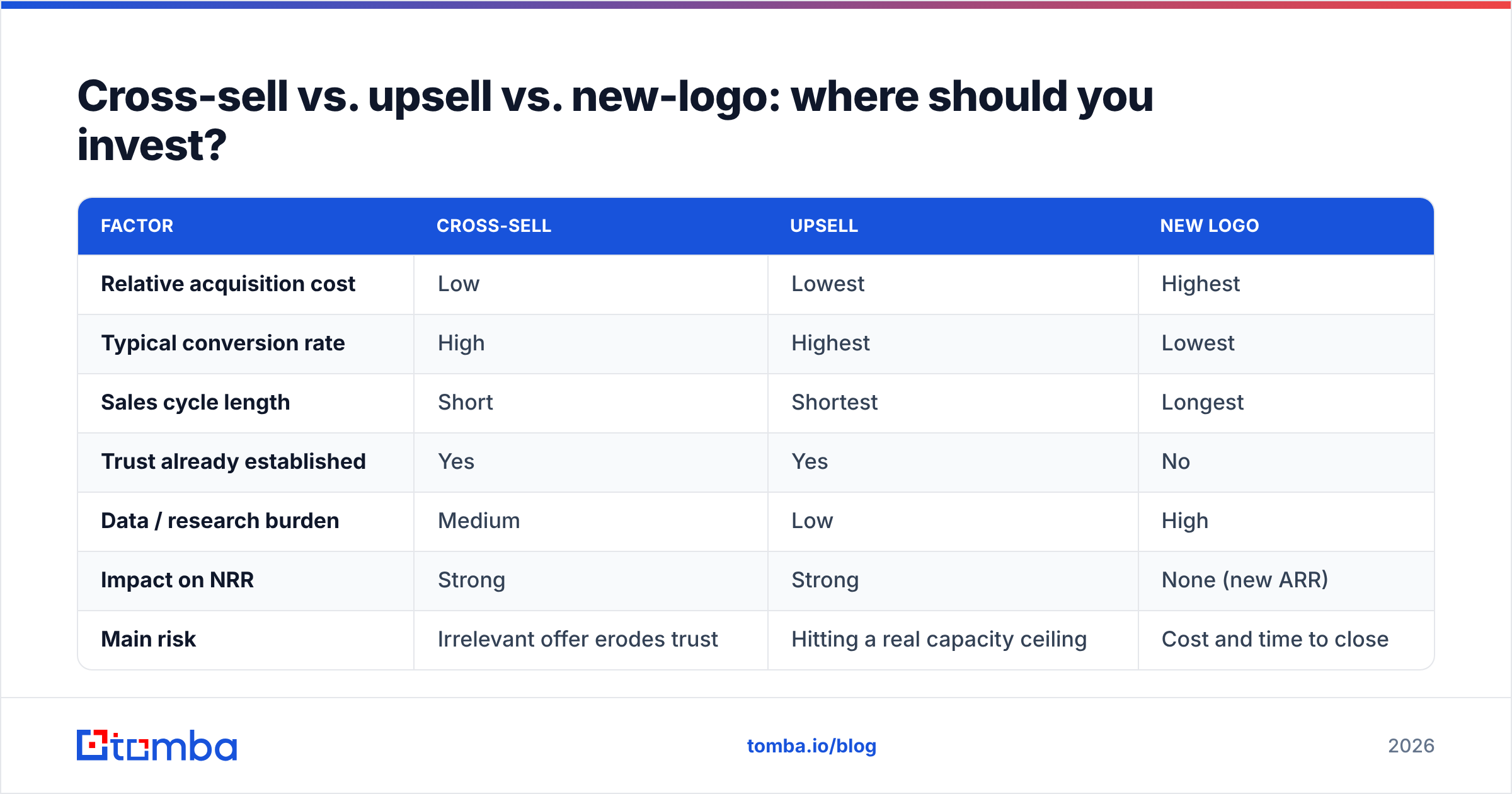
Cross-sell vs. upsell vs. new-logo: where should you invest?#
All three grow revenue, but they don't cost the same or convert the same. Here's the honest comparison.
| Factor | Cross-sell | Upsell | New logo |
|---|---|---|---|
| Relative acquisition cost | Low | Lowest | Highest |
| Typical conversion rate | High | Highest | Lowest |
| Sales cycle length | Short | Shortest | Longest |
| Trust already established | Yes | Yes | No |
| Data / research burden | Medium | Low | High |
| Impact on NRR | Strong | Strong | None (new ARR) |
| Main risk | Irrelevant offer erodes trust | Hitting a real capacity ceiling | Cost and time to close |
The takeaway isn't "stop chasing new logos." You need fresh accounts to have anything to expand later. The takeaway is that most teams over-invest in the highest-cost, lowest-conversion column and under-invest in the two cheap ones. A balanced motion runs all three — but funds cross-sell and upsell first because the ROI is faster.
How do you build a repeatable cross-sell motion?#
Turn it into a process with an owner and a number, or it stays a nice idea nobody executes.
Step 1 — Map the product graph. For each primary product, list the two or three complementary products and the specific need each one solves. If you can't articulate the need in one sentence, it's not a real cross-sell.
Step 2 — Define the triggers. For each pairing, pick the behavioral or lifecycle signal that should fire the play (see the timing table above). Wire those triggers into your CRM or automation so reps get alerted, not left to remember.
Step 3 — Assign an owner. Decide who runs expansion: the AE, a dedicated account manager, or customer success. Ambiguity here is why cross-sells fall through the cracks. One name per account.
Step 4 — Arm the owner with data. Enriched records, verified contacts for the second buyer, and a one-line business case. Tools like the HubSpot integration or the Salesforce integration push that data straight into the workflow reps already live in.
Step 5 — Measure attach rate, not just revenue. Track the percentage of eligible accounts that adopt the second product. Total expansion revenue can hide a low attach rate propped up by a few big deals. Attach rate tells you if the motion works.
Step 6 — Review and prune. Kill pairings that don't convert. A cross-sell that nobody attaches is a signal the need isn't real or the timing is wrong — fix one, then re-test.
What cross-selling mistakes should you avoid?#
Most failed programs die from the same handful of errors:
- Pitching before value lands. If the customer hasn't succeeded with product one, product two feels like a shakedown.
- Selling to the wrong buyer. Product two often has a different owner. Emailing your original champion about a tool for another department goes nowhere.
- Irrelevant, calendar-driven pushes. Blasting every account the same offer in the same week ignores where each account actually is.
- Dirty data. Bounced expansion emails hurt deliverability and make your team look sloppy. Verify before you send.
- No owner, no metric. If nobody owns expansion and nobody watches attach rate, cross-selling stays accidental — and accidental revenue doesn't compound.
Avoid these five and you're already ahead of most teams, because most teams commit at least three of them by default.
A quick example: cross-selling in an outbound data stack#
Say a customer buys your primary email-finding product to build outbound lists. Three natural cross-sells follow: a verifier to keep those lists clean, an enrichment product to prioritize the best accounts, and a phone-finder for multi-channel outreach.
The trigger for the verifier is obvious — the moment their bounce rate ticks up, the need is visible in their own data. That's a usage-trigger cross-sell you can automate. The enrichment cross-sell fires when they start segmenting; the phone product fires when they add a caller to the team. Each one maps to a real, dated moment. None of them is a random quarterly email.
That's the whole discipline in miniature: right product, right buyer, right moment, clean data.
Where does Tomba fit?#
If your cross-sell motion is starving for accurate contact data, that's the piece to fix first. You can't expand into a second department you can't reach, and you can't enrich records you can't verify.
Tomba's Email Finder helps you find the second buyer inside an account — the department head who needs product two but was never in your original deal — with verified, deliverable addresses. Pair it with data enrichment to flag which of your customers look like your best multi-product accounts, and you turn cross-selling from a hunch into a targeted, repeatable motion. Plans start free (25 searches/mo) and scale from $49/mo — see full Tomba pricing to match the tier to your account base.
Start with the accounts you already won. They're the cheapest revenue you'll ever grow.
Related guides#
Ready to find emails that actually work?
Join 150,000+ professionals who stopped guessing and started sending. Free credits on signup — no credit card required.
Get the Tomba newsletter
Practical outbound tactics and product updates — once every two weeks.
About the author