Cross Selling Techniques: A 2026 Playbook That Actually Works
Cross-selling should feel like help, not a pitch. Here are eight cross-selling techniques that grow account value without burning the trust you worked to earn.
Cross-selling is the fastest revenue you already own. The customer trusts you. The contract is signed. The hard part — earning attention — is done. Yet most teams pitch the wrong thing at the wrong moment. The best cross selling techniques fix that: they solve the customer's next problem at the right time. This playbook shows you how.
TL;DR#
- Cross selling techniques work when they solve the customer's next problem — not when they pad your invoice. Relevance beats persistence every time.
- Timing is the whole game. The best moments are right after a win (activation, a milestone, a renewal), not mid-crisis.
- Segment before you offer. A blanket "you might also like" email converts far worse than a trigger-based, account-specific nudge.
- Data quality decides your ceiling. You cannot cross-sell a contact you can't reach — clean, enriched records are the unglamorous foundation.
- Track attach rate and expansion revenue, not just gross bookings, so you know which techniques actually move the number.
What is cross-selling, and how is it different from upselling?#
Cross-selling is offering a customer a complementary product that solves an adjacent problem. Upselling is moving them to a bigger version of what they already bought. The classic analogy: upselling is the large fries; cross-selling is the drink and the dessert.
The distinction matters because the two motions use different triggers. Upselling keys off usage limits and growth ("you're hitting your seat cap"). Cross-selling keys off behavior in a neighboring category ("you just started sending outbound, here's the deliverability tool that protects it"). Confusing the two is why so many expansion plays feel random to the buyer.
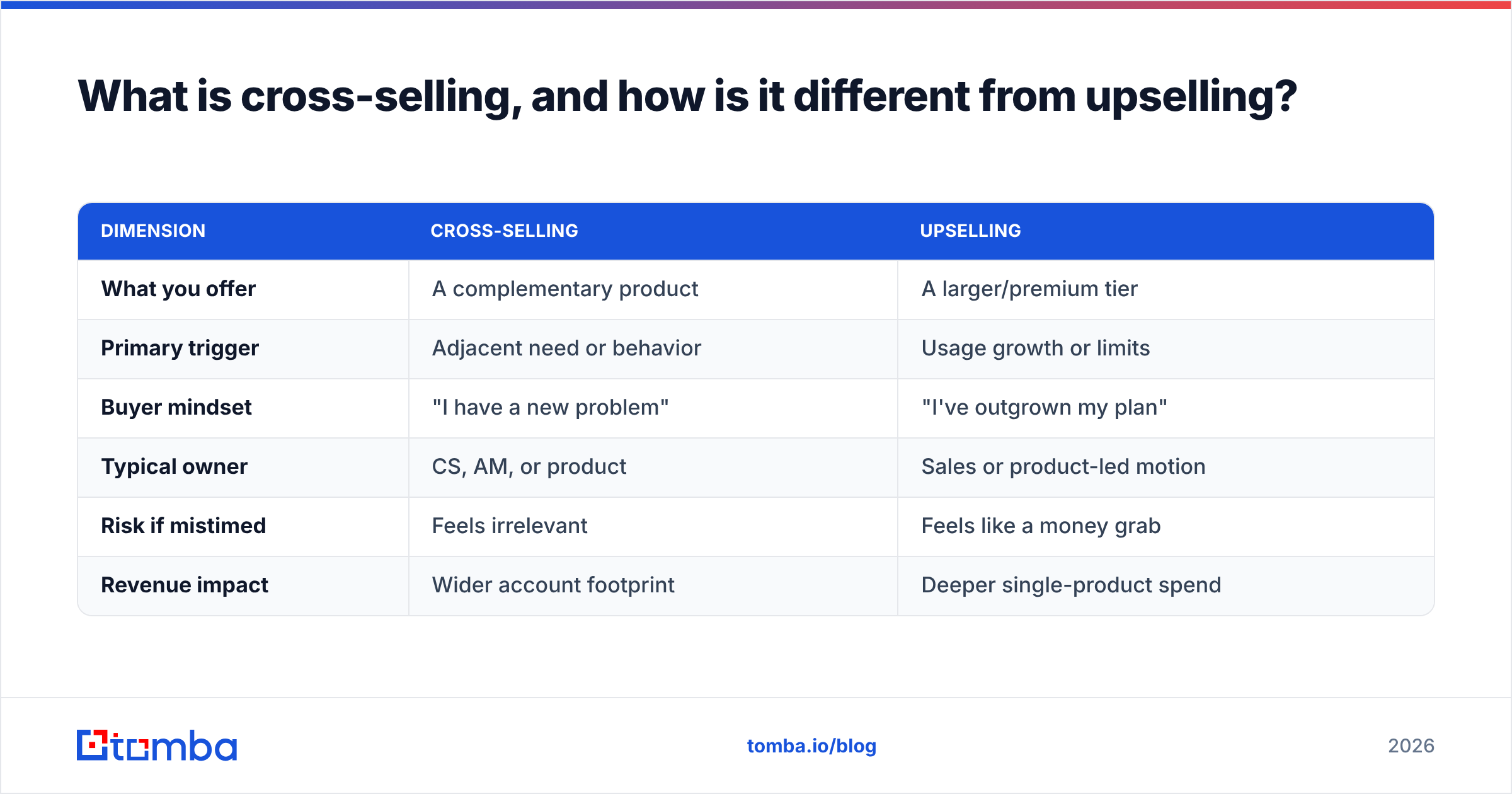
Here's how the two compare in practice:
| Dimension | Cross-selling | Upselling |
|---|---|---|
| What you offer | A complementary product | A larger/premium tier |
| Primary trigger | Adjacent need or behavior | Usage growth or limits |
| Buyer mindset | "I have a new problem" | "I've outgrown my plan" |
| Typical owner | CS, AM, or product | Sales or product-led motion |
| Risk if mistimed | Feels irrelevant | Feels like a money grab |
| Revenue impact | Wider account footprint | Deeper single-product spend |
Both are forms of account expansion, and both belong in a healthy sales process and pipeline. But you'll pick better techniques once you're clear on which motion a given moment calls for.

Why do most cross-selling attempts fail?#
Most cross-sell attempts fail for one of three reasons, and none of them are "the customer didn't need it."
1. Wrong timing. Pitching an add-on while a customer is fighting a support fire reads as tone-deaf. The offer isn't wrong; the moment is.
2. Wrong relevance. Amazon-style "customers also bought" works at consumer scale with millions of data points. B2B teams copy the pattern with a spreadsheet of 200 accounts and wonder why the emails flop.
3. Wrong data. You can build the perfect play and still lose if the champion changed jobs, the email bounces, or the record is a catch-all you never verified. Reachability is the silent killer of expansion campaigns.
According to HubSpot's sales research, existing customers are dramatically more likely to buy again than a cold prospect is to buy the first time — so when a cross-sell fails, the problem is almost always execution, not appetite. Fix timing, relevance, and data, and the same list starts converting.
What are the best cross selling techniques for 2026?#
Below are eight techniques that hold up whether you're a founder-led startup or a full revenue org. Use them as a menu, not a checklist — pick the two or three that match your product and motion.
1. The post-win trigger. The single highest-converting moment is right after the customer succeeds with your core product: first activation, first closed deal sourced through you, a usage milestone, a glowing support ticket. Success creates goodwill and proves the category works. That's when an adjacent offer lands as "here's how to do even more," not "here's another bill."
2. Behavioral segmentation. Group accounts by what they do, not who they are. A customer who just imported 5,000 contacts has a data-hygiene problem you can solve; a customer running daily outbound has a deliverability problem. Match the offer to the observed behavior and your reply rate jumps. Clean data enrichment on your account list is what makes this segmentation possible in the first place.
3. The bundle at the point of need. Don't wait for a quarterly review. Surface the complementary product inside the workflow where the need appears — an in-app prompt when someone hits a wall, a one-line mention in the onboarding email that covers exactly that step. Context beats calendar.
4. The consultative check-in. Train CSMs and AMs to ask diagnostic questions in every review: "What's the next thing you're trying to fix?" The answer is a cross-sell map drawn by the customer. This is slower than automation but converts far higher on large accounts.
5. Social proof from look-alikes. "Teams your size that started with X usually add Y within 90 days" is persuasive because it's specific and non-pushy. Pull the pattern from your own base, not a generic case study.
6. The renewal-adjacent offer. Renewal conversations already have budget attention on them. Attaching a complementary product to a renewal — framed as locking in a better per-unit rate — turns a defensive motion into an expansion one. Just never hold the renewal hostage to the add-on.
7. Free-trial the complement. Let the customer experience the second product before they pay. A 14-day trial of the adjacent tool, seeded with their real data, removes the "will this actually help me" objection that kills cold cross-sells.
8. The reactivation nudge. Dormant customers who once loved you are prime cross-sell targets — a new complementary product is a legitimate reason to re-open the conversation without a stale "just checking in."

How do you time a cross-sell so it doesn't annoy the customer?#
Time it to the customer's momentum, not your quarter. The rule of thumb: offer the next product only after the current one has visibly paid off.
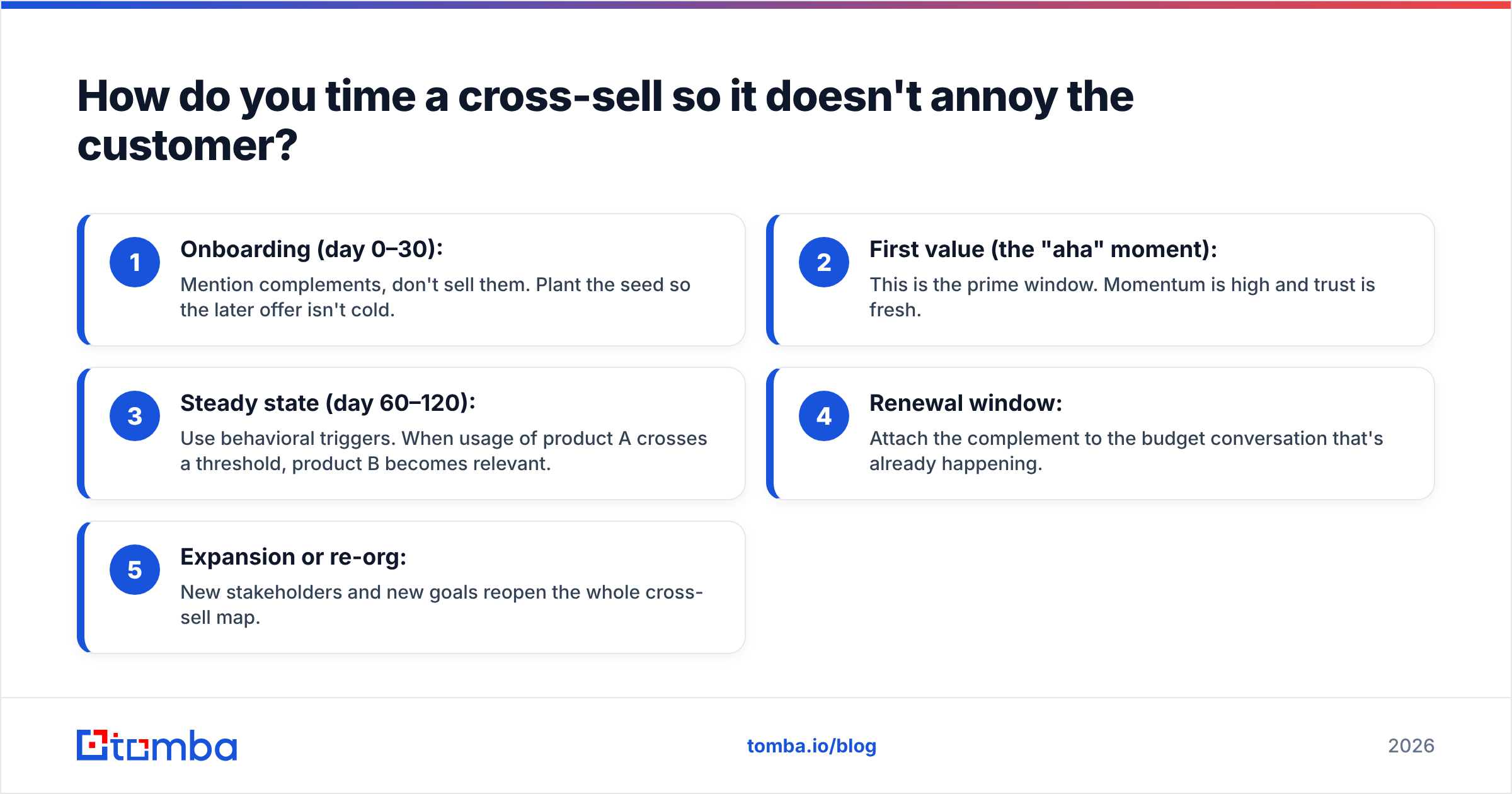
Map your triggers to the customer lifecycle:
- Onboarding (day 0–30): Mention complements, don't sell them. Plant the seed so the later offer isn't cold.
- First value (the "aha" moment): This is the prime window. Momentum is high and trust is fresh.
- Steady state (day 60–120): Use behavioral triggers. When usage of product A crosses a threshold, product B becomes relevant.
- Renewal window: Attach the complement to the budget conversation that's already happening.
- Expansion or re-org: New stakeholders and new goals reopen the whole cross-sell map.
The anti-pattern is the calendar-driven blast — "it's Q3, email everyone about the add-on." It ignores where each account actually is. A CRM-driven trigger system, even a simple one, will outperform any date-based campaign.
What data do you actually need to cross-sell well?#
You need three layers of data, and each one gates the next.
- Account context: What did they buy, how are they using it, what's their health score? This tells you what to offer.
- Contact accuracy: Who is the champion, and can you actually reach them? Roles change constantly; a cross-sell to a person who left three months ago is dead on arrival. This is where a reliable email verifier earns its keep — bouncing your expansion emails also damages your sender reputation for the accounts you can reach.
- Buying-committee coverage: Cross-sells to a bigger product often need a second signer. Knowing the full committee — and having verified email addresses and B2B phone numbers for each — is the difference between a stalled deal and a fast yes.
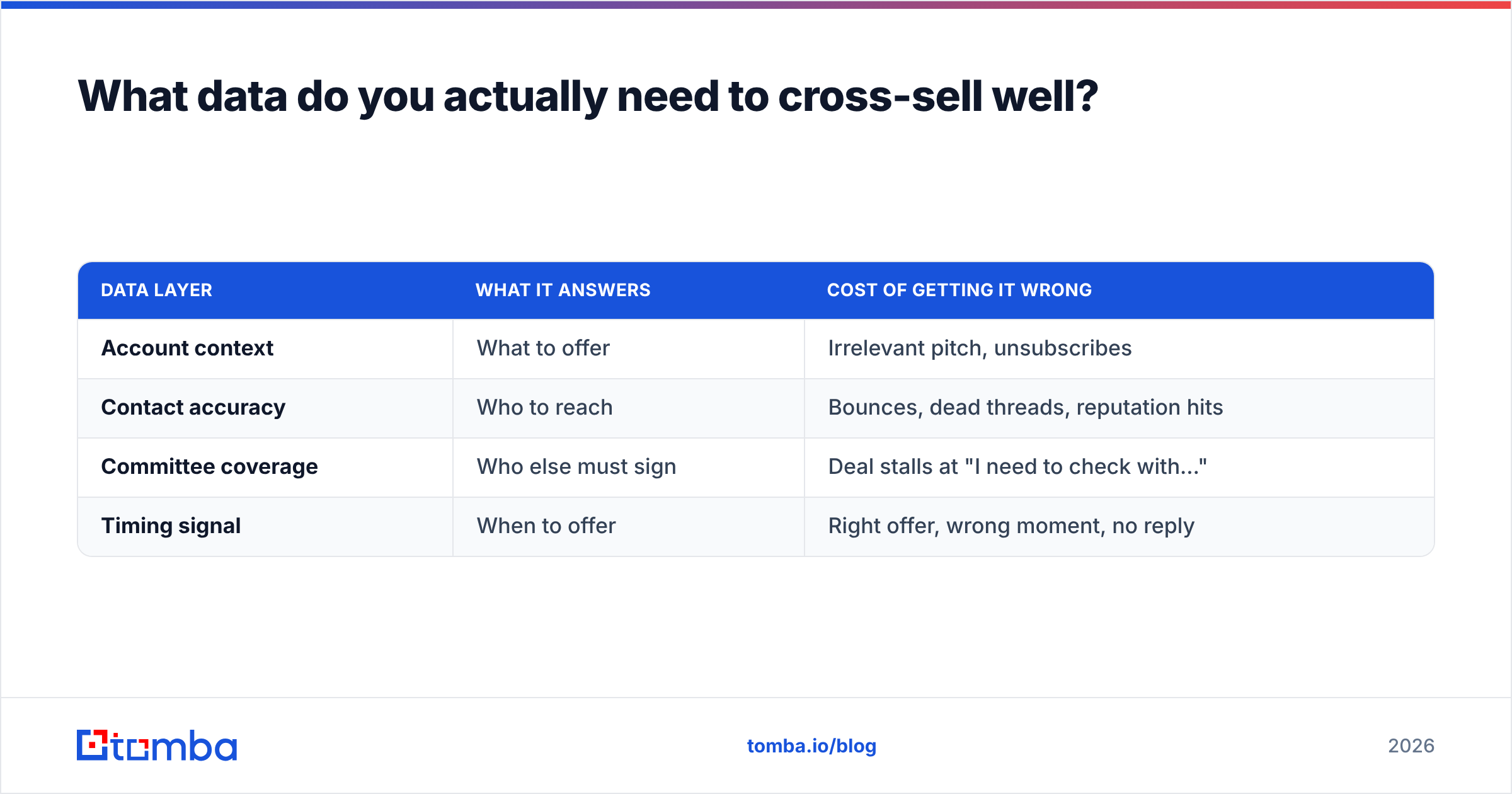
Here's how the data layers stack against the outcome they unlock:
| Data layer | What it answers | Cost of getting it wrong |
|---|---|---|
| Account context | What to offer | Irrelevant pitch, unsubscribes |
| Contact accuracy | Who to reach | Bounces, dead threads, reputation hits |
| Committee coverage | Who else must sign | Deal stalls at "I need to check with…" |
| Timing signal | When to offer | Right offer, wrong moment, no reply |
Teams that treat cross-selling as a pure "sales creativity" problem tend to skip the data layer and cap their own results. Teams that treat it as a data-plus-timing problem compound their expansion revenue quarter over quarter.
How do you measure whether your cross selling techniques are working?#
Track expansion, not just bookings. The metrics that actually reflect cross-sell health:
- Attach rate — the percentage of core-product customers who add at least one complementary product. This is your headline number.
- Expansion revenue / NRR — net revenue retention above 100% means your base grows even without new logos. Cross-selling is a primary driver.
- Time-to-attach — how many days from initial purchase to first cross-sell. Shorter usually means your triggers are well-placed.
- Cross-sell win rate — of the customers you offered a complement, how many bought? A low rate points to relevance or timing problems, not effort.
- Churn delta — multi-product customers almost always churn less. Measure it, because it justifies the whole motion to finance.
Watch the response rate on your cross-sell outreach specifically, separate from new-business outreach. They behave differently, and blending them hides the signal. Industry analysts like Gartner consistently find that expansion motions have better unit economics than net-new acquisition — which is exactly why measuring them properly pays off.
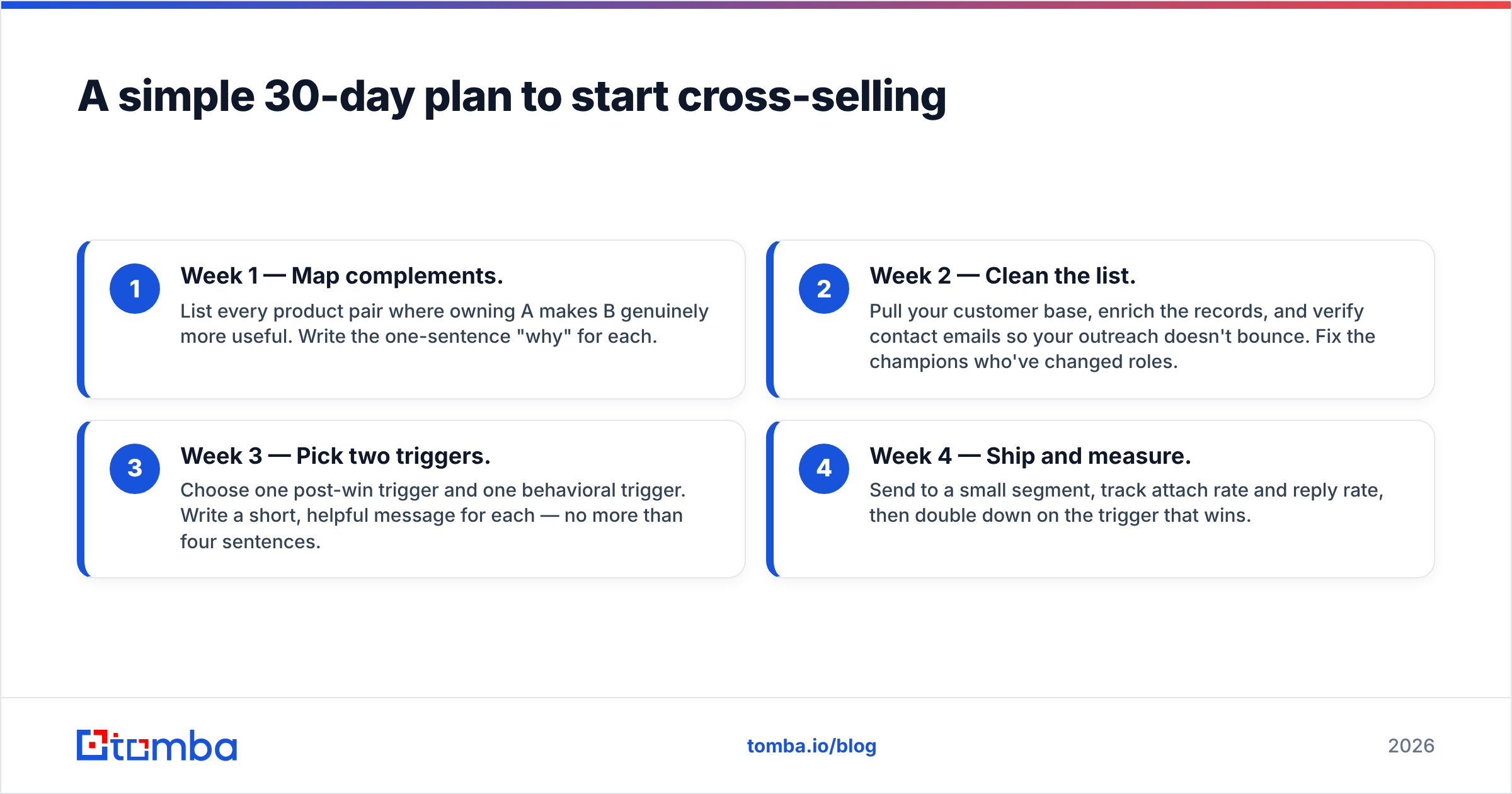
A simple 30-day plan to start cross-selling#
You don't need a platform overhaul. Run this in a month:
- Week 1 — Map complements. List every product pair where owning A makes B genuinely more useful. Write the one-sentence "why" for each.
- Week 2 — Clean the list. Pull your customer base, enrich the records, and verify contact emails so your outreach doesn't bounce. Fix the champions who've changed roles.
- Week 3 — Pick two triggers. Choose one post-win trigger and one behavioral trigger. Write a short, helpful message for each — no more than four sentences.
- Week 4 — Ship and measure. Send to a small segment, track attach rate and reply rate, then double down on the trigger that wins.
The teams that win at cross-selling aren't more aggressive. They're more relevant, better timed, and working from cleaner data.
Put your cross-selling on a reachable foundation#
Every technique here dies if your emails bounce or your champion moved on. Before you build the play, build the list: Tomba's Email Finder locates and verifies the right contact — and the full buying committee — across your existing accounts, so your best-timed cross-sell actually reaches a human. Start on the free tier (25 searches a month) and scale into a paid plan when the attach rate proves it out; see Tomba pricing for details. Relevance you supply. Reachability we'll handle.
Related guides#
Ready to find emails that actually work?
Join 150,000+ professionals who stopped guessing and started sending. Free credits on signup — no credit card required.
Get the Tomba newsletter
Practical outbound tactics and product updates — once every two weeks.
About the author