9 Best Crunchbase Alternatives in 2026 for B2B Data & Leads
Crunchbase is great for company research, but weak on verified contact data and pricey at scale. Here are 9 Crunchbase alternatives that fit real B2B prospecting workflows in 2026.
Crunchbase built its reputation on startup and funding data, but if your team lives in outbound prospecting, it starts to feel like a research library where you actually need a phone book. You can see who raised a Series B last quarter, but turning that signal into a verified email you can send to is a different job entirely.
This guide breaks down the nine best Crunchbase alternatives in 2026, what each one is genuinely good at, and where the honest trade-offs sit. No tool wins every category, so the goal here is to match the tool to the job, not crown a single "best."
TL;DR — Quick Verdict#
- Crunchbase is a company-research tool first, a contact-data tool a distant second. If you need verified emails and phones, you'll usually pair it with something else.
- For funding and firmographic depth, PitchBook and Crunchbase itself are hard to beat — but you pay enterprise prices for it.
- For turning company lists into outreach, contact-data platforms like Apollo, ZoomInfo, and Tomba close the gap Crunchbase leaves open.
- For budget-conscious teams, several alternatives start free or under $50/mo versus Crunchbase Pro's ~$99/user/mo and enterprise tiers.
- The realistic 2026 stack is often "signal source + verified contact layer," not one monolithic tool.
Why Look for a Crunchbase Alternative at All?#
Crunchbase is excellent at what it was built for: tracking companies, funding rounds, acquisitions, and key people. The friction shows up when you try to operationalize that data into a repeatable outbound motion.
Three recurring complaints drive teams to look elsewhere:
- Contact data is thin. Crunchbase surfaces people, but verified, deliverable email addresses and direct-dial phones are not its strength. You often end up guessing formats or exporting to a second tool anyway.
- Pricing scales awkwardly. Crunchbase Pro runs around $99/user/month billed annually, and richer data lives behind Enterprise quotes. For a small SDR team, per-seat costs add up fast.
- Export and API limits. Bulk export and programmatic access are gated to higher tiers, which frustrates anyone trying to build automated enrichment pipelines.
None of this makes Crunchbase bad. It makes it specialized. The question is whether your workflow is "understand a market" (Crunchbase's home turf) or "build and contact a list" (where alternatives shine).
What Should a Good Crunchbase Alternative Actually Do?#
Before comparing logos, get clear on the four capabilities that matter. Weigh them by how you work, not by which vendor markets loudest.
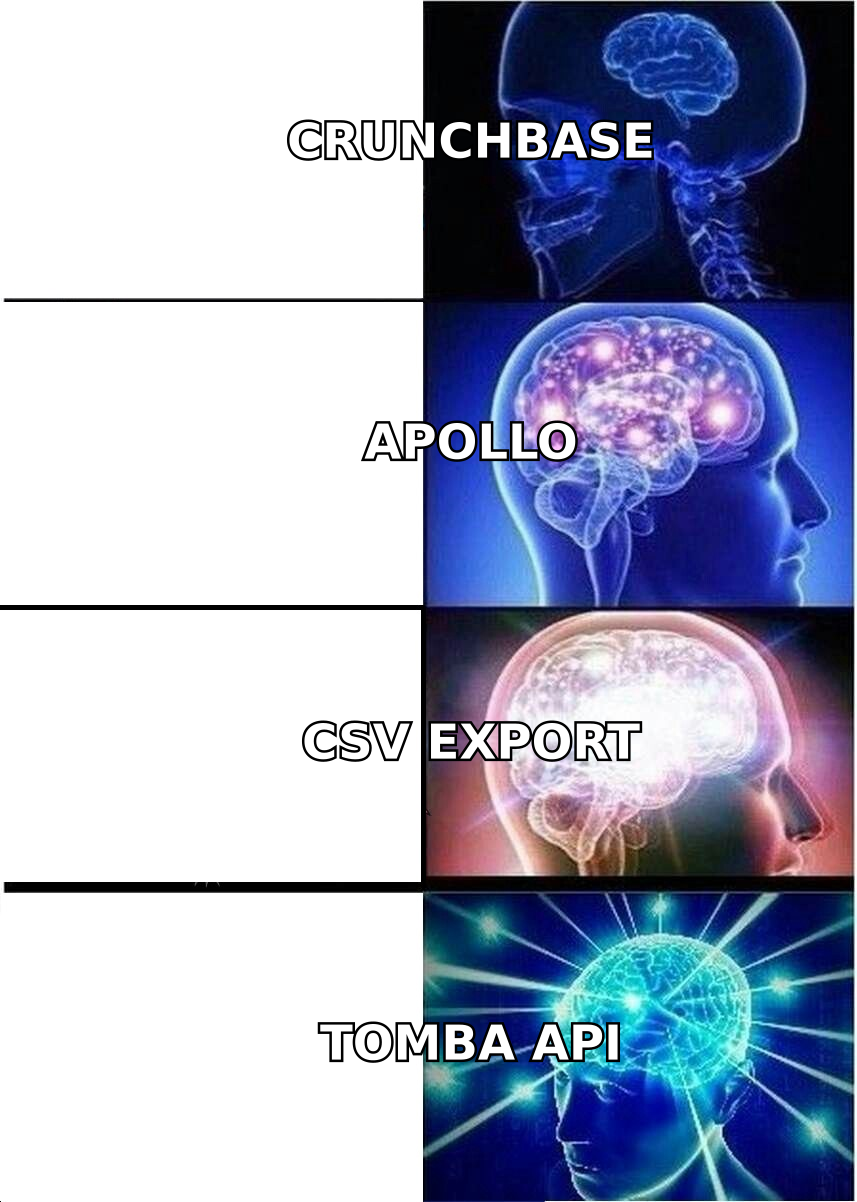
- Firmographic depth — industry, headcount, revenue, tech stack, and location coverage. This is table stakes for segmentation.
- Funding and intent signals — recent rounds, hiring surges, or buying intent that tell you when to reach out, not just who to reach.
- Verified contact data — the difference between a name and a deliverable email or phone. This is where most Crunchbase workarounds live, and where a dedicated email verifier earns its keep.
- Workflow fit — CRM sync, API access, bulk enrichment, and export limits. A perfect dataset trapped behind a rigid UI is only half useful.
A tool that nails signals but hands you unverified contacts will quietly tank your deliverability. A tool with clean contacts but shallow firmographics leaves you targeting blind. The best 2026 stacks cover both, sometimes with two tools working together.
Which Are the Best Crunchbase Alternatives in 2026?#
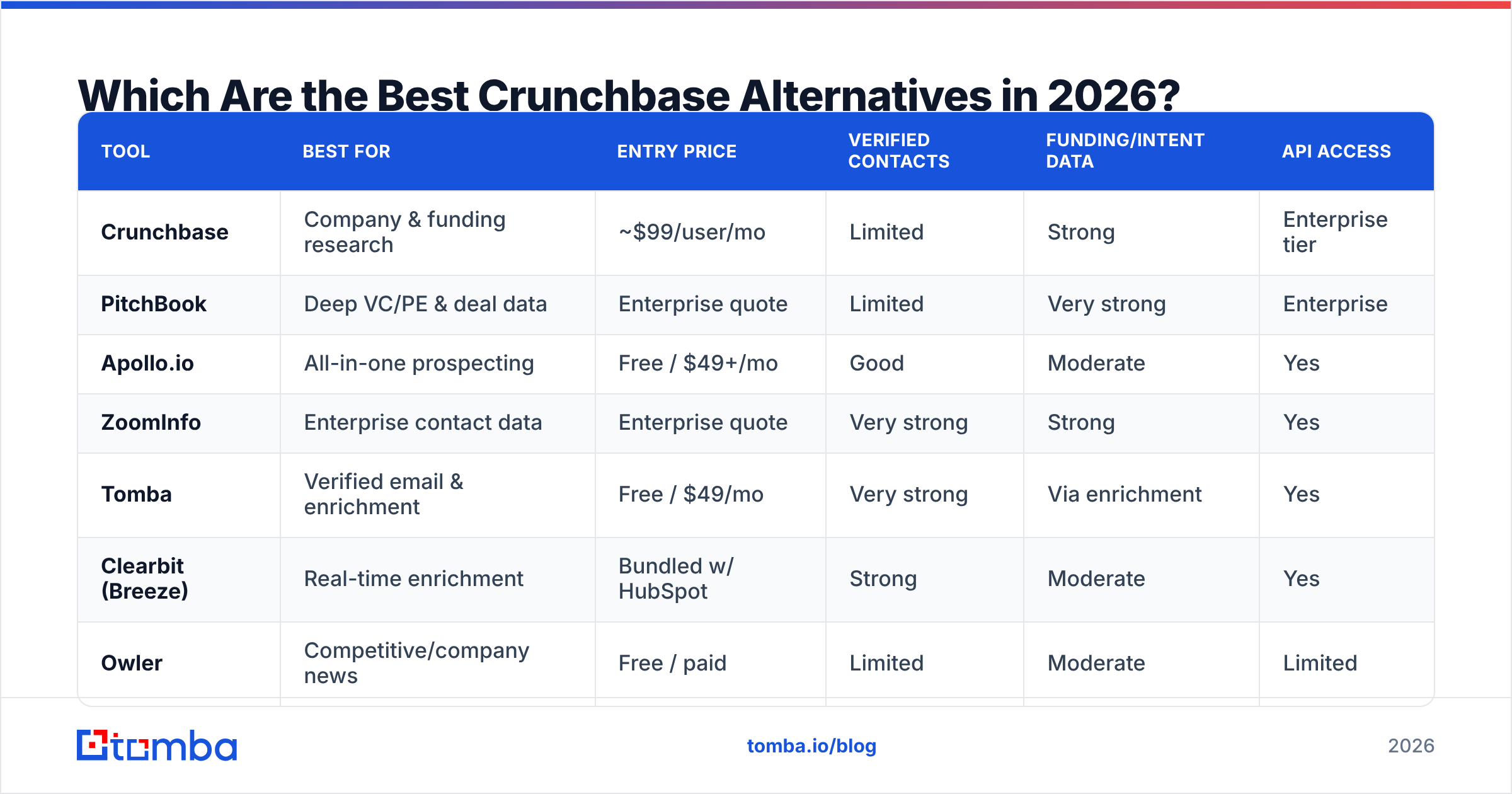
Here's the head-to-head on the attributes that decide real purchases. Prices are entry points and move with seats and credits, so treat them as directional.
| Tool | Best for | Entry price | Verified contacts | Funding/intent data | API access |
|---|---|---|---|---|---|
| Crunchbase | Company & funding research | ~$99/user/mo | Limited | Strong | Enterprise tier |
| PitchBook | Deep VC/PE & deal data | Enterprise quote | Limited | Very strong | Enterprise |
| Apollo.io | All-in-one prospecting | Free / $49+/mo | Good | Moderate | Yes |
| ZoomInfo | Enterprise contact data | Enterprise quote | Very strong | Strong | Yes |
| Tomba | Verified email & enrichment | Free / $49/mo | Very strong | Via enrichment | Yes |
| Clearbit (Breeze) | Real-time enrichment | Bundled w/ HubSpot | Strong | Moderate | Yes |
| Owler | Competitive/company news | Free / paid | Limited | Moderate | Limited |
| Lusha | Quick B2B contacts | Free / $49+/mo | Good | Limited | Yes |
1. PitchBook — When You Need Deal-Grade Depth#
If your reason for using Crunchbase is capital-markets research — tracking valuations, cap tables, LPs, and PE deals — PitchBook is the natural step up. It's the tool investment banks and VCs actually pay for. The catch is obvious: it's enterprise-priced and overkill if you just want to build a prospect list. Choose it for research rigor, not outreach.
2. Apollo.io — The All-in-One Prospecting Play#
Apollo blends a contact database with sequencing and a Chrome extension, which is why it's the most common "I want everything in one place" pick. Firmographics are solid, and it has a usable free tier. The honest trade-off: at scale, credit consumption and data freshness become the thing you monitor, and reply rates depend heavily on verifying before you send. If Apollo's specific mix doesn't fit, teams often weigh an Apollo alternative that separates data quality from the sequencer.
3. ZoomInfo — Enterprise Contact Coverage#

ZoomInfo is the heavyweight for verified B2B contacts, intent signals, and org charts. If budget isn't the constraint and coverage is, it's a serious Crunchbase replacement for the contact side of the equation. The trade-off is well documented: annual contracts, enterprise pricing, and a heavier procurement process. Read recent reviews on G2 before committing — the value depends a lot on your territory and seat count.
4. Tomba — Verified Emails Without the Enterprise Bill#
Where Crunchbase tells you a company exists, Tomba tells you exactly how to reach the people inside it. Its domain search returns the email addresses tied to a company, its finder resolves names to verified addresses, and its data enrichment fills in the firmographic and contact gaps a company-research tool leaves behind.
The practical win is deliverability. Every address can be run through verification, so you're not burning sender reputation on guessed formats. With a free tier (25 searches/mo) and a Starter plan at $49/mo, it slots into a stack without an enterprise contract — see Tomba pricing for the full ladder. Tomba isn't a funding-research tool; pair it with a signal source and it covers the contact layer cleanly.

5. Clearbit (now Breeze Intelligence) — Real-Time Enrichment#
Clearbit, absorbed into HubSpot's Breeze Intelligence, shines at enriching records you already have — form fills, sign-ups, CRM rows — in real time. It's less a discovery database and more a data layer that thickens what you capture. Great if you're deep in HubSpot; less compelling as a standalone research tool. Teams outside that ecosystem sometimes prefer a Clearbit alternative with independent pricing.
6. Owler — Company News and Competitive Signals#
Owler is a lighter, community-driven source for company profiles, news, and competitive tracking. It's a friendly, low-cost way to monitor accounts, though its contact and funding data are shallower than the paid heavyweights. Good as a monitoring companion, not a prospecting engine.
7. Lusha — Fast, Simple Contact Lookups#
Lusha keeps things minimal: a browser extension and database aimed at quickly grabbing a prospect's email and phone. It's easy to adopt and has a free tier. The limitation is depth — you get contacts, not the rich firmographic and funding context Crunchbase offers. Pair it with a signal source if you need the "why now."
8. LinkedIn Sales Navigator — Signal-Rich, Contact-Poor#
Sales Navigator is arguably the richest live source of who-works-where and job-change signals. It intentionally hides direct contact info, which is why it pairs so well with a LinkedIn email finder that resolves those profiles into verified, sendable addresses. Use Navigator to build the list; use a finder to make it actionable.
9. Your Own Database + Enrichment API#
The most scalable "alternative" isn't a single UI at all. Teams building repeatable pipelines increasingly pull from a B2B database and enrich programmatically via API, so lists stay fresh without manual exports. It takes engineering effort, but it removes per-seat friction and export caps entirely — the exact things that push people off Crunchbase in the first place.
How Do the Alternatives Compare on Price?#
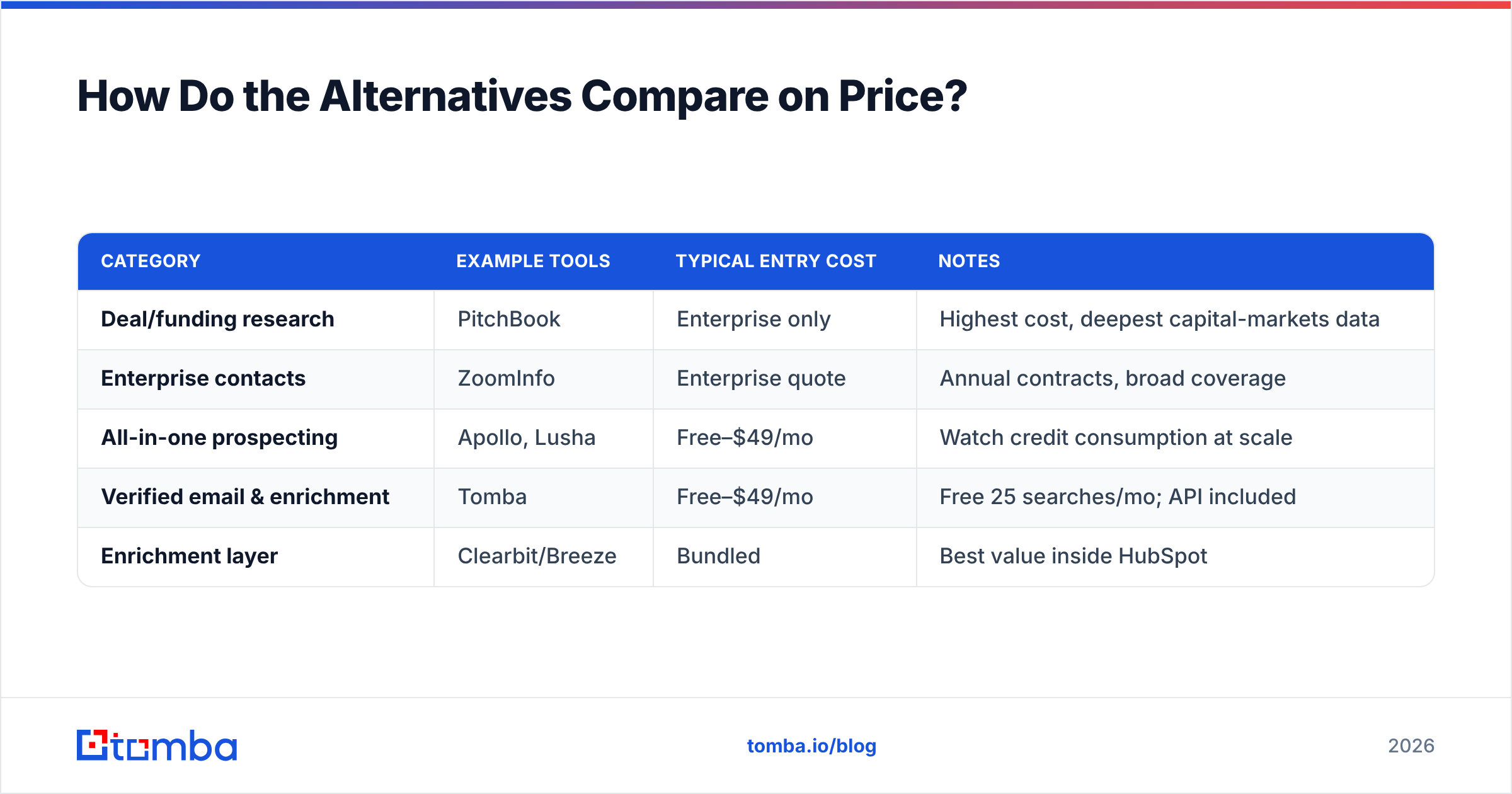
Cost is usually the tiebreaker, so it deserves its own look. Crunchbase Pro sits near $99/user/month annually, with the deepest data behind Enterprise quotes. Here's how the budget picture shifts across categories.
| Category | Example tools | Typical entry cost | Notes |
|---|---|---|---|
| Deal/funding research | PitchBook | Enterprise only | Highest cost, deepest capital-markets data |
| Enterprise contacts | ZoomInfo | Enterprise quote | Annual contracts, broad coverage |
| All-in-one prospecting | Apollo, Lusha | Free–$49/mo | Watch credit consumption at scale |
| Verified email & enrichment | Tomba | Free–$49/mo | Free 25 searches/mo; API included |
| Enrichment layer | Clearbit/Breeze | Bundled | Best value inside HubSpot |
The pattern is clear: if your core need is contacting the companies you find, contact-first tools deliver far more usable outreach per dollar than a research-first subscription. If your core need is understanding markets and deals, you pay a premium and it's often worth it.
What's the Right Crunchbase Alternative for Your Team?#
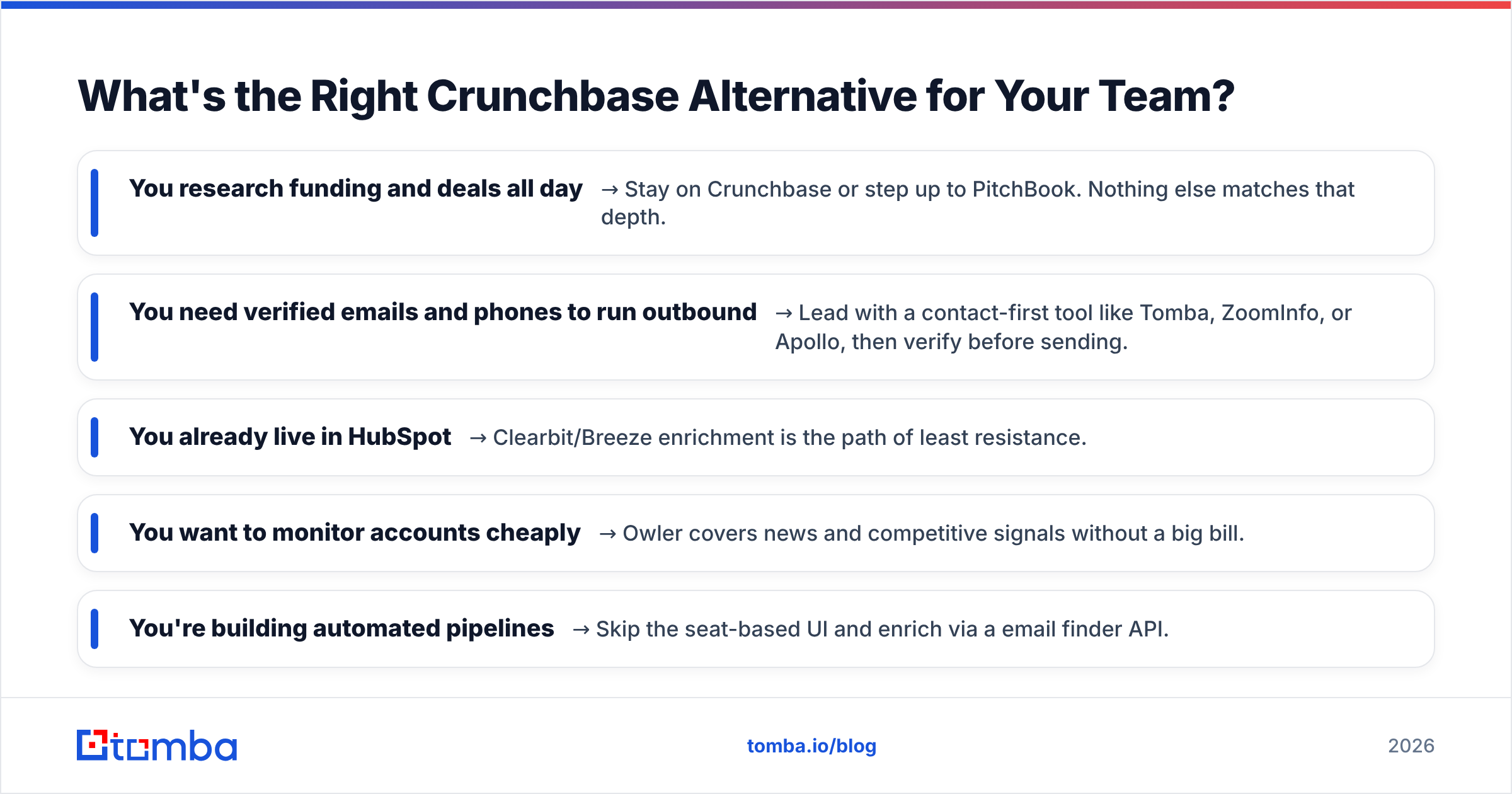
Match the tool to the job with a quick self-check:
- You research funding and deals all day → Stay on Crunchbase or step up to PitchBook. Nothing else matches that depth.
- You need verified emails and phones to run outbound → Lead with a contact-first tool like Tomba, ZoomInfo, or Apollo, then verify before sending.
- You already live in HubSpot → Clearbit/Breeze enrichment is the path of least resistance.
- You want to monitor accounts cheaply → Owler covers news and competitive signals without a big bill.
- You're building automated pipelines → Skip the seat-based UI and enrich via a email finder API.
Most high-performing teams in 2026 run two layers: a signal source that tells them who and when, and a verified-contact layer that makes the outreach land. Crunchbase can absolutely be the first layer. It just rarely wants to be the second.
One more honest note: peers like BookYourData offer ready-built, pay-as-you-go contact lists, which suits teams that prefer buying a vetted list over building one. Different philosophy, valid trade-off — worth a look if speed-to-list beats control for you.
The Bottom Line#
Crunchbase alternatives aren't really "Crunchbase killers" — they're specialists that beat it on the one axis you care about most. Pick by the job in front of you: deal research, enterprise coverage, budget prospecting, or verified outreach.
If the gap you're feeling is contact data — guessed emails, bounced sends, thin phone coverage — that's the exact gap a verified finder fills. Start free with the Tomba Email Finder: 25 searches a month, no card, and every address verifiable before it ever hits your sequence. Turn the companies you already research into people you can actually reach.
Related guides#
Ready to find emails that actually work?
Join 150,000+ professionals who stopped guessing and started sending. Free credits on signup — no credit card required.
Get the Tomba newsletter
Practical outbound tactics and product updates — once every two weeks.
About the author