Crustdata vs DiscoverOrg: B2B Data Platforms Compared (2026)
Crustdata's real-time API vs DiscoverOrg's legacy org charts (now ZoomInfo). See how the two B2B data engines stack up on coverage, freshness, pricing, and fit — and where a lighter tool wins.
Choosing between Crustdata and DiscoverOrg comes down to one question: do you want a modern, developer-first data API, or an enterprise org-chart database that now lives inside ZoomInfo? They solve overlapping problems from opposite ends of the market, and picking the wrong one wastes budget fast.
This guide breaks down coverage, data freshness, pricing, integrations, and real-world fit so you can decide which B2B data engine belongs in your go-to-market stack — and where a lighter, cheaper tool covers 80% of the need.
TL;DR — Crustdata vs DiscoverOrg at a glance#
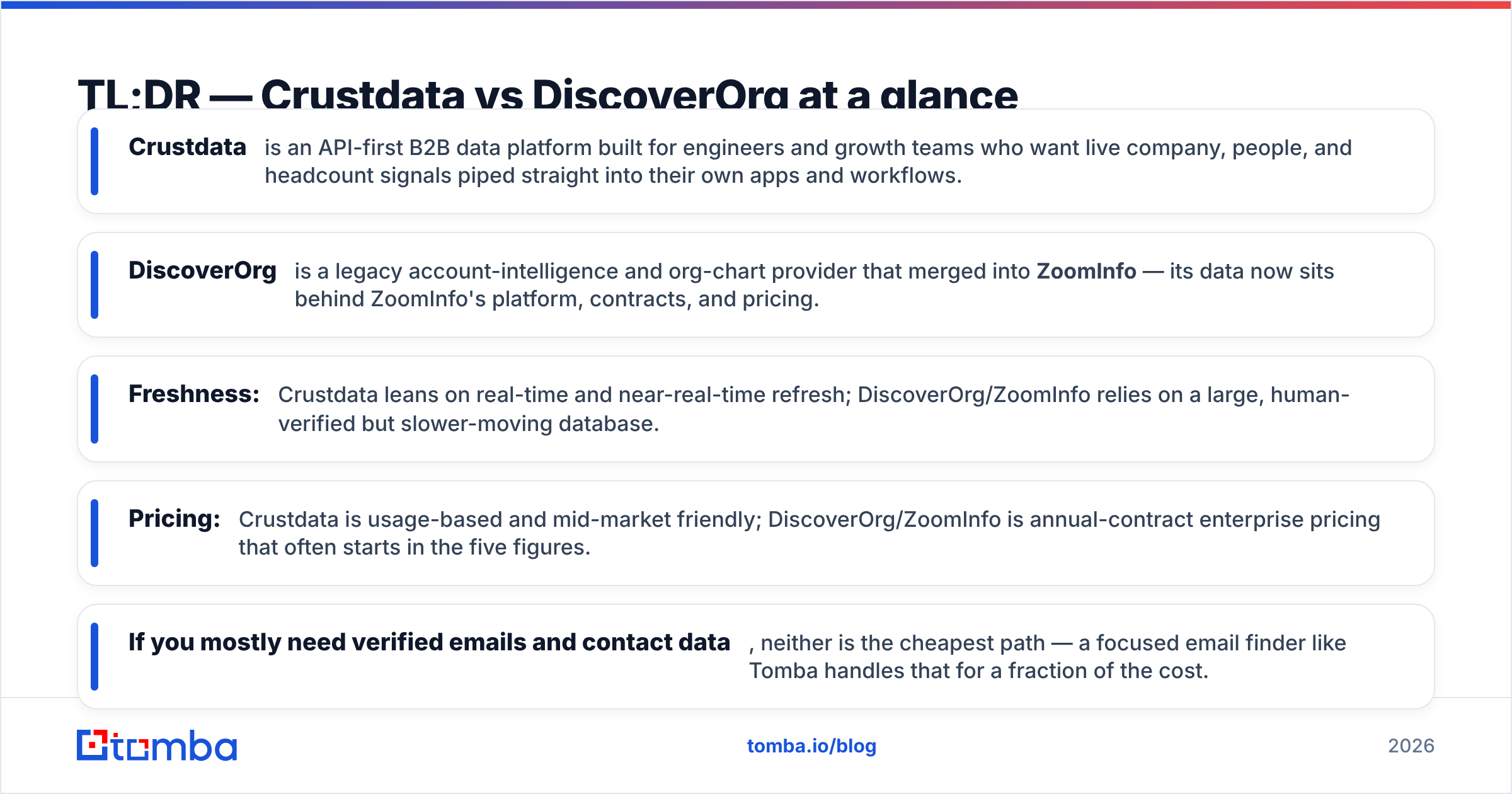
- Crustdata is an API-first B2B data platform built for engineers and growth teams who want live company, people, and headcount signals piped straight into their own apps and workflows.
- DiscoverOrg is a legacy account-intelligence and org-chart provider that merged into ZoomInfo — its data now sits behind ZoomInfo's platform, contracts, and pricing.
- Freshness: Crustdata leans on real-time and near-real-time refresh; DiscoverOrg/ZoomInfo relies on a large, human-verified but slower-moving database.
- Pricing: Crustdata is usage-based and mid-market friendly; DiscoverOrg/ZoomInfo is annual-contract enterprise pricing that often starts in the five figures.
- If you mostly need verified emails and contact data, neither is the cheapest path — a focused email finder like Tomba handles that for a fraction of the cost.
What is Crustdata?#
Crustdata is a B2B data provider that delivers company and people intelligence through a clean, developer-friendly API. Instead of shipping a heavy sales UI, it focuses on giving teams programmatic access to firmographic data, headcount trends, tech-stack signals, funding events, and people movement — the kind of signals RevOps and growth engineers wire into scoring models, enrichment jobs, and outbound triggers.
Its core pitch is freshness and flexibility. Crustdata markets real-time and frequently refreshed datasets, so a company's headcount jump or a key hire shows up quickly rather than months later. For teams building their own data enrichment pipelines, that speed is the whole point.
Crustdata fits best when you have engineering resources and want data as infrastructure, not as another dashboard your reps ignore.

What is DiscoverOrg (and where did it go)?#
DiscoverOrg was one of the original account-intelligence platforms, known for deep, human-verified org charts and direct-dial phone data aimed at enterprise sales teams. In 2019 it merged with ZoomInfo, and the DiscoverOrg brand was absorbed. Today, when someone shops for "DiscoverOrg," they're effectively evaluating ZoomInfo's account and contact database.
That heritage still matters. The DiscoverOrg lineage gave ZoomInfo its reputation for detailed org hierarchies — who reports to whom, department structures, and buying committees inside large accounts. If your motion is enterprise ABM where you need to map a 12-person buying committee, that depth is the historical strength.
The trade-offs are the classic enterprise-data ones: annual contracts, seat-based pricing, and a database that, while massive and verified, refreshes on a slower cadence than an API-native competitor.
Crustdata vs DiscoverOrg: side-by-side comparison#
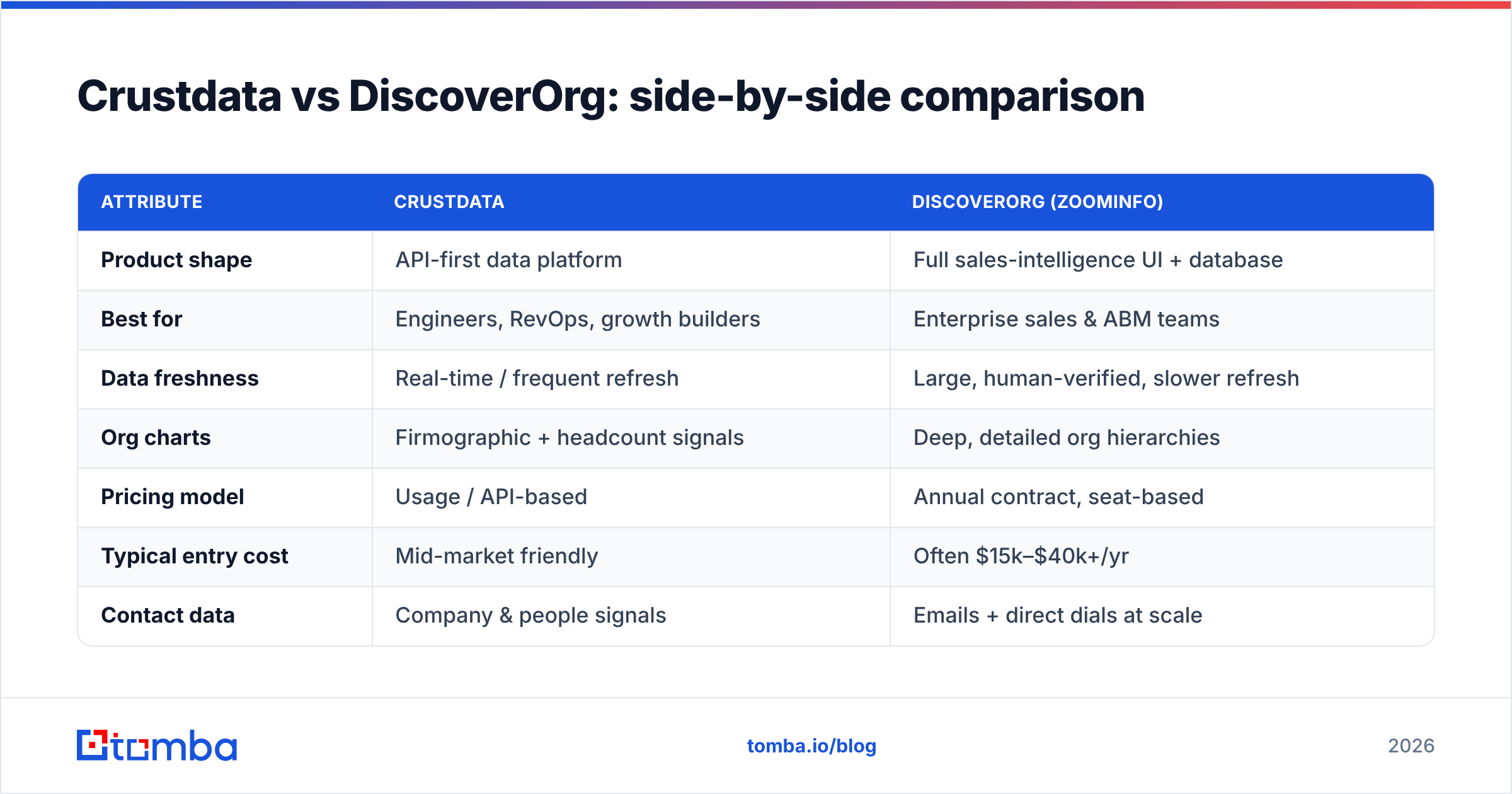
Here's the core-concept breakdown across the attributes that actually change a buying decision.
| Attribute | Crustdata | DiscoverOrg (ZoomInfo) |
|---|---|---|
| Product shape | API-first data platform | Full sales-intelligence UI + database |
| Best for | Engineers, RevOps, growth builders | Enterprise sales & ABM teams |
| Data freshness | Real-time / frequent refresh | Large, human-verified, slower refresh |
| Org charts | Firmographic + headcount signals | Deep, detailed org hierarchies |
| Pricing model | Usage / API-based | Annual contract, seat-based |
| Typical entry cost | Mid-market friendly | Often $15k–$40k+/yr |
| Contact data | Company & people signals | Emails + direct dials at scale |
| Setup effort | Requires dev integration | Turnkey UI, longer procurement |
| Contract flexibility | Flexible, self-serve leaning | Long-term commitment |
The pattern is clear: Crustdata optimizes for developer control and speed, DiscoverOrg/ZoomInfo optimizes for enterprise depth and turnkey coverage. Neither is strictly better — they serve different buyers.
Which has better data quality and freshness?#
Freshness goes to Crustdata; raw verified volume goes to ZoomInfo. This is the most important distinction, so it's worth being precise.
Crustdata's real-time approach means signals like headcount growth, new hires, and job-post spikes surface quickly. That speed is gold for intent-style triggers — you want to reach an account the week it starts hiring SDRs, not the quarter after. The trade-off is that fast-moving data can be noisier and needs sensible validation on your side.
DiscoverOrg's legacy strength — carried into ZoomInfo — is human-verified accuracy at enormous scale, especially org structure and direct dials. The trade-off is cadence: a database that big refreshes more slowly, so titles and moves can lag reality.
Whichever you choose, treat contact records as a starting point, not gospel. Any B2B dataset decays 2–3% per month as people change jobs. Running results through an email verifier before you send is the single cheapest way to protect deliverability — and it's independent of which data vendor you pick. If you want to understand how decay works, G2's data-quality research is a useful neutral reference.
How do Crustdata and DiscoverOrg price their data?#
Pricing is where these two diverge most sharply.
Crustdata uses a usage- and API-based model. You pay roughly in proportion to the volume of data and calls you consume, which suits teams that want to start small, prove ROI, and scale. There's little of the "book a demo to learn the price" friction, and no forced multi-seat minimum.
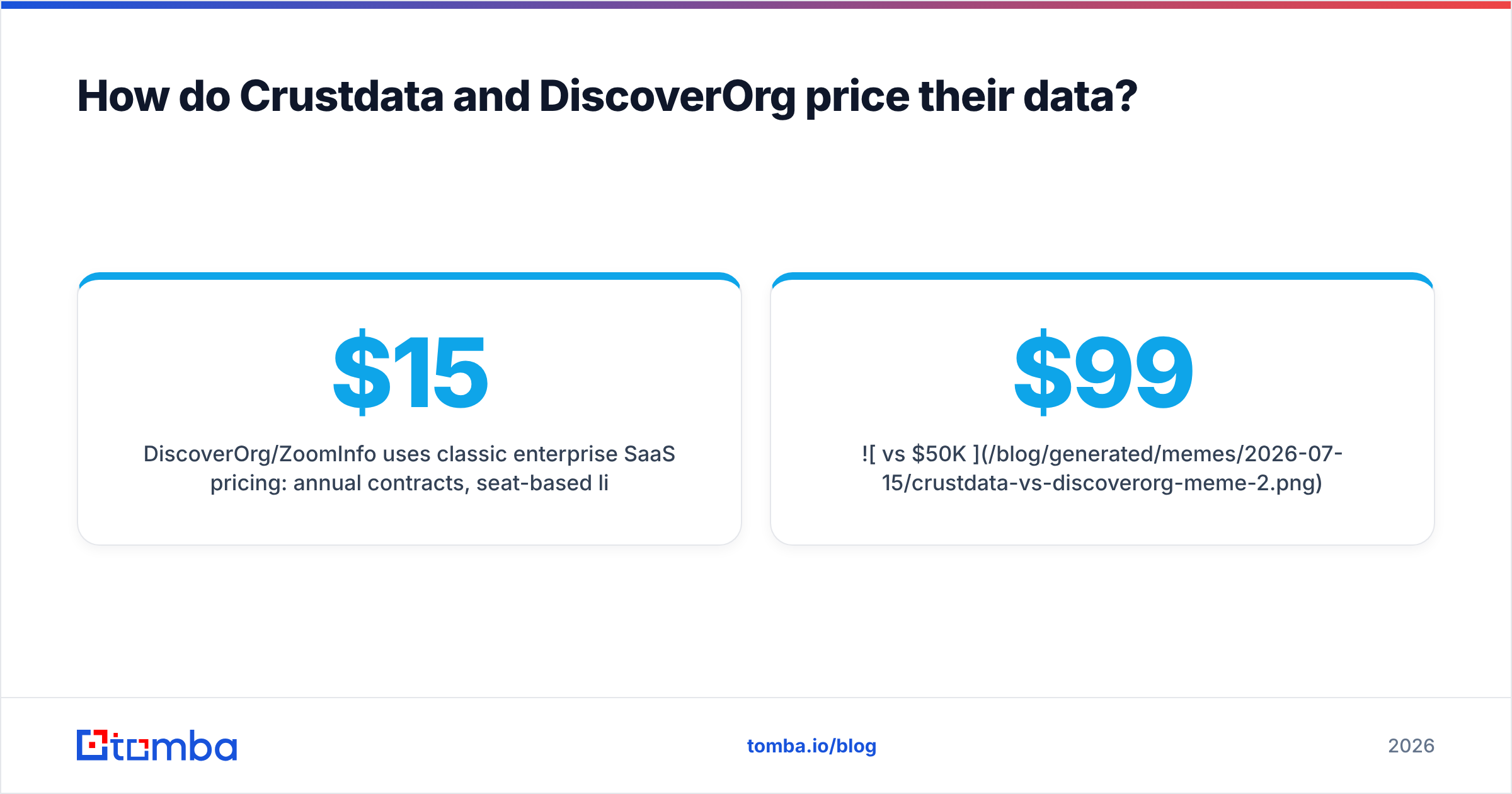
DiscoverOrg/ZoomInfo uses classic enterprise SaaS pricing: annual contracts, seat-based licensing, and add-on modules for intent, scoops, and integrations. Real-world entry points frequently land in the $15,000–$40,000+ per year range once you add seats and data credits, and contracts are typically 12 months minimum. For a large sales org, that can be justified; for a lean team, it's a heavy commitment.
Here's a simplified way to think about total cost of ownership:
- Seat count — ZoomInfo scales with users; Crustdata scales with data volume, not headcount.
- Integration cost — Crustdata needs engineering time; ZoomInfo is more turnkey.
- Data credits — both meter enrichment/export volume, so model your monthly pull.
- Contract lock-in — annual commitment vs flexible usage changes your risk profile.
- Overlap waste — if you already own a CRM enrichment tool, you may be double-paying.

Which integrates better with your stack?#
ZoomInfo wins on out-of-the-box integrations; Crustdata wins on flexibility.
ZoomInfo (carrying the DiscoverOrg data) ships native connectors for Salesforce, HubSpot, Outreach, and most major CRMs and sales-engagement tools, plus browser extensions and workflow automation. If your team lives in Salesforce and wants data enriched inside existing objects with minimal setup, that ecosystem is mature.
Crustdata, being API-first, integrates with anything you can code against — but "anything you can code against" is the operative phrase. You'll get maximum control and can build exactly the enrichment logic you want, at the cost of engineering hours. For a growth team that already runs custom pipelines, that's a feature; for a non-technical sales team, it's a blocker.
If your real need is simpler — find and verify contacts, then push them into your CRM — a purpose-built tool with ready-made integrations for HubSpot, Pipedrive, Zapier, and Google Sheets often removes the whole build-vs-buy dilemma.
When should you pick a lighter alternative?#
Both Crustdata and DiscoverOrg/ZoomInfo are powerful, but they're also overkill for a large share of teams. Ask yourself what you're actually buying data for:
- If you need full account intelligence and org mapping for enterprise ABM → DiscoverOrg/ZoomInfo is the natural fit, budget permitting.
- If you're an engineering-led team building real-time enrichment and scoring → Crustdata's API is the cleaner tool.
- If you mostly need accurate, verified email addresses and direct contacts to run outbound → you don't need a five-figure platform.
That last case is where most small and mid-market teams actually sit. You don't need a 40-module intelligence suite; you need to find the right person's email, confirm it's deliverable, and move on. That's exactly what a focused email-finding stack does.
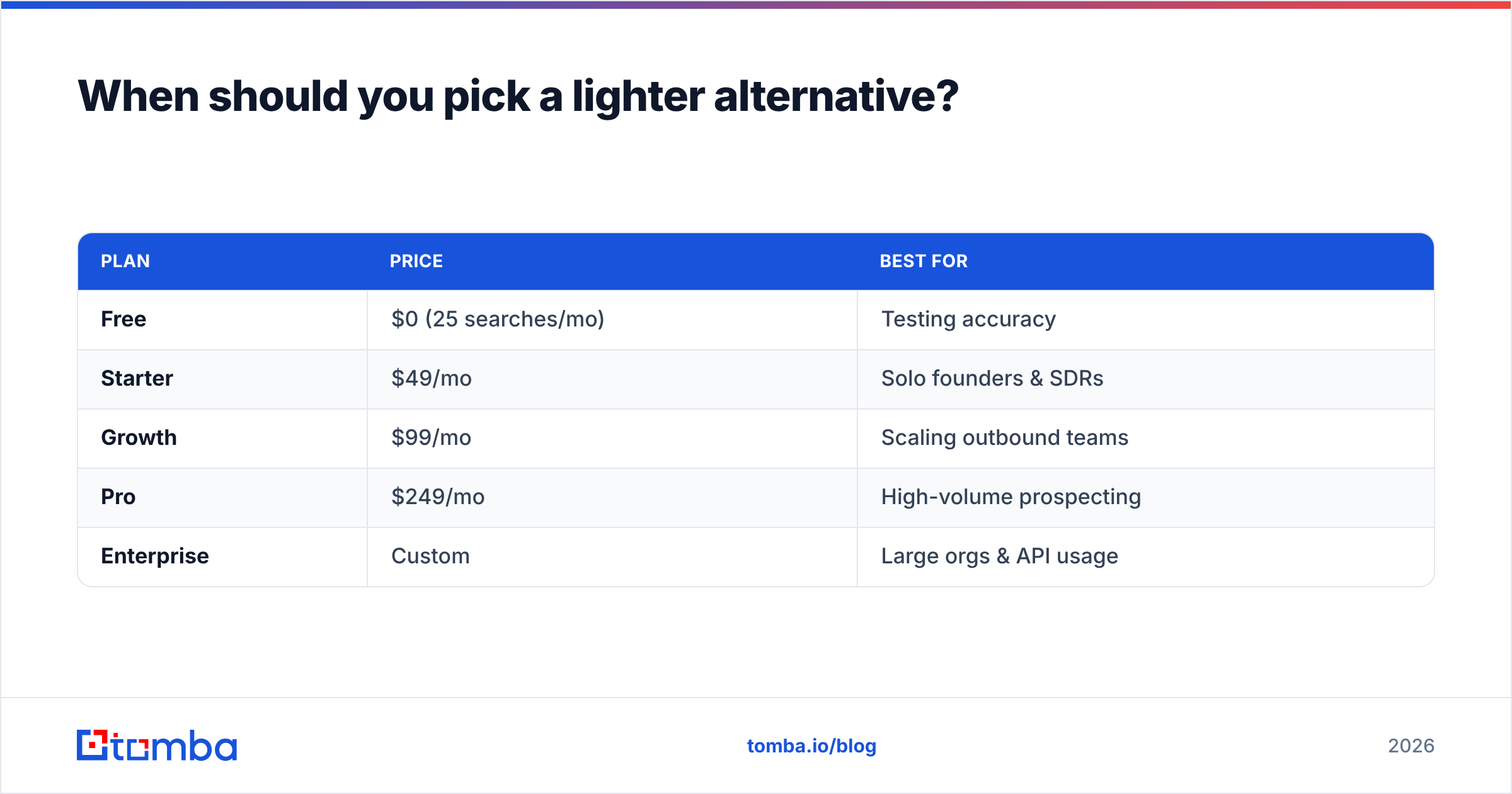
With Tomba, you can run a domain search to pull every known email pattern at a target company, find individual contacts by name, and verify them in bulk — all self-serve, starting free. Compare the Tomba pricing tiers below against a ZoomInfo annual contract and the gap is obvious.
| Plan | Price | Best for |
|---|---|---|
| Free | $0 (25 searches/mo) | Testing accuracy |
| Starter | $49/mo | Solo founders & SDRs |
| Growth | $99/mo | Scaling outbound teams |
| Pro | $249/mo | High-volume prospecting |
| Enterprise | Custom | Large orgs & API usage |
For teams whose spend is currently going to a heavy platform they use at 10% capacity, that's the difference between a rounding error and a real line item. And unlike a locked annual contract, you can start on the free tier and only scale when the pipeline justifies it.
Crustdata vs DiscoverOrg: the verdict#
Pick Crustdata if you're technical and want fresh, flexible, API-delivered B2B signals. Pick DiscoverOrg/ZoomInfo if you're an enterprise sales org that needs deep org charts, direct dials, and turnkey CRM integration — and you have the budget for an annual contract. They're not really rivals so much as tools for two different buyers.
But be honest about your use case before you sign anything. If the core job is finding and verifying business emails so your reps can start conversations, both platforms are more machine than you need. A dedicated email finder gets you accurate contacts, verification, and enrichment without the procurement cycle or the five-figure commitment.
Ready to skip the enterprise contract? Start with the Tomba Email Finder — find professional emails by domain, name, or company, verify them before you send, and enrich your list on a free plan you can scale only when your outbound earns it. Try 25 searches free and see how far a focused tool gets you before you ever need a platform this big.
Related guides#
Ready to find emails that actually work?
Join 150,000+ professionals who stopped guessing and started sending. Free credits on signup — no credit card required.
Get the Tomba newsletter
Practical outbound tactics and product updates — once every two weeks.
About the author