Crustdata vs Generect (2026): B2B Data Platforms Compared
Crustdata vs Generect: an honest, hands-on breakdown of data coverage, freshness, API design, pricing, and which B2B data platform actually fits your GTM stack in 2026.
Picking a B2B data provider used to mean choosing between a bloated all-in-one platform and a spreadsheet full of stale leads. Crustdata and Generect both promise a better path: developer-friendly access to company and people data you can wire straight into your go-to-market stack. But they solve different problems, price very differently, and neither is the obvious winner for every team.
This is a neutral, hands-on comparison. No vendor spin — just where each tool is strong, where it falls short, and when a lighter, cheaper option beats both.
TL;DR: Crustdata vs Generect at a glance#
- Crustdata is an API-first firmographic and people-data platform built for RevOps and data teams that want to pipe company signals, headcount trends, and enriched profiles into their own tools.
- Generect is a lead-generation and LinkedIn-data tool focused on building targeted contact lists with verified emails, aimed more at sales and outbound teams.
- Coverage and freshness are Crustdata's headline strengths; list-building speed and verified email delivery are Generect's.
- Pricing on both skews toward mid-market and up — neither publishes a true free-forever tier for solo prospectors.
- If your core need is simply finding and verifying professional emails at a fair price, a focused tool like Tomba often does that job for less than either platform.
What is Crustdata?#
Crustdata is a B2B data API that delivers real-time company and people intelligence — firmographics, headcount growth, funding events, technographics, web traffic signals, and enriched person profiles. Its pitch is "data as an API," meaning you query endpoints and get structured JSON back rather than logging into a dashboard to export CSVs.
Think of Crustdata like a wholesale data supplier rather than a retail store. You don't browse aisles; you place a structured order and it ships exactly the records you asked for, formatted for your systems. That makes it a strong fit for teams building internal scoring models, enrichment pipelines, or custom sales intelligence dashboards. If you already have engineers and a data enrichment workflow, Crustdata slots in cleanly.
The trade-off: you need technical resources to get value. A non-technical SDR can't easily "just build a list" without someone wiring the API to a destination first.

What is Generect?#
Generect is a lead-generation platform built around LinkedIn data and verified B2B emails. You define an audience — titles, industries, company size, geography — and it returns targeted contact lists with emails it has verified. It leans toward the sales-team side of the spectrum: less "raw data feed," more "give me qualified prospects to email today."
Generect also offers an API, but its center of gravity is list building and email verification for outbound campaigns. If Crustdata is the wholesale supplier, Generect is closer to a curated lead marketplace with a checkout button.
The trade-off runs the other way: you get speed and ready-to-use contacts, but less of the deep firmographic and signal data that RevOps teams use to build custom models.

Crustdata vs Generect: the core comparison#
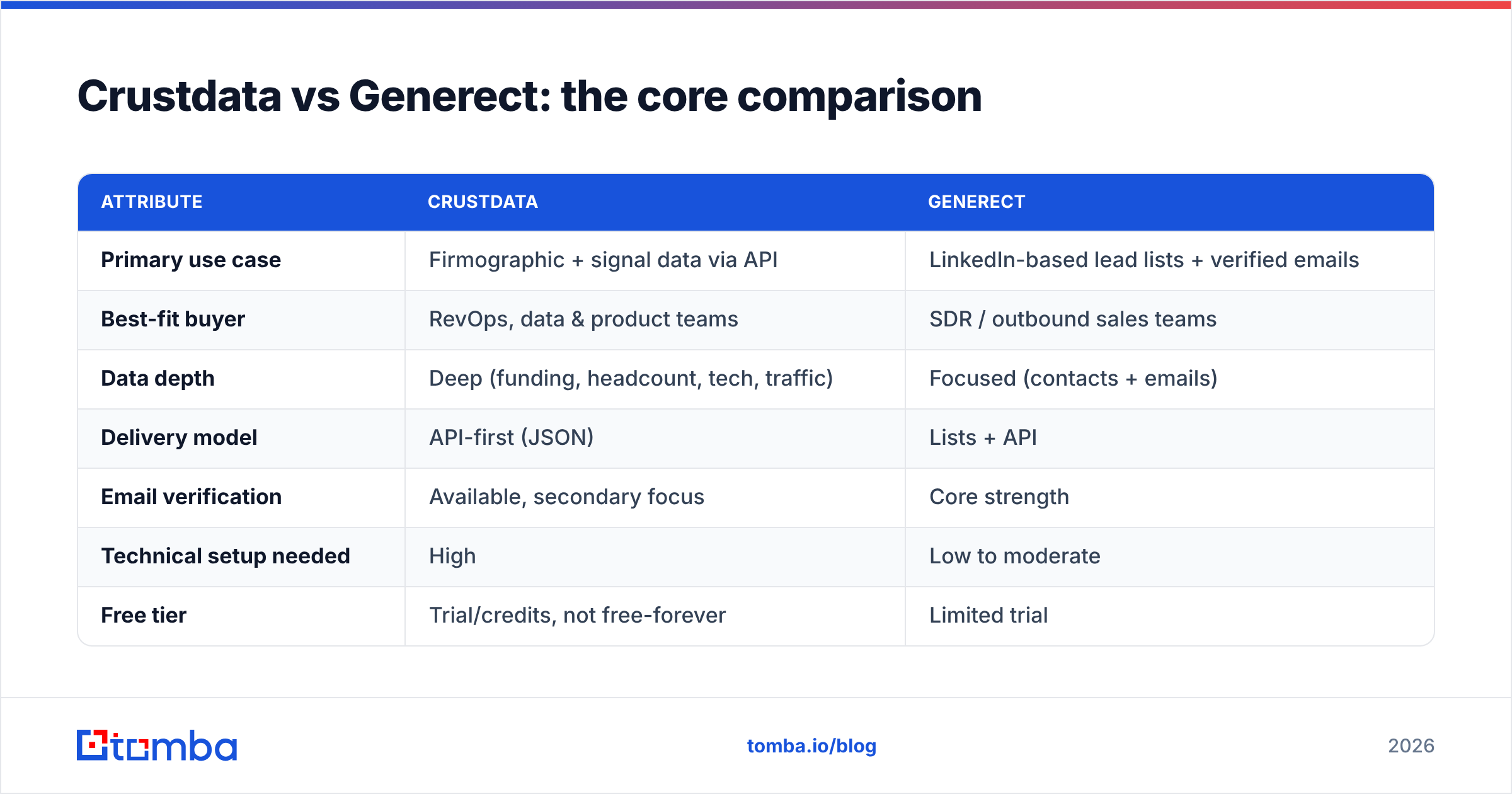
Here's how the two stack up on the attributes that actually change your workflow.
| Attribute | Crustdata | Generect |
|---|---|---|
| Primary use case | Firmographic + signal data via API | LinkedIn-based lead lists + verified emails |
| Best-fit buyer | RevOps, data & product teams | SDR / outbound sales teams |
| Data depth | Deep (funding, headcount, tech, traffic) | Focused (contacts + emails) |
| Delivery model | API-first (JSON) | Lists + API |
| Email verification | Available, secondary focus | Core strength |
| Technical setup needed | High | Low to moderate |
| Free tier | Trial/credits, not free-forever | Limited trial |
| Transparent low-end pricing | Custom-heavy | Custom-heavy |
The pattern is clear: Crustdata optimizes for data breadth and programmatic control; Generect optimizes for speed to a usable contact list. Neither is "better" in the abstract — the right pick depends on who's using it and what sits downstream.
Which has better data coverage and accuracy?#
Coverage and accuracy are where these tools earn or lose their price tag, so treat any single "97% accurate" claim with skepticism and test against your own ICP.
Crustdata tends to win on breadth of signals. Because it pulls firmographics, headcount trends, funding, and technographics, you can enrich a company record with far more than a name and email. For account scoring and territory planning, that depth matters. Its people data is solid, though person-level email accuracy varies by region and seniority — as it does with every provider.
Generect tends to win on verified email delivery for a defined list. If your job is "hand me 2,000 marketing directors at Series B SaaS companies with emails that bounce less," Generect's verification-first approach is built for exactly that.
A practical reality check: no provider is accurate everywhere. Coverage clusters around well-documented industries and geographies and thins out for SMBs, non-English markets, and niche roles. The smart move is to run a 100-record sample through each tool against contacts you can independently confirm, then measure real bounce rates.

This is also where a dedicated email verifier pays for itself regardless of which platform you choose: verifying at the point of send catches the decay that even fresh datasets accumulate between purchase and outreach.
How do the APIs compare for developers?#
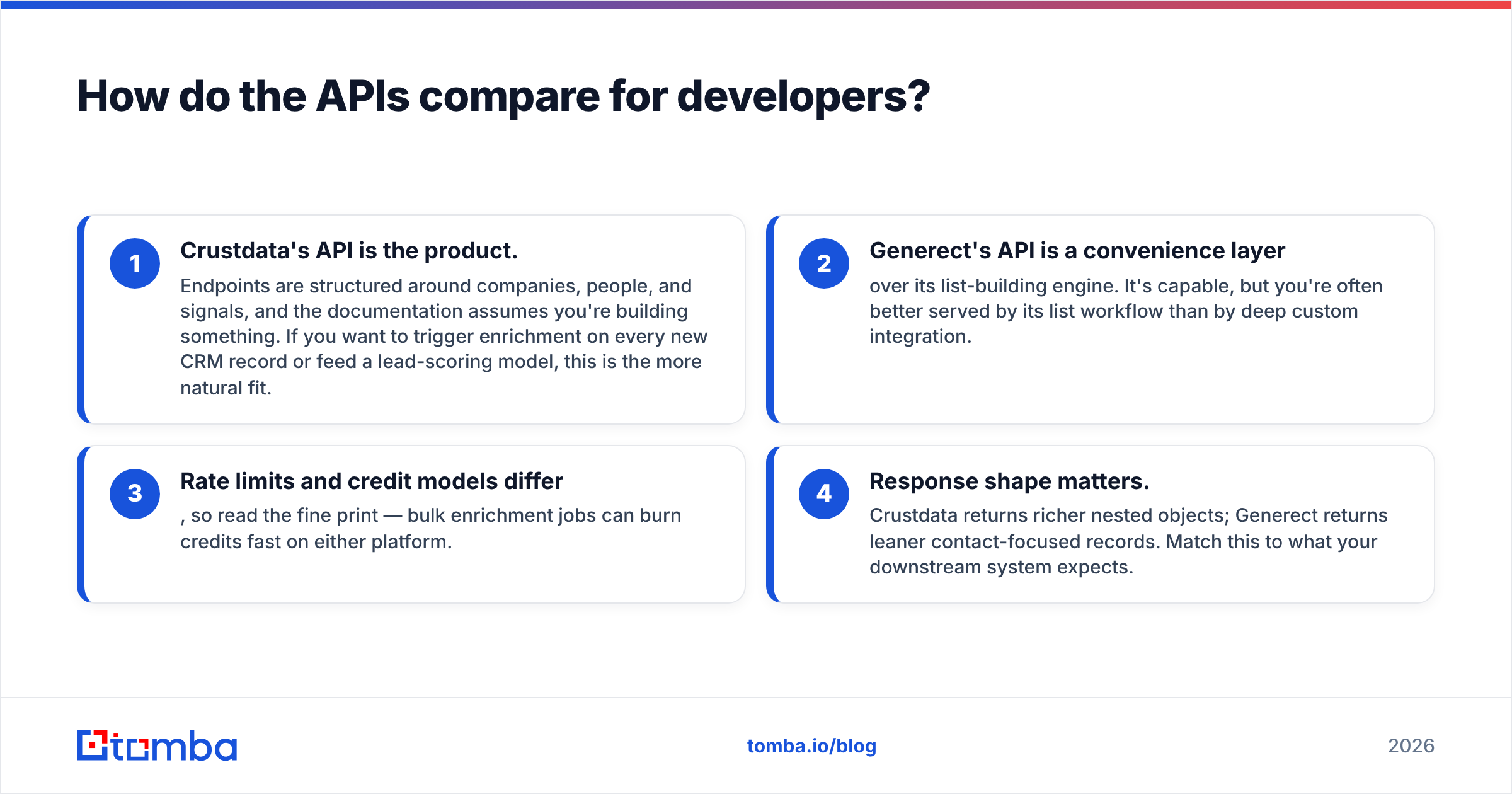
Both ship an API, but they're designed for different consumers.
- Crustdata's API is the product. Endpoints are structured around companies, people, and signals, and the documentation assumes you're building something. If you want to trigger enrichment on every new CRM record or feed a lead-scoring model, this is the more natural fit.
- Generect's API is a convenience layer over its list-building engine. It's capable, but you're often better served by its list workflow than by deep custom integration.
- Rate limits and credit models differ, so read the fine print — bulk enrichment jobs can burn credits fast on either platform.
- Response shape matters. Crustdata returns richer nested objects; Generect returns leaner contact-focused records. Match this to what your downstream system expects.
If you're comparing on developer experience specifically, also weigh a focused email finder API that does one job predictably. Sometimes you don't need a firehose of firmographics — you need a clean endpoint that turns a name and domain into a verified email.
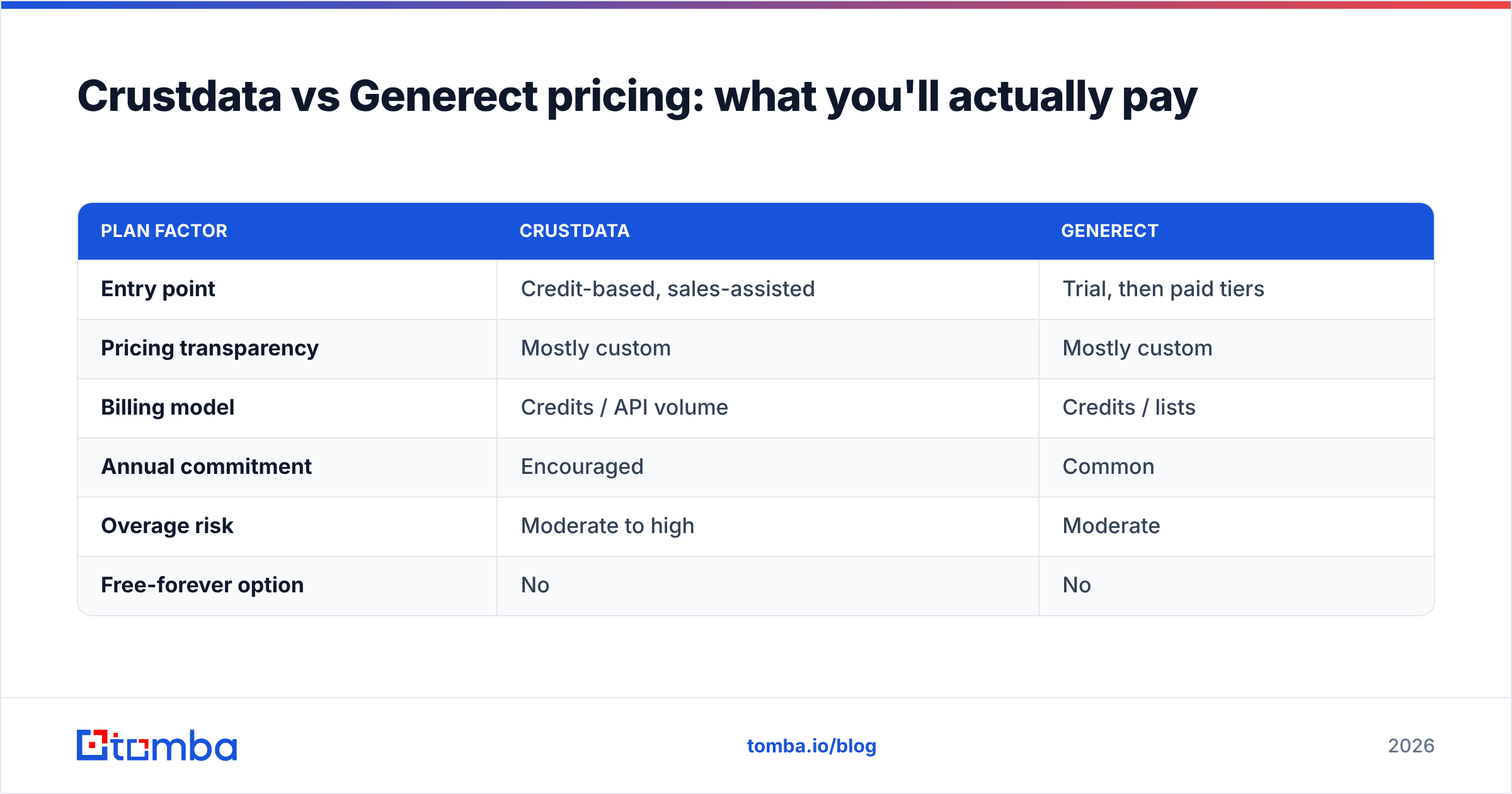
Crustdata vs Generect pricing: what you'll actually pay#
Neither vendor makes low-end pricing effortless to find, and both push serious users toward custom or annual contracts. That's normal for the data-API category, but it means the sticker you see rarely reflects your real bill once credits, seats, and overages are counted.
| Plan factor | Crustdata | Generect |
|---|---|---|
| Entry point | Credit-based, sales-assisted | Trial, then paid tiers |
| Pricing transparency | Mostly custom | Mostly custom |
| Billing model | Credits / API volume | Credits / lists |
| Annual commitment | Encouraged | Common |
| Overage risk | Moderate to high | Moderate |
| Free-forever option | No | No |
The honest takeaway: budget for more than the headline number. Enrichment volume, extra seats, and verification credits stack up. Before signing an annual deal, model your expected monthly record volume and ask each vendor for an all-in quote at that volume — not the per-credit teaser rate.
For teams whose actual need is narrower than a full data platform, this is where cost efficiency swings hard. Tomba pricing starts with a genuine free tier (25 searches/month), then Starter at $49/mo, Growth at $99/mo, and Pro at $249/mo — predictable numbers you can plan around without a sales call.
When should you choose Crustdata?#
Choose Crustdata if:
- You have a technical team ready to consume an API and build on top of it.
- You need signals, not just contacts — funding, headcount growth, technographics for account scoring.
- Enrichment is a pipeline, not a one-off — you want every new record automatically enriched.
- RevOps or data science owns the workflow, and outputs feed dashboards or models rather than a rep's inbox.
Crustdata is overkill if all you want is a list of emails to send tomorrow. You'd be paying for depth you won't use.
When should you choose Generect?#
Choose Generect if:
- Sales owns the workflow and needs targeted lists fast.
- Verified emails for outbound are the primary deliverable.
- LinkedIn-shaped audiences map cleanly to your ICP.
- You want speed over customization — checkout-and-go beats build-and-integrate for your team.
Generect is the weaker pick if you need rich firmographic signals or a deeply programmatic enrichment layer feeding custom internal tools.
Is there a better-value alternative to both?#
Often, yes — if your real bottleneck is finding and verifying professional emails rather than warehousing firmographic signals.
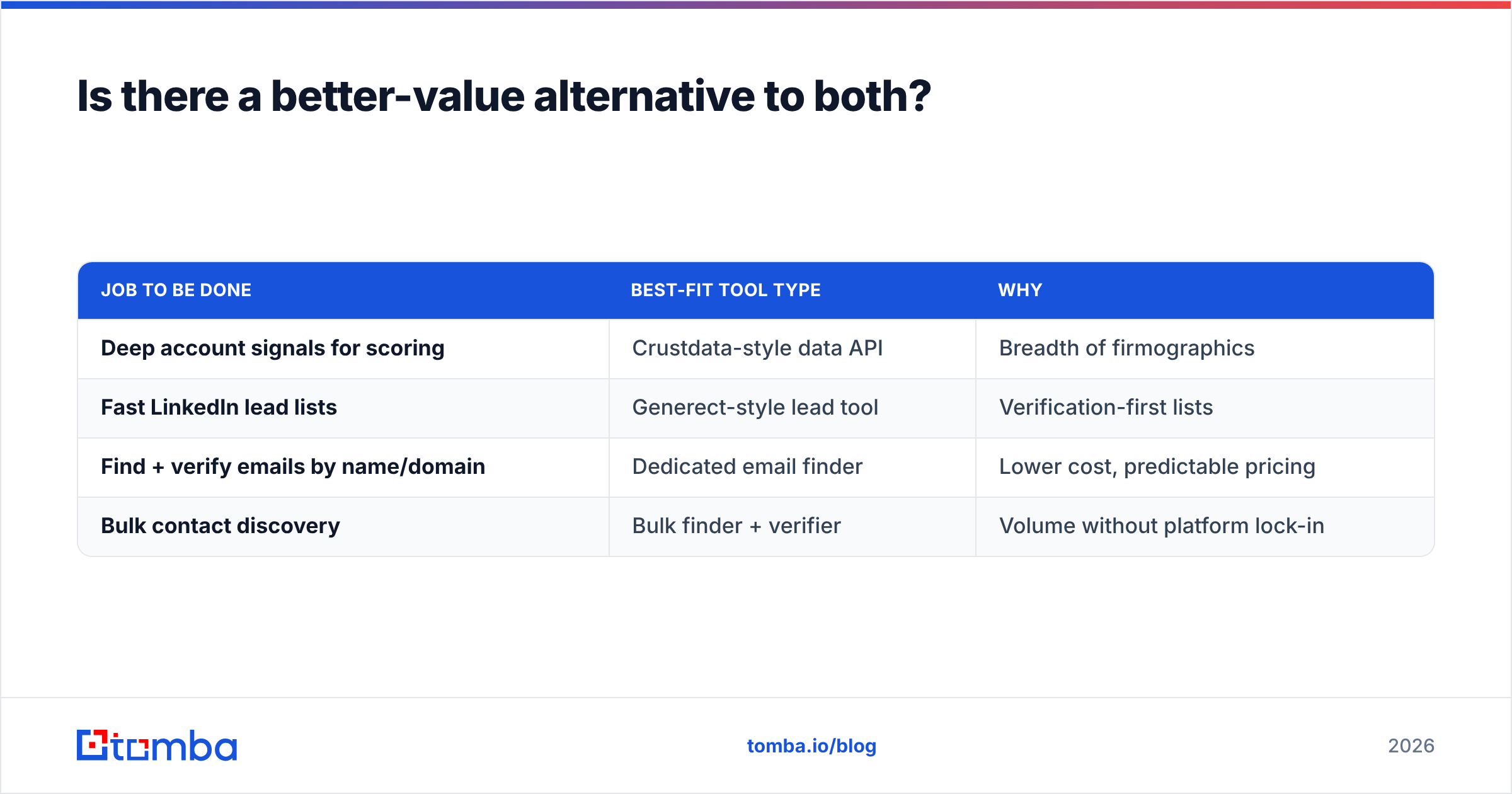
A lot of teams over-buy. They purchase a heavyweight data platform to solve what is, at its core, a contact-discovery problem: "I know the company and the person — get me their verified email." That's a job a focused tool does faster and cheaper.
| Job to be done | Best-fit tool type | Why |
|---|---|---|
| Deep account signals for scoring | Crustdata-style data API | Breadth of firmographics |
| Fast LinkedIn lead lists | Generect-style lead tool | Verification-first lists |
| Find + verify emails by name/domain | Dedicated email finder | Lower cost, predictable pricing |
| Bulk contact discovery | Bulk finder + verifier | Volume without platform lock-in |
If that middle-and-bottom row is where you actually live, look at Tomba. The email finder resolves a name and company domain into a verified professional email, the domain search pulls known addresses for a company, and the bulk email finder handles list-scale work — with a transparent, self-serve price and no mandatory sales call.
You can also stack it: use Crustdata or Generect for the strategic data layer, then run every address through a dedicated verifier before send to protect your sender reputation and keep bounce rates low. Tools compose; you don't have to marry one platform.
The honest verdict#
There's no universal winner — there's a winner for your workflow.
- Pick Crustdata if you're a data-mature team that wants firmographic signals and enrichment delivered as an API you build on.
- Pick Generect if you're a sales team that wants verified, LinkedIn-shaped contact lists with minimal setup.
- Pick a focused email finder if your true need is finding and verifying professional emails at a fair, predictable price — without paying for a full platform you'll half-use.
Whatever you choose, validate with your own data before committing to an annual contract. Run the same 100-record ICP sample through each option, measure real bounce and match rates, and let evidence — not a demo — make the call. You can compare both platforms directly at crustdata.com and generect.com, and cross-check category reviews on G2.
Start finding verified emails today#
If your bottleneck is contacts, not firmographic dashboards, start with the tool built for exactly that job. The Tomba Email Finder turns a name and company domain into a verified professional email in seconds, backs it with built-in verification, and starts free — 25 searches a month, then $49/mo when you scale. Test it against your hardest accounts, measure the bounce rate yourself, and only pay for the volume you actually use. That's the fastest, lowest-risk way to see whether you need a full data platform at all — or just clean, accurate emails that land.
Related guides#
Ready to find emails that actually work?
Join 150,000+ professionals who stopped guessing and started sending. Free credits on signup — no credit card required.
Get the Tomba newsletter
Practical outbound tactics and product updates — once every two weeks.
About the author