Crustdata vs Kaspr: B2B Data and Contact Tools Compared
Crustdata delivers real-time company and people data through an API; Kaspr pulls phone numbers and emails off LinkedIn. Here's how the two stack up on accuracy, coverage, pricing, and the workflows they actually fit.
Choosing between Crustdata and Kaspr feels like an apples-to-oranges problem because, honestly, it partly is. One is a real-time B2B data API built for engineering and RevOps teams. The other is a LinkedIn-first contact tool built for SDRs who live in the browser. They overlap just enough to land on the same shortlist — and different enough that picking the wrong one wastes a quarter.
This is a neutral breakdown of where each tool wins, where each one frustrates buyers, and how to decide without a two-month trial.
TL;DR: Crustdata vs Kaspr at a glance#
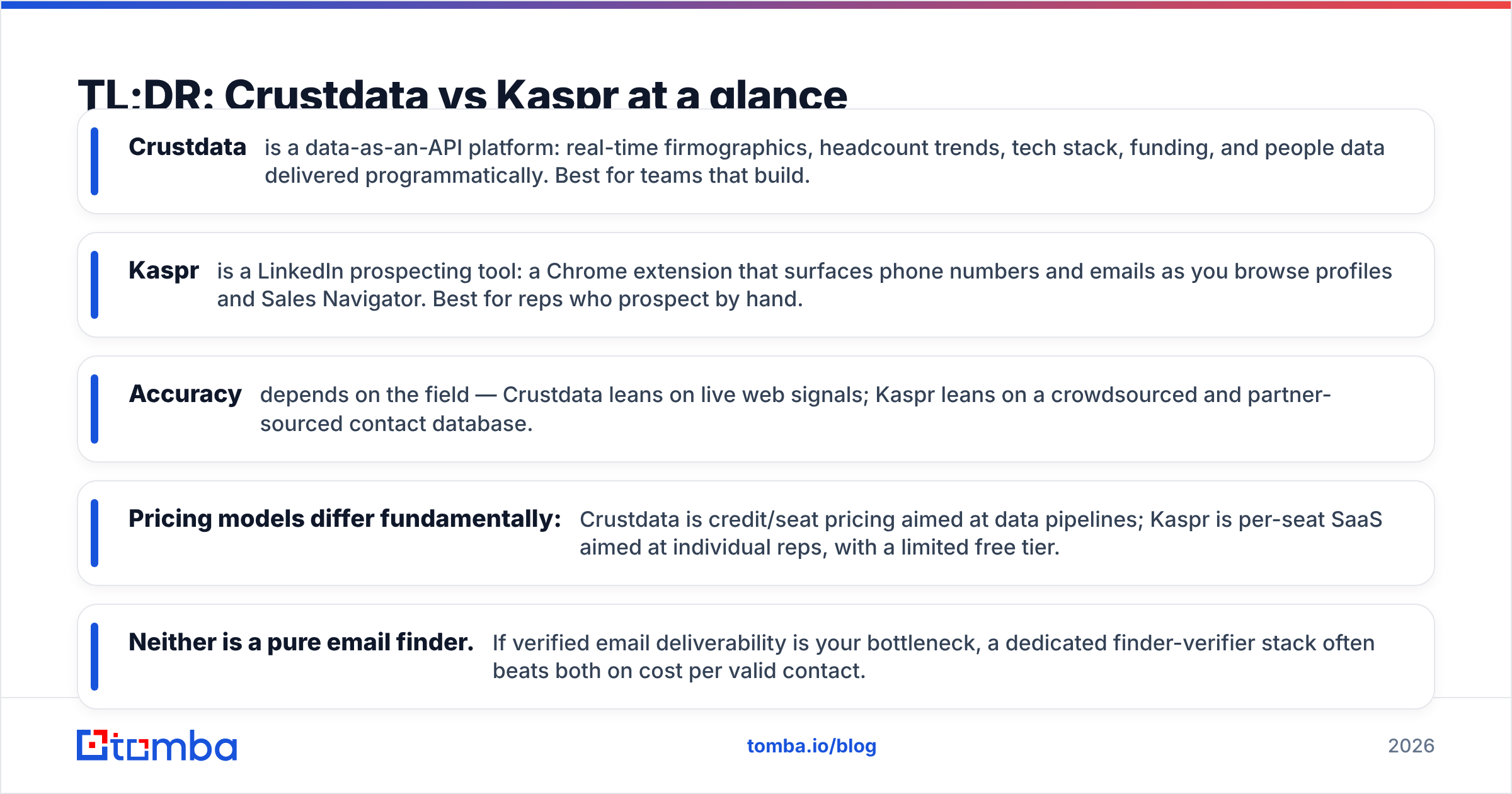
- Crustdata is a data-as-an-API platform: real-time firmographics, headcount trends, tech stack, funding, and people data delivered programmatically. Best for teams that build.
- Kaspr is a LinkedIn prospecting tool: a Chrome extension that surfaces phone numbers and emails as you browse profiles and Sales Navigator. Best for reps who prospect by hand.
- Accuracy depends on the field — Crustdata leans on live web signals; Kaspr leans on a crowdsourced and partner-sourced contact database.
- Pricing models differ fundamentally: Crustdata is credit/seat pricing aimed at data pipelines; Kaspr is per-seat SaaS aimed at individual reps, with a limited free tier.
- Neither is a pure email finder. If verified email deliverability is your bottleneck, a dedicated finder-verifier stack often beats both on cost per valid contact.
What is Crustdata?#
Crustdata is a B2B data provider that ships its data primarily through an API rather than a point-and-click app. Think of it as a live feed of the business world: instead of downloading a static list that ages the moment you export it, you query companies and people on demand and get the current state back.
Its core datasets include company firmographics, employee headcount over time, growth signals, technographics (what a company runs), funding events, and person-level attributes. Teams typically wire it into a CRM, a data warehouse, or an internal scoring model. You can read more about what they offer on the Crustdata homepage.
The buyer profile is clear: RevOps engineers, growth teams with SQL and API skills, and product teams building lead-scoring or enrichment features. If your workflow is "browse LinkedIn and copy a phone number," Crustdata is overkill. If your workflow is "score 40,000 accounts nightly on hiring velocity," it's built for you.
What is Kaspr?#
Kaspr is a prospecting tool centered on LinkedIn. You install a Chrome extension, open a profile or a Sales Navigator search, and Kaspr reveals contact details — most notably mobile phone numbers, plus professional and personal emails where available. It's a French company with a strong GDPR/CCPA compliance story, which matters to European buyers. See the Kaspr site for their current feature set.
Kaspr's sweet spot is the individual SDR or a small outbound team that prospects manually. The value is speed inside a familiar motion: you're already in LinkedIn, so pulling a mobile number in two clicks removes a research step. It also offers list building, basic CRM enrichment, and workflow features like reminders and automated LinkedIn steps.
Where Crustdata is a data backbone, Kaspr is a rep's daily driver. That distinction predicts almost every difference below.
Crustdata vs Kaspr: side-by-side comparison#
Here's the honest head-to-head. Read the "best for" row first — it does most of the deciding.
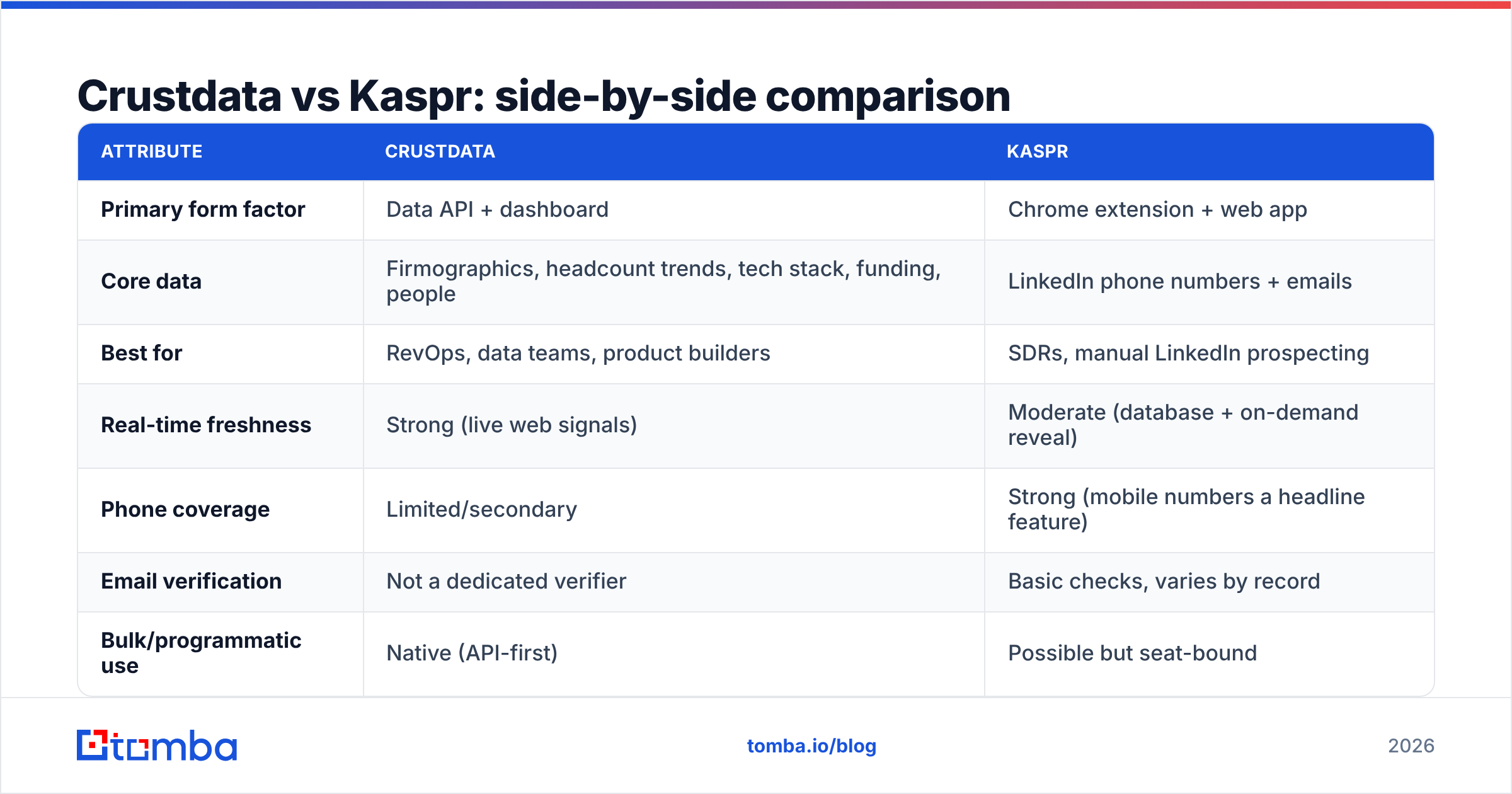
| Attribute | Crustdata | Kaspr |
|---|---|---|
| Primary form factor | Data API + dashboard | Chrome extension + web app |
| Core data | Firmographics, headcount trends, tech stack, funding, people | LinkedIn phone numbers + emails |
| Best for | RevOps, data teams, product builders | SDRs, manual LinkedIn prospecting |
| Real-time freshness | Strong (live web signals) | Moderate (database + on-demand reveal) |
| Phone coverage | Limited/secondary | Strong (mobile numbers a headline feature) |
| Email verification | Not a dedicated verifier | Basic checks, varies by record |
| Bulk/programmatic use | Native (API-first) | Possible but seat-bound |
| Pricing model | Credit/seat, pipeline-scale | Per-seat SaaS + limited free tier |
| Compliance posture | Standard B2B data compliance | GDPR/CCPA-forward (EU-friendly) |
| Learning curve | Higher (technical) | Low (browser-native) |
The pattern: Crustdata wins on depth, freshness, and programmatic scale. Kaspr wins on phone coverage, ease of use, and the LinkedIn-native workflow. Very little of that overlaps, which is good news — the right pick usually falls out of your team's shape, not a feature war.
Which has better data accuracy, Crustdata or Kaspr?#
Accuracy isn't one number — it's per field, so the honest answer is "it depends on what you're pulling."
Crustdata derives much of its value from live signals: it re-checks company attributes against current web sources, which is why headcount trends and tech stack tend to be fresh. That freshness is its accuracy advantage. The tradeoff is that person-level contact data (especially direct dials) is not its headline strength.
Kaspr sources contact data from a mix of partner databases and crowdsourced contributions. That model produces strong mobile-number coverage — its actual selling point — but quality varies by geography and role seniority. European mobile numbers are often a highlight; niche or very senior contacts can be thinner.
Two practical rules cut through the marketing:
- Match the tool to the field. Use Crustdata when you need company intelligence and growth signals. Use Kaspr when you need a rep to dial a real mobile today.
- Always verify before you send or dial. No provider is 100% accurate, and bounce rates quietly wreck sender reputation. Running contacts through an email verifier before a campaign is cheaper than repairing a burned domain.
If cost-per-valid-contact is your real KPI, benchmark both against a dedicated finder-and-verifier flow before committing. Independent reviews on G2 are useful here, but treat headline accuracy claims as a starting point, not gospel — test on your own ICP.
How do Crustdata and Kaspr pricing compare?#
The pricing models aren't just different numbers — they're different philosophies, which makes a straight price war misleading.
Crustdata prices around API usage and seats, scaled for teams pushing data through pipelines. That's efficient when you're enriching tens of thousands of records programmatically and painful if you're a single rep who wants 200 phone numbers a month. Pricing is typically quoted rather than fully self-serve, so budget for a sales conversation.
Kaspr uses per-seat SaaS pricing with a limited free plan to get individual reps started, then paid tiers that unlock more credits and features. It's predictable for a rep or a small team and gets expensive to scale seat-by-seat across a large SDR org.
A quick way to frame the decision by spend profile:
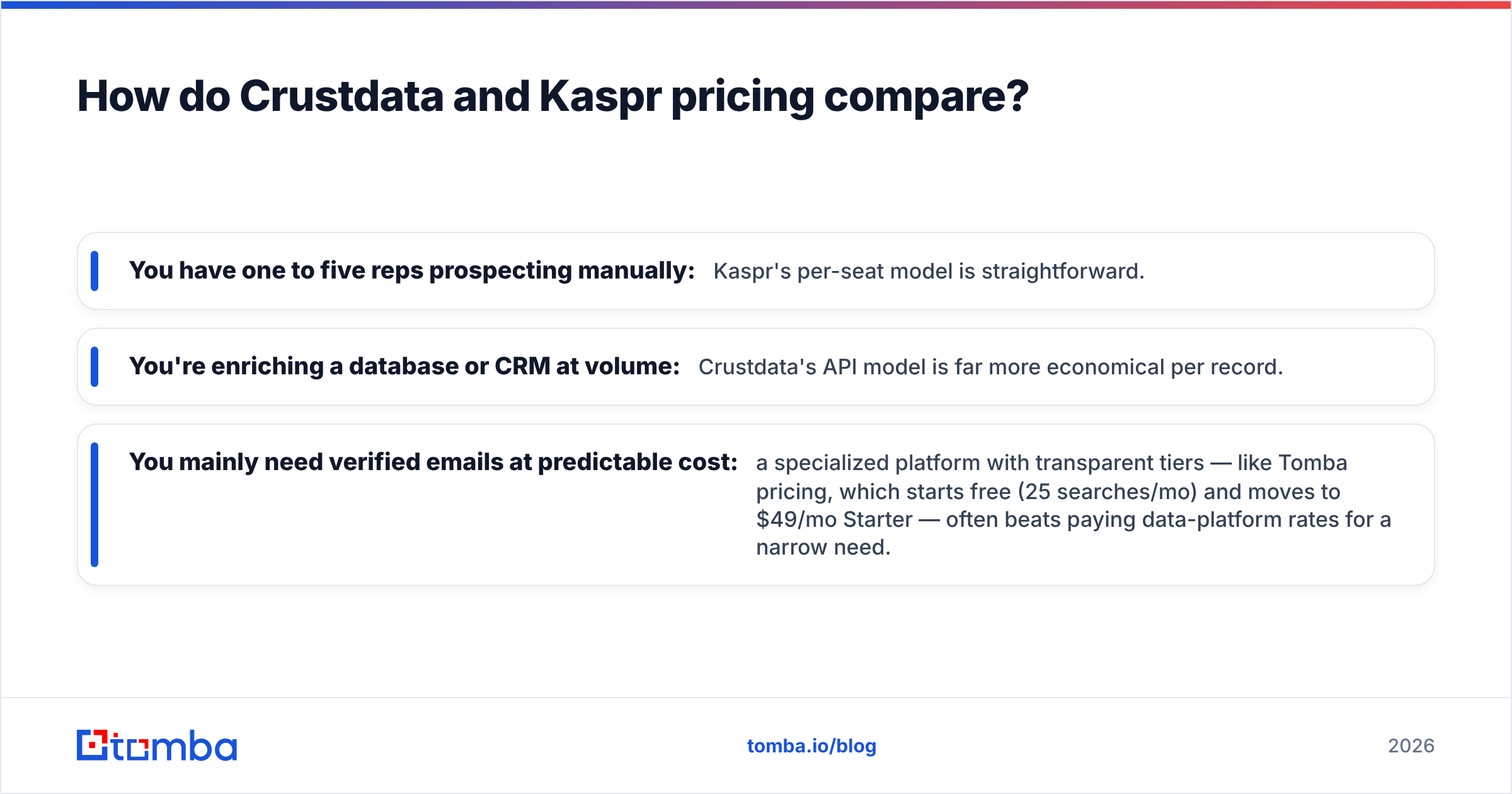
- You have one to five reps prospecting manually: Kaspr's per-seat model is straightforward.
- You're enriching a database or CRM at volume: Crustdata's API model is far more economical per record.
- You mainly need verified emails at predictable cost: a specialized platform with transparent tiers — like Tomba pricing, which starts free (25 searches/mo) and moves to $49/mo Starter — often beats paying data-platform rates for a narrow need.
Don't anchor on sticker price. Anchor on cost per usable outcome: a valid email, a connected call, a scored account.

When should you choose Crustdata over Kaspr?#
Pick Crustdata when your bottleneck is data infrastructure, not a rep's daily list. Clear signals you're in Crustdata territory:
- You have engineering or RevOps resources to consume an API and maintain the integration.
- You need real-time signals — hiring spikes, funding, tech adoption — to trigger plays or score accounts.
- You're building a product feature (enrichment, scoring, routing) on top of live B2B data.
- You operate at warehouse scale where per-record economics matter more than a friendly UI.
Crustdata is the better backbone. It's not the better rep tool, and trying to make it one leads to frustration.
When should you choose Kaspr over Crustdata?#
Pick Kaspr when the job is manual prospecting inside LinkedIn and phone coverage matters. Signals you're in Kaspr territory:
- Your reps prospect by browsing profiles and Sales Navigator, not by querying a database.
- Mobile numbers are the prize — you run a call-heavy or multichannel motion.
- You want zero technical setup and a browser-native workflow.
- EU compliance is a priority and you value Kaspr's GDPR/CCPA-forward stance.
Kaspr is the better daily driver for individual sellers. It's not built to be a data pipeline, and pushing it in that direction gets expensive fast.
Do you actually need a third option?#
Often, yes — because most teams frame this as "Crustdata or Kaspr" when their real problem is narrower: they need accurate, verified contact data at a sane price, not a full data platform or a LinkedIn extension.
If your core need is finding and verifying professional emails, a focused email-finding stack usually delivers better cost-per-valid-contact than either general tool. That's the gap platforms like Tomba fill. A few workflows where a dedicated finder wins outright:
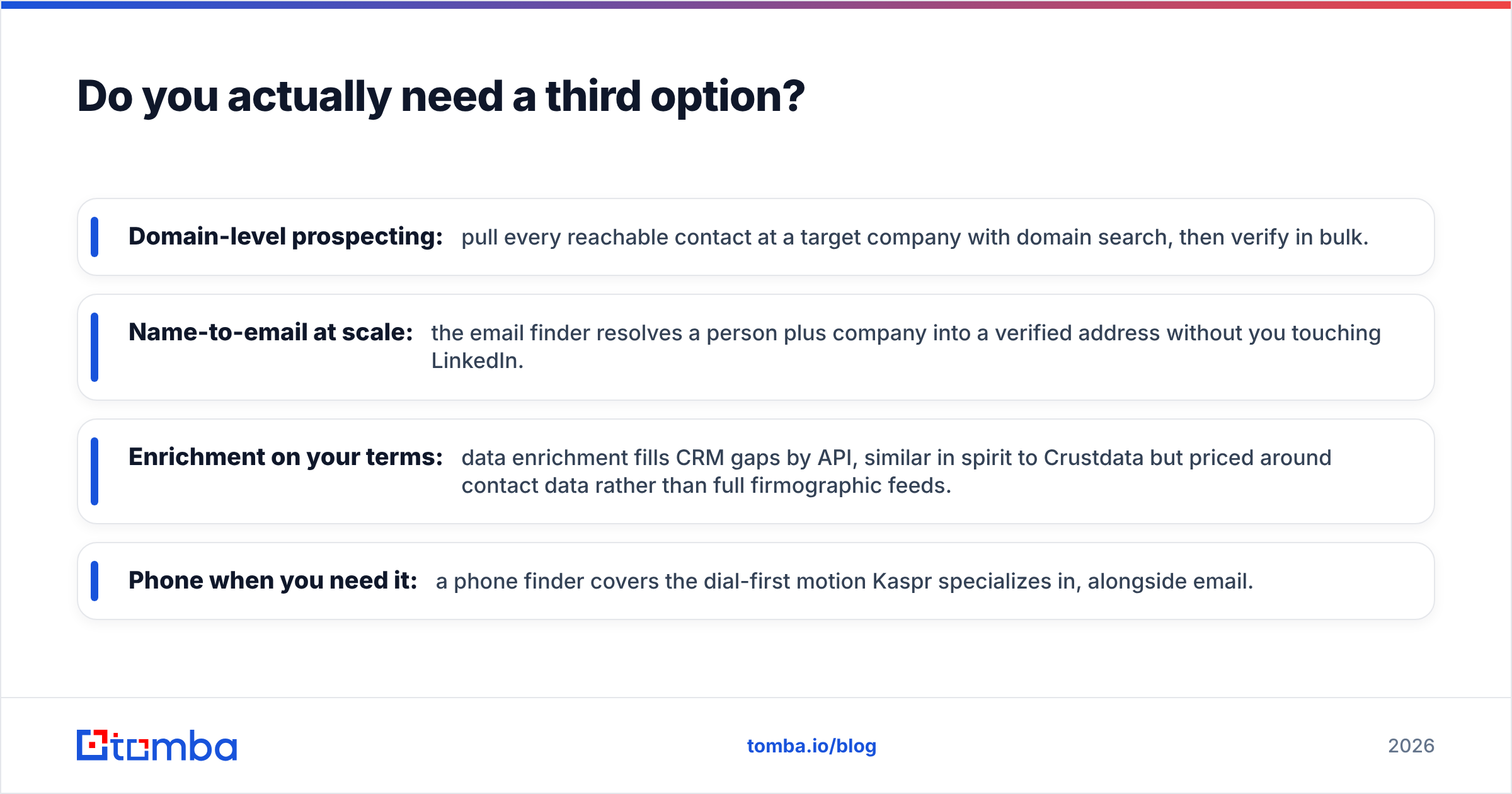
- Domain-level prospecting: pull every reachable contact at a target company with domain search, then verify in bulk.
- Name-to-email at scale: the email finder resolves a person plus company into a verified address without you touching LinkedIn.
- Enrichment on your terms: data enrichment fills CRM gaps by API, similar in spirit to Crustdata but priced around contact data rather than full firmographic feeds.
- Phone when you need it: a phone finder covers the dial-first motion Kaspr specializes in, alongside email.
The point isn't that one tool replaces both. It's that "which platform" is the wrong first question. Start from the outcome — verified emails, connected calls, scored accounts — and the tool choice gets obvious. Many teams end up running a lightweight finder-verifier for outbound alongside a heavier data source only when scale demands it.
Crustdata vs Kaspr: the verdict#
There's no universal winner because they solve different problems.
- Choose Crustdata if you're a technical team that needs real-time company and people data piped into your stack at scale.
- Choose Kaspr if you're an SDR-led team that prospects manually in LinkedIn and needs mobile numbers fast.
- Choose a dedicated finder-verifier if your actual constraint is verified email deliverability at a predictable price — the most common situation, and the one both tools overshoot.
Whatever you pick, verify before you send. The best data source in the world still bounces if you skip that step, and your domain reputation never fully recovers from a bad send.
Start with verified contacts, not guesswork#
If your outbound stalls on the "is this email even real?" question, that's the piece to fix first. The Tomba Email Finder turns a name and company into a verified, ready-to-send address — with built-in verification so you're not gambling on deliverability. It's free to try (25 searches a month, no card), and paid plans start at $49/mo when you're ready to scale. Test it against your current Crustdata or Kaspr workflow on a real list and compare cost per valid contact — the number that actually decides this.
Related guides#
Ready to find emails that actually work?
Join 150,000+ professionals who stopped guessing and started sending. Free credits on signup — no credit card required.
Get the Tomba newsletter
Practical outbound tactics and product updates — once every two weeks.
About the author