Crustdata vs Leadsforge: B2B Data Platforms Compared 2026
Crustdata and Leadsforge both promise fresh B2B data and enrichment, but they solve different problems. Here's an honest breakdown of accuracy, pricing, API depth, and which one fits your outbound stack in 2026.
Crustdata vs Leadsforge: B2B Data Platforms Compared 2026
Choosing between Crustdata and Leadsforge comes down to one question: do you want raw, real-time data you can pipe into your own systems, or a done-for-you lead list that arrives ready to email? They sit on opposite ends of the same market, and picking the wrong one wastes both budget and pipeline.
This is a neutral breakdown. Neither tool pays for placement here, and where one clearly wins on a dimension, we say so.
TL;DR#
- Crustdata is a real-time B2B data and enrichment API built for engineering and RevOps teams who want to build their own workflows on top of fresh company and people data.
- Leadsforge is an AI-driven lead generation tool aimed at founders and small sales teams who want a targeted list delivered without technical setup.
- Crustdata wins on depth, freshness, and programmatic control; Leadsforge wins on speed-to-first-list and ease of use.
- Both charge a premium, and neither replaces a dedicated email verification step before you send.
- If your real bottleneck is finding and verifying contact emails, a focused email finder like Tomba is cheaper and more accurate than bolting either platform onto that job.
What is Crustdata?#
Crustdata is a data infrastructure company that sells access to real-time B2B datasets through an API and flat-file delivery. Instead of shipping you a static list, it exposes live company signals — headcount changes, funding events, tech-stack shifts, job postings, and people-level attributes — that you query on demand.
The core buyer is technical: a RevOps engineer building a lead-scoring model, a growth team wiring intent signals into a CRM, or a product team enriching sign-ups. You are expected to write code (or use a workflow tool) against the API. The payoff is control and freshness — Crustdata's pitch is that its data is refreshed far more aggressively than the quarterly-stale databases most incumbents ship. You can read their positioning on the Crustdata site.
Where Crustdata struggles is the non-technical user. There is no "click a button, get 500 emails" front door. If nobody on your team can consume an API or set up an automation, most of the value stays locked behind the integration work.
What is Leadsforge?#
Leadsforge is an AI lead generation tool that turns a plain-English description of your ideal customer into a targeted contact list. You describe who you want to reach, and the system assembles a list with names, companies, and contact details you can export or push into an outreach sequence.
The buyer here is the opposite of Crustdata's: a founder, solo SDR, or small agency that wants leads today and has no interest in building anything. The conversational interface removes the learning curve, and the time from sign-up to a usable list is short.
The trade-off is transparency and control. You get the AI's interpretation of your ICP, not a queryable dataset, so it is harder to audit where a record came from or to build repeatable, programmatic pipelines. As with any list product, quality varies by niche, and you should treat the contact data as a starting point rather than gospel — verification still matters.
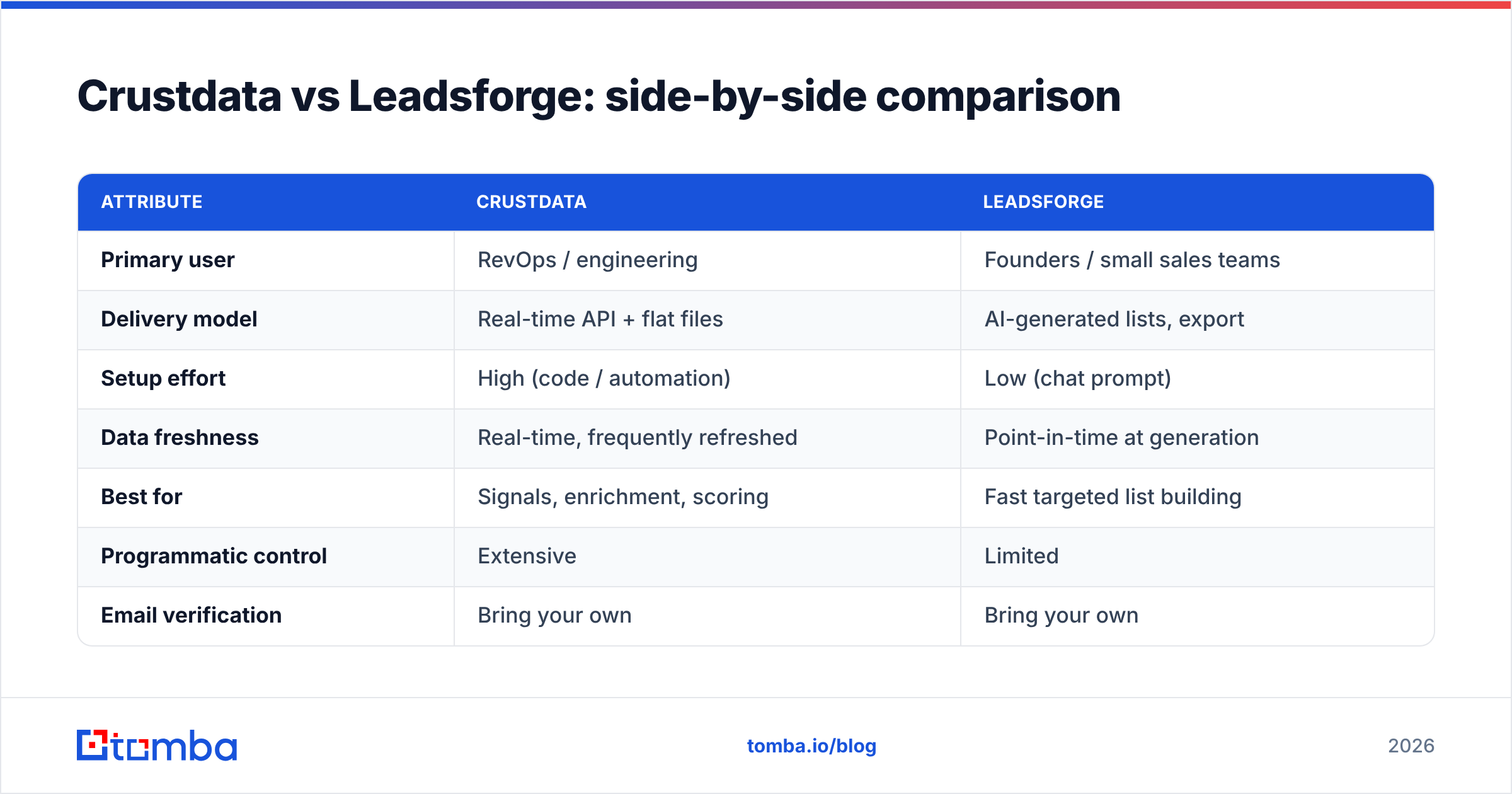
Crustdata vs Leadsforge: side-by-side comparison#
| Attribute | Crustdata | Leadsforge |
|---|---|---|
| Primary user | RevOps / engineering | Founders / small sales teams |
| Delivery model | Real-time API + flat files | AI-generated lists, export |
| Setup effort | High (code / automation) | Low (chat prompt) |
| Data freshness | Real-time, frequently refreshed | Point-in-time at generation |
| Best for | Signals, enrichment, scoring | Fast targeted list building |
| Programmatic control | Extensive | Limited |
| Email verification | Bring your own | Bring your own |
| Learning curve | Steep | Minimal |
| Pricing model | Usage / seat, premium | Credit / subscription |
The table makes the split obvious. These tools rarely compete for the same buyer in the same week. A 20-person outbound team standardizing on live intent data leans Crustdata. A two-person startup that needs 300 qualified contacts before Friday leans Leadsforge.
Which one has better data accuracy?#
Accuracy depends on what you measure. Crustdata's advantage is recency: because records are refreshed on a live cadence, you are less likely to email someone who left the company two quarters ago. That matters most for time-sensitive signals like funding rounds or new-hire triggers.
Leadsforge's accuracy is a function of how well the AI interpreted your prompt plus the freshness of its underlying sources at generation time. For common roles at mid-market companies, hit rates are usually fine. For niche titles or smaller regions, expect more noise.
Here is the part both tools gloss over: neither guarantees a deliverable inbox. A "current" record can still carry a role-based, catch-all, or long-dead email address. If you send to unverified addresses, your bounce rate climbs and your sender reputation takes the hit — regardless of which platform sourced the contact. Running every list through an email verifier before your first send is non-negotiable, and it is a step that lives outside both products.
How do Crustdata and Leadsforge price?#
Both sit at the premium end, and both quote pricing that scales with volume or seats rather than a simple flat rate. Crustdata is typically structured around API usage and RevOps team seats, which makes sense for a data-infrastructure product — you pay in proportion to how much you query and enrich. Leadsforge leans toward credit-based or subscription tiers tied to how many leads you generate.
The important budgeting insight: the sticker price is not your true cost. With Crustdata you should factor in the engineering time to integrate and maintain the pipeline. With Leadsforge you should factor in the verification and cleanup pass on generated lists. Neither cost shows up on the pricing page.
For teams whose actual job-to-be-done is "find and verify business emails at a predictable cost," a specialist tool is dramatically cheaper. As a reference point, transparent Tomba pricing starts free at 25 searches a month, then $49/mo for Starter and $99/mo for Growth — with the email finder, verifier, and domain search bundled rather than metered as separate premium add-ons.
When should you choose Crustdata?#
Pick Crustdata when these are true:
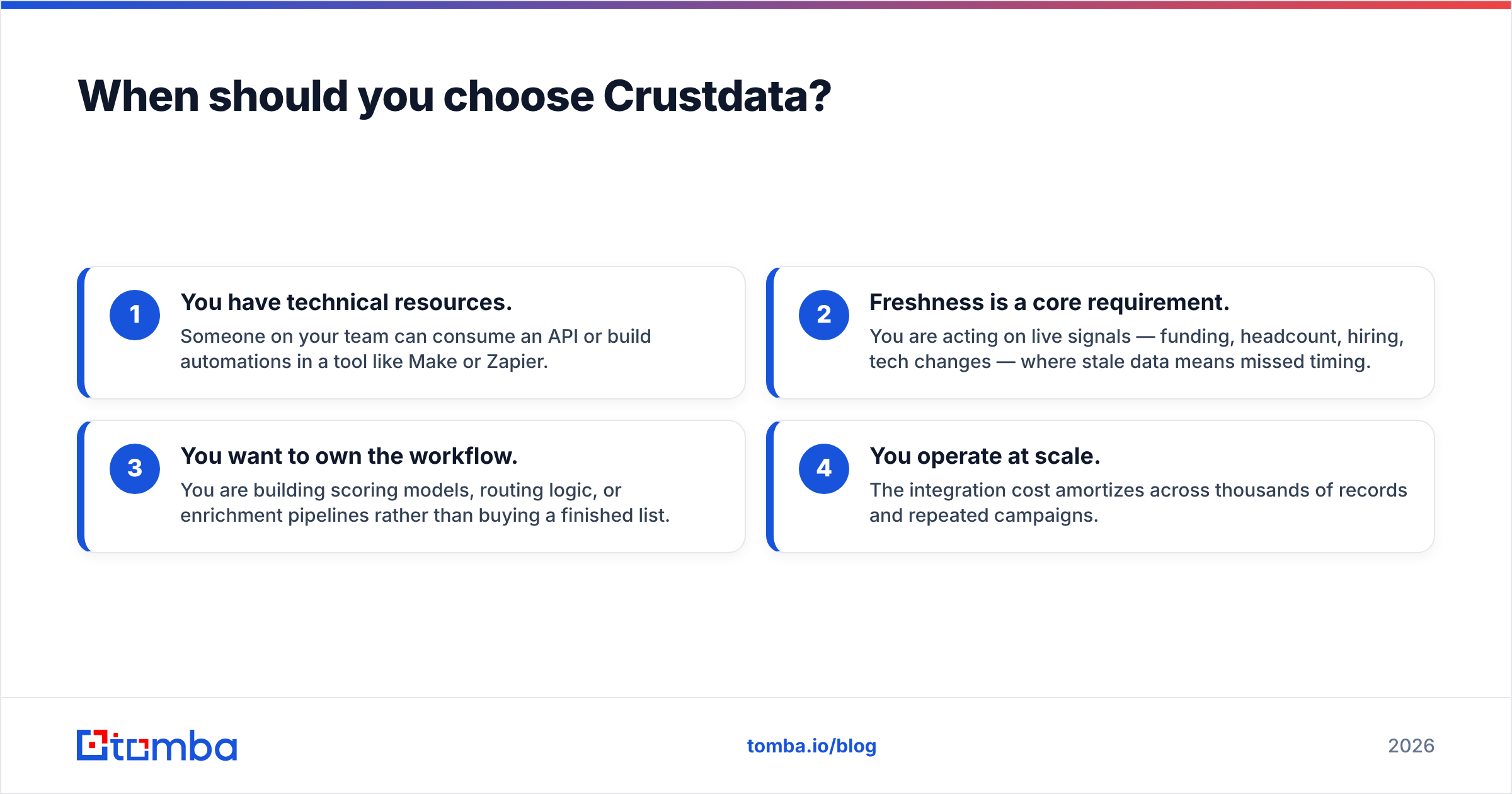
- You have technical resources. Someone on your team can consume an API or build automations in a tool like Make or Zapier.
- Freshness is a core requirement. You are acting on live signals — funding, headcount, hiring, tech changes — where stale data means missed timing.
- You want to own the workflow. You are building scoring models, routing logic, or enrichment pipelines rather than buying a finished list.
- You operate at scale. The integration cost amortizes across thousands of records and repeated campaigns.
If you are a solo operator who just wants contacts to email this afternoon, Crustdata is overkill and you will not extract its value.
When should you choose Leadsforge?#
Pick Leadsforge when these are true:
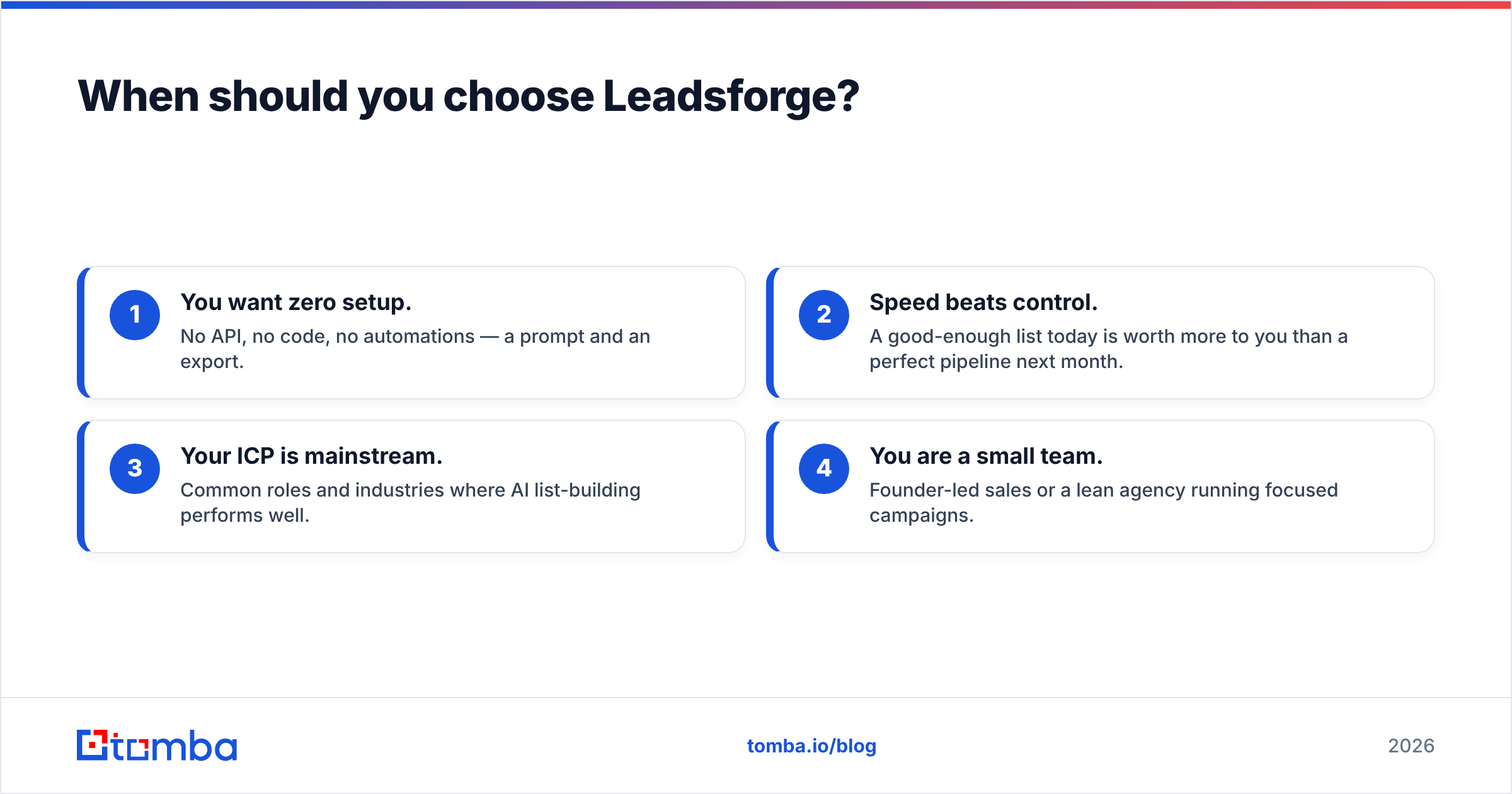
- You want zero setup. No API, no code, no automations — a prompt and an export.
- Speed beats control. A good-enough list today is worth more to you than a perfect pipeline next month.
- Your ICP is mainstream. Common roles and industries where AI list-building performs well.
- You are a small team. Founder-led sales or a lean agency running focused campaigns.
If you need auditable, repeatable, programmatic data feeds, Leadsforge's convenience becomes a ceiling.
What are the alternatives to both?#
Most teams discover that their bottleneck is narrower than either platform is built for. Crustdata is a broad data-infrastructure play; Leadsforge is a broad list-generation play. But the daily pain is usually specific: I have a name and a company — what is the verified work email? Or: I have a domain — who works there and how do I reach them?
That is a focused email-finding and verification problem, and a purpose-built stack handles it better and cheaper than a general platform. A practical toolkit looks like this:
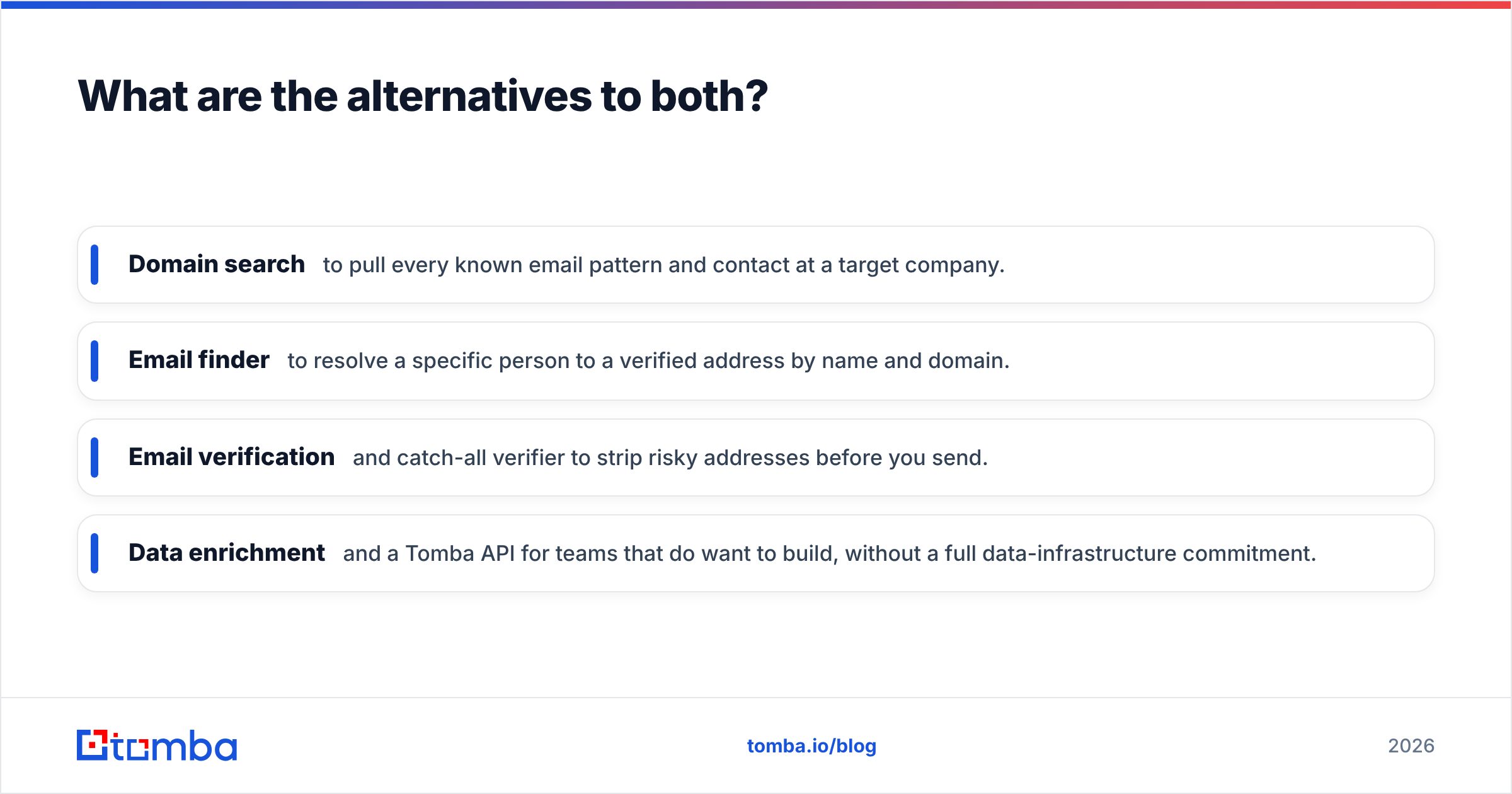
- Domain search to pull every known email pattern and contact at a target company.
- Email finder to resolve a specific person to a verified address by name and domain.
- Email verification and catch-all verifier to strip risky addresses before you send.
- Data enrichment and a Tomba API for teams that do want to build, without a full data-infrastructure commitment.
You can compare tools on independent review sites like G2 to sanity-check accuracy claims across the category before committing budget. The point is not that one vendor beats all others — it is that matching the tool to the actual job usually beats buying a broad platform for a narrow need.
Frequently asked questions#
Is Crustdata or Leadsforge better for cold email? Neither is a cold-email tool. Both source contacts; you still need a verification step and a sending platform. Leadsforge gets you a list faster, but you must verify it. Crustdata gives you fresher raw data to build from.
Do either of them verify email deliverability? Not as a guarantee. Treat every address as unverified until you run it through a dedicated email verifier. Skipping this is the fastest way to torch your domain reputation.
Can I use them together? Yes. Some teams use Crustdata for live signals and enrichment while using a list tool for quick top-of-funnel sourcing. Just consolidate verification into one reliable step regardless of source.
Which is cheaper? It depends on volume and hidden costs — engineering time for Crustdata, cleanup time for Leadsforge. For pure email finding and verification, a specialist tool is almost always the lower total cost.
The verdict#
Crustdata and Leadsforge are not really rivals — they are answers to different questions. Crustdata wins for technical teams that want fresh, controllable data infrastructure. Leadsforge wins for non-technical teams that want a targeted list with no setup. Choose based on who is going to use the tool day to day, not on the marketing.
But before you commit to either premium platform, be honest about your bottleneck. If it is really "find the right person's verified email at a predictable price," you do not need a data-infrastructure contract or an AI list subscription — you need a sharp, accurate finder.
That is where Tomba fits. Start free with 25 searches a month, then use the Tomba Email Finder to turn names and domains into verified professional emails, with the verifier and domain search built in. It is the cheapest way to test whether your outreach problem was ever a "big platform" problem at all.
Related guides#
Ready to find emails that actually work?
Join 150,000+ professionals who stopped guessing and started sending. Free credits on signup — no credit card required.
Get the Tomba newsletter
Practical outbound tactics and product updates — once every two weeks.
About the author