Crustdata vs SeamlessAI 2026: B2B Data Tools Compared
Crustdata vs Seamless.AI compared on data accuracy, coverage, pricing, and workflow fit — plus where a leaner email finder beats both for pure outbound.
Crustdata vs SeamlessAI 2026: B2B Data Tools Compared
Crustdata vs SeamlessAI is a choice between two philosophies of B2B data. One tool hands you a firehose of company and people data through an API. The other sells a self-serve database with an AI search engine on top. They compete for the same budget line. But they solve different problems. Buy the wrong one, and you pay for a workflow you'll never run.
This is a neutral breakdown of where each tool wins, where each one quietly costs you more than the sticker price, and when neither is the right answer for plain outbound email.
TL;DR: Crustdata vs SeamlessAI at a glance#
- Crustdata is an API-first data platform. It's built for RevOps and engineering teams. They pipe company signals, headcount trends, and enriched records into their own systems. Great if you have developers. Overkill if you just want a prospecting list.
- Seamless.AI is a self-serve sales database with real-time search and a Chrome extension. It's built for reps who want contacts now, inside a UI. Credits and seats drive the price. Accuracy is shaky, so verification is a must.
- Neither is a bargain for pure email finding. If you only need verified emails for cold outreach, a focused email finder like Tomba costs far less and skips the platform bloat.
- Data accuracy varies for both. Always run contacts through an email verifier before you send.
- The real question isn't "which is better." It's whether you need an API (Crustdata), a rep-facing database (Seamless.AI), or just clean emails.
What is Crustdata?#
Crustdata is a B2B data provider that delivers company and people intelligence primarily through an API and flat-file datasets. Think of it less like a shopping site for leads and more like a data supplier: you tell it what you want — headcount growth, hiring signals, tech stack, funding, enriched contact records — and it returns structured JSON your team can act on programmatically.
Its sweet spot is teams that treat data as infrastructure. If you're building lead-scoring models, powering a "companies hiring for X role" trigger, or enriching your CRM automatically, Crustdata's strength is breadth of company signals and the ability to query them at scale. The catch is that it assumes you have someone who can work with an API. A solo founder or a five-rep sales team without engineering support will struggle to extract value from raw endpoints.

Crustdata leans into growth and intent signals — job postings, headcount deltas, web traffic — more than it leans into being a contact-lookup tool. You can get emails, but that's not the headline. The headline is "here's what's changing at this company, so you know when to reach out."
What is Seamless.AI?#
Seamless.AI is a sales intelligence platform built around a searchable contact database and a real-time search engine that assembles contact details on demand. Reps log in, filter by title, industry, location, and company size, then export contacts into their sequencer or CRM. A Chrome extension pulls contact data while you browse LinkedIn or company sites.
Its pitch is speed and self-service: a rep can go from "I need VPs of Marketing at Series B SaaS companies" to an exported list in minutes, without touching an API. That accessibility is the whole appeal — and it's genuinely useful for a rep who lives in a UI.
The trade-off is data quality. Seamless.AI's real-time engine sometimes guesses at emails, and independent reviews on G2 frequently flag inconsistent accuracy and aggressive credit consumption. It's fast, but "fast and roughly right" means you're verifying before you send, every time.

Crustdata vs Seamless.AI: the core comparison#
Here's the head-to-head on the attributes that actually change your buying decision.
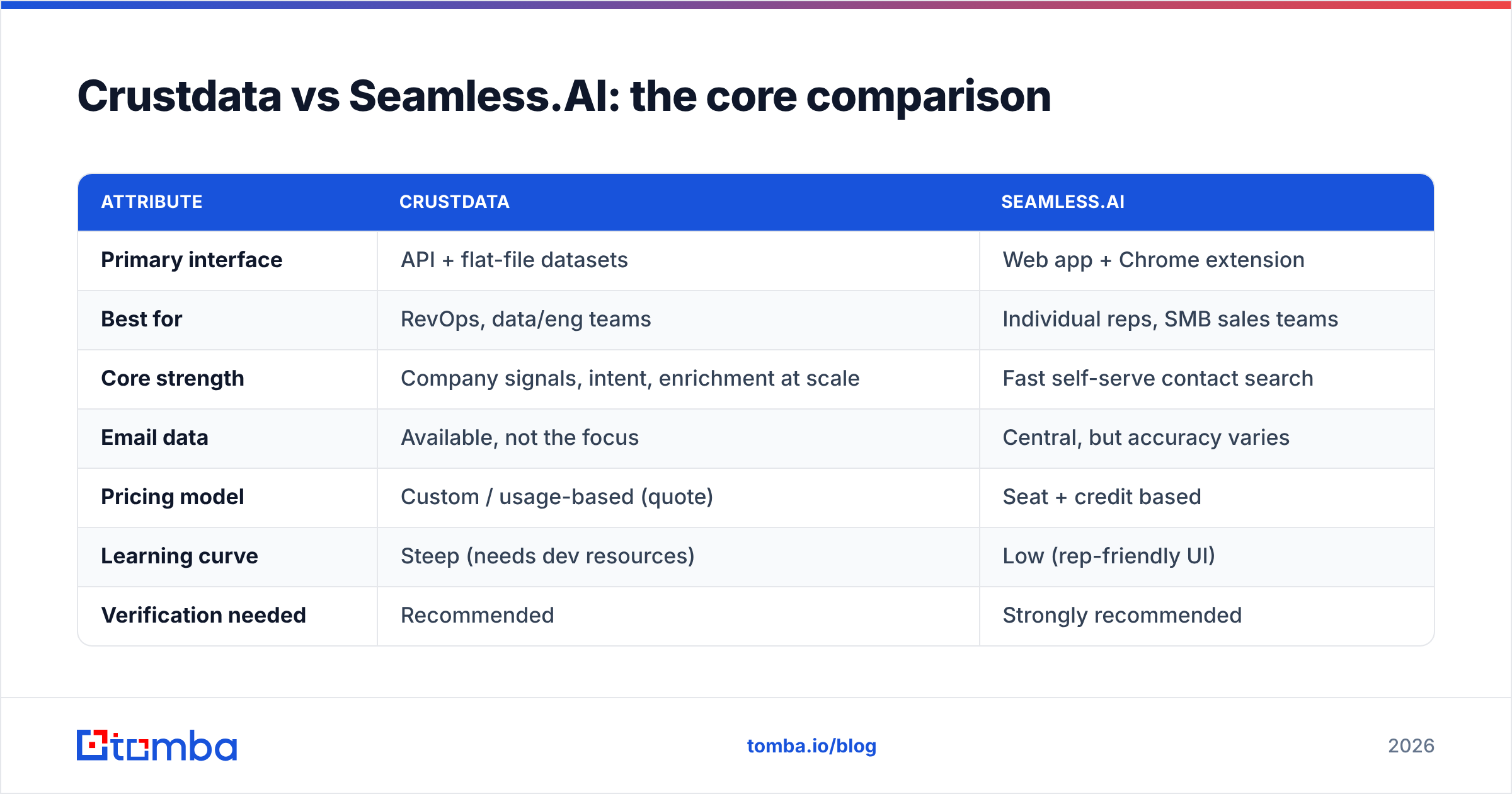
| Attribute | Crustdata | Seamless.AI |
|---|---|---|
| Primary interface | API + flat-file datasets | Web app + Chrome extension |
| Best for | RevOps, data/eng teams | Individual reps, SMB sales teams |
| Core strength | Company signals, intent, enrichment at scale | Fast self-serve contact search |
| Email data | Available, not the focus | Central, but accuracy varies |
| Pricing model | Custom / usage-based (quote) | Seat + credit based |
| Learning curve | Steep (needs dev resources) | Low (rep-friendly UI) |
| Verification needed | Recommended | Strongly recommended |
| Free entry point | Limited / demo-gated | Limited free credits |
The pattern is clear: Crustdata rewards teams that can build on top of data, while Seamless.AI rewards teams that want to point and click. Neither is "wrong" — they're aimed at different buyers.
Which has better data accuracy?#
Accuracy is where this comparison gets uncomfortable, because the honest answer is "verify both."
Crustdata tends to be stronger on company-level data — firmographics, headcount trends, hiring signals — because that's what it's engineered around. Its contact records are decent but not magic; email accuracy depends heavily on the freshness of the underlying record.
Seamless.AI's real-time engine can surface contacts that static databases miss, but it also produces more false positives. When it can't find a confirmed address, it may generate a likely-pattern guess. That's fine as a starting point and dangerous as an ending point: sending to unverified guesses is how you tank your sender reputation and land in spam folders.
The practical takeaway for either tool:
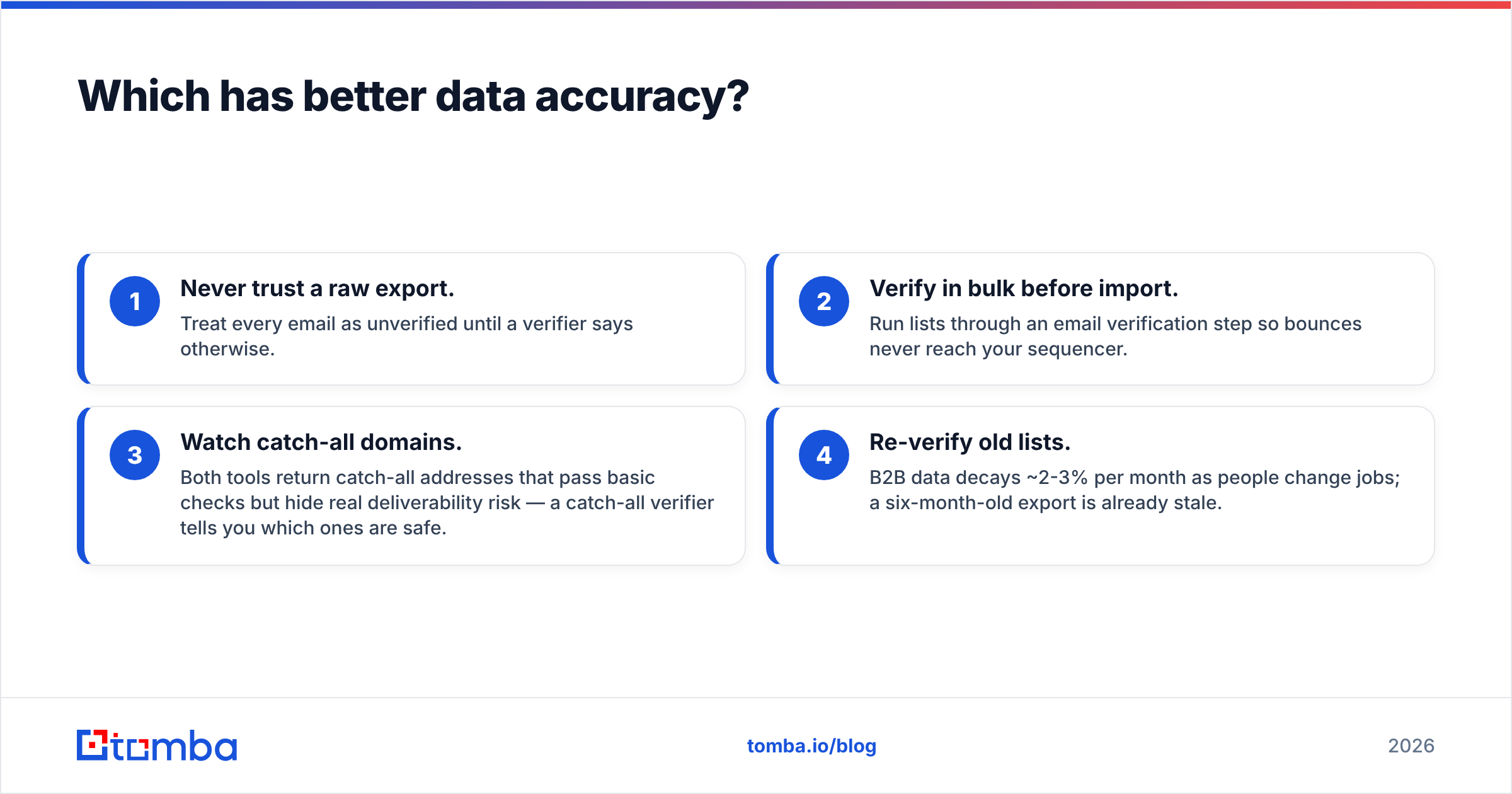
- Never trust a raw export. Treat every email as unverified until a verifier says otherwise.
- Verify in bulk before import. Run lists through an email verification step so bounces never reach your sequencer.
- Watch catch-all domains. Both tools return catch-all addresses that pass basic checks but hide real deliverability risk — a catch-all verifier tells you which ones are safe.
- Re-verify old lists. B2B data decays ~2-3% per month as people change jobs; a six-month-old export is already stale.
Do this and either platform becomes usable. Skip it and even the better tool will burn your domain.
How does pricing compare?#
Pricing is the other place buyers get surprised, because neither vendor makes it simple.
Crustdata uses custom, usage-based pricing — you talk to sales and get a quote scoped to your data volume and endpoints. That's normal for API-first data providers, but it means there's no clean "starts at $X" number, and costs scale with how much you pull. Budget for a real contract, not a credit card signup.
Seamless.AI uses a seat plus credit model. There's a limited free tier, but the useful plans are quoted per seat, and credits deplete as you search and unlock contacts. The common complaint isn't the headline price — it's how fast credits disappear and how the annual commitment is structured. Read the terms before you sign.
Here's how that stacks up against a focused email-finding tool, using Tomba's transparent pricing as the reference point:
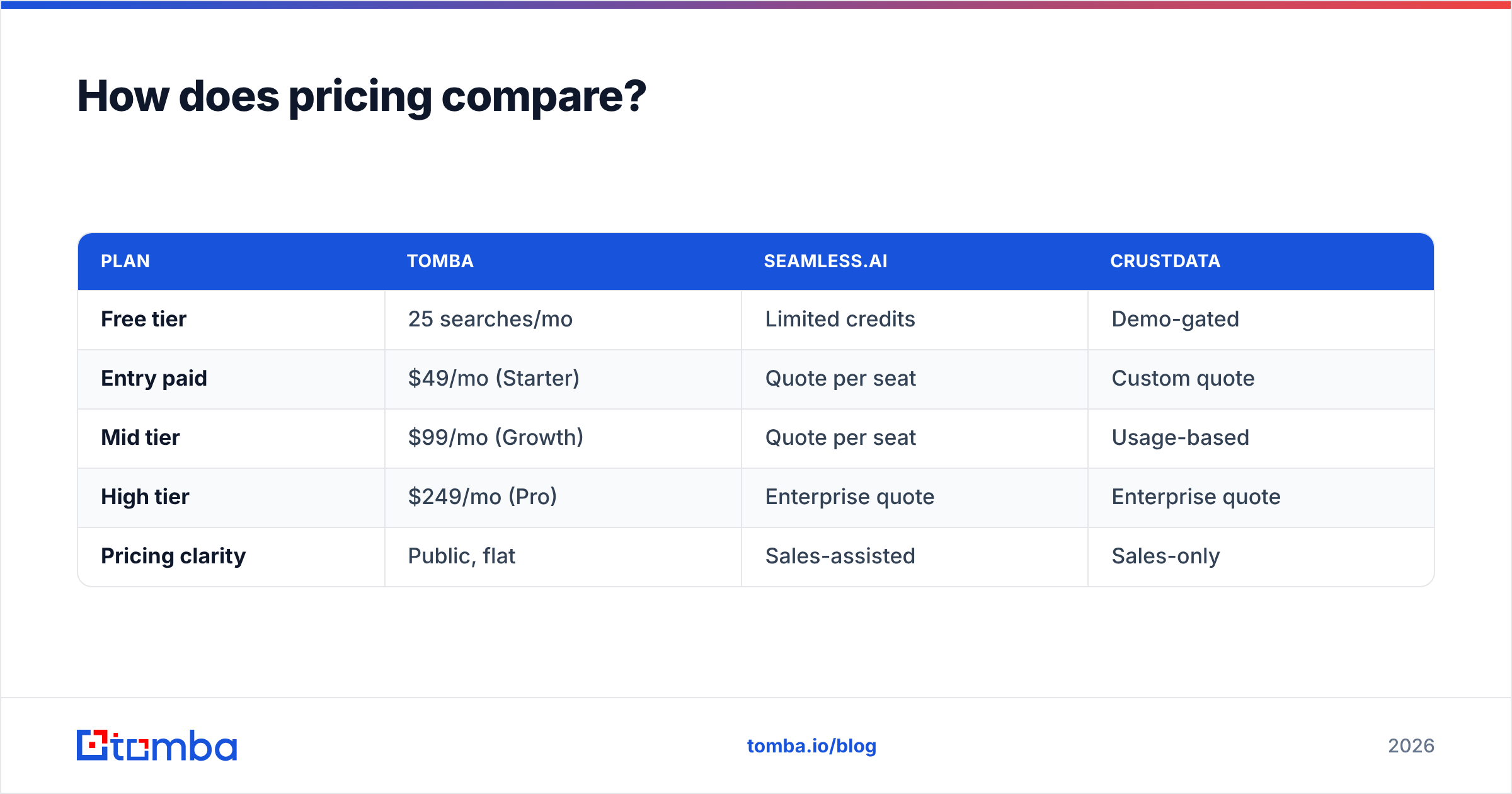
| Plan | Tomba | Seamless.AI | Crustdata |
|---|---|---|---|
| Free tier | 25 searches/mo | Limited credits | Demo-gated |
| Entry paid | $49/mo (Starter) | Quote per seat | Custom quote |
| Mid tier | $99/mo (Growth) | Quote per seat | Usage-based |
| High tier | $249/mo (Pro) | Enterprise quote | Enterprise quote |
| Pricing clarity | Public, flat | Sales-assisted | Sales-only |
If your job is "find verified emails and get out," paying enterprise-data prices is money set on fire. If your job is "power a data platform" or "give 20 reps a self-serve database," the bigger tools earn their keep.
When should you choose Crustdata?#
Choose Crustdata when data is a build, not a buy. Specifically:
- You have engineering resources. Someone on your team can consume an API and wire signals into your CRM, warehouse, or scoring model.
- You care about triggers, not just contacts. You want to know when a company is hiring, growing, or shifting its tech stack — and act on that timing.
- You're doing account-based motions. Firmographic and signal richness matters more to you than raw contact volume.
- You want to own the workflow. You'd rather pipe data into your own system than log into someone else's UI.
If that's you, Crustdata is a strong fit and Seamless.AI will feel limiting. If none of that describes you, you're paying for a Ferrari to drive to the mailbox.
When should you choose Seamless.AI?#
Choose Seamless.AI when reps need self-serve contacts fast and you don't want to build anything:
- Your team lives in a UI. Reps want to search, filter, and export without waiting on ops.
- You value the Chrome extension. Pulling contacts while browsing LinkedIn or company sites fits your workflow.
- You're SMB-scale. You need lists now, and you'll accept some accuracy noise in exchange for speed.
- You'll actually verify. You have a verification step in place so guessed emails never hit send.
Just go in with eyes open on credit burn and accuracy. Many teams treat Seamless.AI as a discovery layer and a separate verifier as the quality gate — which is a smart pattern, not a workaround.
Is there a better option for pure email finding?#
Yes — if email is the actual goal, a dedicated finder beats both on cost and simplicity. This is the honest part most comparison posts skip.
Crustdata and Seamless.AI are platforms. You're buying an ecosystem — signals, databases, extensions, seats. That's valuable when you use all of it. But a huge share of buyers land on these tools for one job: get a verified professional email so they can send a cold email. For that job, a focused tool wins on price, speed, and deliverability.
A purpose-built finder like Tomba does the narrow thing well:
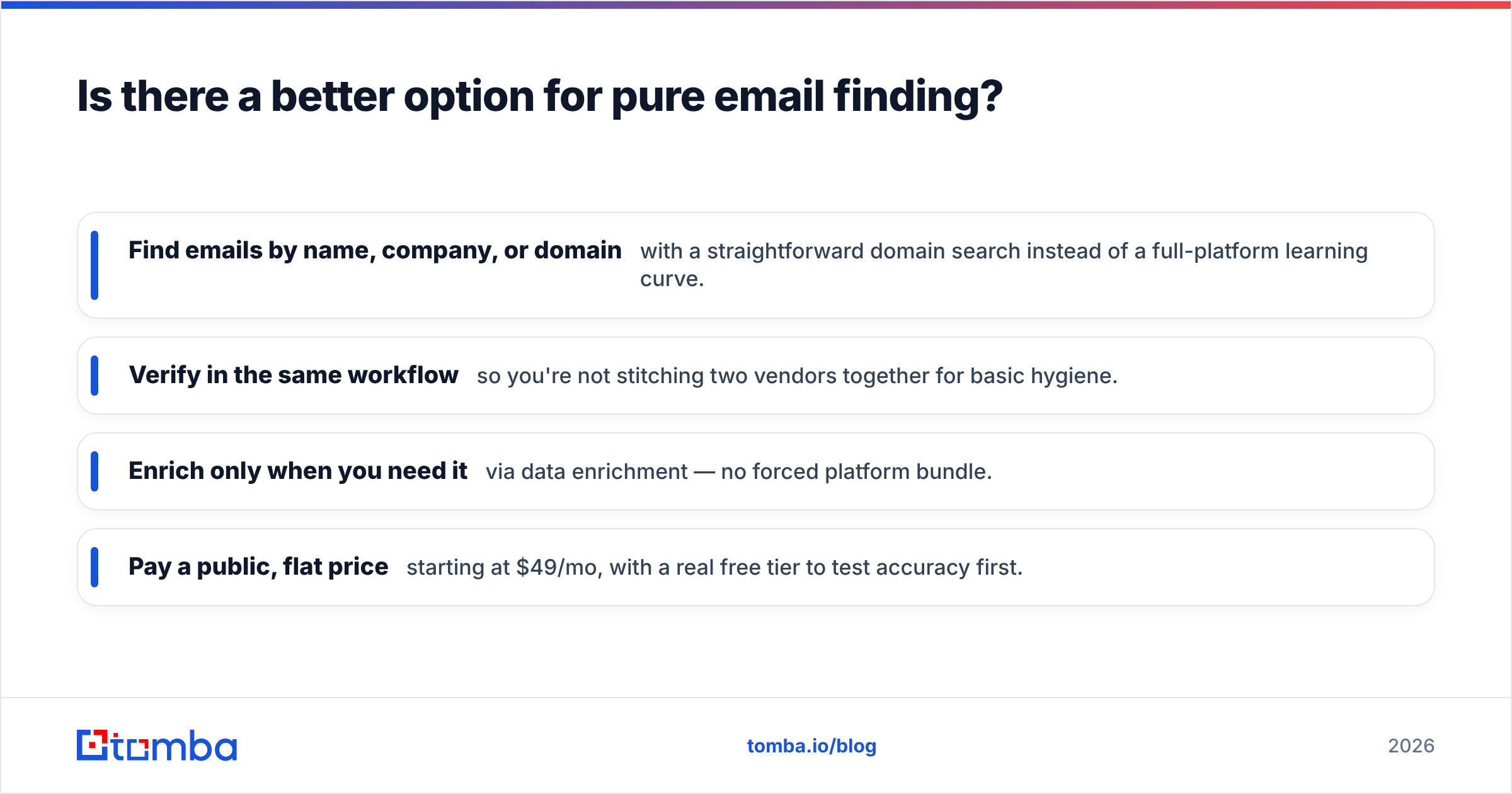
- Find emails by name, company, or domain with a straightforward domain search instead of a full-platform learning curve.
- Verify in the same workflow so you're not stitching two vendors together for basic hygiene.
- Enrich only when you need it via data enrichment — no forced platform bundle.
- Pay a public, flat price starting at $49/mo, with a real free tier to test accuracy first.
It's also a common landing spot for teams shopping Apollo alternatives and other all-in-one platforms who realized they were paying for ten features to use one. If you find yourself doing that math with Crustdata or Seamless.AI, that's your signal.
The rule of thumb: buy the platform when you'll use the platform. Buy the finder when you need emails. Don't buy the platform as a finder — that's the most expensive way to get an email address.
Crustdata vs Seamless.AI: the verdict#
There's no universal winner, only a right answer per team.
- Pick Crustdata if you have developers and you're building data-driven, signal-based motions. It's the strongest option for programmatic company intelligence.
- Pick Seamless.AI if your reps want a fast, self-serve contact database and you'll pair it with a verifier to control quality.
- Pick a dedicated email finder if your real need is verified emails for outbound — you'll spend far less and avoid platform overhead you won't use.
Whatever you choose, the constant is verification. Both Crustdata and Seamless.AI ship data that decays and occasionally guesses, so a verification gate isn't optional — it's the difference between a healthy domain and a blocklisted one.
Start with clean, verified emails#
If your outreach lives or dies on reaching real inboxes, start with the tool built for exactly that. The Tomba Email Finder finds professional email addresses by domain, name, or company — and pairs with built-in verification so every address is send-ready before it hits your sequencer. Test it on the free tier (25 searches/mo), check the accuracy against your current list, and only scale up if the numbers hold. When emails are the job, buy the tool that does the job — not the platform that happens to include it.
Related guides#
Ready to find emails that actually work?
Join 150,000+ professionals who stopped guessing and started sending. Free credits on signup — no credit card required.
Get the Tomba newsletter
Practical outbound tactics and product updates — once every two weeks.
About the author