Crustdata vs Smarte (2026): Which B2B Data Tool Wins?
Crustdata vs Smarte, compared on data freshness, coverage, pricing, and API access — plus where a lean email-finder stack beats both for outbound teams.
Choosing between Crustdata and Smarte comes down to one question: do you need a raw data firehose to build on, or a packaged sales-intelligence tool your reps can open and use today? This guide compares both on coverage, freshness, compliance, API depth, and price — then shows where a leaner email-finder stack outperforms both for pure outbound.
TL;DR#
- Crustdata is an API-first data provider built for engineers who want real-time company and people data piped into their own products, dashboards, or models.
- Smarte (SMARTe) is a sales-intelligence platform focused on GDPR/CCPA-compliant contact data, mobile numbers, and account intelligence for reps working inside a CRM or Chrome extension.
- Crustdata wins on developer flexibility and data freshness; Smarte wins on out-of-the-box usability and compliance coverage.
- Both are priced for teams, not solo prospectors — expect four- to five-figure annual commitments.
- If your real goal is finding and verifying business emails for outbound, a focused tool like the Tomba Email Finder delivers most of the value at a fraction of the cost.
What is Crustdata?#
Crustdata is a B2B data API that delivers real-time firmographic, headcount, and people data. Think of it as the plumbing rather than the faucet: instead of a polished app, you get clean, structured endpoints you query to pull company growth signals, employee counts over time, technographics, and contact records directly into whatever you're building.
Its core audience is technical. Data teams, RevOps engineers, and startups building their own sales-intelligence layers use Crustdata because they want to own the pipeline, not rent someone else's UI. The pitch is freshness and depth — company data refreshed frequently, with time-series signals (like month-over-month headcount changes) that most packaged tools flatten into a single snapshot.
The tradeoff is obvious: there's no rep-friendly interface waiting for you. If your team can't write an API call or wire up a data enrichment workflow, Crustdata's raw power is hard to unlock.
What is Smarte?#
Smarte (styled SMARTe) is a sales-intelligence platform built around compliant contact data — verified business emails, direct-dial and mobile numbers, and account intelligence, wrapped in a Chrome extension and CRM integrations your reps actually touch.
Where Crustdata assumes you'll build, Smarte assumes you'll click. A rep browsing LinkedIn or a company site can pull contact details on the spot, push them to Salesforce or HubSpot, and move on. Its strongest selling point is data compliance: Smarte leans heavily on GDPR- and CCPA-aligned sourcing, which matters if you sell into Europe or operate in regulated industries.
The catch is the usual sales-intelligence catch — coverage and accuracy vary by region and seniority, mobile-number availability is uneven, and the "compliant" positioning sometimes means fewer records surface than a less cautious competitor would show.
Crustdata vs Smarte: side-by-side comparison#
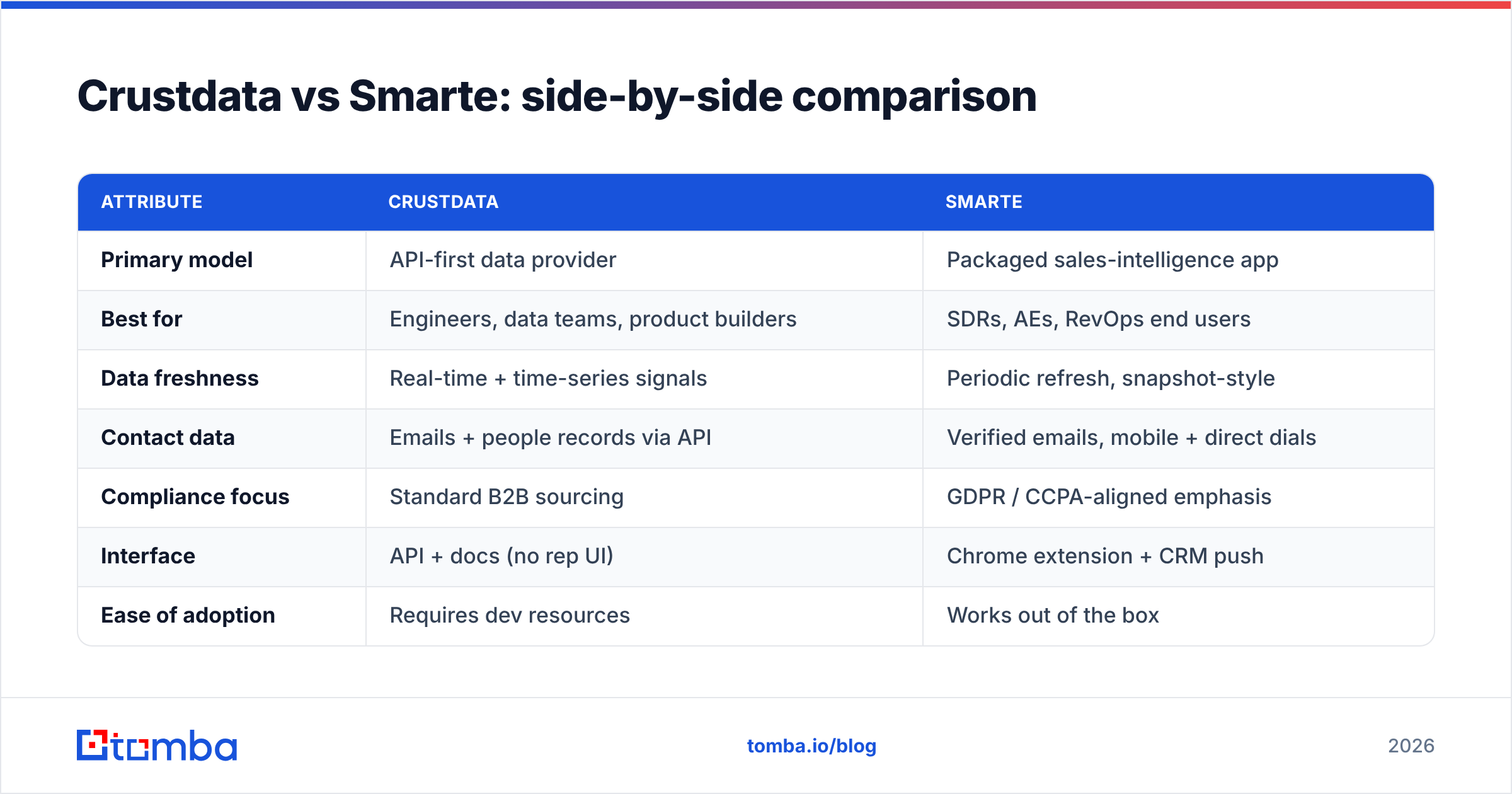
Here's how the two stack up on the attributes that actually drive a buying decision.
| Attribute | Crustdata | Smarte |
|---|---|---|
| Primary model | API-first data provider | Packaged sales-intelligence app |
| Best for | Engineers, data teams, product builders | SDRs, AEs, RevOps end users |
| Data freshness | Real-time + time-series signals | Periodic refresh, snapshot-style |
| Contact data | Emails + people records via API | Verified emails, mobile + direct dials |
| Compliance focus | Standard B2B sourcing | GDPR / CCPA-aligned emphasis |
| Interface | API + docs (no rep UI) | Chrome extension + CRM push |
| Ease of adoption | Requires dev resources | Works out of the box |
| Pricing | Custom, usage/seat-based | Custom, seat-based |
| Learning curve | Steep (technical) | Low (rep-friendly) |
The pattern is clear. Crustdata rewards teams with engineering capacity who want control and fresh signals. Smarte rewards teams who want contacts in a CRM by Friday without touching a single line of code.
Is Crustdata better than Smarte for data freshness?#
For freshness and signal depth, Crustdata generally edges ahead. Its time-series approach — tracking how a company's headcount, hiring, or department size changes over weeks and months — is genuinely hard to replicate with a snapshot-based tool. If you're building lead-scoring models or triggering outreach on growth signals, that temporal data is the whole point.
Smarte's data is refreshed on a slower cadence and presented as a current-state snapshot. That's perfectly adequate for a rep who needs a working email and phone number right now, but it won't tell you that a target account just doubled its sales team last quarter.
So the honest framing: Crustdata is better if you can consume the freshness. A snapshot you can actually use beats a real-time feed you can't query. Match the tool to your team's technical reality, not to the spec sheet.
Which has better contact data and phone numbers?#
This is where Smarte was purpose-built to compete. Direct-dial and mobile numbers are its headline feature, and for teams running heavy phone-based outbound, packaged access to those numbers — with compliance guardrails — is valuable. Crustdata surfaces contact records too, but phone coverage is not its central promise; you're more likely to get strong email and firmographic data than a reliable mobile number for every contact.
That said, no single provider wins every region or seniority band. Serious outbound teams almost always layer a dedicated verification and lookup step on top of whatever database they buy. That's where standalone tools matter: run purchased records through an email verifier to strip dead addresses before they hurt your sender reputation, and fill phone gaps with a focused phone finder rather than trusting one vendor's coverage blindly.
How do Crustdata and Smarte compare on pricing?#
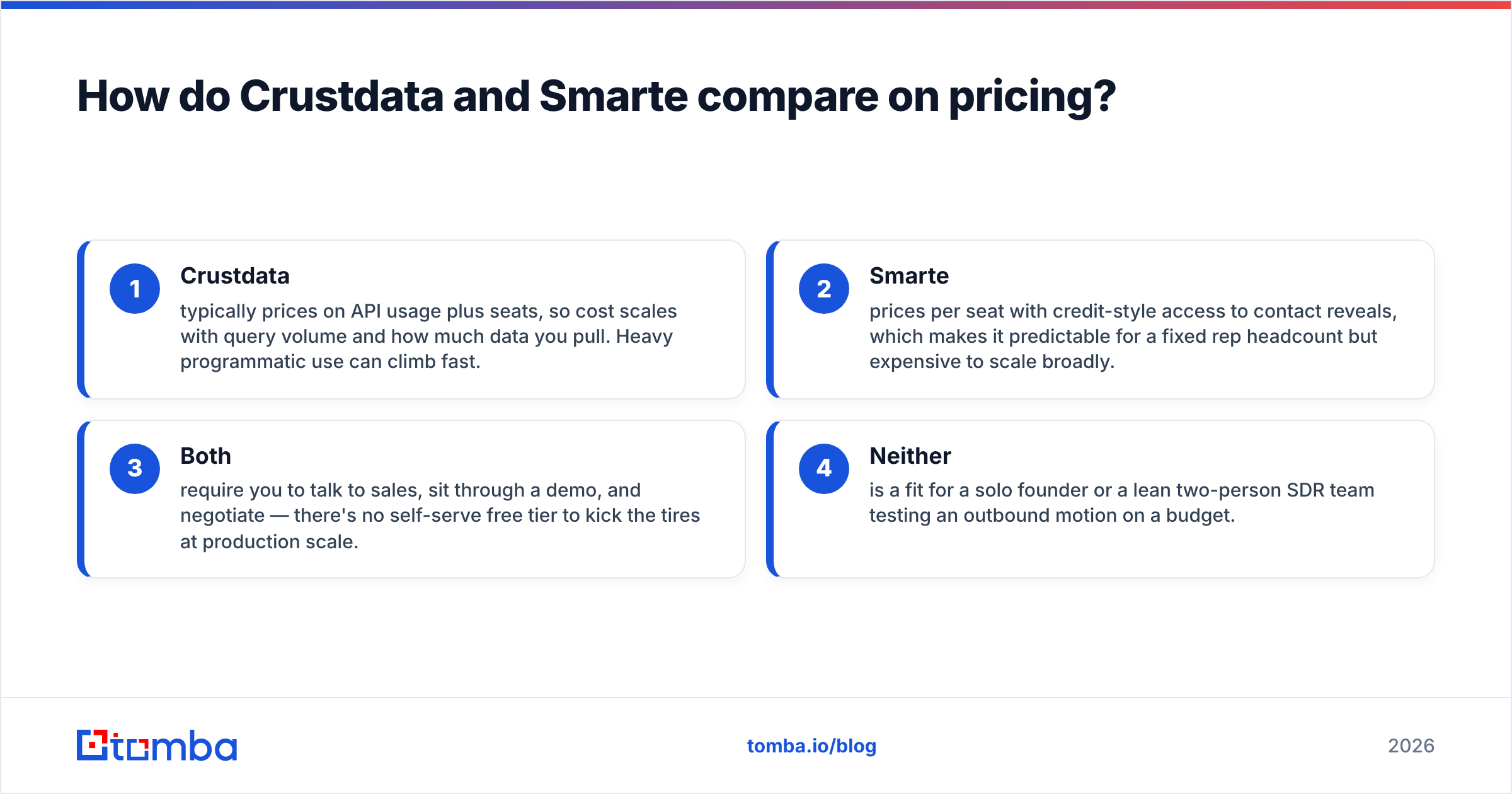
Neither Crustdata nor Smarte publishes simple, transparent pricing — both run custom, sales-led quotes, which is the norm for enterprise B2B data. Expect that:
- Crustdata typically prices on API usage plus seats, so cost scales with query volume and how much data you pull. Heavy programmatic use can climb fast.
- Smarte prices per seat with credit-style access to contact reveals, which makes it predictable for a fixed rep headcount but expensive to scale broadly.
- Both require you to talk to sales, sit through a demo, and negotiate — there's no self-serve free tier to kick the tires at production scale.
- Neither is a fit for a solo founder or a lean two-person SDR team testing an outbound motion on a budget.
That last point is the one buyers underestimate. If your actual job to be done is "find verified business emails and reach the right people," you're often paying enterprise-platform prices for a sliver of the platform you'll use.
When is a focused email-finder stack the smarter buy?#
Reach for a lightweight, purpose-built stack when finding and verifying contacts — not building a data product — is the real goal. Most outbound teams don't need time-series headcount graphs or a 40-field enrichment schema. They need accurate emails, working phone numbers, and clean lists, fast.
That's the gap tools like Tomba fill. Instead of a five-figure annual contract, you get pay-as-you-grow access to the exact functions outbound runs on:
- Find emails at scale — use domain search to pull every reachable contact at a target company, or the email finder for named prospects.
- Verify before you send — catch invalid and risky addresses so bounces don't tank your deliverability.
- Enrich and integrate — push clean records into your CRM through native integrations or the Tomba API when you do want to build.
- Stay affordable — transparent Tomba pricing starts with a free tier (25 searches/month), then Starter at $49/mo, Growth at $99/mo, and Pro at $249/mo.
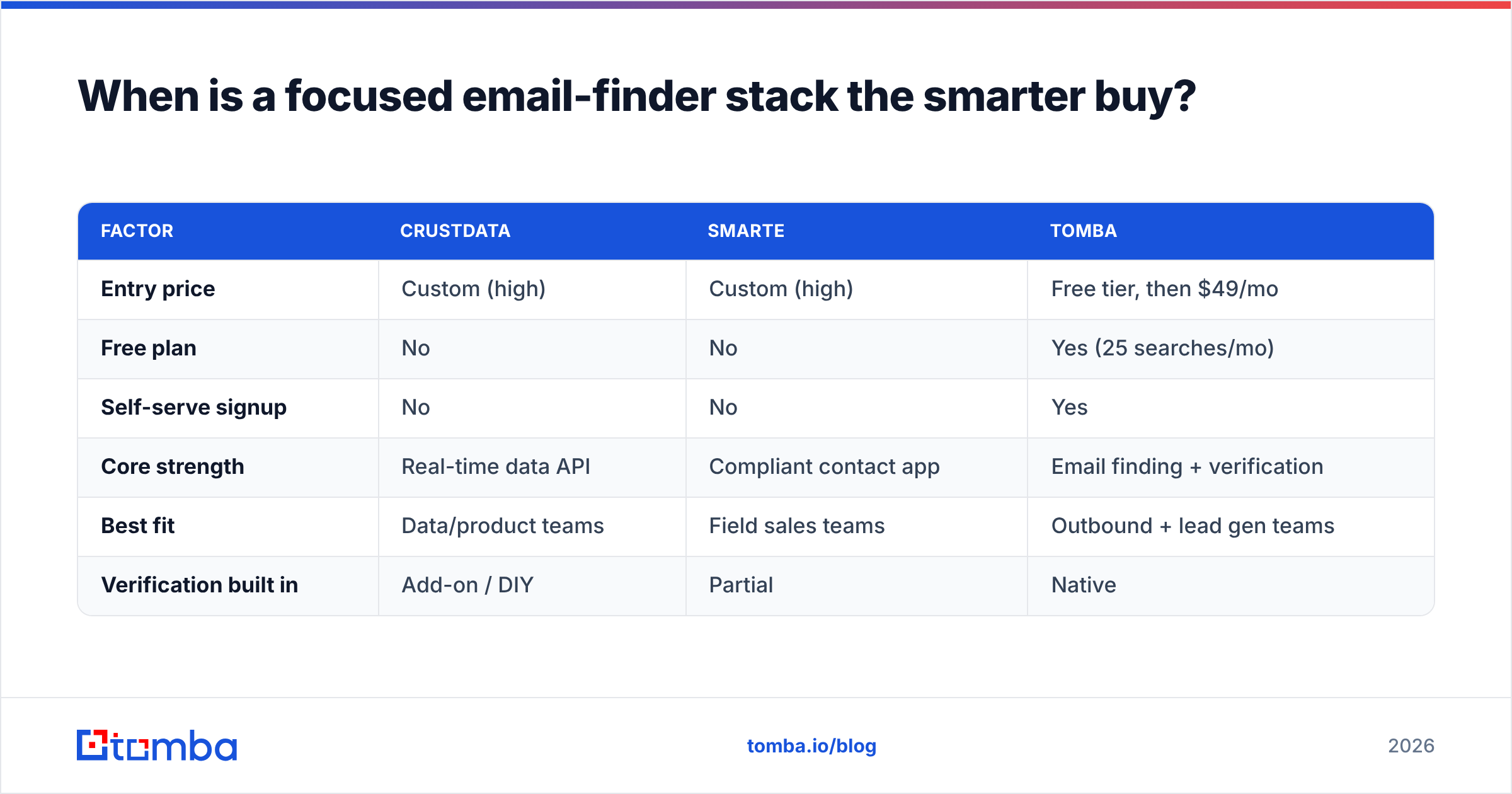
Here's how the positioning compares against the two platforms:
| Factor | Crustdata | Smarte | Tomba |
|---|---|---|---|
| Entry price | Custom (high) | Custom (high) | Free tier, then $49/mo |
| Free plan | No | No | Yes (25 searches/mo) |
| Self-serve signup | No | No | Yes |
| Core strength | Real-time data API | Compliant contact app | Email finding + verification |
| Best fit | Data/product teams | Field sales teams | Outbound + lead gen teams |
| Verification built in | Add-on / DIY | Partial | Native |
This isn't to say Tomba replaces a full data-intelligence platform for every use case — if you genuinely need headcount time-series or deep account-intelligence dashboards, buy the platform. But for the majority of teams whose north star is booked meetings from cold outreach, the focused stack wins on speed, cost, and simplicity.
Which should you choose?#
Match the tool to the job, not the hype:
- Choose Crustdata if you have engineering resources and want to own a fresh, queryable data pipeline for lead scoring, product features, or custom RevOps workflows. You can read more on their official site and cross-check user reviews on G2.
- Choose Smarte if your reps live in a CRM and Chrome extension, you sell into GDPR/CCPA-sensitive regions, and phone-based outbound with compliant contact data is central. Their positioning is detailed at smarte.pro.
- Choose a focused email-finder stack if your real goal is outbound volume — accurate emails, verified lists, and reasonable pricing — without an enterprise contract or a developer to unlock the value.
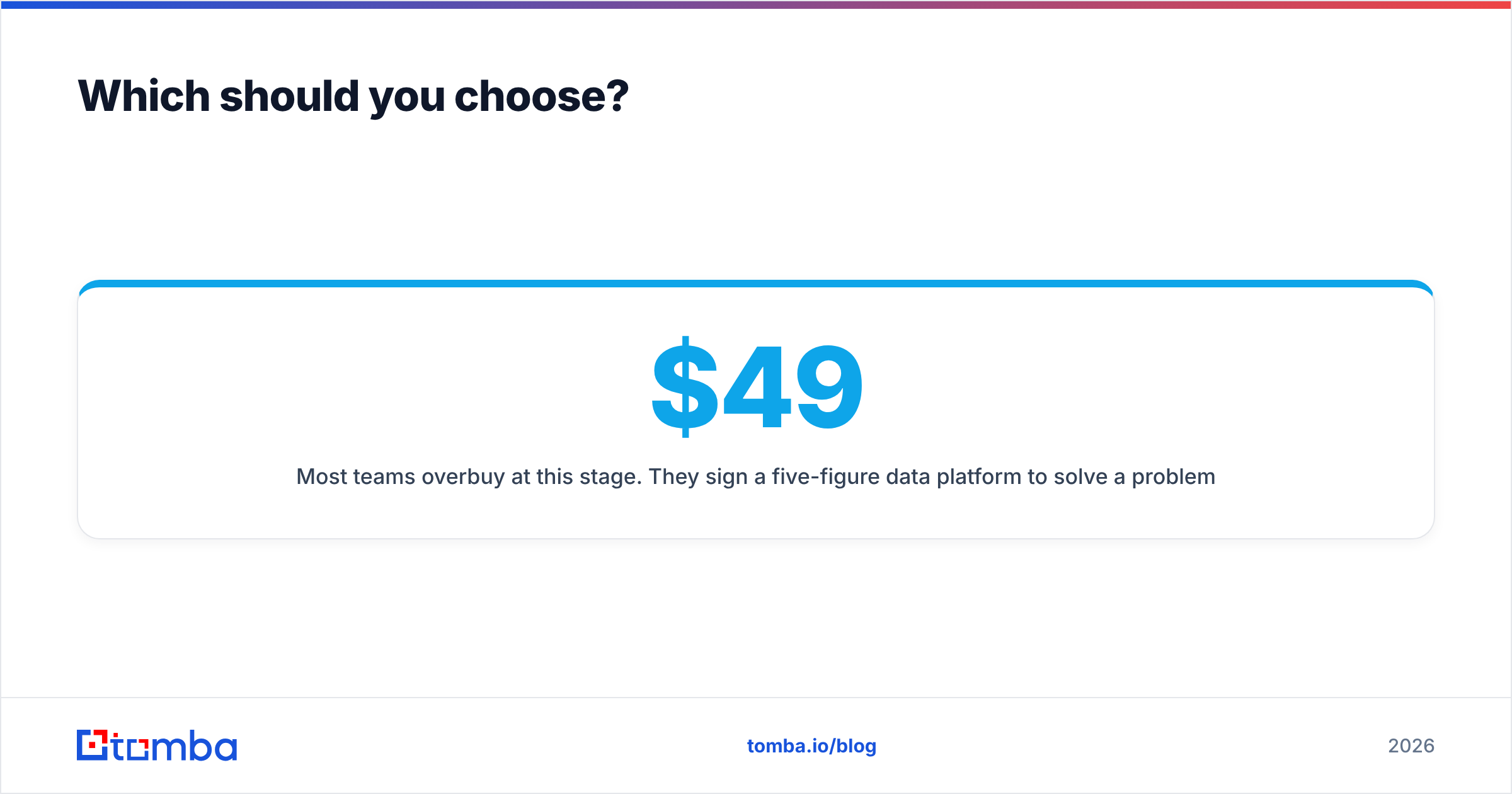
Most teams overbuy at this stage. They sign a five-figure data platform to solve a problem a $49–$99 tool would have handled, then use 10% of the feature set. Be honest about your job to be done before you sign.
The bottom line#
Crustdata and Smarte are both credible B2B data tools serving different buyers: Crustdata for builders who want a real-time API, Smarte for reps who want compliant contacts in their CRM. Neither is "better" in the abstract — they're better for different teams.
But if you strip the decision down to what most outbound and lead-gen teams actually do every day — find the right people, get verified emails, and reach out — you don't need to start with an enterprise platform. Start lean, prove the motion, and scale your data spend only when the pipeline justifies it.
Ready to test the fastest path? Spin up the free tier of the Tomba Email Finder, pull verified business emails by name or domain in seconds, and see how much of your "data platform" wishlist you actually needed. Upgrade only when your outbound proves it's worth it.
Related guides#
Ready to find emails that actually work?
Join 150,000+ professionals who stopped guessing and started sending. Free credits on signup — no credit card required.
Get the Tomba newsletter
Practical outbound tactics and product updates — once every two weeks.
About the author