Crustdata vs Tomba (2026): Which B2B Data Tool Wins?
Crustdata is a real-time data API; Tomba is an email-finding and enrichment suite. Here's an honest, side-by-side breakdown of accuracy, pricing, and the right use case for each.
Choosing between Crustdata and Tomba usually means you're stuck at a fork: do you need a raw firmographic data pipe, or do you need verified contact details you can email today? They look similar on a feature grid, but they solve different problems. This guide breaks down where each one actually earns its price.
TL;DR — Crustdata vs Tomba in 30 seconds#
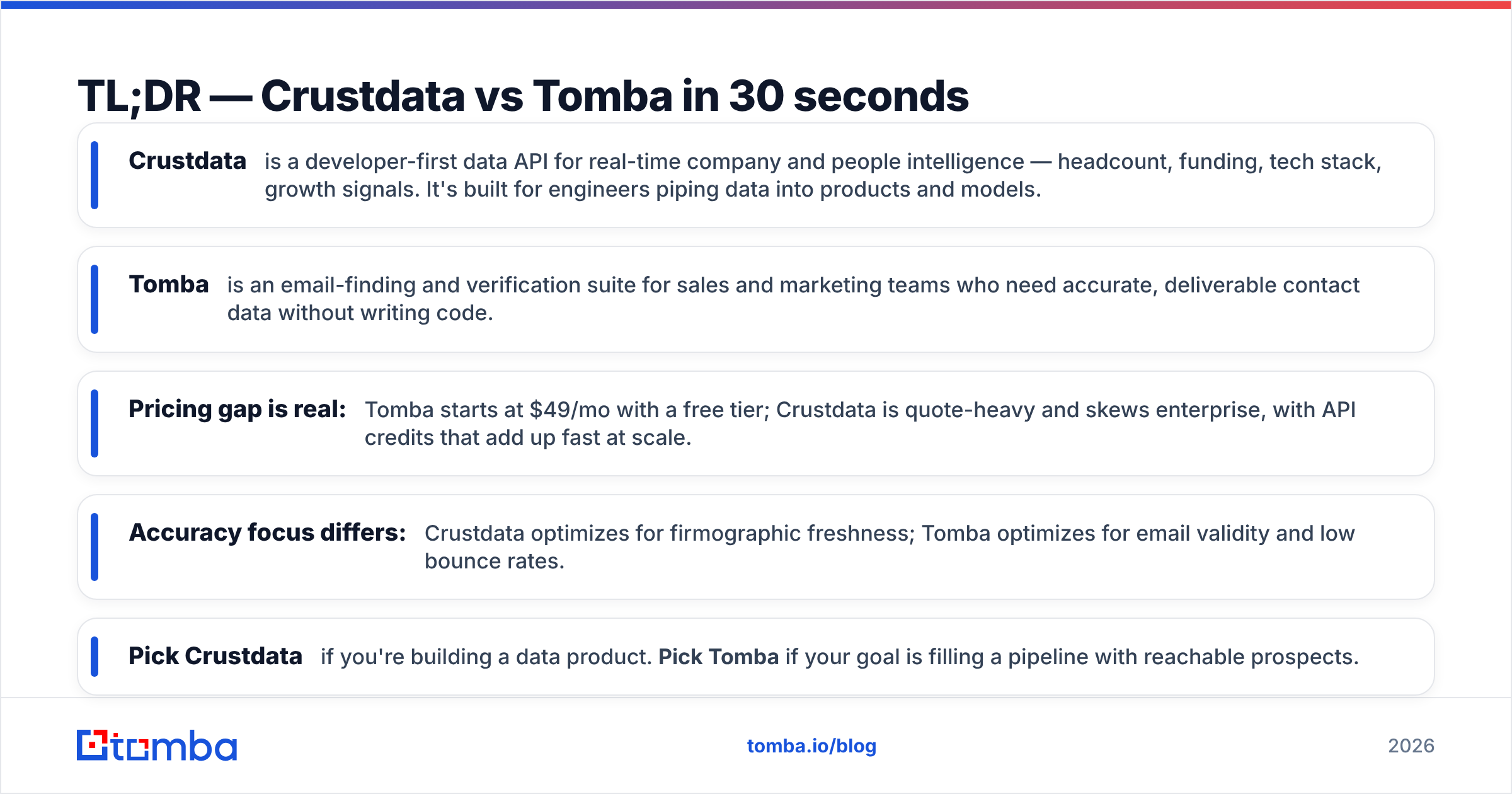
- Crustdata is a developer-first data API for real-time company and people intelligence — headcount, funding, tech stack, growth signals. It's built for engineers piping data into products and models.
- Tomba is an email-finding and verification suite for sales and marketing teams who need accurate, deliverable contact data without writing code.
- Pricing gap is real: Tomba starts at $49/mo with a free tier; Crustdata is quote-heavy and skews enterprise, with API credits that add up fast at scale.
- Accuracy focus differs: Crustdata optimizes for firmographic freshness; Tomba optimizes for email validity and low bounce rates.
- Pick Crustdata if you're building a data product. Pick Tomba if your goal is filling a pipeline with reachable prospects.
What is Crustdata?#
Crustdata is a B2B data platform delivered primarily as an API. Its pitch is real-time company and people data: employee headcount trends, job-opening counts, funding rounds, web traffic, technographics, and social signals. Think of it as a data warehouse you query on demand — you send a domain or a person's profile URL, and it returns a structured JSON payload of intelligence.
The audience is technical. Crustdata is popular with founders building sales-intelligence products, data scientists training lead-scoring models, and growth engineers who want signals (like "this company just tripled its sales team") to trigger outbound. You can see the depth of its firmographic feed on the Crustdata site, and it's positioned much closer to a data infrastructure vendor than a point tool.
What Crustdata is not is a plug-and-play prospecting app. There's no polished Chrome extension for a non-technical SDR, and email discovery is not its headline strength. It gives you the raw material; you build the workflow.
What is Tomba?#
Tomba is an email-finding and contact-enrichment suite aimed at people who need to reach prospects, not just describe them. Its core is the email finder: give it a name and a company domain, and it returns the person's professional email, scored for confidence. Around that core sits a full toolkit — an email verifier, domain search to pull every address at a company, a catch-all verifier, a phone finder, and data enrichment.
Tomba is deliberately accessible. You get a web app, a Chrome extension, Google Sheets and Excel add-ins, and a clean email finder API if you want to automate. It serves the same technical crowd Crustdata does and the non-technical SDR who lives in a spreadsheet. The whole product is optimized around one outcome: contact data that lands in an inbox instead of bouncing.
The philosophical difference is simple. Crustdata answers "who is this company and what are they doing?" Tomba answers "how do I email the right person there, and will it deliver?"
Crustdata vs Tomba: side-by-side comparison#
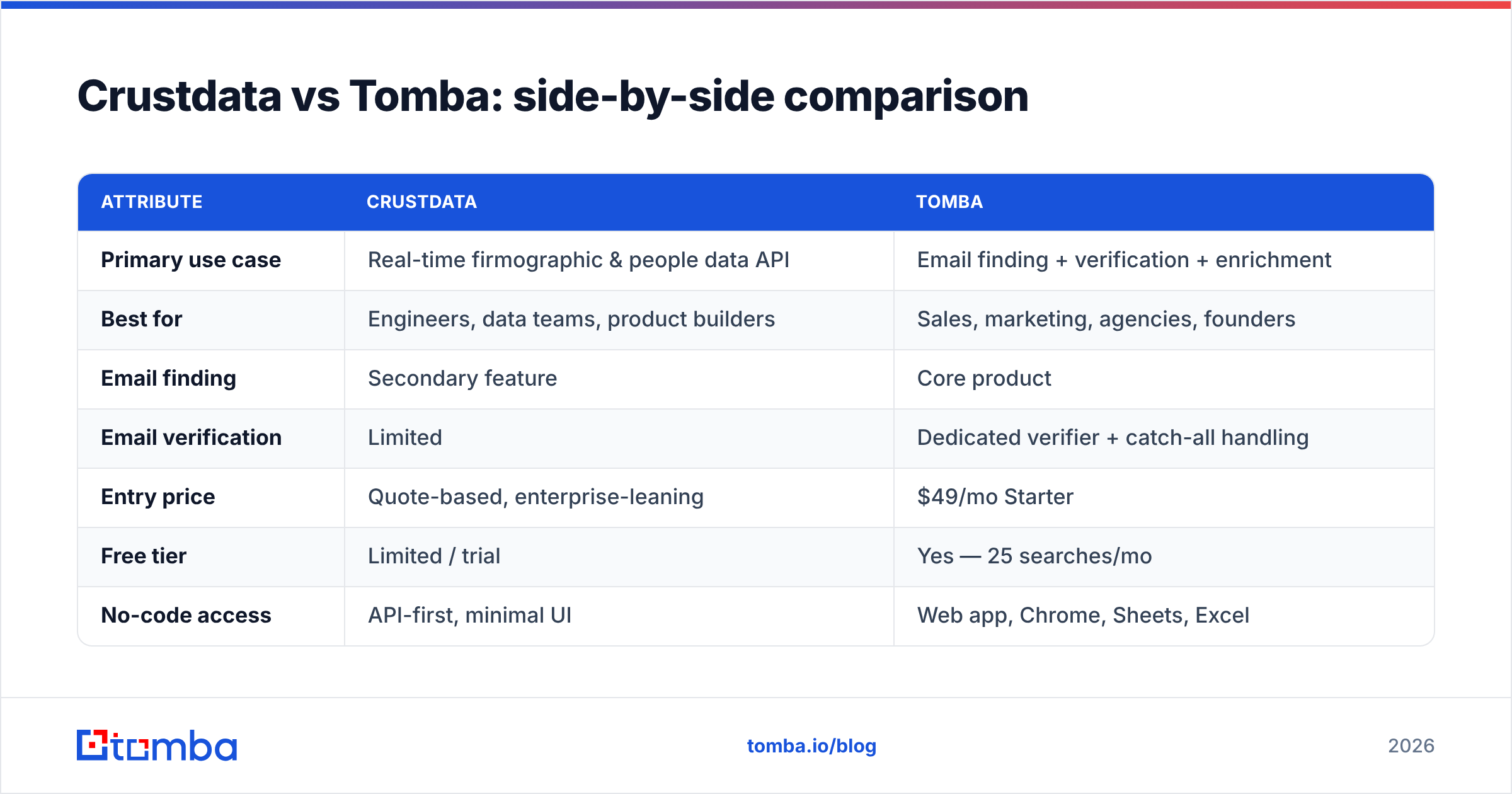
Here's the head-to-head on the attributes that actually decide the purchase.
| Attribute | Crustdata | Tomba |
|---|---|---|
| Primary use case | Real-time firmographic & people data API | Email finding + verification + enrichment |
| Best for | Engineers, data teams, product builders | Sales, marketing, agencies, founders |
| Email finding | Secondary feature | Core product |
| Email verification | Limited | Dedicated verifier + catch-all handling |
| Entry price | Quote-based, enterprise-leaning | $49/mo Starter |
| Free tier | Limited / trial | Yes — 25 searches/mo |
| No-code access | API-first, minimal UI | Web app, Chrome, Sheets, Excel |
| Phone numbers | Available via data feed | Dedicated phone finder + validator |
| Learning curve | Steep (developer-oriented) | Low |
| Ideal buyer | "I'm building a data product" | "I'm filling a sales pipeline" |
The table makes the split clear: these tools overlap on the words "B2B data," but they diverge hard on who touches the product and what the output is for.
How do they compare on data accuracy?#
Accuracy is where the "same category" illusion falls apart, because the two tools measure different things.
Crustdata's accuracy story is about freshness of firmographics. Its selling point is that headcount, hiring, and funding data are updated frequently, so a growth signal you act on today reflects reality this week, not last quarter. If your model depends on detecting momentum, that recency matters more than any single field's precision.
Tomba's accuracy story is about email validity and deliverability. An email finder is only as good as the percentage of addresses that actually accept mail. Tomba runs SMTP-level checks, scores each result with a confidence level, and handles the notoriously tricky catch-all domains with a dedicated catch-all verifier so you're not flying blind. You can read how the platform sources and validates records on the Tomba data page.
Why does this distinction matter? Because a firmographically "perfect" record with a dead email address is useless to an SDR, and a valid email with stale headcount data is fine for a cold campaign. Match the accuracy dimension to your job:
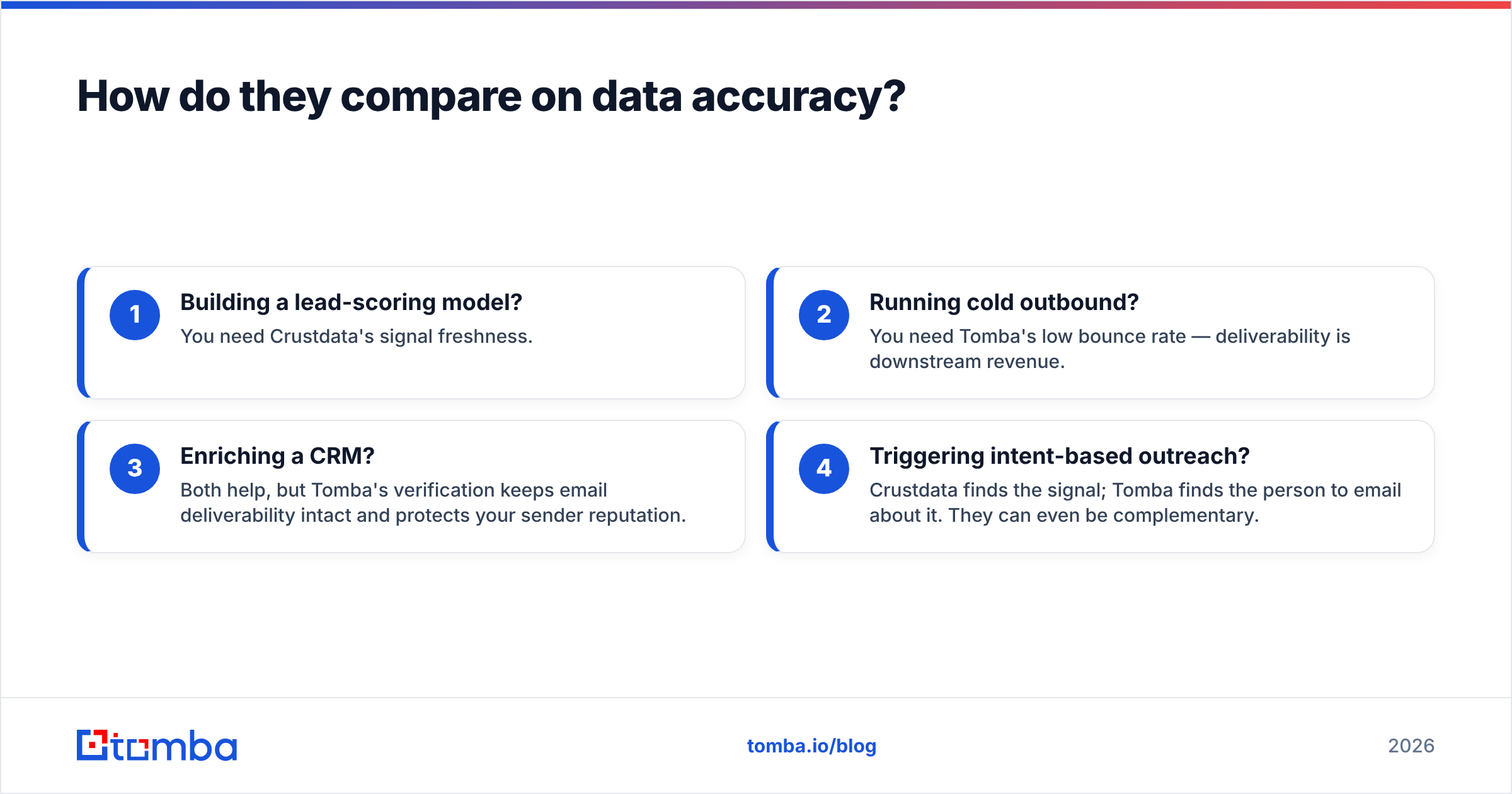
- Building a lead-scoring model? You need Crustdata's signal freshness.
- Running cold outbound? You need Tomba's low bounce rate — deliverability is downstream revenue.
- Enriching a CRM? Both help, but Tomba's verification keeps email deliverability intact and protects your sender reputation.
- Triggering intent-based outreach? Crustdata finds the signal; Tomba finds the person to email about it. They can even be complementary.
A high bounce rate doesn't just waste sends — it damages your domain reputation, which quietly tanks every future campaign. That's why teams focused on outbound weight email verification so heavily. Industry deliverability guidance from vendors like HubSpot consistently ties list hygiene directly to inbox placement.
How does pricing compare?#
Pricing is the most concrete difference, and it's where budget-conscious teams usually make the call.
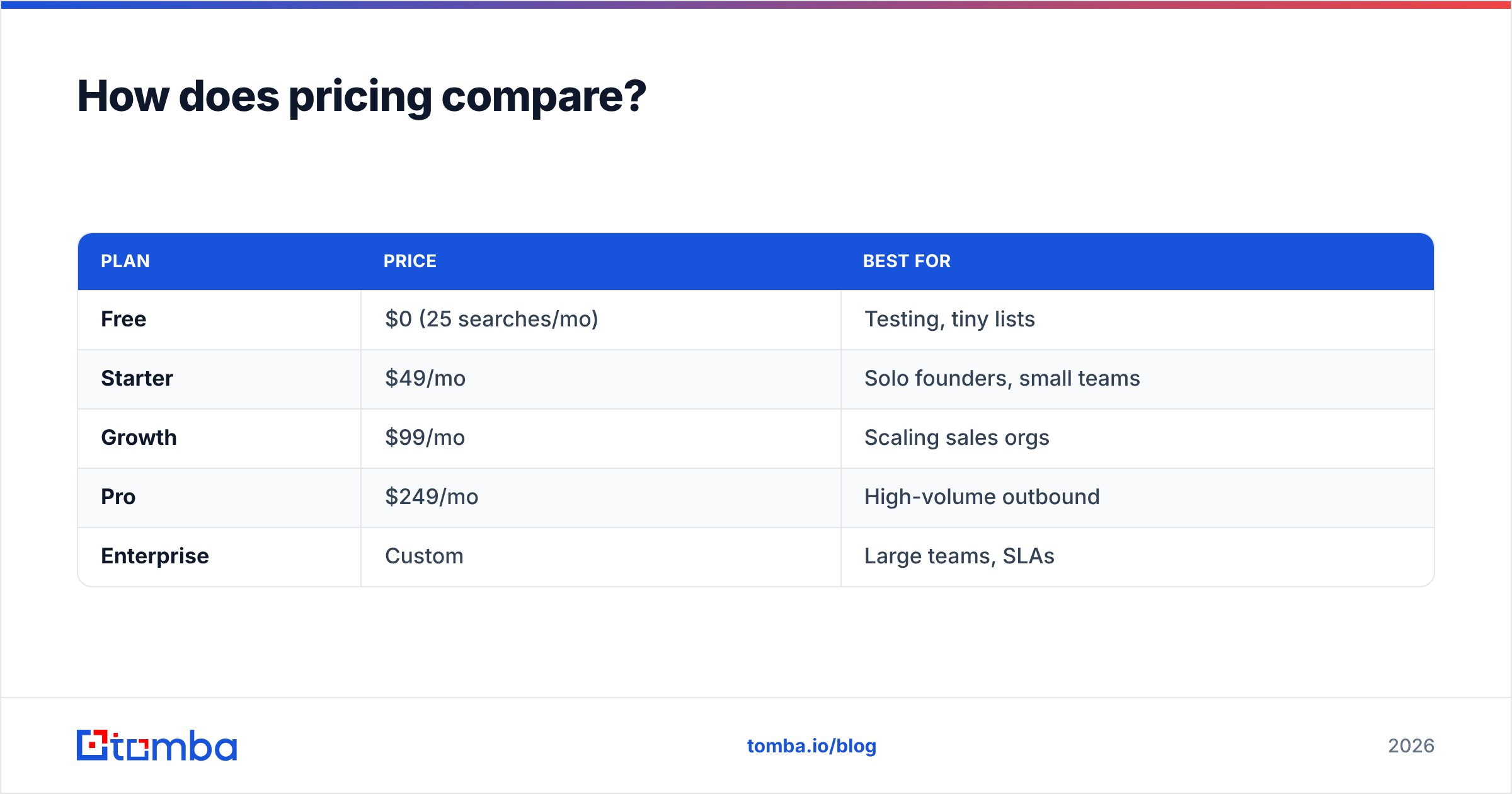
Tomba publishes transparent, self-serve tiers. You can start free, scale on a credit card, and never talk to a salesperson if you don't want to. Full Tomba pricing looks like this:
| Plan | Price | Best for |
|---|---|---|
| Free | $0 (25 searches/mo) | Testing, tiny lists |
| Starter | $49/mo | Solo founders, small teams |
| Growth | $99/mo | Scaling sales orgs |
| Pro | $249/mo | High-volume outbound |
| Enterprise | Custom | Large teams, SLAs |
Crustdata's pricing is less transparent and skews toward annual, quote-based contracts sized for companies embedding data at scale. That's not a criticism — API infrastructure priced per credit is the norm for data vendors, and heavy programmatic usage genuinely costs more to serve. But it does mean the entry experience is different: Tomba lets a one-person team get value for $49, while Crustdata's model is built around larger commitments and higher volumes.
The practical takeaway: if you're a small team or an agency that needs predictable per-seat costs, Tomba's published tiers are easier to justify. If you're a funded startup building a data-heavy product and need thousands of enriched records via API daily, Crustdata's model may pencil out better despite the higher floor.

Which one fits your workflow?#
Forget the feature checklist for a second and think about who's actually going to use the tool day to day.
Choose Crustdata if:
- You have engineering resources to consume an API.
- Your product or model is the data — you're reselling or scoring it.
- You care most about real-time company signals (hiring, funding, growth).
- Enterprise procurement and annual contracts aren't a blocker.
Choose Tomba if:
- You need verified emails and phone numbers to run outbound now.
- Your users are SDRs, marketers, or founders — not just developers.
- You want no-code access via Chrome extension, Google Sheets, or a web app, plus an API when you're ready.
- Predictable, self-serve pricing matters.
- Deliverability and low bounce rates are non-negotiable.
There's also a "both" answer. Some sophisticated GTM teams use a data-signal source to decide who to contact, then use Tomba to find and verify how to contact them. Crustdata surfaces the account that just raised a Series B; Tomba's bulk email finder turns that account into a verified list of decision-makers you can actually email. They're not always either/or.
Do they integrate with your existing stack?#
Tooling only matters if it lives where you already work. Both tools expose APIs, but their integration philosophies differ.
Tomba leans into no-code and native connectors. Beyond the API, CLI, and MCP server, it plugs into HubSpot, Salesforce, Pipedrive, Zapier, and Make, so a RevOps person can wire up enrichment without engineering tickets. That breadth is a big deal for teams whose CRM is the center of gravity.
Crustdata's integration story is API-centric. You'll typically pull data into your own systems programmatically, which is powerful and flexible — but it assumes you have the developer time to build and maintain those pipes. If you don't, that flexibility becomes a cost.
For a fair external view of how buyers rate each category of tool, review verified reviews on G2 before committing — real user feedback on support responsiveness and data quality often tells you more than any spec sheet.
The verdict: Crustdata vs Tomba#
There's no universal winner, because these tools aren't really competing for the same job.
Crustdata wins when the data itself is your product — when you need fresh, granular firmographic and people signals delivered programmatically, and you have the engineering muscle plus budget to consume an enterprise data API.
Tomba wins when your goal is reaching real people. If you need accurate, verified emails and phone numbers, a low bounce rate to protect your sender reputation, no-code access for a non-technical team, and pricing that starts at $49/mo instead of a procurement cycle, Tomba is the more direct path from "I found a company" to "I booked a meeting."
For most sales and marketing teams — the people who need contacts, not just context — Tomba is the pragmatic pick.
Ready to find and verify contacts that convert?#
If your bottleneck is turning target accounts into a clean, deliverable outbound list, start with the Tomba Email Finder. Find professional emails by name, domain, or company, verify them before you send, and keep your bounce rate low enough to protect every campaign that follows. Spin up the free tier — 25 searches a month, no credit card — and see the accuracy for yourself before you scale to a paid plan.
Related guides#
Ready to find emails that actually work?
Join 150,000+ professionals who stopped guessing and started sending. Free credits on signup — no credit card required.
Get the Tomba newsletter
Practical outbound tactics and product updates — once every two weeks.
About the author