Crustdata vs Warpleads (2026): Which B2B Lead Tool Wins?
Crustdata is a real-time data API; Warpleads is an unlimited-export lead machine. Here's an honest breakdown of pricing, data quality, and which one fits cold email in 2026.
Crustdata and Warpleads solve the same problem from opposite ends. One hands you a real-time data API for engineers building enrichment into their own stack. The other hands you an unlimited-export button for founders who just want more leads in a CSV by lunchtime. Picking the wrong one wastes budget and, worse, poisons your cold email sender reputation.
This is an honest, vendor-neutral breakdown of Crustdata vs Warpleads in 2026: what each does well, where each falls short, what they actually cost, and which one belongs in your outbound stack.
TL;DR: Crustdata vs Warpleads at a glance#
- Crustdata is a developer-first, real-time B2B data and enrichment API. Best for teams building data pipelines, scoring models, or product features that need fresh company and people signals.
- Warpleads is an unlimited-export lead database built for cold email volume. Best for solo founders and agencies who want large, cheap lists fast.
- Neither is a verification layer. Both hand you data; neither guarantees the address still lands. You still need a dedicated email verifier before you send.
- Pricing models differ hard: Crustdata is usage/seat-based and enterprise-leaning; Warpleads sells flat unlimited-export subscriptions.
- The smart play for most cold-email teams is a data source plus a real verification step. That's where a focused tool like Tomba fits between "raw list" and "hitting send."
What is Crustdata?#
Crustdata is a real-time B2B data platform delivered primarily as an API. Instead of a point-and-click list builder, it exposes endpoints for company data, people data, headcount trends, job changes, funding signals, and technographics. You call it; it returns fresh JSON.
The pitch is freshness and depth. Crustdata markets itself on real-time signals rather than a stale quarterly snapshot, which matters if you're building lead scoring, territory routing, or a product feature that surfaces "companies that just raised a Series B." You can read more on the Crustdata site.
Who it fits:
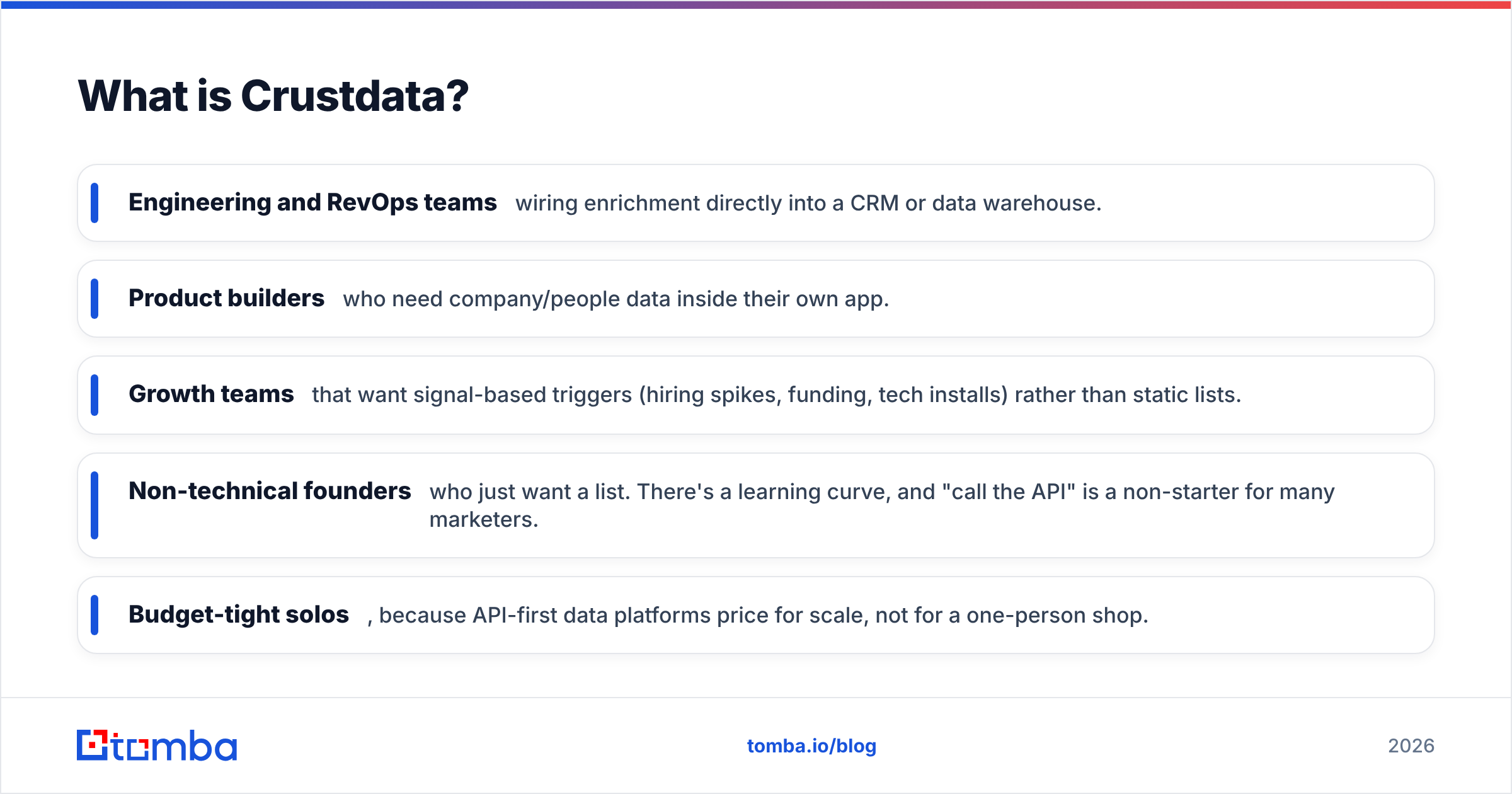
- Engineering and RevOps teams wiring enrichment directly into a CRM or data warehouse.
- Product builders who need company/people data inside their own app.
- Growth teams that want signal-based triggers (hiring spikes, funding, tech installs) rather than static lists.
Who it frustrates:
- Non-technical founders who just want a list. There's a learning curve, and "call the API" is a non-starter for many marketers.
- Budget-tight solos, because API-first data platforms price for scale, not for a one-person shop.
What is Warpleads?#
Warpleads is a lead-generation database built around one headline promise: unlimited exports. You filter a large B2B contact database by title, industry, geography, and company size, then export as many records as your plan allows without per-lead credit metering.
The pitch is volume economics. For agencies and founders running high-tempo cold email, per-lead pricing gets brutal fast. Warpleads flips that by charging a flat subscription and letting you pull big lists. See the official Warpleads site for current specifics.
Who it fits:
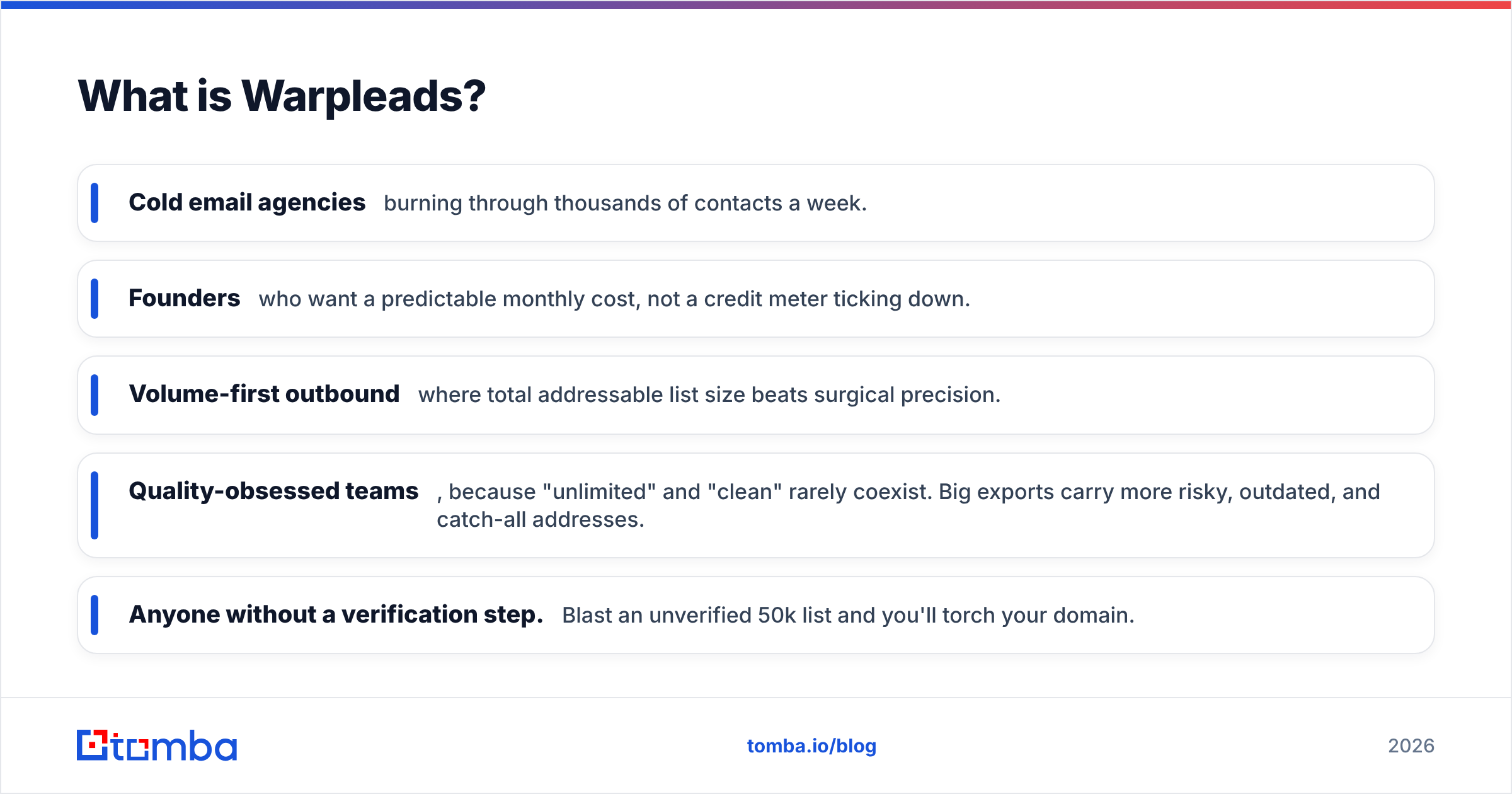
- Cold email agencies burning through thousands of contacts a week.
- Founders who want a predictable monthly cost, not a credit meter ticking down.
- Volume-first outbound where total addressable list size beats surgical precision.
Who it frustrates:
- Quality-obsessed teams, because "unlimited" and "clean" rarely coexist. Big exports carry more risky, outdated, and catch-all addresses.
- Anyone without a verification step. Blast an unverified 50k list and you'll torch your domain.
Crustdata vs Warpleads: the comparison table#
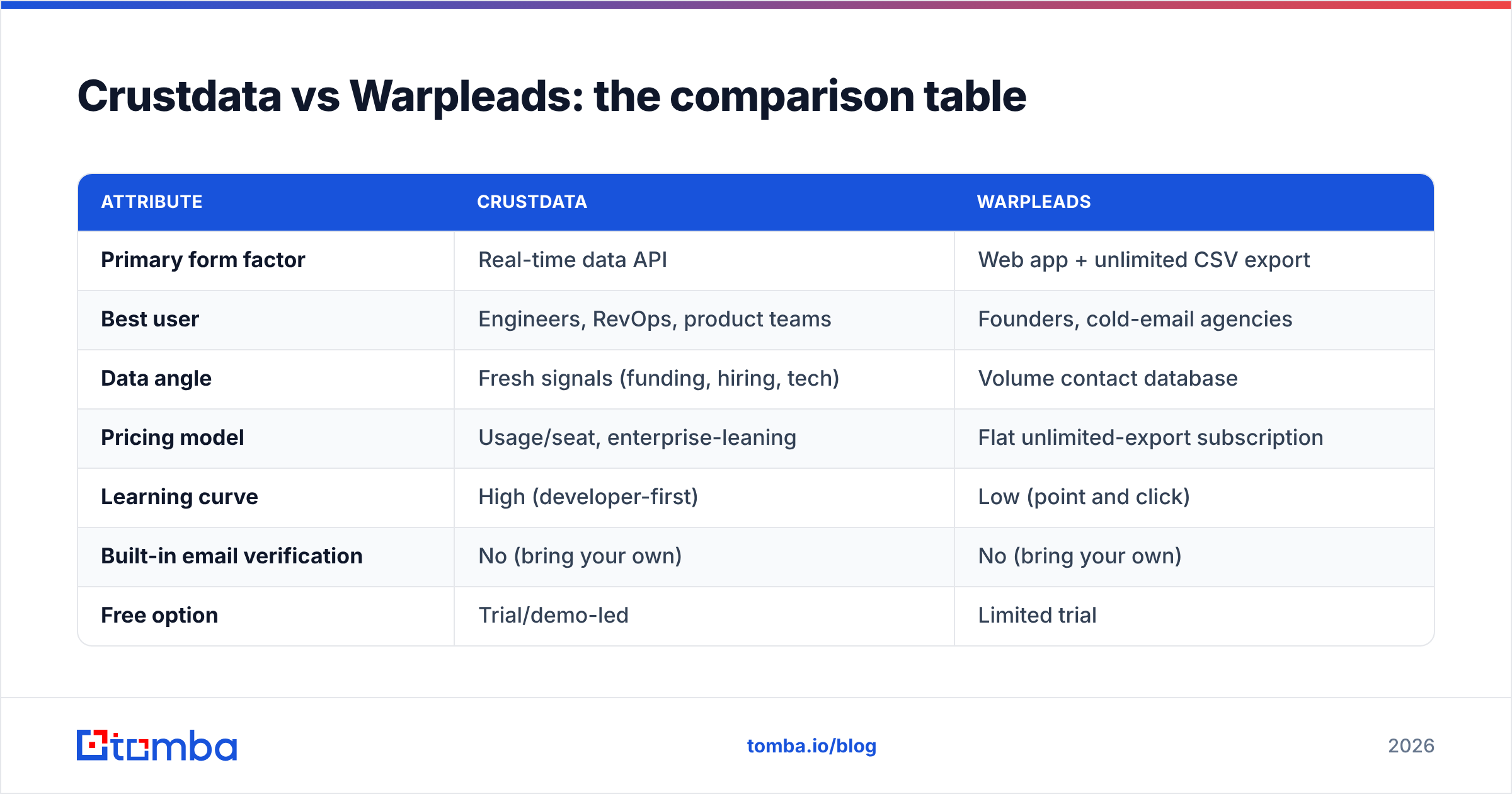
| Attribute | Crustdata | Warpleads |
|---|---|---|
| Primary form factor | Real-time data API | Web app + unlimited CSV export |
| Best user | Engineers, RevOps, product teams | Founders, cold-email agencies |
| Data angle | Fresh signals (funding, hiring, tech) | Volume contact database |
| Pricing model | Usage/seat, enterprise-leaning | Flat unlimited-export subscription |
| Learning curve | High (developer-first) | Low (point and click) |
| Built-in email verification | No (bring your own) | No (bring your own) |
| Free option | Trial/demo-led | Limited trial |
| Ideal use case | Enrichment pipelines, lead scoring | High-volume cold outreach |
The table makes the core tension obvious: Crustdata optimizes for signal depth and freshness; Warpleads optimizes for raw volume and cost predictability. They rarely compete for the same buyer.
Is Crustdata or Warpleads better for cold email?#
For pure cold email, Warpleads is the more natural fit on paper. Volume outreach lives or dies on list size and cost per contact, and unlimited exports match that motion. Crustdata's real-time API is overkill if all you need is 5,000 marketing directors in SaaS.
But "better for cold email" has a trap. Cold email in 2026 is a deliverability game, not a volume game. Google and Microsoft tightened bulk-sender enforcement, and a single spammy campaign against a dirty list can tank your domain reputation for weeks. A giant unlimited export is a liability if you don't clean it.
That's the piece both tools leave to you. Neither Crustdata nor Warpleads is a verification service. Before any of that data touches your sending inbox, you should run it through a dedicated email verifier to strip invalids, spam traps, and role accounts. Catch-all domains are their own headache, which is why a catch-all verifier matters when a big chunk of your export sits behind accept-all mail servers.
Rule of thumb: the bigger the export, the more verification discipline you need. Unlimited data with zero verification is the fastest way to a blocked domain.
How do Crustdata and Warpleads price in 2026?#
Pricing is where these two diverge most, and where buyers get surprised.
Crustdata follows a usage- and seat-based model typical of developer data platforms. Expect demo-led sales, custom quotes at scale, and costs that climb with API call volume and enriched records. It's built for teams that treat data as infrastructure, so the spend is justified when it feeds a revenue-critical pipeline, and hard to justify for a hobbyist list pull.
Warpleads sells flat, subscription-based unlimited exports. The appeal is predictability: you know your monthly number regardless of how many leads you pull. The catch is that "unlimited leads" is not "unlimited good leads," and the true cost includes the verification you'll bolt on afterward.
Here's a simplified way to think about the real cost of each path:
- List/data cost — Crustdata (usage-based) vs Warpleads (flat unlimited).
- Verification cost — required for both; scales with export size.
- Deliverability risk cost — invisible until a campaign fails, then enormous.
- Engineering time — high for Crustdata's API, near zero for Warpleads' UI.
When you total those four lines, a cheap unlimited export can end up pricier than it looks, and a "premium" API can pay for itself if it drives pipeline. Always price the whole path, not just the sticker.
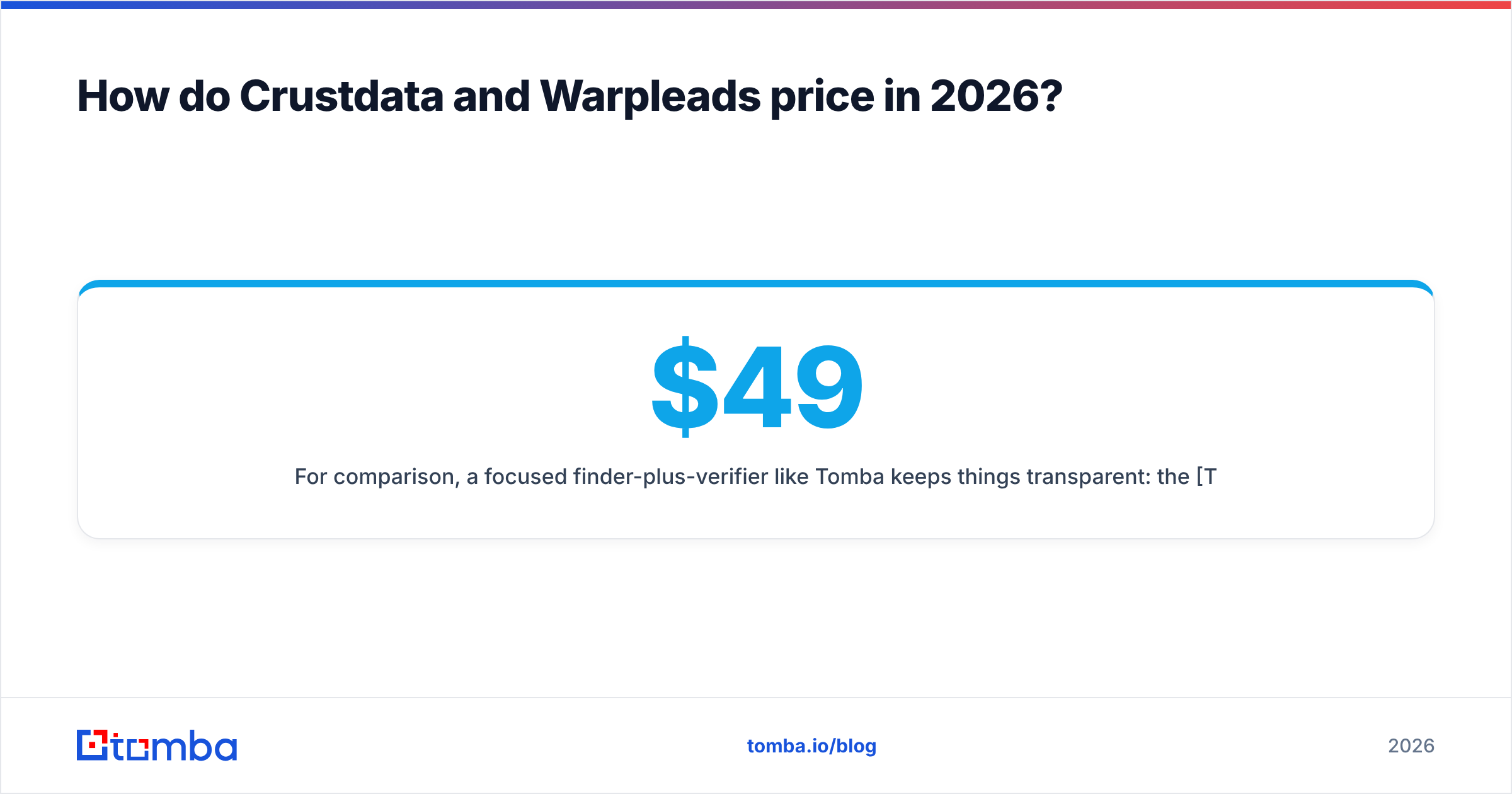
For comparison, a focused finder-plus-verifier like Tomba keeps things transparent: the Tomba pricing ladder runs a Free tier at 25 searches per month, Starter at $49/mo, Growth at $99/mo, and Pro at $249/mo, with verification built into the same platform instead of billed as a separate vendor.
What about data accuracy and freshness?#
Accuracy is the quiet dealbreaker. A lead is worthless if the person left the company or the address bounces.
- Crustdata leans into freshness as its main selling point, emphasizing real-time signals over static snapshots. For job-change and funding triggers, that recency is genuinely valuable, and it's the strongest argument for paying API prices.
- Warpleads competes on breadth. Large databases inevitably carry more decay, so a slice of any big unlimited export will be stale, duplicated, or catch-all by the time you send.
Independent buyer reviews on G2 are the sanity check here. Vendor accuracy claims are marketing; peer reviews describe what real users saw on real lists. Read them before you commit.
Whichever source you pick, treat every record as unverified until proven otherwise. A quick data enrichment and verification pass turns a raw export into a list you can actually send to, and it's cheaper than repairing a burned domain. For big lists, a bulk email finder and bulk verify step is the difference between a 2% bounce rate and a 30% one.
Crustdata vs Warpleads: which should you choose?#
Pick based on your motion, not the marketing:
- Choose Crustdata if you're technical, you need fresh signals inside your own systems, and data is core infrastructure. It rewards teams building enrichment pipelines and signal-based scoring. It punishes anyone who just wanted a list.
- Choose Warpleads if you run high-volume cold email, want predictable flat pricing, and value export size over surgical precision, and you already have a serious verification workflow behind it.
- Choose neither as your whole stack. Both are data sources. Neither closes the loop from "raw contact" to "safe to send."
The honest verdict: these tools answer where do I get data, but the campaign-killer question is is this address deliverable right now. If you skip that second question, the cheapest and the priciest data source fail the same way, in your spam folder.
Where Tomba fits between the two#
Most cold-email teams don't actually need to choose a single mega-platform. They need a reliable way to find and verify professional email addresses, then keep those addresses clean over time.
That's Tomba's lane. Use the Tomba Email Finder to find professional emails by domain, name, or company, then verify them in the same platform before they ever reach your sequencer. It sits neatly downstream of a data source like Crustdata or Warpleads, or replaces the need for one entirely when your outreach is targeted rather than spray-and-pray.
Concretely, a clean 2026 outbound stack looks like this: source your accounts, find and verify the specific people you want with Tomba, enrich the gaps, and only then load a small, clean, deliverable list into your sender. You send less, you land more, and your domain stays healthy.
If your real problem is bounce rates and blown-up campaigns rather than "not enough rows in a CSV," start with the finder and verifier, not another unlimited-export firehose. Try the Tomba Email Finder free with 25 searches a month, verify every address before you send, and keep your sender reputation the asset it should be.
Related guides#
Ready to find emails that actually work?
Join 150,000+ professionals who stopped guessing and started sending. Free credits on signup — no credit card required.
Get the Tomba newsletter
Practical outbound tactics and product updates — once every two weeks.
About the author