Crustdata vs ZoomInfo (2026): Which B2B Data Platform Wins?
Crustdata's API-first real-time data or ZoomInfo's enterprise database? We compare coverage, pricing, freshness, and fit so you pick the right B2B data source in 2026.
Choosing between Crustdata and ZoomInfo is really a choice between two philosophies: a modern, API-first data pipe built for engineers and RevOps automation, versus a mature enterprise database built for large sales teams who live inside a GUI. Both are legitimate. Neither is right for everyone. This guide breaks down where each one actually earns its price.
TL;DR — Crustdata vs ZoomInfo at a glance#
- Crustdata is API-first: real-time company and people data delivered as JSON, priced for developers and growth teams who want to build data into their own product or workflows.
- ZoomInfo is the incumbent enterprise database: massive contact coverage, intent data, a polished web app, and CRM integrations — sold on annual contracts that routinely start in the five figures.
- Pick Crustdata if you need fresh, programmatic data, real-time signals, and predictable usage-based pricing without a sales cycle.
- Pick ZoomInfo if you need deep US contact coverage, intent scoring, and an all-in-one seat-based platform your whole GTM org can log into.
- Pick a focused email finder (like Tomba) if your real need is accurate, verified email addresses at a fraction of either platform's cost.
What is Crustdata?#
Crustdata is a data-as-an-API platform. Instead of a big web app you log into, you get endpoints that return structured company and people data: firmographics, headcount trends, job changes, funding, tech stack, and contact details. It's aimed at teams who want to build with data — populating their own CRM, scoring accounts programmatically, or embedding enrichment inside a SaaS product.
The pitch is freshness and flexibility. Crustdata leans on real-time and near-real-time signals (hiring, growth, social activity) rather than a slow-moving static database. Pricing is usage-based and published, so a two-person startup can start without negotiating an annual seat contract. If you have an engineer and a use case, you can be pulling data the same afternoon.
The trade-off: it's a pipe, not a destination. There's no rich seat-based UI for a 40-rep sales floor, and the "just log in and search" experience that ZoomInfo sells is not the core product.
What is ZoomInfo?#
ZoomInfo is the 800-pound gorilla of B2B data. It combines one of the largest contact databases in the market with intent data, website visitor tracking, conversation intelligence (via its Chorus acquisition), and deep CRM/MAP integrations. Its natural buyer is a mid-market or enterprise revenue org that wants a single platform for prospecting, enrichment, and go-to-market signals.
ZoomInfo's strengths are coverage and completeness, especially for US-based direct dials and verified corporate emails. Its weaknesses are well documented on review sites: opaque annual contracts, aggressive renewals, seat minimums, and add-on modules that inflate the bill. It is powerful, and it is rarely cheap.

Crustdata vs ZoomInfo: the core comparison#
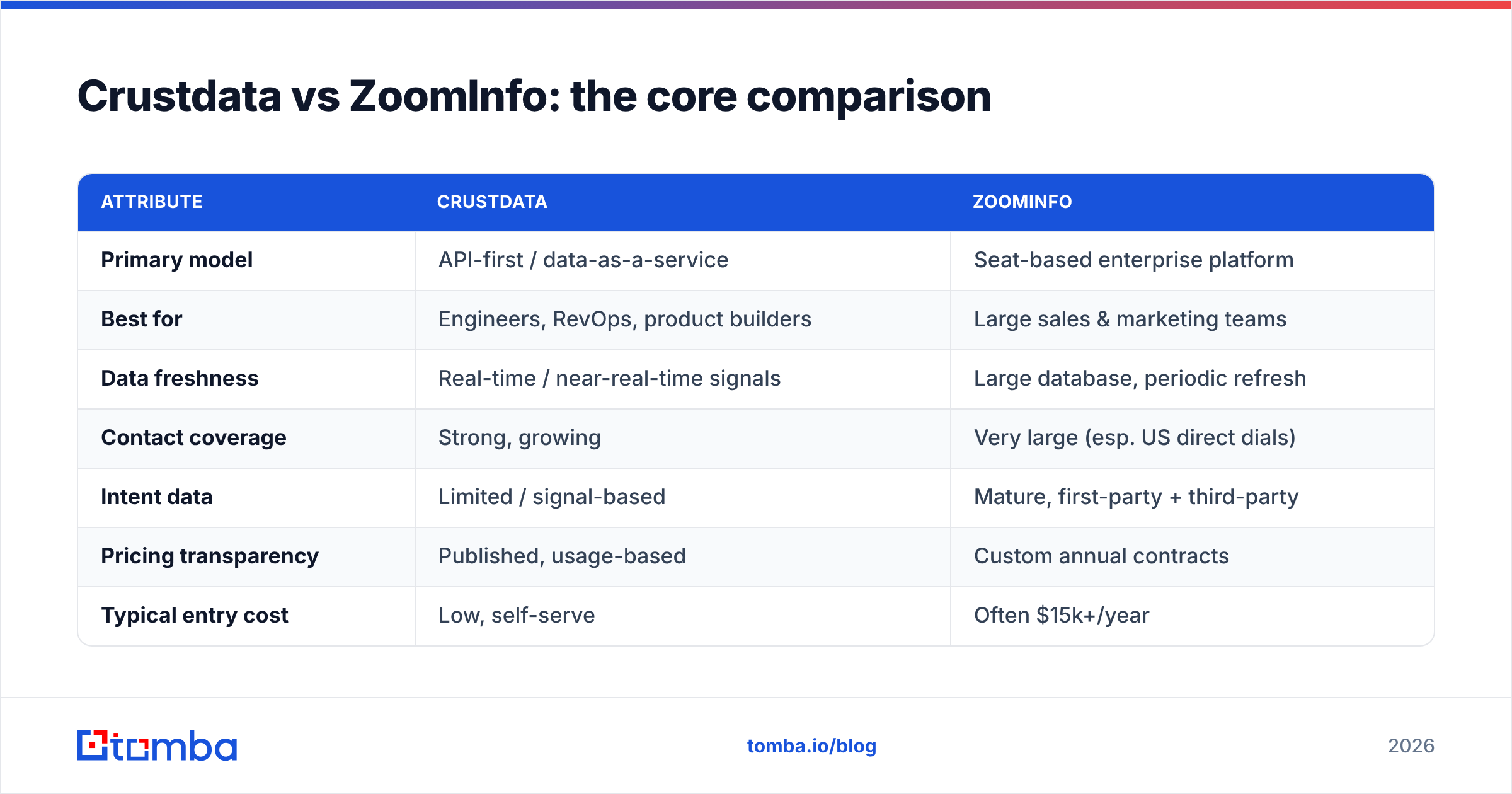
Here's the head-to-head on the attributes that actually change your decision.
| Attribute | Crustdata | ZoomInfo |
|---|---|---|
| Primary model | API-first / data-as-a-service | Seat-based enterprise platform |
| Best for | Engineers, RevOps, product builders | Large sales & marketing teams |
| Data freshness | Real-time / near-real-time signals | Large database, periodic refresh |
| Contact coverage | Strong, growing | Very large (esp. US direct dials) |
| Intent data | Limited / signal-based | Mature, first-party + third-party |
| Pricing transparency | Published, usage-based | Custom annual contracts |
| Typical entry cost | Low, self-serve | Often $15k+/year |
| Web app UX | Minimal (API focus) | Polished, feature-rich |
| Contract commitment | Flexible | Usually annual, seat minimums |
The pattern is clear: Crustdata optimizes for developer velocity and cost control, ZoomInfo optimizes for breadth and an all-in-one seat experience. If you catch yourself saying "I just want the data in my own system," you're describing Crustdata. If you're saying "I want my whole team searching and prospecting in one tool," you're describing ZoomInfo.
Is Crustdata better than ZoomInfo for data freshness?#
For real-time signals, Crustdata generally has the edge; for raw historical contact depth, ZoomInfo still leads. This is the most important nuance in the whole comparison, so don't skip it.
ZoomInfo's database is enormous, but a database that large refreshes on a cycle. That means some records — job titles, direct dials, company sizes — can lag reality by weeks or months. For most steady-state prospecting that's fine. For trigger-based outbound ("reach out the week someone changes jobs"), staleness quietly kills your response rate.
Crustdata is architected around change detection. Because it pulls signals continuously, it's better suited to workflows where timing is the differentiator: funding events, headcount spikes, new hires in a buying role. If your motion depends on being early, freshness beats sheer volume.
That said, no single vendor is fresh on everything. The teams who win treat any provider's contact data as a starting point and verify before they send — which is exactly where a dedicated verification layer pays for itself.
How much do Crustdata and ZoomInfo cost?#
Cost is where these two diverge most sharply.
Crustdata publishes usage-based pricing. You pay for what you pull, you can start small, and there's no mandatory annual commitment to get going. That predictability is a big deal for startups and lean RevOps teams who need to model spend against pipeline.
ZoomInfo almost never shows a public number. Deals are custom, annual, and seat-based, with add-on modules (intent, enrich, engage, conversation intelligence) layered on top. Public reports and G2 reviews consistently put realistic entry points in the $15,000+/year range, climbing quickly with seats and modules. You also negotiate — meaning the price depends on how hard your procurement team pushes.
For many buyers the honest question isn't "which is cheaper," it's "am I actually using enough of ZoomInfo to justify enterprise pricing?" If you mostly need emails and enrichment, you're likely overpaying for modules you never open.

Where does a dedicated email finder fit in?#
If you strip both platforms down, a huge share of real-world usage is one job: get me a correct, verified email for this person or company. You don't need a five-figure contract or a data-engineering project for that.
That's the case for a focused tool. With Tomba's email finder you find professional addresses by name, domain, or company, then run them through an email verifier before they ever hit your sequence. Need to map an entire org? Domain search returns the addresses and patterns behind a company in one call. And when you already have a list of records to fill in, data enrichment tops them up without a platform migration.
Here's how the three approaches stack up on the job most teams actually care about:
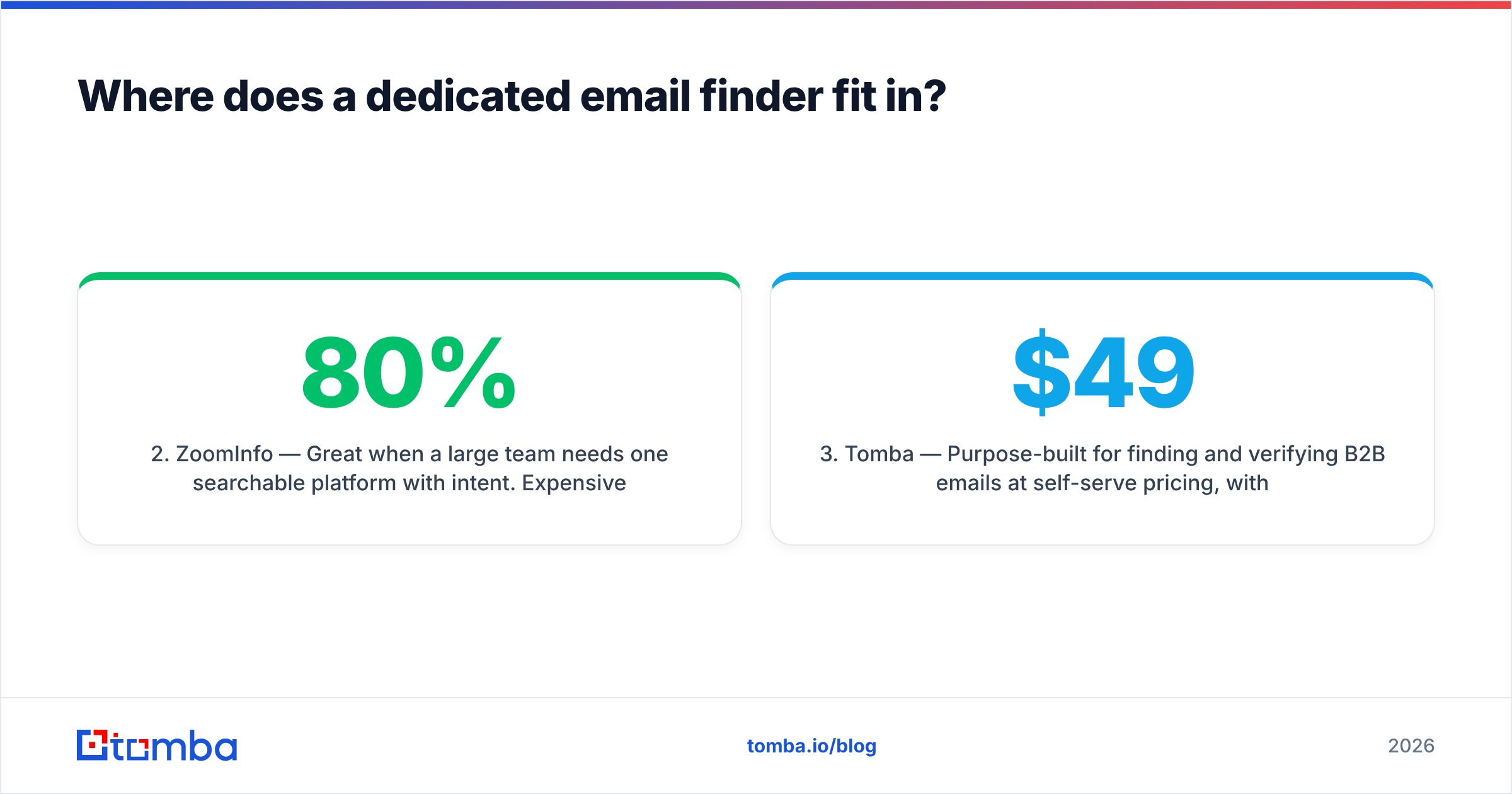
- Crustdata — Great when you want programmatic, signal-rich data and have engineering to consume an API. Overkill if you only need verified emails.
- ZoomInfo — Great when a large team needs one searchable platform with intent. Expensive if 80% of your usage is "find and verify an email."
- Tomba — Purpose-built for finding and verifying B2B emails at self-serve pricing, with a free tier (25 searches/mo), Starter at $49/mo, and Growth at $99/mo. It slots alongside either platform or replaces the part you actually use.
Many teams run a hybrid: a data platform for accounts and signals, and a specialist finder/verifier for accuracy on the addresses that get contacted. The verify step is not optional — sending to unverified data is the fastest way to torch your sender reputation.
Crustdata vs ZoomInfo: pros and cons#
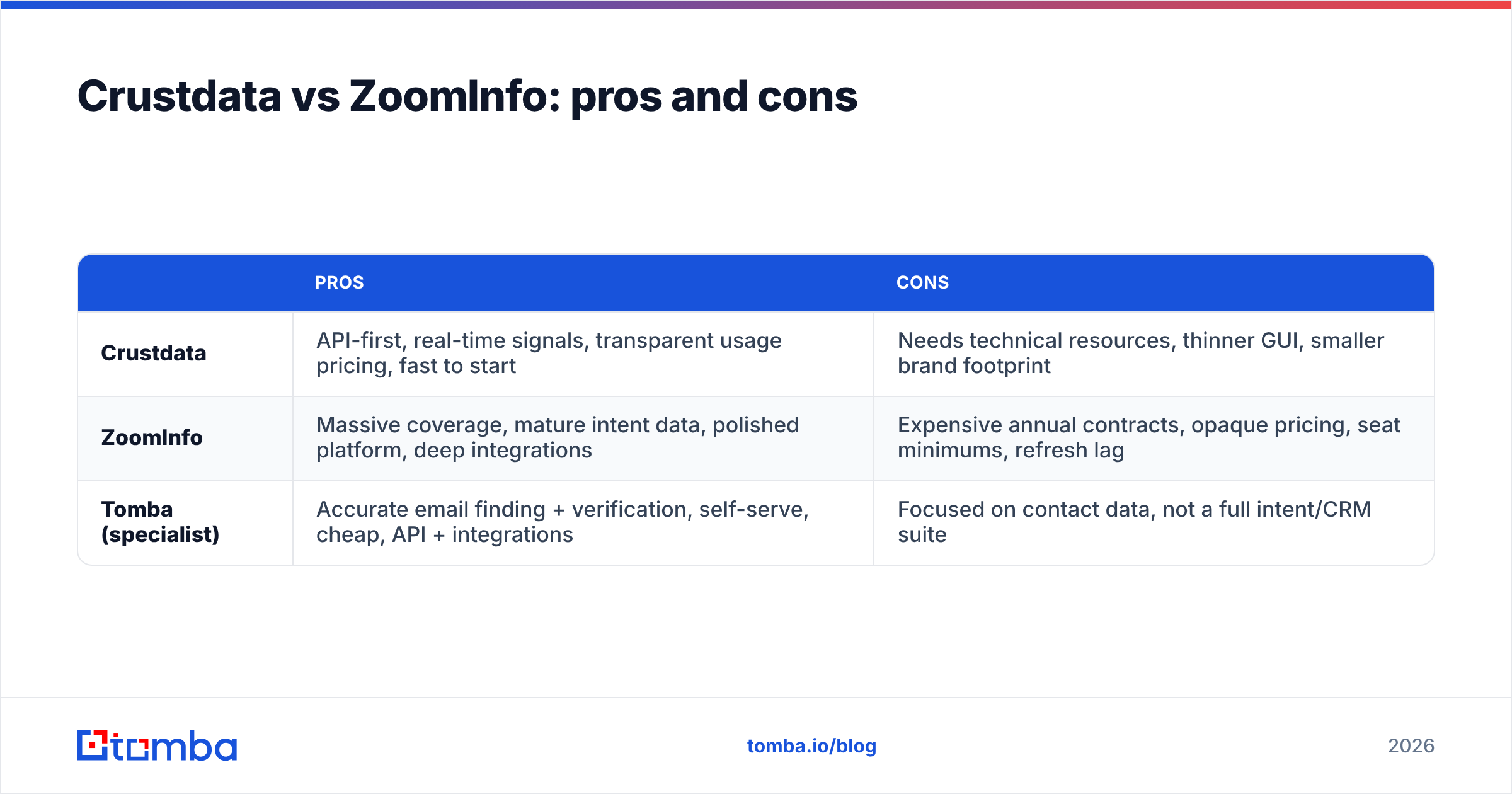
| Pros | Cons | |
|---|---|---|
| Crustdata | API-first, real-time signals, transparent usage pricing, fast to start | Needs technical resources, thinner GUI, smaller brand footprint |
| ZoomInfo | Massive coverage, mature intent data, polished platform, deep integrations | Expensive annual contracts, opaque pricing, seat minimums, refresh lag |
| Tomba (specialist) | Accurate email finding + verification, self-serve, cheap, API + integrations | Focused on contact data, not a full intent/CRM suite |
Which should you choose in 2026?#
Match the tool to the job, not the hype.
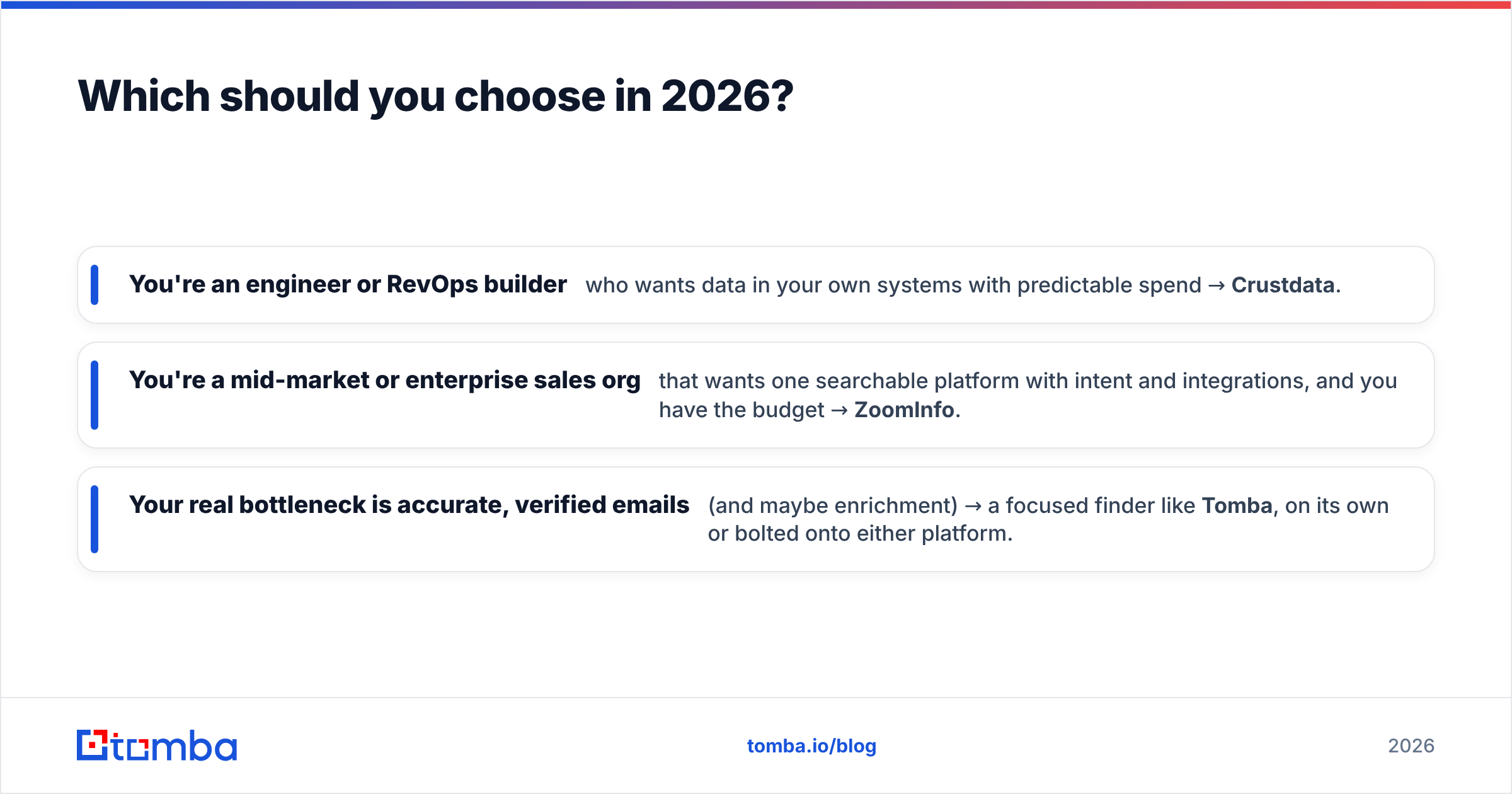
- You're an engineer or RevOps builder who wants data in your own systems with predictable spend → Crustdata.
- You're a mid-market or enterprise sales org that wants one searchable platform with intent and integrations, and you have the budget → ZoomInfo.
- Your real bottleneck is accurate, verified emails (and maybe enrichment) → a focused finder like Tomba, on its own or bolted onto either platform.
The expensive mistake is buying an enterprise database to solve an email-finding problem, or forcing a raw API on a team that just wants to search and click. Be honest about your actual workflow, then buy exactly that.
One more principle worth internalizing: no vendor is a substitute for verification. Whichever source you pick, run every address through a verifier before you send. Deliverability is earned one clean list at a time, and it's a lot cheaper to protect than to rebuild.
The bottom line#
Crustdata and ZoomInfo aren't really competing for the same buyer. Crustdata wins for programmatic, real-time, cost-conscious teams; ZoomInfo wins for large orgs that want an all-in-one platform and can absorb the contract. But if you audit where your spend actually goes, a lot of it is just finding and verifying emails — and that job has a far cheaper, more accurate home.
Start free with Tomba's Email Finder: find professional email addresses by domain, name, or company, verify them before you send, and only scale up to Starter ($49/mo) or Growth ($99/mo) when your volume demands it. Pair it with the data platform that fits your motion — or let it replace the part of that platform you were overpaying for.
Related guides#
Ready to find emails that actually work?
Join 150,000+ professionals who stopped guessing and started sending. Free credits on signup — no credit card required.
Get the Tomba newsletter
Practical outbound tactics and product updates — once every two weeks.
About the author