7 Best csvGO Alternatives in 2026 for Cleaner B2B Data
csvGO is handy for quick CSV enrichment, but accuracy caps, pricing, and coverage push many teams to look elsewhere. Here are the 7 best csvGO alternatives for 2026, compared honestly.

If you spend your week uploading messy spreadsheets, enriching them, and hoping the emails bounce less than last time, you already know why people search for csvGO alternatives. csvGO does one job well — take a CSV, clean it, enrich it — but "one job" is exactly the problem when your pipeline needs verified emails, phone numbers, an API, and coverage outside a handful of regions.
This guide compares the seven strongest csvGO alternatives for 2026 on the things that actually move revenue: match rate, verification quality, pricing, and how far the data reaches. No fluff, no vendor cheerleading — just where each tool wins and where it quietly falls down.
TL;DR — The Short Version#
- csvGO is fine for lightweight CSV enrichment, but teams outgrow it once they need verified emails at scale, phone data, or a real API.
- For accuracy + verification in one place, Tomba is the strongest all-rounder — email finder, verifier, and enrichment under one roof with a free tier and a $49/mo Starter plan.
- For a huge prebuilt database, BookYourData and Apollo are the go-to picks; for developer workflows, Tomba's API and Clearbit-style enrichment win.
- Price matters more than logos. Several csvGO alternatives undercut it on cost-per-verified-contact once you factor in bounce waste.
- Verify before you send. No enrichment tool is 100% accurate — a separate email verifier step is what keeps your sender reputation intact.
What Is csvGO and Why Look for Alternatives?#
csvGO is a CSV-first enrichment tool: you drop in a list of names and companies, and it appends emails and basic firmographic data so you can push it into your sequencer or CRM. It's spreadsheet-native, which is genuinely convenient for one-off list cleanups and small outbound batches.
The friction shows up when your needs grow past "clean this file once." Common reasons teams start shopping for csvGO alternatives:
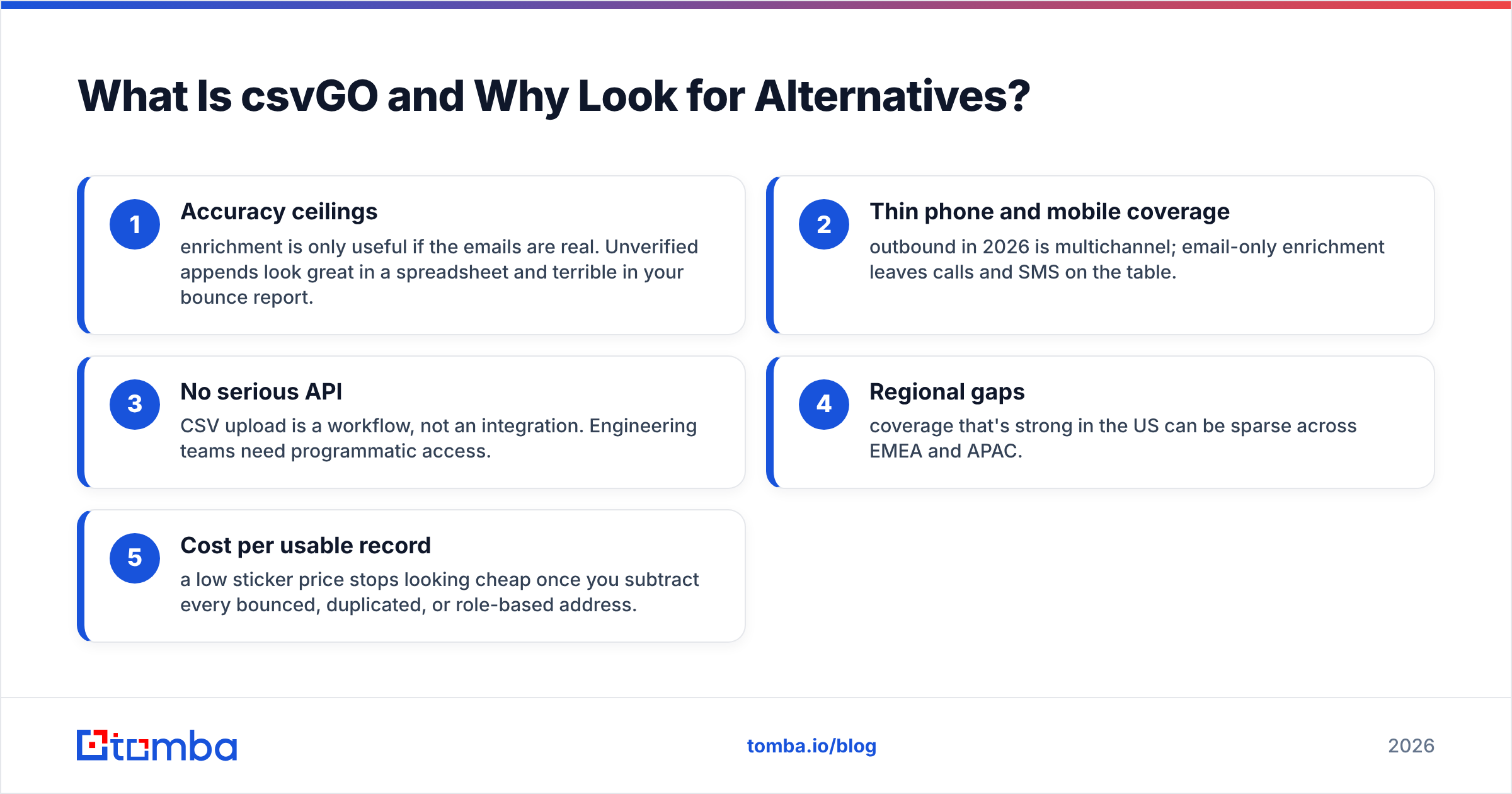
- Accuracy ceilings — enrichment is only useful if the emails are real. Unverified appends look great in a spreadsheet and terrible in your bounce report.
- Thin phone and mobile coverage — outbound in 2026 is multichannel; email-only enrichment leaves calls and SMS on the table.
- No serious API — CSV upload is a workflow, not an integration. Engineering teams need programmatic access.
- Regional gaps — coverage that's strong in the US can be sparse across EMEA and APAC.
- Cost per usable record — a low sticker price stops looking cheap once you subtract every bounced, duplicated, or role-based address.
None of this makes csvGO bad. It makes it a starting point that many teams eventually replace with something broader.

How We Compared the csvGO Alternatives#
Every tool below is scored on the same five dimensions, because a "best" list without criteria is just a logo parade:
- Match rate — how often it returns a usable contact for a given input.
- Verification — does it check deliverability (SMTP, catch-all handling) or just guess a pattern?
- Data breadth — emails only, or emails + phones + firmographics + intent.
- Pricing transparency — published plans vs "book a demo" black boxes.
- Integration surface — API, CRM connectors, spreadsheet add-ons, and bulk tooling.
Accuracy is the one that quietly decides everything. A tool with a 95% match rate but no verification can still torch your domain if a third of those matches are dead. Reputable vendors publish independently tested accuracy, and you should weight that heavily.

The 7 Best csvGO Alternatives in 2026#
1. Tomba — Best All-Round csvGO Alternative#
Tomba covers the full "find, verify, enrich" loop instead of just appending columns to a CSV. You can search by domain, by name, or in bulk; every result runs through deliverability checks; and there's a proper email finder API, CLI, and spreadsheet add-ons for teams that don't want to live in an upload screen.
Where it beats csvGO: built-in verification, phone data, catch-all handling, and data enrichment that hydrates a thin list into full contact records. The free tier (25 searches/mo) lets you sanity-check accuracy on your own list before paying anything.
- Best for: teams that want accuracy and verification in one tool.
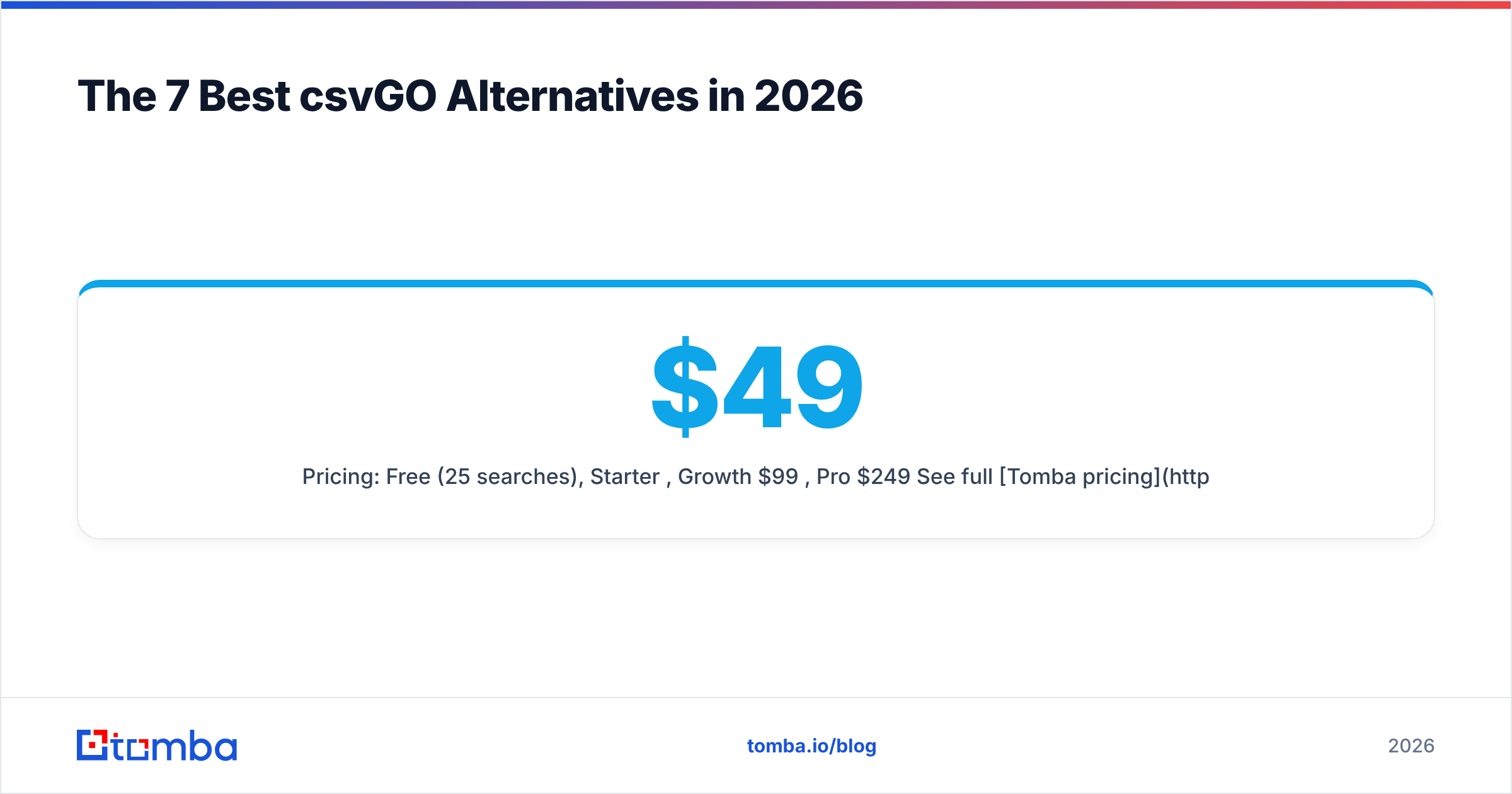
- Pricing: Free (25 searches), Starter $49/mo, Growth $99/mo, Pro $249/mo. See full Tomba pricing.
- Watch-out: it's a data platform, not a full sequencer — pair it with your sending tool.
2. BookYourData — Best Prebuilt B2B List#
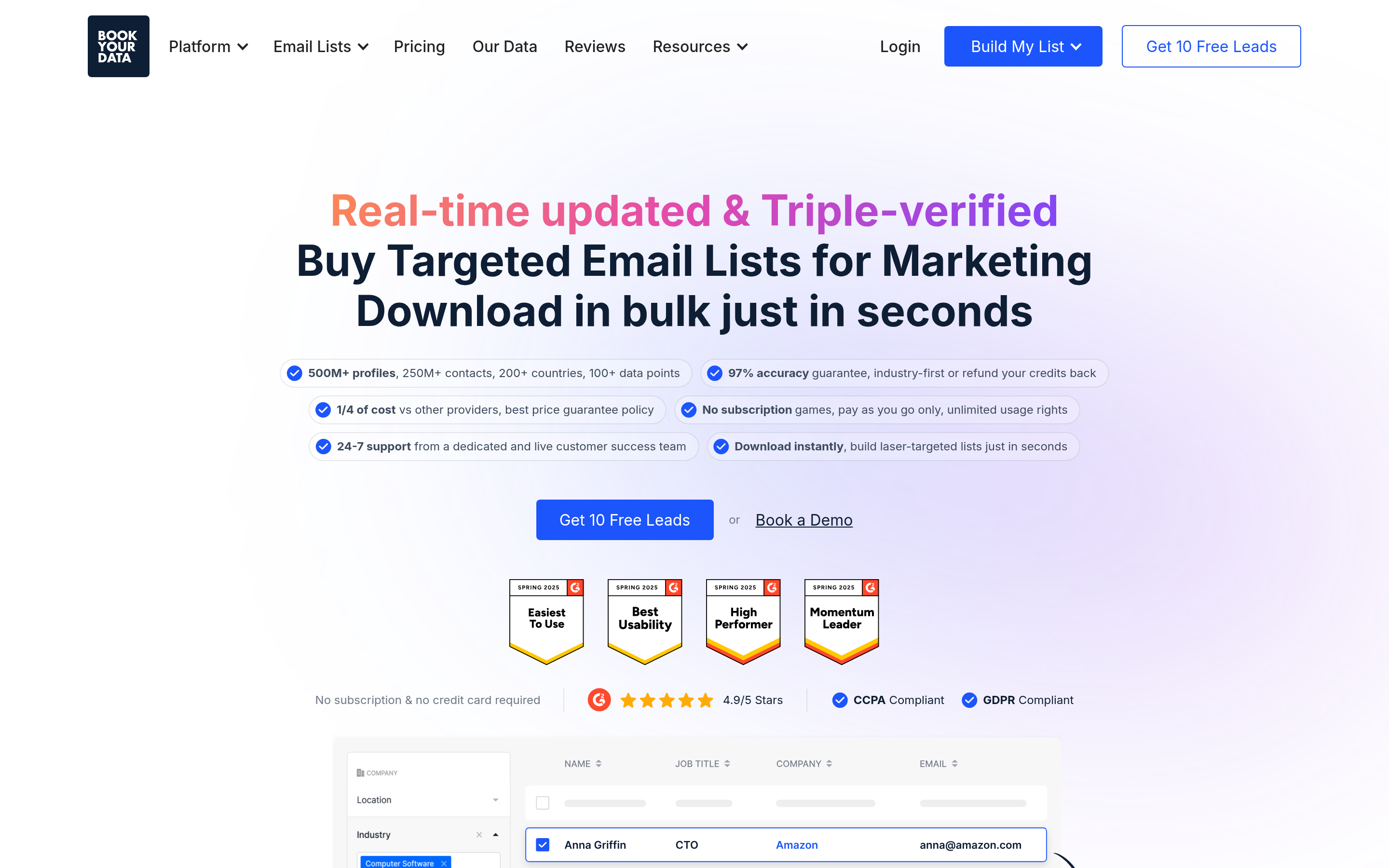
BookYourData is a strong, well-regarded option when you want to buy a targeted list rather than enrich one you already have. Its self-service database lets you filter by industry, title, and geography, and it markets a high deliverability guarantee, which makes it a respected peer for anyone who prefers ready-made contacts over row-by-row enrichment. It's a genuinely good fit when you're entering a new segment cold and have nothing to enrich yet.
- Best for: buying fresh, filtered lists on demand.
- Watch-out: prebuilt lists still deserve a verification pass before you send.
3. Apollo.io — Best Database + Sequencer Combo#
Apollo bundles a large contact database with a native sequencer, so it appeals to teams that want prospecting and sending in one login. The database breadth is real, and the free tier is generous.
- Best for: SMB teams wanting an all-in-one prospect-and-send stack.
- Watch-out: data freshness and export limits vary by plan; many users layer a dedicated verifier on top. If Apollo is your reference point, compare a focused Apollo alternative on cost-per-verified-contact.
4. Clearbit — Best for Enrichment-Heavy Product Teams#
Clearbit (now part of HubSpot) is built around real-time enrichment and web-form intelligence rather than CSV batches. If your use case is "enrich every signup the moment it hits our app," this is the shape you want.
- Best for: product-led enrichment inside HubSpot's ecosystem.
- Watch-out: it's priced and positioned for enrichment, not high-volume email discovery.
5. RocketReach — Best for Deep Contact Lookups#
RocketReach shines when you need one specific person's email and phone across a wide index of professionals. It's a lookup tool at heart rather than a bulk-list engine.
- Best for: one-off, high-value contact hunts.
- Watch-out: costs climb with volume; check limits before scaling.
6. Hunter — Best Simple Domain Search#
Hunter is the clean, minimal choice for domain-based discovery — type a company, get the pattern and known addresses. It's easy to hand to a non-technical team.
- Best for: quick, low-volume domain searches.
- Watch-out: narrower data depth than the database-first tools above.
7. Findymail — Best for Sequencer-Attached Verification#
Findymail focuses on verified B2B emails with tight sequencer integrations, positioning itself as a bounce-reducer for cold outbound. It's a lean, sending-adjacent option.
- Best for: cold-email teams optimizing for low bounce rates.
- Watch-out: smaller feature surface than full data platforms.
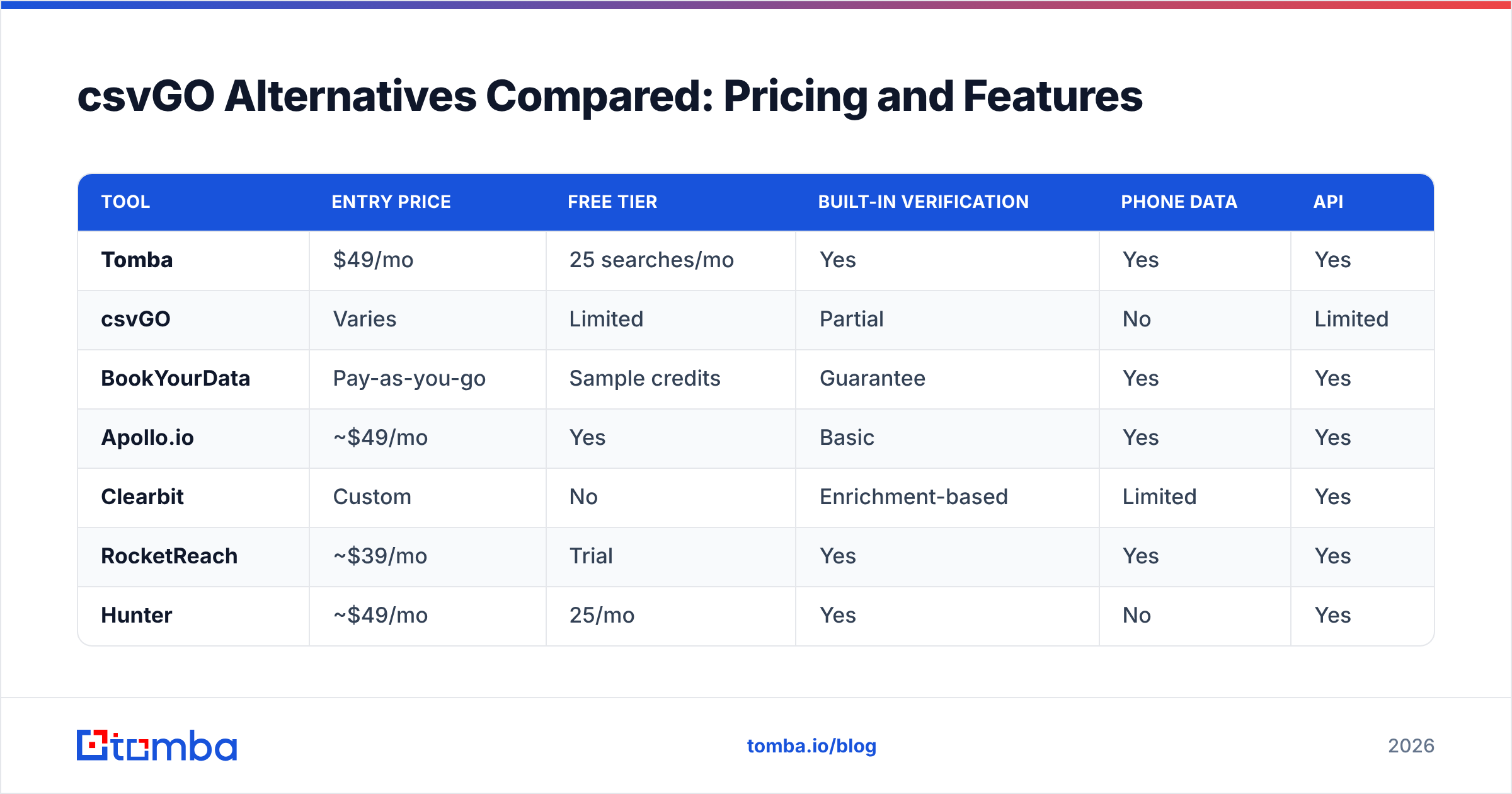
csvGO Alternatives Compared: Pricing and Features#
Here's the honest side-by-side. Prices are entry paid tiers; features reflect what's included without add-ons.
| Tool | Entry price | Free tier | Built-in verification | Phone data | API |
|---|---|---|---|---|---|
| Tomba | $49/mo | 25 searches/mo | Yes | Yes | Yes |
| csvGO | Varies | Limited | Partial | No | Limited |
| BookYourData | Pay-as-you-go | Sample credits | Guarantee | Yes | Yes |
| Apollo.io | ~$49/mo | Yes | Basic | Yes | Yes |
| Clearbit | Custom | No | Enrichment-based | Limited | Yes |
| RocketReach | ~$39/mo | Trial | Yes | Yes | Yes |
| Hunter | ~$49/mo | 25/mo | Yes | No | Yes |

The pattern is clear: the tools that combine discovery and verification (Tomba, BookYourData, RocketReach) protect your deliverability better than enrich-only or find-only tools, because you're not exporting guesses.

Which csvGO Alternative Should You Pick?#
Match the tool to the job instead of the loudest brand:
- You enrich existing lists and want verification baked in → Tomba. The find-verify-enrich loop in one platform is the cleanest replacement for a CSV-only workflow, and the bulk email finder handles large lists without a spreadsheet dance.
- You need a fresh, filtered list right now → BookYourData for prebuilt targeting, or Apollo if you also want to sequence inside the same tool.
- You enrich signups in real time inside a product → Clearbit.
- You chase individual high-value contacts → RocketReach.
- You want dead-simple domain search → Hunter.
- You're optimizing cold-email bounce rates specifically → Findymail.
A practical setup for most outbound teams: use one platform for discovery and enrichment, then always run a final email verification pass before import. Even a great match rate leaves catch-all and role-based addresses that should be filtered, not sent.
Does Accuracy Really Matter That Much?#
Yes — it's the whole game. A quick way to see it: imagine two tools that both "enrich" 1,000 rows.
- Tool A returns 950 emails but doesn't verify. If 25% are dead, you send 950 and hard-bounce ~237. Your domain reputation drops, inbox placement falls, and every future campaign underperforms.
- Tool B returns 820 verified emails. You send fewer, bounce almost none, and your reputation stays clean.
Tool B wins on revenue even though it "found less." That's why the verification column in the table above matters more than raw volume, and why independent accuracy testing (the kind reflected in the benchmark image earlier) should anchor your decision. For a deeper explanation of the deliverability mechanics, HubSpot's guides and third-party review sites like G2 are useful neutral references, and you can always sanity-check a vendor against its own homepage — for example Apollo.io or BookYourData.
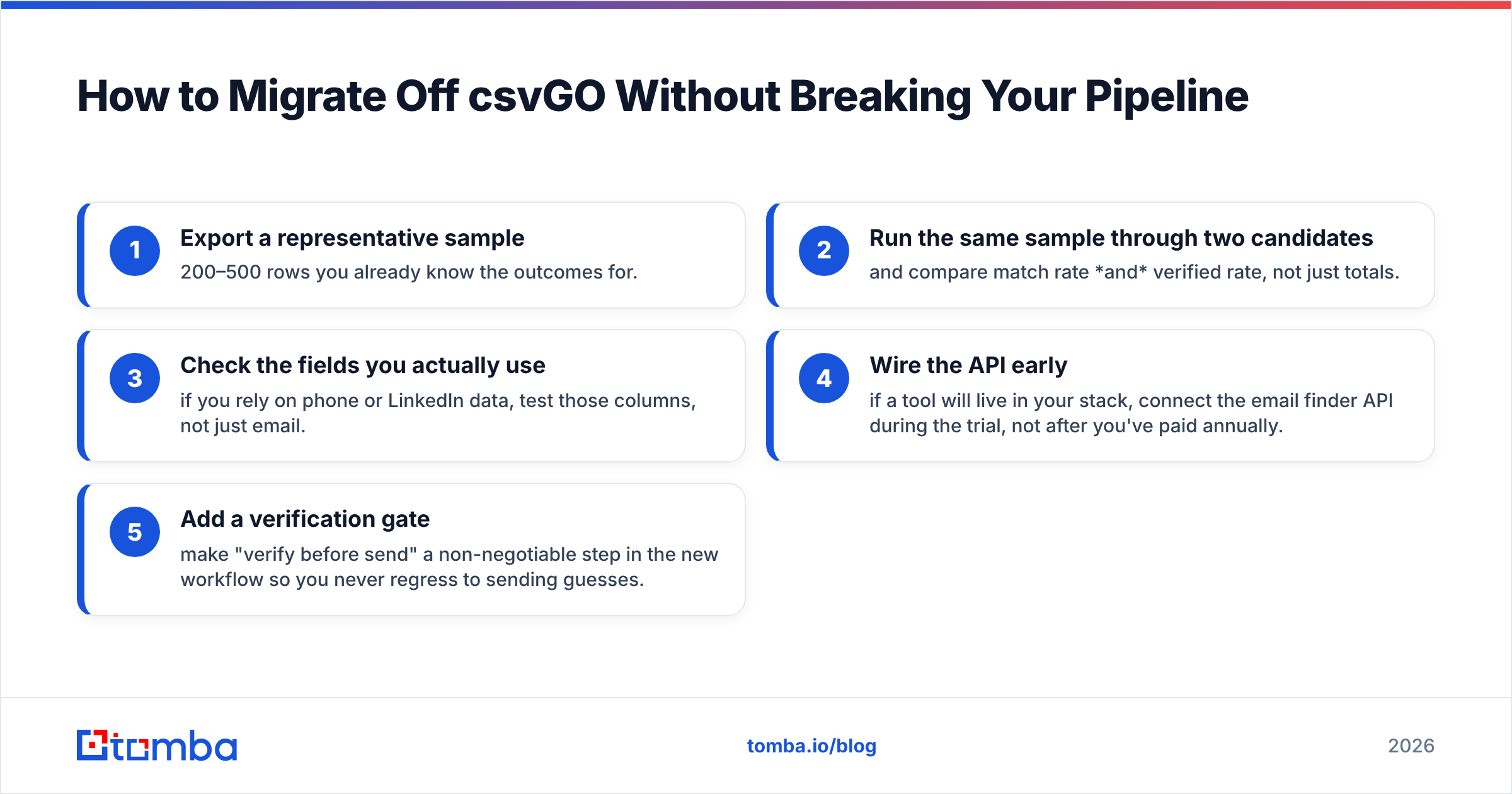
How to Migrate Off csvGO Without Breaking Your Pipeline#
Switching tools is where good intentions die in a half-finished spreadsheet. Keep it boring and it'll work:
- Export a representative sample — 200–500 rows you already know the outcomes for.
- Run the same sample through two candidates and compare match rate and verified rate, not just totals.
- Check the fields you actually use — if you rely on phone or LinkedIn data, test those columns, not just email.
- Wire the API early — if a tool will live in your stack, connect the email finder API during the trial, not after you've paid annually.
- Add a verification gate — make "verify before send" a non-negotiable step in the new workflow so you never regress to sending guesses.
Do this once and you'll have real numbers instead of vibes, which makes the final decision obvious.
Frequently Asked Questions#
Is there a free csvGO alternative? Yes. Tomba offers a free tier with 25 searches per month, and Apollo and Hunter both have free plans. Free tiers are ideal for testing accuracy on your own list before committing.
What's the most accurate csvGO alternative? Accuracy varies by data segment, but tools that pair discovery with built-in SMTP verification — like Tomba — consistently reduce bounces more than enrich-only tools, because you're not exporting unverified guesses.
Can I replace csvGO with a single tool? Usually, yes. A platform that combines finding, verifying, and enriching covers most CSV-enrichment use cases in one login, and adds an API and phone data that CSV-only tools lack.
Do I still need a separate verifier? It's best practice regardless of tool. Even accurate platforms return catch-all and role-based addresses you should filter before sending.
The Bottom Line#
csvGO is a fine on-ramp, but most teams outgrow CSV-only enrichment the moment deliverability, phone data, or an API enters the picture. If you want one tool that finds, verifies, and enriches — with a free tier to test accuracy on your own list first — start with the Tomba Email Finder. Upload a sample, compare the verified match rate against csvGO, and let the numbers pick your winner.
Related guides#
Ready to find emails that actually work?
Join 150,000+ professionals who stopped guessing and started sending. Free credits on signup — no credit card required.
Get the Tomba newsletter
Practical outbound tactics and product updates — once every two weeks.
About the author