CSVGO vs Jet Leads Pro (2026): Which Lead Tool Wins?
CSVGO and Jet Leads Pro both promise ready-to-send B2B lead lists, but they win on different things. Here's an honest breakdown of data quality, pricing, exports, and where a verification layer fits.
Choosing between CSVGO and Jet Leads Pro usually comes down to one question you can't see on the pricing page: how much of the list you buy is actually usable? Both tools sell the same promise — a downloadable spreadsheet of B2B contacts you can drop into your sequencer tomorrow morning. The difference is in the details: how the data is sourced, how fresh it is, what the export limits look like, and how much cleanup you'll do before a single email goes out.
This is a neutral, hands-on-style comparison. No tool is perfect, and the right pick depends on your motion — high-volume outbound, niche account targeting, or occasional list-building. Let's break it down.
TL;DR: CSVGO vs Jet Leads Pro at a glance#
- CSVGO leans toward fast, bulk CSV generation and self-serve list building — good when you need volume and format flexibility over hand-curated accuracy.
- Jet Leads Pro positions around targeted lead lists with more filtering and enrichment fields — better when precision and firmographic depth matter more than raw count.
- Neither replaces a verification step. Static lists decay 2–3% per month, so whatever you export should pass through an email verifier before send.
- Pricing models differ: one favors flat, export-heavy plans; the other favors credit-based, quality-weighted plans. Cost-per-valid-lead is the only number that matters.
- Best combined workflow: use either tool to build the list, then use a live-lookup finder like Tomba's email finder to fill gaps and confirm deliverability.

What are CSVGO and Jet Leads Pro?#
Both are B2B lead-generation tools that output contact lists — names, companies, job titles, and (crucially) email addresses — as spreadsheets or CRM-ready files.
CSVGO is built around the export itself. The pitch is speed and format control: define your parameters, generate a CSV, and download it in the shape your CRM or cold-email tool expects. Tools in this category tend to win on throughput and simplicity. You're not spending an afternoon in a filter builder; you're getting a big file fast.
Jet Leads Pro sits closer to the "targeted list" end of the market. The emphasis is on filtering — industry, headcount, seniority, geography — and on returning richer records per contact. That usually means fewer rows per pull but more context on each one, which suits account-based outreach where you care about who more than how many.
The category itself is crowded, and independent review sites like G2 and Capterra list dozens of overlapping options. The reason the market fragments is simple: data quality is expensive to maintain, so different vendors optimize different corners of the accuracy-vs-volume-vs-price triangle.
How do CSVGO and Jet Leads Pro compare on the things that matter?#
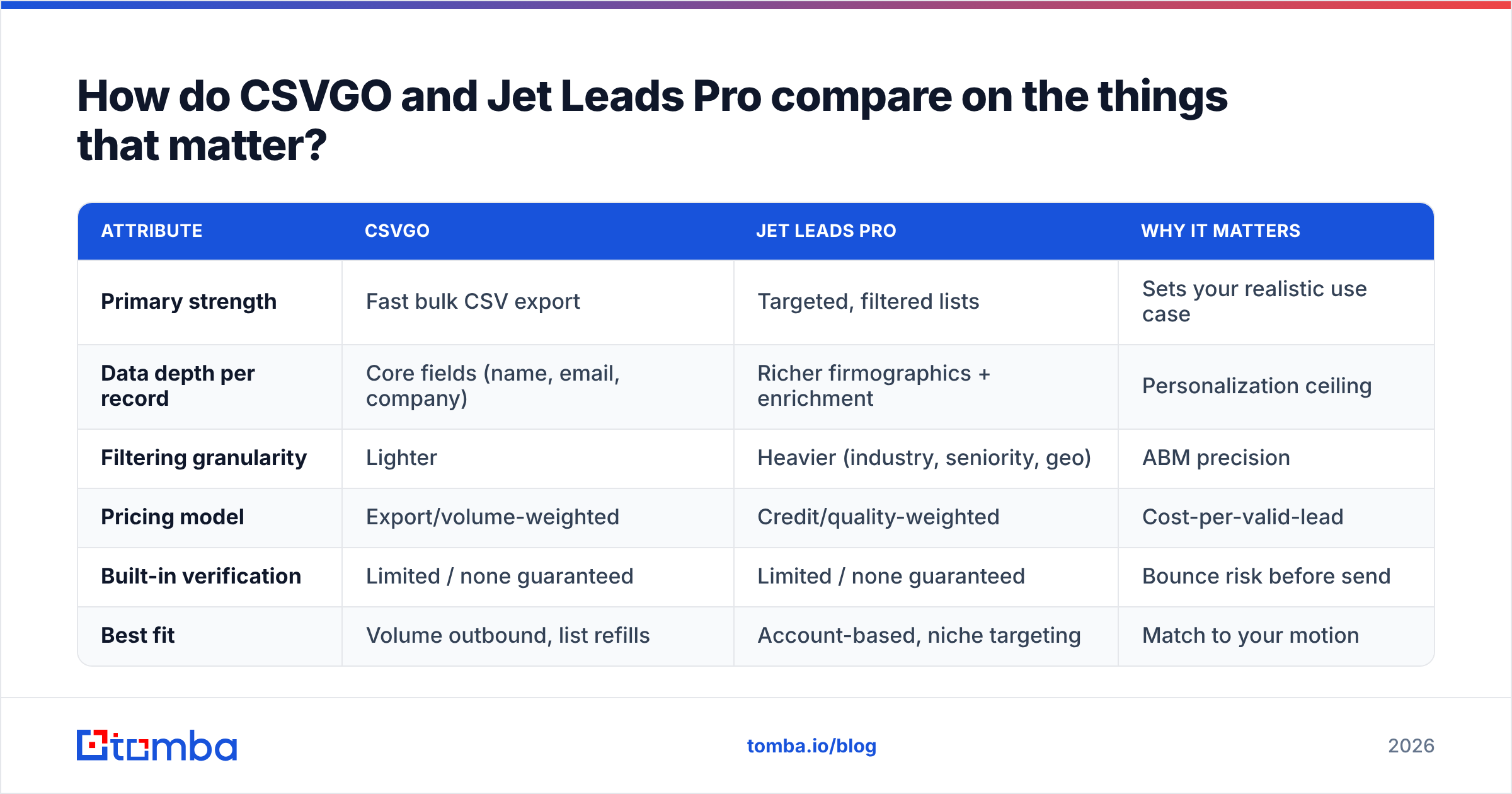
Here's a side-by-side on the attributes that actually change your results. Where a tool's public details are thin, treat the row as a question to ask their sales team rather than a verified spec.
| Attribute | CSVGO | Jet Leads Pro | Why it matters |
|---|---|---|---|
| Primary strength | Fast bulk CSV export | Targeted, filtered lists | Sets your realistic use case |
| Data depth per record | Core fields (name, email, company) | Richer firmographics + enrichment | Personalization ceiling |
| Filtering granularity | Lighter | Heavier (industry, seniority, geo) | ABM precision |
| Pricing model | Export/volume-weighted | Credit/quality-weighted | Cost-per-valid-lead |
| Built-in verification | Limited / none guaranteed | Limited / none guaranteed | Bounce risk before send |
| Best fit | Volume outbound, list refills | Account-based, niche targeting | Match to your motion |
The pattern here is the classic trade-off: volume tools optimize the download, targeting tools optimize the record. Neither optimizes for what happens after export — which is where most cold-email problems actually start.
Which tool has more accurate data?#
Accuracy is where "it depends" earns its keep, but there's a useful way to reason about it.
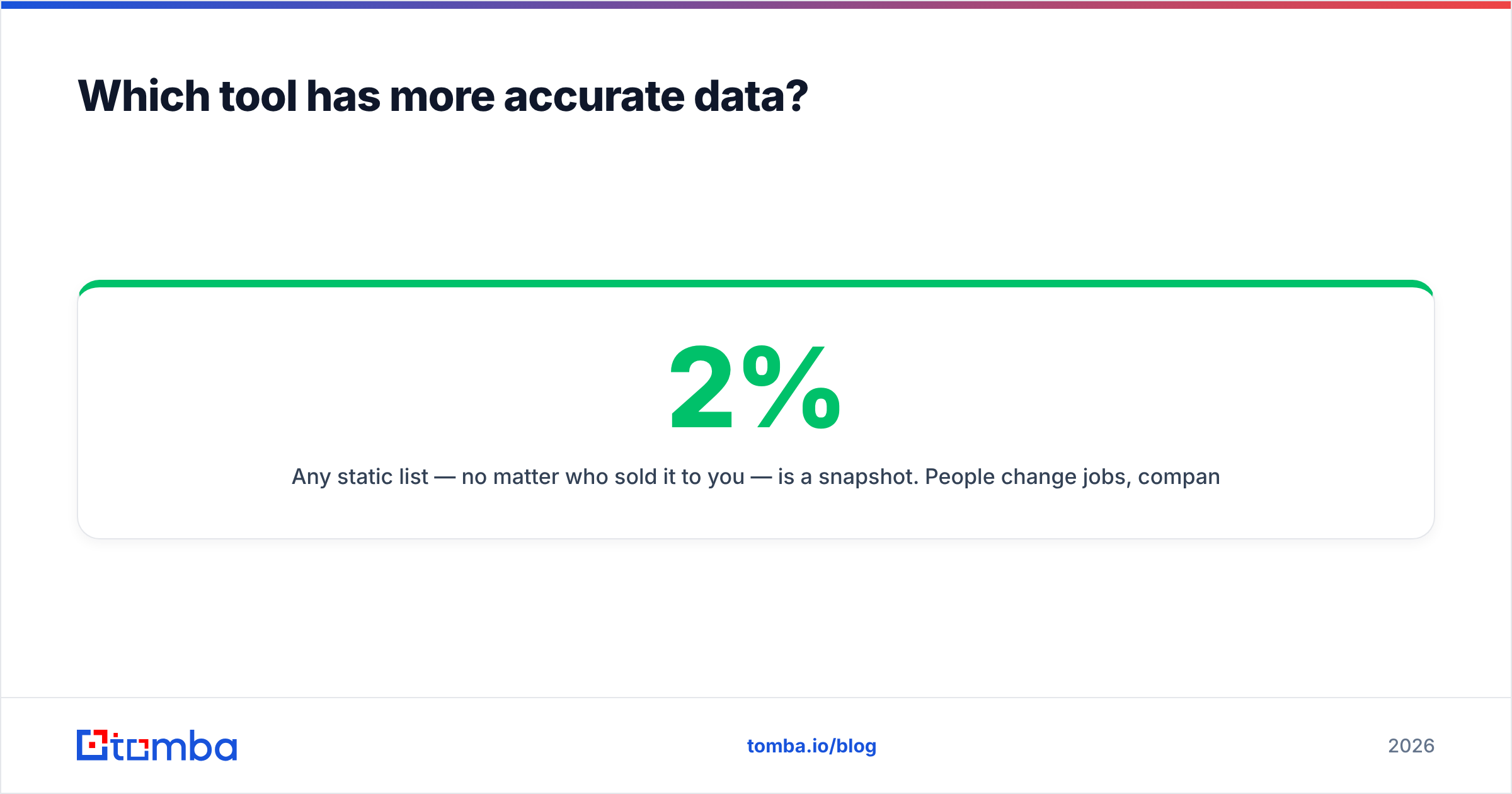
Any static list — no matter who sold it to you — is a snapshot. People change jobs, companies rebrand, and email formats get deprecated. Independent studies of B2B data consistently show contact records going stale at roughly 2% to 3% per month, which compounds fast: a list that's six months old can be 15–20% wrong before you send anything. This is a property of databases, not of any one vendor, which is why the concept of data decay matters more than a marketing "95% accurate" badge.
So the honest comparison isn't "CSVGO's data vs Jet Leads Pro's data." It's:
- How recently was this record re-checked? A targeting tool that verifies at pull-time beats a volume tool that serves cached rows — and vice versa.
- Does the tool distinguish valid, catch-all, and risky addresses? Catch-all domains accept everything at SMTP, so they look valid but aren't. If neither tool flags them, you inherit the risk.
- What's the refund/replacement policy on bad rows? Credit-based models often credit back invalids; flat export models often don't.
Because both tools sell you a file and then step back, the accuracy question effectively transfers to you at the moment of download. That's not a knock — it's the structure of the product. It just means your process needs a verification layer regardless of which you choose.

What does a real cold-email workflow look like with these tools?#
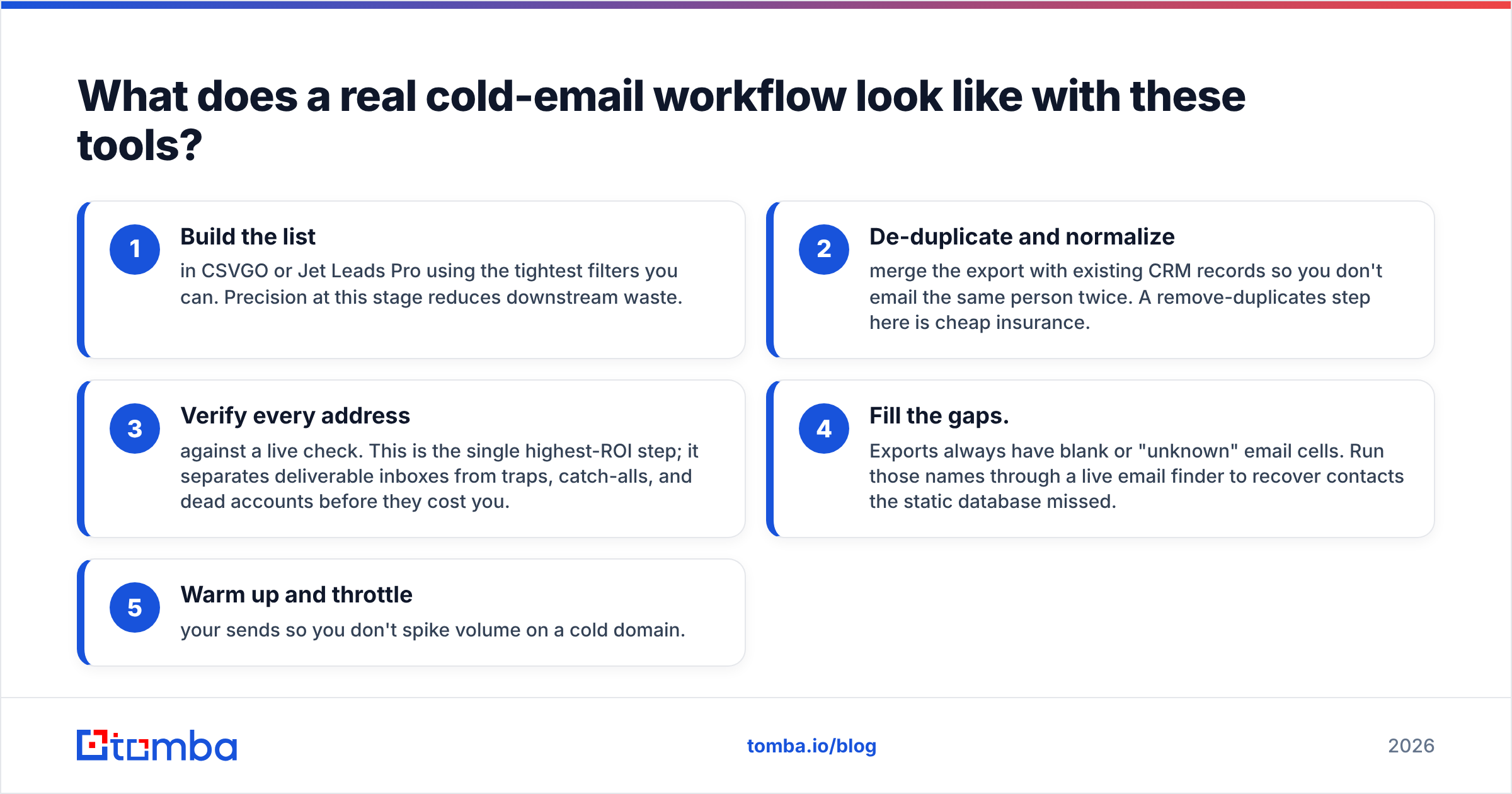
Here's the sequence that keeps deliverability intact, no matter which list tool you pick. Follow it and your sender reputation survives; skip it and one dirty import can tank a domain.
- Build the list in CSVGO or Jet Leads Pro using the tightest filters you can. Precision at this stage reduces downstream waste.
- De-duplicate and normalize — merge the export with existing CRM records so you don't email the same person twice. A remove-duplicates step here is cheap insurance.
- Verify every address against a live check. This is the single highest-ROI step; it separates deliverable inboxes from traps, catch-alls, and dead accounts before they cost you.
- Fill the gaps. Exports always have blank or "unknown" email cells. Run those names through a live email finder to recover contacts the static database missed.
- Warm up and throttle your sends so you don't spike volume on a cold domain.
The tools in this comparison own step 1. Everything from step 2 onward is where results are won or lost — and it's tooling-agnostic, so you can bolt it onto whichever list provider you prefer.
How does pricing really compare?#
The sticker price is the least useful number in this whole comparison. What you want is cost per valid, deliverable lead, which folds in the invalid rows you paid for but can't use.
A quick worked example. Say a plan gives you 10,000 contacts for a flat fee. If 18% are stale or catch-all, you actually have ~8,200 usable rows — so your effective cost per usable lead is about 22% higher than advertised. A credit-based competitor that costs more per record but credits back invalids can end up cheaper per usable lead.
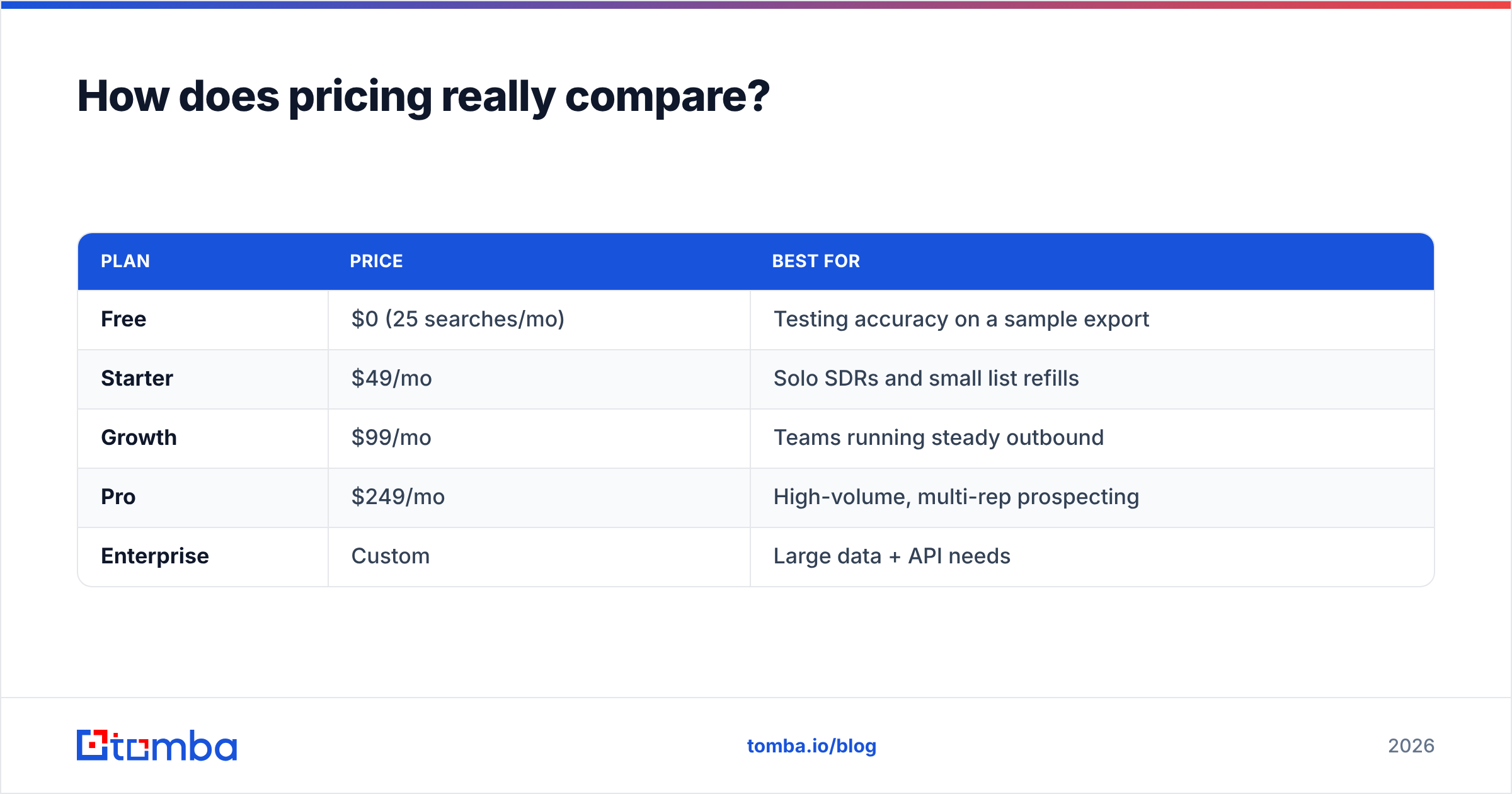
That's why a verification-first stack often lowers total cost even though it adds a line item. For reference, Tomba's pricing is built to sit on top of whatever list source you use:
| Plan | Price | Best for |
|---|---|---|
| Free | $0 (25 searches/mo) | Testing accuracy on a sample export |
| Starter | $49/mo | Solo SDRs and small list refills |
| Growth | $99/mo | Teams running steady outbound |
| Pro | $249/mo | High-volume, multi-rep prospecting |
| Enterprise | Custom | Large data + API needs |
Note the correct Starter price is $49/mo — worth flagging because comparison roundups sometimes quote outdated figures. If your volume is high, run the export through a bulk verifier so you're only paying to email addresses that actually resolve.
Is CSVGO or Jet Leads Pro better for you?#
Match the tool to your motion rather than to a leaderboard.
- Pick CSVGO-style volume tools if: you run high-throughput outbound, refill lists often, and value export speed and format control. You'll accept a bit more cleanup in exchange for scale.
- Pick Jet Leads Pro-style targeting tools if: you run account-based or niche campaigns where firmographic depth and filtering precision drive reply rates. You'll trade raw count for record quality.
- Pick neither in isolation if: deliverability is your bottleneck. In that case the list provider matters less than the verification and enrichment layer you put after it.
The uncomfortable truth is that most teams overspend on the source and underspend on the cleanup. A mediocre list run through disciplined verification outperforms a premium list blasted raw — every time.
What are the honest pros and cons?#
CSVGO strengths: speed, simplicity, export flexibility, good for volume. CSVGO watch-outs: lighter filtering and no guaranteed verification means more manual QA before send.
Jet Leads Pro strengths: richer records, granular targeting, better fit for ABM. Jet Leads Pro watch-outs: fewer rows per pull and a steeper filter-building step; still needs a verification pass.
Shared limitation (both): they hand you a static file. Freshness and deliverability become your responsibility the moment you hit download. That's not unique to these two — it's true of nearly every list vendor — but it's the thing most likely to break a campaign.
The verdict#
There's no universal winner between CSVGO and Jet Leads Pro; there's only a winner for your workflow. Choose CSVGO when volume and export speed lead your priorities. Choose Jet Leads Pro when targeting precision and record depth matter more. Then, whichever you pick, treat the export as raw material — not a finished list.
The step that reliably moves reply rates isn't switching list vendors. It's adding a live-lookup and verification layer so every address you send to is confirmed deliverable, and every "unknown" cell gets a second chance at being found.
That's exactly where Tomba's Email Finder fits: point it at the names your CSV couldn't resolve, verify the ones it could, and export a list that actually lands in the inbox. Start free with 25 searches, test it against a sample of your CSVGO or Jet Leads Pro export, and compare cost-per-valid-lead for yourself — that's the only benchmark that pays your commission.
Related guides#
Ready to find emails that actually work?
Join 150,000+ professionals who stopped guessing and started sending. Free credits on signup — no credit card required.
Get the Tomba newsletter
Practical outbound tactics and product updates — once every two weeks.
About the author