CSVGO vs LeadzenAI: Which Lead Data Tool Wins in 2026?
CSVGO and LeadzenAI both promise clean B2B lead data, but they solve different problems. Here's an honest breakdown of pricing, accuracy, and the best-fit alternative before you commit budget.
Choosing between CSVGO and LeadzenAI usually comes down to one question your sales team keeps avoiding: do you need a bulk list cleaner, or a full lead-intelligence engine? They sound similar in a demo, but they behave very differently once real prospecting starts. This comparison breaks down what each tool actually does, where each one costs you, and when a focused alternative wins outright.
TL;DR — CSVGO vs LeadzenAI at a glance#
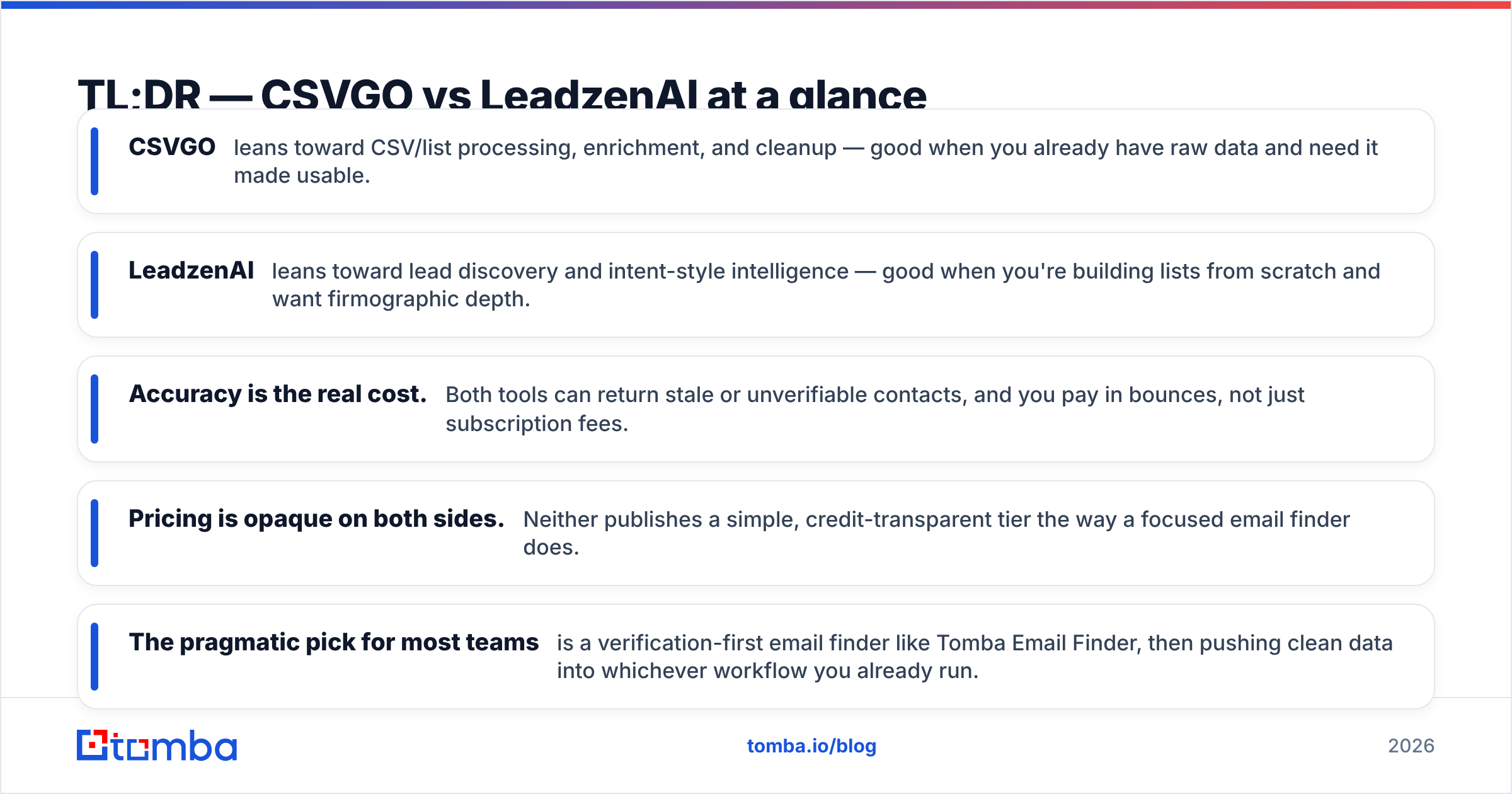
- CSVGO leans toward CSV/list processing, enrichment, and cleanup — good when you already have raw data and need it made usable.
- LeadzenAI leans toward lead discovery and intent-style intelligence — good when you're building lists from scratch and want firmographic depth.
- Accuracy is the real cost. Both tools can return stale or unverifiable contacts, and you pay in bounces, not just subscription fees.
- Pricing is opaque on both sides. Neither publishes a simple, credit-transparent tier the way a focused email finder does.
- The pragmatic pick for most teams is a verification-first email finder like Tomba Email Finder, then pushing clean data into whichever workflow you already run.

What is CSVGO and who is it for?#
CSVGO positions itself around the messy middle of prospecting: the spreadsheet. You import a list of names, domains, or partial records, and it enriches, dedupes, and formats them into something a CRM can ingest. If your day-to-day involves exports from LinkedIn scrapers, event attendee lists, or old marketing databases, that's the pain it targets.
The strength here is workflow. Teams that live in CSVs — RevOps analysts, agencies running client campaigns, freelancers stitching lists together — like having enrichment and contact enrichment logic in one place. You don't have to hand-match columns or run three tools to fill missing job titles.
The weakness is that a cleaner is only as good as its underlying data. If the source records are wrong, enrichment can confidently "fill in" an email that was never valid. Cleanup tools rarely tell you how confident they are per row, which means you inherit risk you can't see until the campaign bounces.
What is LeadzenAI and who is it for?#
LeadzenAI sits earlier in the funnel. Instead of assuming you already have a list, it helps you build one — search by industry, geography, company size, or role, then pull contact and company data into a workspace. The "AI" framing usually points to scoring, recommendations, or intent-style signals layered on top of raw firmographics.
This suits founders and SDRs starting cold in a new market. When you don't have a seed list, discovery-first tooling saves the blank-page problem. It's closer in spirit to a database-plus-search product than to a spreadsheet utility, which is why teams often evaluate it against broader B2B database platforms rather than against pure cleaners.
The trade-off is depth versus reliability. Discovery platforms cast wide, and wide nets catch outdated records. A contact that looked perfect in the search UI may have changed jobs six months ago. Without a hard verification layer, you're trusting the platform's freshness claims on faith.
CSVGO vs LeadzenAI: how do they compare directly?#
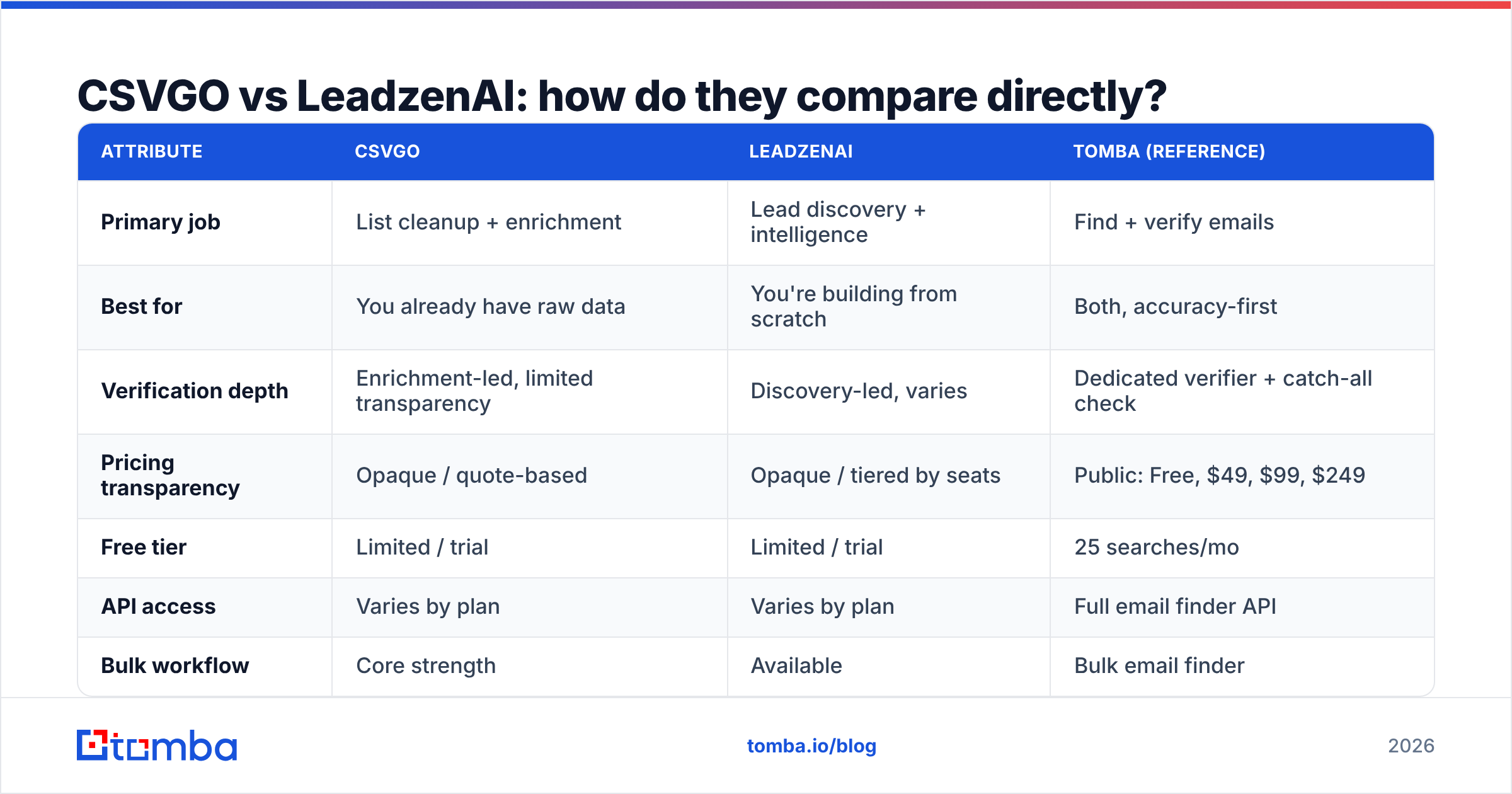
Here's the honest side-by-side. Treat any pricing as directional — both vendors gate specifics behind sign-up or sales calls, so confirm current numbers before you buy.
| Attribute | CSVGO | LeadzenAI | Tomba (reference) |
|---|---|---|---|
| Primary job | List cleanup + enrichment | Lead discovery + intelligence | Find + verify emails |
| Best for | You already have raw data | You're building from scratch | Both, accuracy-first |
| Verification depth | Enrichment-led, limited transparency | Discovery-led, varies | Dedicated verifier + catch-all check |
| Pricing transparency | Opaque / quote-based | Opaque / tiered by seats | Public: Free, $49, $99, $249 |
| Free tier | Limited / trial | Limited / trial | 25 searches/mo |
| API access | Varies by plan | Varies by plan | Full email finder API |
| Bulk workflow | Core strength | Available | Bulk email finder |
The pattern is clear: CSVGO and LeadzenAI solve different halves of the same problem. If you frame it as "which one wins," you'll often pick wrong, because the real question is whether your bottleneck is building the list or trusting it.
Which tool is more accurate for B2B email data?#
Accuracy is where both tools quietly cost you the most, and it's the metric neither markets aggressively. A discovery platform that surfaces 10,000 contacts is worthless if 30% bounce — your sender reputation absorbs the damage, and your deliverability drops for the good contacts too.

Two things separate reliable data from expensive noise:
- Per-record confidence. You need a score or status for each email, not a blanket "enriched" label. A row that says "valid, SMTP-checked" is worth ten rows of unverified guesses.
- Catch-all handling. Many corporate domains accept every address, so a naive verifier marks them "valid" when they're anything but. A real catch-all verifier treats these separately instead of inflating your valid count.
Neither CSVGO nor LeadzenAI leads with these guarantees, which is the core reason experienced teams add a dedicated email verifier regardless of which discovery or cleanup tool they run. According to deliverability guidance from providers like HubSpot, keeping hard bounce rates under 2% is essential to staying out of spam folders — and that's a verification job, not an enrichment one.
What do CSVGO and LeadzenAI cost in practice?#
Sticker price is the smallest part of the bill. The full cost of any lead-data tool is three numbers stacked together:
- Subscription — the monthly plan.
- Wasted credits — searches or enrichments that return dead or catch-all records you can't use.
- Reputation cost — the revenue lost when bounces push your domain into spam filters.
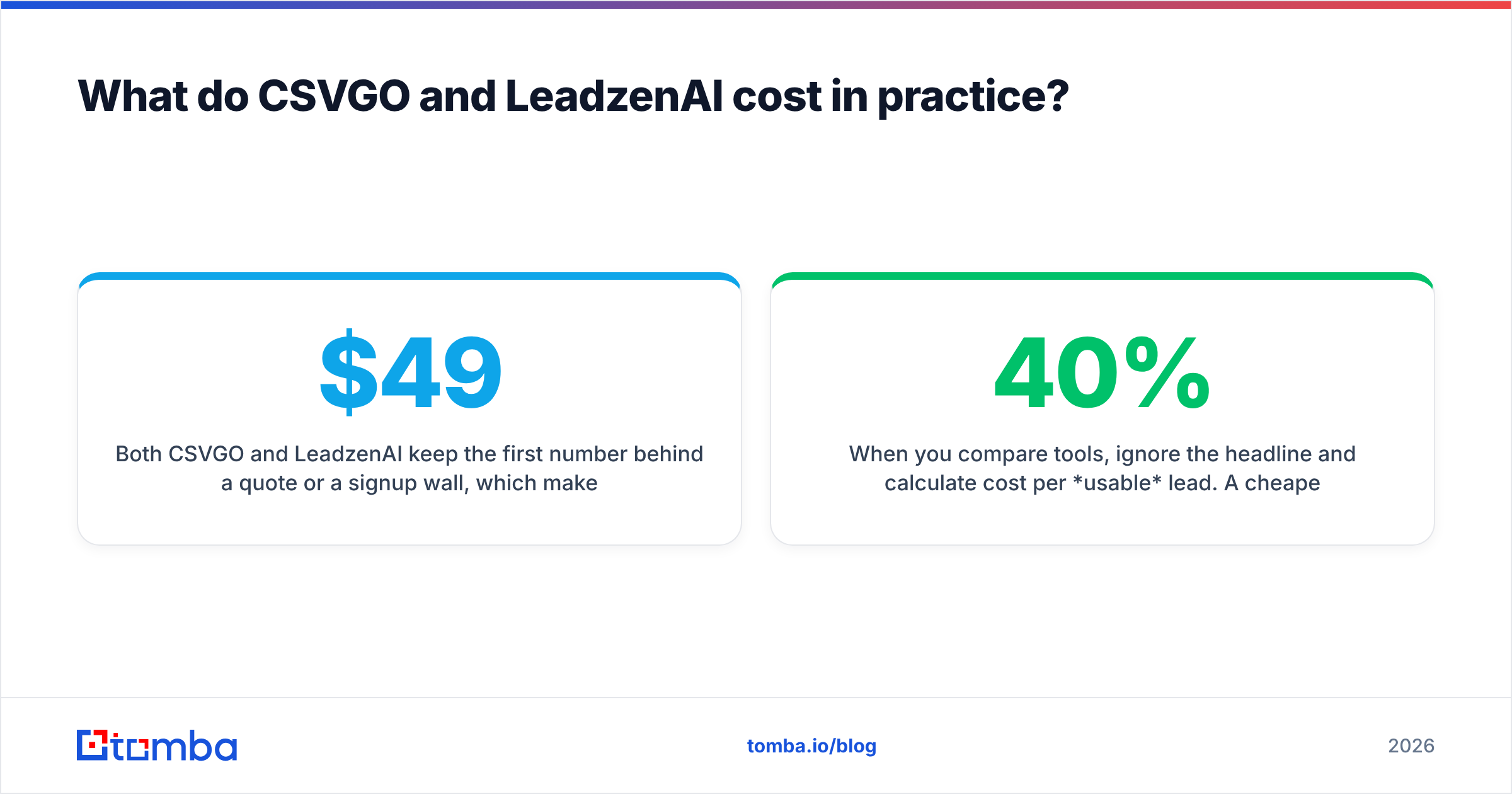
Both CSVGO and LeadzenAI keep the first number behind a quote or a signup wall, which makes true comparison hard. That opacity is itself a signal: transparent, credit-based pricing is easier to model against ROI. For contrast, Tomba pricing is public — a Free tier with 25 searches, Starter at $49/mo, Growth at $99/mo, and Pro at $249/mo — so you can forecast cost per verified contact before spending a dollar.
When you compare tools, ignore the headline and calculate cost per usable lead. A cheaper plan that delivers 40% unverified data is more expensive than a mid-tier plan delivering 95% verified contacts. Run the math on your own last campaign and the ranking usually flips.

When should you pick CSVGO over LeadzenAI?#
Pick CSVGO when your problem is data you already have. Signs you're in this bucket:
- You export lists regularly from scrapers, webinars, or partner databases.
- Your records are inconsistent — mixed formats, missing titles, duplicate rows.
- You want enrichment and dedupe inside one repeatable workflow instead of five manual steps.
In that scenario, a discovery-first tool like LeadzenAI is overkill — you're not short on prospects, you're short on clean prospects. Just remember to bolt on verification so "enriched" doesn't quietly mean "guessed."
When should you pick LeadzenAI over CSVGO?#
Pick LeadzenAI when your problem is the blank page. Signs you're in this bucket:
- You're entering a new market or vertical with no seed list.
- You want to filter by firmographics — industry, headcount, geography — to define a target account list.
- You value search-and-discover over import-and-clean.
Here, CSVGO has nothing to chew on because you don't have data yet. LeadzenAI's discovery gives you a starting universe. The catch is unchanged: whatever it surfaces still needs verification before it touches your outbound sequence, ideally paired with a domain search to confirm real, active company inboxes.
Is there a better alternative to both?#
For most teams, yes — and it's a boring, effective one: lead with accuracy, not with the shape of the tool.
CSVGO and LeadzenAI both optimize for a stage (cleanup vs discovery) and treat verification as an afterthought. But bounces don't care which stage you were in. The teams with the best reply rates flip the priority: they find and verify contacts first, then plug that clean data into whatever discovery or CRM workflow they prefer.
That's the design philosophy behind Tomba. Instead of forcing you to choose between building and cleaning, it treats verified contact data as the foundation:
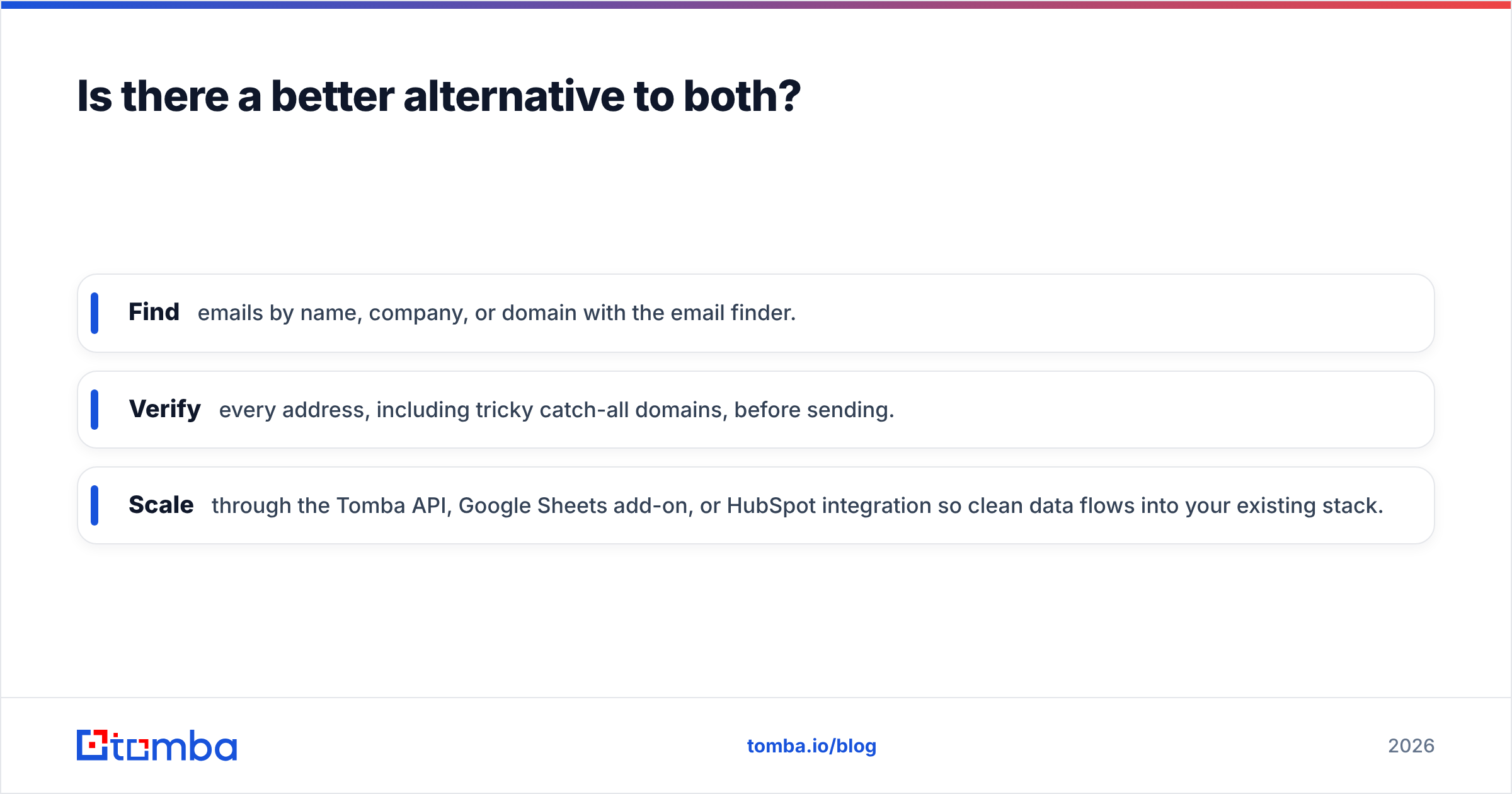
- Find emails by name, company, or domain with the email finder.
- Verify every address, including tricky catch-all domains, before sending.
- Scale through the Tomba API, Google Sheets add-on, or HubSpot integration so clean data flows into your existing stack.
Independent review sites like G2 are a good sanity check here — read how each tool scores specifically on data accuracy and deliverability, not just on breadth of features. A platform can have a beautiful search UI and still hand you a list that torches your domain.
How to choose in five minutes#
Skip the feature-matrix paralysis. Answer three questions:
- Do I have data or do I need data? Have it → cleanup-first (CSVGO). Need it → discovery-first (LeadzenAI). Either → accuracy-first (a verification-led finder).
- Can I see per-contact confidence? If the tool can't tell you why a record is valid, budget for a separate verifier no matter what.
- Is pricing transparent enough to model cost-per-usable-lead? If you can't forecast it, you can't control it.
Run any tool through those three and the right pick stops being a coin flip. In practice, most teams discover their true bottleneck was never discovery or cleanup — it was trusting the data. Once you fix that, the "CSVGO vs LeadzenAI" debate matters far less than it seemed.
The bottom line#
CSVGO and LeadzenAI aren't really rivals — they're two halves of a pipeline, and neither closes the accuracy gap on its own. CSVGO cleans what you have; LeadzenAI finds what you don't; both leave verification as your problem. If your outbound lives and dies on deliverability — and it does — start with verified data and build outward.
That's exactly where Tomba fits. Start free with 25 searches a month, find the contacts you need with the Tomba Email Finder, verify every one before you hit send, and keep your sender reputation clean while your competitors are still cleaning spreadsheets. Try it, measure your cost per usable lead, and let the numbers pick the winner.
Related guides#
Ready to find emails that actually work?
Join 150,000+ professionals who stopped guessing and started sending. Free credits on signup — no credit card required.
Get the Tomba newsletter
Practical outbound tactics and product updates — once every two weeks.
About the author