CSVGO vs ListKit: Which B2B Lead List Builder Wins in 2026?
CSVGO and ListKit both promise verified B2B lead lists for cold outreach — but they price, verify, and enrich data very differently. Here's an honest, side-by-side breakdown to help you pick.

CSVGO vs ListKit comes down to one question: whose data actually connects when you hit send? Both tools sell the same promise. They offer clean, verified B2B lead lists you can drop straight into a cold email sequencer. But they get there in different ways. Pricing models, verification depth, and enrichment sources all vary. This CSVGO vs ListKit breakdown compares them honestly. You can then pick the tool that fits your outreach, not the one with the loudest landing page.
TL;DR: CSVGO vs ListKit at a glance#
- CSVGO leans into credit-based, waterfall-style enrichment and CSV workflows — good if you already have partial lists and want to fill gaps cheaply.
- ListKit is built as an all-in-one prospecting database with triple-verified emails and native handoff to sequencers like Smartlead and Instantly — good if you want to build lists from scratch.
- Verification quality is the real differentiator; both claim high deliverability, but you should test-verify a sample before trusting either at scale.
- Neither is a full data-and-outreach stack — you'll still want a dedicated email verifier and a finder for edge cases and catch-all domains.
- If your bottleneck is finding and validating contacts rather than buying a static list, a purpose-built email finder like Tomba often beats both on cost per valid contact.
What are CSVGO and ListKit?#
Both tools live in the same category. They are B2B lead-data platforms that let you build a targeted list of prospects with work emails, and sometimes phone numbers. You then export or push that list into your outreach tool. The CSVGO vs ListKit split starts with how each one builds that list.
CSVGO positions itself around the CSV workflow that most sales teams already live in. You upload a list of companies or partial contacts, and it enriches the rows. It appends emails, titles, and firmographics. It often uses a waterfall approach that queries multiple data sources until it finds a match. The credit model rewards you for only paying when a row is successfully enriched.
ListKit (listkit.io) is built more like a searchable database plus a list builder. You filter by ICP attributes — industry, headcount, title, technology, geography — and it returns contacts with emails that the platform markets as "triple-verified." It is tightly integrated with the cold-email ecosystem. Exporting to a sequencer is a first-class action rather than a manual CSV round-trip.
The practical difference is simple. CSVGO shines when you already have a seed list and want to enrich it. ListKit shines when you're starting from an ICP definition and need net-new contacts.

How do CSVGO and ListKit compare on core features?#
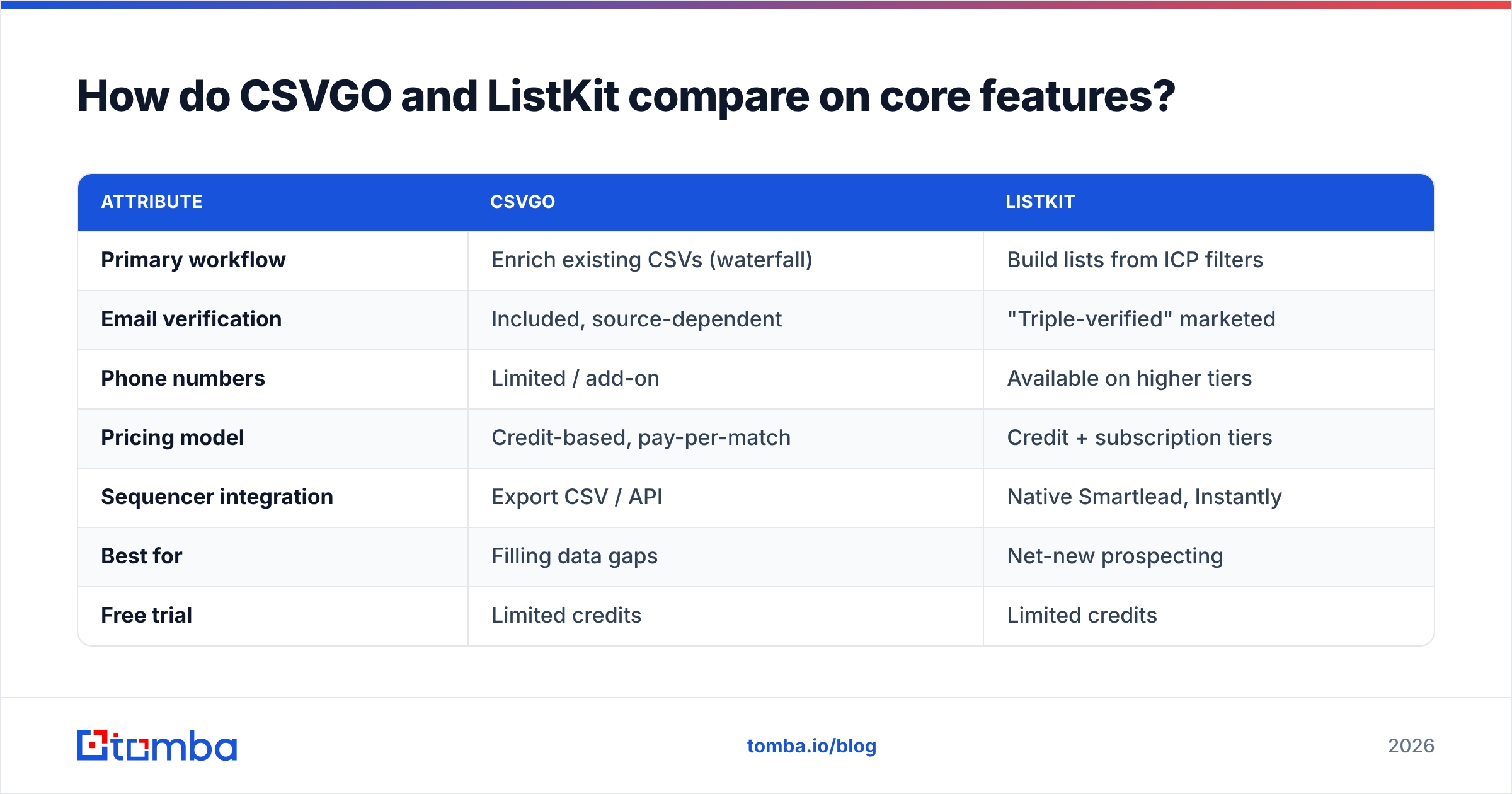
Here is the CSVGO vs ListKit head-to-head on the attributes that actually change your reply rate and your bill.
| Attribute | CSVGO | ListKit |
|---|---|---|
| Primary workflow | Enrich existing CSVs (waterfall) | Build lists from ICP filters |
| Email verification | Included, source-dependent | "Triple-verified" marketed |
| Phone numbers | Limited / add-on | Available on higher tiers |
| Pricing model | Credit-based, pay-per-match | Credit + subscription tiers |
| Sequencer integration | Export CSV / API | Native Smartlead, Instantly |
| Best for | Filling data gaps | Net-new prospecting |
| Free trial | Limited credits | Limited credits |
| Catch-all handling | Basic | Basic |
A few honest caveats about this table. Both vendors adjust pricing and packaging often. So treat the "credits" columns as directional and confirm the current numbers on their sites before you buy. And "triple-verified" is a marketing term, not an industry standard. It usually means a syntax check, an MX/SMTP check, and a historical-bounce check. That is roughly what any competent email verification pass does. The label matters less than the measured bounce rate on your sends.
Which has more accurate data?#
Accuracy is the whole game. It is also where blanket claims fall apart. Neither CSVGO nor ListKit can promise a fixed accuracy number that holds across every industry, seniority level, and region. Data decays constantly as people change jobs.
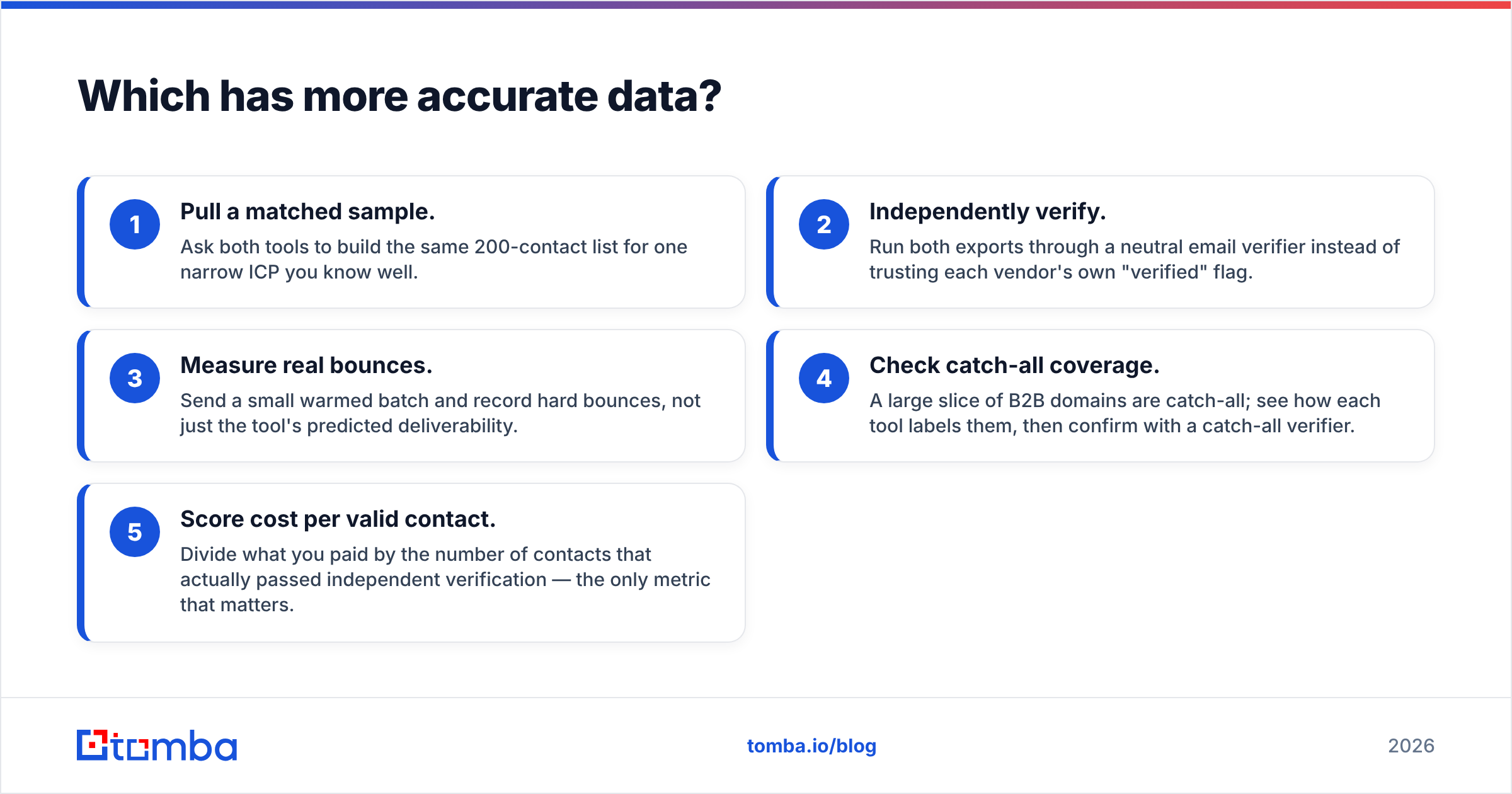
What you can control is your test methodology. Before committing budget:
- Pull a matched sample. Ask both tools to build the same 200-contact list for one narrow ICP you know well.
- Independently verify. Run both exports through a neutral email verifier instead of trusting each vendor's own "verified" flag.
- Measure real bounces. Send a small warmed batch and record hard bounces, not just the tool's predicted deliverability.
- Check catch-all coverage. A large slice of B2B domains are catch-all; see how each tool labels them, then confirm with a catch-all verifier.
- Score cost per valid contact. Divide what you paid by the number of contacts that actually passed independent verification — the only metric that matters.
That last number is the one to negotiate on. A list that looks cheaper per credit but returns 30% invalid emails is more expensive than a slightly pricier list at 95% valid.

How does CSVGO vs ListKit pricing compare?#
CSVGO's credit model is attractive when your enrichment hit rate is high. In theory you pay only for matched rows. The risk is variable cost. A messy input list burns credits on attempts, and waterfall lookups across multiple sources can add up fast on hard-to-find contacts.
ListKit's subscription-plus-credit structure is more predictable month to month, which finance teams like. But you can end up paying for a database seat during slow months when you're not actively building lists.
Neither publishes pricing that stays fixed for long. So here is the fair way to compare total cost:
| Cost factor | What to check |
|---|---|
| Cost per valid email | After independent verification, not vendor's claim |
| Wasted credits | Failed matches, duplicates, invalid rows |
| Seat/subscription floor | Minimum monthly commitment |
| Overage rates | Price once you exceed included credits |
| Export limits | Caps on rows per export or per month |
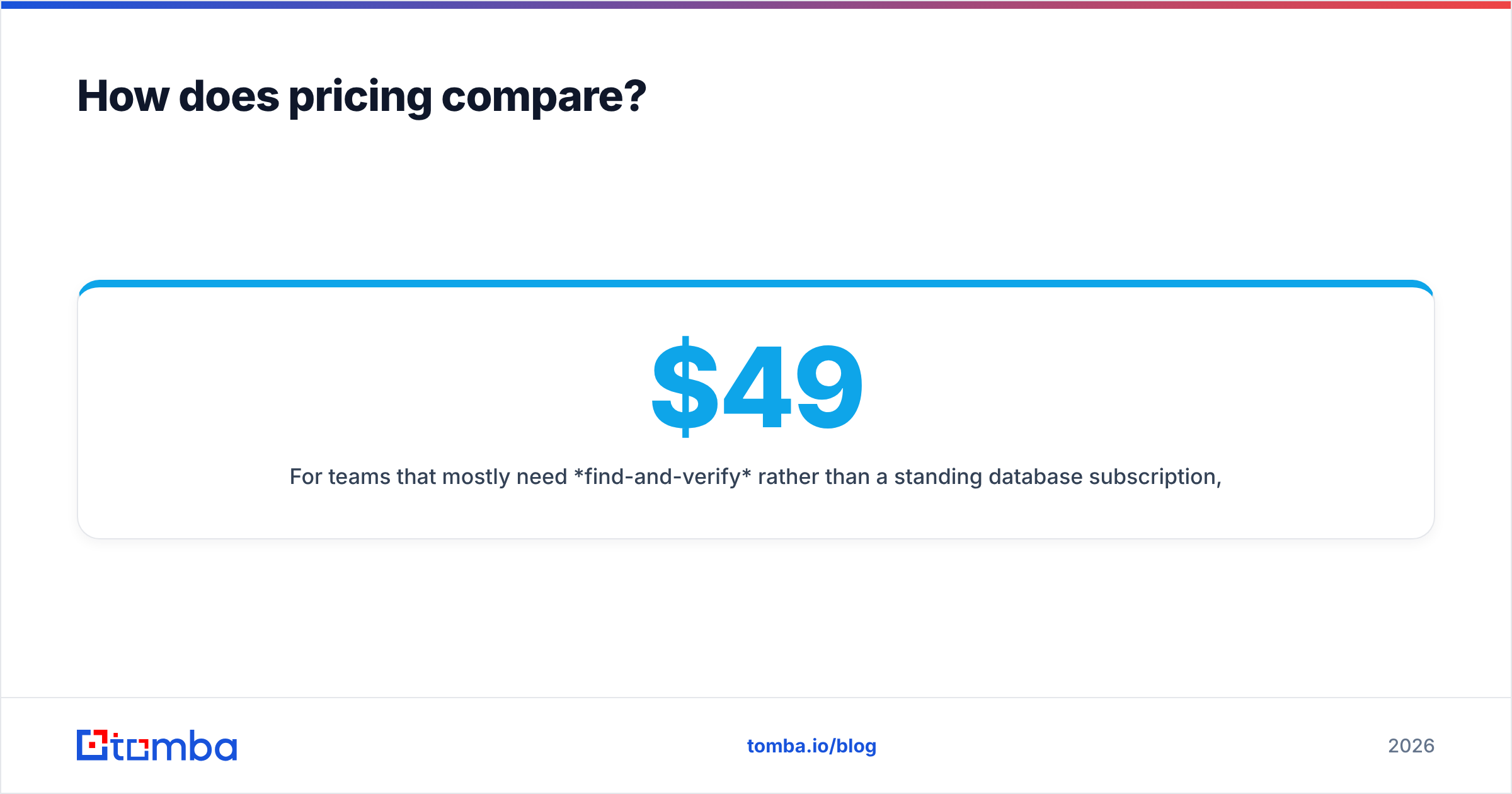
Some teams mostly need find-and-verify rather than a standing database subscription. For them, a transparent per-search tool can undercut both. Tomba, for reference, runs a free tier at 25 searches/month, Starter at $49/mo, Growth at $99/mo, and Pro at $249/mo — see full Tomba pricing for how credits map to finds and verifications. The point is not that one model is universally cheaper. It is that you should model your volume against each structure instead of comparing sticker prices.
Which integrates better with your outreach stack?#
ListKit has a clear edge here for cold-email-first teams. Its native pushes to Smartlead and Instantly mean you can go from filter to loaded campaign without touching a spreadsheet. That reduces the copy-paste errors that quietly wreck deliverability.
CSVGO's strength is the opposite kind of flexibility. Because it is CSV- and API-centric, it slots into custom pipelines, RevOps automations, and enrichment jobs where you control the destination. If your workflow already runs through a warehouse, a data enrichment step, or a Make/Zapier chain, that neutrality is a feature.
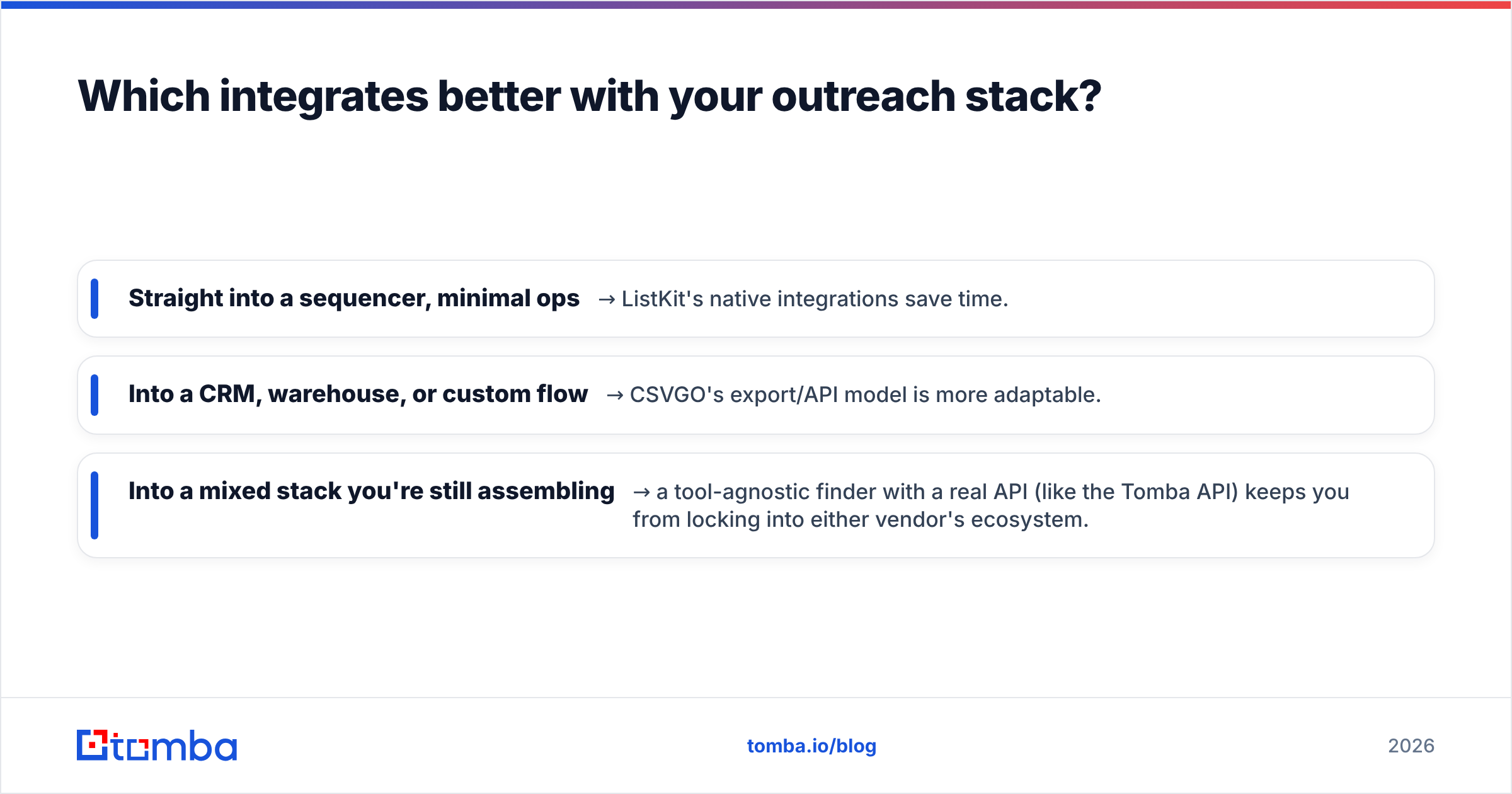
Ask yourself where the list needs to land:
- Straight into a sequencer, minimal ops → ListKit's native integrations save time.
- Into a CRM, warehouse, or custom flow → CSVGO's export/API model is more adaptable.
- Into a mixed stack you're still assembling → a tool-agnostic finder with a real API (like the Tomba API) keeps you from locking into either vendor's ecosystem.
Where do both tools fall short?#
Being fair to both means naming the shared gaps.
Static lists go stale. Any list you buy today starts decaying immediately. Neither tool eliminates the need for a verification pass right before you send. The closer to send-time you validate, the fewer bounces you eat.
Catch-all domains are hard for everyone. Both give you a basic label, but confidently resolving catch-alls needs specialized logic. This is a common reason teams keep a dedicated catch-all verifier in the stack regardless of which list tool they use.
Coverage varies by region and role. Both skew stronger in North American, mid-market-and-up datasets. Niche verticals, non-English markets, and very small companies expose thinner coverage. That is exactly where a live finder that queries the open web outperforms a pre-built database.
No tool replaces sender hygiene. Clean data is necessary but not sufficient. If your domain authentication, warmup, and content are weak, even a perfect list bounces or lands in spam.
CSVGO vs ListKit vs a dedicated email finder#
It is worth widening the frame. CSVGO and ListKit both sell lists. But a lot of teams don't actually need a standing list subscription. They need to find and verify specific people on demand, which is a different tool category. Competitors and peers in the broader space, including data providers like BookYourData, each optimize for a slightly different buyer. So match the tool to your motion rather than the category label.
| Job to be done | Best-fit approach |
|---|---|
| Enrich an existing CSV | CSVGO |
| Build net-new ICP lists for cold email | ListKit |
| Find + verify specific named prospects | Email finder (e.g., Tomba) |
| One-off bulk verification of a purchased list | Dedicated bulk verify |
| Ongoing CRM enrichment via API | Enrichment API |
Say your reality is "I keep needing the right email for a specific person at a specific company." Then neither a database subscription nor a CSV enricher is the tightest fit. A per-search finder that returns a confidence score and verification status usually gives you a lower cost per valid contact. You can cross-check any of these tools' outputs on independent review sites like G2 before committing.
So which should you choose?#
Pick CSVGO if you live in spreadsheets, already have partial data, and want a credit-efficient way to fill gaps without paying for a standing seat.
Pick ListKit if you're building cold-email lists from scratch, value predictable subscription pricing, and want one-click handoff into Smartlead or Instantly.
But maybe the honest answer is "I mostly need accurate emails I can trust at send-time." Then the smarter money is often on a dedicated finder-plus-verifier. Tomba's Email Finder returns work emails by name, domain, or company with a verification status attached. It backs that with an email verifier and catch-all handling. It starts free at 25 searches a month, so you can benchmark it against your CSVGO or ListKit exports before spending a dollar. To settle the CSVGO vs ListKit question, run the same ICP through all three, verify every result independently, and let cost-per-valid-contact — not marketing labels — make the call.
Related guides#
Ready to find emails that actually work?
Join 150,000+ professionals who stopped guessing and started sending. Free credits on signup — no credit card required.
Get the Tomba newsletter
Practical outbound tactics and product updates — once every two weeks.
About the author