CSVGo vs RampedUp (2026): Which B2B Data Tool Wins?
CSVGo cleans and enriches spreadsheets on demand; RampedUp bundles a contact database with intent signals. Here's which B2B data tool fits your workflow and budget in 2026.
Choosing between CSVGo and RampedUp comes down to one question: do you already have a list you need cleaned, or do you need the list built for you in the first place? Get that wrong and you either overpay for a database you never query, or you keep exporting spreadsheets a lighter tool could have enriched for a fraction of the price.
This is a neutral, hands-on comparison of the two platforms across data model, accuracy, pricing, integrations, and the workflows each one actually rewards. No affiliation with either vendor — just the trade-offs you'd want a colleague to tell you before you sign an annual contract.
TL;DR — CSVGo vs RampedUp at a glance#
- CSVGo is a spreadsheet-first enrichment and cleaning tool. You bring a CSV, it appends missing fields (emails, titles, company data), dedupes, and hands it back. Pay-as-you-go friendly.
- RampedUp is a fuller B2B data platform: a contact/company database, intent signals, and Salesforce-native enrichment aimed at RevOps and sales teams that want data inside the CRM.
- Accuracy is workflow-dependent — CSVGo is only as good as the rows you feed it; RampedUp leans on its own database coverage, which is strong in North America but thinner outside it.
- Budget split: CSVGo suits solo operators and lean teams doing occasional list work; RampedUp suits seat-based teams that live in Salesforce and want intent data bundled in.
- The gap both leave: verified, real-time email discovery by domain or name. Many teams pair either tool with a dedicated email finder to close that gap.

What is CSVGo and who is it for?#
CSVGo is built around a single job: take a messy spreadsheet and make it usable. You upload a CSV, map your columns, pick the fields you want appended or corrected, and export a clean file. Think of it as a car wash for your contact lists — the car (your data) is already yours; the service just makes it presentable and fills in the dents.
Its strengths are practical:
- Column-level enrichment — append job titles, company size, industry, or a best-guess email to rows that only have a name and domain.
- Cleaning and deduplication — normalize formats, strip duplicates, and standardize company names before the list hits your CRM.
- No seat lock-in — the pay-as-you-go posture means an occasional user isn't stuck paying every month for a tool they touch twice a quarter.
The trade-off is scope. CSVGo doesn't originate contacts. If your spreadsheet has ten rows, you get ten enriched rows back — it won't hand you the other 490 prospects at that account. It's a finishing tool, not a sourcing engine.
What is RampedUp and who is it for?#
RampedUp is a B2B data and intelligence platform with a database you can query, buyer-intent signals, and deep Salesforce integration. Where CSVGo waits for you to bring data, RampedUp generates it — you search its contact and company records, layer on intent signals, and push enriched records straight into the CRM.
That positions it closer to a full revenue operations stack than to a spreadsheet utility. RampedUp tends to fit:
- Sales teams that live in Salesforce and want records enriched on creation, not in a batch export.
- RevOps functions standardizing account and contact data across a pipeline.
- Teams that value intent — knowing which accounts are researching your category, not just who works there.
The cost of that breadth is complexity and price. You're buying a platform with seats, onboarding, and a database subscription — overkill if all you needed was to clean a list a marketer downloaded from an event.
CSVGo vs RampedUp: side-by-side comparison#
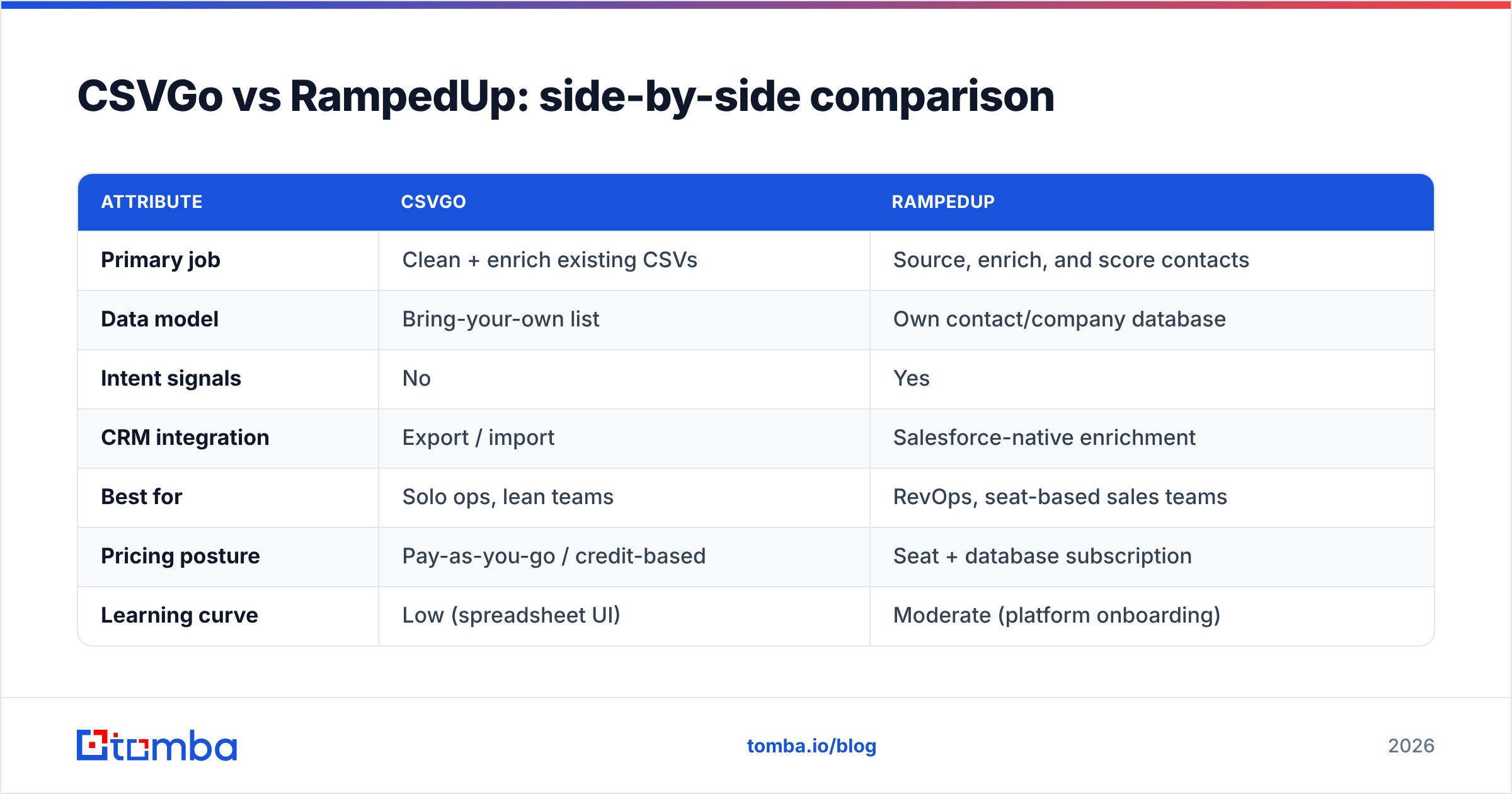
Here's the core split. Treat vendor pricing as directional — both change tiers and it's worth confirming on their sites — but the shape of each offer is the real signal.
| Attribute | CSVGo | RampedUp |
|---|---|---|
| Primary job | Clean + enrich existing CSVs | Source, enrich, and score contacts |
| Data model | Bring-your-own list | Own contact/company database |
| Intent signals | No | Yes |
| CRM integration | Export / import | Salesforce-native enrichment |
| Best for | Solo ops, lean teams | RevOps, seat-based sales teams |
| Pricing posture | Pay-as-you-go / credit-based | Seat + database subscription |
| Learning curve | Low (spreadsheet UI) | Moderate (platform onboarding) |
| Weak spot | No net-new sourcing | Cost + non-NA coverage gaps |
The decision usually falls out of the first two rows. If you already have lists, CSVGo's model is cheaper and faster. If you need the lists built and scored, RampedUp's database earns its keep — provided your market is where its coverage is strongest.
Which tool has better data accuracy?#
Neither wins accuracy outright — they fail differently, which matters more than a single percentage.
CSVGo's accuracy is inherited. It enriches what you give it, so a clean input with correct domains produces reliable output. Feed it stale or malformed rows and the appended fields inherit that noise. Its email guesses in particular are pattern-based, so they should be verified before you send. Run any appended addresses through an email verifier before they touch a sequence.
RampedUp's accuracy is database-bound. Its records are as fresh as its last data refresh and as complete as its coverage in your target geography. In North American mid-market and enterprise, coverage is solid. Move into EMEA SMBs or APAC and you'll hit more blanks and more decayed records — a known limitation of database-first vendors generally, not a RampedUp-specific flaw.
Two practical rules regardless of which you pick:
- Verify emails before sending. Both tools can hand you plausible-but-wrong addresses. Bounces damage your sender reputation faster than a slightly smaller list ever will.
- Check catch-all domains separately. Neither tool fully resolves catch-all servers, so a "valid" flag can be optimistic. A dedicated catch-all verifier closes that blind spot.
Independent reviews on G2 are useful for reading between the marketing lines here — sort by your company size and region rather than trusting an aggregate score.
How do CSVGo and RampedUp compare on pricing?#
Price is where the two diverge most, because you're not buying the same thing.
CSVGo's pay-as-you-go, credit-style model means your cost tracks usage. Enrich 2,000 rows one month and 0 the next, and your bill reflects it. That's ideal for spiky, project-based work — an event follow-up, a quarterly list cleanup, a one-off ABM push.
RampedUp is a platform subscription: seats plus database access, typically annual. The per-user math only works if multiple reps use it daily and you actually consume the intent data. Buy it for occasional cleanup and the effective cost per enriched record balloons.
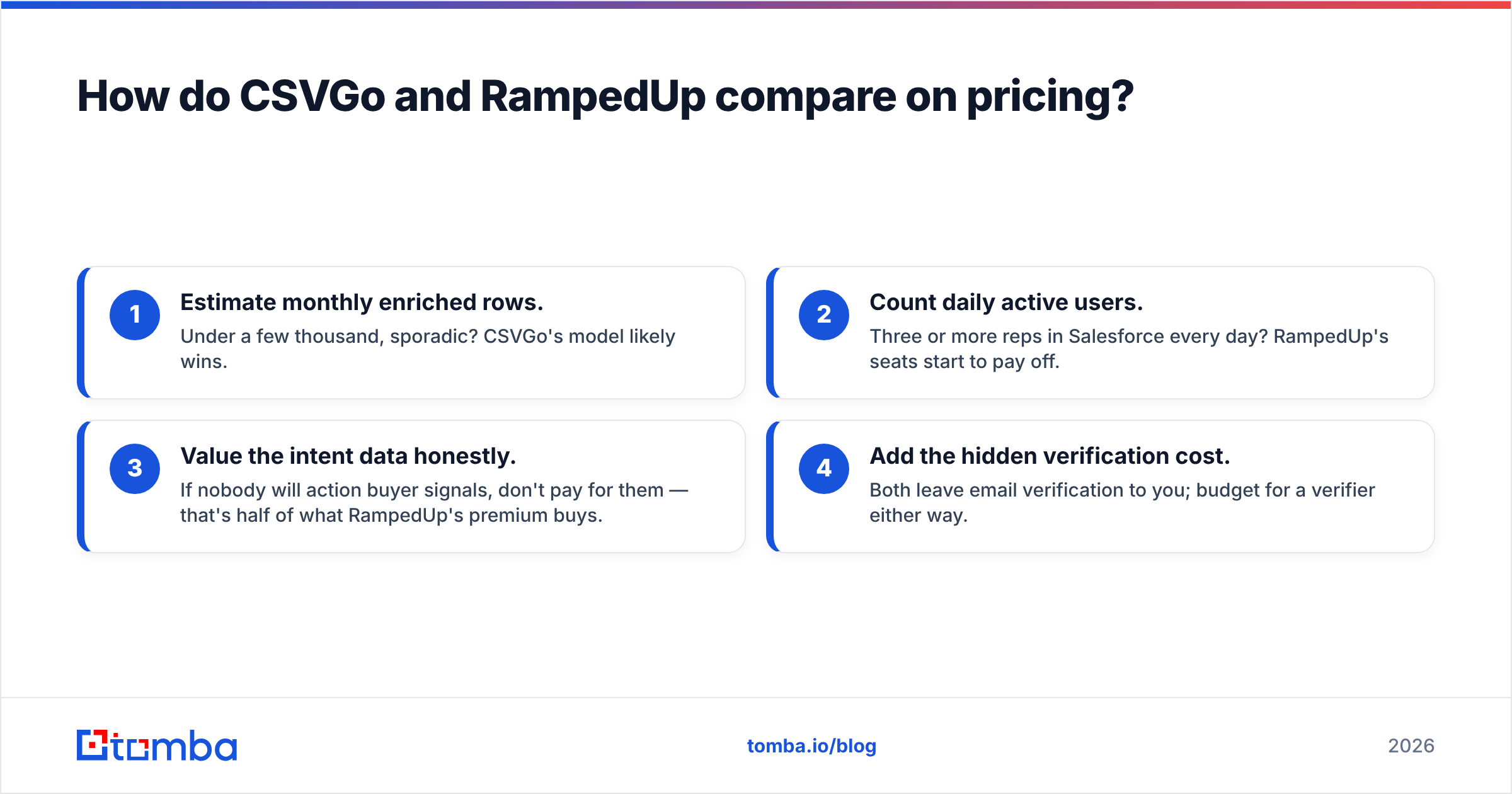
A quick way to decide:
- Estimate monthly enriched rows. Under a few thousand, sporadic? CSVGo's model likely wins.
- Count daily active users. Three or more reps in Salesforce every day? RampedUp's seats start to pay off.
- Value the intent data honestly. If nobody will action buyer signals, don't pay for them — that's half of what RampedUp's premium buys.
- Add the hidden verification cost. Both leave email verification to you; budget for a verifier either way.

What do both tools miss — and how to fill the gap?#
Both platforms share a blind spot: real-time, verified email discovery from a name or domain, independent of any list or database subscription. CSVGo needs you to already have the row; RampedUp needs the contact to exist in its database. Neither reliably answers "find the verified email for this specific person at this specific company, right now."
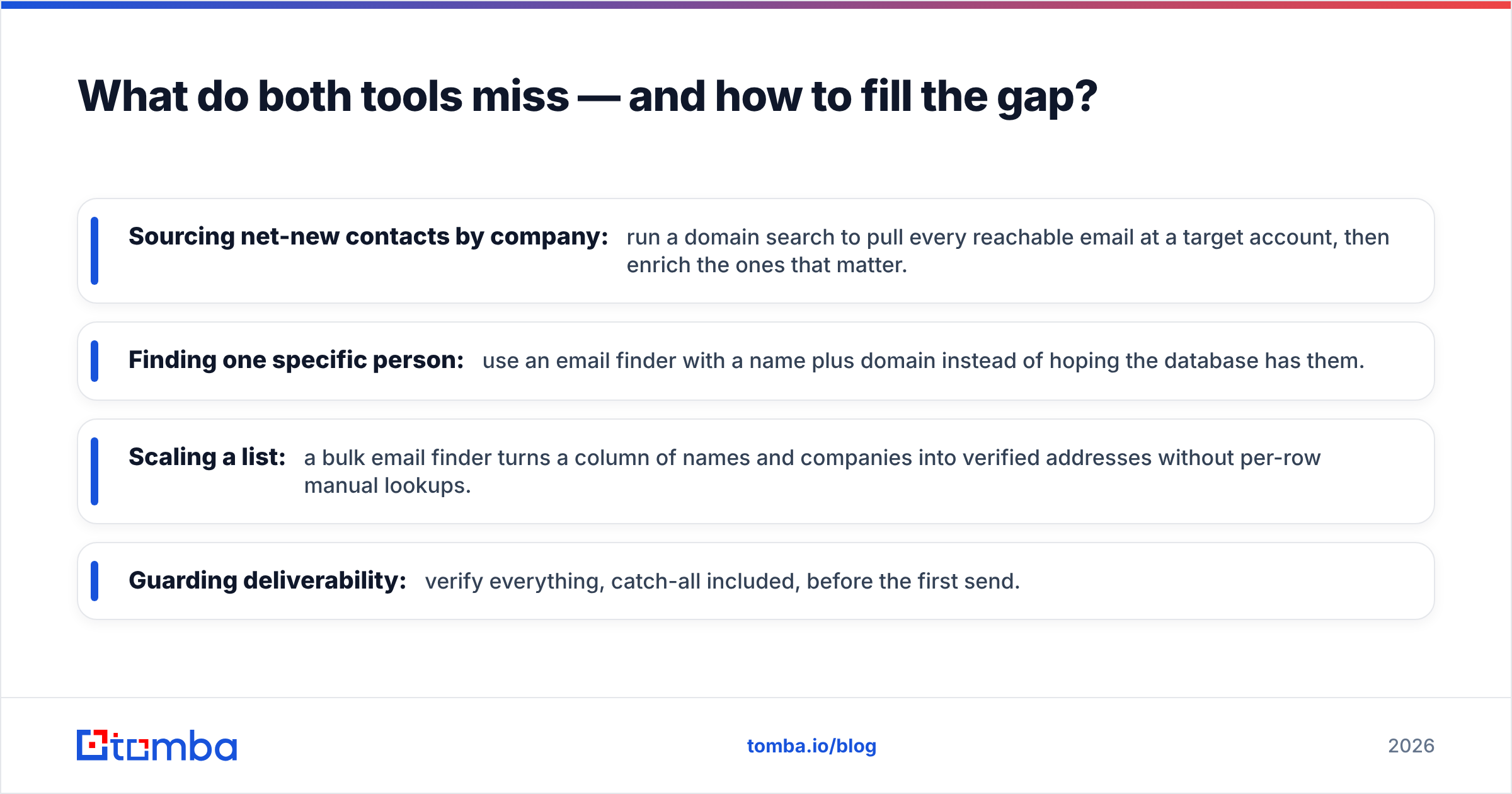
That's the job a dedicated email finder does. Here's how the pieces fit together in a realistic stack:
- Sourcing net-new contacts by company: run a domain search to pull every reachable email at a target account, then enrich the ones that matter.
- Finding one specific person: use an email finder with a name plus domain instead of hoping the database has them.
- Scaling a list: a bulk email finder turns a column of names and companies into verified addresses without per-row manual lookups.
- Guarding deliverability: verify everything, catch-all included, before the first send.
This is exactly where Tomba tends to slot in alongside — not against — a tool like CSVGo or RampedUp. You keep your enrichment or database workflow and add reliable, verified email discovery on top. For teams comparing broader options, Tomba also publishes side-by-side breakdowns like its Clearbit alternative and RocketReach alternative pages.
CSVGo vs RampedUp: which should you choose?#
Match the tool to the problem, not the feature list:
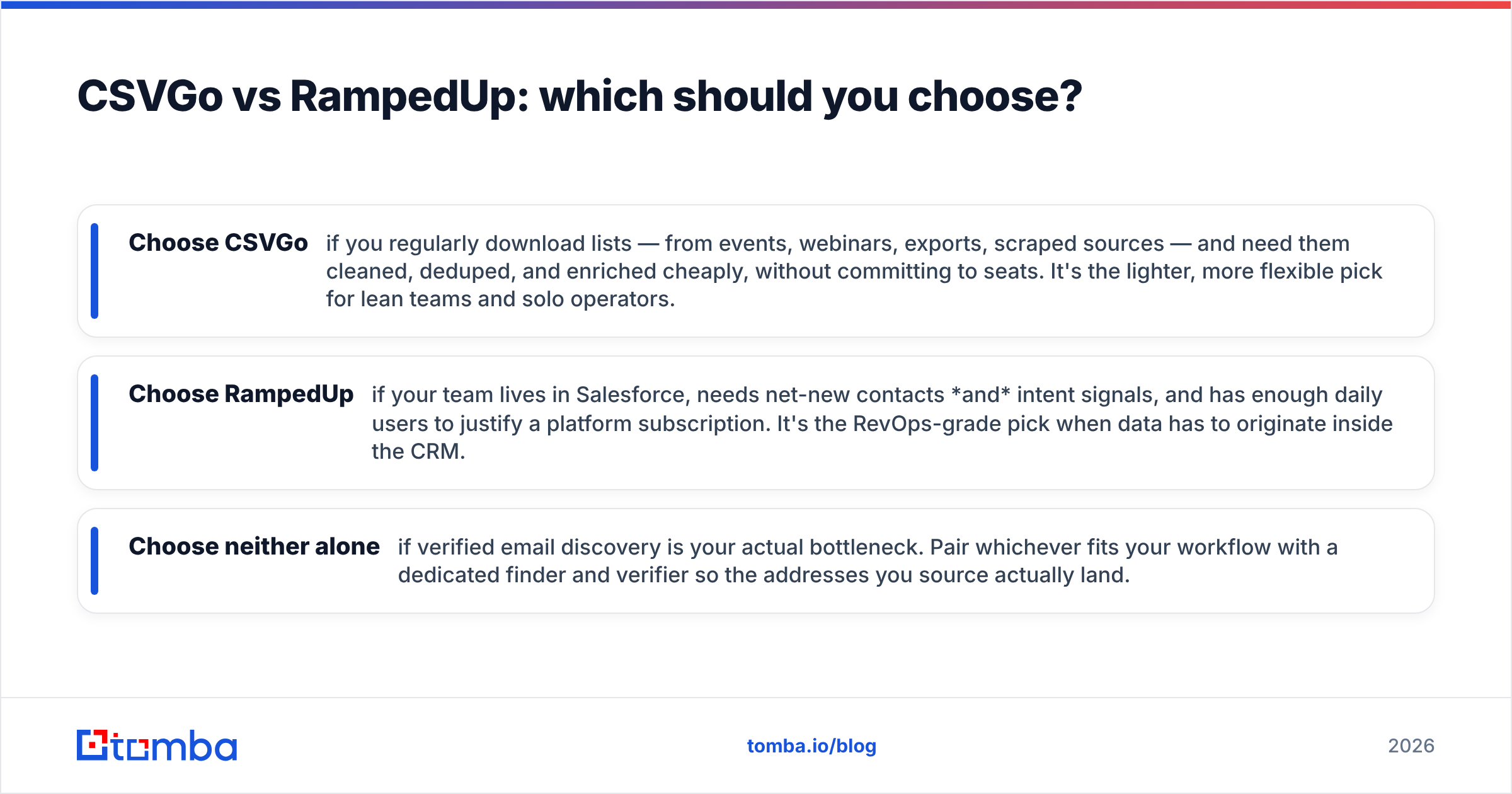
- Choose CSVGo if you regularly download lists — from events, webinars, exports, scraped sources — and need them cleaned, deduped, and enriched cheaply, without committing to seats. It's the lighter, more flexible pick for lean teams and solo operators.
- Choose RampedUp if your team lives in Salesforce, needs net-new contacts and intent signals, and has enough daily users to justify a platform subscription. It's the RevOps-grade pick when data has to originate inside the CRM.
- Choose neither alone if verified email discovery is your actual bottleneck. Pair whichever fits your workflow with a dedicated finder and verifier so the addresses you source actually land.
Here's a compact decision matrix:
| Your situation | Best fit |
|---|---|
| Occasional list cleanup, tight budget | CSVGo |
| Daily Salesforce team wanting intent | RampedUp |
| Need net-new emails by name/domain | Email finder + either tool |
| Deliverability is the real problem | Verifier layer on top |
| Non-North-American target market | Test coverage before committing |
The honest verdict: CSVGo and RampedUp aren't really rivals — they solve adjacent problems. CSVGo finishes lists you already have; RampedUp builds and scores lists inside your CRM. Pick by which problem is actually yours, and don't pay platform prices for a spreadsheet job or accept spreadsheet scope when you needed a database.
Close the email gap with Tomba#
Whichever platform you land on, your outreach still depends on one thing: a verified, deliverable email for the right person. That's Tomba's core job. Point the Tomba Email Finder at a name and domain, get a verified address back, and enrich or clean the rest with the tool that fits your workflow. Start on the free tier (25 searches a month), then scale up — see full Tomba pricing with the Starter plan at $49/mo. Build the list your way; let Tomba make sure the emails actually reach an inbox.
Related guides#
Ready to find emails that actually work?
Join 150,000+ professionals who stopped guessing and started sending. Free credits on signup — no credit card required.
Get the Tomba newsletter
Practical outbound tactics and product updates — once every two weeks.
About the author