Csvgo vs UpLead 2026: Which B2B Data Tool Actually Wins?
Csvgo and UpLead both promise verified B2B contacts, but they solve different problems. Here's an honest, side-by-side breakdown of accuracy, pricing, and fit — plus where a leaner tool beats both.
You need clean B2B contact data, and two names keep coming up: Csvgo and UpLead. Both sell "verified" emails and company records. Both promise you can stop wasting sends on bounces. But they are built for different buyers, and the wrong pick will cost you either budget or bounce rate.
This is a neutral, hands-on breakdown of csvgo vs UpLead — what each does well, where each falls short, what they actually cost, and who should choose which. At the end, we look at a leaner option that beats both on price-per-verified-contact for teams that mainly need accurate emails.
TL;DR: Csvgo vs UpLead at a glance#
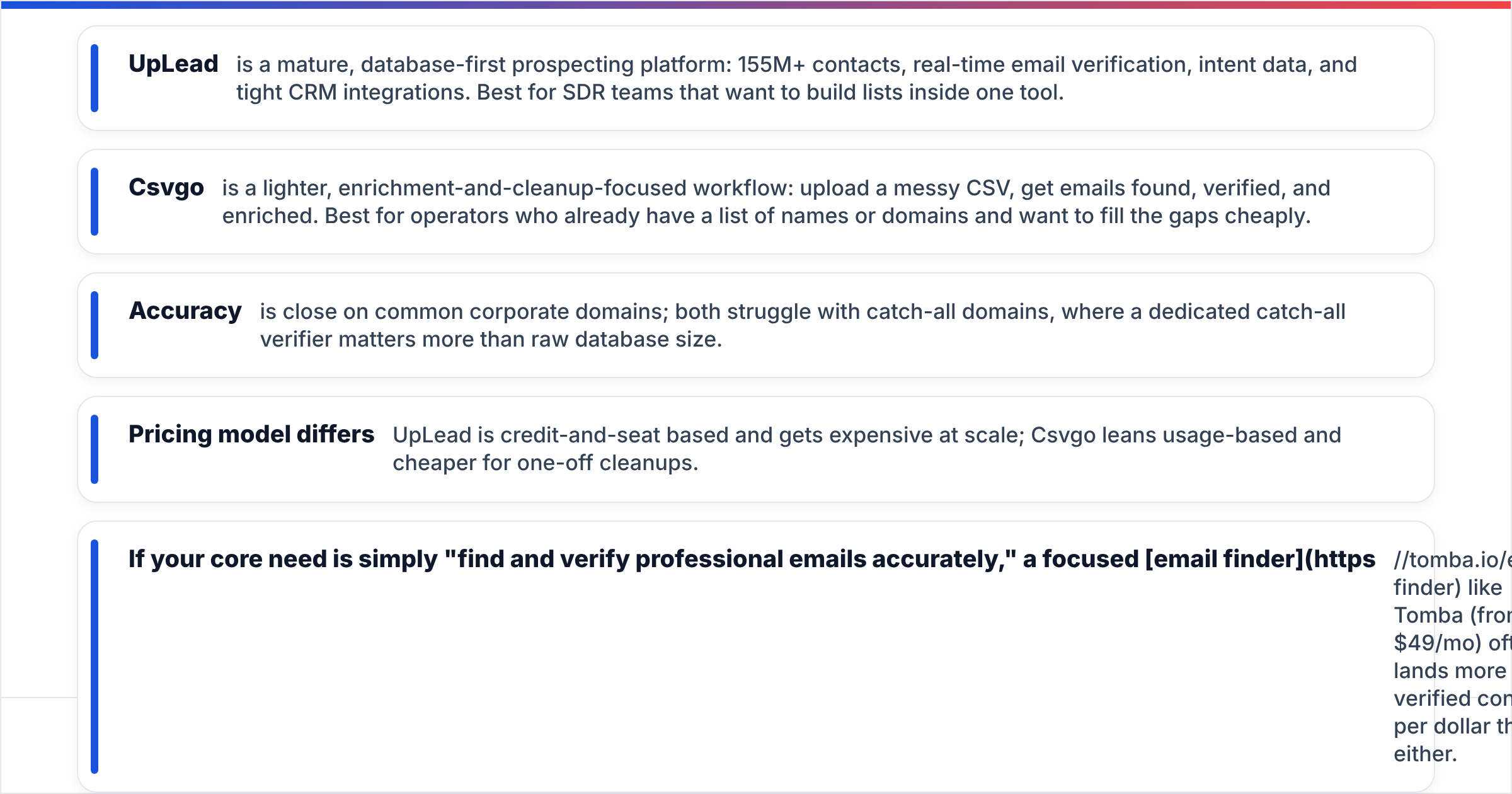
- UpLead is a mature, database-first prospecting platform: 155M+ contacts, real-time email verification, intent data, and tight CRM integrations. Best for SDR teams that want to build lists inside one tool.
- Csvgo is a lighter, enrichment-and-cleanup-focused workflow: upload a messy CSV, get emails found, verified, and enriched. Best for operators who already have a list of names or domains and want to fill the gaps cheaply.
- Accuracy is close on common corporate domains; both struggle with catch-all domains, where a dedicated catch-all verifier matters more than raw database size.
- Pricing model differs: UpLead is credit-and-seat based and gets expensive at scale; Csvgo leans usage-based and cheaper for one-off cleanups.
- If your core need is simply "find and verify professional emails accurately," a focused email finder like Tomba (from $49/mo) often lands more verified contacts per dollar than either.

What is Csvgo?#
Csvgo is a data-enrichment tool built around the humble CSV. The core loop is simple: you upload a spreadsheet of names, companies, or domains, and Csvgo returns enriched rows — professional emails, job titles, company details, and verification status. Think of it less as a place to discover prospects and more as a machine that cleans and completes the prospects you already have.
That design makes Csvgo attractive to a specific persona: the growth operator, the RevOps analyst, or the founder who scraped a list from an event, a LinkedIn export, or a partner spreadsheet and now needs to turn raw names into deliverable contacts. You are not paying for a giant static database you may never fully use; you are paying to process the rows you actually have.
The tradeoff is that Csvgo is weaker when you don't have a starting list. If you want to say "give me every VP of Marketing at 50–200 person SaaS companies in Texas," a cleanup-first tool is not the natural home for that query. You need a searchable database — which is where UpLead shines.
What is UpLead?#
UpLead is a B2B prospecting database and lead-generation platform. Its pitch is a large, continuously maintained contact universe — 155M+ contacts across millions of companies — that you search with 50+ filters (industry, headcount, technology used, revenue, location, seniority) and export with verified emails attached.
UpLead's signature feature is real-time email verification at the point of export: it validates the address before it burns a credit, and it advertises a 95% accuracy guarantee, crediting back invalid emails. It also layers in buyer-intent data, technographics, and native integrations with Salesforce, HubSpot, Pipedrive, and Zapier.
In practice, UpLead is a list-building tool for outbound teams. If your SDRs live inside a prospecting workflow all day, having search, verification, and CRM push in one place is genuinely valuable. The catch is cost and lock-in: you pay per credit and per seat, and heavy list-builders can exhaust monthly credits fast.

Csvgo vs UpLead: the core comparison#
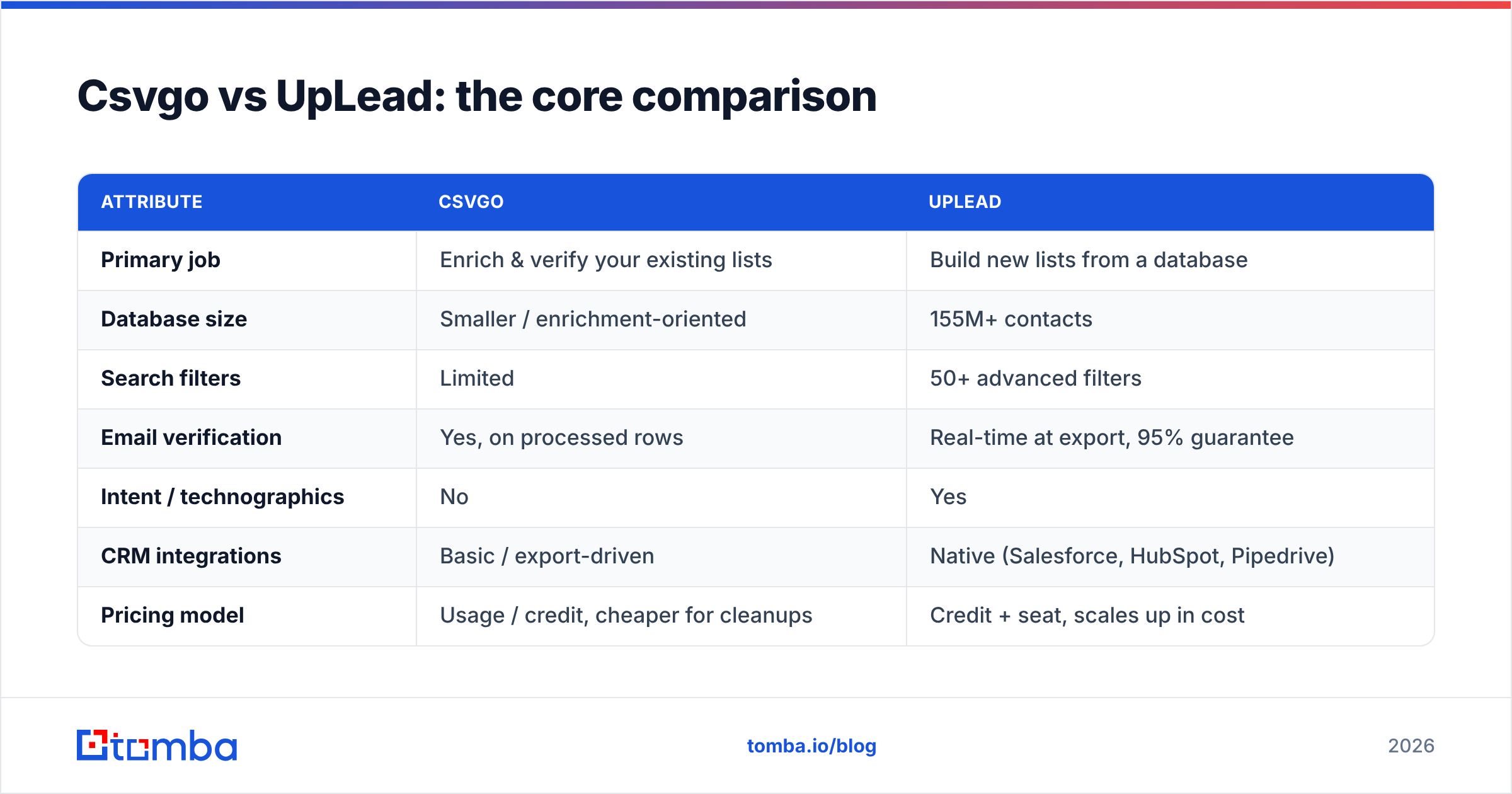
Here is the head-to-head on the attributes that actually change your outcomes.
| Attribute | Csvgo | UpLead |
|---|---|---|
| Primary job | Enrich & verify your existing lists | Build new lists from a database |
| Database size | Smaller / enrichment-oriented | 155M+ contacts |
| Search filters | Limited | 50+ advanced filters |
| Email verification | Yes, on processed rows | Real-time at export, 95% guarantee |
| Intent / technographics | No | Yes |
| CRM integrations | Basic / export-driven | Native (Salesforce, HubSpot, Pipedrive) |
| Pricing model | Usage / credit, cheaper for cleanups | Credit + seat, scales up in cost |
| Best for | RevOps, founders, list cleanup | SDR teams, outbound at scale |
| Weakness | No net-new discovery | Cost and credit burn at volume |
The honest summary: these tools are not really competitors so much as different stages of the same pipeline. Csvgo answers "I have names — get me deliverable emails." UpLead answers "I have an ICP — get me names and emails." Many teams that think they must choose actually need both jobs done, which is why a single accurate email API often wins.

Is UpLead more accurate than Csvgo?#
On standard corporate domains, the accuracy gap is smaller than either vendor's marketing implies. Both verify at the SMTP layer, both catch obvious syntax and role-based issues, and both will land the majority of firstname.lastname@company.com addresses correctly.
The real accuracy battleground is catch-all domains — servers configured to accept mail for any address, so a normal SMTP check can't confirm whether a specific mailbox exists. This is where databases and simple verifiers both get soft, returning "accept-all" or an optimistic "valid" that later bounces. If a meaningful share of your ICP sits on catch-all infrastructure (common in enterprise and education), you want a tool with a dedicated catch-all strategy, not just a bigger table of guesses. Tomba's catch-all finder exists precisely for this gap.
Two practical rules regardless of which tool you pick:
- Never trust a single "valid" flag on catch-all domains. Segment those contacts and warm into them carefully.
- Re-verify lists older than 90 days. B2B data decays 25–30% per year as people change jobs, so yesterday's verified email is today's bounce. Independent research on B2B data decay from firms like Gartner backs this up.
Accuracy is not a static number on a pricing page. It is a function of your ICP's domains and how fresh your list is.
Csvgo vs UpLead pricing: what you actually pay#
Pricing is where the two diverge most, and where a third option gets interesting.
UpLead publishes tiered plans built around monthly credits and seats. Entry pricing starts around the high double digits per month for a modest credit allotment, climbing quickly as you add credits, seats, and premium data like intent. The model rewards teams that consistently export within their credit band and punishes bursty, high-volume list pulls. You can validate current numbers on the UpLead pricing page and cross-check reviews on G2.
Csvgo leans toward usage-based enrichment pricing — you pay for the rows you process — which tends to be cheaper for occasional, project-based cleanups and more predictable when your volume is spiky.
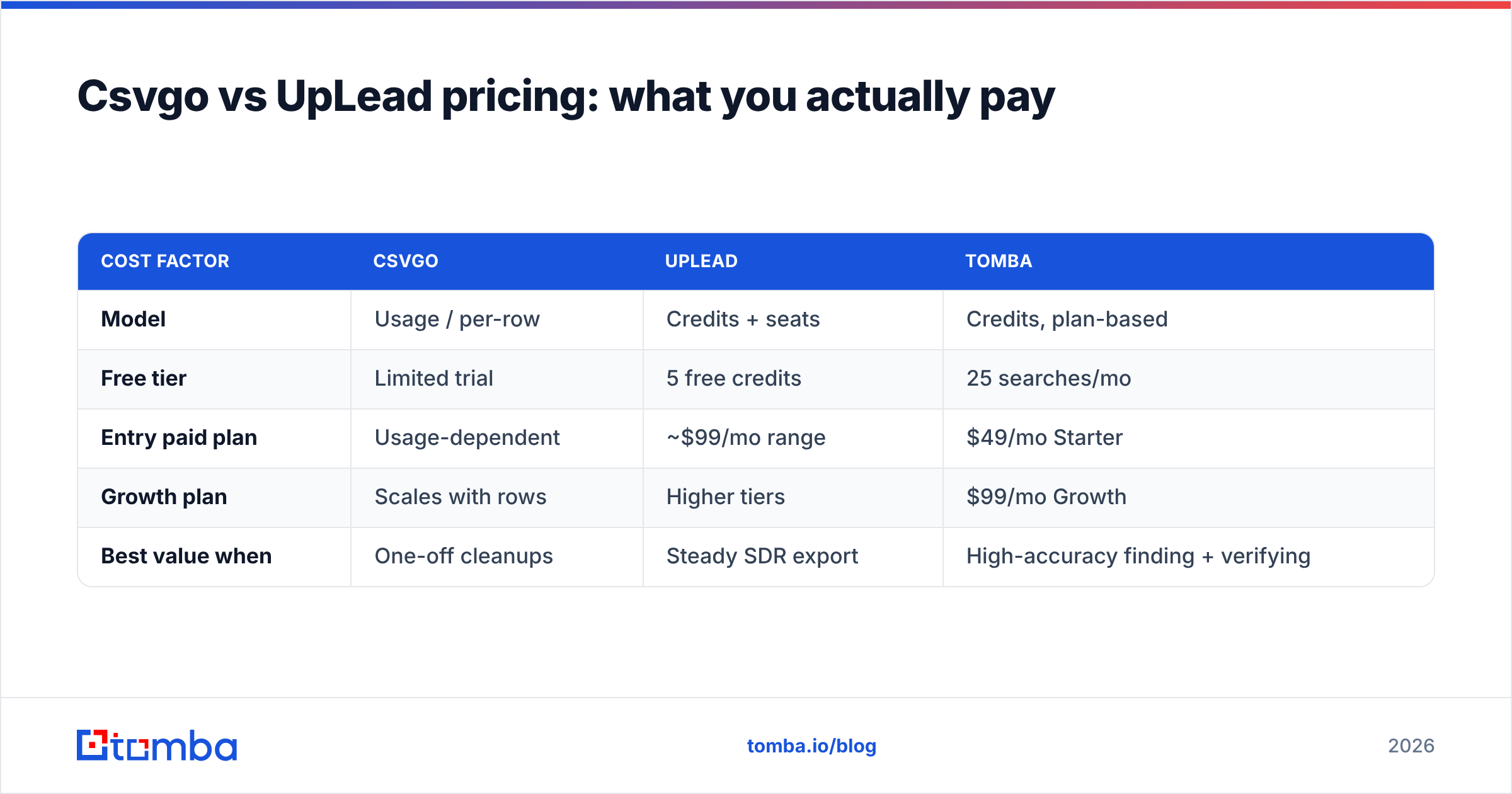
| Cost factor | Csvgo | UpLead | Tomba |
|---|---|---|---|
| Model | Usage / per-row | Credits + seats | Credits, plan-based |
| Free tier | Limited trial | 5 free credits | 25 searches/mo |
| Entry paid plan | Usage-dependent | ~$99/mo range | $49/mo Starter |
| Growth plan | Scales with rows | Higher tiers | $99/mo Growth |
| Best value when | One-off cleanups | Steady SDR export | High-accuracy finding + verifying |
If deliverable emails are the outcome you're buying, compare tools on cost per verified contact, not headline plan price. A cheap plan that returns a lot of "accept-all" guesses is more expensive than a slightly pricier one that lands real inboxes. Full Tomba pricing is public if you want to run that math yourself.
When should you choose Csvgo?#
Pick Csvgo when:
- You already have a list. Event scans, webinar signups, scraped exports, partner data — you have names or domains and need emails filled in and verified.
- Your volume is bursty. You run enrichment projects, not a constant daily export, so usage-based pricing beats a fat monthly credit commitment.
- You're a small team or solo operator who doesn't need seats, intent data, or a full prospecting UI.
- You value simplicity over a sprawling feature set.
Csvgo is the pragmatic choice for cleanup and completion. It is not the tool to hand an SDR who needs to discover 500 net-new accounts this quarter.
When should you choose UpLead?#
Pick UpLead when:
- You need net-new prospects from filters, not from a list you already own.
- You run a real outbound motion with multiple SDRs who benefit from search, verification, and CRM push in one screen.
- Intent and technographics matter to your targeting — you want to reach companies showing buying signals or running a specific tech stack.
- Native CRM integration into Salesforce or HubSpot is a hard requirement, not a nice-to-have.
UpLead earns its price when list-building is a daily job and the platform replaces several point tools. It becomes hard to justify when you only need occasional emails or when credit burn outpaces your pipeline.

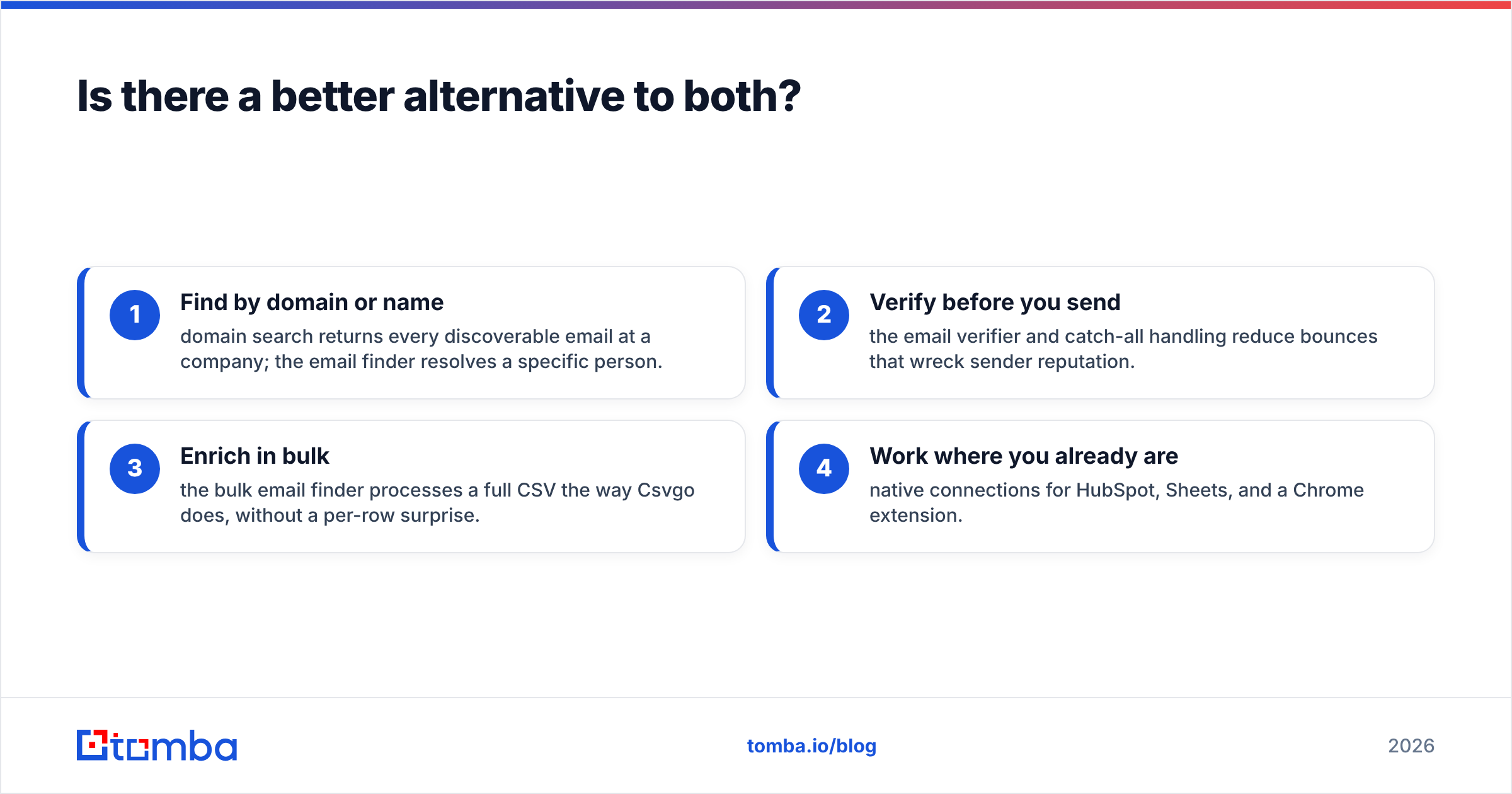
Is there a better alternative to both?#
For many teams the honest answer is: you're overbuying. If your actual need is "find accurate professional emails and verify them before I send," a focused email-finding stack often outperforms both a cleanup tool and a full database on the metric that matters — verified contacts per dollar.
That's the lane Tomba sits in. Instead of forcing you to choose between "enrich my CSV" and "search a database," it covers both jobs through one API and a set of purpose-built tools:
- Find by domain or name — domain search returns every discoverable email at a company; the email finder resolves a specific person.
- Verify before you send — the email verifier and catch-all handling reduce bounces that wreck sender reputation.
- Enrich in bulk — the bulk email finder processes a full CSV the way Csvgo does, without a per-row surprise.
- Work where you already are — native connections for HubSpot, Sheets, and a Chrome extension.
The point isn't that Tomba beats UpLead at everything — UpLead's intent data and 155M-record search are genuinely deeper for pure discovery. It's that if email accuracy is your real goal, paying database-and-seat prices for it is the expensive route. Start on the free tier (25 searches/mo), move to Starter at $49/mo, and compare cost-per-verified-contact directly.
Csvgo vs UpLead: the verdict#
There's no universal winner — there's a winner for your workflow:
- Choose Csvgo if you have lists to clean and enrich, run bursty volume, and want simple usage-based pricing.
- Choose UpLead if you need net-new prospecting from a large, filterable database with intent data and native CRM sync, and your volume justifies the credit-and-seat cost.
- Choose a focused finder like Tomba if your true bottleneck is accurate, deliverable emails and you'd rather not pay for a full database or a separate cleanup tool to get them.
Map the tool to the job, not to the marketing. If your job is "stop bouncing and reach real inboxes," start with the highest-accuracy, lowest-cost path to a verified address.
Ready to test that path? Try the Tomba Email Finder free — 25 searches a month, no card — and benchmark its verified-contact rate against whatever Csvgo or UpLead quote you're weighing. Let the bounce rate pick the winner.
Related guides#
Ready to find emails that actually work?
Join 150,000+ professionals who stopped guessing and started sending. Free credits on signup — no credit card required.
Get the Tomba newsletter
Practical outbound tactics and product updates — once every two weeks.
About the author