CUFinder vs DiscoverORG (2026): Which B2B Data Tool Wins?
CUFinder is a budget-friendly enrichment engine; DiscoverORG is now folded into ZoomInfo's enterprise suite. Here's an honest, side-by-side look at pricing, data depth, and which one actually fits your team in 2026.
Picking a B2B data provider usually comes down to a quiet trade-off nobody puts on the pricing page: how much depth do you actually need, and how much are you willing to pay for coverage you may never touch? CUFinder and DiscoverORG sit on opposite ends of that spectrum, which makes the matchup more useful than most "Tool A vs Tool B" posts.
This is a neutral walkthrough. No vendor wrote it, and the goal is to help you spend money once instead of twice.
TL;DR: CUFinder vs DiscoverORG at a glance#
- CUFinder is a self-serve, affordable enrichment and lead-gen platform. Fast to start, credit-based, strong for SMBs and lean outbound teams.
- DiscoverORG no longer exists as a standalone product — it merged with ZoomInfo in 2019 and its org-chart and technographic data now lives inside ZoomInfo's enterprise suite. Deep data, enterprise pricing, annual contracts.
- If you want rich org charts, intent data, and enterprise integrations, the DiscoverORG/ZoomInfo lineage wins — at a real cost.
- If you want accurate emails and enrichment without a five-figure contract, CUFinder is the lighter pick.
- If your core job is simply finding and verifying professional emails at scale, a focused tool like Tomba often beats both on price-per-verified-contact.
What is CUFinder?#
CUFinder is a B2B lead generation and data enrichment platform aimed at teams that want contact and company data without an enterprise sales cycle. You feed it a name, domain, or company, and it returns emails, phone numbers, firmographics, and social profiles. It leans on a credit model, offers a Chrome extension and API, and positions itself as an affordable ZoomInfo/Apollo alternative.
The appeal is simple: you can sign up, buy a plan, and start enriching lists the same afternoon. There's no mandatory demo, no procurement dance. For founders, agencies, and small sales teams, that self-serve motion is the whole selling point. Coverage skews strongest in tech-forward and startup segments, and thins out in niche verticals or heavily offline industries — a normal pattern for aggregator-style databases.
What is DiscoverORG (and where did it go)?#
Here's the part most comparison posts skip: DiscoverORG is not sold as its own product anymore. In 2019, DiscoverORG acquired ZoomInfo and adopted the ZoomInfo brand. The technology that made DiscoverORG respected — human-verified org charts, IT technographics, and deep account intelligence — got absorbed into the ZoomInfo platform.
So when you evaluate "DiscoverORG" in 2026, you're really evaluating ZoomInfo's enterprise data engine with DiscoverORG's DNA inside it. That matters for three reasons:
- Pricing is enterprise-grade. Expect annual contracts, seat minimums, and quotes that typically start in the low five figures per year.
- Onboarding is sales-led. You go through a demo and a rep, not a checkout page.
- Depth is the headline. Org hierarchies, buying committees, scoops (trigger events), and intent signals are what you're paying for — not just an email.
If your motion is enterprise ABM, that depth is genuinely hard to replicate. If your motion is high-volume outbound, you may be renting a mansion to store a bicycle.

CUFinder vs DiscoverORG: the core comparison#
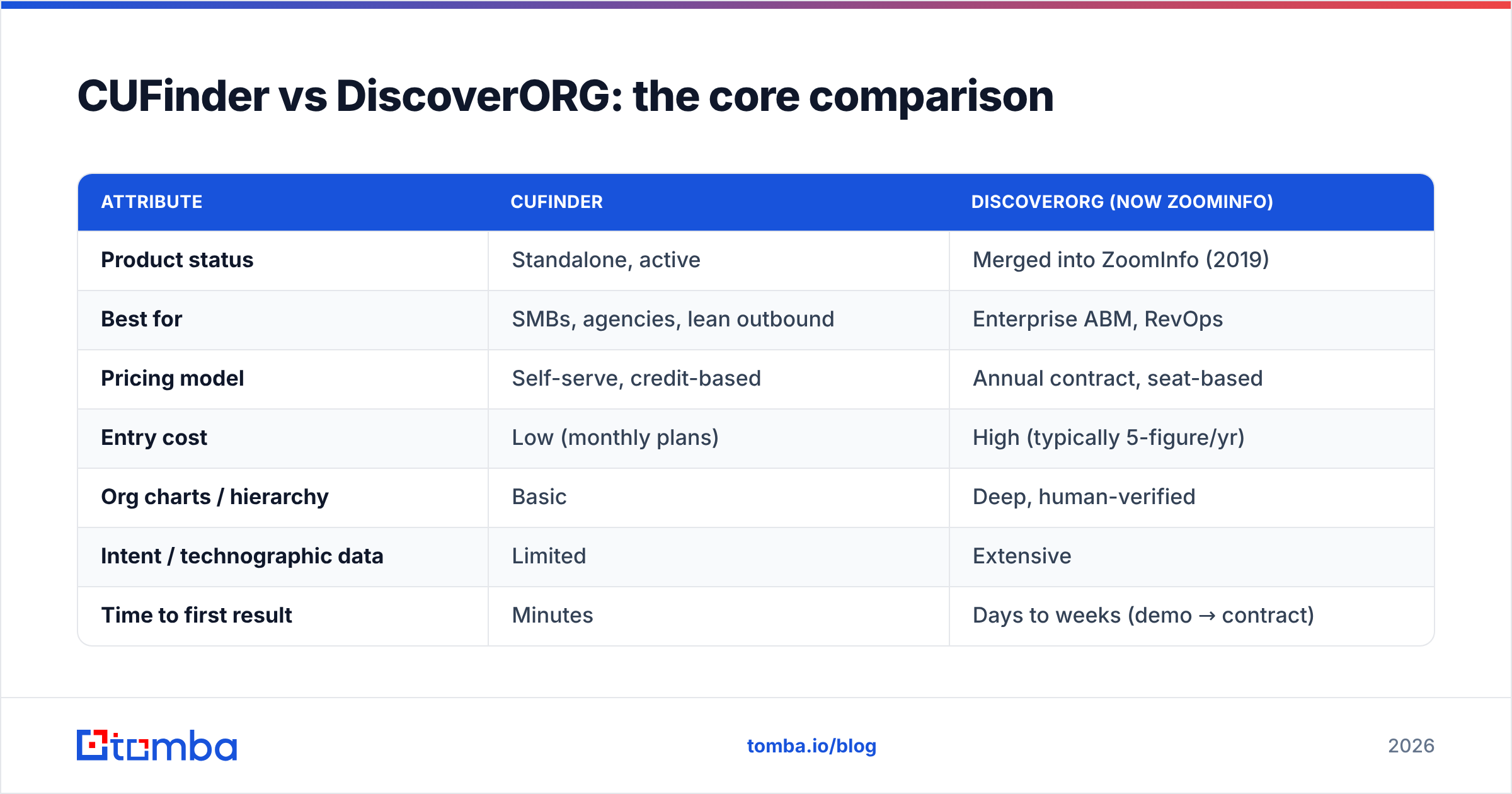
| Attribute | CUFinder | DiscoverORG (now ZoomInfo) |
|---|---|---|
| Product status | Standalone, active | Merged into ZoomInfo (2019) |
| Best for | SMBs, agencies, lean outbound | Enterprise ABM, RevOps |
| Pricing model | Self-serve, credit-based | Annual contract, seat-based |
| Entry cost | Low (monthly plans) | High (typically 5-figure/yr) |
| Org charts / hierarchy | Basic | Deep, human-verified |
| Intent / technographic data | Limited | Extensive |
| Time to first result | Minutes | Days to weeks (demo → contract) |
| Contract flexibility | Month-to-month options | Annual commitment |
| API access | Yes | Yes (enterprise tiers) |
The table makes the split obvious. These tools rarely compete for the same buyer. CUFinder wins on speed, price, and simplicity. DiscoverORG's lineage wins on depth, coverage, and enterprise-grade signals like intent data and buying-committee mapping.
Which one has better data accuracy?#
Accuracy is where the honest answer is "it depends on what you count."
DiscoverORG built its reputation on human verification. Analysts manually validated org charts and contact roles, which is why enterprise teams trusted it for account planning. Inside ZoomInfo, that verification layer plus a massive contributory network gives it a coverage edge in enterprise accounts and hard-to-reach titles. The trade-off: large databases accumulate stale rows, and no provider escapes email decay — professionals change jobs constantly, and every record ages.
CUFinder leans on aggregation plus real-time lookups. For common professional emails at active companies, hit rates are competitive, especially in tech. Where it struggles is the same place most affordable tools struggle: deep hierarchy, niche verticals, and offline-heavy industries.
The practical lesson applies to both: never trust a database's "verified" label blindly. Whatever tool you use, run addresses through a dedicated email verifier before you send. Bounce rates above 3% start hurting sender reputation, and a clean list protects your domain more than any single provider's accuracy claim.
How does pricing really compare?#
This is the deciding factor for most teams, so let's be concrete.
- CUFinder publishes tiered monthly and annual plans built around credits. You can start small, scale credits as you grow, and avoid long lock-ins. Total cost stays predictable and low for most SMB use cases.
- DiscoverORG/ZoomInfo is quote-based. Public benchmarks and buyer reports on G2 consistently put annual spend in the tens of thousands once you add seats, credits, and premium data packages (intent, scoops, integrations). There's real value there — but only if you use the depth.
A useful gut check: add up the features you'll actually touch in the next 90 days. If that list is "find emails, enrich a CRM field, maybe grab a phone number," you're overpaying for the enterprise suite. If it's "map a 12-person buying committee across 300 target accounts and trigger plays on intent spikes," CUFinder can't match that, and the enterprise price is justified.

When should you choose CUFinder?#
Choose CUFinder when:
- You're self-serve by nature. You'd rather swipe a card than sit through a demo and a procurement review.
- Budget is a hard constraint. You need working data without an annual enterprise commitment.
- Your ICP is SMB or tech-forward. Coverage is strongest there, and that's where your list actually lives.
- You want flexibility. Month-to-month or low-commitment plans let you scale up or pause without penalty.
CUFinder is the "get moving today" option. For a growing team running outbound, that momentum often beats marginal data depth you won't use.
When should you choose DiscoverORG / ZoomInfo?#
Choose the DiscoverORG lineage when:
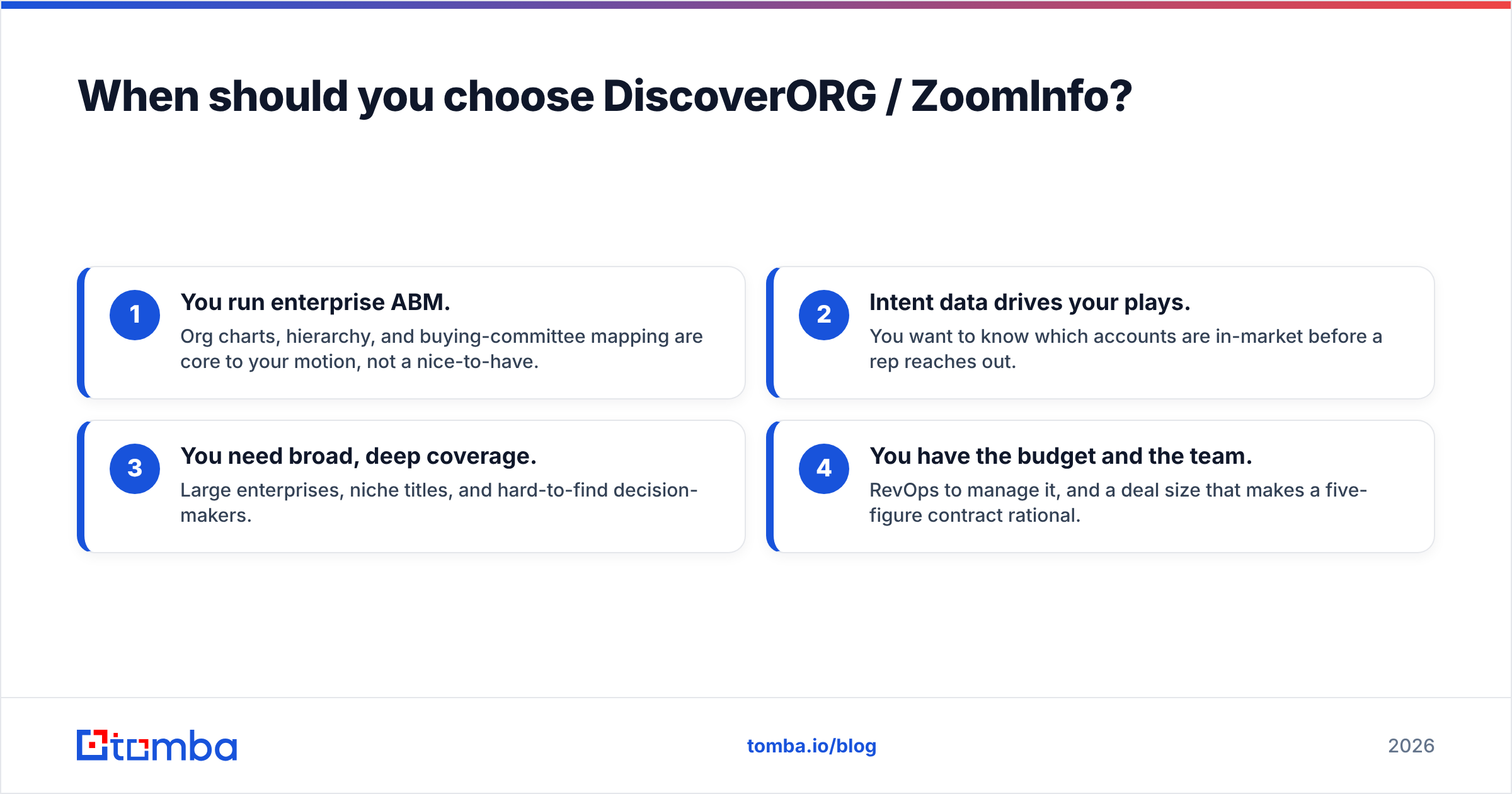
- You run enterprise ABM. Org charts, hierarchy, and buying-committee mapping are core to your motion, not a nice-to-have.
- Intent data drives your plays. You want to know which accounts are in-market before a rep reaches out.
- You need broad, deep coverage. Large enterprises, niche titles, and hard-to-find decision-makers.
- You have the budget and the team. RevOps to manage it, and a deal size that makes a five-figure contract rational.
If you're closing $80k+ deals into the enterprise, the data depth can pay for itself in a single won opportunity. That's the honest case for the higher price.
Is there a middle path between cheap and enterprise?#
Yes — and it's worth naming because most buyers assume they must pick one extreme.
A lot of teams don't actually need a full sales-intelligence suite. They need accurate emails, reliable verification, and clean enrichment that plugs into their existing stack. That's a narrower job than either CUFinder or ZoomInfo is built for, and buying either can mean paying for surface area you'll never use.
This is where a focused email-finding platform like Tomba fits. Instead of bundling org charts and intent you may ignore, it concentrates on the part of the funnel almost everyone touches: turning names and domains into verified, deliverable contacts.
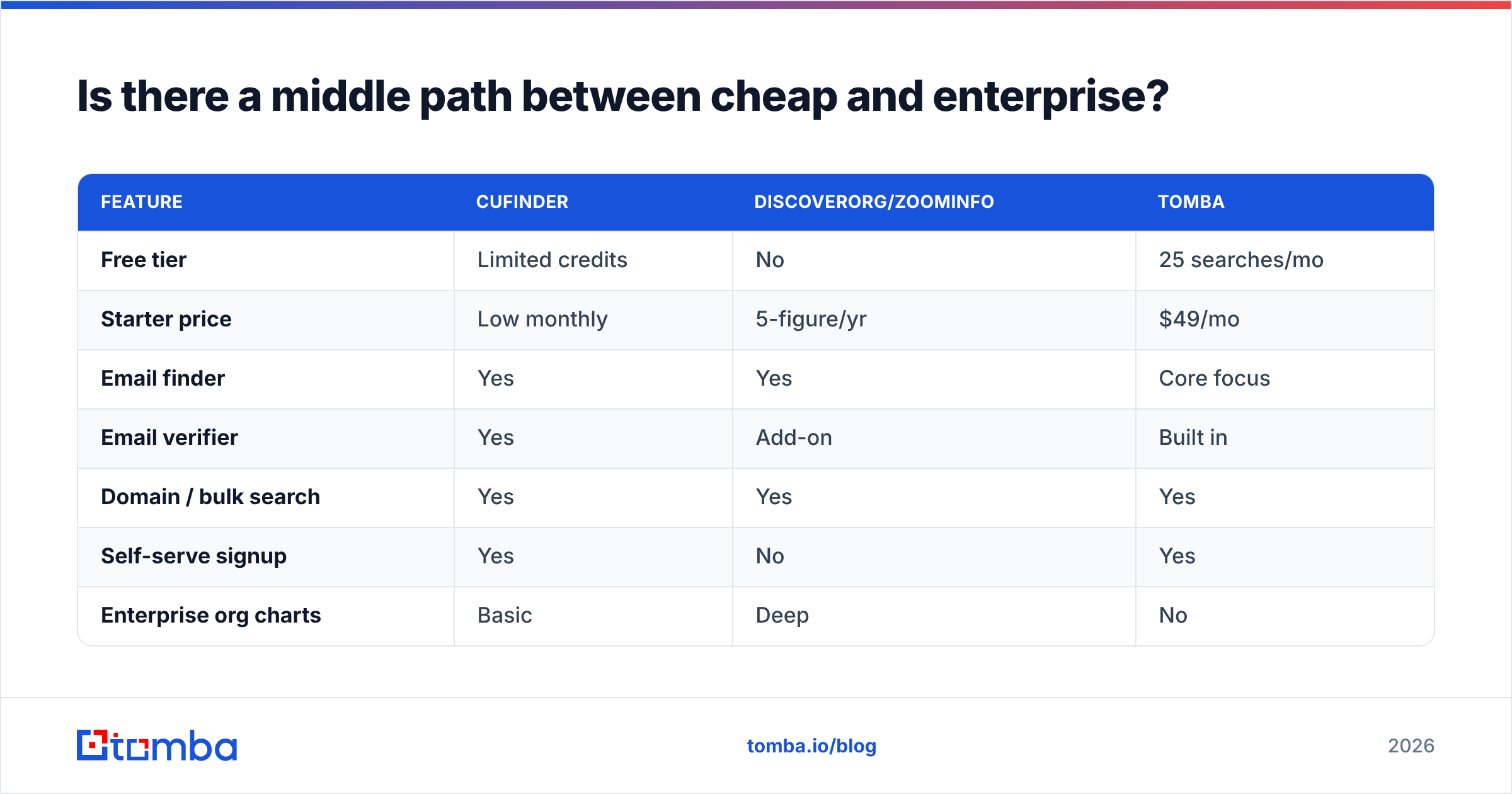
| Feature | CUFinder | DiscoverORG/ZoomInfo | Tomba |
|---|---|---|---|
| Free tier | Limited credits | No | 25 searches/mo |
| Starter price | Low monthly | 5-figure/yr | $49/mo |
| Email finder | Yes | Yes | Core focus |
| Email verifier | Yes | Add-on | Built in |
| Domain / bulk search | Yes | Yes | Yes |
| Self-serve signup | Yes | No | Yes |
| Enterprise org charts | Basic | Deep | No |
The point isn't that Tomba replaces an enterprise ABM platform — it doesn't try to. The point is that if your real need is finding and verifying emails, you can do that with a focused tool at a fraction of the cost. Tomba's email finder works by name, domain, or company, its data enrichment fills CRM gaps, and transparent Tomba pricing — free, then $49/mo Starter, $99/mo Growth, $249/mo Pro — means no surprise annual quote. You can also verify a competitor's export before importing it, so accuracy stays your decision, not the vendor's marketing claim.
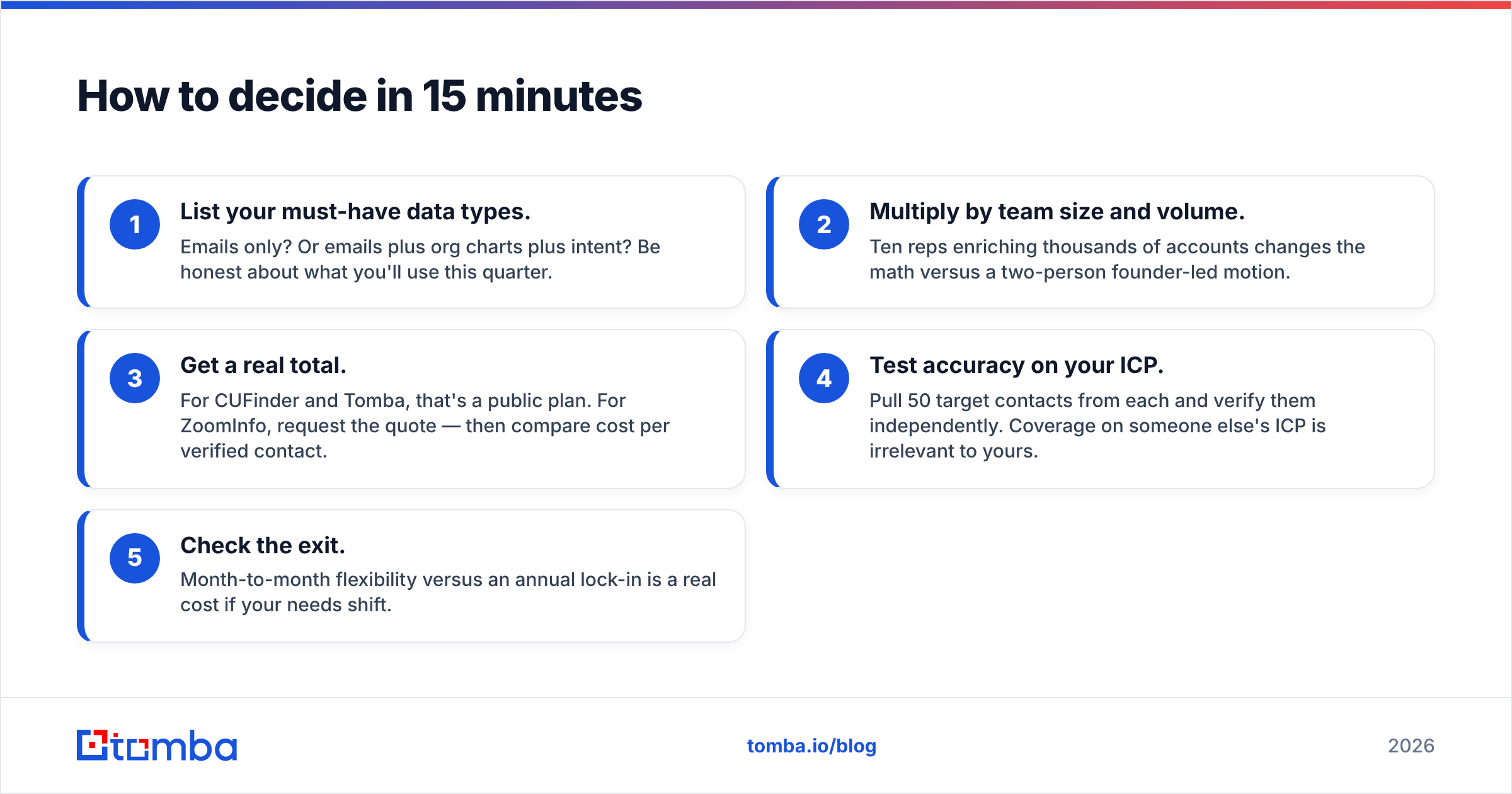
How to decide in 15 minutes#
Run this quick test before you commit to any of the three:
- List your must-have data types. Emails only? Or emails plus org charts plus intent? Be honest about what you'll use this quarter.
- Multiply by team size and volume. Ten reps enriching thousands of accounts changes the math versus a two-person founder-led motion.
- Get a real total. For CUFinder and Tomba, that's a public plan. For ZoomInfo, request the quote — then compare cost per verified contact.
- Test accuracy on your ICP. Pull 50 target contacts from each and verify them independently. Coverage on someone else's ICP is irrelevant to yours.
- Check the exit. Month-to-month flexibility versus an annual lock-in is a real cost if your needs shift.
Nine times out of ten, this exercise sorts buyers cleanly: enterprise ABM teams land on ZoomInfo, budget-conscious generalists land on CUFinder, and email-first outbound teams land on a focused finder-and-verifier.
The verdict#
There's no universal winner in CUFinder vs DiscoverORG — there's a winner for your situation.
- DiscoverORG (now ZoomInfo) wins on depth: org charts, intent, and enterprise coverage. Pay for it only if your motion genuinely depends on that intelligence.
- CUFinder wins on accessibility: fast, affordable, self-serve enrichment for SMBs and lean teams.
- If your core need is verified emails, both may be more platform than you need — and a specialized tool will get you cleaner contacts for less.
Match the tool to the job, not to the longest feature list. The most expensive mistake in this category isn't picking the "wrong" brand — it's paying enterprise prices for data depth your outbound never touches.
Ready to skip the sales call and start finding verified contacts today? Try the Tomba Email Finder free — 25 searches a month, no contract, no demo. Find emails by name, domain, or company, verify them in the same workflow, and keep your sender reputation clean while you scale. When your only real question is "what's this person's email," that's the fastest answer on this page.
Related guides#
Ready to find emails that actually work?
Join 150,000+ professionals who stopped guessing and started sending. Free credits on signup — no credit card required.
Get the Tomba newsletter
Practical outbound tactics and product updates — once every two weeks.
About the author