Cufinder vs Emailvalidationio: Which Tool Wins in 2026?
Cufinder finds and enriches contacts; Emailvalidation.io only checks if an address is deliverable. Here's the honest breakdown of which one your workflow actually needs in 2026 — and where the gaps are.
Choosing between Cufinder and Emailvalidation.io feels like a head-to-head. Usually it isn't. One tool builds your contact list. The other checks that the list won't bounce. Mix them up and you pay for a tool that solves half your problem.
This Cufinder vs Emailvalidationio comparison shows what each tool does, where each one is strong, what they cost, and how to choose. It won't pretend they're interchangeable.
TL;DR#
- Cufinder is a data and email finder. It finds emails, phone numbers, and company data from names, domains, or LinkedIn. Then it enriches them. It is a sourcing tool.
- Emailvalidation.io is a verification API. It tells you if an email is valid, deliverable, disposable, or a catch-all. It is a cleaning tool. It does not find emails.
- They solve different jobs. Most serious outbound stacks need both a finder and a verifier.
- Their pricing differs. Cufinder sells credits and seats for finding and enriching. Emailvalidation.io sells API volume for checking.
- The simplest setup for most teams finds and verifies in one pass. That is where an all-in-one like Tomba changes the math.

What is Cufinder?#
Cufinder is a B2B data platform. It finds and enriches contact and company records. You give it an input: a name plus company, a domain, or a LinkedIn URL. It returns work emails, direct-dial phone numbers, job titles, company size, tech stack, and other company fields.
Its main value is discovery. If your list is empty, Cufinder helps you fill it. It is built for enrichment too. Upload a partial CSV of names or companies. Get back a fuller dataset ready for outreach or CRM import. You can read more on Cufinder's own website.
Cufinder is weaker at verification. It surfaces contact data. But confirming that an address really delivers often falls to a dedicated verifier. Catch-all domains are the hardest case.
What is Emailvalidation.io?#
Emailvalidation.io is part of the APILayer family. It is a single-purpose email verification API. You send it an address. It returns a verdict. Is the format valid? Does the domain have MX records? Will the mailbox accept mail? Is it disposable? Is it a free provider? Is it a role account like info@ or sales@? Is the domain a catch-all?
It does one job and does it well. The REST interface is developer-friendly. Already have addresses from a form, a scraped list, or another finder? Emailvalidation.io scrubs them before you send. Full docs live on the Emailvalidation.io site.
What it does not do: find anyone. Point it at a company domain and ask "who works here?" It has no answer. It has no prospecting database, no name-to-email lookup, and no phone data.
Cufinder vs Emailvalidationio: how do they compare?#
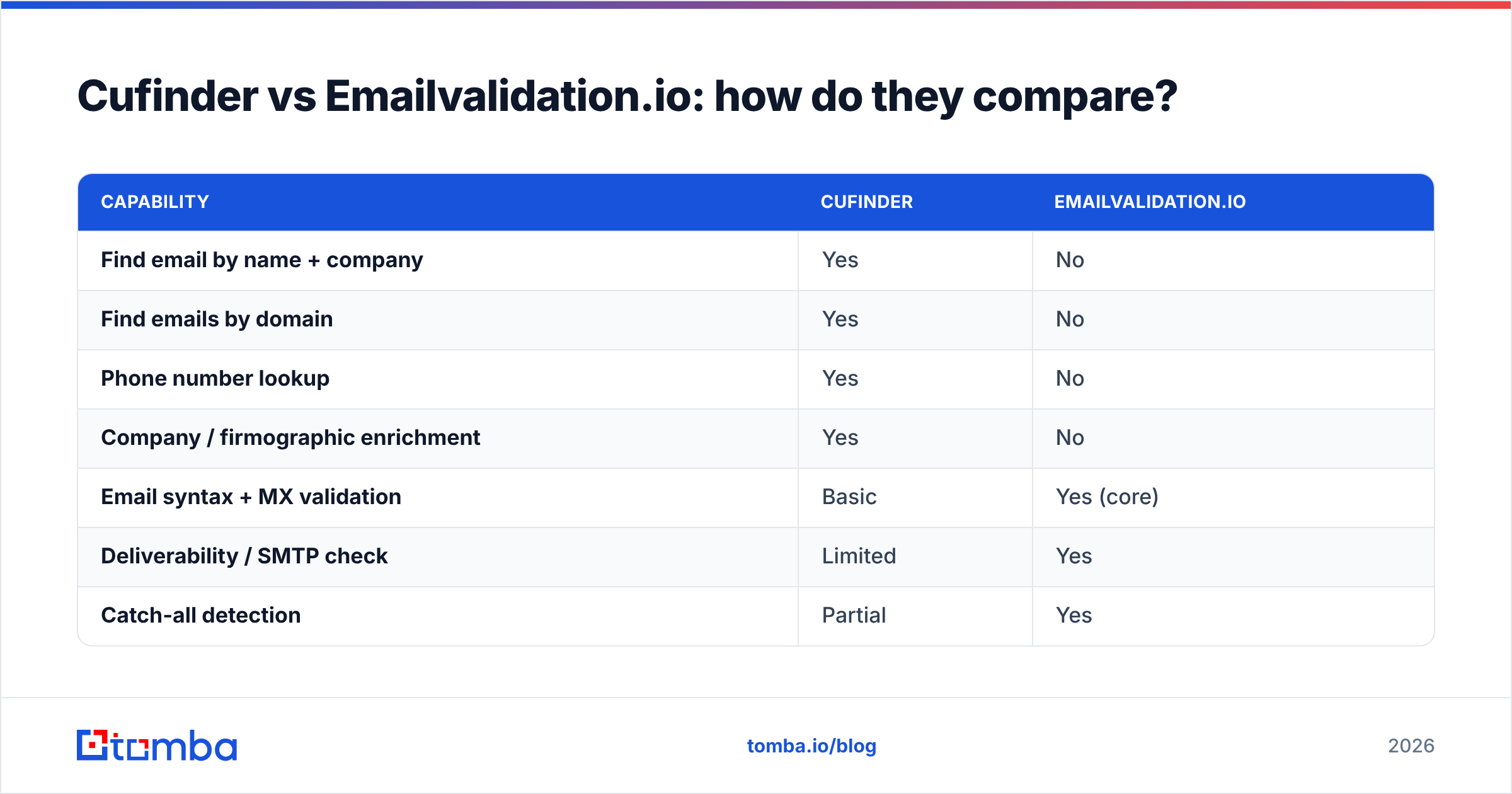
Here is the honest side-by-side. These are two different types of tool. So many rows show a hard "No." That is the whole point.

| Capability | Cufinder | Emailvalidation.io |
|---|---|---|
| Find email by name + company | Yes | No |
| Find emails by domain | Yes | No |
| Phone number lookup | Yes | No |
| Company / firmographic enrichment | Yes | No |
| Email syntax + MX validation | Basic | Yes (core) |
| Deliverability / SMTP check | Limited | Yes |
| Catch-all detection | Partial | Yes |
| Disposable / role-account flags | Partial | Yes |
| Primary use case | Sourcing leads | Cleaning lists |
| Delivery model | Web app + API | API-first |
The split is clear. Cufinder owns the left column, which is finding. Emailvalidation.io owns the right column, which is verifying. Neither one covers the other's job.
Which is more accurate?#
Accuracy means different things for each tool. So one shared number would mislead you.
For Cufinder, accuracy means this: did it return the right email, and does that email work? A finder can score 95% on "found an address." It can score far lower on "the address still delivers." People change jobs. Inboxes get shut off.
For Emailvalidation.io, accuracy means this: did the verdict match reality? Did a "valid" address accept mail? Did an "invalid" one truly bounce? Verifiers live and die on false positives and false negatives. Catch-all domains trip up most of them.
The takeaway is simple. A finder without good verification hands you addresses that only look real. A verifier without a finder has nothing to check. So the accuracy leaders pair discovery with a built-in email verifier. Every found address gets a confidence score before it reaches your sequence.

How does pricing compare?#
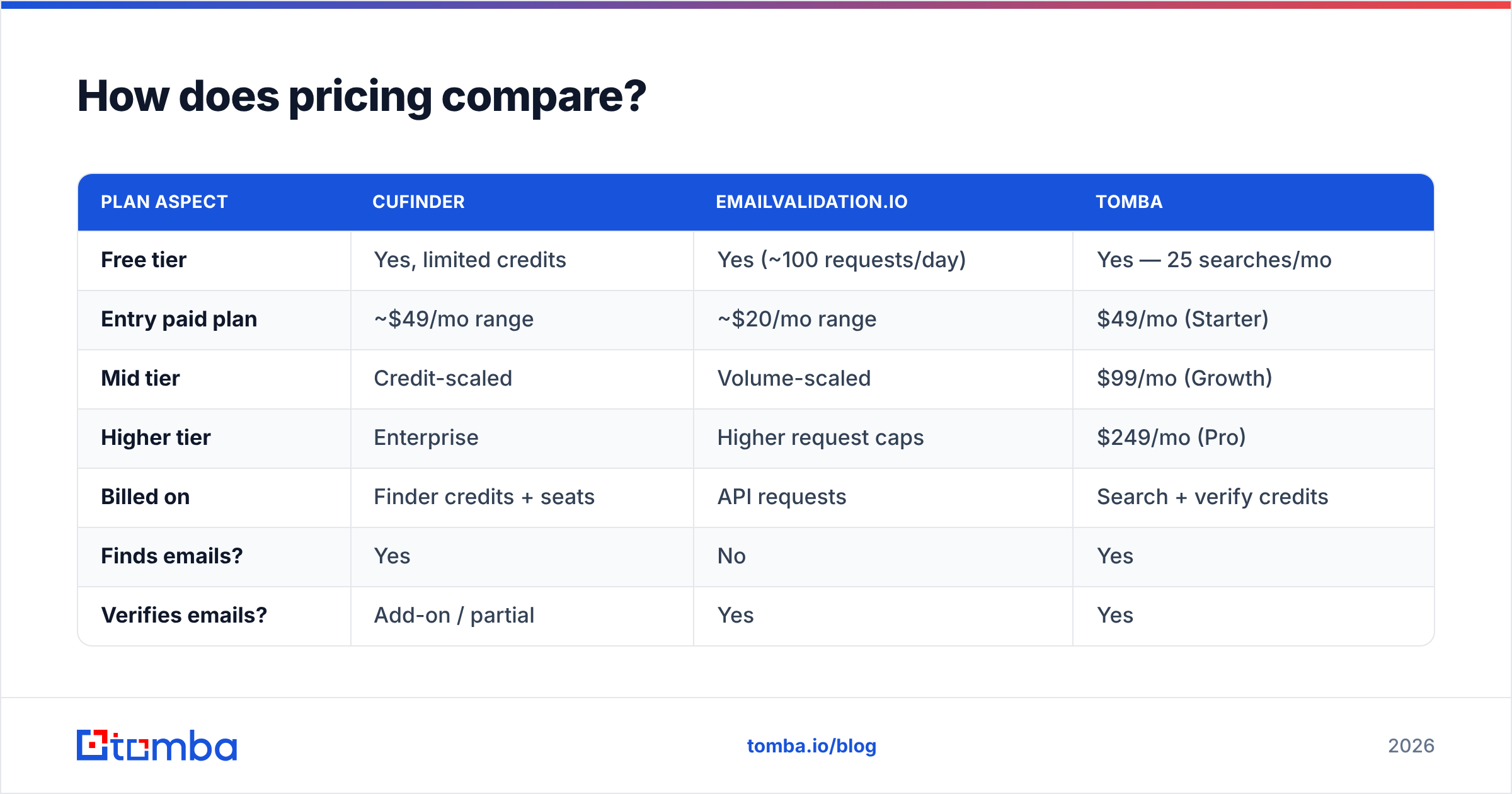
Pricing differs because the products differ. Cufinder charges for finding and enriching, through credits and seats. Emailvalidation.io charges for verification volume, through API requests. The figures below reflect published plans at the time of writing. Always confirm current numbers on each vendor's pricing page.
| Plan aspect | Cufinder | Emailvalidation.io | Tomba |
|---|---|---|---|
| Free tier | Yes, limited credits | Yes (~100 requests/day) | Yes — 25 searches/mo |
| Entry paid plan | ~$49/mo range | ~$20/mo range | $49/mo (Starter) |
| Mid tier | Credit-scaled | Volume-scaled | $99/mo (Growth) |
| Higher tier | Enterprise | Higher request caps | $249/mo (Pro) |
| Billed on | Finder credits + seats | API requests | Search + verify credits |
| Finds emails? | Yes | No | Yes |
| Verifies emails? | Add-on / partial | Yes | Yes |
There is a hidden cost. Buy Cufinder to find and Emailvalidation.io to verify, and you now pay two vendors. You reconcile two credit systems. You glue two APIs together. For many teams that combined bill and setup work costs more than one platform that does both. Compare the math against clear Tomba pricing.
Is Cufinder better than Emailvalidationio?#
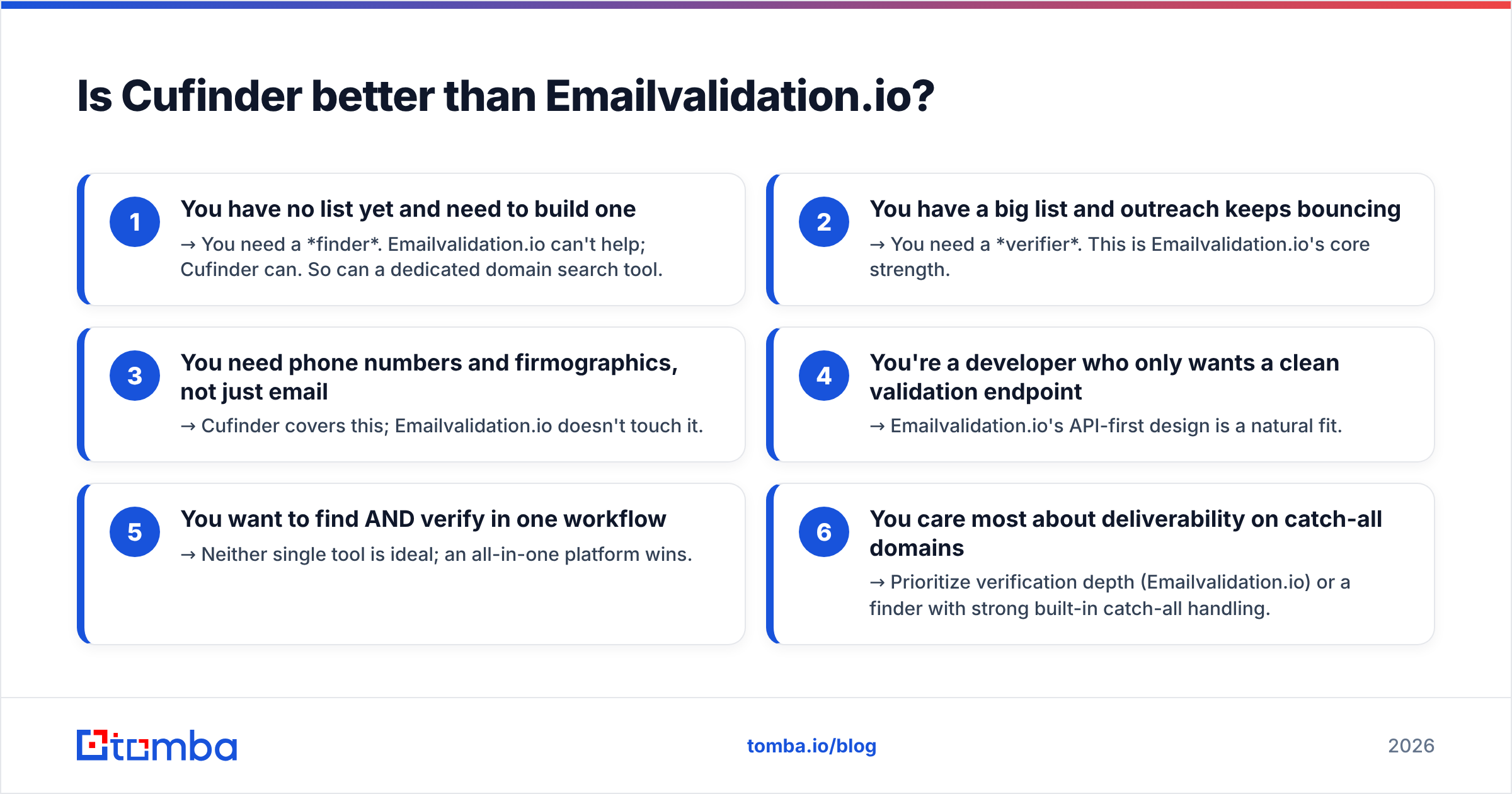
Neither is "better." They are built for different steps in the same funnel. Use this quick guide instead:
- No list yet and need to build one? You need a finder. Emailvalidation.io can't help. Cufinder can. So can a dedicated domain search tool.
- Big list and outreach keeps bouncing? You need a verifier. This is Emailvalidation.io's core strength.
- Need phone numbers and company data, not just email? Cufinder covers this. Emailvalidation.io does not.
- A developer who just wants a clean validation endpoint? Emailvalidation.io's API-first design fits.
- Want to find AND verify in one workflow? Neither single tool is ideal. An all-in-one platform wins.
- Care most about deliverability on catch-all domains? Lean on verification depth, or a finder with strong catch-all handling.

Where does an all-in-one option fit?#
The Cufinder vs Emailvalidationio framing assumes you must pick a lane. You don't. The best modern stacks fold "find" and "verify" into one motion. A prospect goes from unknown to verified and ready to email, all inside one tool.
That is where Tomba sits. It is an email finder first. Enter a domain, name, or company. Get work addresses back. But every result runs through verification. You see a confidence score, not a raw guess. It also adds a standalone verifier, catch-all handling, a phone finder, and data enrichment. So it covers Cufinder's discovery jobs and Emailvalidation.io's cleaning jobs. One login. One credit system.
The practical wins for teams:
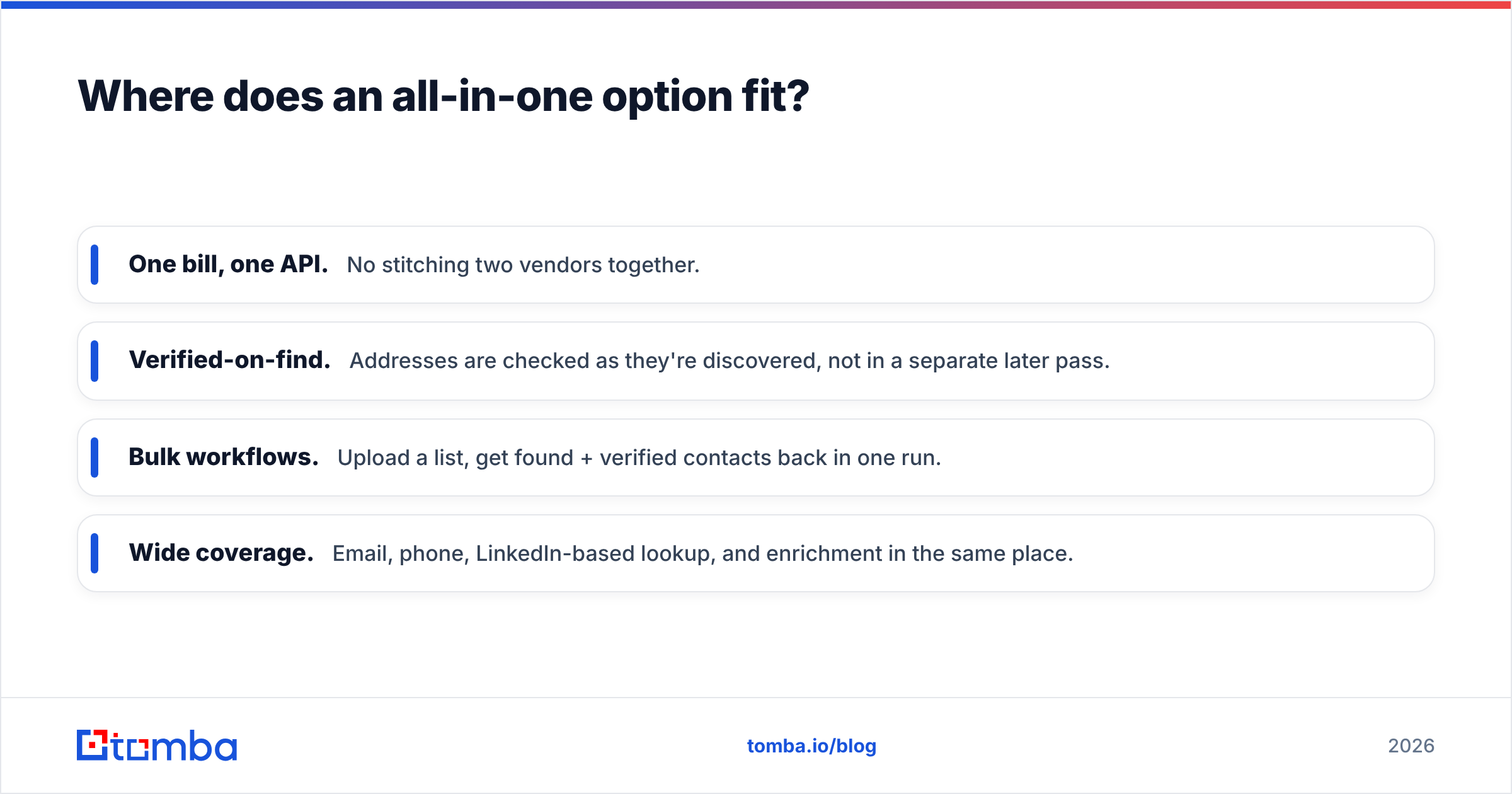
- One bill, one API. No stitching two vendors together.
- Verified on find. Addresses are checked as they are found, not in a later pass.
- Bulk workflows. Upload a list. Get found and verified contacts back in one run.
- Wide coverage. Email, phone, LinkedIn-based lookup, and enrichment in one place.
This does not make Cufinder or Emailvalidation.io bad. Both are good at their specialty. But if your goal is "get verified contacts into my sequence," two point tools are the long way around.
How do you actually choose?#
Ask three questions in order.
1. What is my bottleneck: finding or cleaning? An empty list is a finding problem, and Emailvalidation.io can't fix it. A full but bouncing list is a cleaning problem, and a pure finder can't fix it.
2. Do I need more than email? If phone numbers, titles, and company data matter, verify-only tools are out. Then you choose between Cufinder-style enrichment and an all-in-one.
3. How many vendors do I want to manage? Each extra tool is another contract, another credit pool, and another integration. Consolidation pays off once you are past testing.
For most outbound and RevOps teams, the honest answer is the same. "I need both find and verify, reliably, without babysitting two systems." That points to one consolidated platform.
Frequently asked questions#
Does Emailvalidation.io find email addresses? No. It only validates addresses you already have. To find new contacts, use a finder like Cufinder or Tomba's email finder.
Does Cufinder verify emails? It offers basic validation. But its focus is discovery and enrichment, not deep deliverability checks. Many Cufinder users still run results through a dedicated verifier.
Can I use both Cufinder and Emailvalidation.io together? Yes. Find with Cufinder, then verify with Emailvalidation.io. It works. But you pay for and integrate two systems to do what some all-in-one tools do in one pass.
Which is cheaper? They price on different units: finder credits versus API requests. So it depends on volume. If you need both jobs, a combined platform is usually cheaper than two subscriptions.
Which should a developer pick? Need only a clean validation endpoint? Emailvalidation.io's API-first design is excellent. Need discovery too? Look at a finder with a full API.
The verdict#
Cufinder and Emailvalidation.io aren't rivals. They are two halves of one workflow. Cufinder finds and enriches. Emailvalidation.io verifies. Pick Cufinder if your gap is sourcing contacts and company data. Pick Emailvalidation.io if your gap is cleaning a list you already own. Pick both only if you will run and pay for two systems.
But maybe you just want verified, ready-to-email contacts from one tool. Finding, verification, phone lookup, and enrichment in one place. Then start with the Tomba Email Finder. The free tier gives you 25 searches a month. Test discovery and built-in verification side by side. Judge accuracy on your own domains before you spend a cent. That is the version of this Cufinder vs Emailvalidationio comparison that doesn't force you to pick a lane.
Related guides#
Ready to find emails that actually work?
Join 150,000+ professionals who stopped guessing and started sending. Free credits on signup — no credit card required.
Get the Tomba newsletter
Practical outbound tactics and product updates — once every two weeks.
About the author