Cufinder vs Getro: Which B2B Data Tool Wins in 2026?
Cufinder and Getro get lumped together as B2B data tools, but they solve completely different problems. Here's the honest breakdown of pricing, data quality, and which one actually fits your workflow.
TL;DR
- Cufinder and Getro are not real competitors. Cufinder is a B2B contact-data and enrichment platform for sales teams. Getro is talent-network and job-board software for VC firms and communities. If you're comparing them, you probably need to re-scope the question first.
- Choose Cufinder if you need company and contact data — emails, phones, firmographics — to feed outbound.
- Choose Getro if you run a portfolio, accelerator, or community and need a job board plus a talent network that members actually use.
- Pricing sits in different universes. Cufinder starts in the sub-$50/mo range on entry tiers; Getro is a platform subscription typically quoted annually and negotiated per organization.
- If it's contact data you're after, the honest comparison isn't Cufinder vs Getro — it's Cufinder vs dedicated email-finding tools like Tomba, Hunter, or Findymail, where accuracy and verification depth actually differ.
Why are people even comparing Cufinder vs Getro?#
Because search engines are bad at telling apart two tools whose names both surface under "B2B data platform." Type either into a comparison query and you get a grab-bag of listicles that never explain the category difference.
Here's the plain version: Cufinder sells you contact records. Getro sells you a talent network.
Cufinder is a data vendor. You give it a company name or domain, it hands back emails, phone numbers, firmographics, and technographics. Its buyers are SDRs, growth marketers, and recruiters who need to reach people who don't know them yet.
Getro is infrastructure for communities. A VC firm with 80 portfolio companies uses Getro to run a unified job board — every portfolio role in one place — plus a talent network where vetted candidates opt in and get matched to openings. Its buyers are platform teams, community managers, and talent partners.
The overlap is roughly one word: "people." That's it.
So the real question isn't which one wins. It's which problem you actually have — and then which tool in that category is best. Let's do both.

What is Cufinder and who is it for?#
Cufinder is a B2B data platform out of the "one API, many enrichments" school. You feed it an identifier — company name, domain, LinkedIn URL, or a person's name plus company — and it returns enriched records.
Core surfaces:
- Company search and enrichment — firmographics, employee count, industry, tech stack, funding signals
- Contact finding — work emails and phone numbers tied to a named person at a named company
- Bulk enrichment — upload a CSV, get columns filled in
- API access — programmatic lookups for your own tooling
- Chrome extension — pull contacts while browsing LinkedIn or a company site
Who it fits: small-to-mid outbound teams who want breadth (company + contact + tech data in one bill) and are willing to accept that a generalist rarely leads any single category. If your entire job is finding verified work emails at scale, a specialist email finder will typically beat a broad enrichment suite on hit rate and bounce rate — that's not a knock on Cufinder, it's how focus works.
Who it doesn't fit: anyone who needs deep, defensible verification before a send. Broad enrichment platforms tend to return an email and a confidence label; they don't always run the SMTP-level checks that keep your bounce rate under 2%.
What is Getro and who is it for?#
Getro (getro.com) is two products stitched together:
- GetroJobs — a hosted job board you embed on your site. It auto-scrapes openings from your portfolio companies' career pages so you don't chase founders for job posts. This is the part people actually rave about; the automation is the moat.
- GetroNetwork — a talent CRM. Candidates join your network, you tag and segment them, and you can push matched candidates to portfolio companies hiring for specific roles.
Who it fits: VC platform teams, accelerators, private equity talent partners, professional communities, and any organization whose value prop is "we connect our members to opportunities."
Who it doesn't fit: literally anyone doing outbound sales. Getro has no email-finding function. It does not append phone numbers to cold prospects. It is not a prospecting database. If you land on Getro looking for lead gen, you're in the wrong aisle.
How do Cufinder and Getro compare head-to-head?#
Since a spec table is what you came for, here it is — with the caveat that half these rows are "N/A" precisely because the tools don't compete.
| Attribute | Cufinder | Getro | Tomba |
|---|---|---|---|
| Primary category | B2B contact + company data | Talent network / job board software | Email finding + verification |
| Core buyer | SDRs, growth, recruiters | VC platform teams, communities | Sales, RevOps, agencies |
| Finds work emails | Yes | No | Yes (core product) |
| Email verification | Basic confidence score | N/A | Dedicated verifier + catch-all handling |
| Phone numbers | Yes | No | Yes |
| Company enrichment | Yes | Portfolio company profiles only | Yes |
| Job board automation | No | Yes (auto-scrapes career pages) | No |
| Talent CRM | No | Yes | No |
| API | Yes | Limited / partner-level | Full REST API |
| Chrome extension | Yes | No | Yes |
| Entry price | Sub-$50/mo tiers | Annual platform contract, quoted | Free (25 searches/mo), then $49/mo |
| Free tier | Limited credits | No | Yes — 25 searches/mo |
| Best at | Breadth of data types | Automating a portfolio job board | Email accuracy + verification depth |
Read that table once and the decision makes itself. There is no scenario where a buyer is genuinely torn between these two.
Which one should you pick for outbound prospecting?#
Neither, if we're being strict — and Getro definitely not.
If outbound is the job, your evaluation set should be prospecting-native tools. Cufinder belongs in that set. Getro does not. The tools worth benchmarking against each other look like this:
- Cufinder — good breadth, generalist accuracy, aggressive entry pricing
- Tomba — email-finder-first, with a dedicated email verifier and catch-all verifier for the domains most tools quietly skip
- Apollo — huge database, but data staleness on long-tail contacts is a known complaint (see G2 reviews)
- Findymail — waterfall enrichment, strong on bounce guarantees, pricier per credit
- BookYourData — pay-as-you-go B2B lists with a verified-data guarantee, useful when you want to buy a segment outright rather than search contact-by-contact
The variable that decides your bill isn't sticker price — it's hit rate and bounce rate. A $29/mo tool that returns 40% of your list and bounces 8% of that is more expensive than a $49/mo tool that returns 70% and bounces under 2%. You pay the difference in domain reputation, which is the one budget line you can't top up with a credit card.
What actually separates good email data from bad?#
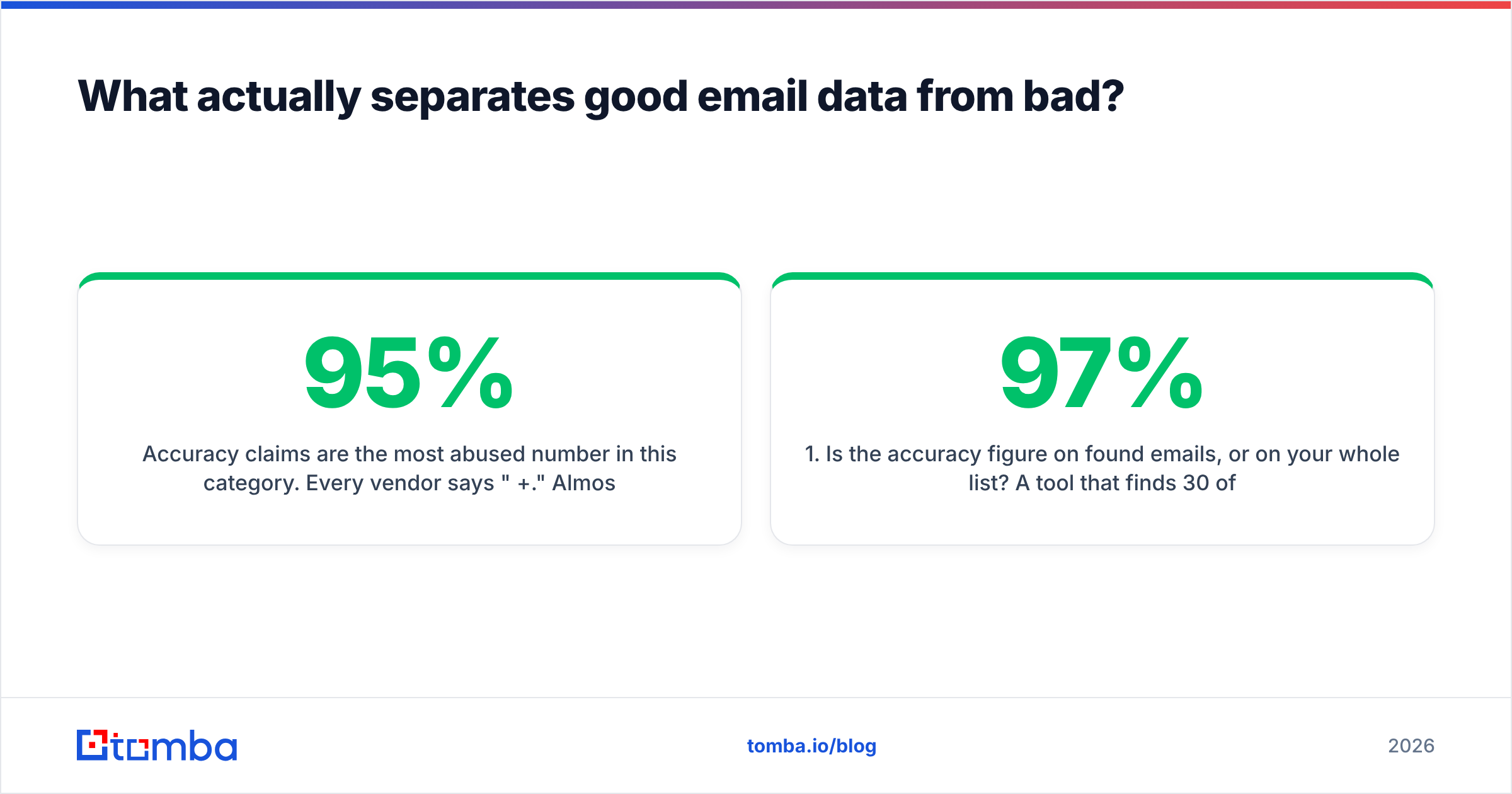
Accuracy claims are the most abused number in this category. Every vendor says "95%+." Almost none define the denominator.
Here's what to interrogate before you sign anything:
- Is the accuracy figure on found emails, or on your whole list? A tool that finds 30 of your 100 targets and gets 29 right will advertise 97% accuracy. Its real coverage is 29%.
- How are catch-all domains handled? Roughly a fifth of B2B domains accept everything at the MTA and reveal nothing via SMTP. A tool that returns them as "valid" is guessing. A tool that flags them honestly and offers a separate catch-all finder is telling you the truth.
- Is verification live or cached? A verification run six months ago against a company that's since had layoffs is fiction.
- Where does the data come from? Scraped-and-resold vs pattern-inferred-and-verified are very different products. Tomba publishes its data sources; ask any vendor for the equivalent.
- What's the refund policy on bad rows? Vendors confident in their data credit you back. Vendors who aren't, don't.

Run any candidate through the same test: take 100 contacts you already know the emails for — your own customers, your CRM's closed-won records — strip the emails, and see what each tool returns. It takes an afternoon and it is the only benchmark that reflects your actual ICP. Vendor-published accuracy charts reflect their test set, which was chosen to flatter them.
Which one should you pick for a portfolio job board?#
Getro, almost certainly — and Cufinder isn't in the running.
If you're a VC platform lead and your founders keep asking why the portfolio job board is stale, Getro's career-page scraping solves exactly that. No other category of tool does this. Your alternatives are Consider.com, building it yourself on Airtable plus a scraper, or doing it manually and hating your life.
The honest counterpoint: Getro is a real annual contract, and small funds with under ~15 portfolio companies often find the math doesn't work. At that size, a manual board updated monthly costs less than a platform subscription. Getro's value curve steepens with portfolio size and network volume — it's genuinely excellent for a 60-company portfolio and genuinely overkill for an 8-company one.
Check their current pricing and product pages directly — talent-network software pricing moves and no blog post should be your source of truth on a quoted contract.
Can one tool do both jobs?#
No, and you should be suspicious of anything that claims otherwise.
Prospecting data and talent networks have opposite consent models. Outbound contact data is about reaching people who haven't opted in — it's governed by GDPR legitimate interest, CAN-SPAM, and a lot of careful legal framing. A talent network is opt-in by design; candidates choose to be there. Merging those datasets is a compliance problem, not a feature.
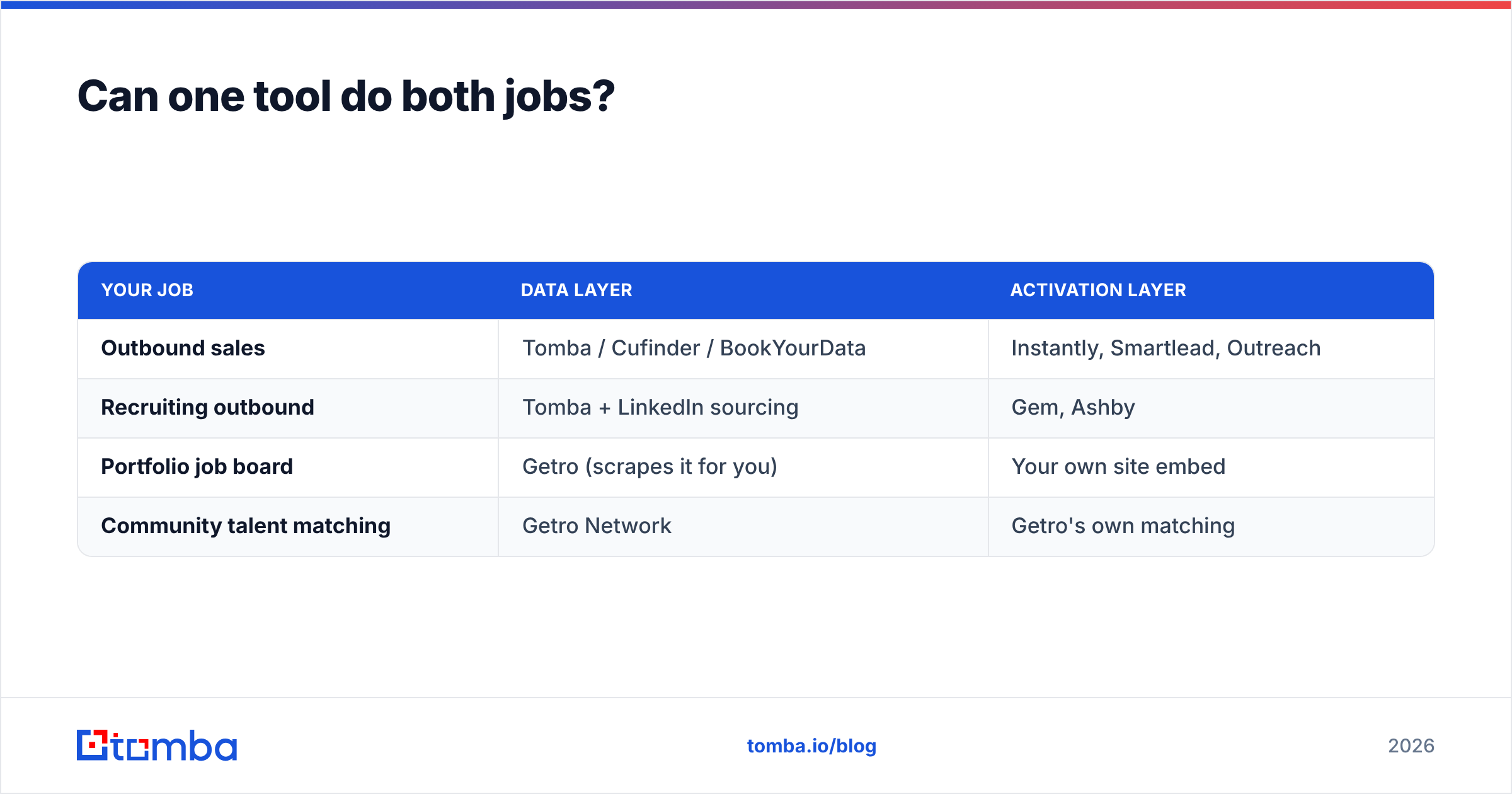
What does stack sensibly:
| Your job | Data layer | Activation layer |
|---|---|---|
| Outbound sales | Tomba / Cufinder / BookYourData | Instantly, Smartlead, Outreach |
| Recruiting outbound | Tomba + LinkedIn sourcing | Gem, Ashby |
| Portfolio job board | Getro (scrapes it for you) | Your own site embed |
| Community talent matching | Getro Network | Getro's own matching |
Note that Tomba appears twice and Getro appears twice — in non-overlapping rows. That's the whole point.
If you're running outbound and want your data layer to plug directly into your CRM, look at whether the vendor has native connections rather than Zapier-taped ones — Tomba's HubSpot integration and Salesforce integration are examples of the shape you want. Enrichment that requires a CSV round-trip is enrichment your team will stop doing by week three.
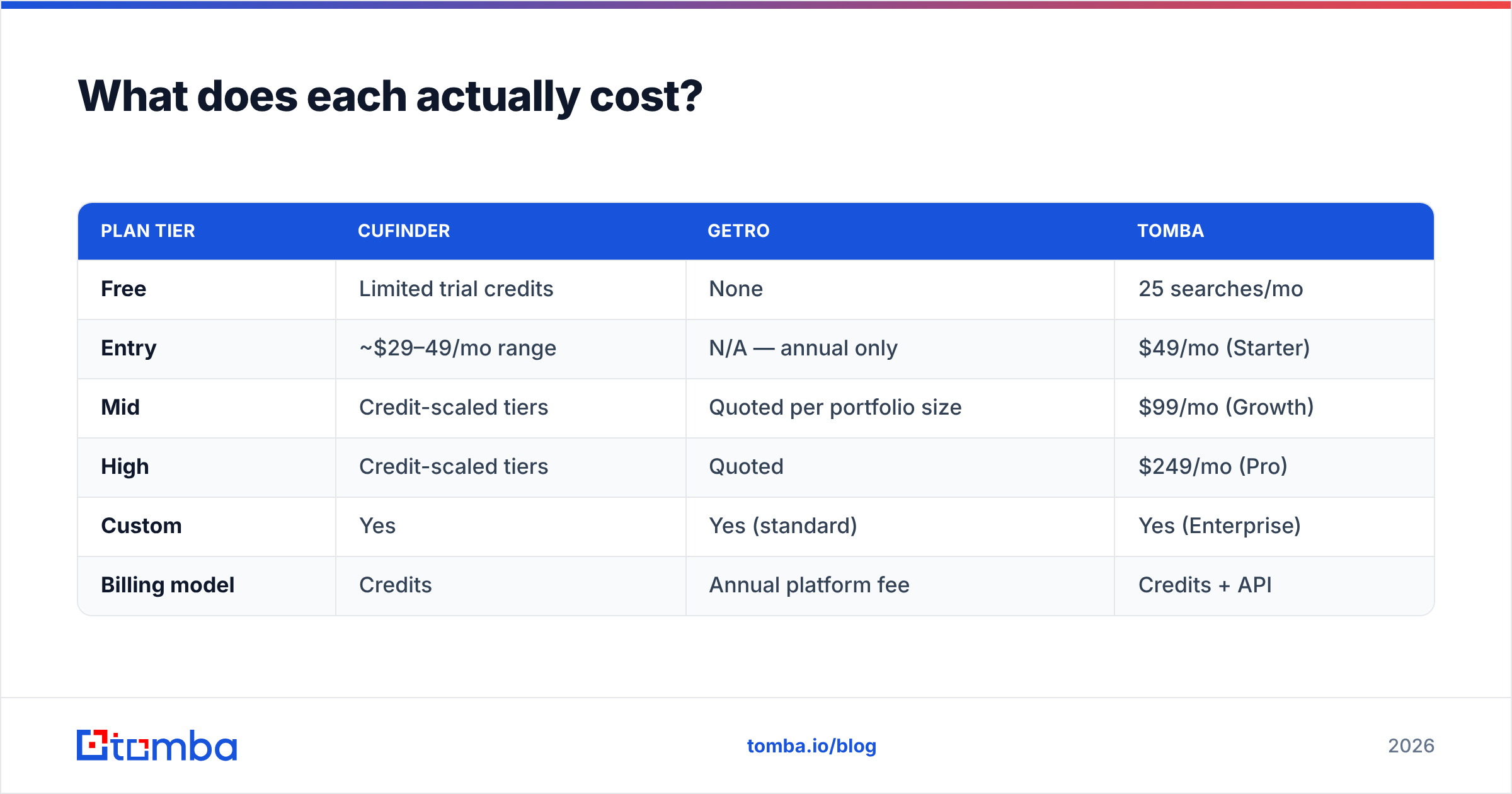
What does each actually cost?#
Pricing transparency is itself a signal. Vendors who publish pricing are usually confident their unit economics survive comparison.
| Plan tier | Cufinder | Getro | Tomba |
|---|---|---|---|
| Free | Limited trial credits | None | 25 searches/mo |
| Entry | ~$29–49/mo range | N/A — annual only | $49/mo (Starter) |
| Mid | Credit-scaled tiers | Quoted per portfolio size | $99/mo (Growth) |
| High | Credit-scaled tiers | Quoted | $249/mo (Pro) |
| Custom | Yes | Yes (standard) | Yes (Enterprise) |
| Billing model | Credits | Annual platform fee | Credits + API |
Two things worth flagging. First, "credits" is not a unit — one vendor's credit is a search, another's is a returned result, another's is an API call whether or not it found anything. Read the definition, because a cheap credit that burns on empty results is not cheap. Second, Getro's absence of a free tier isn't stinginess — it reflects that you can't meaningfully trial a job board without wiring it into your site.
Full Tomba pricing is public if you want a reference point with defined credit semantics.
How should you actually decide?#
Answer one question: are you trying to reach strangers, or serve members?
If you're reaching strangers — cold prospects who don't know you — you need contact data, and your shortlist is Cufinder, Tomba, Findymail, Apollo, BookYourData. Run the 100-known-contacts test. Pick on hit rate and bounce rate, not sticker price.
If you're serving members — a portfolio, a cohort, a community — you need Getro or a direct alternative. There is no email-finder in your evaluation, and any listicle that put one there wasted your time.
If you somehow need both — say you're a VC that also runs outbound to source deals — buy both. They cost different money from different budgets and don't overlap. That's not a compromise; it's just what two different jobs cost.
The failure mode to avoid is picking a generalist because it appeared next to a specialist in a search result. Category confusion costs more than tool cost. You'll spend a quarter discovering the tool can't do the thing, and the quarter is worth more than the subscription.
Ready to build a list that doesn't bounce?#
If this comparison landed you on the prospecting side of the fence, start with the data layer. Tomba's Email Finder finds verified work emails by domain, name, or company, with a dedicated verifier and honest catch-all handling behind it — so what lands in your sequencer is the stuff that actually delivers. The free tier gives you 25 searches a month, which is enough to run the 100-contact test on a slice of your own CRM and see the hit rate for yourself before you pay anyone, including us. Start there, compare the numbers, then decide.
Related guides#
Ready to find emails that actually work?
Join 150,000+ professionals who stopped guessing and started sending. Free credits on signup — no credit card required.
Get the Tomba newsletter
Practical outbound tactics and product updates — once every two weeks.
About the author