Cufinder vs Grata (2026): Honest Comparison and Our Pick
Cufinder and Grata both sell B2B data, but they solve completely different problems. One fills your contact list; the other finds companies nobody else can see. Here's which one your team actually needs in 2026.
TL;DR
- Cufinder is a contact-data engine. It finds emails, phone numbers, and company records at volume, on self-serve pricing that a two-person SDR team can expense without a procurement call.
- Grata is a private-market search engine. It indexes millions of private companies (mostly small and mid-market) and lets you search them by what they do, not by SIC code. It is sold to PE firms, corp dev teams, and investment banks at enterprise price points.
- They are not substitutes. If you are comparing Cufinder vs Grata head-to-head, one of them is almost certainly wrong for your job.
- Buy Cufinder if you need contacts to email. Buy Grata if you need to build a target list of private companies to acquire or partner with.
- The gap both leave open is verification. Neither is built primarily as an accuracy layer, which is why most teams end up pairing a finder with a dedicated email verifier before anything hits a sending domain.
Why are people comparing Cufinder vs Grata at all?#
Because both companies use the phrase "B2B data platform," and search engines flatten everything under that phrase into one bucket.
Think of it like comparing a phone book to a map of every business district in the country. Both contain company names. Only one tells you who to call. Only the other tells you which neighborhoods exist in the first place.
Cufinder sits in the prospecting-data category — the same shelf as Apollo, RocketReach, and Lusha. Its job is turning a name or a domain into a working email address or mobile number, then pushing that into your sequencer.
Grata sits in the private-market intelligence category — the same shelf as SourceScrub, Sourcescrub, and (at the enterprise end) parts of PitchBook. Its job is answering "which 340 companies in North America do robotic weld inspection for the auto sector and have 20–200 employees?" That question has no good answer in a standard prospecting tool, because standard prospecting tools rely on industry taxonomies that were designed in the 1980s.
So the real question underneath "Cufinder vs Grata" is usually: am I doing outbound, or am I doing sourcing?
What does Cufinder actually do?#
Cufinder is a self-serve contact and company enrichment suite. The core motions:
- Email finder — feed it a full name plus a company domain, get back a best-guess address with a confidence score. This is pattern inference plus source-data lookup, same as every tool in the category.
- Phone finder — mobile and direct-dial numbers, coverage skewed toward North America.
- Company enrichment — hand it a domain, get firmographics: headcount band, industry, tech stack, location, socials.
- Bulk + API — CSV upload for list work, REST API for pushing enrichment into your own systems.
- Chrome extension — pull contacts while browsing LinkedIn or a company site.
Cufinder's positioning is volume-for-price. It leans on a large aggregate database and prices credits aggressively compared to Apollo or ZoomInfo. Independent reviews on G2 consistently praise the pricing and flag the same thing every aggregate-database vendor gets flagged for: coverage is strong in some segments and thin in others, and accuracy varies by region.
That is not a knock specific to Cufinder. It is the physics of the category. Aggregate databases are snapshots; people change jobs roughly every 2–3 years; a record that was perfect in March is stale by October.
Wait — corrected:
What does Grata actually do?#
Grata is a search engine over private companies, built on machine-read company websites rather than a filed industry code.
The mechanism matters. Traditional databases classify a company by whatever NAICS/SIC code it registered under, which produces useless buckets — "Software Publishers" contains both a $2M dental scheduling tool and Adobe. Grata instead reads what a company's site says it does and lets you search in plain language, then expands outward from a seed company to find lookalikes.
The core motions:
- Natural-language search — "companies that do PCB assembly for medical devices."
- Similar-company expansion — give it three targets you like, get 200 more that look like them.
- Ownership and deal signals — PE-backed vs founder-owned, prior funding, M&A history, growth signals.
- List building and CRM sync — push a sourced list into Salesforce, HubSpot, DealCloud, or Affinity.
- Contact data — Grata does surface contacts, but it is a supporting feature, not the product.
Grata's buyer is a private-equity associate building a thesis-driven target list, a corp-dev lead mapping a category, or an investment banker prepping a sell-side buyer list. The value is finding companies that don't market themselves, don't rank on Google, and have never filled out a form.
Cufinder vs Grata: how do they compare on the things that matter?#
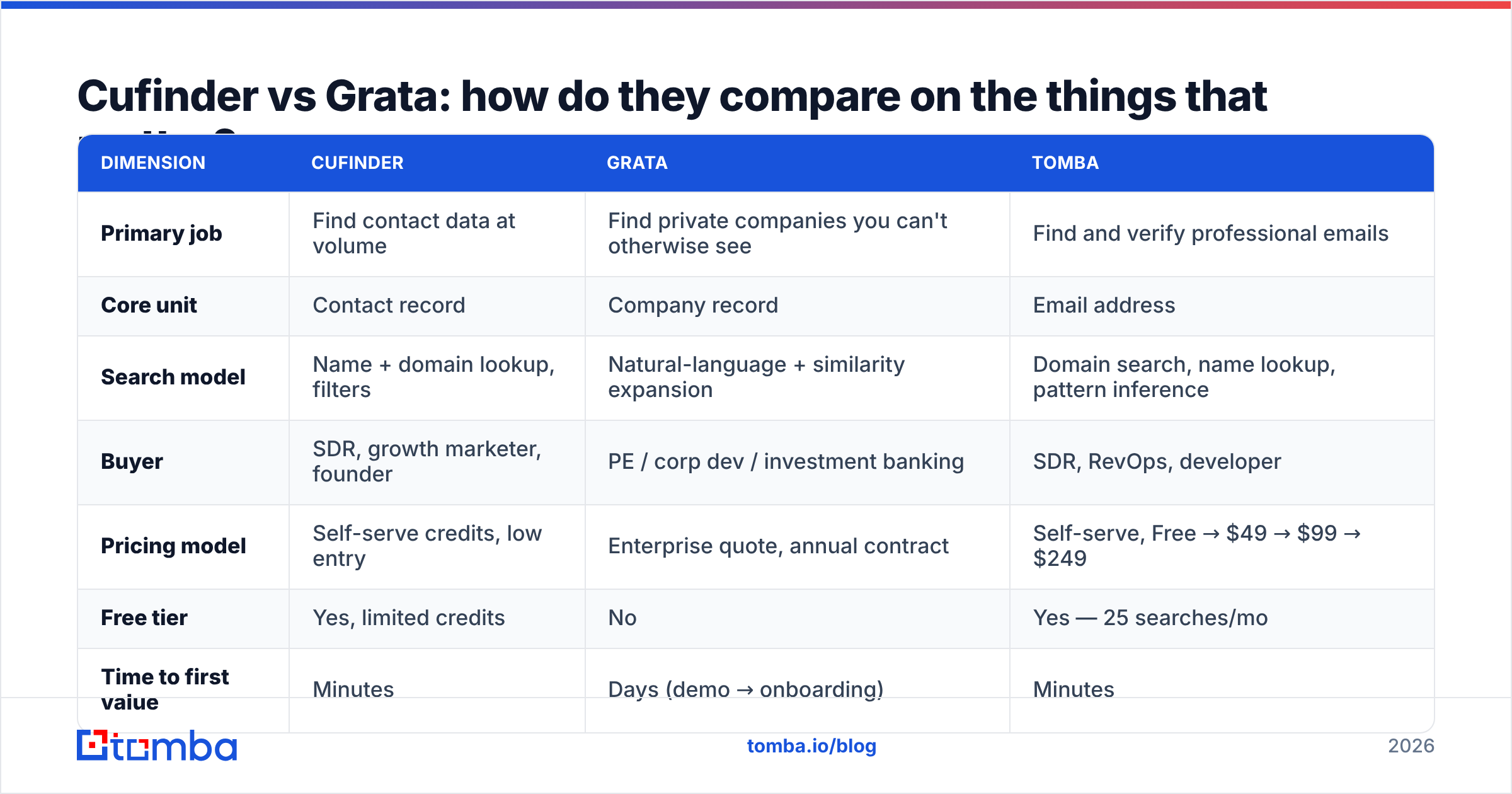
| Dimension | Cufinder | Grata | Tomba |
|---|---|---|---|
| Primary job | Find contact data at volume | Find private companies you can't otherwise see | Find and verify professional emails |
| Core unit | Contact record | Company record | Email address |
| Search model | Name + domain lookup, filters | Natural-language + similarity expansion | Domain search, name lookup, pattern inference |
| Buyer | SDR, growth marketer, founder | PE / corp dev / investment banking | SDR, RevOps, developer |
| Pricing model | Self-serve credits, low entry | Enterprise quote, annual contract | Self-serve, Free → $49 → $99 → $249 |
| Free tier | Yes, limited credits | No | Yes — 25 searches/mo |
| Time to first value | Minutes | Days (demo → onboarding) | Minutes |
| Verification depth | Confidence score | Not a focus | Dedicated verifier + catch-all handling |
| API | Yes | Yes (enterprise tier) | Yes, documented, all plans |
| Best for | Outbound at volume | Deal sourcing and market maps | Accuracy-first outbound |
The table makes the mismatch obvious. These tools overlap on maybe 15% of their surface area — the part where both can tell you a company exists and roughly how big it is.
Which one is better for outbound prospecting?#
Cufinder, by a wide margin — and Grata isn't really trying to compete here.
If your job is to put 2,000 qualified contacts into a sequence this quarter, Grata is an expensive and awkward tool for it. You would be paying enterprise rates for a company-discovery layer, then still needing a contact layer on top.
But there's a caveat that applies to Cufinder and every peer in its category: volume without verification is a deliverability problem wearing a lead-gen costume.
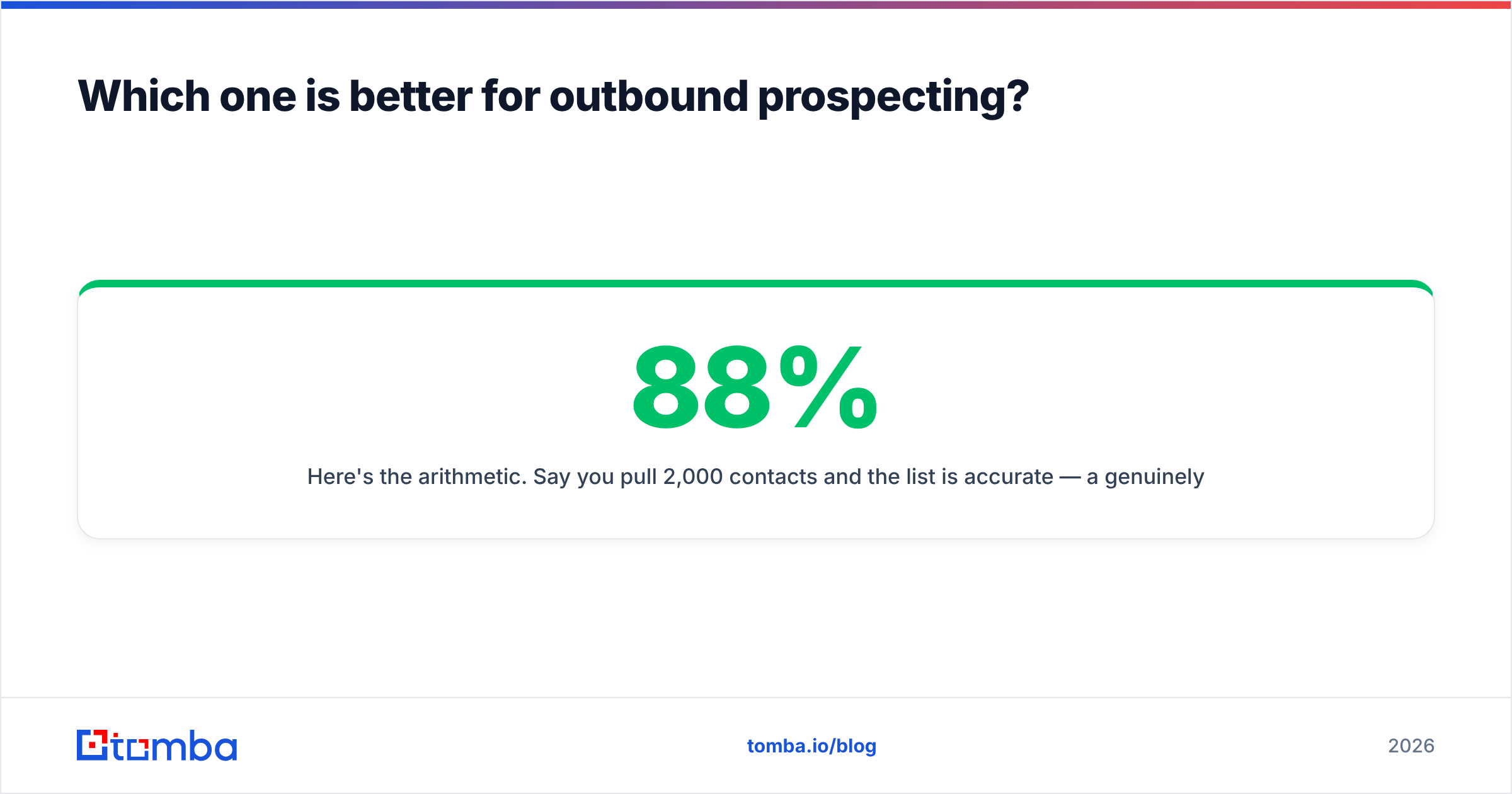
Here's the arithmetic. Say you pull 2,000 contacts and the list is 88% accurate — a genuinely respectable number for aggregate data. That's 240 bad addresses. Send to all 2,000 and your bounce rate is 12%. Google and Microsoft start throttling at around 2–3%. You have not just wasted 240 credits; you have measurably damaged your sender reputation for every campaign that follows.
This is why the finder-plus-verifier stack exists. You find at volume, then you gate. A bulk verify pass before the first send costs a fraction of what a burned domain costs, and it's the single highest-ROI step in the whole outbound chain.

Catch-all domains are where this gets genuinely hard. Roughly a fifth of B2B domains accept mail to any address at the SMTP layer, which means a basic verifier returns "unknown" and you're guessing. Tools with a real catch-all verifier resolve a meaningful share of those instead of leaving them in limbo — which matters, because "unknown" contacts are exactly the ones SDRs send to anyway.
Which one is better for deal sourcing and market mapping?#
Grata, and it isn't close.
Cufinder cannot answer "show me every founder-owned company doing industrial IoT retrofits in the Midwest with 30–150 employees and no PE backing." It can filter by industry code and headcount, which will return a bucket that is simultaneously too broad and missing your best targets.
That's the specific thing Grata is engineered for, and the reason PE firms pay enterprise rates for it. The alternative is an associate spending three weeks with Google, trade-show attendee lists, and a spreadsheet. Grata compresses that into an afternoon. At a firm where one sourced deal is worth seven figures in carry, the math is trivially favorable.
The honest downside: Grata's contact data is the weak leg of the stool. Once you've sourced the 340 companies, you still need the right person's email at each one — and a company-search engine is not optimized for that last mile. Most Grata users end up pairing it with a contact-data layer. That's the actual stack, not an either/or.
What does the real-world stack look like?#
Here's how the four common configurations shake out:
- Outbound-only (SMB / startup) — a contact finder plus a verifier plus a sequencer. Grata is not in this stack. Budget: a few hundred dollars a month, total.
- Deal sourcing (PE / corp dev) — Grata for discovery, a contact finder for the last mile, CRM (DealCloud or Affinity) for pipeline. Budget: five figures annually, dominated by Grata.
- ABM / enterprise marketing — an intent platform for signals, a contact finder for the buying committee, a verifier before every send. Grata occasionally appears if the target market is private-company-heavy.
- Developer / programmatic enrichment — an email finder API called from your own pipeline, no UI involved. Cufinder can serve this; Grata's API is gated to enterprise tiers.
- Recruiting / partnerships — contact finder plus reverse email lookup for identity resolution. Neither vendor is the obvious pick; both work.
Notice the pattern: in every stack that includes Grata, there's still a contact-data tool underneath it. Grata replaces your sourcing process. It does not replace your finder.
How does pricing actually compare?#
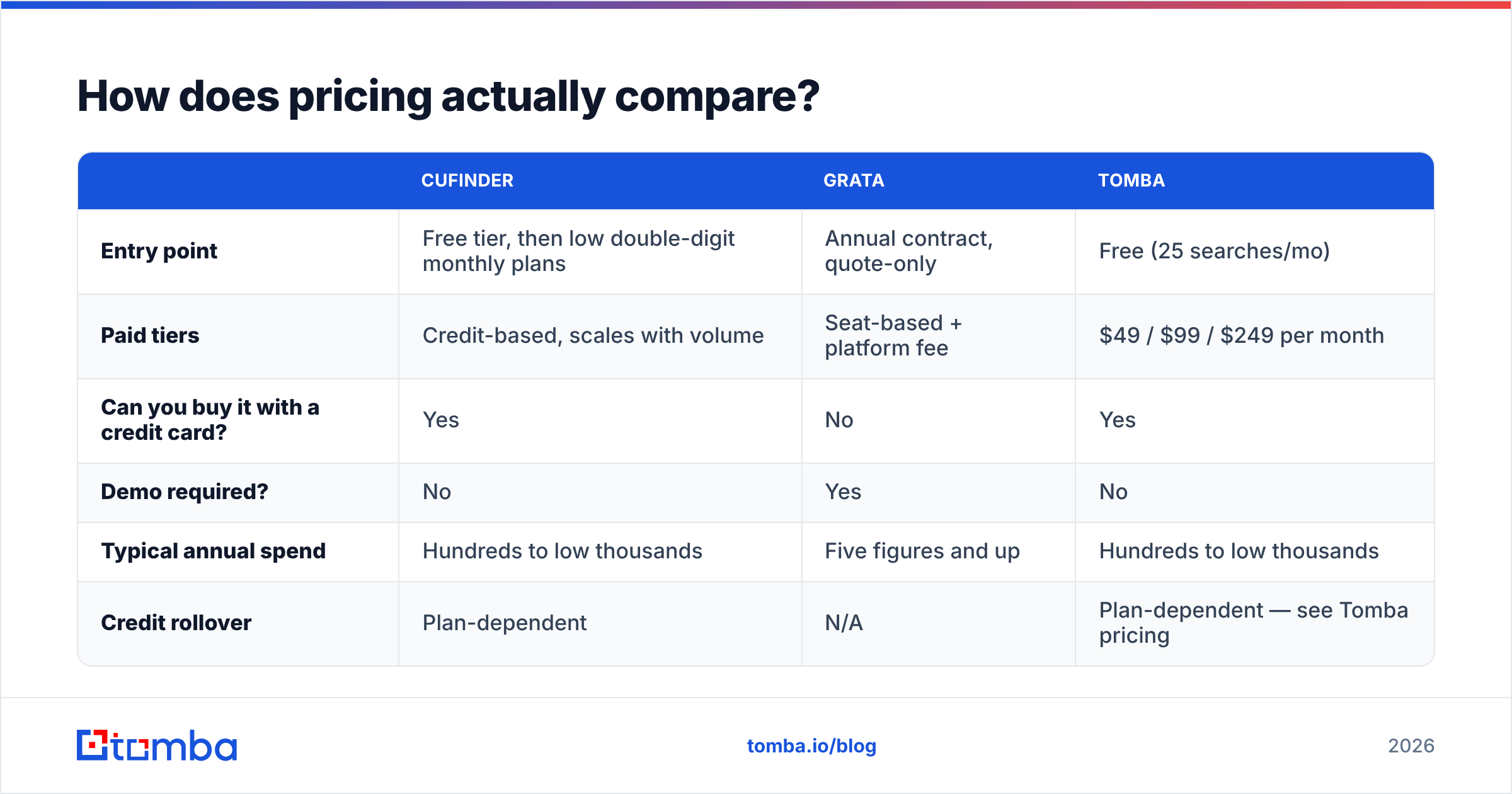
This is where the two tools are least comparable, and where most buyers get surprised.
| Cufinder | Grata | Tomba | |
|---|---|---|---|
| Entry point | Free tier, then low double-digit monthly plans | Annual contract, quote-only | Free (25 searches/mo) |
| Paid tiers | Credit-based, scales with volume | Seat-based + platform fee | $49 / $99 / $249 per month |
| Can you buy it with a credit card? | Yes | No | Yes |
| Demo required? | No | Yes | No |
| Typical annual spend | Hundreds to low thousands | Five figures and up | Hundreds to low thousands |
| Credit rollover | Plan-dependent | N/A | Plan-dependent — see Tomba pricing |
Two practical notes. First, vendor pricing pages change; confirm current numbers directly before you budget. Second, credit-based pricing hides its real cost in the miss rate. A tool at half the price-per-credit that finds 60% of your list is more expensive than one at full price that finds 85%, because you pay for the misses either way and then pay again to fill the gap elsewhere. Always run the same 100-row test list through every finalist and compare hit rate and accuracy, not sticker price.
What are the honest weaknesses of each?#
Cufinder's weak spots:
- Coverage is uneven outside North America and Western Europe — a common issue across the whole aggregate-data category.
- Confidence scores are a signal, not a verification. Treat them as a sorting hint, not a green light.
- The breadth of the suite means no single module is best-in-class; you're buying convenience.
Grata's weak spots:
- Price and procurement friction put it out of reach for anyone below the mid-market.
- Contact data is thin relative to its company data.
- If your target market is public companies or well-known SaaS brands, you're paying a premium for a discovery capability you don't need — those companies are already easy to find.
And the shared gap: neither vendor's core competency is validating that an address will actually deliver. That's a distinct engineering problem — SMTP handshakes, catch-all resolution, role-account detection, disposable-domain filtering — and it's why it tends to live in a separate tool.
Which should you pick?#
Run it as a decision tree, not a comparison:
- Do you need to discover private companies that don't show up in standard databases? → Grata. Nothing on the self-serve shelf substitutes for it.
- Do you need contacts to email, at volume, this month? → Cufinder or a peer. Grata is the wrong instrument.
- Do you need both? → Buy both. They stack cleanly; they don't overlap enough to be redundant.
- Do you care most about not burning your domain? → Whatever you pick for finding, put a verification gate in front of your sender. Non-negotiable.
If you landed on this page from a search for "Cufinder vs Grata," you were probably doing outbound and Grata drifted into your results because of shared category language. That's a search-engine artifact, not a real shortlist.
Where does Tomba fit?#
Tomba competes in the same lane as Cufinder — contact data — with a different emphasis: accuracy over raw breadth.
The practical difference shows up in the workflow. Domain search returns every discoverable address at a company along with the confirmed email pattern, so you can generate the rest yourself. The verifier and catch-all handling are first-class products rather than a confidence score bolted onto a finder. And the whole thing is self-serve: free tier at 25 searches a month, $49/mo Starter, $99/mo Growth, $249/mo Pro, no demo call to get a number.
It does not do what Grata does. It will not surface a founder-owned machine shop that has no web presence and no LinkedIn page. If that's your job, Grata is the tool and this post won't change that.
If your job is getting a working email address in front of the right person without torching your sending domain, start with the Tomba Email Finder. The free tier is enough to run your own 25-row bake-off against Cufinder — same names, same domains, same afternoon. Then send both lists through a verifier and compare bounce rates. That test tells you more in an hour than any comparison post, including this one.
Related guides#
Ready to find emails that actually work?
Join 150,000+ professionals who stopped guessing and started sending. Free credits on signup — no credit card required.
Get the Tomba newsletter
Practical outbound tactics and product updates — once every two weeks.
About the author