Cufinder vs LakeB2B (2026): Which B2B Data Tool Wins?
Cufinder and LakeB2B both sell B2B contact data, but they solve different problems. Here's an honest breakdown of accuracy, pricing, and coverage — plus a cheaper pick worth testing.
Cufinder vs LakeB2B (2026): Which B2B Data Tool Wins?
Choosing between Cufinder and LakeB2B usually means you're stuck at the same fork: do you want a self-serve tool that finds and enriches contacts on demand, or a data vendor that hands you a pre-built list? They look similar on a feature grid, but they solve different problems — and picking the wrong one wastes both budget and deliverability.
This is a neutral, hands-on comparison. No affiliate spin, no "everything is amazing." Where Cufinder wins, we say so. Where LakeB2B wins, we say so. And where a leaner tool beats both on cost-per-verified-contact, we say that too.
TL;DR: Cufinder vs LakeB2B at a glance#
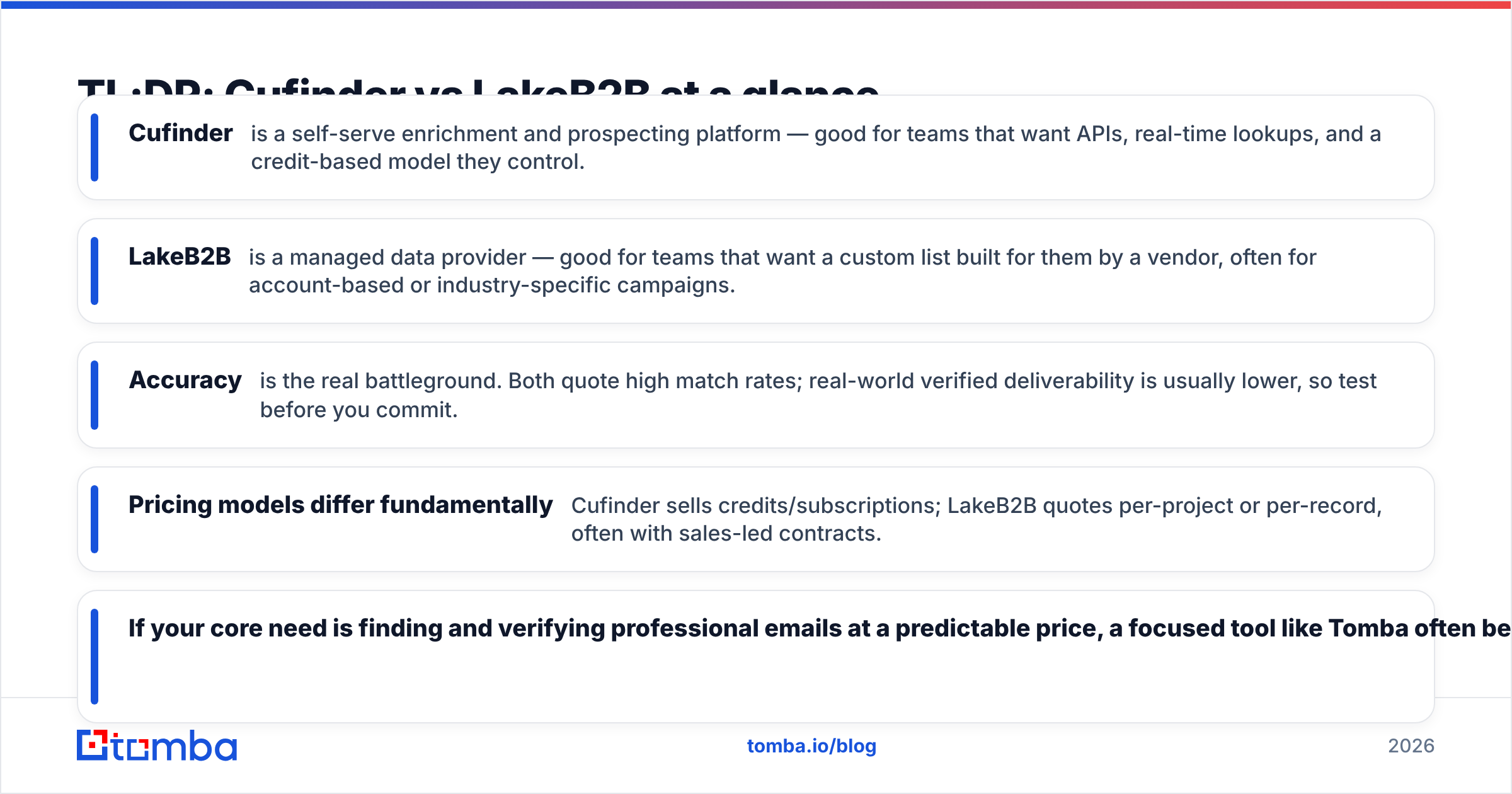
- Cufinder is a self-serve enrichment and prospecting platform — good for teams that want APIs, real-time lookups, and a credit-based model they control.
- LakeB2B is a managed data provider — good for teams that want a custom list built for them by a vendor, often for account-based or industry-specific campaigns.
- Accuracy is the real battleground. Both quote high match rates; real-world verified deliverability is usually lower, so test before you commit.
- Pricing models differ fundamentally: Cufinder sells credits/subscriptions; LakeB2B quotes per-project or per-record, often with sales-led contracts.
- If your core need is finding and verifying professional emails at a predictable price, a focused tool like Tomba often beats both on cost-per-usable-contact.
What is Cufinder?#
Cufinder is a B2B lead-generation and enrichment platform. You feed it a company name, domain, or partial contact detail, and it returns enriched data — emails, phone numbers, company firmographics, technographics, and social profiles. It leans self-serve: you sign up, buy credits or a subscription, and pull data through the dashboard, bulk uploads, or an API.
The pitch is breadth. Cufinder markets a large company and contact database plus a stack of point tools (company-to-domain, email finder, enrichment). For a growth team that wants to run lookups themselves and wire results into a CRM, that self-serve control is the main draw. You can review their live feature set on the Cufinder homepage.
Where Cufinder gets criticized — like most database tools — is variance. Coverage is strong in some regions and industries and thin in others, and match rates on the marketing page rarely survive contact with a strict verifier. That's not unique to Cufinder; it's the nature of aggregated B2B data.
What is LakeB2B?#
LakeB2B is a managed B2B data and marketing-services provider. Instead of a purely self-serve dashboard, LakeB2B often works like an agency-plus-database: you tell them the audience you want — say, "IT decision-makers at US hospitals with 500+ beds" — and they assemble, clean, and deliver a targeted list, sometimes bundled with email or telemarketing campaign services.
That model suits buyers who want an audience built for them, especially in healthcare, technology, and other verticals where LakeB2B has invested in specialized data. You can see their positioning on the LakeB2B website. The tradeoff is that you're buying a snapshot. A delivered list is accurate on the day it ships and starts decaying immediately as people change jobs — B2B data typically decays 20–30% per year — so a static list needs re-verification before every send.
Cufinder vs LakeB2B: the core differences#
The single most useful way to frame this: Cufinder is a tool, LakeB2B is a service. One gives you the machine; the other gives you the output. That difference drives everything else — pricing, speed, control, and how much ongoing work lands on your team.
Here's the side-by-side.
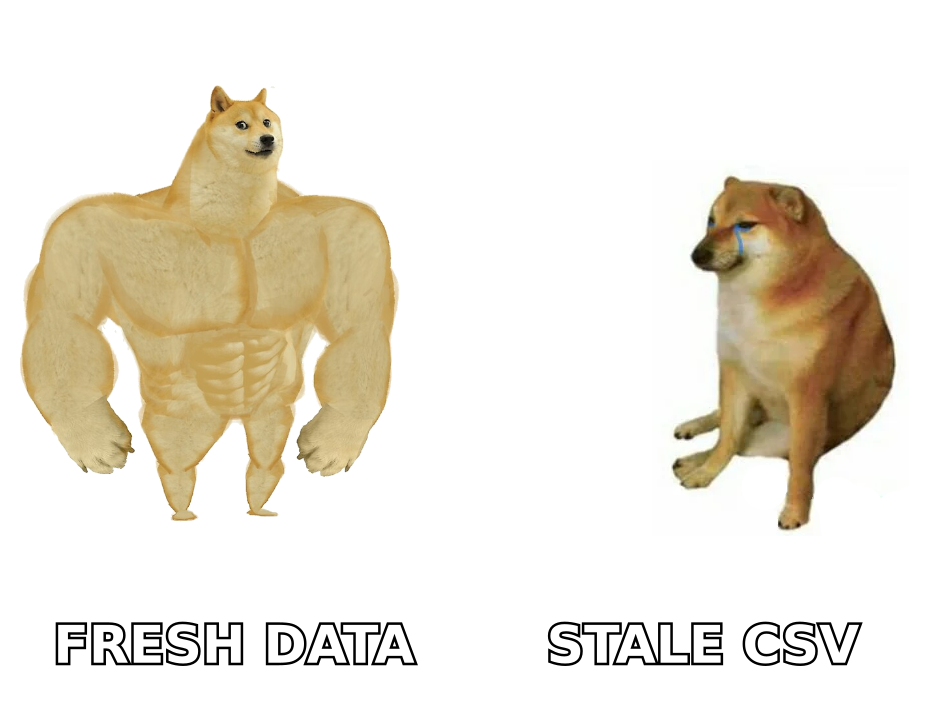
| Attribute | Cufinder | LakeB2B | Focused finder (e.g. Tomba) |
|---|---|---|---|
| Model | Self-serve tool + API | Managed data vendor | Self-serve tool + API |
| Best for | On-demand enrichment | Custom-built list projects | Email finding + verification |
| Data delivery | Real-time lookups, bulk | Delivered lists / campaigns | Real-time + bulk |
| Pricing | Credits / subscription | Quote-based, per project | Transparent tiers from $49/mo |
| Free tier | Limited free credits | Sample list on request | 25 free searches/mo |
| Verification built in | Partial | Vendor-cleaned at delivery | Dedicated verifier + catch-all |
| Contract friction | Low (self-serve) | Higher (sales-led) | Low (self-serve) |
| Ongoing decay handling | You re-run lookups | You re-buy / re-clean | Re-verify anytime |
The pattern is clear. Cufinder and a focused finder both put a live tool in your hands, so you refresh data whenever you need it. LakeB2B front-loads the work into a delivered dataset — powerful for a one-time targeted push, weaker for continuous outbound where freshness matters most.
Is Cufinder more accurate than LakeB2B?#
Neither wins accuracy by default — it depends on when and how you measure. This is where marketing numbers mislead most.
Both vendors advertise high match or accuracy rates. Those figures usually describe how often the system returns something, not how often that something is a currently valid, deliverable, non-catch-all mailbox. Those are very different metrics. A tool can boast a 95% "match rate" while a chunk of those matches bounce or land in catch-all limbo.
For a managed provider like LakeB2B, the list is cleaned at delivery, so day-one quality can be excellent — then it decays. For a self-serve tool like Cufinder, you get fresher lookups on demand, but quality varies by how well-covered your target segment is.

The only number that matters for your campaigns is cost per verified, deliverable contact in your target segment. To get it, run the same test list through both tools and then push every result through an independent email verifier — including a catch-all verifier for domains that accept everything. Whichever tool gives you more usable addresses per dollar wins, regardless of the badge on the pricing page. Don't trust a vendor's self-reported accuracy; measure it against a neutral checker.
How do Cufinder and LakeB2B price their data?#
The pricing philosophies are almost opposites, and that matters more than any single dollar figure.
Cufinder uses a self-serve, credit- and subscription-based model. You pick a plan, get a monthly credit allotment, and spend credits on lookups and enrichment. This is predictable and easy to start, but heavy bulk enrichment can burn credits fast, and per-credit economics vary by data type.
LakeB2B is typically quote-based. Because lists are custom-built (and sometimes bundled with campaign services), you usually talk to sales and get pricing per project or per record. That can be cost-effective at large volumes with tight targeting, but it introduces contract friction and less transparency up front.
Here's a simplified way to think about the three models:
- Credit/subscription (Cufinder): Best when usage is steady and self-directed. You trade some per-record efficiency for control and no sales calls.
- Quote/project (LakeB2B): Best for large, specialized, one-time audiences where a vendor's vertical data justifies a custom build.
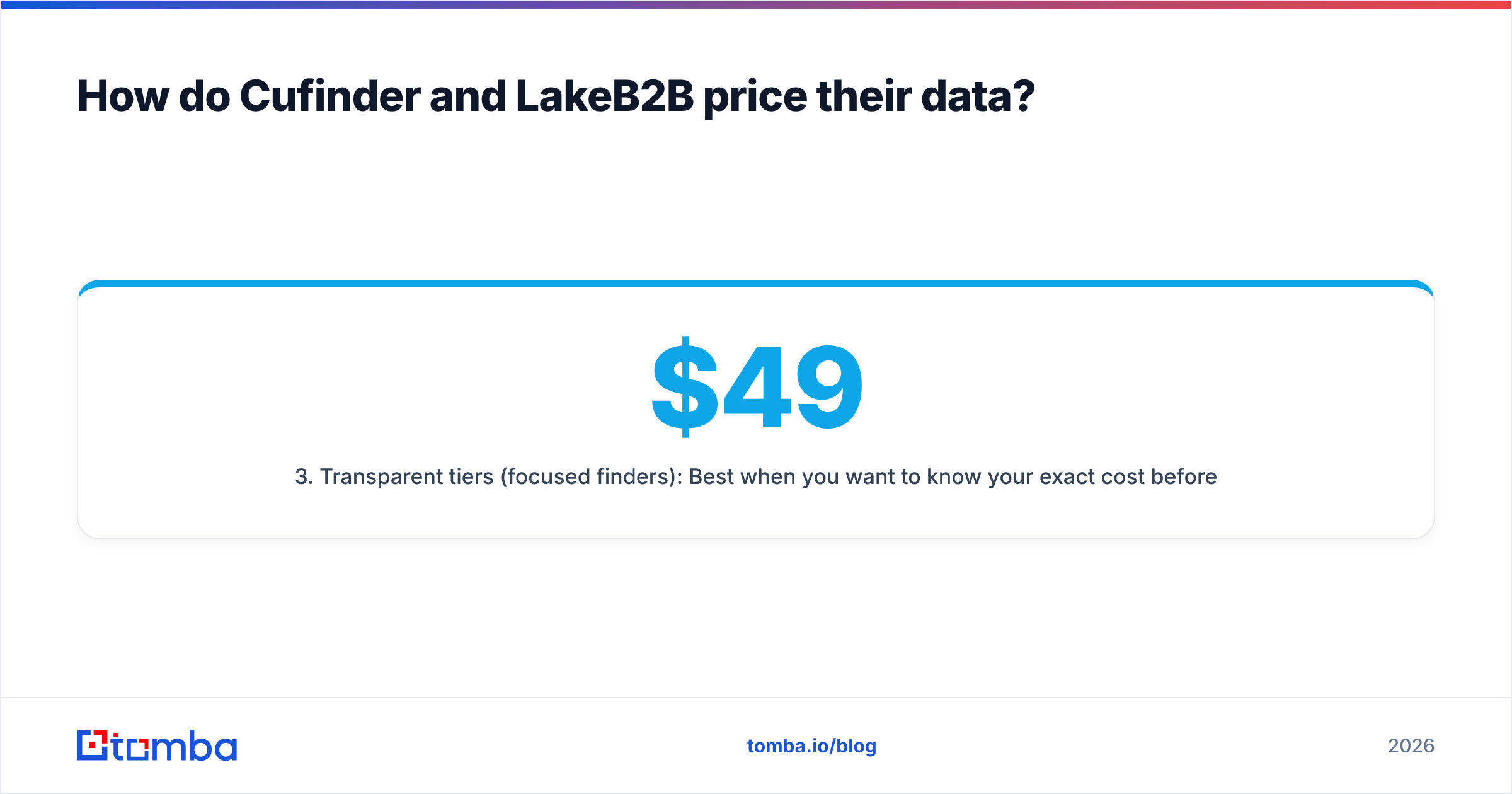
- Transparent tiers (focused finders): Best when you want to know your exact cost before you commit. For reference, Tomba pricing runs Free (25 searches/mo), Starter $49/mo, Growth $99/mo, and Pro $249/mo — no quote call required.
If budget predictability is a priority, published tiers beat "contact us." If you need a specialized vertical audience assembled for you, the quote model earns its friction.
Which one should you choose?#
Match the tool to the job, not the other way around.
Choose Cufinder if you want a self-serve platform your team operates daily, you value API access and real-time enrichment, and you'd rather control usage through credits than negotiate a contract. It fits growth and RevOps teams doing continuous, hands-on prospecting.
Choose LakeB2B if you need a custom, vertical-specific audience built and cleaned for you — especially in healthcare or technology — and you're running a defined campaign where a delivered list plus optional services saves your team time. It fits marketers who want done-for-you targeting at project scale.
Choose a focused finder if your bottleneck is specifically finding and verifying professional emails at a known price. Broad databases are great until you realize most of your outbound problem is deliverability, not volume.
Where does Tomba fit against Cufinder and LakeB2B?#
Tomba is not trying to be an all-in-one database or a managed-services agency — and that focus is the point. It concentrates on the part of the funnel where both Cufinder and LakeB2B introduce the most risk: turning a name and a company into a verified, deliverable email.
With Tomba you can:
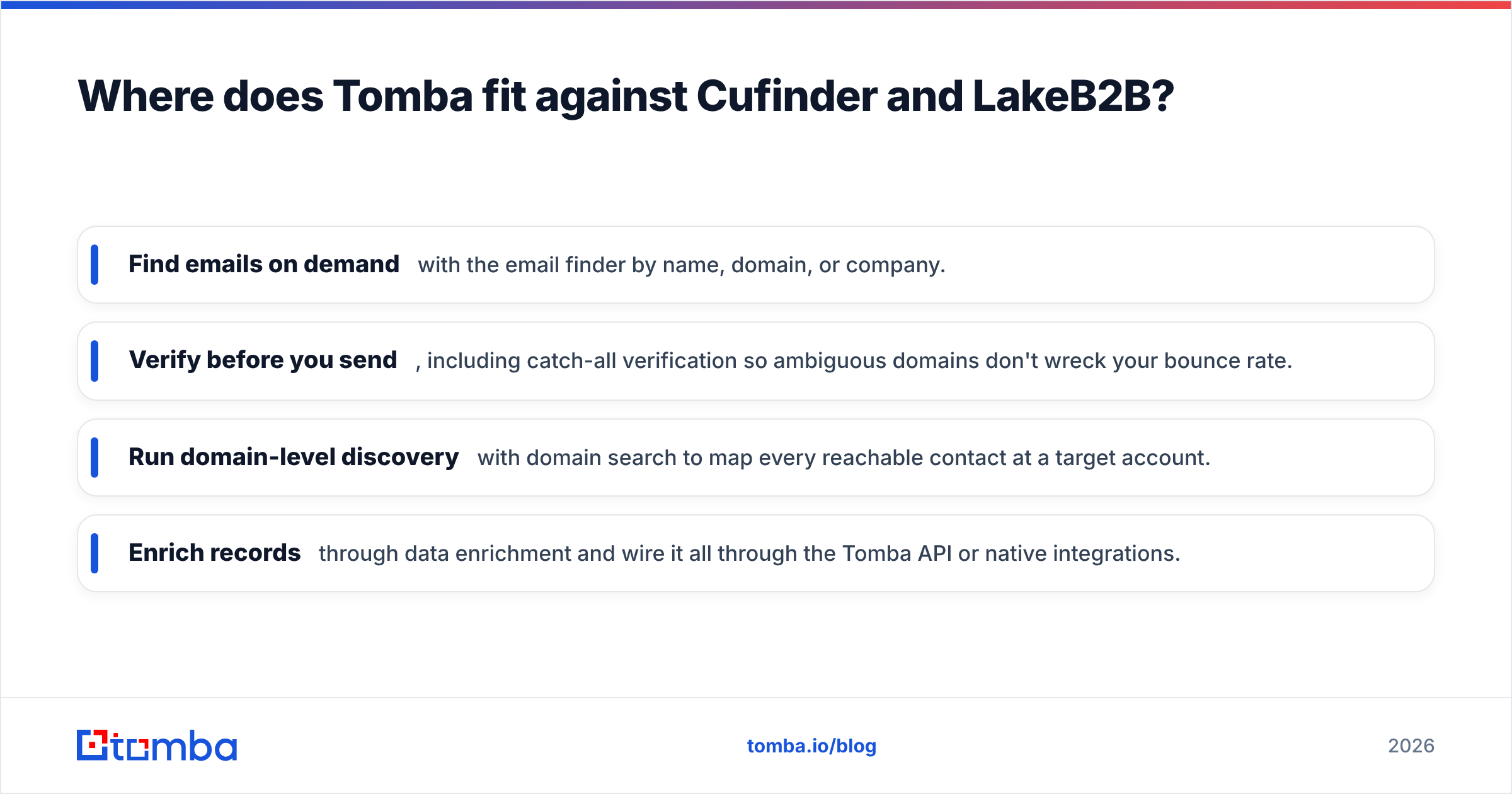
- Find emails on demand with the email finder by name, domain, or company.
- Verify before you send, including catch-all verification so ambiguous domains don't wreck your bounce rate.
- Run domain-level discovery with domain search to map every reachable contact at a target account.
- Enrich records through data enrichment and wire it all through the Tomba API or native integrations.
The transparency argument is straightforward: you know the price, you get a free tier to test real accuracy on your own list, and you're not buying a static snapshot that decays the moment it lands. On third-party review sites like G2, buyers consistently weight verification quality and predictable pricing heavily — which is exactly where a focused finder is built to compete.
None of this makes Cufinder or LakeB2B bad tools. If you genuinely need Cufinder's broad enrichment stack or LakeB2B's done-for-you vertical lists, buy them. But if you strip the decision down to "how many emails actually reach a human inbox per dollar," a specialized finder frequently comes out ahead of a general database or a managed list.
Cufinder vs LakeB2B: the honest verdict#
There's no universal winner — there's a winner for your workflow.
- Want a self-serve tool you run yourself? Cufinder is the more natural fit of the two.
- Want a custom audience built and delivered for a specific vertical push? LakeB2B is designed for that.
- Want maximum verified emails per dollar with pricing you can see up front? Test a focused finder against both before you sign anything.
The mistake isn't picking Cufinder or LakeB2B — it's picking either one without running a real cost-per-verified-contact test. Data quality claims are cheap; bounced campaigns are expensive.
Start with verified emails, not a guess#
If your real goal is reaching more of the right people without torching your sender reputation, start where the risk is highest: the email itself. Use the Tomba Email Finder to pull professional emails by name, domain, or company, then verify every one before it hits your sequence. The free tier gives you 25 searches a month — enough to benchmark Tomba's accuracy against Cufinder and LakeB2B on your own list before you commit a dollar. Test all three, keep the one that delivers the most inboxed emails per dollar, and let the results — not the marketing pages — pick your winner.
Related guides#
Ready to find emails that actually work?
Join 150,000+ professionals who stopped guessing and started sending. Free credits on signup — no credit card required.
Get the Tomba newsletter
Practical outbound tactics and product updates — once every two weeks.
About the author