Cufinder vs Leadsrush (2026): Which B2B Data Tool Wins?
Cufinder and Leadsrush both promise fresh B2B contacts, but they win on different fronts. Here is an honest, side-by-side breakdown of accuracy, pricing, and coverage for 2026.
Choosing between Cufinder and Leadsrush usually comes down to one question you can't answer from a pricing page: which one gives you contacts that actually reach a real inbox? Both platforms sell the same promise — fresh B2B leads on demand — but they get there in different ways, and the gap shows up fast once you export a list and start sending.
This is a neutral, side-by-side look at how the two compare on data accuracy, pricing, coverage, and workflow fit in 2026, plus where a dedicated tool like the Tomba Email Finder earns a spot in your stack.
TL;DR: Cufinder vs Leadsrush at a glance#
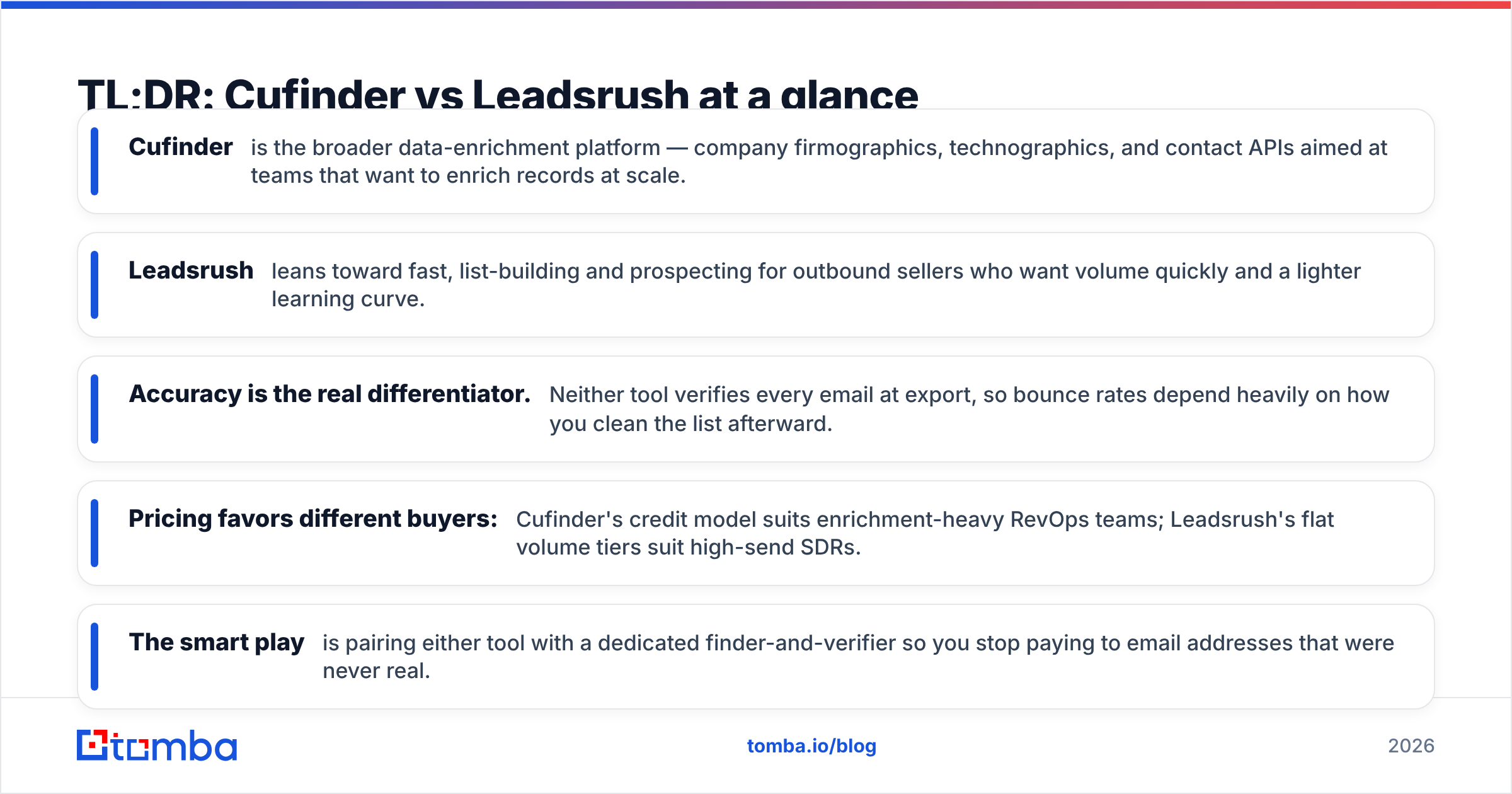
- Cufinder is the broader data-enrichment platform — company firmographics, technographics, and contact APIs aimed at teams that want to enrich records at scale.
- Leadsrush leans toward fast, list-building and prospecting for outbound sellers who want volume quickly and a lighter learning curve.
- Accuracy is the real differentiator. Neither tool verifies every email at export, so bounce rates depend heavily on how you clean the list afterward.
- Pricing favors different buyers: Cufinder's credit model suits enrichment-heavy RevOps teams; Leadsrush's flat volume tiers suit high-send SDRs.
- The smart play is pairing either tool with a dedicated finder-and-verifier so you stop paying to email addresses that were never real.

What is Cufinder and who is it for?#
Cufinder positions itself as an all-in-one B2B data and enrichment engine. Beyond email lookups, it exposes a stack of APIs — company name to domain, domain to technographics, contact enrichment, and firmographic filters — that let you append missing fields to records you already own. If your CRM is full of half-empty rows, that enrichment angle is Cufinder's strongest pitch.
The typical Cufinder buyer is a RevOps or growth team that treats data as infrastructure: they pipe enrichment into HubSpot or Salesforce, score leads, and route them automatically. That's a different job than "give me 500 new prospects by Friday," and it matters when you compare the two tools honestly.
Where Cufinder gets criticized is coverage consistency. Firmographic data is strong for mid-market and enterprise, but personal contact emails — especially for smaller companies and non-US regions — can come back thin or unverified. That's not unique to Cufinder; it's the reality of any single-source database. It's also why a second-pass email verifier belongs in the workflow regardless of which platform you pick.
What is Leadsrush and who is it for?#
Leadsrush is built for speed. The product is oriented around building targeted prospect lists fast — search by role, industry, and geography, then export. For an SDR who needs to fill a sequence today, that low-friction workflow is genuinely appealing, and the learning curve is shorter than a full data platform.
The trade-off is depth. Leadsrush is lighter on enrichment APIs and technographic filtering, so if your motion depends on knowing a prospect's tech stack or intent signals, you'll hit the ceiling sooner. For straightforward "find people in this ICP and email them" outbound, though, it does the core job without much ceremony.
Like Cufinder, Leadsrush's exported emails aren't guaranteed verified at the point of download. High-volume senders who skip a verification step tend to see bounce rates creep up, which quietly damages sender reputation and drags down the deliverability of every campaign that follows.
Cufinder vs Leadsrush: full comparison table#
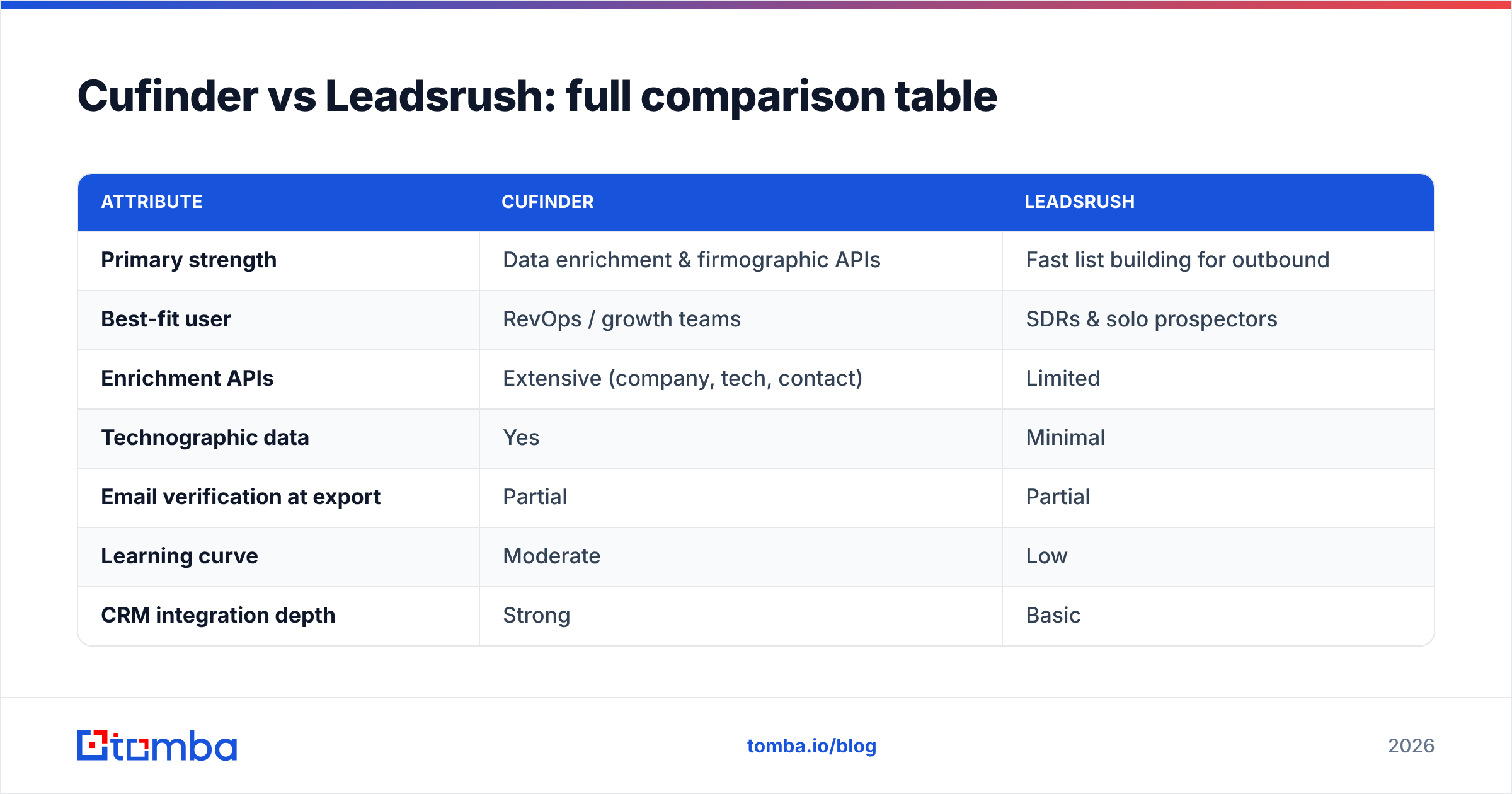
Here's the head-to-head on the attributes that actually change your results.
| Attribute | Cufinder | Leadsrush |
|---|---|---|
| Primary strength | Data enrichment & firmographic APIs | Fast list building for outbound |
| Best-fit user | RevOps / growth teams | SDRs & solo prospectors |
| Enrichment APIs | Extensive (company, tech, contact) | Limited |
| Technographic data | Yes | Minimal |
| Email verification at export | Partial | Partial |
| Learning curve | Moderate | Low |
| CRM integration depth | Strong | Basic |
| Free trial / entry tier | Limited credits | Limited credits |
| Ideal use case | Enrich & score existing pipeline | Build net-new lists quickly |
The pattern is clear: Cufinder is a platform, Leadsrush is a tool. Neither is "wrong" — they're built for different jobs. Your choice should follow your motion, not the other way around.
Which tool has better data accuracy?#
Accuracy is where these comparisons are won or lost, and it's the metric buyers underweight most. A list of 1,000 contacts at 70% accuracy isn't a 1,000-contact list — it's a 700-contact list with 300 landmines that hurt your domain reputation when they bounce.

Both Cufinder and Leadsrush draw from aggregated sources, and both will occasionally hand you catch-all domains, role-based addresses (info@, sales@), or stale contacts from people who changed jobs. That's not a knock on either — it's the nature of static databases. The fix isn't picking the "more accurate" vendor and trusting it blindly; it's verifying every address before it enters a sequence.
This is exactly where a dedicated finder-and-verifier stack changes the math. Running exports through a catch-all verifier catches the addresses that "pass" a basic syntax check but will never deliver. If you sell into segments where either platform's coverage is thin, filling gaps with domain search on the specific companies you care about beats buying a bigger, dirtier list.
How do Cufinder and Leadsrush compare on pricing?#
Pricing structure tells you who each tool is really for.
Cufinder uses a credit-based model, where enrichment calls and lookups draw down a monthly allowance. That's efficient if your usage is enrichment-heavy and predictable, but credits can burn faster than expected when you're appending multiple fields per record. RevOps teams with steady volume tend to like the control; spiky users sometimes get surprised.
Leadsrush leans toward volume-based tiers aimed at list builders — you're paying primarily for how many contacts you pull. For an SDR who exports large batches, that can be more predictable than counting individual API calls.
Neither vendor publishes pricing that maps cleanly onto the other, so the honest advice is to model your real monthly usage against both before committing. And factor in the hidden cost that neither quotes: the price of bounces. A cheaper list that's 15% invalid can cost more than a pricier clean one once you account for reputation damage and re-sends.
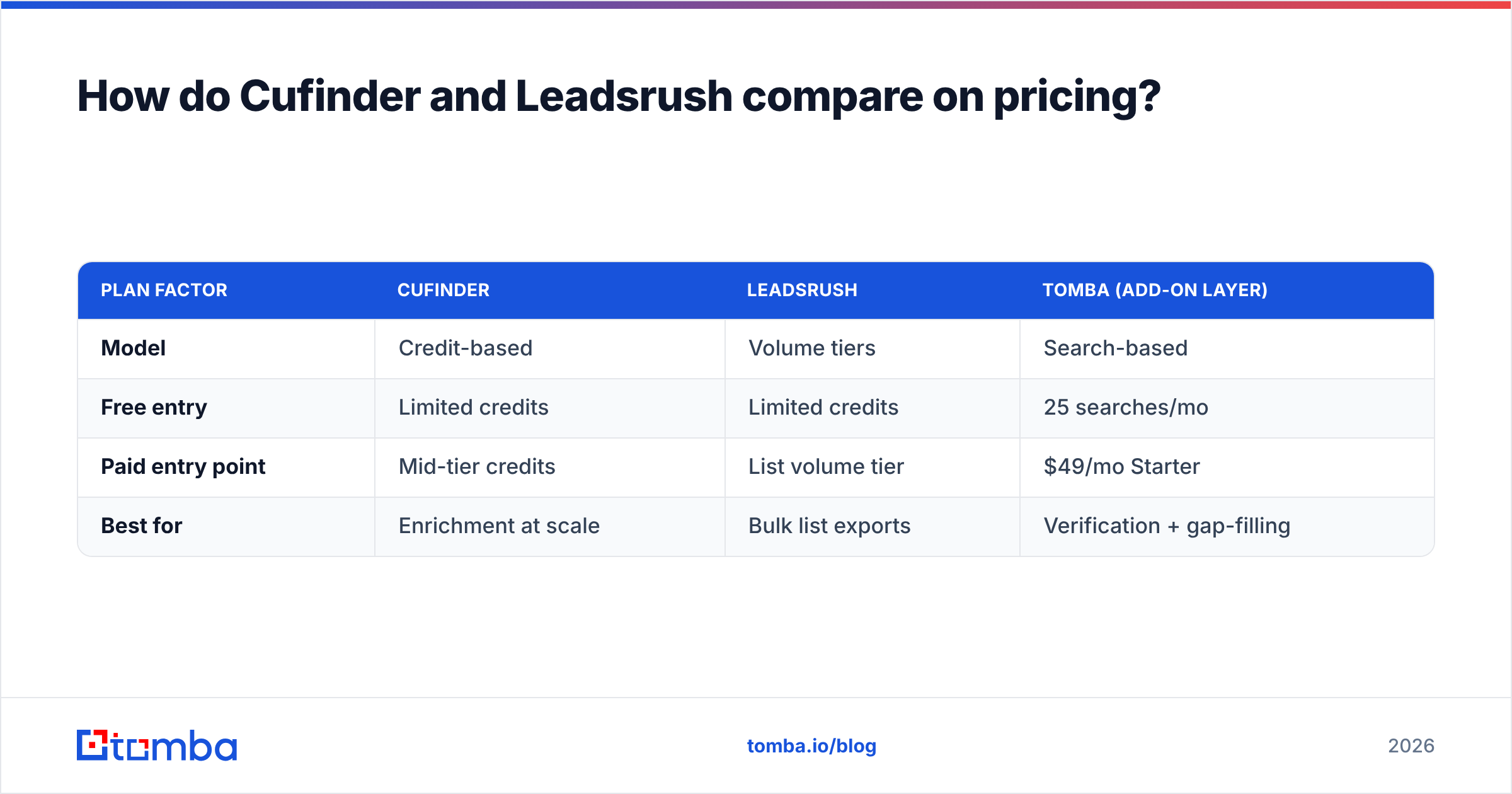
For reference, a dedicated finder like Tomba starts with a free tier of 25 searches per month, then Starter at $49/mo, Growth at $99/mo, and Pro at $249/mo — a straightforward layer you can bolt onto either platform to clean and extend what they give you.
| Plan factor | Cufinder | Leadsrush | Tomba (add-on layer) |
|---|---|---|---|
| Model | Credit-based | Volume tiers | Search-based |
| Free entry | Limited credits | Limited credits | 25 searches/mo |
| Paid entry point | Mid-tier credits | List volume tier | $49/mo Starter |
| Best for | Enrichment at scale | Bulk list exports | Verification + gap-filling |
Is Cufinder better than Leadsrush?#
It depends entirely on your job to be done — and here's the honest split:
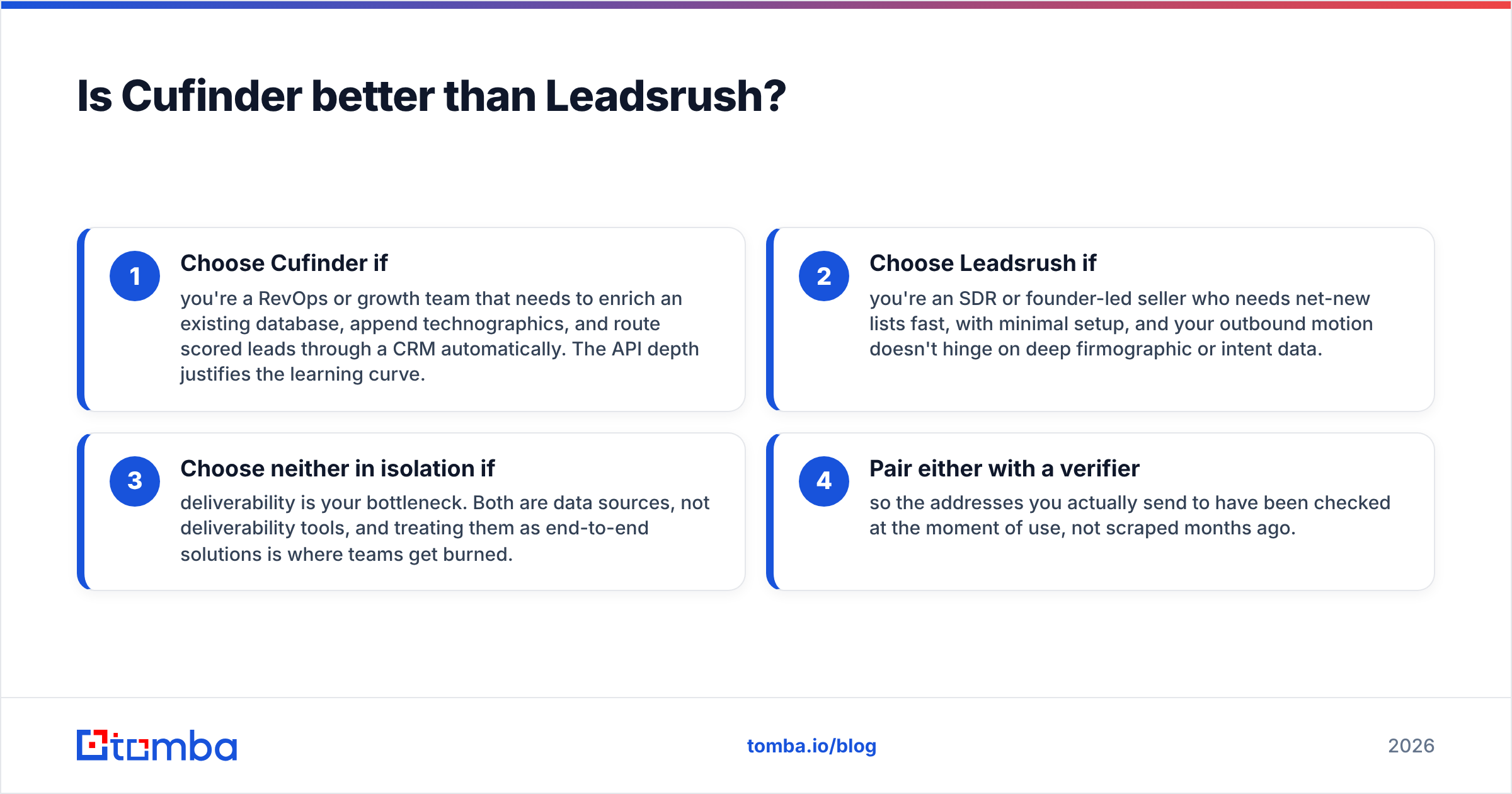
- Choose Cufinder if you're a RevOps or growth team that needs to enrich an existing database, append technographics, and route scored leads through a CRM automatically. The API depth justifies the learning curve.
- Choose Leadsrush if you're an SDR or founder-led seller who needs net-new lists fast, with minimal setup, and your outbound motion doesn't hinge on deep firmographic or intent data.
- Choose neither in isolation if deliverability is your bottleneck. Both are data sources, not deliverability tools, and treating them as end-to-end solutions is where teams get burned.
- Pair either with a verifier so the addresses you actually send to have been checked at the moment of use, not scraped months ago.
There's no universal winner here, and any post that declares one is selling you something. The winner is the tool that matches your motion — plus the verification step that both tools quietly assume you'll handle yourself.

Where does a dedicated email finder fit?#
Both Cufinder and Leadsrush are "top of funnel" data — they get you names and best-guess contact details at volume. What they don't specialize in is the last mile: confirming a specific person's email is real, deliverable, and current, right before you hit send.
That last mile is where bounce rates are decided. A focused tool like Tomba is built for exactly this: find email addresses for named prospects, verify them, and pull them into your workflow through the Tomba API or a spreadsheet add-on. Used alongside a broader platform, it acts as a quality gate — the difference between a list that lands and a list that gets you filtered.

It's worth noting that no single database wins on coverage everywhere. Providers like BookYourData built respected reputations on curated, human-verified B2B lists, and platforms differ by region and industry. That's the real lesson: coverage is uneven across every vendor, so verifying at the point of use beats betting everything on one source's accuracy claim.
How to verify accuracy claims before you buy#
Don't take any vendor's accuracy percentage at face value — including the ones in this article. Run the same small test against both tools:
- Pull the same 100-contact segment from Cufinder and Leadsrush for an ICP you know well.
- Verify both exports through an independent email verification pass and record the valid rate.
- Check overlap and gaps — how many contacts did only one tool find, and were the unique ones real?
- Send a small warmed batch and measure actual bounce and reply rates, not just the dashboard's promised numbers.
This costs you an afternoon and saves you a quarter of degraded deliverability. Public review sites like G2 and Capterra are useful for surfacing recurring complaints, but your own test on your own ICP is the only benchmark that counts.
The verdict#
Cufinder and Leadsrush solve adjacent problems: Cufinder is the enrichment platform for data-driven RevOps teams, and Leadsrush is the fast list builder for outbound sellers who value speed over depth. Pick based on your motion — enrichment and scoring, or quick net-new lists — not on a headline accuracy number.
But whichever you choose, treat it as a data source, not a deliverability guarantee. The teams that get the most out of either tool are the ones that add a verification and gap-filling layer on top, so every address they send to has been confirmed real at the moment it matters.
Ready to stop paying for bounces? Start with the Tomba Email Finder — find and verify professional emails by name, domain, or company, test it free with 25 searches a month, and use it as the quality gate that makes your Cufinder or Leadsrush exports actually deliver.
Related guides#
Ready to find emails that actually work?
Join 150,000+ professionals who stopped guessing and started sending. Free credits on signup — no credit card required.
Get the Tomba newsletter
Practical outbound tactics and product updates — once every two weeks.
About the author