Cufinder vs Postaga (2026): Which B2B Sales Tool Wins?
Cufinder finds B2B data; Postaga runs cold outreach. We compare accuracy, features, pricing, and use cases to show which one fits your sales stack in 2026.
Cufinder and Postaga get lumped together as "sales tools," but they solve two different halves of the same problem. One builds your list. The other works your list. Picking between them without knowing which half you're missing is how teams end up paying for software they barely touch.
This comparison breaks down what each tool actually does, where the accuracy and pricing land, and which one belongs in your stack in 2026.
TL;DR — Cufinder vs Postaga at a glance#
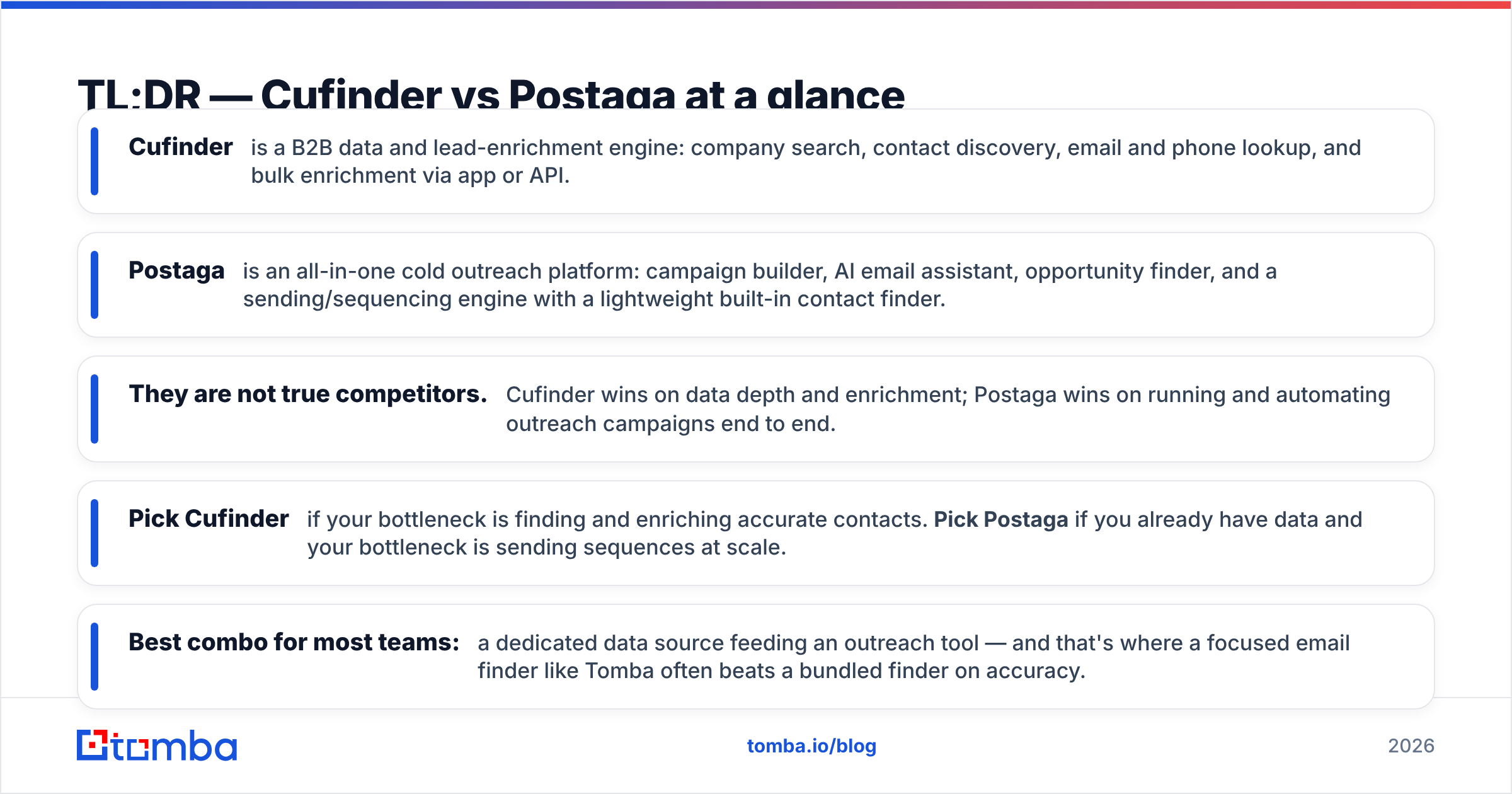
- Cufinder is a B2B data and lead-enrichment engine: company search, contact discovery, email and phone lookup, and bulk enrichment via app or API.
- Postaga is an all-in-one cold outreach platform: campaign builder, AI email assistant, opportunity finder, and a sending/sequencing engine with a lightweight built-in contact finder.
- They are not true competitors. Cufinder wins on data depth and enrichment; Postaga wins on running and automating outreach campaigns end to end.
- Pick Cufinder if your bottleneck is finding and enriching accurate contacts. Pick Postaga if you already have data and your bottleneck is sending sequences at scale.
- Best combo for most teams: a dedicated data source feeding an outreach tool — and that's where a focused email finder like Tomba often beats a bundled finder on accuracy.
What is Cufinder?#
Cufinder is a lead generation and data enrichment platform. Its core job is turning a thin input — a company name, a domain, a LinkedIn URL — into a full contact record: verified work email, phone number, job title, company size, tech stack, and firmographics.
You interact with it three ways: a web app for manual lookups, bulk CSV enrichment for lists you already have, and an API for pushing enrichment into your own product or CRM. Sales, marketing, and RevOps teams use it to fill gaps in messy records before those records ever reach a sequence.
The pitch is simple: better inputs mean better outreach. If half your list bounces or lands on the wrong buyer, no amount of clever copy saves the campaign.

What is Postaga?#
Postaga is a cold outreach and link-building platform. It's built around campaigns, not records. You define a target, Postaga's "opportunity finder" surfaces prospects and relevant angles, its AI assistant drafts personalized emails, and its sequencing engine sends follow-ups on autopilot until someone replies.
It includes a contact-finder step so you can grab an email inside the same workflow, but that finder is a convenience feature bolted onto an outreach product — not a standalone data engine. Postaga's strength is orchestration: connecting your mailbox, personalizing at volume, and tracking opens, clicks, and replies in one place.
Agencies and founders doing content promotion, backlink outreach, and cold sales like Postaga because it collapses five tools into one dashboard.
Cufinder vs Postaga: the core difference#
Here's the cleanest way to think about it — one tool feeds the pipeline, the other runs it:
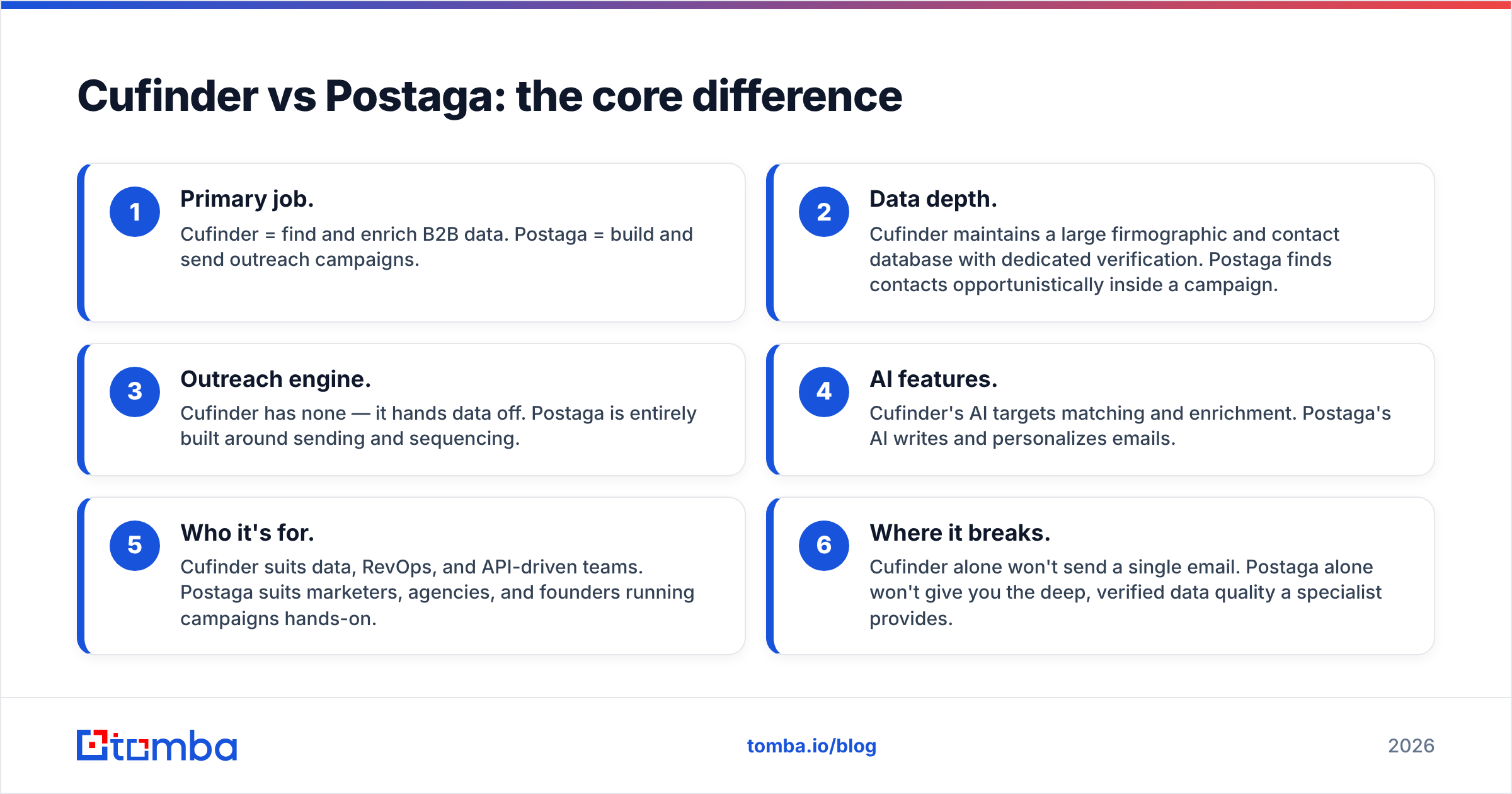
- Primary job. Cufinder = find and enrich B2B data. Postaga = build and send outreach campaigns.
- Data depth. Cufinder maintains a large firmographic and contact database with dedicated verification. Postaga finds contacts opportunistically inside a campaign.
- Outreach engine. Cufinder has none — it hands data off. Postaga is entirely built around sending and sequencing.
- AI features. Cufinder's AI targets matching and enrichment. Postaga's AI writes and personalizes emails.
- Who it's for. Cufinder suits data, RevOps, and API-driven teams. Postaga suits marketers, agencies, and founders running campaigns hands-on.
- Where it breaks. Cufinder alone won't send a single email. Postaga alone won't give you the deep, verified data quality a specialist provides.
Read that list and the "vs" mostly dissolves. The real question is which gap you're filling.
How do Cufinder and Postaga compare on features and pricing?#
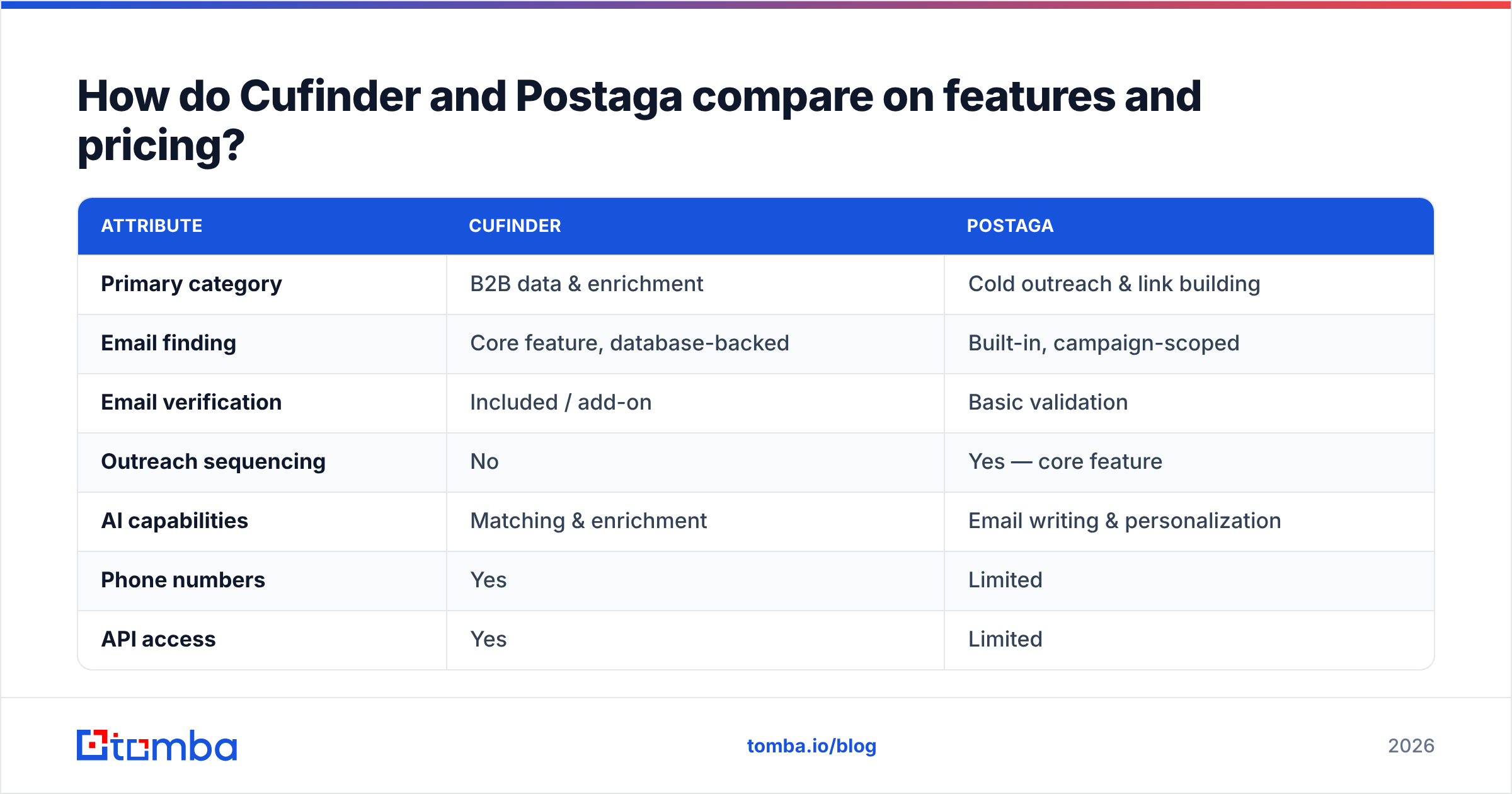
The table below lines up the attributes that actually change a buying decision. Treat pricing as directional — both vendors adjust tiers and credit limits, so confirm current numbers on their sites before you commit.
| Attribute | Cufinder | Postaga |
|---|---|---|
| Primary category | B2B data & enrichment | Cold outreach & link building |
| Email finding | Core feature, database-backed | Built-in, campaign-scoped |
| Email verification | Included / add-on | Basic validation |
| Outreach sequencing | No | Yes — core feature |
| AI capabilities | Matching & enrichment | Email writing & personalization |
| Phone numbers | Yes | Limited |
| API access | Yes | Limited |
| Bulk enrichment | Yes | No (campaign lists) |
| Best for | Data, RevOps, developers | Agencies, founders, marketers |
| Free option | Limited free tier | Free trial |
| Entry paid pricing | ~$49/mo range | ~$49/mo range |
Both land in a similar entry price bracket, so cost rarely decides this. What decides it is whether you're paying for data or for a sending engine — and paying a data tool to send email (or an outreach tool to be your source of truth) is where budgets leak.
If you want a neutral third-party read on how these platforms stack up beyond the vendor pages, G2 carries user reviews for both categories and is worth 10 minutes before you buy.
Which tool is more accurate?#
Accuracy is Cufinder's home turf, and it's the single biggest reason not to lean on Postaga's built-in finder as your primary data source.
A dedicated data platform verifies contacts against multiple signals and re-checks them over time, so bounce rates stay low. A finder embedded in an outreach tool is optimized for "good enough to send now," which is fine occasionally and expensive at scale. Every bounced send chips away at your sender reputation, and once that drops, even your valid emails start hitting spam.
That's why many teams run outreach and data as separate best-in-class layers: a verification-first source builds and cleans the list, the outreach tool sends it. Pairing an email verifier with your finder before a campaign is the cheapest insurance you can buy against a wrecked domain.

When should you choose Cufinder?#
Choose Cufinder when the missing piece is data, not delivery:
- You already have an outreach tool (Instantly, Smartlead, Lemlist, your CRM sequencer) and just need cleaner, richer contacts feeding it.
- You enrich in bulk — uploading lists of hundreds or thousands of accounts and needing emails, phones, and firmographics back.
- You're building on an API and want enrichment inside your own app, workflow, or data enrichment pipeline.
- Phone numbers matter because your motion includes cold calling, not just email.
If your reps have plenty of targets but half the records are incomplete or stale, Cufinder-class tooling is the fix.
When should you choose Postaga?#
Choose Postaga when the missing piece is the campaign machine:
- You run content promotion or link building and need to find opportunities, pitch angles, and sequence follow-ups in one place.
- You're a founder or small agency who wants one dashboard instead of stitching a finder, a writer, and a sender together.
- AI-assisted personalization at volume is your priority and you're comfortable with "good enough" contact data for warm-ish targets.
- You value speed to first campaign over deep, verified data quality.
If you have a source of contacts (or a modest volume where perfect data matters less) and your real pain is sending and tracking, Postaga earns its seat.
Can you use both together?#
Yes — and for many teams that's the honest answer. Use a data layer to build and verify the list, then push it into an outreach layer to run the campaign. Cufinder-style enrichment plus Postaga-style sequencing is a legitimate stack.
But before you buy two subscriptions, ask whether the data half is best served by either bundled finder. A specialist source usually wins on accuracy and price-per-verified-contact. Options like BookYourData for pre-built lists, or a self-serve finder for on-demand lookups, can slot in as the data layer that feeds whichever outreach tool you prefer.
The stack that works looks like this: specialist data in → clean list → outreach engine out. Skip any layer and you feel it in bounce rates or reply rates.
Where does Tomba fit in this comparison?#
Tomba sits on the data side of this debate — the layer that feeds outreach tools like Postaga rather than replacing them.
If your bottleneck is Cufinder's territory (finding and verifying professional emails accurately), Tomba is a direct, focused alternative built around that one job. You can find email addresses by name or company, run domain search to pull every contact at an account, verify before you send, and enrich in bulk or via API — then hand a clean list to whatever sequencer you already love.
| Need | Reach for |
|---|---|
| Deep, verified B2B data | Cufinder or a specialist finder |
| Run & automate campaigns | Postaga |
| Accurate emails to feed any tool | Tomba Email Finder |
| Cheapest verified-contact cost | Dedicated data source |
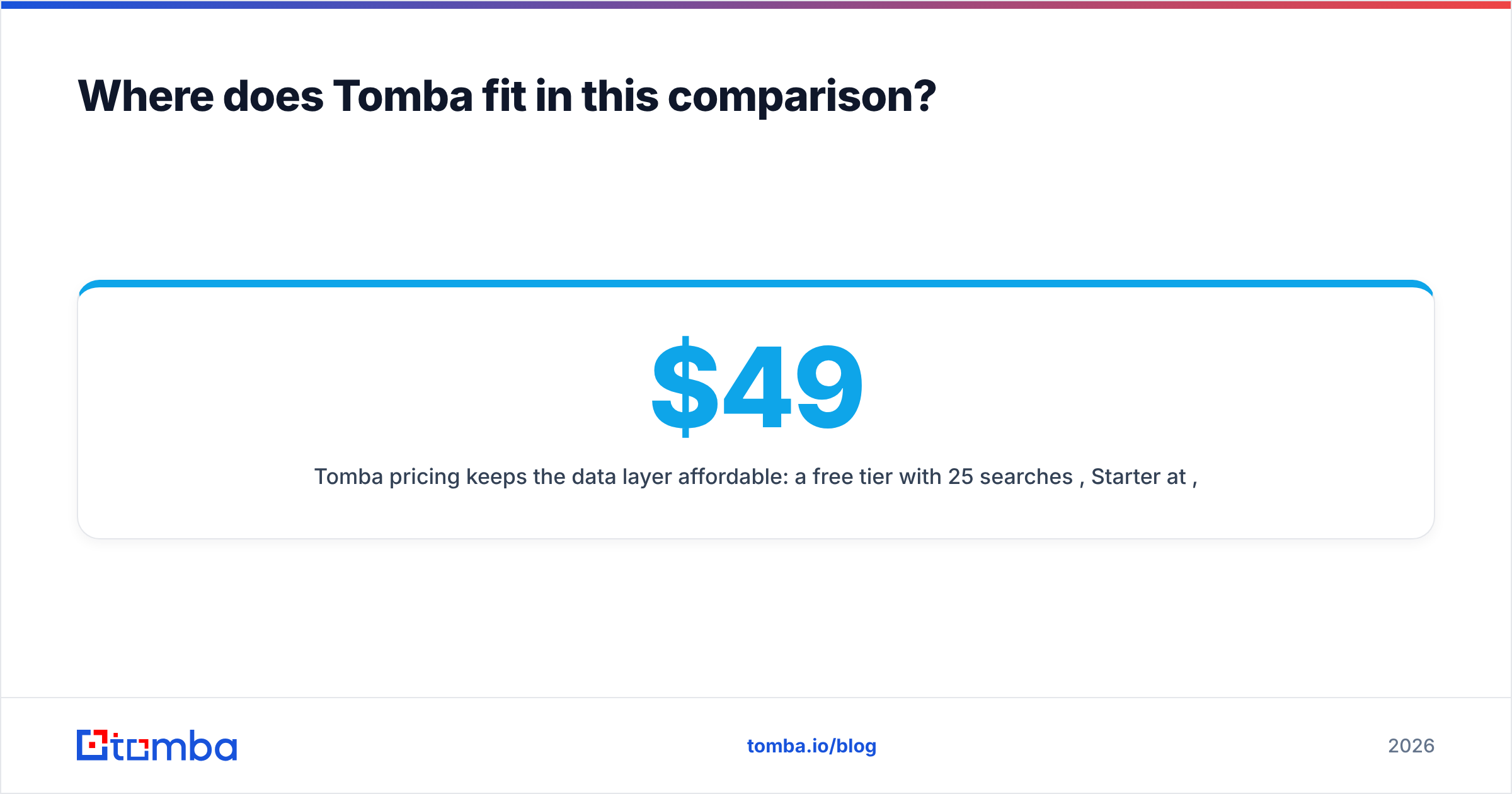
Tomba pricing keeps the data layer affordable: a free tier with 25 searches/month, Starter at $49/mo, Growth at $99/mo, and Pro at $249/mo — see full Tomba pricing for the current credit limits. That means you can run best-in-class data without doubling your outreach budget.
The verdict: Cufinder vs Postaga#
There's no single winner because they're not really fighting for the same job. Cufinder wins the data war; Postaga wins the outreach war. Match the tool to your actual gap: if records are your problem, buy data; if sending is your problem, buy an outreach engine; and if you're honest, you probably need one of each.
Where you can save money and protect your domain is by refusing to overpay a bundled finder for data quality it wasn't built to deliver. Feed your outreach a verification-first source, and every downstream metric — bounce rate, deliverability, reply rate — moves in your favor.
Ready to fix the data half without a bloated all-in-one? Start free with the Tomba Email Finder — find and verify professional emails by name, company, or domain, then push a clean list straight into Postaga, your CRM, or any sequencer. Twenty-five searches a month, no card required, and accuracy your campaigns can actually trust.
Related guides#
Ready to find emails that actually work?
Join 150,000+ professionals who stopped guessing and started sending. Free credits on signup — no credit card required.
Get the Tomba newsletter
Practical outbound tactics and product updates — once every two weeks.
About the author