Cufinder vs Stirista (2026): B2B Data & Email Finder Compared
Cufinder and Stirista both promise B2B contact data, but they serve very different buyers. See how the two compare on accuracy, pricing, coverage, and fit — and where a verification-first finder beats both.
Choosing between Cufinder and Stirista feels harder than it should, because they look similar on a feature grid but solve different problems. One is a self-serve B2B enrichment and email-finder platform. The other is an enterprise data and identity marketing company built around large audience files and omnichannel campaigns. Picking the wrong one wastes budget and stalls your pipeline.
This comparison breaks down what each tool actually does, who it fits, how they price, and where an accuracy-first email finder is the smarter buy for outbound teams that live and die by deliverability.
TL;DR: Cufinder vs Stirista in 30 seconds#
- Cufinder is a self-serve B2B data platform — company and contact enrichment, email finding, and API access aimed at sales and growth teams.
- Stirista is an enterprise data and identity-resolution provider focused on audience building, CTV, programmatic, and omnichannel marketing at scale.
- Buyer fit differs sharply: Cufinder suits SDRs and RevOps building targeted lists; Stirista suits enterprise marketers running paid media campaigns.
- Accuracy is the real battleground. Neither is built primarily around real-time email verification, which is where cold outbound quietly bleeds bounce rate.
- The pragmatic pick for outbound teams is a verification-first finder like Tomba Email Finder with an SMTP-checked API and transparent Tomba pricing.
What is Cufinder?#
Cufinder is a B2B lead generation and data enrichment platform. You feed it a company name, domain, or partial contact detail, and it returns enriched records — company firmographics, contact roles, emails, and phone numbers. It leans self-serve: sign up, run lookups in the dashboard, or wire the API into your stack.
The core use cases are list building, CRM enrichment, and appending missing fields to records you already own. It markets a large database of companies and contacts, plus a chain of "AI" enrichment tools that convert one data point (say, a company name) into others (domain, LinkedIn, email pattern).
Where Cufinder fits: a growth or sales team that wants to turn a thin lead list into something workable without a six-figure data contract. Where it strains: teams that need every email individually SMTP-verified before send, or that need audience activation across ad platforms.
What is Stirista?#
Stirista is an enterprise data company with identity resolution at its center. Instead of self-serve email lookups, it builds and licenses audience datasets, resolves identities across channels, and powers omnichannel campaigns — email, display, connected TV (CTV), and programmatic.
Stirista's buyer is usually a mid-market or enterprise marketing team, an agency, or a media buyer who needs large, targetable audiences and the pipes to activate them. Think campaign scale and reach, not one-off contact lookups for a 40-account outbound sequence.
That focus is a strength for paid media and a mismatch for a two-person SDR team. Stirista is priced, packaged, and supported like an enterprise platform, with sales-led onboarding rather than a credit-card checkout.

Cufinder vs Stirista: the core differences#
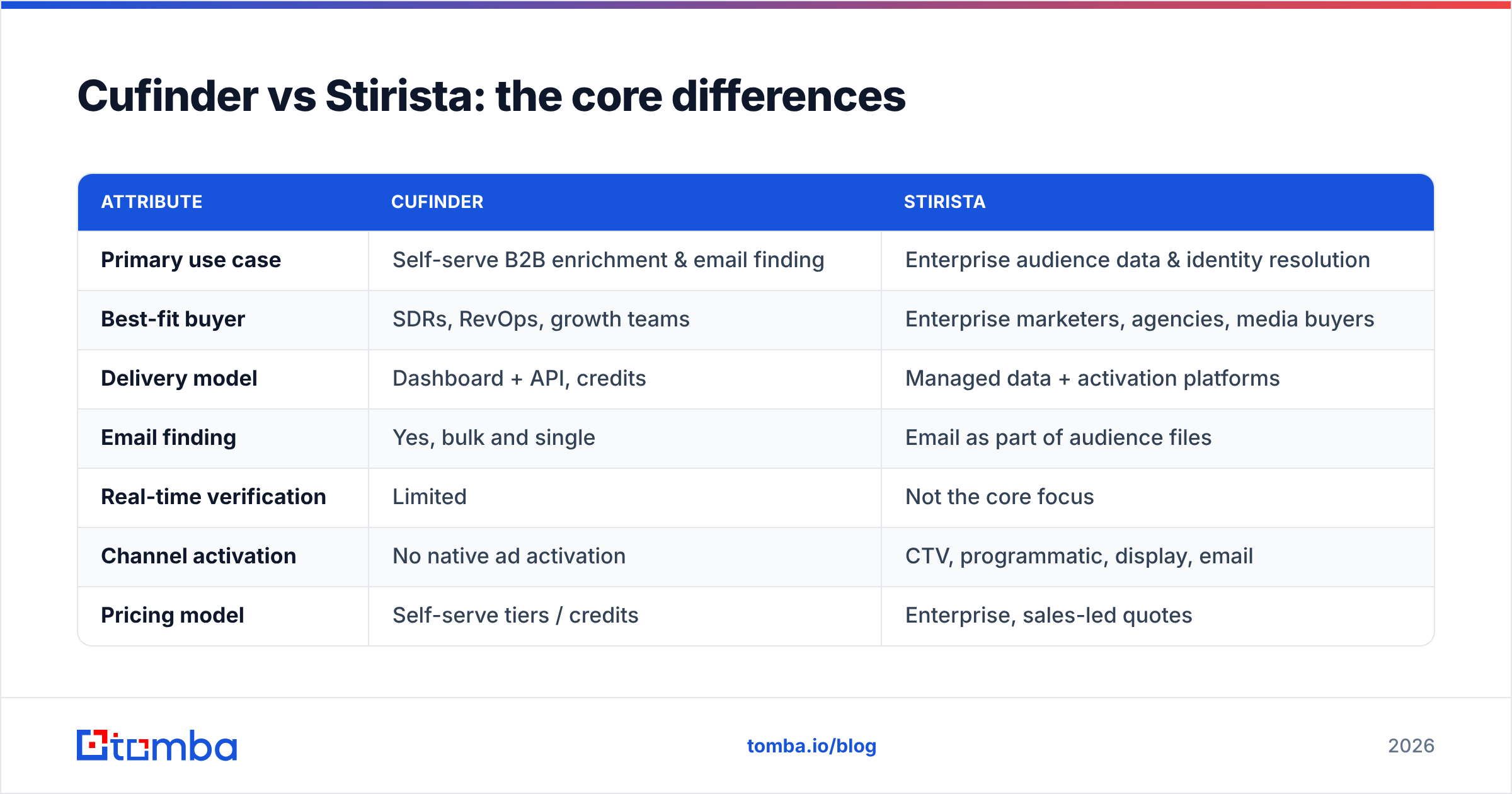
The fastest way to see the gap is to line them up on the attributes that actually change your results. The section below feeds our diagram renderer, so read it as the at-a-glance verdict.
| Attribute | Cufinder | Stirista |
|---|---|---|
| Primary use case | Self-serve B2B enrichment & email finding | Enterprise audience data & identity resolution |
| Best-fit buyer | SDRs, RevOps, growth teams | Enterprise marketers, agencies, media buyers |
| Delivery model | Dashboard + API, credits | Managed data + activation platforms |
| Email finding | Yes, bulk and single | Email as part of audience files |
| Real-time verification | Limited | Not the core focus |
| Channel activation | No native ad activation | CTV, programmatic, display, email |
| Pricing model | Self-serve tiers / credits | Enterprise, sales-led quotes |
| Onboarding | Instant signup | Sales-led |
Read the table as a fork in the road: Cufinder is a tool you operate; Stirista is a data partner you contract with. If your day is "find and verify contacts for a campaign I'm running this week," Cufinder is in the right category. If your day is "build a 4-million-record CTV audience and activate it," that is Stirista's world.
Which one is more accurate for cold outbound?#
Accuracy is the metric that decides whether cold outbound works, and it is where both tools deserve scrutiny. A returned email address is only useful if it is deliverable. Every invalid address you send to damages your sender reputation and pushes future messages toward spam.
Cufinder returns emails, but its verification is not the loud, central promise of the product — it is one feature among many enrichment outputs. Stirista's emails live inside audience files built for campaign reach, where a small bounce percentage across millions of records is treated differently than in a hand-built 200-lead SDR list.
For targeted outbound, you want a finder that pairs discovery with a real SMTP check on the address before it ever reaches your sequence. That is a different design goal than "enrich as many fields as possible" or "assemble the largest audience." It is why many outbound teams run a dedicated email verifier as a mandatory step, regardless of where the address came from.

The practical takeaway: treat any single-source email — from Cufinder, Stirista, or anyone else — as a candidate, not a verified send. Verification-first tooling collapses discovery and validation into one step so you are not stitching two vendors together.
How do Cufinder and Stirista price?#
Pricing philosophy is the cleanest tell of who each tool is for.
- Cufinder uses self-serve, credit-based tiers. You can start small, scale up, and predict cost per lookup. That transparency suits teams that want to try before committing.
- Stirista is quote-driven and enterprise-oriented. You talk to sales, scope your audience and channels, and get a contract. That model fits large campaign budgets, not a solo prospector.
- Neither publishes a one-size price that maps cleanly to "cost per verified email," which is the number outbound teams actually care about.
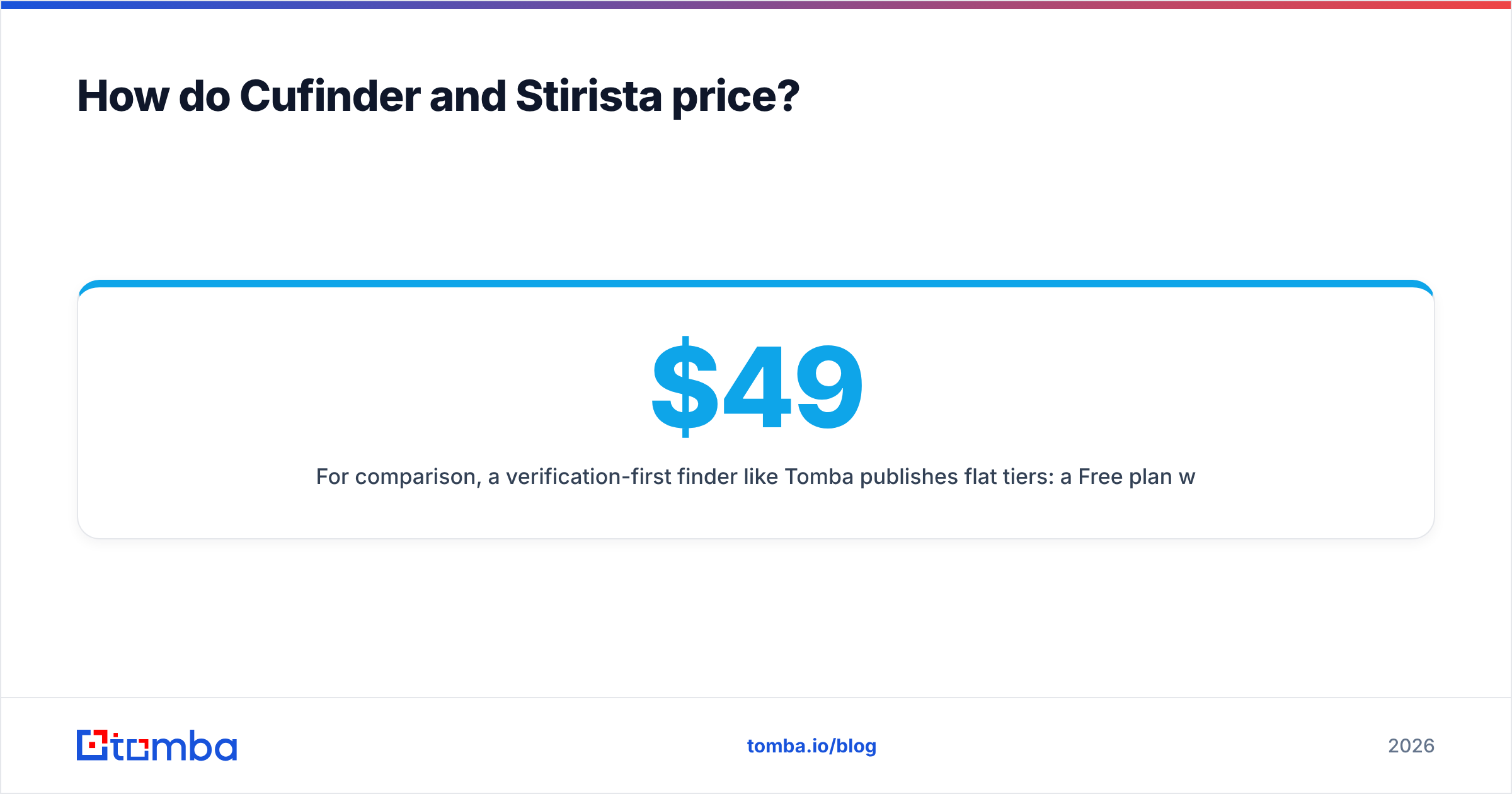
For comparison, a verification-first finder like Tomba publishes flat tiers: a Free plan with 25 searches per month, Starter at $49/mo, Growth at $99/mo, and Pro at $249/mo, with Enterprise custom. You can see the full breakdown on the Tomba plans page. The point is not that cheaper always wins — it is that you can calculate your true cost per usable contact before you commit a dollar.
When should you pick Cufinder over Stirista?#
Choose Cufinder when:
- You run sales-led outbound, not paid-media campaigns, and need contacts by company or role.
- You want self-serve — instant signup, credits, no procurement cycle.
- You enrich a CRM and need to append firmographics or missing fields at moderate volume.
- Your team is small-to-mid and a full enterprise data contract is overkill.
Choose Stirista when:
- You buy media at scale — CTV, programmatic, and display are core to your plan.
- You need identity resolution across channels and devices, not single lookups.
- You have enterprise budget and a marketing ops team to operate a managed data partnership.
- Audience reach matters more than per-contact hand-verification.
If you read those two lists and neither fully fits — because what you actually need is accurate, verified emails for targeted outbound — that is the signal to look at a purpose-built email finder instead of forcing a marketing-data platform or a broad enrichment suite into an outbound role.
Where a verification-first finder beats both#
Most outbound problems trace back to one thing: bad addresses that never should have been sent. A finder built around verification changes the economics because you stop paying — in reputation and reply rate — for guesses.
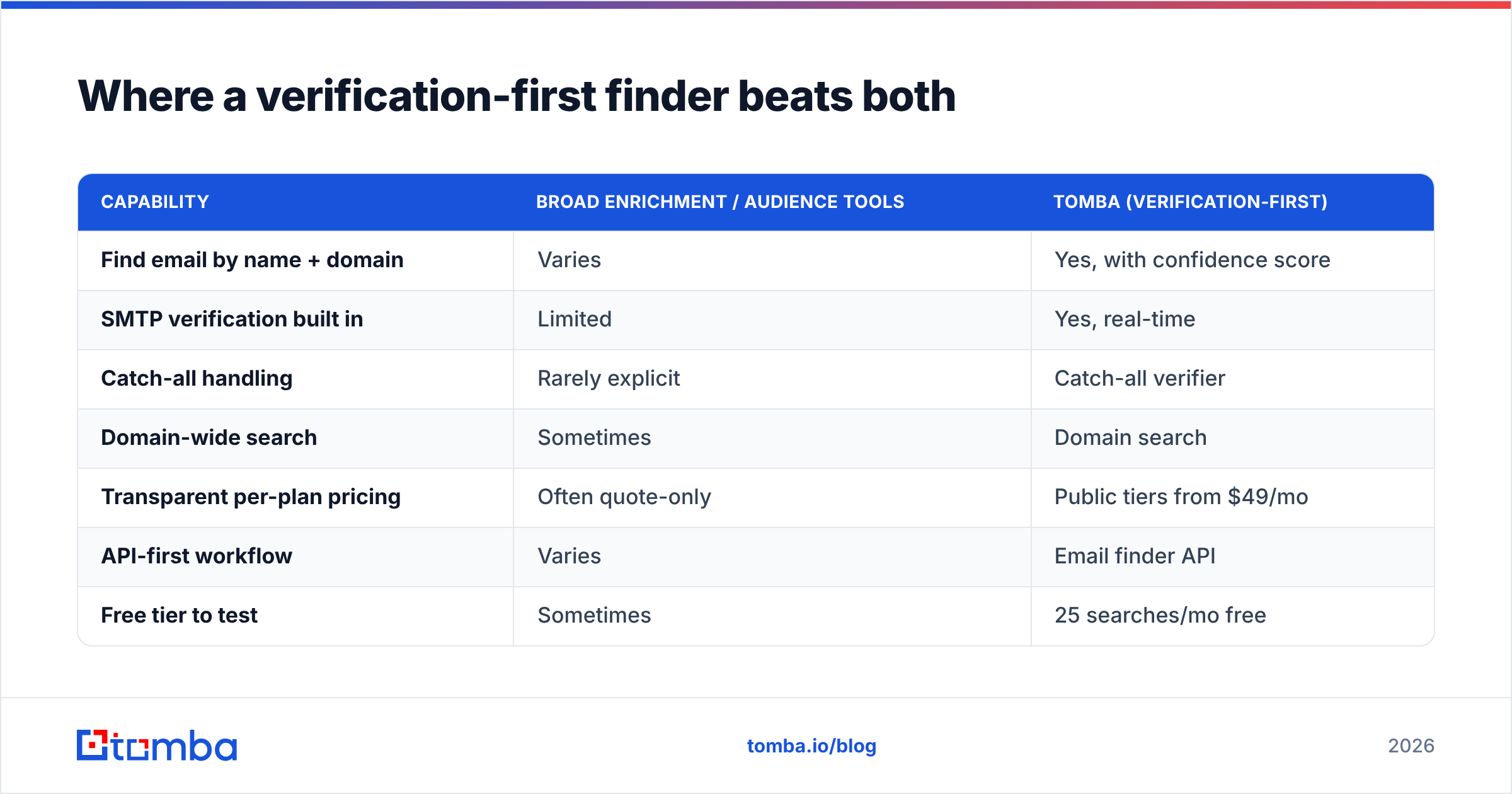
Here is how a focused stack compares to using either Cufinder or Stirista alone for outbound:
| Capability | Broad enrichment / audience tools | Tomba (verification-first) |
|---|---|---|
| Find email by name + domain | Varies | Yes, with confidence score |
| SMTP verification built in | Limited | Yes, real-time |
| Catch-all handling | Rarely explicit | Catch-all verifier |
| Domain-wide search | Sometimes | Domain search |
| Transparent per-plan pricing | Often quote-only | Public tiers from $49/mo |
| API-first workflow | Varies | Email finder API |
| Free tier to test | Sometimes | 25 searches/mo free |
The workflow that keeps bounce rates low is simple: find the address, verify it in the same call, and only then push it into your sequencing tool. Because Tomba exposes this through an email finder API, you can bake it directly into the moment a lead enters your CRM, so no unverified address ever reaches a mailbox.
That does not make Cufinder or Stirista "bad." It means they are optimized for different jobs — enrichment breadth and audience scale, respectively — and outbound deliverability is a job with its own best tool.
How to actually decide#
Run a small, honest test before you sign anything.
- Take 100 real target accounts you'd genuinely email.
- Pull contacts from each candidate tool for the same accounts.
- Verify every returned email with an independent email verification pass.
- Score by valid, deliverable emails — not raw record count.
- Divide cost by verified contacts to get your true unit price.
That single spreadsheet will tell you more than any feature list. Vendors compete on database size; your campaign competes on deliverable addresses. Optimize for the second number.
For a broader view of how the major finders stack up on exactly this metric, this independent breakdown is worth a look:

The verdict#
If you're an enterprise marketer running omnichannel paid media, Stirista is the natural fit — identity resolution and audience activation are its home turf, and no self-serve finder replaces that. You can evaluate its positioning directly on the Stirista site and read peer reviews on G2.
If you're a sales or growth team building targeted lists, Cufinder is the more sensible starting point than an enterprise data contract — self-serve, credit-based, and quick to try.
But if your core job is cold outbound that lands in the inbox, neither is built around the metric that decides your results: verified deliverability. That is where a focused tool wins.
Start free with Tomba Email Finder — find professional emails by name, domain, or company, verify them in the same step, and only send to addresses that actually exist. You get 25 searches a month at no cost, transparent pricing as you scale, and an API that drops verification straight into your workflow. Run the 100-account test above, compare your cost per verified contact, and let the deliverable numbers pick the winner.
Related guides#
Ready to find emails that actually work?
Join 150,000+ professionals who stopped guessing and started sending. Free credits on signup — no credit card required.
Get the Tomba newsletter
Practical outbound tactics and product updates — once every two weeks.
About the author