Cufinder vs The Data City (2026): B2B Data Platforms Compared
Cufinder and The Data City both sell B2B data, but they solve different problems. Here's an honest breakdown of coverage, accuracy, pricing, and which one fits your GTM stack in 2026.
Choosing between Cufinder and The Data City feels harder than it should, because the two tools get lumped into the same "B2B data" bucket while actually solving very different jobs. This guide cuts through that. You will see where each platform is strong, where each falls short, and how to decide without burning a month of trial credits.
TL;DR — Cufinder vs The Data City at a glance#
- Cufinder is a contact-and-company enrichment engine: emails, phone numbers, firmographics, and API lookups aimed at sales and outbound teams worldwide.
- The Data City is a UK-focused market-intelligence platform that maps companies into emerging sectors and real-time economy data, aimed at analysts, economic-development bodies, and researchers.
- If your goal is finding and reaching contacts, Cufinder is the closer fit; if your goal is understanding markets and sectors, The Data City wins.
- Neither is a pure email-finder specialist, so accuracy on verified business emails is worth testing before you commit.
- For teams whose core need is verified email discovery, a dedicated tool like the Tomba Email Finder often beats a generalist on cost-per-valid-contact.
What is Cufinder?#
Cufinder is a B2B lead generation and data enrichment platform. Its pitch is breadth: you feed it a company name, domain, or a person's details, and it returns enriched records — business emails, direct and mobile phone numbers, company size, industry, technologies used, and social profiles. It ships a web app, bulk CSV enrichment, a Chrome extension, and an API for teams that want to wire enrichment into their own systems.
The audience is outbound sales, recruiters, and marketers who need contact data at volume. Cufinder leans on a large aggregated database plus real-time lookups, and it prices around credit bundles that scale with usage. You can review third-party impressions on G2 before trialing, since self-reported coverage numbers rarely survive contact with your actual target accounts.
The honest caveat: generalist enrichment tools optimize for coverage (return something for as many records as possible) rather than precision (return only data you can trust). That trade-off matters most on email, where a wrong address quietly damages your sender reputation.

What is The Data City?#
The Data City is a fundamentally different animal. It is a UK-centric real-time economy and market-mapping platform. Instead of handing you a lead's mobile number, it classifies companies into emerging and traditional sectors using its "Real-Time Industrial Classification" (RTICs) approach, drawing on website text, Companies House filings, and other public signals.
Its users are economists, policy teams, economic-development agencies, investors, and strategy analysts who need to answer questions like "how big is the UK's quantum-computing sector, and which firms are in it?" You can explore the methodology on the official The Data City site. This is deep, defensible market intelligence — but it is not built to power a cold-email sequence to 5,000 contacts.
So the first decision is not "which tool is better" but "which job am I hiring a tool to do." Contact acquisition and sector analysis are different products that happen to share the words "B2B data."
Cufinder vs The Data City: full comparison table#
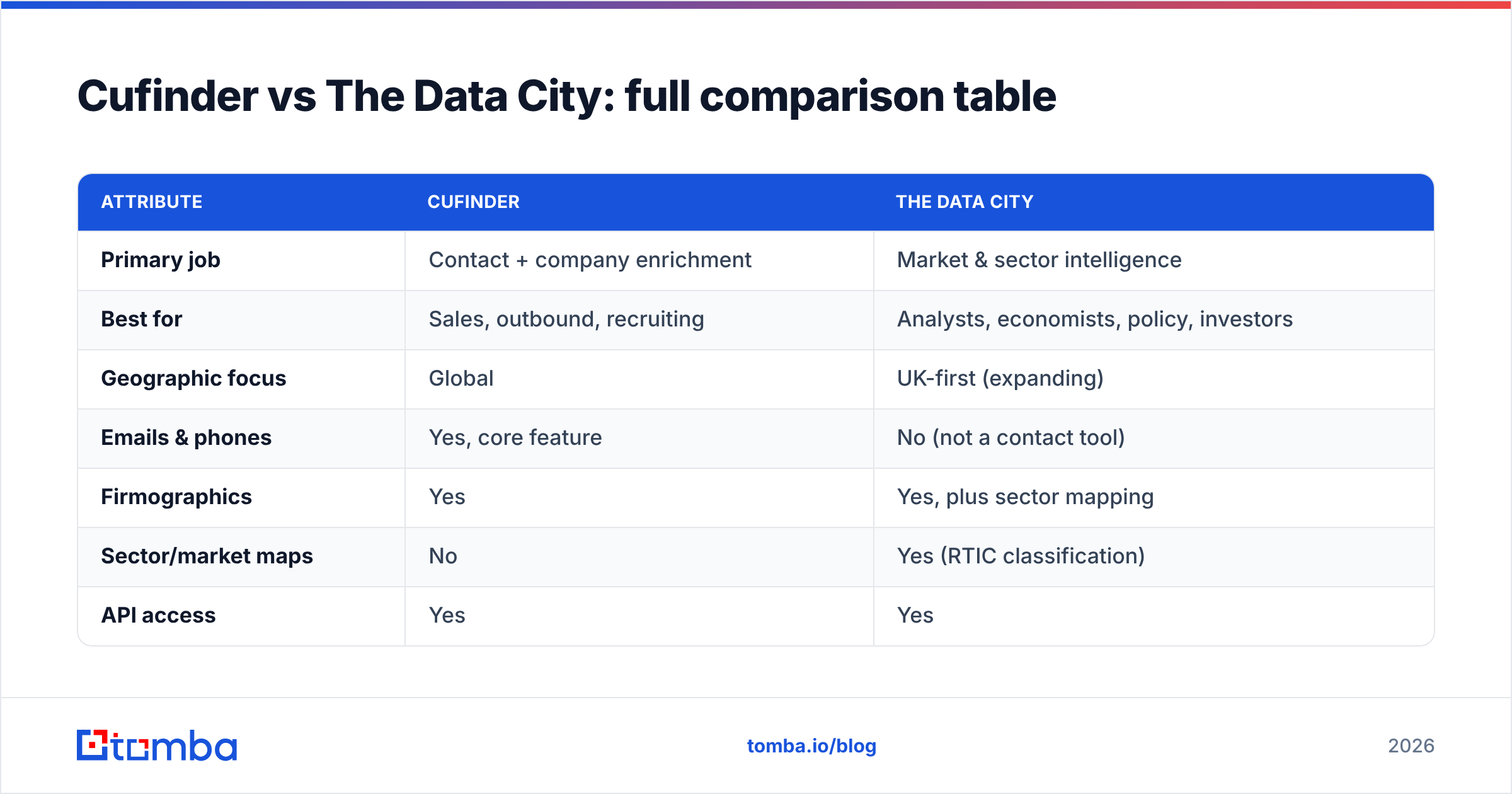
| Attribute | Cufinder | The Data City |
|---|---|---|
| Primary job | Contact + company enrichment | Market & sector intelligence |
| Best for | Sales, outbound, recruiting | Analysts, economists, policy, investors |
| Geographic focus | Global | UK-first (expanding) |
| Emails & phones | Yes, core feature | No (not a contact tool) |
| Firmographics | Yes | Yes, plus sector mapping |
| Sector/market maps | No | Yes (RTIC classification) |
| API access | Yes | Yes |
| Bulk enrichment | Yes (CSV) | Data exports / dashboards |
| Typical buyer | GTM / RevOps teams | Research & strategy teams |
| Free/trial option | Limited free credits | Demo-led, custom |
The table makes the split obvious: there is very little head-to-head feature overlap. The overlap that exists — firmographics and company records — is where you should focus any bake-off.
Which one is more accurate for B2B data?#
Accuracy depends entirely on the data type you care about.
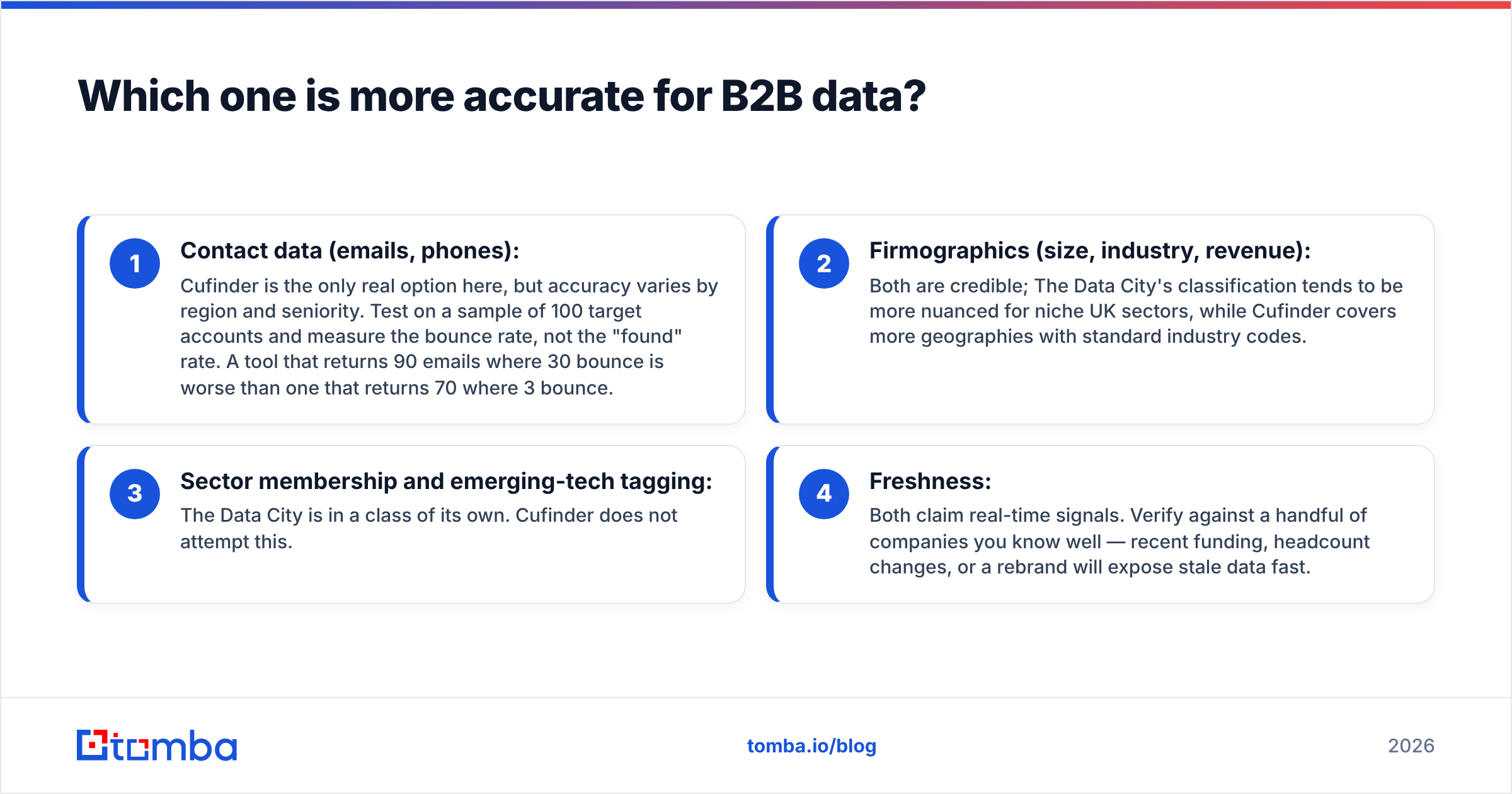
- Contact data (emails, phones): Cufinder is the only real option here, but accuracy varies by region and seniority. Test on a sample of 100 target accounts and measure the bounce rate, not the "found" rate. A tool that returns 90 emails where 30 bounce is worse than one that returns 70 where 3 bounce.
- Firmographics (size, industry, revenue): Both are credible; The Data City's classification tends to be more nuanced for niche UK sectors, while Cufinder covers more geographies with standard industry codes.
- Sector membership and emerging-tech tagging: The Data City is in a class of its own. Cufinder does not attempt this.
- Freshness: Both claim real-time signals. Verify against a handful of companies you know well — recent funding, headcount changes, or a rebrand will expose stale data fast.
For email specifically, the safest workflow is to treat any generalist tool's output as unverified until a dedicated email verifier confirms deliverability. Enrichment coverage and email deliverability are two different metrics, and vendors love to blur them.

Pricing: how do Cufinder and The Data City compare?#
Pricing philosophy differs as much as the products.
- Cufinder uses credit-based tiers. You buy a monthly bundle of enrichment/lookup credits, and heavier use pushes you up the plans. This is predictable for steady outbound volume but can spike when you run large bulk jobs.
- The Data City is enterprise/subscription and demo-led. Because it sells to institutions and strategy teams, pricing is quote-based and typically annual, reflecting seat count and data scope rather than per-lookup credits.
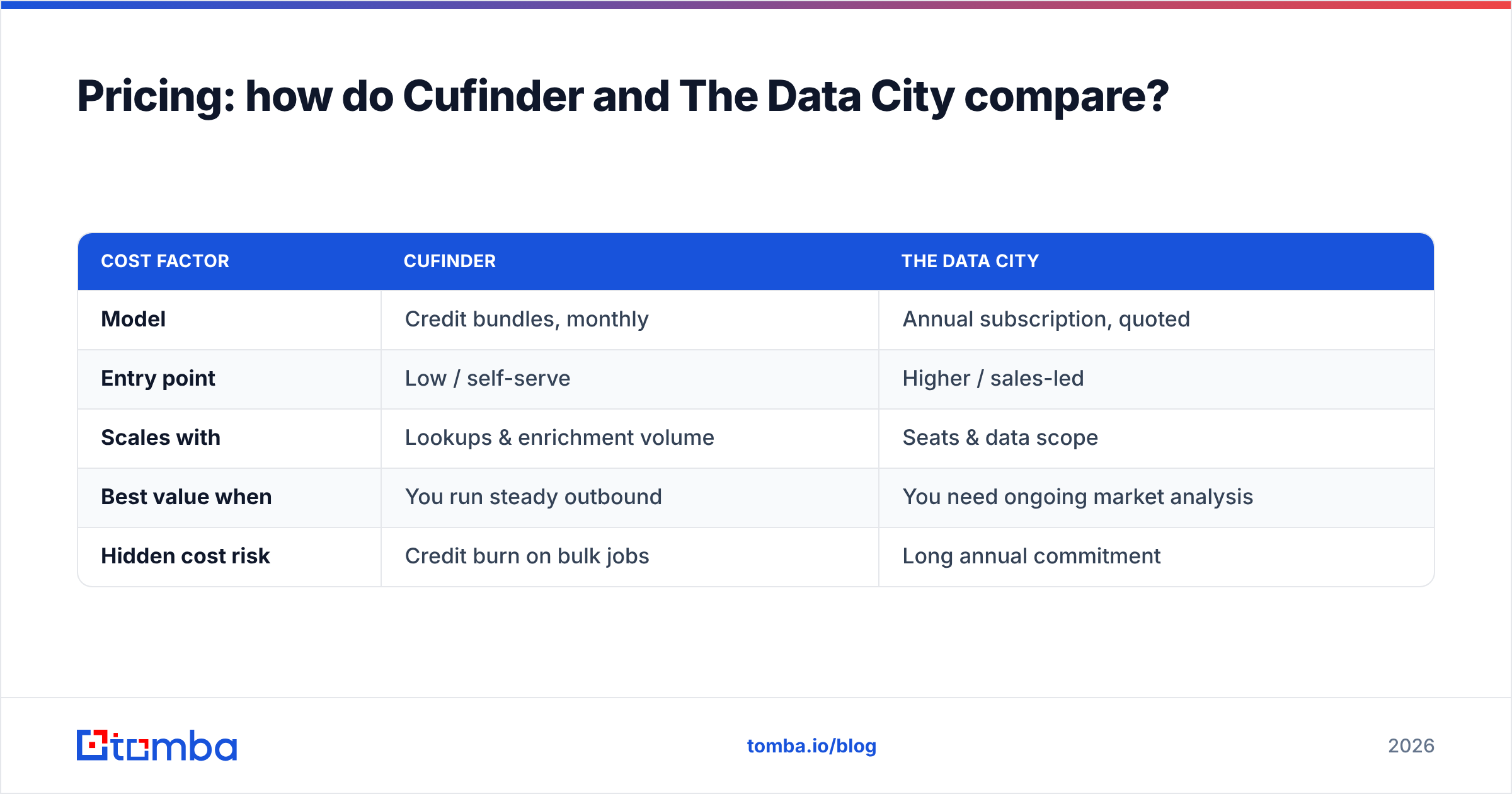
| Cost factor | Cufinder | The Data City |
|---|---|---|
| Model | Credit bundles, monthly | Annual subscription, quoted |
| Entry point | Low / self-serve | Higher / sales-led |
| Scales with | Lookups & enrichment volume | Seats & data scope |
| Best value when | You run steady outbound | You need ongoing market analysis |
| Hidden cost risk | Credit burn on bulk jobs | Long annual commitment |
If your budget is the deciding factor and your need is contacts, a self-serve email-finding tool is usually cheaper per valid record than either platform. For reference, Tomba pricing starts with a free tier of 25 searches per month, then $49/mo (Starter), $99/mo (Growth), and $249/mo (Pro) — credit costs you can model against your list size before committing.
When should you choose Cufinder?#
Pick Cufinder if most of these are true:
- You run outbound or recruiting and need emails and phone numbers, not sector reports.
- Your targets are global, not UK-concentrated.
- You want self-serve enrichment with an API and Chrome extension.
- You value coverage breadth and are willing to verify contacts before sending.
Cufinder is a reasonable all-in-one for a small GTM team that wants firmographics plus contacts from one vendor. Just build verification into your process so coverage does not become a deliverability problem.
When should you choose The Data City?#
Pick The Data City if most of these are true:
- You do market research, policy, or investment analysis, especially in the UK.
- You need sector maps and emerging-industry classification, not lead lists.
- Defensible methodology matters more to you than per-contact cost.
- Your output is a report or a dashboard, not an email campaign.
If you are an economic-development agency sizing a regional tech cluster, The Data City is purpose-built and Cufinder simply is not in the conversation. Using it for cold outreach would be like buying a telescope to read a menu.
What if you actually just need verified emails?#
Here is the uncomfortable truth many "vs" articles skip: a large share of people comparing Cufinder and The Data City are really trying to solve one narrow problem — get accurate business emails for a list of companies or people. Neither platform is a specialist at that.
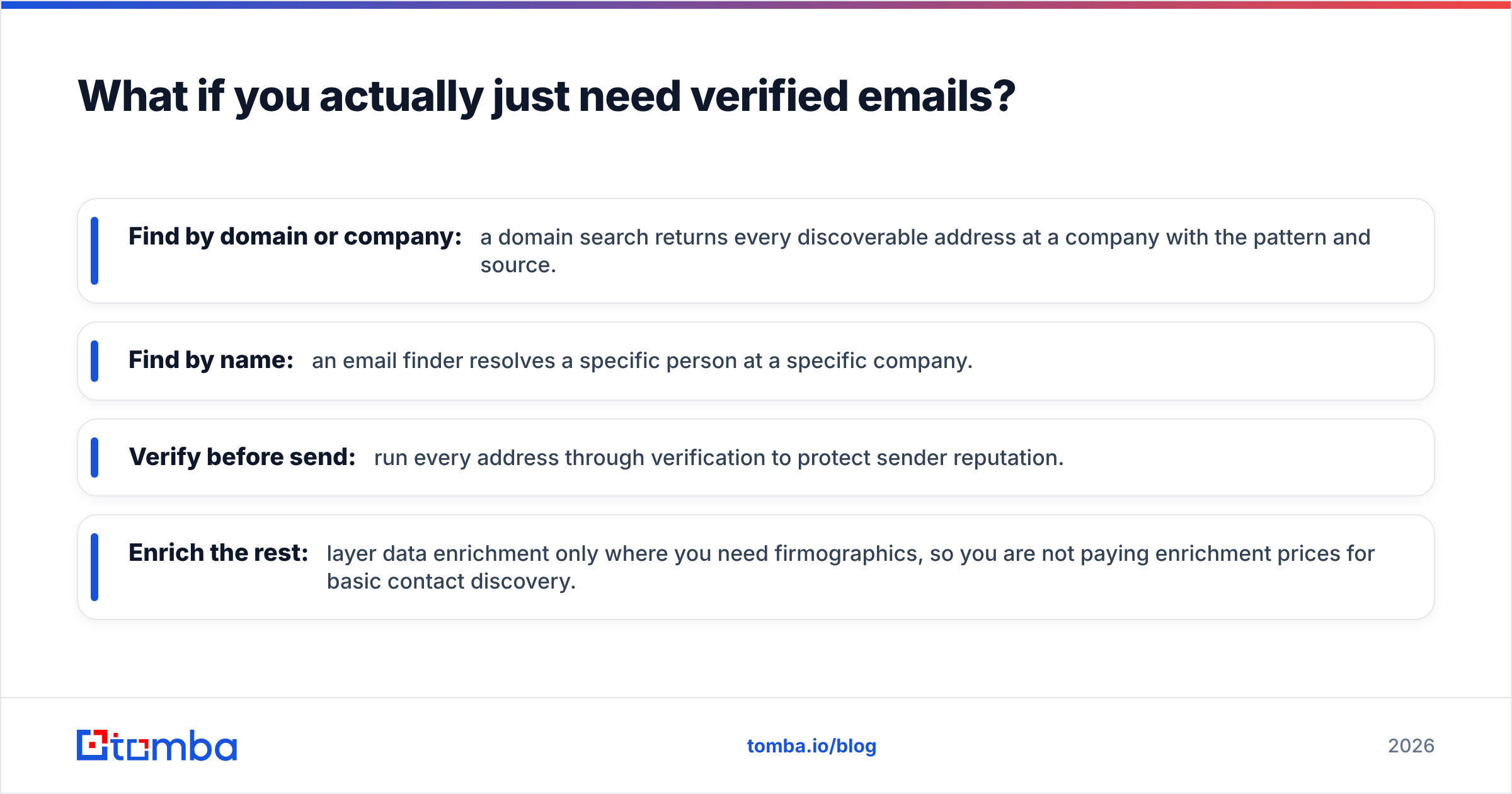
A focused stack usually wins on that job:
- Find by domain or company: a domain search returns every discoverable address at a company with the pattern and source.
- Find by name: an email finder resolves a specific person at a specific company.
- Verify before send: run every address through verification to protect sender reputation.
- Enrich the rest: layer data enrichment only where you need firmographics, so you are not paying enrichment prices for basic contact discovery.
This "specialist tool per job" approach almost always beats a single generalist on cost-per-valid-contact, because you stop paying for coverage you never use.
Cufinder vs The Data City: the verdict#
There is no single winner, because they barely compete:
- Choose Cufinder for global contact and company enrichment that feeds sales and recruiting.
- Choose The Data City for UK-first market and sector intelligence that feeds research and strategy.
- Choose a dedicated email finder if your real need is verified emails at a predictable, low cost — the job both platforms treat as secondary.
Match the tool to the job, run a small paid test before scaling, and measure the metric that actually matters (bounce rate for contacts, methodology defensibility for market data). Do that and you will not overpay for the wrong strength.
Get verified B2B emails without the generalist tax#
If your comparison came down to "I just need emails that actually land," skip the generalist markup. The Tomba Email Finder finds professional addresses by domain, name, or company, backs each result with a confidence score and source, and pairs with built-in verification so you send to real inboxes — not guesses. Start on the free tier (25 searches a month), test it against your target accounts, and only pay once the accuracy proves out on your own list.
Related guides#
Ready to find emails that actually work?
Join 150,000+ professionals who stopped guessing and started sending. Free credits on signup — no credit card required.
Get the Tomba newsletter
Practical outbound tactics and product updates — once every two weeks.
About the author